belt FORD MUSTANG 2002 4.G Owners Manual
[x] Cancel search | Manufacturer: FORD, Model Year: 2002, Model line: MUSTANG, Model: FORD MUSTANG 2002 4.GPages: 264, PDF Size: 2.56 MB
Page 8 of 264
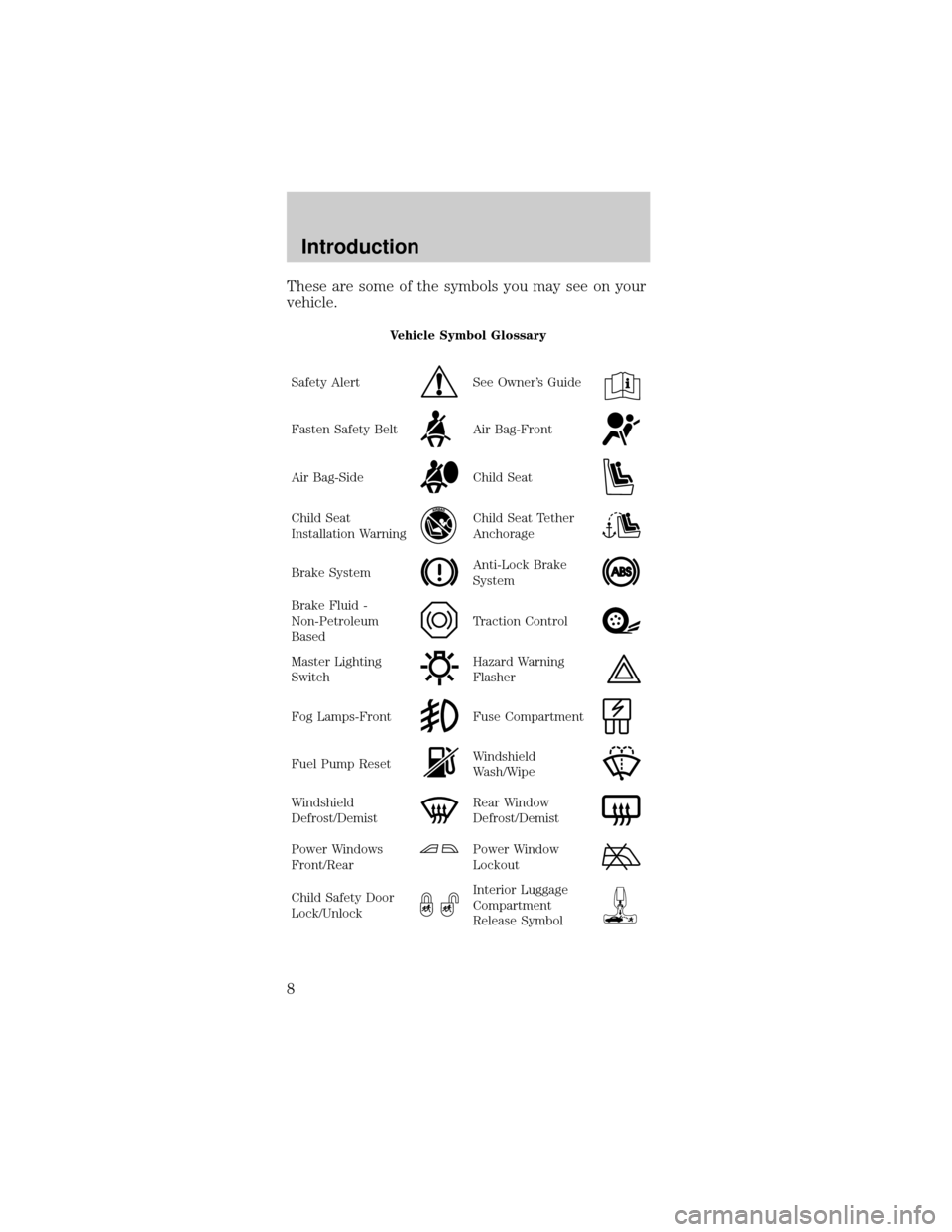
These are some of the symbols you may see on your
vehicle.
Vehicle Symbol Glossary
Safety Alert
See Owner's Guide
Fasten Safety BeltAir Bag-Front
Air Bag-SideChild Seat
Child Seat
Installation WarningChild Seat Tether
Anchorage
Brake SystemAnti-Lock Brake
System
Brake Fluid -
Non-Petroleum
BasedTraction Control
Master Lighting
SwitchHazard Warning
Flasher
Fog Lamps-FrontFuse Compartment
Fuel Pump ResetWindshield
Wash/Wipe
Windshield
Defrost/DemistRear Window
Defrost/Demist
Power Windows
Front/RearPower Window
Lockout
Child Safety Door
Lock/UnlockInterior Luggage
Compartment
Release Symbol
Introduction
8
Page 11 of 264
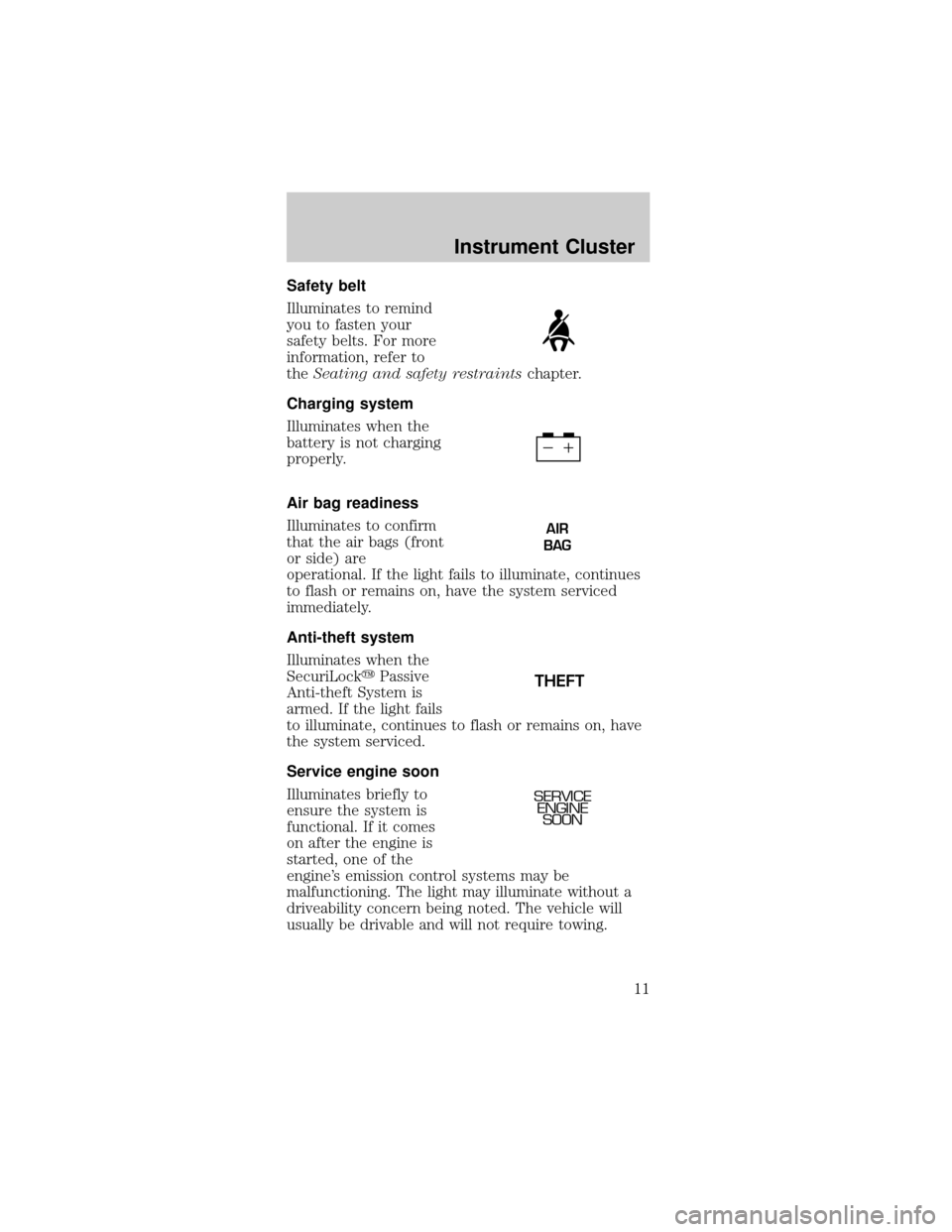
Safety belt
Illuminates to remind
you to fasten your
safety belts. For more
information, refer to
theSeating and safety restraintschapter.
Charging system
Illuminates when the
battery is not charging
properly.
Air bag readiness
Illuminates to confirm
that the air bags (front
or side) are
operational. If the light fails to illuminate, continues
to flash or remains on, have the system serviced
immediately.
Anti-theft system
Illuminates when the
SecuriLockyPassive
Anti-theft System is
armed. If the light fails
to illuminate, continues to flash or remains on, have
the system serviced.
Service engine soon
Illuminates briefly to
ensure the system is
functional. If it comes
on after the engine is
started, one of the
engine's emission control systems may be
malfunctioning. The light may illuminate without a
driveability concern being noted. The vehicle will
usually be drivable and will not require towing.
AIR
BAG
THEFT
SERVICE
ENGINE
SOON
Instrument Cluster
11
Page 15 of 264
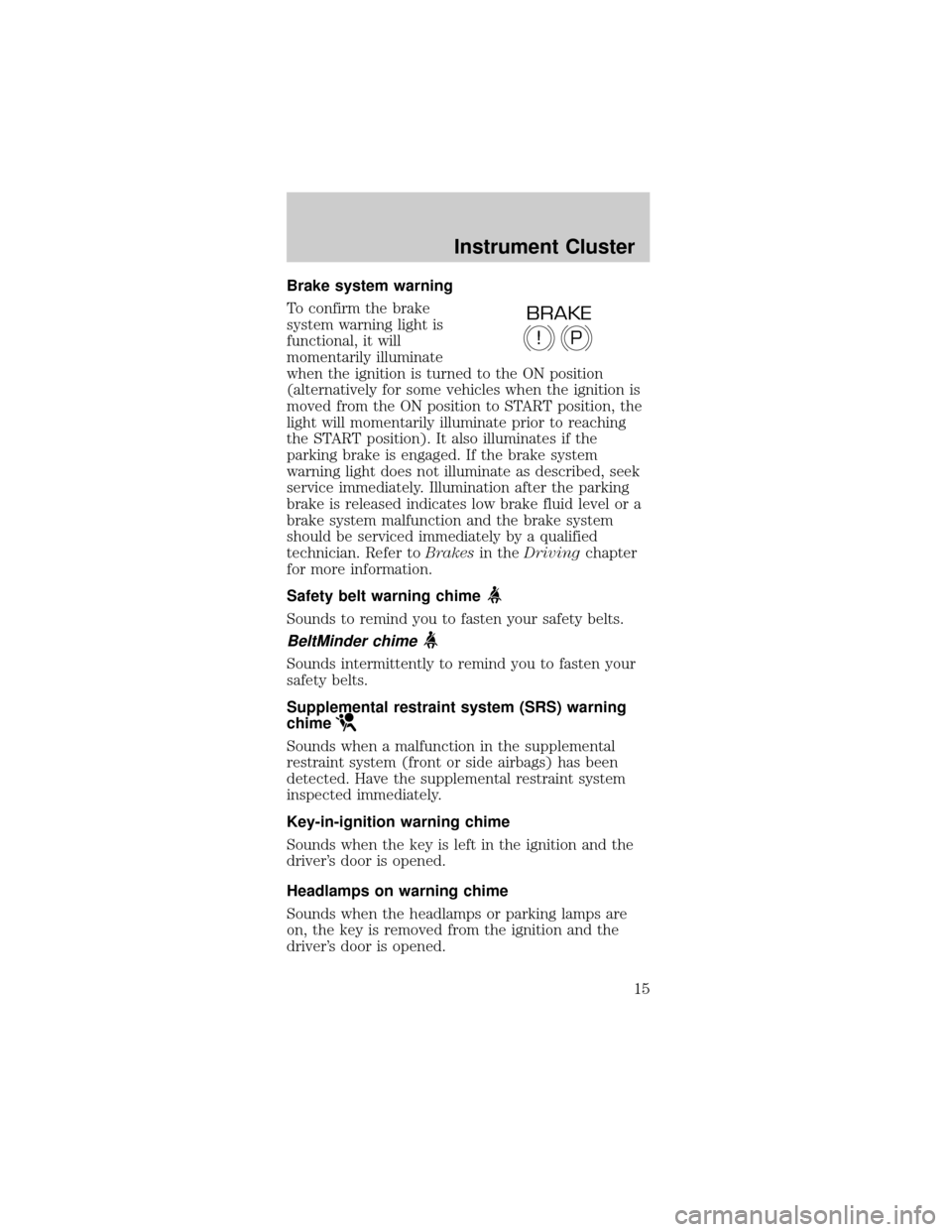
Brake system warning
To confirm the brake
system warning light is
functional, it will
momentarily illuminate
when the ignition is turned to the ON position
(alternatively for some vehicles when the ignition is
moved from the ON position to START position, the
light will momentarily illuminate prior to reaching
the START position). It also illuminates if the
parking brake is engaged. If the brake system
warning light does not illuminate as described, seek
service immediately. Illumination after the parking
brake is released indicates low brake fluid level or a
brake system malfunction and the brake system
should be serviced immediately by a qualified
technician. Refer toBrakesin theDrivingchapter
for more information.
Safety belt warning chime
Sounds to remind you to fasten your safety belts.
BeltMinder chime
Sounds intermittently to remind you to fasten your
safety belts.
Supplemental restraint system (SRS) warning
chime
Sounds when a malfunction in the supplemental
restraint system (front or side airbags) has been
detected. Have the supplemental restraint system
inspected immediately.
Key-in-ignition warning chime
Sounds when the key is left in the ignition and the
driver's door is opened.
Headlamps on warning chime
Sounds when the headlamps or parking lamps are
on, the key is removed from the ignition and the
driver's door is opened.
P!
BRAKE
Instrument Cluster
15
Page 104 of 264
SEATING
Adjustable head restraints (if equipped)
Your vehicle's seats may be equipped with head
restraints which are vertically adjustable. The
purpose of these head restraints is to help limit head
motion in the event of a rear collision. To properly
adjust your head restraints, lift the head restraint so
that it is located directly behind your head or as
close to that position as possible. Refer to the
following to raise and lower the head restraints.
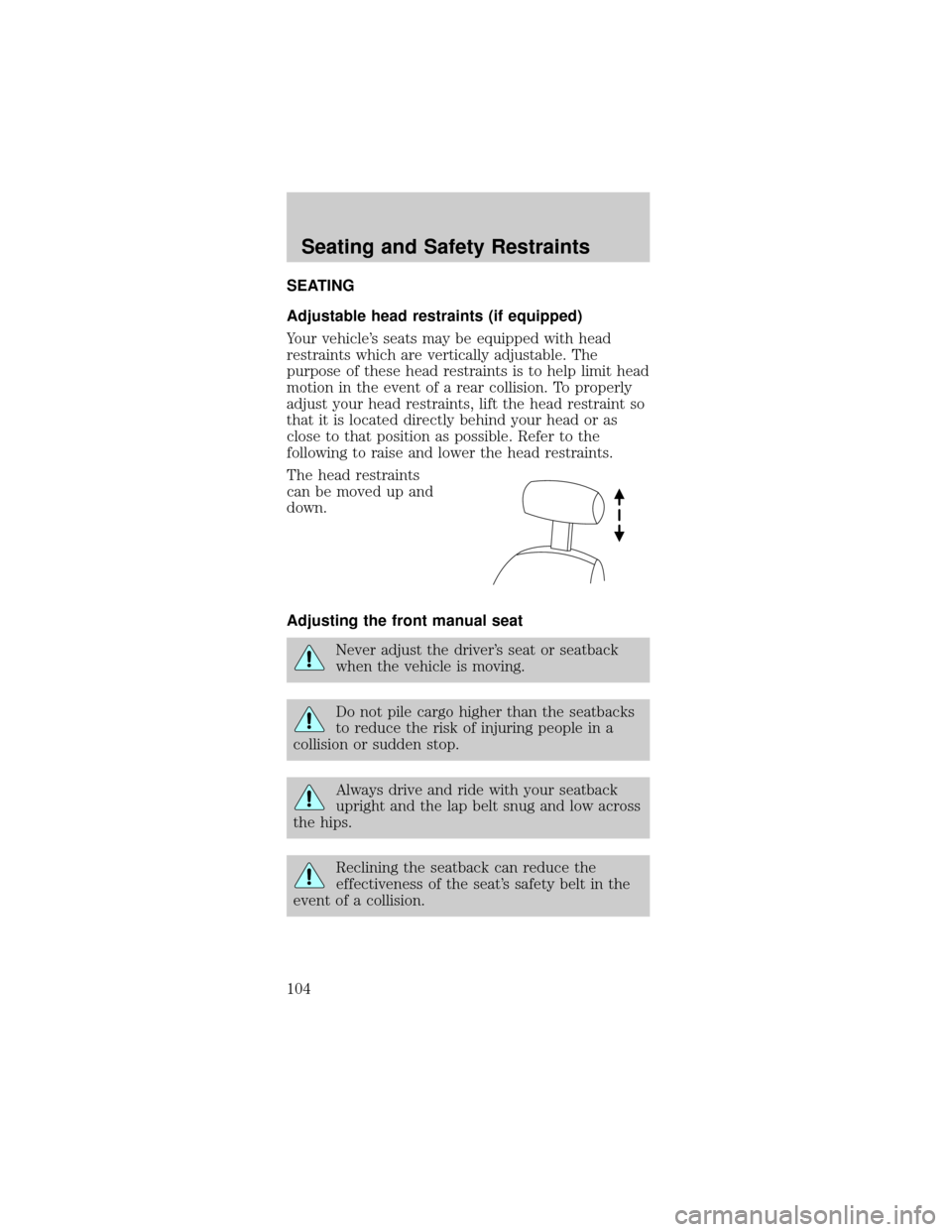
The head restraints
can be moved up and
down.
Adjusting the front manual seat
Never adjust the driver's seat or seatback
when the vehicle is moving.
Do not pile cargo higher than the seatbacks
to reduce the risk of injuring people in a
collision or sudden stop.
Always drive and ride with your seatback
upright and the lap belt snug and low across
the hips.
Reclining the seatback can reduce the
effectiveness of the seat's safety belt in the
event of a collision.
Seating and Safety Restraints
104
Page 105 of 264
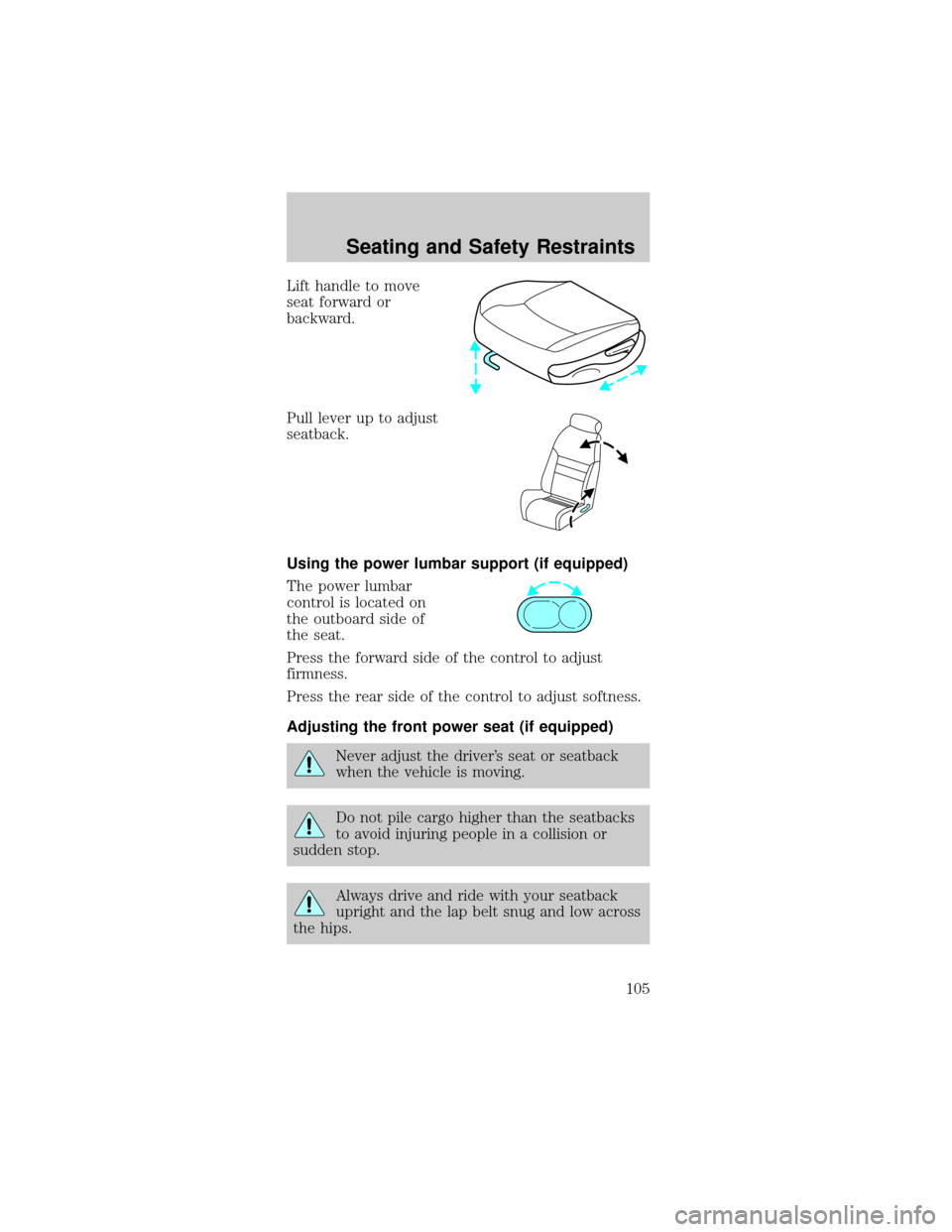
Lift handle to move
seat forward or
backward.
Pull lever up to adjust
seatback.
Using the power lumbar support (if equipped)
The power lumbar
control is located on
the outboard side of
the seat.
Press the forward side of the control to adjust
firmness.
Press the rear side of the control to adjust softness.
Adjusting the front power seat (if equipped)
Never adjust the driver's seat or seatback
when the vehicle is moving.
Do not pile cargo higher than the seatbacks
to avoid injuring people in a collision or
sudden stop.
Always drive and ride with your seatback
upright and the lap belt snug and low across
the hips.
Seating and Safety Restraints
105
Page 106 of 264
Reclining the seatback can reduce the
effectiveness of the seat's safety belt in the
event of a collision.
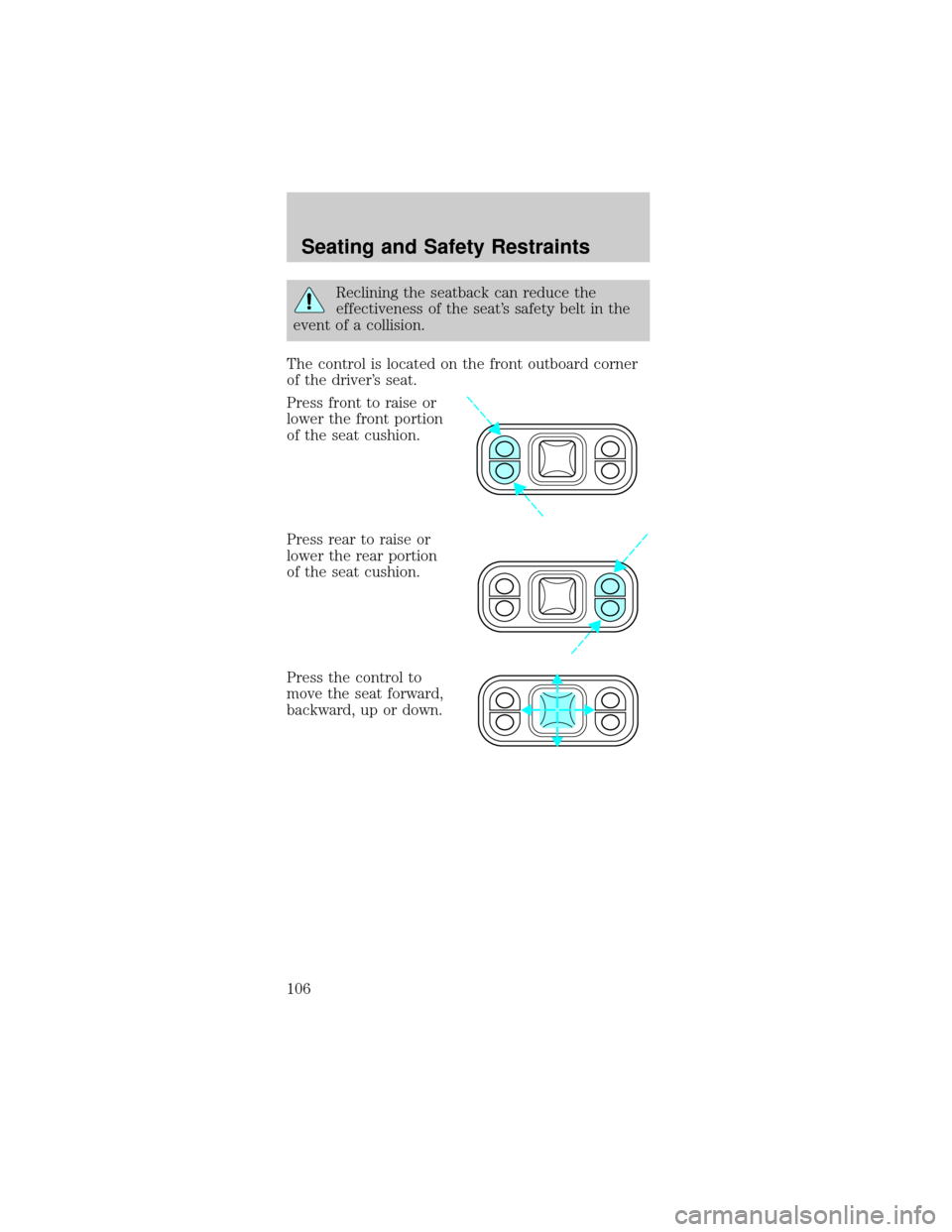
The control is located on the front outboard corner
of the driver's seat.
Press front to raise or
lower the front portion
of the seat cushion.
Press rear to raise or
lower the rear portion
of the seat cushion.
Press the control to
move the seat forward,
backward, up or down.
Seating and Safety Restraints
106
Page 107 of 264

REAR SEATS
Use the seatback
release to fold the back
of the front seat
forward for rear seat
passenger entry or exit.
This release handle is
located on the lower
outboard back of the
seat. The seatback
locks automatically when returned to the normal
position.
The rotating boot on the front seat belt is designed
to allow rear seat entry/exit. To enter the rear seat:
1. Remove safety belt
from safety belt guide
on top of front seat.
2. Rotate the safety
belt boot rearward.
3. Enter the rear seat in front of the safety belt.
4. Rotate the safety belt boot forward and place the
belt in the belt guide on the seat back to allow use
by the front driver/passenger.
2nd seat/split-folding rear seat (if equipped)
One or both rear seatbacks can be folded down to
provide additional cargo space.
To lower the
seatback(s) from inside
the vehicle, pull tab to
release seat back and
then fold seatback
down.
Seating and Safety Restraints
107
Page 108 of 264
When raising the seatback(s), make sure you hear
the seat latch into place.
SAFETY RESTRAINTS
Safety restraints precautions
Always drive and ride with your seatback
upright and the lap belt snug and low across
the hips.
To reduce the risk of injury, make sure
children sit where they can be properly
restrained.
Never let a passenger hold a child on his or
her lap while the vehicle is moving. The
passenger cannot protect the child from injury in a
collision.
All occupants of the vehicle, including the
driver, should always properly wear their
safety belts, even when an air bag (SRS) is
provided.
It is extremely dangerous to ride in a cargo
area, inside or outside of a vehicle. In a
collision, people riding in these areas are more
likely to be seriously injured or killed. Do not allow
people to ride in any area of your vehicle that is
not equipped with seats and safety belts. Be sure
everyone in your vehicle is in a seat and using a
safety belt properly.
In a rollover crash, an unbelted person is
significantly more likely to die than a person
wearing a safety belt.
Seating and Safety Restraints
108
Page 109 of 264
Each seating position in your vehicle has a
specific safety belt assembly which is made
up of one buckle and one tongue that are designed
to be used as a pair. 1) Use the shoulder belt on
the outside shoulder only. Never wear the shoulder
belt under the arm. 2) Never swing the safety belt
around your neck over the inside shoulder. 3)
Never use a single belt for more than one person.
Always transport children 12 years old and
under in the back seat and always properly
use appropriate child restraints.
Combination lap and shoulder belts
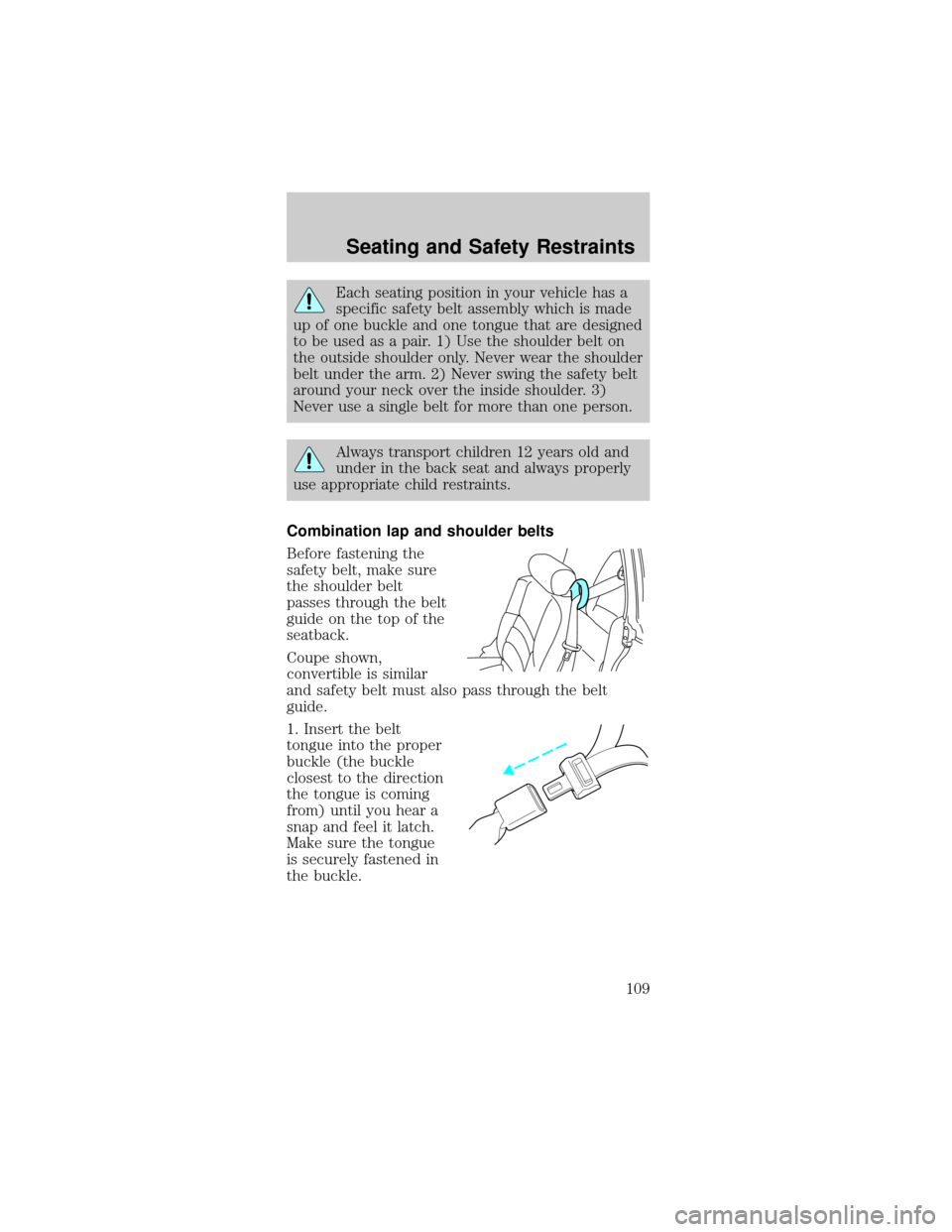
Before fastening the
safety belt, make sure
the shoulder belt
passes through the belt
guide on the top of the
seatback.
Coupe shown,
convertible is similar
and safety belt must also pass through the belt
guide.
1. Insert the belt
tongue into the proper
buckle (the buckle
closest to the direction
the tongue is coming
from) until you hear a
snap and feel it latch.
Make sure the tongue
is securely fastened in
the buckle.
Seating and Safety Restraints
109
Page 110 of 264
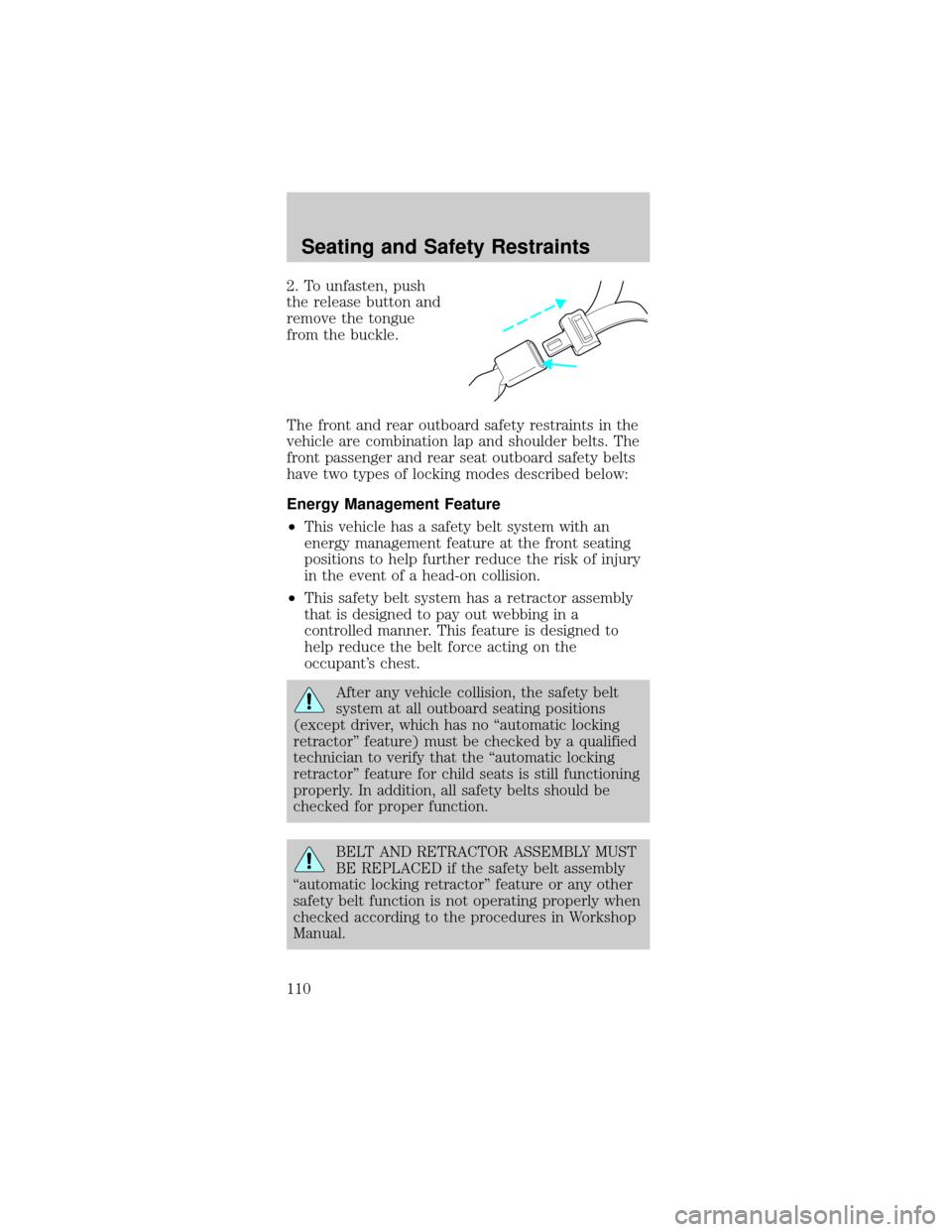
2. To unfasten, push
the release button and
remove the tongue
from the buckle.
The front and rear outboard safety restraints in the
vehicle are combination lap and shoulder belts. The
front passenger and rear seat outboard safety belts
have two types of locking modes described below:
Energy Management Feature
²This vehicle has a safety belt system with an
energy management feature at the front seating
positions to help further reduce the risk of injury
in the event of a head-on collision.
²This safety belt system has a retractor assembly
that is designed to pay out webbing in a
controlled manner. This feature is designed to
help reduce the belt force acting on the
occupant's chest.
After any vehicle collision, the safety belt
system at all outboard seating positions
(except driver, which has no ªautomatic locking
retractorº feature) must be checked by a qualified
technician to verify that the ªautomatic locking
retractorº feature for child seats is still functioning
properly. In addition, all safety belts should be
checked for proper function.
BELT AND RETRACTOR ASSEMBLY MUST
BE REPLACED if the safety belt assembly
ªautomatic locking retractorº feature or any other
safety belt function is not operating properly when
checked according to the procedures in Workshop
Manual.
Seating and Safety Restraints
110