child seat FORD MUSTANG 2002 4.G Owners Manual
[x] Cancel search | Manufacturer: FORD, Model Year: 2002, Model line: MUSTANG, Model: FORD MUSTANG 2002 4.GPages: 264, PDF Size: 2.56 MB
Page 2 of 264
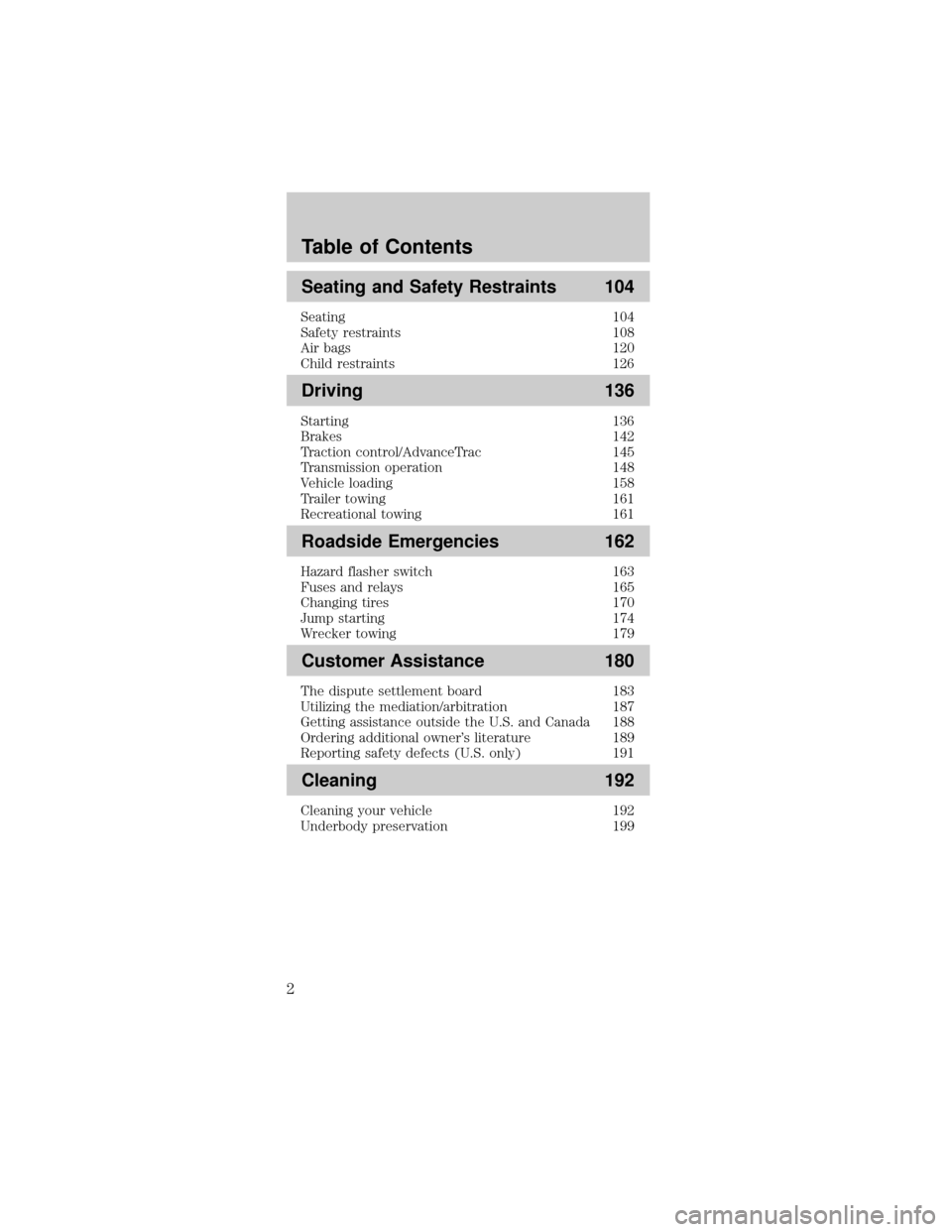
Seating and Safety Restraints 104
Seating 104
Safety restraints 108
Air bags 120
Child restraints 126
Driving 136
Starting 136
Brakes 142
Traction control/AdvanceTrac 145
Transmission operation 148
Vehicle loading 158
Trailer towing 161
Recreational towing 161
Roadside Emergencies 162
Hazard flasher switch 163
Fuses and relays 165
Changing tires 170
Jump starting 174
Wrecker towing 179
Customer Assistance 180
The dispute settlement board 183
Utilizing the mediation/arbitration 187
Getting assistance outside the U.S. and Canada 188
Ordering additional owner's literature 189
Reporting safety defects (U.S. only) 191
Cleaning 192
Cleaning your vehicle 192
Underbody preservation 199
Table of Contents
2
Page 6 of 264
BREAKING-IN YOUR VEHICLE
There are no particular guidelines for breaking-in
your vehicle. During the first 1 600 km (1 000 miles)
of driving, vary speeds frequently. This is
recommended to give the moving parts a chance to
break in.
SPECIAL NOTICES
Emission warranty
The New Vehicle Limited Warranty includes
Bumper-to-Bumper Coverage, Safety Restraint
Coverage, Corrosion Coverage, and 7.3L Power
Stroke Diesel Engine Coverage. In addition, your
vehicle is eligible for Emissions Defect and
Emissions Performance Warranties. For a detailed
description of what is covered and what is not
covered, refer to theWarranty Guidethat is
provided to you along with your Owner's Guide.
Special instructions
For your added safety, your vehicle is fitted with
sophisticated electronic controls.
By operating other electronic equipment
(e.g. mobile telephone without exterior
aerial) electromagnetic fields can occur which can
cause malfunctions of the vehicle electronics.
Therefore you should observe the instructions of
the equipment manufacturers.
Please read the sectionAir bagin the
Seating and safety restraintschapter.
Failure to follow the specific warnings and
instructions could result in personal injury.
Rear facing child or baby seats should
NEVERbe used in front of a passenger side
air bag.
Introduction
6
Page 8 of 264
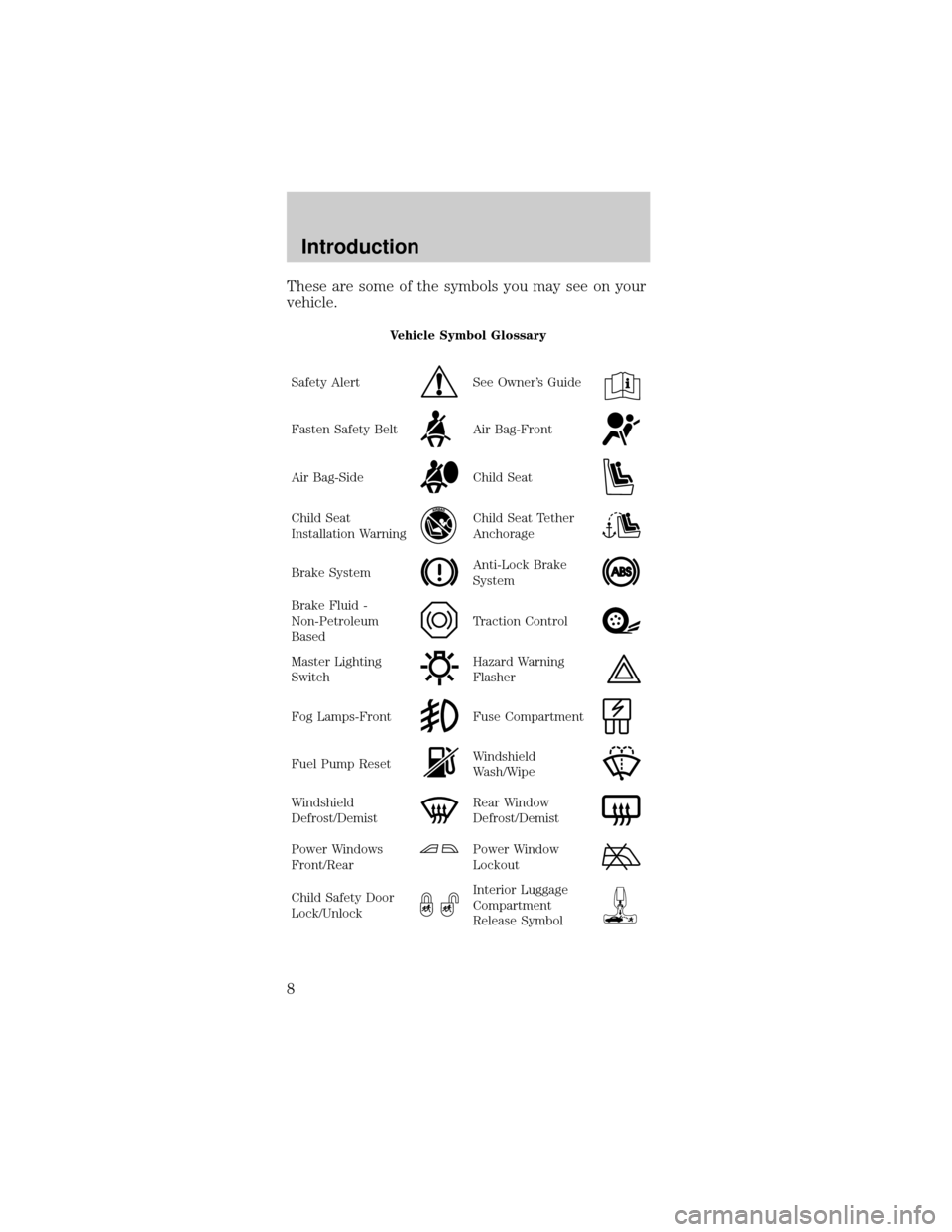
These are some of the symbols you may see on your
vehicle.
Vehicle Symbol Glossary
Safety Alert
See Owner's Guide
Fasten Safety BeltAir Bag-Front
Air Bag-SideChild Seat
Child Seat
Installation WarningChild Seat Tether
Anchorage
Brake SystemAnti-Lock Brake
System
Brake Fluid -
Non-Petroleum
BasedTraction Control
Master Lighting
SwitchHazard Warning
Flasher
Fog Lamps-FrontFuse Compartment
Fuel Pump ResetWindshield
Wash/Wipe
Windshield
Defrost/DemistRear Window
Defrost/Demist
Power Windows
Front/RearPower Window
Lockout
Child Safety Door
Lock/UnlockInterior Luggage
Compartment
Release Symbol
Introduction
8
Page 108 of 264
When raising the seatback(s), make sure you hear
the seat latch into place.
SAFETY RESTRAINTS
Safety restraints precautions
Always drive and ride with your seatback
upright and the lap belt snug and low across
the hips.
To reduce the risk of injury, make sure
children sit where they can be properly
restrained.
Never let a passenger hold a child on his or
her lap while the vehicle is moving. The
passenger cannot protect the child from injury in a
collision.
All occupants of the vehicle, including the
driver, should always properly wear their
safety belts, even when an air bag (SRS) is
provided.
It is extremely dangerous to ride in a cargo
area, inside or outside of a vehicle. In a
collision, people riding in these areas are more
likely to be seriously injured or killed. Do not allow
people to ride in any area of your vehicle that is
not equipped with seats and safety belts. Be sure
everyone in your vehicle is in a seat and using a
safety belt properly.
In a rollover crash, an unbelted person is
significantly more likely to die than a person
wearing a safety belt.
Seating and Safety Restraints
108
Page 109 of 264
Each seating position in your vehicle has a
specific safety belt assembly which is made
up of one buckle and one tongue that are designed
to be used as a pair. 1) Use the shoulder belt on
the outside shoulder only. Never wear the shoulder
belt under the arm. 2) Never swing the safety belt
around your neck over the inside shoulder. 3)
Never use a single belt for more than one person.
Always transport children 12 years old and
under in the back seat and always properly
use appropriate child restraints.
Combination lap and shoulder belts
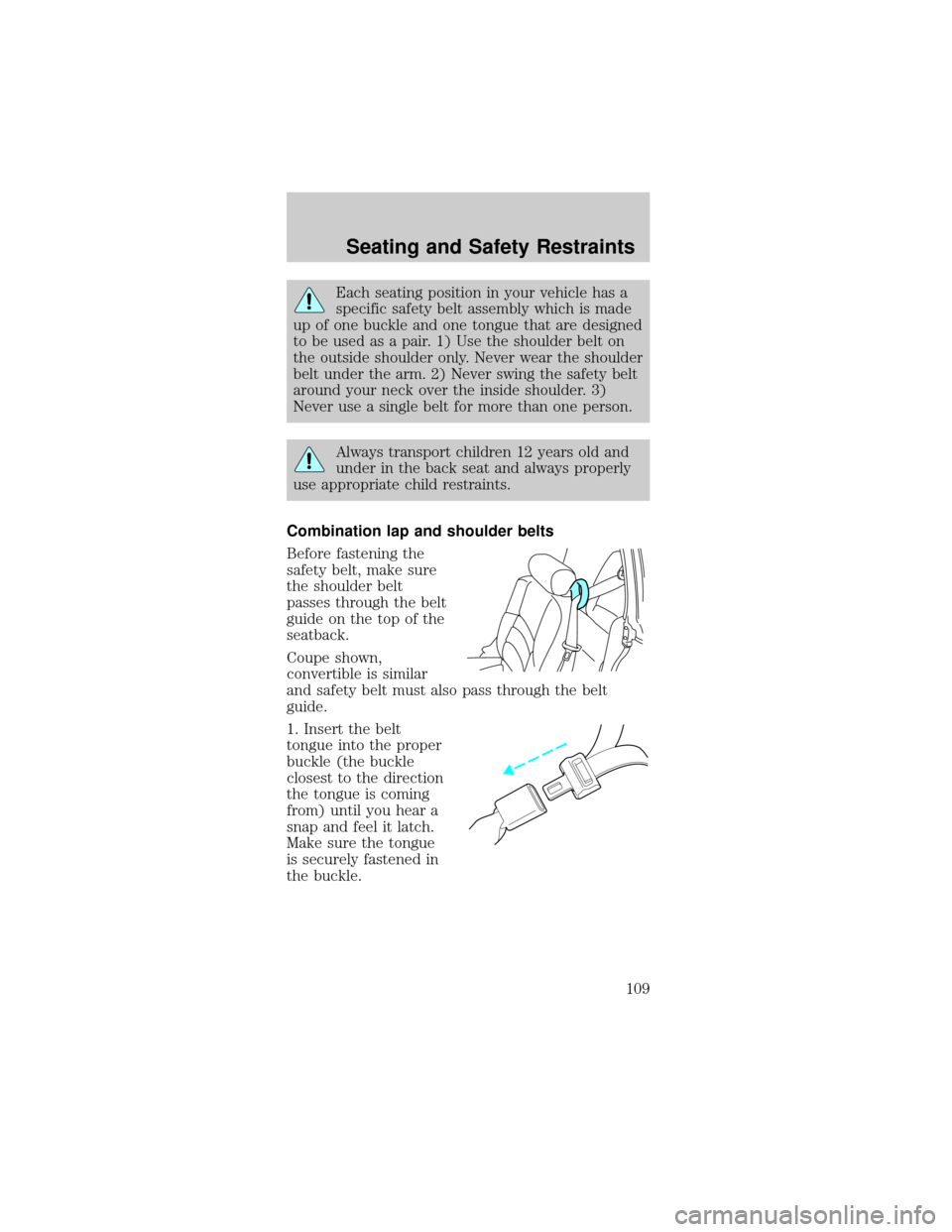
Before fastening the
safety belt, make sure
the shoulder belt
passes through the belt
guide on the top of the
seatback.
Coupe shown,
convertible is similar
and safety belt must also pass through the belt
guide.
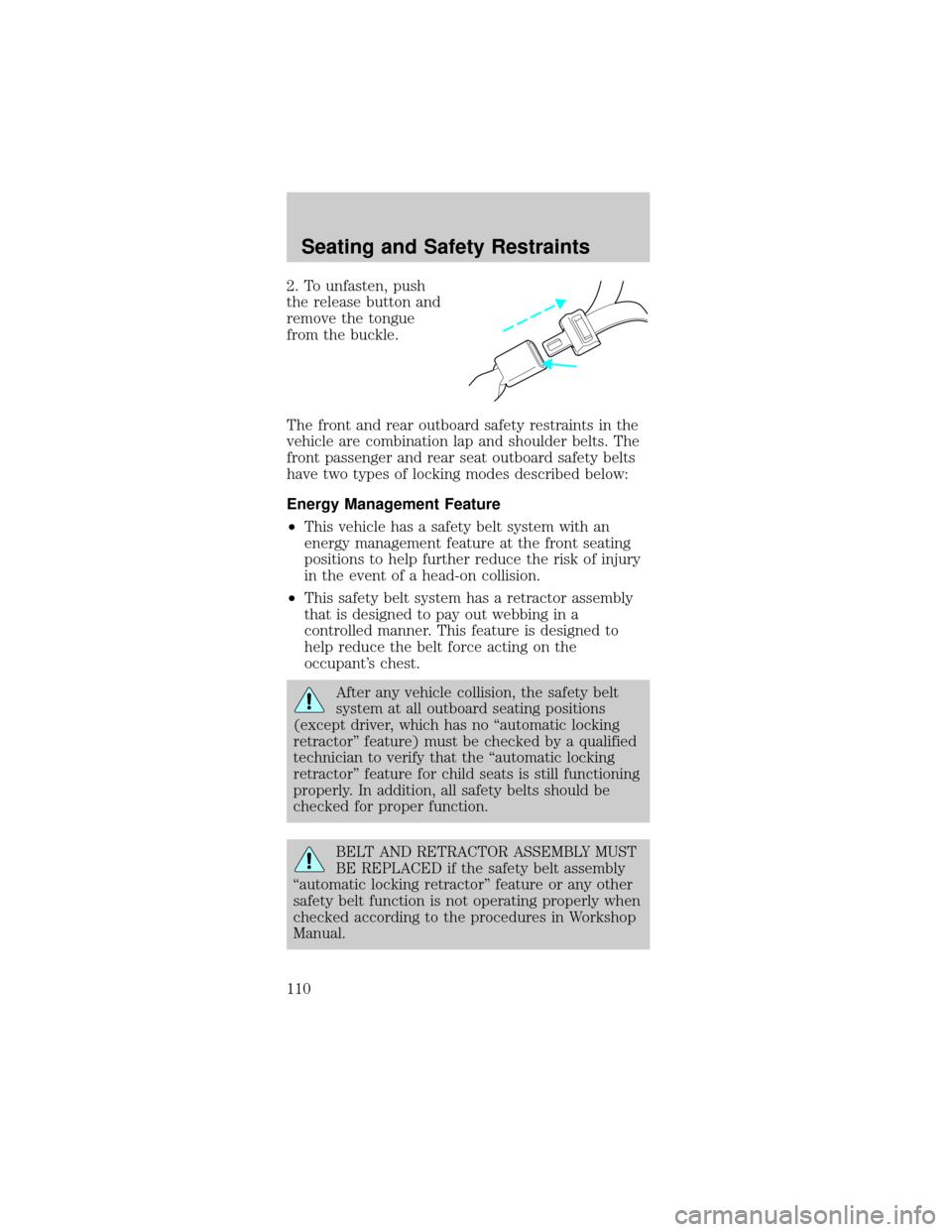
1. Insert the belt
tongue into the proper
buckle (the buckle
closest to the direction
the tongue is coming
from) until you hear a
snap and feel it latch.
Make sure the tongue
is securely fastened in
the buckle.
Seating and Safety Restraints
109
Page 110 of 264
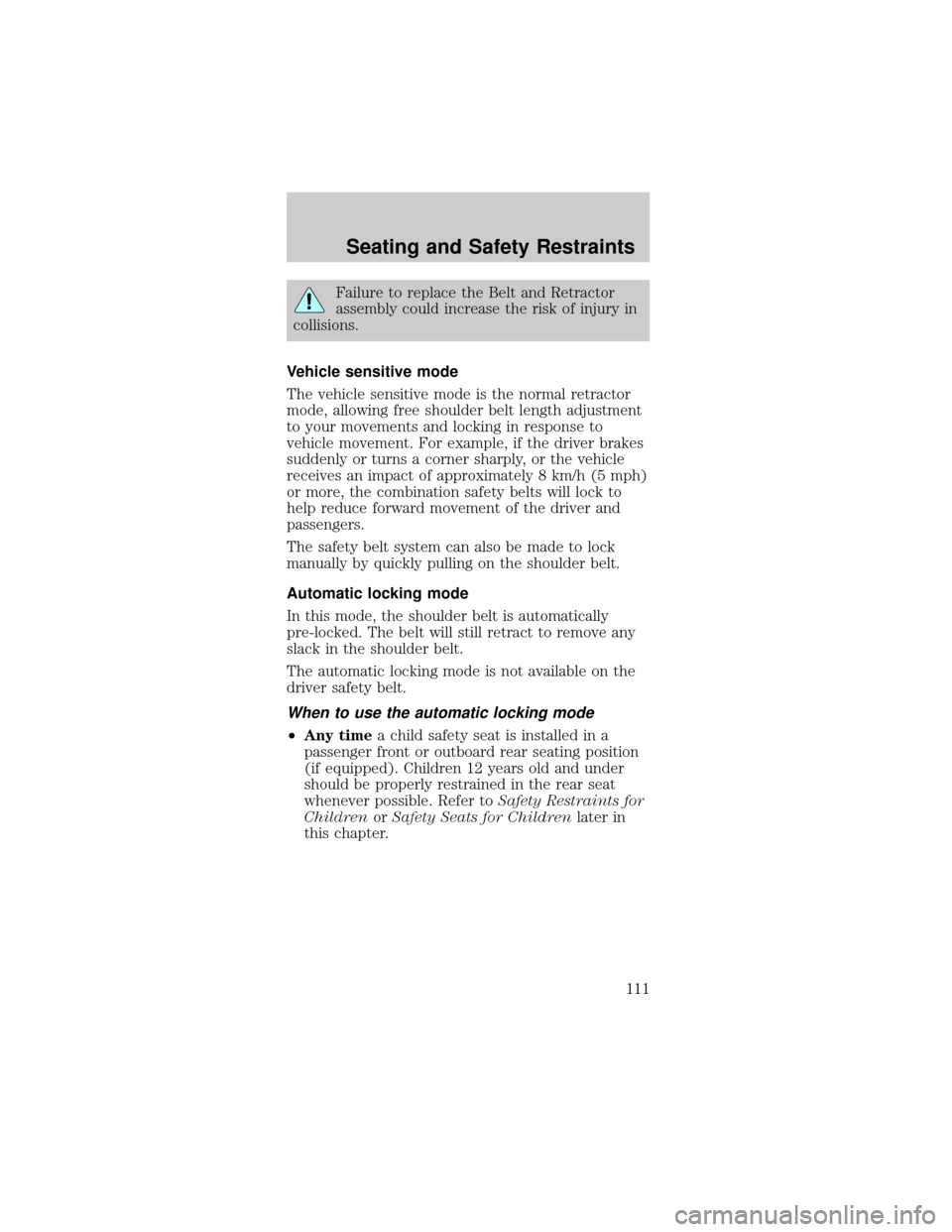
2. To unfasten, push
the release button and
remove the tongue
from the buckle.
The front and rear outboard safety restraints in the
vehicle are combination lap and shoulder belts. The
front passenger and rear seat outboard safety belts
have two types of locking modes described below:
Energy Management Feature
²This vehicle has a safety belt system with an
energy management feature at the front seating
positions to help further reduce the risk of injury
in the event of a head-on collision.
²This safety belt system has a retractor assembly
that is designed to pay out webbing in a
controlled manner. This feature is designed to
help reduce the belt force acting on the
occupant's chest.
After any vehicle collision, the safety belt
system at all outboard seating positions
(except driver, which has no ªautomatic locking
retractorº feature) must be checked by a qualified
technician to verify that the ªautomatic locking
retractorº feature for child seats is still functioning
properly. In addition, all safety belts should be
checked for proper function.
BELT AND RETRACTOR ASSEMBLY MUST
BE REPLACED if the safety belt assembly
ªautomatic locking retractorº feature or any other
safety belt function is not operating properly when
checked according to the procedures in Workshop
Manual.
Seating and Safety Restraints
110
Page 111 of 264
Failure to replace the Belt and Retractor
assembly could increase the risk of injury in
collisions.
Vehicle sensitive mode
The vehicle sensitive mode is the normal retractor
mode, allowing free shoulder belt length adjustment
to your movements and locking in response to
vehicle movement. For example, if the driver brakes
suddenly or turns a corner sharply, or the vehicle
receives an impact of approximately 8 km/h (5 mph)
or more, the combination safety belts will lock to
help reduce forward movement of the driver and
passengers.
The safety belt system can also be made to lock
manually by quickly pulling on the shoulder belt.
Automatic locking mode
In this mode, the shoulder belt is automatically
pre-locked. The belt will still retract to remove any
slack in the shoulder belt.
The automatic locking mode is not available on the
driver safety belt.
When to use the automatic locking mode
²Any timea child safety seat is installed in a
passenger front or outboard rear seating position
(if equipped). Children 12 years old and under
should be properly restrained in the rear seat
whenever possible. Refer toSafety Restraints for
ChildrenorSafety Seats for Childrenlater in
this chapter.
Seating and Safety Restraints
111
Page 113 of 264
How to disengage the automatic locking mode
Ford Motor Company recommends that all
safety belt assemblies and attaching
hardware should be inspected by a qualified
technician after any collision. Safety belt
assemblies not in use during a collision should also
be inspected and replaced if either damage or
improper operation is noted.
Disconnect the combination lap/shoulder belt and
allow it to retract completely to disengage the
automatic locking mode and activate the vehicle
sensitive (emergency) locking mode.
After any vehicle collision, the front
passenger and rear outboard seat belt
systems must be checked by a qualified technician
to verify that the ªautomatic locking retractorº
feature for child seats is still functioning properly.
In addition, all seat belts should be checked for
proper function.
BELT AND RETRACTOR ASSEMBLY MUST
BE REPLACED if the seat belt assembly
ªautomatic locking retractorº feature or any other
seat belt function is not operating properly when
checked according to the procedures in Workshop
Manual.
Failure to replace the Belt and Retractor
assembly could increase the risk of injury in
collisions.
Safety belt warning light and indicator
chime
The seat belt warning light illuminates in the
instrument cluster and a chime sounds to remind
the occupants to fasten their safety belts.
Seating and Safety Restraints
113
Page 116 of 264
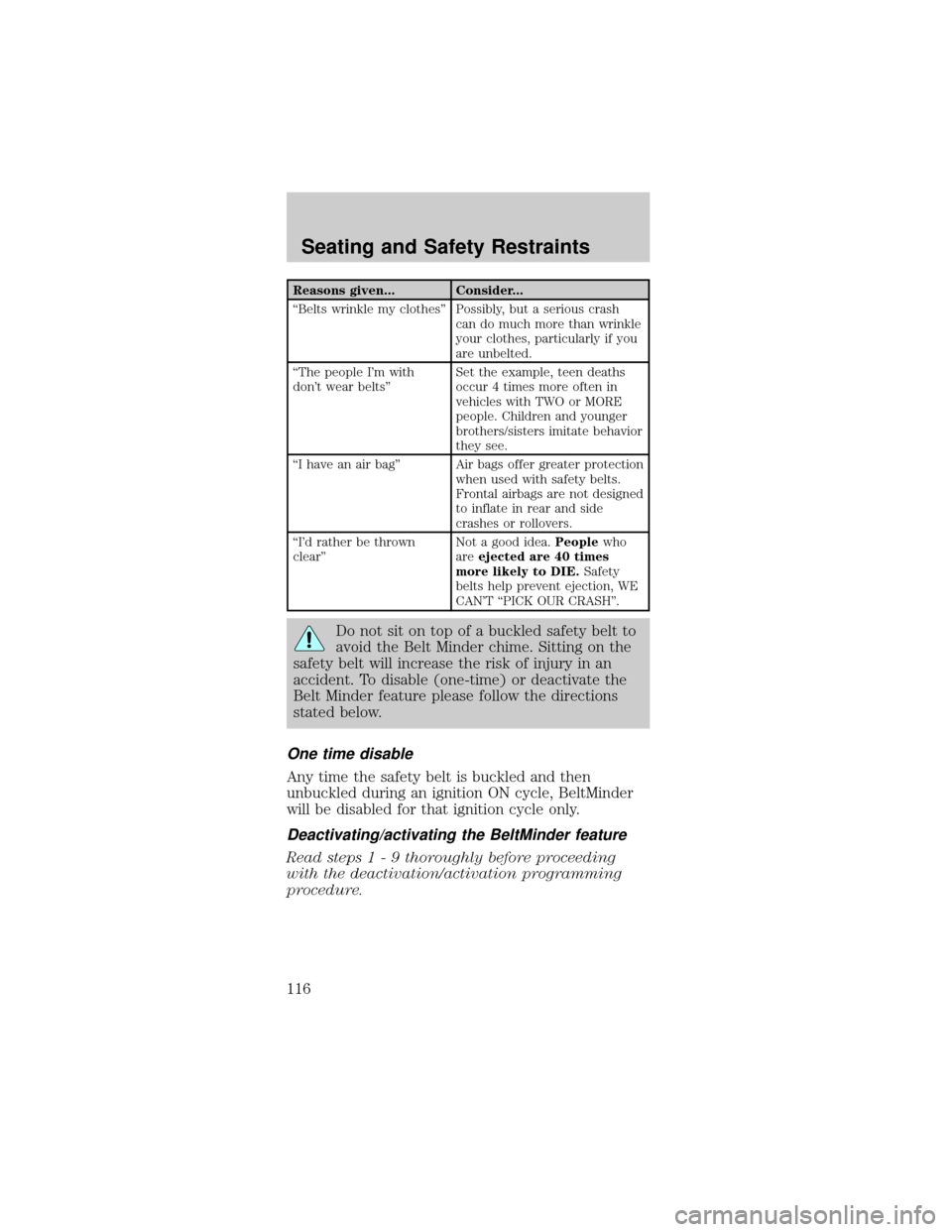
Reasons given... Consider...
ªBelts wrinkle my clothesº Possibly, but a serious crash
can do much more than wrinkle
your clothes, particularly if you
are unbelted.
ªThe people I'm with
don't wear beltsºSet the example, teen deaths
occur 4 times more often in
vehicles with TWO or MORE
people. Children and younger
brothers/sisters imitate behavior
they see.
ªI have an air bagº Air bags offer greater protection
when used with safety belts.
Frontal airbags are not designed
to inflate in rear and side
crashes or rollovers.
ªI'd rather be thrown
clearºNot a good idea.Peoplewho
areejected are 40 times
more likely to DIE.Safety
belts help prevent ejection, WE
CAN'T ªPICK OUR CRASHº.
Do not sit on top of a buckled safety belt to
avoid the Belt Minder chime. Sitting on the
safety belt will increase the risk of injury in an
accident. To disable (one-time) or deactivate the
Belt Minder feature please follow the directions
stated below.
One time disable
Any time the safety belt is buckled and then
unbuckled during an ignition ON cycle, BeltMinder
will be disabled for that ignition cycle only.
Deactivating/activating the BeltMinder feature
Read steps1-9thoroughly before proceeding
with the deactivation/activation programming
procedure.
Seating and Safety Restraints
116
Page 119 of 264
Safety belt maintenance
Inspect the safety belt systems periodically to make
sure they work properly and are not damaged.
Inspect the safety belts to make sure there are no
nicks, tears or cuts. Replace if necessary. All safety
belt assemblies, including retractors, buckles, front
seat belt buckle assemblies, buckle support
assemblies (slide bar-if equipped), shoulder belt
height adjusters (if equipped), shoulder belt guide
on seatback (if equipped), child safety seat tether
bracket assemblies (if equipped), LATCH child seat
tether anchors and lower anchors (if equipped), and
attaching hardware, should be inspected after a
collision. Ford Motor Company recommends that all
safety belt assemblies used in vehicles involved in a
collision be replaced. However, if the collision was
minor and a qualified technician finds that the belts
do not show damage and continue to operate
properly, they do not need to be replaced. Safety
belt assemblies not in use during a collision should
also be inspected and replaced if either damage or
improper operation is noted.
Failure to inspect and if necessary replace
the safety belt assembly under the above
conditions could result in severe personal injuries
in the event of a collision.
Refer toCleaning and maintaining the safety
beltsin theCleaningchapter.
Seating and Safety Restraints
119