fuel pressure FORD MUSTANG 2002 4.G Owners Manual
[x] Cancel search | Manufacturer: FORD, Model Year: 2002, Model line: MUSTANG, Model: FORD MUSTANG 2002 4.GPages: 264, PDF Size: 2.56 MB
Page 143 of 264
Always set the parking brake fully and make
sure that the gearshift is securely latched in
P (Park) (automatic transmission) or in 1 (First
Gear) (manual transmission).
The parking brake is not recommended to stop a
moving vehicle. However, if the normal brakes fail,
the parking brake can be used to stop your vehicle
in an emergency. Since the parking brake applies
only the rear brakes, the vehicle's stopping distance
will increase greatly and the handling of your vehicle
will be adversely affected.
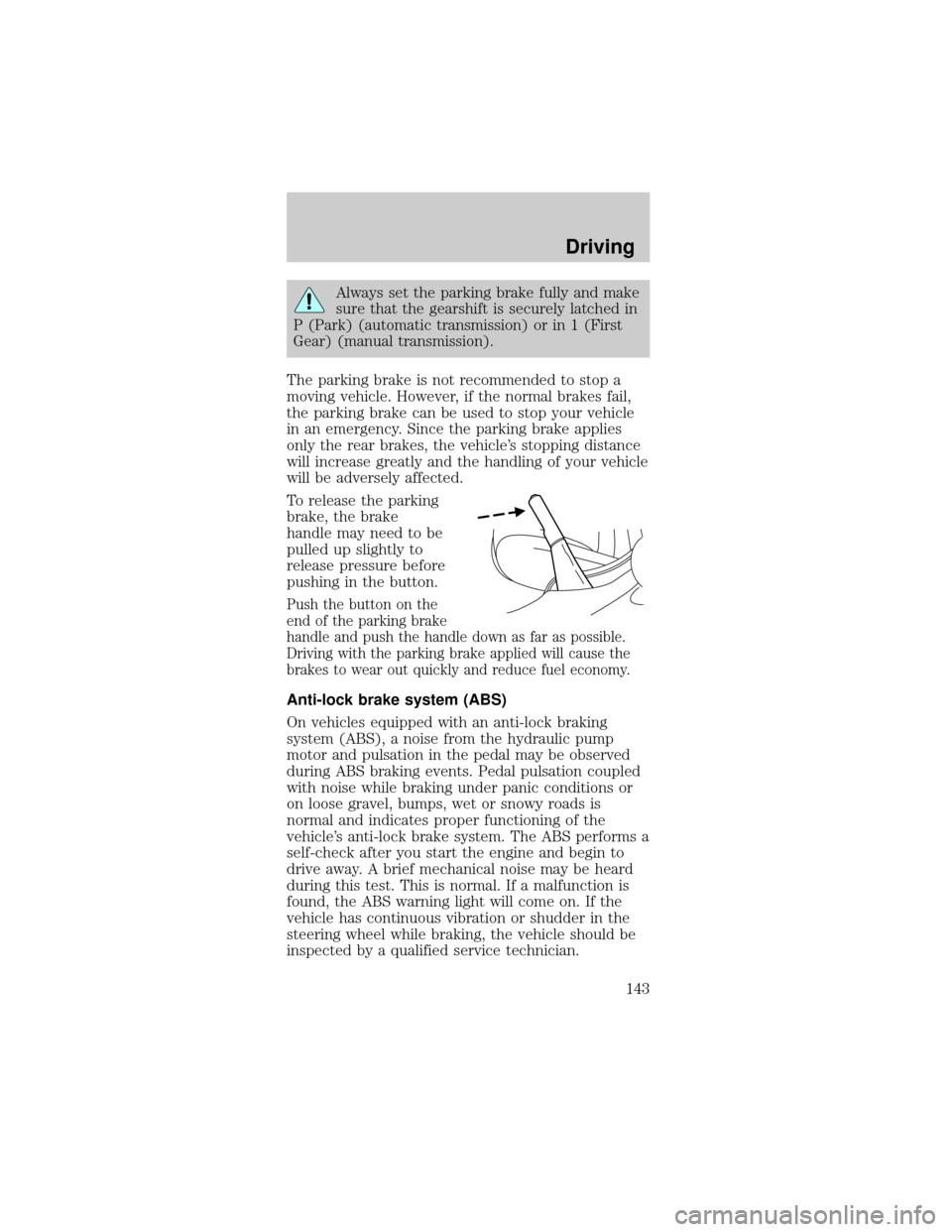
To release the parking
brake, the brake
handle may need to be
pulled up slightly to
release pressure before
pushing in the button.
Push the button on the
end of the parking brake
handle and push the handle down as far as possible.
Driving with the parking brake applied will cause the
brakes to wear out quickly and reduce fuel economy.
Anti-lock brake system (ABS)
On vehicles equipped with an anti-lock braking
system (ABS), a noise from the hydraulic pump
motor and pulsation in the pedal may be observed
during ABS braking events. Pedal pulsation coupled
with noise while braking under panic conditions or
on loose gravel, bumps, wet or snowy roads is
normal and indicates proper functioning of the
vehicle's anti-lock brake system. The ABS performs a
self-check after you start the engine and begin to
drive away. A brief mechanical noise may be heard
during this test. This is normal. If a malfunction is
found, the ABS warning light will come on. If the
vehicle has continuous vibration or shudder in the
steering wheel while braking, the vehicle should be
inspected by a qualified service technician.
Driving
143
Page 170 of 264
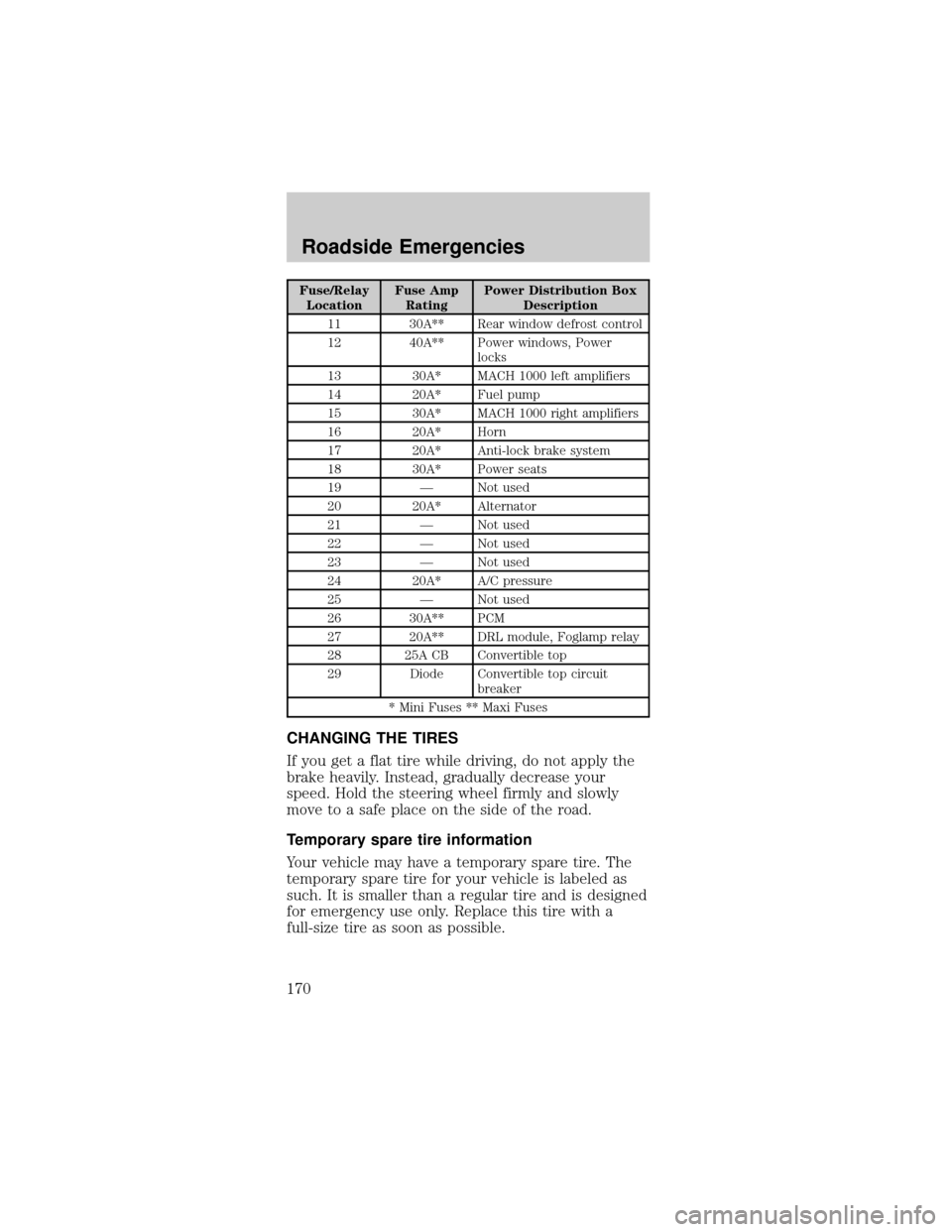
Fuse/Relay
LocationFuse Amp
RatingPower Distribution Box
Description
11 30A** Rear window defrost control
12 40A** Power windows, Power
locks
13 30A* MACH 1000 left amplifiers
14 20A* Fuel pump
15 30A* MACH 1000 right amplifiers
16 20A* Horn
17 20A* Anti-lock brake system
18 30A* Power seats
19 Ð Not used
20 20A* Alternator
21 Ð Not used
22 Ð Not used
23 Ð Not used
24 20A* A/C pressure
25 Ð Not used
26 30A** PCM
27 20A** DRL module, Foglamp relay
28 25A CB Convertible top
29 Diode Convertible top circuit
breaker
* Mini Fuses ** Maxi Fuses
CHANGING THE TIRES
If you get a flat tire while driving, do not apply the
brake heavily. Instead, gradually decrease your
speed. Hold the steering wheel firmly and slowly
move to a safe place on the side of the road.
Temporary spare tire information
Your vehicle may have a temporary spare tire. The
temporary spare tire for your vehicle is labeled as
such. It is smaller than a regular tire and is designed
for emergency use only. Replace this tire with a
full-size tire as soon as possible.
Roadside Emergencies
170
Page 194 of 264

Do not use hydrofluoric acid-based or high
caustic-based wheel cleaners, steel wool, fuels
or strong household detergents for soiled
wheel rims and covers.
Never apply any cleaning chemical to hot or warm
wheel rims or covers.
Clean wheel rims and covers with Detail Wash
(ZC-3±A), which is available from your authorized
Ford, Lincoln or Mercury dealer. Spray cleaner on
cool wheel rims or covers and allow to set for 2±5
minutes. Agitate the area with a sponge and rinse off
with plenty of water.
Use Extra Strength Tar and Road Oil Removal
(B7A-19520±AA), available from your authorized
Ford, Lincoln or Mercury dealer, in order to remove
tar and grease from wheel rims and covers.
CLEANING THE ENGINE
Engines are more efficient when they are clean
because grease and dirt buildup keep the engine
warmer than normal. When washing:
²The engine must be cool to the touch before
spraying with water.
²Never spray a hot engine with cold water, as
damage to the engine block or engine
components may occur.
²Use caution when using a self-serve power washer
(1000psi maximum pressure) to clean the engine,
as the high-pressure fluid could penetrate the
sealed parts and cause damage.
²Never apply anything to any exposed belts in
the engine compartment, including belt
dressing.
For general cleaning of the engine and engine
compartment, spray Engine Shampoo and Degreaser
(F4AZ-19A536±A) on all parts that require cleaning
and pressure rinse the area with cool water.
Cleaning
194
Page 197 of 264

Do not clean the windshield or rear window
glass with abrasives, as they may cause
scratches.
Do not use fuel, kerosene, or paint thinner to
clean the windshield, rear window or the wiper
blades as damage may occur.
Clean the outside of the windshield or rear window
with a non-abrasive cleaner such as Ultra Clear Spray
Glass Cleaner (E4AZ-19C507±AA), available from your
authorized Ford, Lincoln or Mercury dealer. If after
cleaning the glass surface, the water sheets from the
glass (e.g., does not bead), then the window is clean.
The windshield, rear window and wiper blades should
be cleaned regularly. Wiper blades can be cleaned with
isopropyl (rubbing) alcohol or windshield washer
solution. Be sure to replace wiper blades when they
appear worn or do not function properly.
CONVERTIBLE TOP AND PADDED MOLDING
CARE
To avoid damage to the vinyl top and moldings, wash
with Triple Clean (EOAZ-19526±AA), which is
available from your authorized Ford, Lincoln or
Mercury dealer. Do not use stiff bristle brushes or
abrasive materials or cleaners.
Hot waxes applied by commercial car washes can
affect the cleanability of vinyl material.
Using high water pressure or wand-type car washes
against the convertible top and windows may cause
water leaks and possible seal damage.
CLEANING THE INSTRUMENT PANEL
Clean the instrument panel with a damp cloth, then
dry with a dry cloth.
Avoid cleaners or polish that increase the gloss of
the upper portion of the instrument panel. The dull
finish in this area helps protect the driver from
undesirable windshield reflection.
Cleaning
197
Page 211 of 264
If you see any corrosion on the battery or terminals,
remove the cables from the terminals and clean with
a wire brush. You can neutralize the acid with a
solution of baking soda and water.
Batteries normally produce explosive gases
which can cause personal injury. Therefore,
do not allow flames, sparks or lighted substances
to come near the battery. When working near the
battery, always shield your face and protect your
eyes. Always provide proper ventilation.
When lifting a plastic-cased battery,
excessive pressure on the end walls could
cause acid to flow through the vent caps, resulting
in personal injury and/or damage to the vehicle or
battery. Lift the battery with a battery carrier or
with your hands on opposite corners.
Keep batteries out of reach of children.
Batteries contain sulfuric acid. Avoid contact
with skin, eyes or clothing. Shield your eyes when
working near the battery to protect against
possible splashing of acid solution. In case of acid
contact with skin or eyes, flush immediately with
water for a minimum of 15 minutes and get
prompt medical attention. If acid is swallowed, call
a physician immediately.
Battery posts, terminals and related
accessories contain lead and lead
compounds.Wash hands after handling.
Because your vehicle's engine is electronically
controlled by a computer, some control conditions
are maintained by power from the battery. When the
battery is disconnected or a new battery is installed,
the engine must relearn its idle and fuel trim
strategy for optimum driveability and performance.
Maintenance and Specifications
211
Page 221 of 264
²Refer to the chart on the coolant container
to ensure the coolant concentration in your
vehicle will provide adequate freeze
protection at the temperatures in which you
drive in the winter months.
If you drive in extremely hot climates:
²It is still necessary to maintain the coolant
concentration above 40%.
²NEVER decrease the coolant concentration
below 40%.
²Decreased engine coolant concentrations
below 40% will decrease the corrosion
protection characteristics of the engine
coolant and may cause engine damage.
²Decreased engine coolant concentrations
below 40% will decrease the freeze
protection characteristics of the engine
coolant and may cause engine damage.
²Refer to the chart on the coolant container
to ensure the coolant concentration in your
vehicle will provide adequate protection at
the temperatures in which you drive.
Vehicles driven year-round in non-extreme climates
should use a 50/50 mixture of engine coolant and
distilled water for optimum cooling system and
engine protection.
WHAT YOU SHOULD KNOW ABOUT
AUTOMOTIVE FUELS
Important safety precautions
Do not overfill the fuel tank. The pressure in
an overfilled tank may cause leakage and
lead to fuel spray and fire.
Maintenance and Specifications
221
Page 222 of 264
The fuel system may be under pressure. If
the fuel filler cap is venting vapor or if you
hear a hissing sound, wait until it stops before
completely removing the fuel filler cap. Otherwise,
fuel may spray out and injure you or others.
If you do not use the proper fuel filler cap,
excessive pressure or vacuum in the fuel
tank may damage the fuel system or cause the fuel
cap to disengage in a collision, which may result in
possible personal injury.
Automotive fuels can cause serious injury or
death if misused or mishandled.
Gasoline may contain benzene, which is a
cancer-causing agent.
Observe the following guidelines when handling
automotive fuel:
²Extinguish all
smoking materials
and any open flames
before fueling your
vehicle.
²Always turn off the
vehicle before
fueling.
²Automotive fuels can be harmful or fatal if
swallowed. Fuel such as gasoline is highly toxic
and if swallowed can cause death or permanent
injury. If fuel is swallowed, call a physician
immediately, even if no symptoms are immediately
apparent. The toxic effects of fuel may not be
visible for hours.
Maintenance and Specifications
222
Page 225 of 264
The fuel system may be under pressure. If
the fuel filler cap is venting vapor or if you
hear a hissing sound, wait until it stops before
completely removing the fuel filler cap. Otherwise,
fuel may spray out and injure you or others.
If you do not use the proper fuel filler cap,
excessive pressure or vacuum in the fuel
tank may damage the fuel system or cause the fuel
cap to disengage in a collision, which may result in
possible personal injury.
Choosing the right fuel
Use only UNLEADED FUEL. The use of leaded fuel
is prohibited by law and could damage your vehicle.
Do not use fuel containing methanol. It can damage
critical fuel system components.
Your vehicle was not designed to use fuel or fuel
additives with metallic compounds, including
manganese-based compounds containing MMT.
Repairs to correct the effects of using a fuel for
which your vehicle was not designed may not be
covered by your warranty.
Octane recommendations
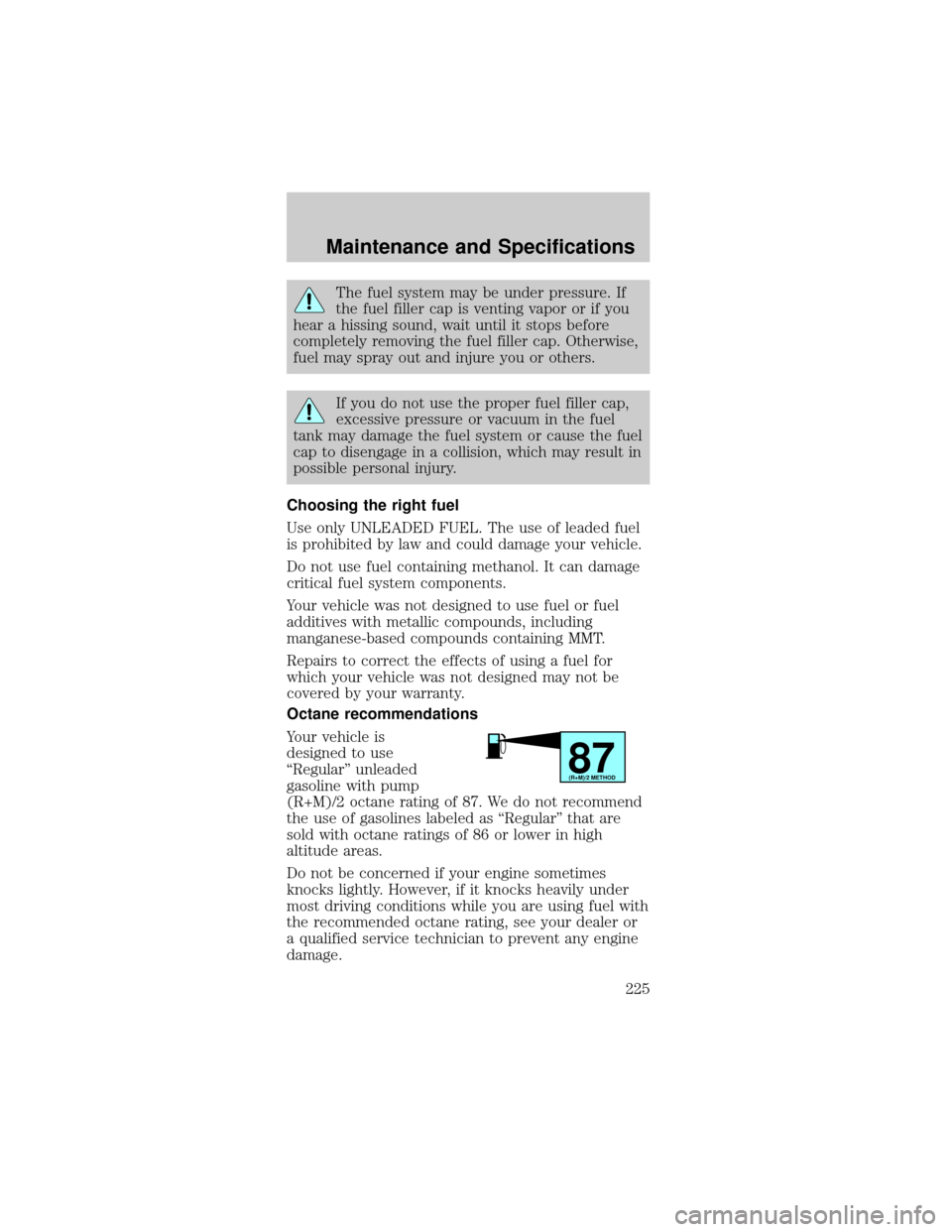
Your vehicle is
designed to use
ªRegularº unleaded
gasoline with pump
(R+M)/2 octane rating of 87. We do not recommend
the use of gasolines labeled as ªRegularº that are
sold with octane ratings of 86 or lower in high
altitude areas.
Do not be concerned if your engine sometimes
knocks lightly. However, if it knocks heavily under
most driving conditions while you are using fuel with
the recommended octane rating, see your dealer or
a qualified service technician to prevent any engine
damage.
87(R+M)/2 METHOD
Maintenance and Specifications
225
Page 231 of 264
![FORD MUSTANG 2002 4.G Owners Manual Conditions
²Heavily loading a vehicle or towing a trailer may
reduce fuel economy at any speed.
²Carrying unnecessary weight may reduce fuel
economy (approximately 0.4 km/L [1 mpg] is lost
for every](/img/11/5210/w960_5210-230.png "FORD MUSTANG 2002 4.G Owners Manual Conditions
²Heavily loading a vehicle or towing a trailer may
reduce fuel economy at any speed.
²Carrying unnecessary weight may reduce fuel
economy (approximately 0.4 km/L [1 mpg] is lost
for every")
Conditions
²Heavily loading a vehicle or towing a trailer may
reduce fuel economy at any speed.
²Carrying unnecessary weight may reduce fuel
economy (approximately 0.4 km/L [1 mpg] is lost
for every 180 kg [400 lb] of weight carried).
²Adding certain accessories to your vehicle (for
example bug deflectors, rollbars/light bars,
running boards, ski/luggage racks) may reduce
fuel economy.
²Using fuel blended with alcohol may lower fuel
economy.
²Fuel economy may decrease with lower
temperatures during the first 12±16 km
(8±10 miles) of driving.
²Driving on flat terrain offers improved fuel
economy as compared to driving on hilly terrain.
²Transmissions give their best fuel economy when
operated in the top cruise gear and with steady
pressure on the gas pedal.
²Close windows for high speed driving.
EPA window sticker
Every new vehicle should have the EPA window
sticker. Contact your dealer if the window sticker is
not supplied with your vehicle. The EPA window
sticker should be your guide for the fuel economy
comparisons with other vehicles.
It is important to note the box in the lower left
corner of the window sticker. These numbers
represent the Range of L/100 km (MPG) expected
on the vehicle under optimum conditions. Your fuel
economy may vary depending upon the method of
operation and conditions.
Maintenance and Specifications
231
Page 261 of 264

low fuel warning
light .......................... 13
octane rating.. 225, 251
quality .................... 226
running out of fuel 226
safety information
relating to automotive
fuels ....................... 221
Fuses ................ 165±166
G
Gas cap
(see Fuel cap) ... 13, 224
Gas mileage (see
Fuel economy) ........ 227
Gauges ....................... 16
battery voltage
gauge ....................... 17
engine coolant
temperature gauge... 16
engine oil pressure
gauge ....................... 17
fuel gauge ................ 18
odometer ................. 18
speedometer ........... 18
tachometer .............. 19
trip odometer .......... 19
GAWR (Gross Axle
Weight Rating) ........ 158
definition ............... 158
driving with a
heavy load ............. 158
location .................. 158
GVWR (Gross Vehicle
Weight Rating) ........ 158
calculating ............. 158
definition ............... 158
driving with a
heavy load ............. 158
location .................. 158H
Hazard flashers ....... 163
Head restraints ....... 104
Headlamps ................. 71
aiming ...................... 73
bulb specifications .. 75
daytime running
lights ........................ 71
flash to pass ............ 72
high beam ......... 10, 72
replacing bulbs ....... 76
turning on and off .. 71
warning chime ........ 15
Heating
heating and air
conditioning
system ..................... 67
Hood ........................ 203
I
Ignition ............. 136, 251
removing the key .. 157
Infant seats
(see Safety seats) ... 128
Inspection/maintenance
(I/M) testing ............ 233
Instrument panel
cleaning ................. 197
cluster .............. 10, 198
lighting up panel
and interior ............. 72
J
Jack .......................... 170
positioning ............. 170
storage ................... 170
Jump-starting your
vehicle ...................... 174
Index
261