wheel FORD MUSTANG 2003 4.G User Guide
[x] Cancel search | Manufacturer: FORD, Model Year: 2003, Model line: MUSTANG, Model: FORD MUSTANG 2003 4.GPages: 256, PDF Size: 2.4 MB
Page 156 of 256

TRAILERTOWING
Your vehicle is not equipped to tow. No towing
packages are available through Ford or
Lincoln/Mercury dealers.
RECREATIONAL TOWING
(ALL WHEELS ON THE GROUND)
Follow these guidelines for your specific powertrain
combination to tow your vehicle with all four wheels
on the ground (such as behind a recreational
vehicle).
These guidelines are designed to ensure that your
transmission is not damaged due to insufficient
lubrication.
All Rear Wheel Drive (RWD) vehicles:
This applies to all cars and 4x2 trucks/sport utilities
with rear wheel drive capability.
An example of recreational towing is towing your
vehicle behind a motorhome. The following
recreational towing guidelines are designed to
ensure that your transmission is not damaged.
•Place the transmission in N (Neutral)
•Maximum speed is 56 km/h (35 mph)
•Maximum distance is 80 km (50 miles)
If a distance of 80 km (50 miles) or a speed of 56
km/h (35 mph) must be exceeded, you must
disconnect the driveshaft. Ford recommends the
driveshaft be removed/installed only by a qualified
technician. See your local dealer for driveshaft
removal/installation.
Improper removal/installation of the driveshaft
can cause transmission fluid loss, damage to
the driveshaft and internal transmission
components.
Driving
156
Page 160 of 256
FUSES AND RELAYS
Fuses
If electrical
components in the
vehicle are not
working, a fuse may
have blown. Blown
fuses are identified by a broken wire within the fuse.
Check the appropriate fuses before replacing any
electrical components.
Note:Always replace a fuse with one that has the
specified amperage rating. Using a fuse with a higher
amperage rating can cause severe wire damage and
could start a fire.
Standard fuse amperage rating and color
COLOR
Fuse
ratingMini
fusesStandard
fusesMaxi
fusesCartridge
maxi
fusesFuse
link
cartridge
2A Grey Grey—— —
3A Violet Violet—— —
4A Pink Pink—— —
5A Tan Tan—— —
7.5A Brown Brown—— —
10A Red Red—— —
15A Blue Blue—— —
20A Yellow Yellow Yellow Blue Blue
25A Natural Natural—— —
30A Green Green Green Pink Pink
40A——Orange Green Green
50A——Red Red Red
60A——Blue—Yellow
70A——Ta n—Brown
80A——Natural—Black
Passenger compartment fuse panel
The fuse panel is located below and to the left of
the steering wheel by the brake pedal. Remove the
panel cover to access the fuses.
15
Roadside Emergencies
160
Page 165 of 256
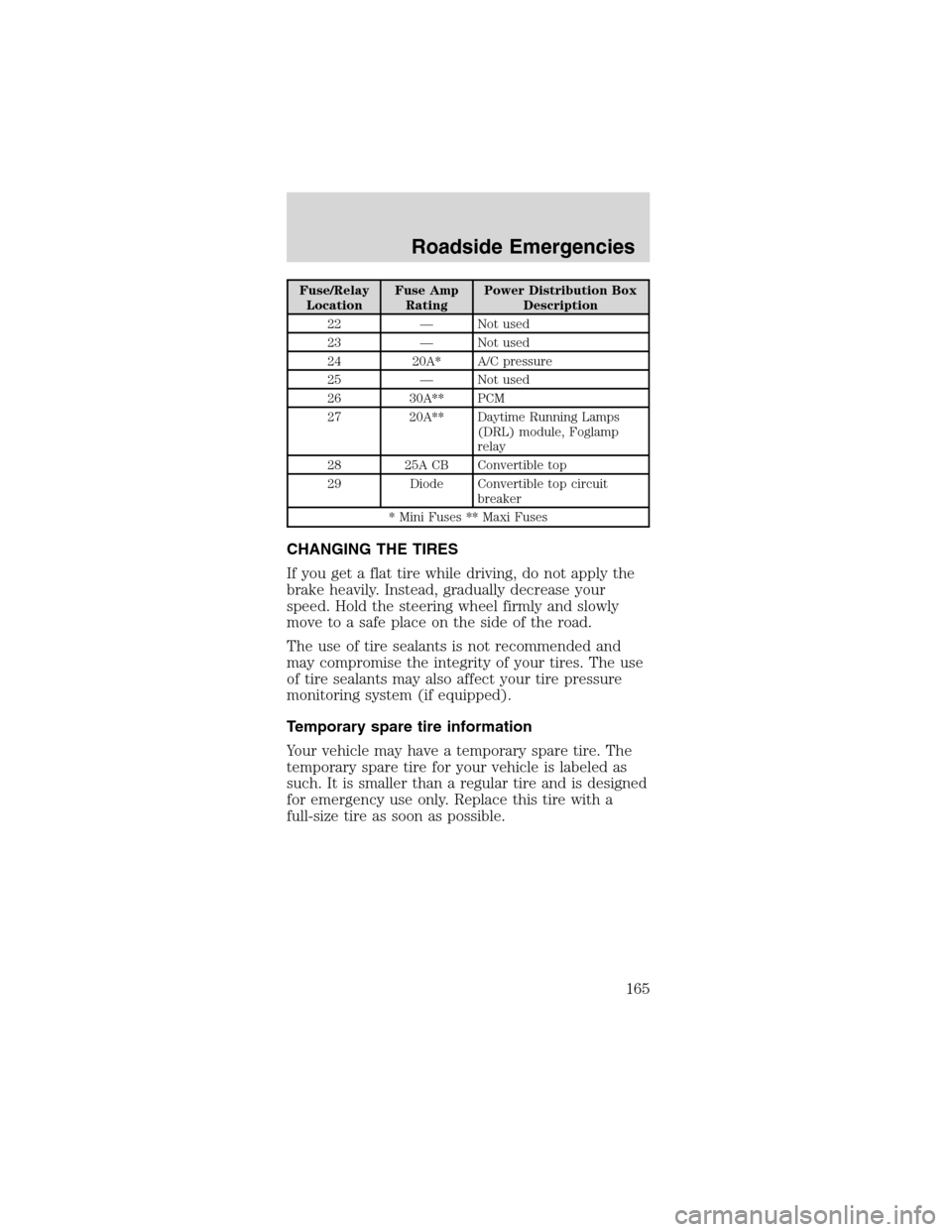
Fuse/Relay
LocationFuse Amp
RatingPower Distribution Box
Description
22—Not used
23—Not used
24 20A* A/C pressure
25—Not used
26 30A** PCM
27 20A** Daytime Running Lamps
(DRL) module, Foglamp
relay
28 25A CB Convertible top
29 Diode Convertible top circuit
breaker
* Mini Fuses ** Maxi Fuses
CHANGING THE TIRES
If you get a flat tire while driving, do not apply the
brake heavily. Instead, gradually decrease your
speed. Hold the steering wheel firmly and slowly
move to a safe place on the side of the road.
The use of tire sealants is not recommended and
may compromise the integrity of your tires. The use
of tire sealants may also affect your tire pressure
monitoring system (if equipped).
Temporary spare tire information
Your vehicle may have a temporary spare tire. The
temporary spare tire for your vehicle is labeled as
such. It is smaller than a regular tire and is designed
for emergency use only. Replace this tire with a
full-size tire as soon as possible.
Roadside Emergencies
165
Page 166 of 256
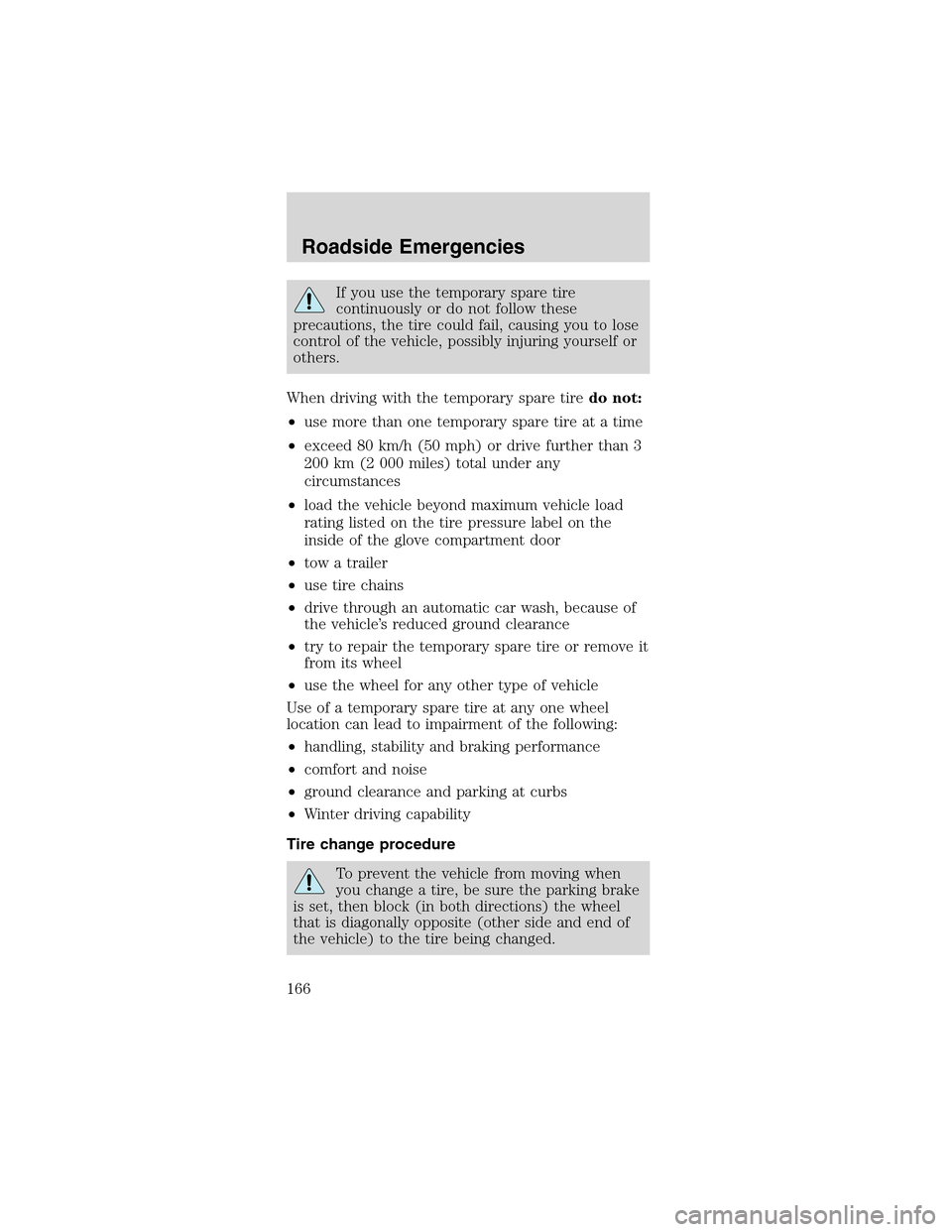
Ifyou use the temporary spare tire
continuously or do not follow these
precautions, the tire could fail, causing you to lose
control of the vehicle, possibly injuring yourself or
others.
When driving with the temporary spare tiredo not:
•use more than one temporary spare tire at a time
•exceed 80 km/h (50 mph) or drive further than 3
200 km (2 000 miles) total under any
circumstances
•load the vehicle beyond maximum vehicle load
rating listed on the tire pressure label on the
inside of the glove compartment door
•tow a trailer
•use tire chains
•drive through an automatic car wash, because of
the vehicle’s reduced ground clearance
•try to repair the temporary spare tire or remove it
from its wheel
•use the wheel for any other type of vehicle
Use of a temporary spare tire at any one wheel
location can lead to impairment of the following:
•handling, stability and braking performance
•comfort and noise
•ground clearance and parking at curbs
•Winter driving capability
Tire change procedure
To prevent the vehicle from moving when
you change a tire, be sure the parking brake
is set, then block (in both directions) the wheel
that is diagonally opposite (other side and end of
the vehicle) to the tire being changed.
Roadside Emergencies
166
Page 167 of 256
If the vehicle slips off the jack, you or
someone else could be seriously injured.
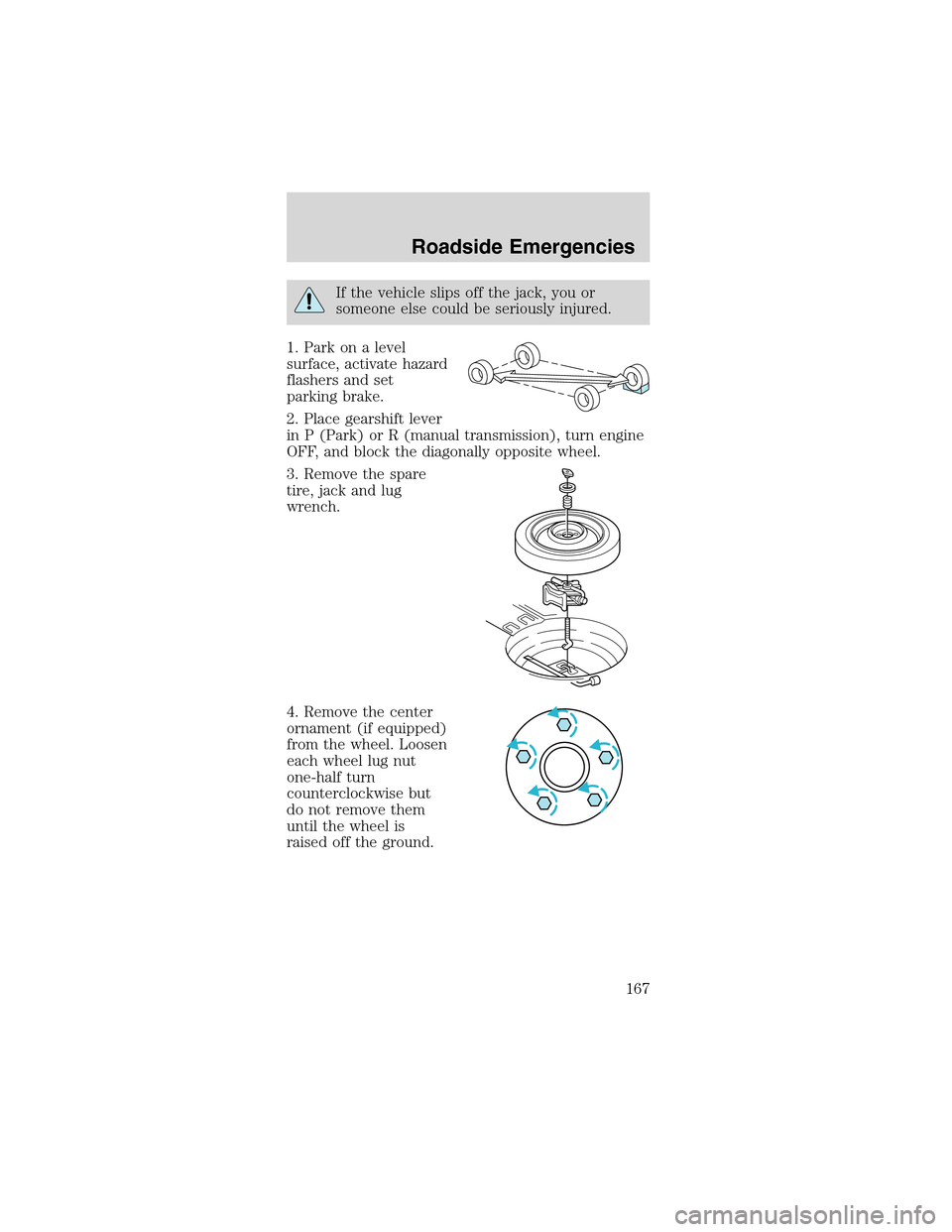
1. Park on a level
surface, activate hazard
flashers and set
parking brake.
2. Place gearshift lever
in P (Park) or R (manual transmission), turn engine
OFF, and block the diagonally opposite wheel.
3. Remove the spare
tire, jack and lug
wrench.
4. Remove the center
ornament (if equipped)
from the wheel. Loosen
each wheel lug nut
one-half turn
counterclockwise but
do not remove them
until the wheel is
raised off the ground.
Roadside Emergencies
167
Page 168 of 256
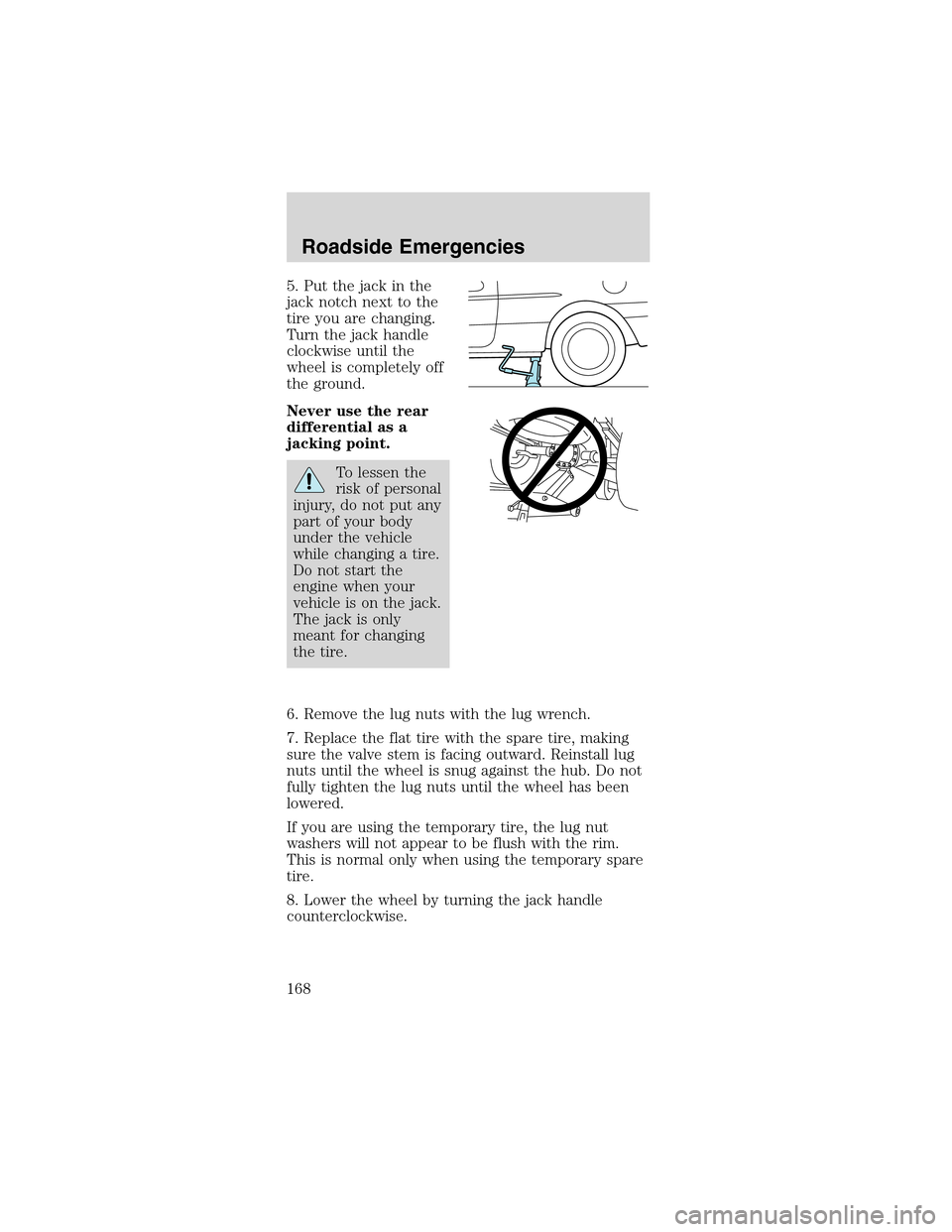
5. Put the jack in the
jack notch next to the
tire you are changing.
Turn the jack handle
clockwise until the
wheel is completely off
the ground.
Never use the rear
differential as a
jacking point.
To lessen the
risk of personal
injury, do not put any
part of your body
under the vehicle
while changing a tire.
Do not start the
engine when your
vehicle is on the jack.
The jack is only
meant for changing
the tire.
6. Remove the lug nuts with the lug wrench.
7. Replace the flat tire with the spare tire, making
sure the valve stem is facing outward. Reinstall lug
nuts until the wheel is snug against the hub. Do not
fully tighten the lug nuts until the wheel has been
lowered.
If you are using the temporary tire, the lug nut
washers will not appear to be flush with the rim.
This is normal only when using the temporary spare
tire.
8. Lower the wheel by turning the jack handle
counterclockwise.
Roadside Emergencies
168
Page 169 of 256
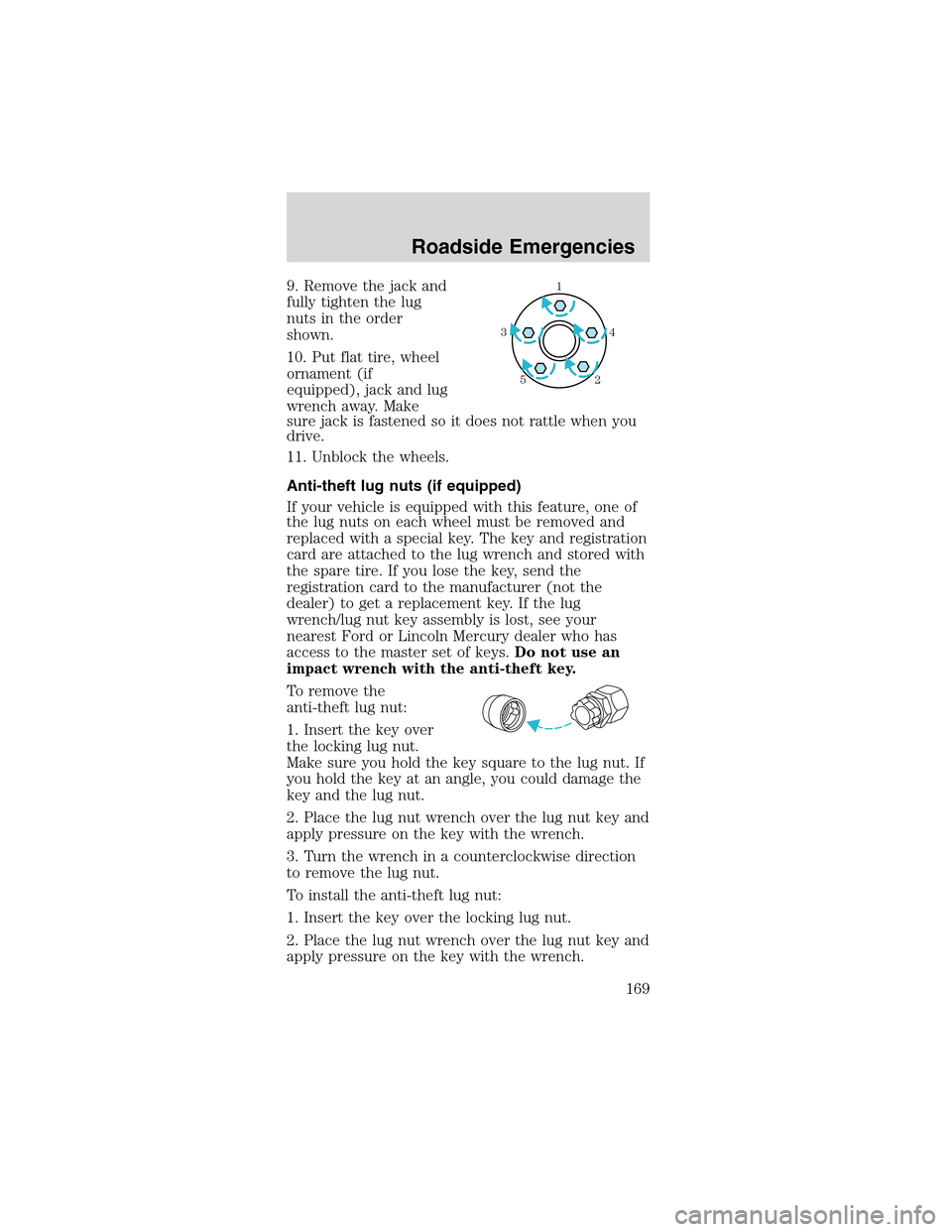
9. Remove the jack and
fully tighten the lug
nuts in the order
shown.
10. Put flat tire, wheel
ornament (if
equipped), jack and lug
wrench away. Make
sure jack is fastened so it does not rattle when you
drive.
11. Unblock the wheels.
Anti-theft lug nuts (if equipped)
If your vehicle is equipped with this feature, one of
the lug nuts on each wheel must be removed and
replaced with a special key. The key and registration
card are attached to the lug wrench and stored with
the spare tire. If you lose the key, send the
registration card to the manufacturer (not the
dealer) to get a replacement key. If the lug
wrench/lug nut key assembly is lost, see your
nearest Ford or Lincoln Mercury dealer who has
access to the master set of keys.Do not use an
impact wrench with the anti-theft key.
To remove the
anti-theft lug nut:
1. Insert the key over
the locking lug nut.
Make sure you hold the key square to the lug nut. If
you hold the key at an angle, you could damage the
key and the lug nut.
2. Place the lug nut wrench over the lug nut key and
apply pressure on the key with the wrench.
3. Turn the wrench in a counterclockwise direction
to remove the lug nut.
To install the anti-theft lug nut:
1. Insert the key over the locking lug nut.
2. Place the lug nut wrench over the lug nut key and
apply pressure on the key with the wrench.1
4 3
2 5
Roadside Emergencies
169
Page 175 of 256
WRECKER TOWING
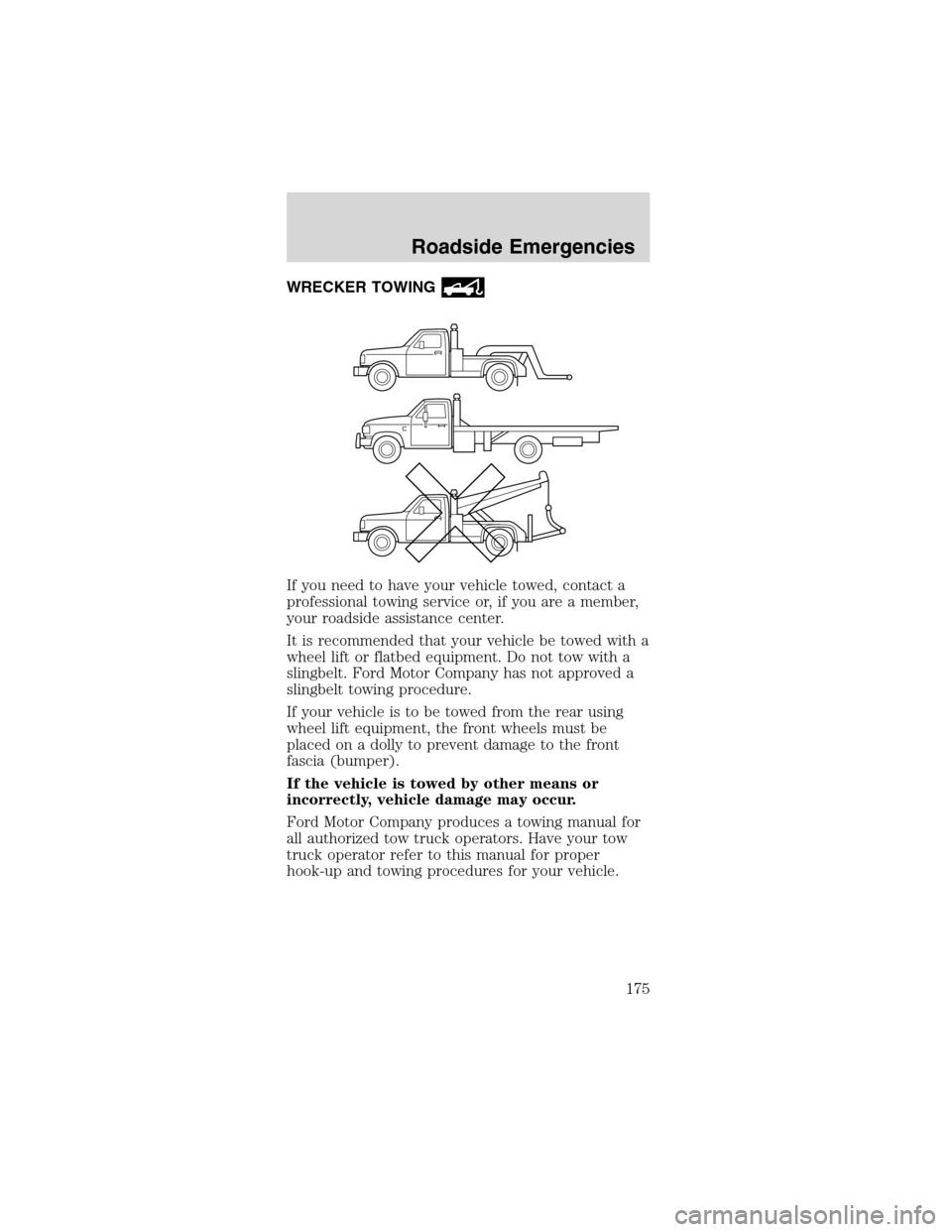
If you need to have your vehicle towed, contact a
professional towing service or, if you are a member,
your roadside assistance center.
It is recommended that your vehicle be towed with a
wheel lift or flatbed equipment. Do not tow with a
slingbelt. Ford Motor Company has not approved a
slingbelt towing procedure.
If your vehicle is to be towed from the rear using
wheel lift equipment, the front wheels must be
placed on a dolly to prevent damage to the front
fascia (bumper).
If the vehicle is towed by other means or
incorrectly, vehicle damage may occur.
Ford Motor Company produces a towing manual for
all authorized tow truck operators. Have your tow
truck operator refer to this manual for proper
hook-up and towing procedures for your vehicle.
Roadside Emergencies
175
Page 188 of 256
PAINT CHIPS
Your dealer has touch-up paint and sprays to match
your vehicle’s color. Take your color code (printed
on a sticker in the driver’s door jam) to your dealer
to ensure you get the correct color.
•Remove particles such as bird droppings, tree sap,
insect deposits, tar spots, road salt and industrial
fallout before repairing paint chips.
•Always read the instructions before using the
products.
ALUMINUM WHEELS AND COVERS
Aluminum wheel rims or covers are coated with a
clearcoat paint finish. In order to maintain their
shine:
•Clean with Motorcraft Wheel and Tire Cleaner
(ZC-37–A), which is available from your dealer.
•Never apply any cleaning chemical to hot or warm
wheel rims or covers.
•Some automatic car washes may cause damage to
the finish on your wheel rims or covers.
Chemical-strength cleaners, or cleaning chemicals,
in combination with brush agitation to remove
brake dust and dirt, could wear away the
clearcoat finish over time.
•Do not use hydrofluoric acid-based or high
caustic-based wheel cleaners, steel wool, fuels or
strong household detergent.
•To remove tar and grease, use Ford Extra
Strength Tar and Road Oil Removal
(B7A-19520–AA), available from your dealer.
ENGINE
Engines are more efficient when they are clean
because grease and dirt buildup keep the engine
warmer than normal. When washing:
•Take care when using a power washer to clean
the engine. The high-pressure fluid could
penetrate the sealed parts and cause damage.
Cleaning
188
Page 191 of 256
Do not use chemical solvents or strong
detergents when cleaning the steering wheel
or instrument panel to avoid contamination of the
air bag system.
•Be certain to wash or wipe your hands clean if
you have been in contact with certain products
such as insect repellent and suntan lotion in order
to avoid possible damage to the painted surfaces.
INTERIOR
For fabric, carpets, cloth seats, safety belts and seats
equipped with side air bags:
•Remove dust and loose dirt with a vacuum
cleaner.
•Remove light stains and soil with Ford Extra
Strength Upholstery Cleaner (E8AZ-19523–AA).
•If grease or tar is present on the material,
spot-clean the area first with Motorcraft Spot and
Stain Remover (ZC-14).
•Never saturate the seat covers with cleaning
solution.
•Do not use household cleaning products or glass
cleaners, which can stain and discolor the fabric
and affect the flame retardant abilities of the seat
materials.
Do not use cleaning solvents, bleach or dye
on the vehicle’s safety belts, as these actions
may weaken the belt webbing.
Do not use chemical solvents or strong
detergents when cleaning the seat where the
side air bag is mounted. Such products may
contaminate the side air bag system and affect
performance of the side air bag in a collision. The
air bag may not function correctly and not provide
any injury reduction benefits.
Cleaning
191