ECU FORD MUSTANG 2003 4.G Owner's Manual
[x] Cancel search | Manufacturer: FORD, Model Year: 2003, Model line: MUSTANG, Model: FORD MUSTANG 2003 4.GPages: 256, PDF Size: 2.4 MB
Page 130 of 256
If the tether strap is clipped incorrectly, the
child safety seat may not be retained
properly in the event of a collision.
6. Refer to theInstalling child safety seats in
combination lap and shoulder belt seating
positionssection of this chapter for further
instructions to secure the child safety seat.
7. Tighten the child safety seat tether strap
according to the manufacturer’s instructions.
If the safety seat is not anchored properly,
the risk of a child being injured in a collision
greatly increases.
Attaching safety seats with LATCH (Lower
Anchors and Tethers for Children) attachments
(if equipped)
Some child safety seats have two rigid or webbing
mounted attachments that connect to two anchors
at certain seating positions in your vehicle. This type
of child seat eliminates the need to use safety belts
to attach the child seat. For forward-facing child
seats, the tether strap must also be attached to the
proper tether anchor. SeeAttaching safety seats
with tether strapsin this chapter.
Seating and Safety Restraints
130
Page 139 of 256

cold, heat, moisture, road dust, salt or mud. If a
“metal-to-metal,”“continuous grinding”or
“continuous squeal”sound is present while braking,
the brake linings may be worn-out and should be
inspected by a qualified service technician.
If you are driving down a long or steep hill,
shift to a lower gear. Do not apply your
brakes continuously, as they may overheat and
become less effective.
Parking brake
Apply the parking
brake whenever the
vehicle is parked. To
set the parking brake,
apply the brake pedal
and pull the parking
brake handle up as far
as possible.
The BRAKE warning
lamp in the instrument
cluster illuminates and
remains illuminated
(when the ignition is turned ON) until the parking
brake is released.
Always set the parking brake fully and make
sure that the gearshift is securely latched in
P (Park) (automatic transmission) or in 1 (First
Gear) (manual transmission).
The parking brake is not recommended to stop a
moving vehicle. However, if the normal brakes fail,
the parking brake can be used to stop your vehicle
in an emergency. Since the parking brake applies
only the rear brakes, the vehicle’s stopping distance
will increase greatly and the handling of your vehicle
will be adversely affected.
P!
BRAKE
Driving
139
Page 147 of 256

Understanding gearshift positions
P (Park)
Always come to a
complete stop before
shifting into P (Park).
Make sure the gearshift
lever is securely
latched in P (Park).
This position locks the
transmission and
prevents the rear
wheels from turning.
Always set the parking brake fully and make
sure the gearshift lever is latched in P
(Park). Turn the ignition to the LOCK position and
remove the key whenever you leave your vehicle.
R (Reverse)
With the gearshift lever
in R (Reverse), the
vehicle will move
backward. Always come
to a complete stop
before shifting into and
out of R (Reverse).
N (Neutral)
With the gearshift lever
in N (Neutral), the
vehicle can be started
and is free to roll. Hold
the brake pedal down
while in this gear.
Driving
147
Page 162 of 256
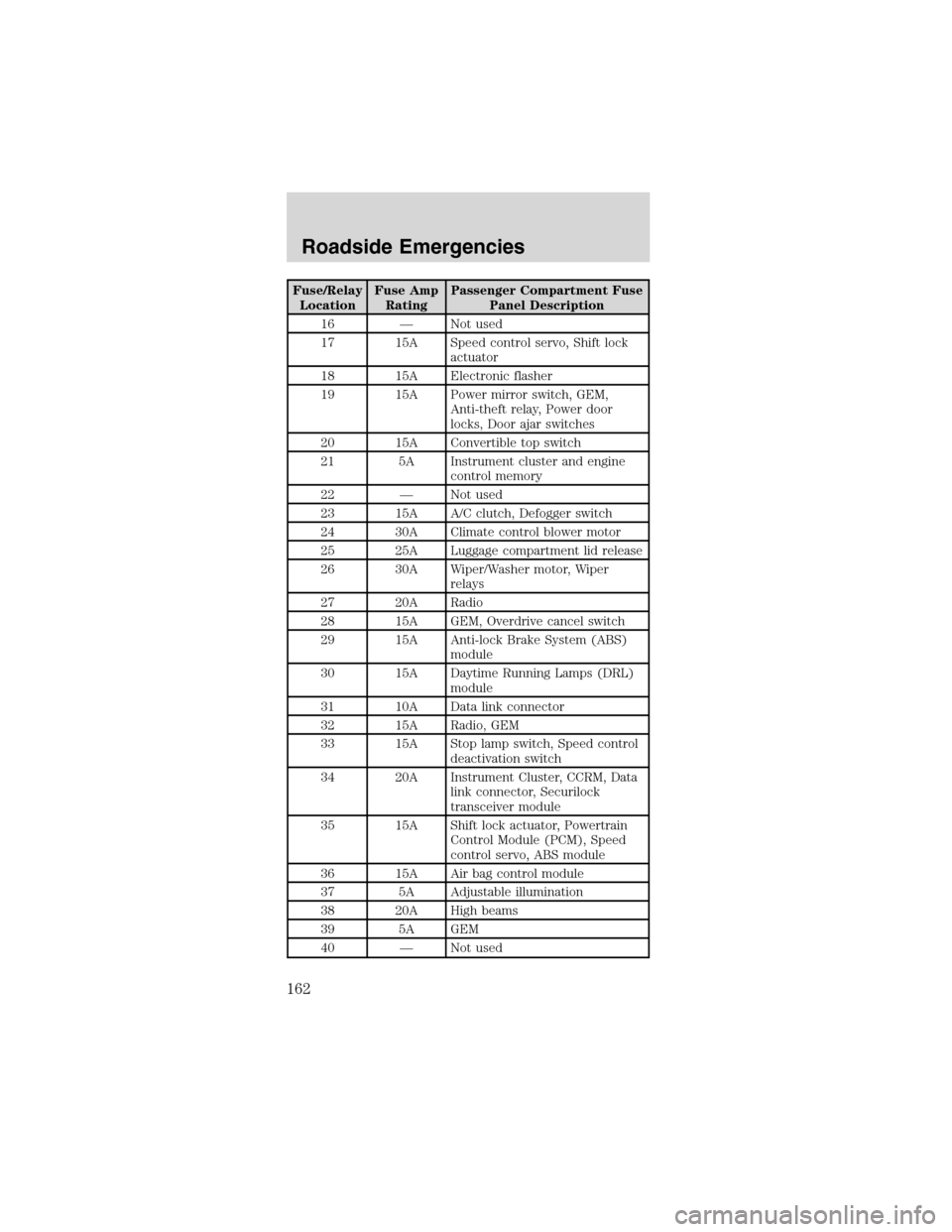
Fuse/Relay
LocationFuse Amp
RatingPassenger Compartment Fuse
Panel Description
16—Not used
17 15A Speed control servo, Shift lock
actuator
18 15A Electronic flasher
19 15A Power mirror switch, GEM,
Anti-theft relay, Power door
locks, Door ajar switches
20 15A Convertible top switch
21 5A Instrument cluster and engine
control memory
22—Not used
23 15A A/C clutch, Defogger switch
24 30A Climate control blower motor
25 25A Luggage compartment lid release
26 30A Wiper/Washer motor, Wiper
relays
27 20A Radio
28 15A GEM, Overdrive cancel switch
29 15A Anti-lock Brake System (ABS)
module
30 15A Daytime Running Lamps (DRL)
module
31 10A Data link connector
32 15A Radio, GEM
33 15A Stop lamp switch, Speed control
deactivation switch
34 20A Instrument Cluster, CCRM, Data
link connector, Securilock
transceiver module
35 15A Shift lock actuator, Powertrain
Control Module (PCM), Speed
control servo, ABS module
36 15A Air bag control module
37 5A Adjustable illumination
38 20A High beams
39 5A GEM
40—Not used
Roadside Emergencies
162
Page 177 of 256

In the United States:
Ford Motor Company
Customer Relationship Center
16800 Executive Plaza Drive
P.O. Box 6248
Dearborn, Michigan 48121
1-800-392-3673 (FORD)
(TDD for the hearing impaired: 1-800-232-5952)
www.ford.com
In Canada:
Customer Relationship Centre
Ford Motor Company of Canada, Limited
P.O. Box 2000
Oakville, Ontario L6J 5E4
1-800-565-3673 (FORD)
www.ford.ca
If you own a Lincoln vehicle and are away from
home when your vehicle needs service, or if you
need more help than the dealership could provide,
after following the steps described above, contact
the Ford Customer Relationship Center to find an
authorized dealership to help you.
In the United States:
Ford Motor Company
Customer Relationship Center
16800 Executive Plaza Drive
P.O. Box 6248
Dearborn, Michigan 48121
1-800-521-4140
(TDD for the hearing impaired: 1-800-232-5952)
www.ford.com
In Canada:
Customer Relationship Centre
Ford Motor Company of Canada, Limited
P.O. Box 2000
Oakville, Ontario L6J 5E4
1-800-565-3673 (FORD)
www.ford.ca
Customer Assistance
177
Page 183 of 256
for the hearing impaired: 1-800-232-5952 or by
writing to the Center at the following address:
Ford Motor Company
Customer Relationship Center
16800 Executive Plaza Drive
P.O. Box 6248
Dearborn, Michigan 48121
UTILIZING THE MEDIATION/ARBITRATION
PROGRAM (CANADA ONLY)
In those cases where you continue to feel that the
efforts by Ford and the dealer to resolve a
factory-related vehicle service concern have been
unsatisfactory, Ford of Canada participates in an
impartial third party mediation/arbitration program
administered by the Canadian Motor Vehicle
Arbitration Plan (CAMVAP).
The CAMVAP program is a straight-forward and
relatively speedy alternative to resolve a
disagreement when all other efforts to produce a
settlement have failed. This procedure is without
cost to you and is designed to eliminate the need for
lengthy and expensive legal proceedings.
In the CAMVAP program, impartial third-party
arbitrators conduct hearings at mutually convenient
times and places in an informal environment. These
impartial arbitrators review the positions of the
parties, make decisions and, when appropriate,
render awards to resolve disputes. CAMVAP
decisions are fast, fair, and final; the arbitrator’s
award is binding both to you and Ford of Canada.
CAMVAP services are available in all territories and
provinces. For more information, without charge or
obligation, call your CAMVAP Provincial
Administrator directly at 1-800-207-0685.
GETTING ASSISTANCE OUTSIDE THE U.S. AND
CANADA
Before exporting your vehicle to a foreign country,
contact the appropriate foreign embassy or
consulate. These officials can inform you of local
vehicle registration regulations and where to find
unleaded fuel.
Customer Assistance
183
Page 186 of 256

2. Four or more repair attempts are made on the
same nonconformity (a defect or condition that
substantially impairs the use, value or safety of the
vehicle) OR
3. The vehicle is out of service for repair of
nonconformities for a total of more than 30 calendar
days (not necessarily all at one time)
In the case of 1 or 2 above, the consumer must also
notify the manufacturer of the need for the repair of
the nonconformity at the following address:
Ford Motor Company
16800 Executive Plaza Drive
Mail Drop 3NE-B
Dearborn, MI 48126
REPORTING SAFETY DEFECTS (U.S. ONLY)
If you believe that your
vehicle has a defect
which could cause a
crash or could cause injury or death, you should
immediately inform the National Highway Traffic
Safety Administration (NHTSA) in addition to
notifying Ford Motor Company.
If NHTSA receives similar complaints, it may open
an investigation, and if it finds that a safety defect
exists in a group of vehicles, it may order a recall
and remedy campaign. However, NHTSA cannot
become involved in individual problems between
you, your dealer, or Ford Motor Company.
To contact NHTSA, you may either call the Auto
Safety Hotline toll-free at 1–800–424–9393 (or
366–0123 in the Washington D.C. area) or write to:
NHTSA
U.S. Department of Transportation
Washington, D.C. 20590
You can also obtain other information about motor
vehicle safety from the Hotline.
Customer Assistance
186
Page 194 of 256
SERVICE RECOMMENDATIONS
To help you service your vehicle:
•We highlight do-it-yourself items in the engine
compartment for easy location.
•We provide a scheduled maintenance guide which
makes tracking routine service easy.
If your vehicle requires professional service, your
dealership can provide the necessary parts and
service. Check yourWarranty Guide/Owner
Information Guideto find out which parts and
services are covered.
Use only recommended fuels, lubricants, fluids and
service parts conforming to specifications. Motorcraft
parts are designed and built to provide the best
performance in your vehicle.
PRECAUTIONS WHEN SERVICING YOUR
VEHICLE
Be especially careful when inspecting or servicing
your vehicle.
•Do not work on a hot engine.
•When the engine is running, keep loose clothing,
jewelry or long hair away from moving parts.
•Do not work on a vehicle with the engine running
in an enclosed space, unless you are sure you
have enough ventilation.
•Keep all lit cigarettes, open flames and other lit
material away from the battery and all fuel related
parts.
If you disconnect the battery, the engine must
“relearn”its idle conditions before your vehicle will
drive properly, as explained in theBatterysection in
this chapter.
Working with the engine off
•Automatic transmission:
1. Set the parking brake and ensure the gearshift is
securely latched in P (Park).
Maintenance and Specifications
194
Page 195 of 256
2. Turn off the engine and remove the key.
3. Block the wheels to prevent the vehicle from
moving unexpectedly.
•Manual transmission:
1. Set the parking brake.
2. Depress the clutch and place the gearshift in 1
(First).
3. Turn off the engine and remove the key.
4. Block the wheels to prevent the vehicle from
moving unexpectedly.
Working with the engine on
•Automatic transmission:
1. Set the parking brake and ensure the gearshift is
securely latched in P (Park).
2. Block the wheels to prevent the vehicle from
moving unexpectedly.
Note:Do not start your engine with the air cleaner
removed and do not remove it while the engine is
running.
•Manual transmission:
1. Set the parking brake, depress the clutch and
place the gearshift in neutral.
2. Block the wheels to prevent the vehicle from
moving unexpectedly.
Note:Do not start your engine with the air cleaner
removed and do not remove it while the engine is
running.
The cooling fan is automatic and may come
on at any time. Always disconnect the
negative terminal of the battery before working
near the fan.
Maintenance and Specifications
195
Page 196 of 256
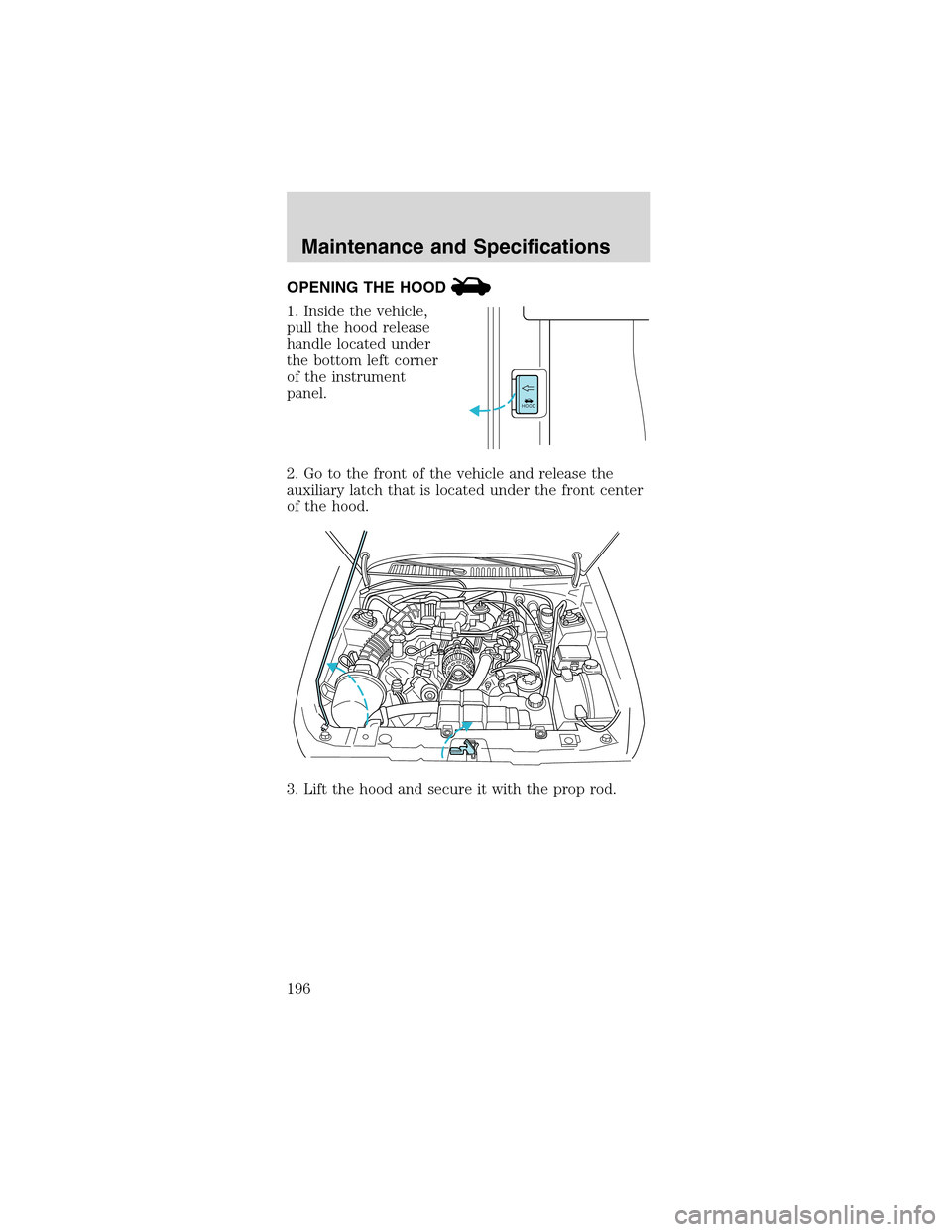
OPENING THE HOOD
1. Inside the vehicle,
pull the hood release
handle located under
the bottom left corner
of the instrument
panel.
2. Go to the front of the vehicle and release the
auxiliary latch that is located under the front center
of the hood.
3. Lift the hood and secure it with the prop rod.
HOOD
Maintenance and Specifications
196