light FORD MUSTANG 2003 4.G Workshop Manual
[x] Cancel search | Manufacturer: FORD, Model Year: 2003, Model line: MUSTANG, Model: FORD MUSTANG 2003 4.GPages: 256, PDF Size: 2.4 MB
Page 178 of 256
In order to help you service your Ford or Lincoln
Mercury vehicle, please have the following
information available when contacting a Customer
Relationship Center:
•Your telephone number (home and business)
•The name of the dealer and the city where the
dealership is located
•The year and make of your vehicle
•The date of vehicle purchase
•The current odometer reading
•The vehicle identification number (VIN)
If you still have a complaint involving a warranty
dispute, you may wish to contact the Dispute
Settlement Board (U.S.).
In some states (in the U.S.) you must directly notify
Ford in writing before pursuing remedies under your
state’s warranty laws. Ford is also allowed a final
repair attempt in some states.
In the United States, a warranty dispute must be
submitted to the Dispute Settlement Board before
taking action under the Magnuson-Moss Warranty
Act, or to the extent allowed by state law, before
pursuing replacement or repurchase remedies
provided by certain state laws. This dispute handling
procedure is not required prior to enforcing state
created rights or other rights which are independent
of the Magnuson-Moss Warranty Act or state
replacement or repurchase laws.
FORD EXTENDED SERVICE PLAN
You can get more protection for your new car or
light truck by purchasing Ford Extended Service
Plan (Ford ESP) coverage. Ford ESP is an optional
service contract which is backed by Ford Motor
Company or Ford Motor Service Company (in the
U.S.) and Ford of Canada (in Canada). It provides
the following:
•Benefits during the warranty period depending on
the plan you purchase (such as: reimbursement
for rentals; coverage for certain maintenance and
wear items).
Customer Assistance
178
Page 179 of 256
•Protection against covered repair costs after your
Bumper-to-Bumper Warranty expires.
You may purchase Ford ESP from any participating
Ford and Lincoln Mercury and Ford of Canada
dealer. There are several plans available in various
time, distance and deductible combinations which
can be tailored to fit your own driving needs. Ford
ESP also offers reimbursement benefits for towing
and rental coverage.
When you buy Ford ESP, you receive Peace-of-Mind
protection throughout the United States and Canada,
provided by a network of more than 5,000
participating Ford or Lincoln Mercury and Ford of
Canada dealers.
If you did not take advantage of the Ford Extended
Service Plan at the time of purchasing your vehicle,
you may still be eligible. Please contact your dealer
for further information. Since this information is
subject to change, please ask your dealer for
complete details about Ford Extended Service Plan
coverage options, or visit the Ford ESP website at
www.ford-esp.com.
THE DISPUTE SETTLEMENT BOARD
(U.S. ONLY)
The Dispute Settlement Board is:
•an independent, third-party arbitration program
for warranty disputes.
•available free to owners and lessees of qualifying
Ford Motor Company vehicles.
The Dispute Settlement Board may not be available in
all states. Ford Motor Company reserves the right to
change eligibility limitations, modify procedures
and/or to discontinue this service without notice and
without incurring obligations per applicable state law.
What kinds of cases does the Board review?
Unresolved warranty repair concerns or vehicle
performance concerns as on Ford and Lincoln
Mercury cars and Ford and Lincoln Mercury light
Customer Assistance
179
Page 187 of 256
WASHING THE EXTERIOR
Wash your vehicle regularly with cool or lukewarm
water and a neutral Ph shampoo, such as Detail
Wash (ZC-3–A), which is available from your dealer.
•Never use strong household detergents or soap,
such as dish washing or laundry liquid. These
products can discolor and spot painted surfaces.
•Never wash a vehicle that is“hot to the touch”or
during exposure to strong, direct sunlight.
•Always use a clean sponge or carwash mitt with
plenty of water for best results.
•Dry the vehicle with a chamois or soft terry cloth
towel in order to eliminate water spotting.
•It is especially important to wash the vehicle
regularly during the winter months, as dirt and
road salt are difficult to remove and cause
damage to the vehicle.
•Immediately remove items such as gasoline, diesel
fuel, bird droppings and insect deposits because
they can cause damage to the vehicle’s paintwork
and trim over time.
•Remove any exterior accessories, such as
antennas, before entering a car wash.
•Suntan lotions and insect repellents can
damage any painted surface; if these
substances come in contact with your
vehicle, wash off as soon as possible.
WAXING
Applying a polymer paint sealant to your vehicle
every six months will assist in reducing minor
scratches and paint damage.
•Wash the vehicle first.
•Do not use waxes that contain abrasives.
•Do not allow paint sealant to come in contact with
any non-body (low-gloss black) colored trim, such
as grained door handles, roof racks, bumpers, side
moldings, mirror housings or the windshield cowl
area. The paint sealant will“gray”or stain the
parts over time.
Cleaning
187
Page 189 of 256

•Do not spray a hot engine with cold water to
avoid cracking the engine block or other engine
components.
•Spray Motorcraft Engine Shampoo and Degreaser
(ZC-20) on all parts that require cleaning and
pressure rinse clean.
•Cover the highlighted areas to prevent water
damage when cleaning the engine.
•3.8L OHV V6 engine
•4.6L SOHC V8 engine
•Never wash or rinse the engine while it is
running; water in the running engine may cause
internal damage.
Cleaning
189
Page 191 of 256
Do not use chemical solvents or strong
detergents when cleaning the steering wheel
or instrument panel to avoid contamination of the
air bag system.
•Be certain to wash or wipe your hands clean if
you have been in contact with certain products
such as insect repellent and suntan lotion in order
to avoid possible damage to the painted surfaces.
INTERIOR
For fabric, carpets, cloth seats, safety belts and seats
equipped with side air bags:
•Remove dust and loose dirt with a vacuum
cleaner.
•Remove light stains and soil with Ford Extra
Strength Upholstery Cleaner (E8AZ-19523–AA).
•If grease or tar is present on the material,
spot-clean the area first with Motorcraft Spot and
Stain Remover (ZC-14).
•Never saturate the seat covers with cleaning
solution.
•Do not use household cleaning products or glass
cleaners, which can stain and discolor the fabric
and affect the flame retardant abilities of the seat
materials.
Do not use cleaning solvents, bleach or dye
on the vehicle’s safety belts, as these actions
may weaken the belt webbing.
Do not use chemical solvents or strong
detergents when cleaning the seat where the
side air bag is mounted. Such products may
contaminate the side air bag system and affect
performance of the side air bag in a collision. The
air bag may not function correctly and not provide
any injury reduction benefits.
Cleaning
191
Page 194 of 256
SERVICE RECOMMENDATIONS
To help you service your vehicle:
•We highlight do-it-yourself items in the engine
compartment for easy location.
•We provide a scheduled maintenance guide which
makes tracking routine service easy.
If your vehicle requires professional service, your
dealership can provide the necessary parts and
service. Check yourWarranty Guide/Owner
Information Guideto find out which parts and
services are covered.
Use only recommended fuels, lubricants, fluids and
service parts conforming to specifications. Motorcraft
parts are designed and built to provide the best
performance in your vehicle.
PRECAUTIONS WHEN SERVICING YOUR
VEHICLE
Be especially careful when inspecting or servicing
your vehicle.
•Do not work on a hot engine.
•When the engine is running, keep loose clothing,
jewelry or long hair away from moving parts.
•Do not work on a vehicle with the engine running
in an enclosed space, unless you are sure you
have enough ventilation.
•Keep all lit cigarettes, open flames and other lit
material away from the battery and all fuel related
parts.
If you disconnect the battery, the engine must
“relearn”its idle conditions before your vehicle will
drive properly, as explained in theBatterysection in
this chapter.
Working with the engine off
•Automatic transmission:
1. Set the parking brake and ensure the gearshift is
securely latched in P (Park).
Maintenance and Specifications
194
Page 199 of 256
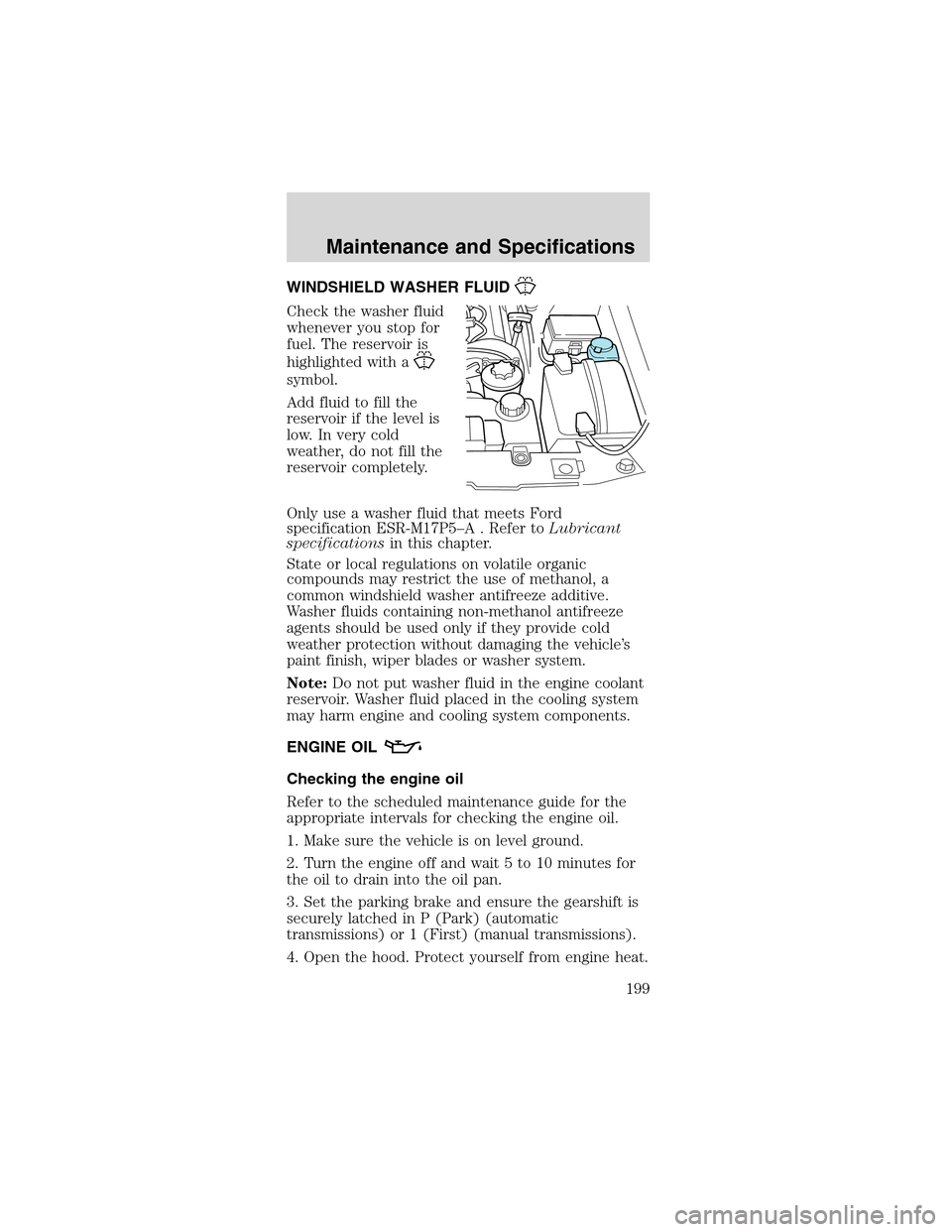
WINDSHIELD WASHER FLUID
Check the washer fluid
whenever you stop for
fuel. The reservoir is
highlighted with a
symbol.
Add fluid to fill the
reservoir if the level is
low. In very cold
weather, do not fill the
reservoir completely.
Only use a washer fluid that meets Ford
specification ESR-M17P5–A . Refer toLubricant
specificationsin this chapter.
State or local regulations on volatile organic
compounds may restrict the use of methanol, a
common windshield washer antifreeze additive.
Washer fluids containing non-methanol antifreeze
agents should be used only if they provide cold
weather protection without damaging the vehicle’s
paint finish, wiper blades or washer system.
Note:Do not put washer fluid in the engine coolant
reservoir. Washer fluid placed in the cooling system
may harm engine and cooling system components.
ENGINE OIL
Checking the engine oil
Refer to the scheduled maintenance guide for the
appropriate intervals for checking the engine oil.
1. Make sure the vehicle is on level ground.
2. Turn the engine off and wait 5 to 10 minutes for
the oil to drain into the oil pan.
3. Set the parking brake and ensure the gearshift is
securely latched in P (Park) (automatic
transmissions) or 1 (First) (manual transmissions).
4. Open the hood. Protect yourself from engine heat.
Maintenance and Specifications
199
Page 204 of 256
Batteries normally produce explosive gases
which can cause personal injury. Therefore,
do not allow flames, sparks or lighted substances
to come near the battery. When working near the
battery, always shield your face and protect your
eyes. Always provide proper ventilation.
When lifting a plastic-cased battery,
excessive pressure on the end walls could
cause acid to flow through the vent caps, resulting
in personal injury and/or damage to the vehicle or
battery. Lift the battery with a battery carrier or
with your hands on opposite corners.
Keep batteries out of reach of children.
Batteries contain sulfuric acid. Avoid contact
with skin, eyes or clothing. Shield your eyes when
working near the battery to protect against
possible splashing of acid solution. In case of acid
contact with skin or eyes, flush immediately with
water for a minimum of 15 minutes and get
prompt medical attention. If acid is swallowed, call
a physician immediately.
Battery posts, terminals and related
accessories contain lead and lead
compounds.Wash hands after handling.
Because your vehicle’s engine is electronically
controlled by a computer, some control conditions
are maintained by power from the battery. When the
battery is disconnected or a new battery is installed,
the engine must relearn its idle and fuel trim
strategy for optimum driveability and performance.
To begin this process:
1. With the vehicle at a complete stop, set the
parking brake.
2. Put the gearshift in P (Park) (automatic
transmission) or the neutral position (manual
transmission), turn off all accessories and start the
engine.
Maintenance and Specifications
204
Page 209 of 256
water as soon as possible. Water alone (without
engine coolant) can cause engine damage from
corrosion, overheating or freezing.
•Do not use alcohol, methanol or brine or any
engine coolants mixed with alcohol or
methanol antifreeze (coolant).Alcohol and
other liquids can cause engine damage from
overheating or freezing.
•Do not add extra inhibitors or additives to
the coolant.These can be harmful and
compromise the corrosion protection of the
engine coolant.
•Do not mix with recycled coolant unless from
a Ford-approved recycling process (seeUse of
Recycled Engine Coolantsection).
To reduce the risk of personal injury, make
sure the engine is cool before unscrewing
the coolant pressure relief cap. The cooling system
is under pressure; steam and hot liquid can come
out forcefully when the cap is loosened slightly.
If you must remove the pressure relief cap or
radiator cap (depending upon engine application),
follow these steps to avoid personal injury:
1. Before you remove the cap, turn the engine off
and let it cool.
2. When the engine is cool, wrap a thick cloth
around the cap. Slowly turn cap counterclockwise
until pressure begins to release.
3. Step back while the pressure releases.
4. When you are sure that all the pressure has been
released, use the cloth to turn it counterclockwise
and remove the cap.
Engine coolant refill procedure-3.8L V6 engine
Note:Use the following procedure when refilling the
cooling system of a vehicle equipped with a 3.8L V6
engine. Failure to follow this warning may result in
damage to the engine and engine cooling system.
Maintenance and Specifications
209
Page 216 of 256
Usethe following guidelines to avoid static build-up
when filling an ungrounded fuel container:
•Place approved fuel container on the ground.
•DO NOT fill a fuel container while it is in the
vehicle (including the cargo area).
•Keep the fuel pump nozzle in contact with the
fuel container while filling.
•DO NOT use a device that would hold the fuel
pump handle in the fill position.
Fuel Filler Cap
Your fuel tank filler cap has an indexed design with
a 1/8 turn on/off feature.
When fueling your vehicle:
1. Turn the engine off.
2. Carefully turn the filler cap counterclockwise 1/8
of a turn until it stops.
3. Pull to remove the cap from the fuel filler pipe.
4. To install the cap, align the tabs on the cap with
the notches on the filler pipe.
5. Turn the filler cap clockwise 1/8 of a turn until it
stops.
“Check Fuel Cap”illuminates when the ignition is
turned to the ON position to ensure your bulb is
working. When this light turns on, check the fuel
filler cap. Continuing to operate the vehicle with the
Check Fuel Cap light on, can activate the Service
Engine Soon warning. When the fuel filler cap is
properly re-installed, the light(s) will turn off after a
period of normal driving.It may take a long
period of time for the system to detect an
improperly installed fuel filler cap.
If you must replace the fuel filler cap, replace
it with a fuel filler cap that is designed for
your vehicle. The customer warranty may be
void for any damage to the fuel tank or fuel
system if the correct genuine Ford or
Motorcraft fuel filler cap is not used.
Maintenance and Specifications
216