odometer FORD MUSTANG 2003 4.G Owners Manual
[x] Cancel search | Manufacturer: FORD, Model Year: 2003, Model line: MUSTANG, Model: FORD MUSTANG 2003 4.GPages: 256, PDF Size: 2.4 MB
Page 17 of 256
When refueling the vehicle from empty indication,
the amount of fuel that can be added will be less
than the advertised capacity due to the reserve fuel.
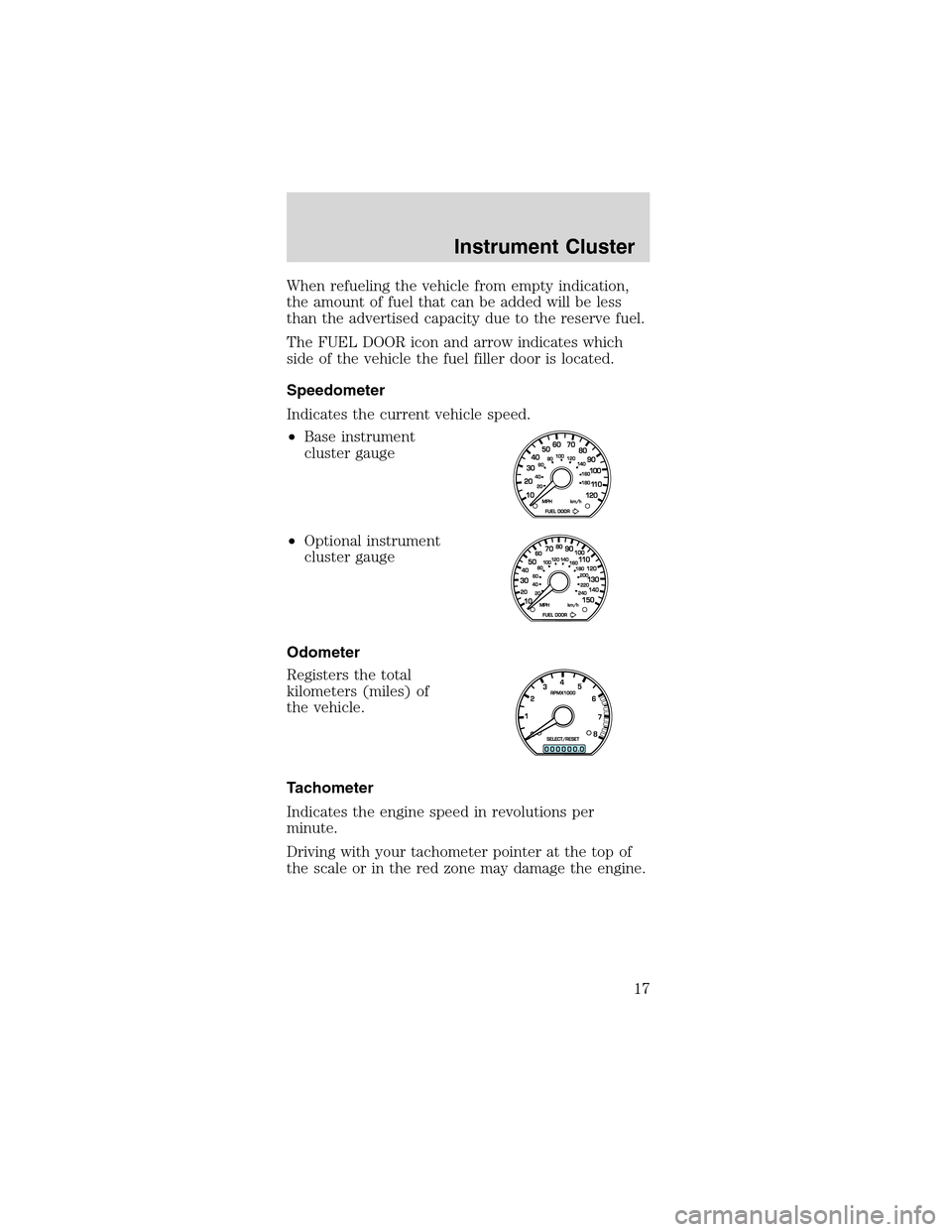
The FUEL DOOR icon and arrow indicates which
side of the vehicle the fuel filler door is located.
Speedometer
Indicates the current vehicle speed.
•Base instrument
cluster gauge
•Optional instrument
cluster gauge
Odometer
Registers the total
kilometers (miles) of
the vehicle.
Tachometer
Indicates the engine speed in revolutions per
minute.
Driving with your tachometer pointer at the top of
the scale or in the red zone may damage the engine.
Instrument Cluster
17
Page 18 of 256
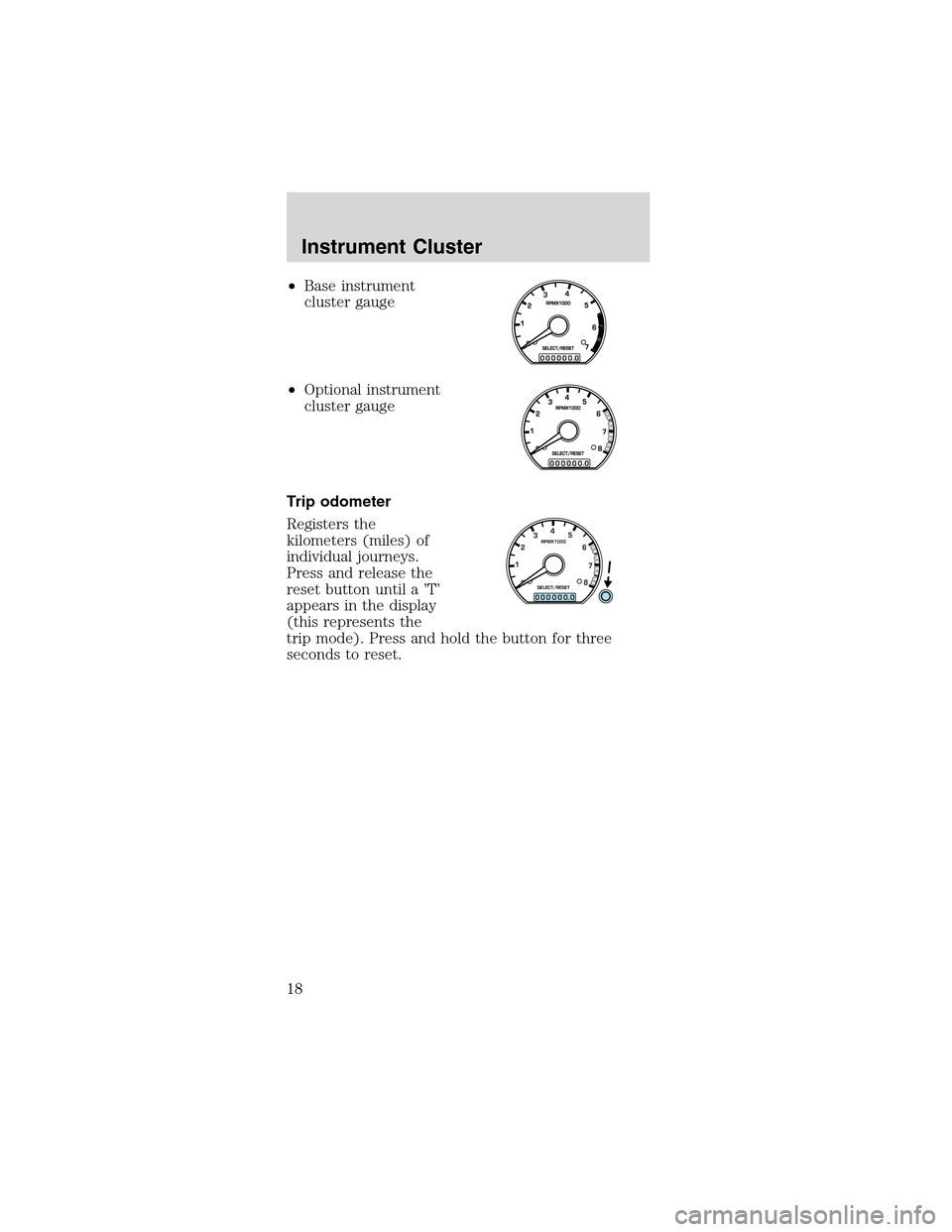
•Base instrument
cluster gauge
•Optional instrument
cluster gauge
Trip odometer
Registers the
kilometers (miles) of
individual journeys.
Press and release the
reset button until a’T’
appears in the display
(this represents the
trip mode). Press and hold the button for three
seconds to reset.
0
00000 00
4
5
6
7
8 3
2
1RPMX1000
SELECT/RESET
.
Instrument Cluster
18
Page 178 of 256
In order to help you service your Ford or Lincoln
Mercury vehicle, please have the following
information available when contacting a Customer
Relationship Center:
•Your telephone number (home and business)
•The name of the dealer and the city where the
dealership is located
•The year and make of your vehicle
•The date of vehicle purchase
•The current odometer reading
•The vehicle identification number (VIN)
If you still have a complaint involving a warranty
dispute, you may wish to contact the Dispute
Settlement Board (U.S.).
In some states (in the U.S.) you must directly notify
Ford in writing before pursuing remedies under your
state’s warranty laws. Ford is also allowed a final
repair attempt in some states.
In the United States, a warranty dispute must be
submitted to the Dispute Settlement Board before
taking action under the Magnuson-Moss Warranty
Act, or to the extent allowed by state law, before
pursuing replacement or repurchase remedies
provided by certain state laws. This dispute handling
procedure is not required prior to enforcing state
created rights or other rights which are independent
of the Magnuson-Moss Warranty Act or state
replacement or repurchase laws.
FORD EXTENDED SERVICE PLAN
You can get more protection for your new car or
light truck by purchasing Ford Extended Service
Plan (Ford ESP) coverage. Ford ESP is an optional
service contract which is backed by Ford Motor
Company or Ford Motor Service Company (in the
U.S.) and Ford of Canada (in Canada). It provides
the following:
•Benefits during the warranty period depending on
the plan you purchase (such as: reimbursement
for rentals; coverage for certain maintenance and
wear items).
Customer Assistance
178
Page 220 of 256
fuel in a full tank and a tank when the fuel gauge
indicates empty. Empty reserve is the small amount
of fuel remaining in the fuel tank after the fuel
gauge indicates empty.
The amount of usable fuel in the empty reserve
varies and should not be relied upon to
increase driving range. When refueling your
vehicle after the fuel gauge indicates empty,
you might not be able to refuel the full amount
of the advertised capacity of the fuel tank due
to the empty reserve still present in the tank.
For consistent results when filling the fuel tank:
•Turn the engine/ignition switch to the off position
prior to refueling, an error in the reading will
result if the engine is left running.
•Use the same filling rate setting (low—medium
—high) each time the tank is filled.
•Allow no more than 2 automatic click-offs when
filling.
•Always use fuel with the recommended octane
rating.
•Use a known quality gasoline, preferably a
national brand.
•Use the same side of the same pump and have
the vehicle facing the same direction each time
you fill up.
•Have the vehicle loading and distribution the
same every time.
Your results will be most accurate if your filling
method is consistent.
Calculating fuel economy
1. Fill the fuel tank completely and record the initial
odometer reading (in kilometers or miles).
2. Each time you fill the tank, record the amount of
fuel added (in liters or gallons).
3. After at least three to five tank fill-ups, fill the
fuel tank and record the current odometer reading.
Maintenance and Specifications
220
Page 221 of 256
4. Subtract your initial odometer reading from the
current odometer reading.
5. Follow one of the simple calculations in order to
determine fuel economy:
Multiply liters used by 100, then divide by
total kilometers traveled.
Divide total miles traveled by total gallons
used.
Keep a record for at least one month and record the
type of driving (city or highway). This will provide
an accurate estimate of the vehicle’s fuel economy
under current driving conditions. Additionally,
keeping records during summer and winter will show
how temperature impacts fuel economy. In general,
lower temperatures give lower fuel economy.
Driving style—good driving and fuel economy
habits
Give consideration to the lists that follow and you
may be able to change a number of variables and
improve your fuel economy.
Habits
•Smooth, moderate operation can yield up to 10%
savings in fuel.
•Steady speeds without stopping will usually give
the best fuel economy.
•Idling for long periods of time (greater than one
minute) may waste fuel.
•Anticipate stopping; slowing down may eliminate
the need to stop.
•Sudden or hard accelerations may reduce fuel
economy.
•Slow down gradually.
•Driving at reasonable speeds (traveling at 88 km/h
[55 mph] uses 15% less fuel than traveling at 105
km/h [65 mph]).
•Revving the engine before turning it off may
reduce fuel economy.
Maintenance and Specifications
221
Page 251 of 256
running out
of
fuel ......................... 218
safety information
relating to
automotive fuels ... 214
Fuses ........................ 160
G
Gas cap
(see Fuel cap) ... 12, 216
Gas mileage
(see
Fuel economy) ........ 219
Gauges ....................... 15
battery voltage
gauge ....................... 16
engine coolant
temperature
gauge ....................... 15
engine oil pressure
gauge ....................... 16
fuel gauge ................ 16
odometer ................. 17
speedometer ........... 17
tachometer .............. 17
trip odometer .......... 18
GAWR (Gross Axle
Weight Rating) ........ 154
definition ............... 154
driving with a
heavy load ............. 154
location .................. 154
GVWR (Gross Vehicle
Weight Rating) ........ 154
calculating ............. 154
definition ............... 154
driving with a
heavy load ............. 154
location .................. 154H
Hazard flashers ....... 158
Head restraints ......... 99
Headlamps ................. 67
aiming ................ 68–69
bulb specifications .. 71
daytime running
lights ........................ 67
flash to pass ............ 68
high beam ......... 10, 68
replacing bulbs ....... 72
turning on and off .. 67
warning chime ........ 15
Heating
heating and air
conditioning
system ..................... 63
Hood ........................ 196
I
Ignition ............. 133, 242
removing the key .. 153
Infant seats (see
Safety seats) ........... 123
Inspection/maintenance
(I/M) testing ............ 224
Instrument panel
cleaning ................. 190
cluster ...................... 10
lighting up panel
and interior ............. 68
J
Jack .......................... 165
positioning ............. 165
storage ................... 165
Index
251
Page 253 of 256
Odometer ................... 17
Oil (see
Engine oil) ............... 199
Overdrive ........... 84, 146
P
Panic alarm feature,
remote entry
system ........................ 92
Parking brake .......... 139
Parts (see Motorcraft
parts) ....................... 237
Power distribution
box (see Fuses) ...... 163
Power door locks ...... 89
Power mirrors ........... 80
Power point ............... 78
Power steering ........ 142
fluid, checking
and adding ............ 225
fluid, refill
capacity ................. 238
fluid,
specifications... 240, 242
Power Windows ......... 78
R
Radio .................... 19, 43
Radio reception ... 61–62
Rear window
defroster .................... 66
Relays ...................... 160
Remote entry
system .................. 91–92
illuminated entry .... 94locking/unlocking
doors .................. 89, 92
opening the trunk ... 93
panic alarm ............. 92
replacement/additional
transmitters ............. 94
replacing the
batteries .................. 93
Roadside
assistance ................ 157
S
Safety belts (see
Safety restraints) ..... 14,
102, 104–107
Safety defects,
reporting .................. 186
Safety
restraints... 102, 104–107
belt minder ........... 109
cleaning the
safety belts ............ 113
extension
assembly ................ 113
for adults ....... 104–107
for children ... 119–120
warning light
and chime ............... 10,
14, 108–109
Safety seats
for children .............. 123
Seat belts (see Safety
restraints) ................ 102
Seats .......................... 99
child safety seats .. 123
SecuriLock passive
anti-theft
system .................. 95–97
Index
253
Page 254 of 256
Servicing your
vehicle ...................... 194
Spare tire
(see Changing
the Tire) .................. 165
Spark plugs,
specifications ... 237, 242
Specification chart,
lubricants ......... 240, 242
Speed control ............ 80
Speedometer ............. 17
Starting your
vehicle ...... 133–134, 136
jump starting ........ 170
Steering wheel
controls .............. 77, 80
tilting ....................... 77
T
Tachometer ............... 17
Tires ......... 165, 232–234
changing ........ 165–166
checking the
pressure ................. 234
replacing ................ 235
rotating .................. 234
snow tires and
chains .................... 236
tire grades ............. 233
treadwear .............. 232
Towing ..................... 156
recreational
towing .................... 156
trailer towing ........ 156
wrecker .................. 175
Traction control ...... 142
active light .............. 13Traction-lok rear
axle .......................... 144
Transmission
automatic
operation ............... 144
fluid, checking
and adding
(automatic) ........... 228
fluid, checking
and adding
(manual) ............... 231
fluid, refill
capacities ............... 238
lubricant
specifications... 240, 242
manual operation .. 150
Trip odometer ........... 18
Trunk ......................... 89
remote release .. 85, 93
Turn signal .......... 10, 70
V
Vehicle dimensions . 242
Vehicle Identification
Number (VIN) ......... 244
Vehicle loading ........ 154
Ventilating your
vehicle ...................... 138
W
Warning chimes ... 14–15
Warning lights
(see Lights) ............... 10
Washer fluid ............ 199
Water, Driving
through .................... 153
Index
254