engine FORD MUSTANG 2008 5.G Owner's Guide
[x] Cancel search | Manufacturer: FORD, Model Year: 2008, Model line: MUSTANG, Model: FORD MUSTANG 2008 5.GPages: 280, PDF Size: 2.69 MB
Page 177 of 280
The Traction Control™ system will allow your vehicle to make better use
of available traction on slippery surfaces while you are trying to
accelerate or while your foot is on the accelerator pedal. The system is a
driver aid which makes your vehicle easier to handle primarily on snow
and ice covered roads.
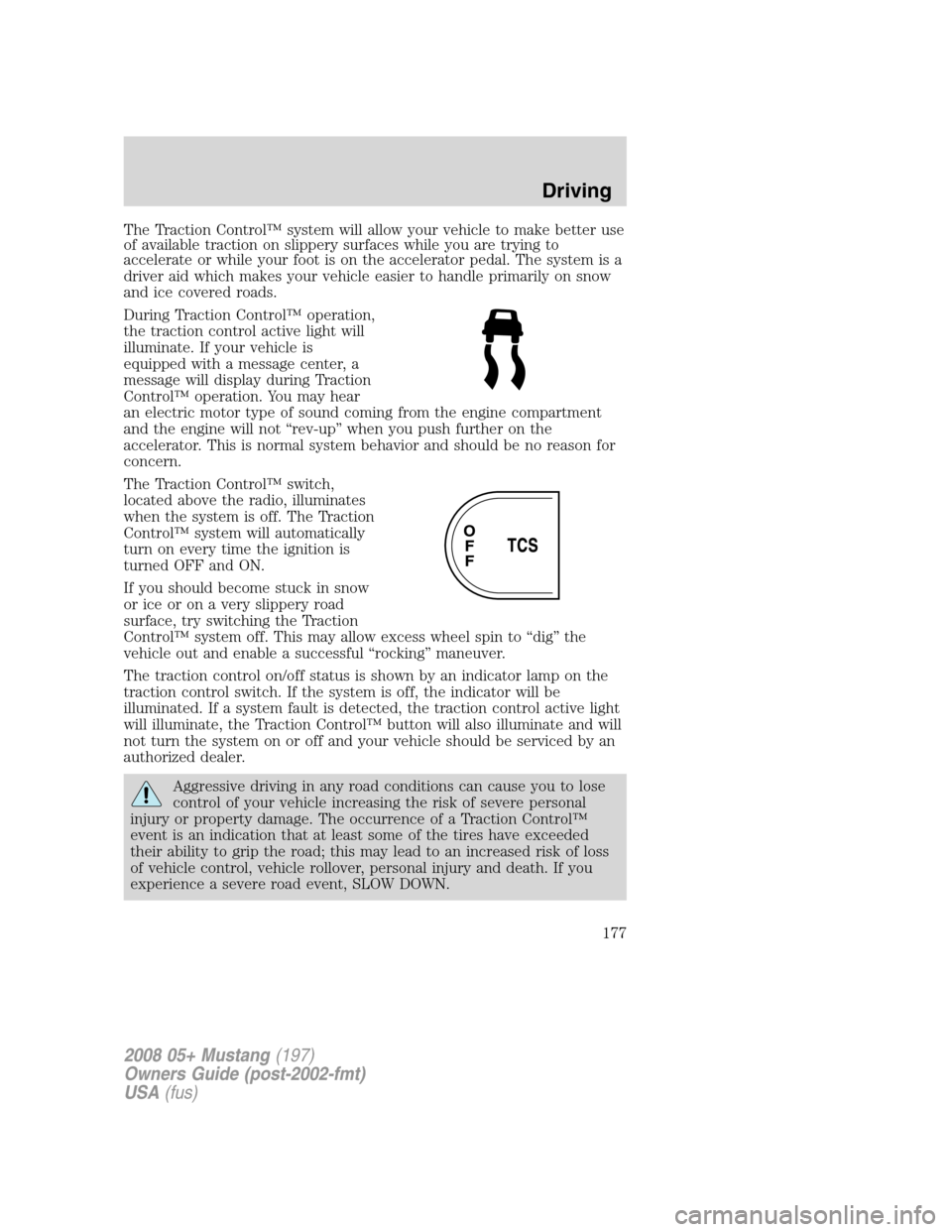
During Traction Control™ operation,
the traction control active light will
illuminate. If your vehicle is
equipped with a message center, a
message will display during Traction
Control™ operation. You may hear
an electric motor type of sound coming from the engine compartment
and the engine will not “rev-up” when you push further on the
accelerator. This is normal system behavior and should be no reason for
concern.
The Traction Control™ switch,
located above the radio, illuminates
when the system is off. The Traction
Control™ system will automatically
turn on every time the ignition is
turned OFF and ON.
If you should become stuck in snow
or ice or on a very slippery road
surface, try switching the Traction
Control™ system off. This may allow excess wheel spin to “dig” the
vehicle out and enable a successful “rocking” maneuver.
The traction control on/off status is shown by an indicator lamp on the
traction control switch. If the system is off, the indicator will be
illuminated. If a system fault is detected, the traction control active light
will illuminate, the Traction Control™ button will also illuminate and will
not turn the system on or off and your vehicle should be serviced by an
authorized dealer.
Aggressive driving in any road conditions can cause you to lose
control of your vehicle increasing the risk of severe personal
injury or property damage. The occurrence of a Traction Control™
event is an indication that at least some of the tires have exceeded
their ability to grip the road; this may lead to an increased risk of loss
of vehicle control, vehicle rollover, personal injury and death. If you
experience a severe road event, SLOW DOWN.
2008 05+ Mustang(197)
Owners Guide (post-2002-fmt)
USA(fus)
Driving
177
Page 178 of 280
STEERING
To help prevent damage to the power steering system:
•Never hold the steering wheel at its furthest turning points (until it
stops) for more than a few seconds when the engine is running.
•Do not operate the vehicle with a low power steering fluid level
(below the MIN mark on the reservoir).
•Some noise is normal during operation. If the noise is excessive, check
for a low power steering fluid level before seeking service by your
authorized dealer.
•Heavy or uneven steering efforts may be caused by a low power
steering fluid level. Check for a low power steering fluid level before
seeking service by your authorized dealer.
•Do not fill the power steering fluid reservoir above the MAX mark on
the reservoir.
If the power steering system breaks down (or if the engine is turned
off), you can steer the vehicle manually, but it takes more effort.
If the steering wanders or pulls, check for:
•an improperly inflated tire
•uneven tire wear
•loose or worn suspension components
•loose or worn steering components
•improper steering alignment
A high crown in the road or high crosswinds may also make the steering
seem to wander/pull.
TRACTION-LOK™ AXLE (IF EQUIPPED)
This axle provides added traction on slippery surfaces, particularly when
one wheel is on a poor traction surface. Under normal conditions, the
Traction-Lok™ axle functions like a standard rear axle.
Extended use of other than the manufacturer’s specified size tires on a
Traction-Lok™ rear axle could result in a permanent reduction in
effectiveness. This loss of effectiveness does not affect normal driving
and should not be noticeable to the driver.
2008 05+ Mustang(197)
Owners Guide (post-2002-fmt)
USA(fus)
Driving
178
Page 180 of 280
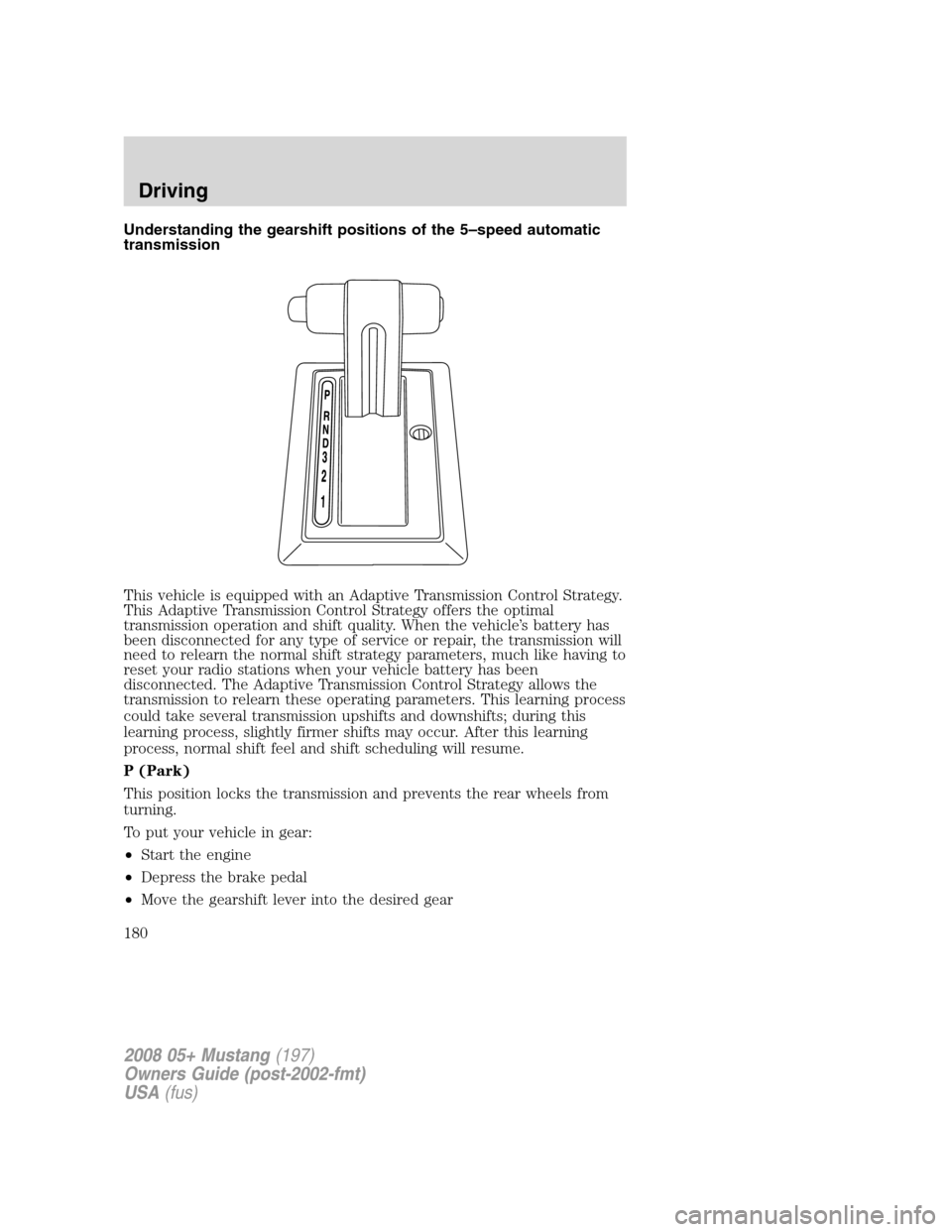
Understanding the gearshift positions of the 5–speed automatic
transmission
This vehicle is equipped with an Adaptive Transmission Control Strategy.
This Adaptive Transmission Control Strategy offers the optimal
transmission operation and shift quality. When the vehicle’s battery has
been disconnected for any type of service or repair, the transmission will
need to relearn the normal shift strategy parameters, much like having to
reset your radio stations when your vehicle battery has been
disconnected. The Adaptive Transmission Control Strategy allows the
transmission to relearn these operating parameters. This learning process
could take several transmission upshifts and downshifts; during this
learning process, slightly firmer shifts may occur. After this learning
process, normal shift feel and shift scheduling will resume.
P (Park)
This position locks the transmission and prevents the rear wheels from
turning.
To put your vehicle in gear:
•Start the engine
•Depress the brake pedal
•Move the gearshift lever into the desired gear
2008 05+ Mustang(197)
Owners Guide (post-2002-fmt)
USA(fus)
Driving
180
Page 181 of 280
To put your vehicle in P (Park):
•Come to a complete stop
•Move the gearshift lever and securely latch it in P (Park)
Always set the parking brake fully and make sure the gearshift is
latched in P (Park). Turn the ignition to the LOCK position and
remove the key whenever you leave your vehicle.
R (Reverse)
With the gearshift lever in R (Reverse), the vehicle will move backward.
Always come to a complete stop before shifting into and out of R (Reverse).
N (Neutral)
With the gearshift lever in N (Neutral), the vehicle can be started and is
free to roll. Hold the brake pedal down while in this position.
D (Drive) with Overdrive
The normal driving position for the best fuel economy. Transmission
operates in gears one through five.
D (Drive) without Overdrive
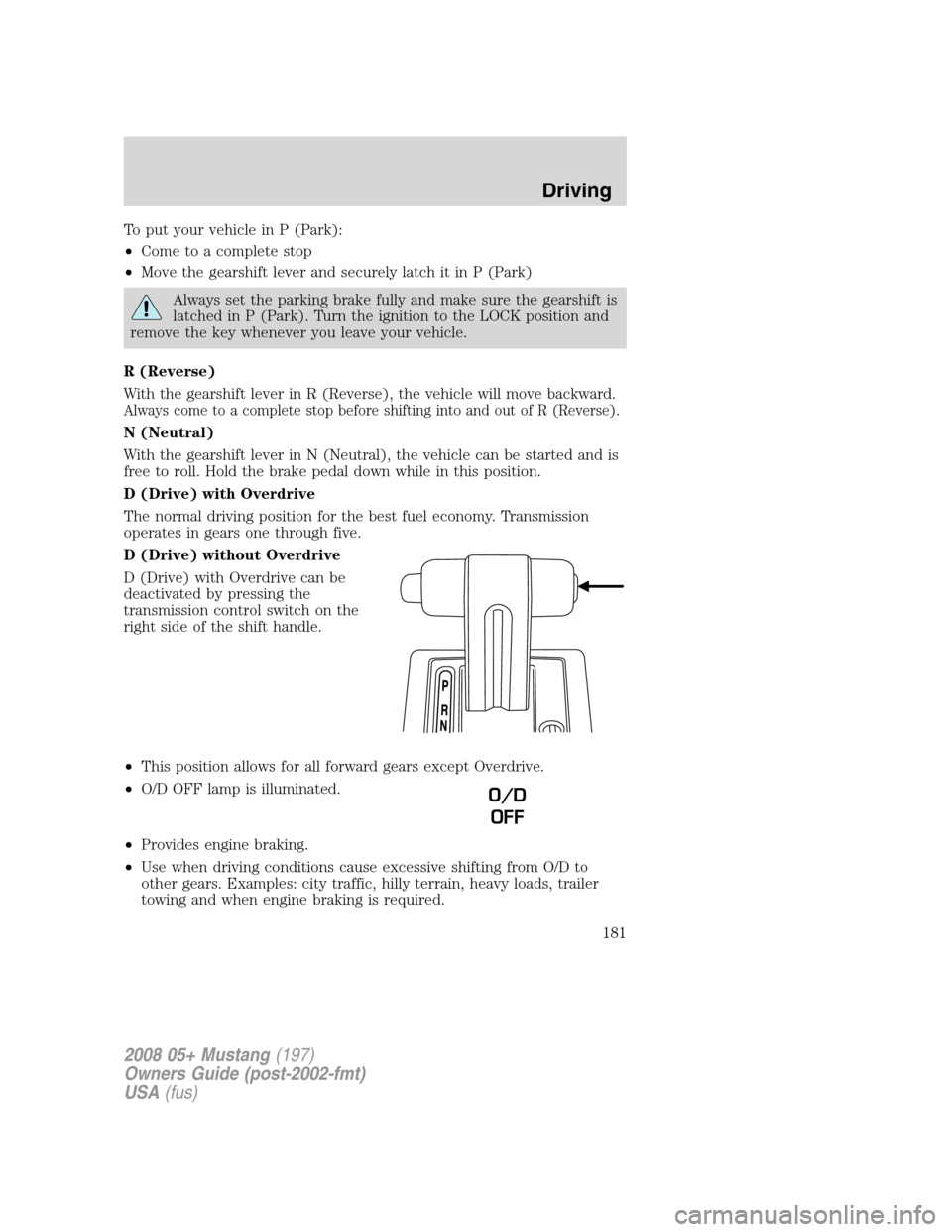
D (Drive) with Overdrive can be
deactivated by pressing the
transmission control switch on the
right side of the shift handle.
•This position allows for all forward gears except Overdrive.
•O/D OFF lamp is illuminated.
•Provides engine braking.
•Use when driving conditions cause excessive shifting from O/D to
other gears. Examples: city traffic, hilly terrain, heavy loads, trailer
towing and when engine braking is required.
O/D
OFF
2008 05+ Mustang(197)
Owners Guide (post-2002-fmt)
USA(fus)
Driving
181
Page 182 of 280
•To return to Overdrive mode, press the transmission control switch.
The O/D OFF lamp will not be illuminated.
•Overdrive mode is automatically returned each time the key is turned
off.
3 (Third)
This position allows for third gear only.
•Provides engine braking.
•To return to D (Drive) without Overdrive, move the transmission shift
lever into the D (Drive) position.
•Selecting 3 (Third) at higher speeds will cause the transmission to
downshift to third gear at the appropriate vehicle speed.
2 (Second)
This position allows for second gear only.
•Provides engine braking.
•Use to start-up on slippery roads.
•To return to D (Drive) without Overdrive or 3 (Third), move the
transmission shift lever into the D (Drive) or 3 (Third) position.
•Selecting 2 (Second) at higher speeds will cause the transmission to
downshift to second gear at the appropriate vehicle speed.
1 (First)
This position allows for first gear only.
•Provides maximum engine braking.
•Will not downshift into first gear at high speeds; will cause the
transmission to downshift to a lower gear, then allows for first gear
when the vehicle reaches slower speeds.
Forced downshifts
•Allowed in Overdrive or Drive.
•Depress the accelerator to the floor.
•Allows transmission to select an appropriate gear.
If your vehicle gets stuck in mud or snow
If your vehicle gets stuck in mud or snow, it may be rocked out by
shifting between forward and reverse gears, stopping between shifts in a
steady pattern. Press lightly on the accelerator in each gear.
Do not rock the vehicle if the engine is not at normal operating
temperature or damage to the transmission may occur.
2008 05+ Mustang(197)
Owners Guide (post-2002-fmt)
USA(fus)
Driving
182
Page 183 of 280
Do not rock the vehicle for more than a minute or damage to the
transmission and tires may occur, or the engine may overheat.
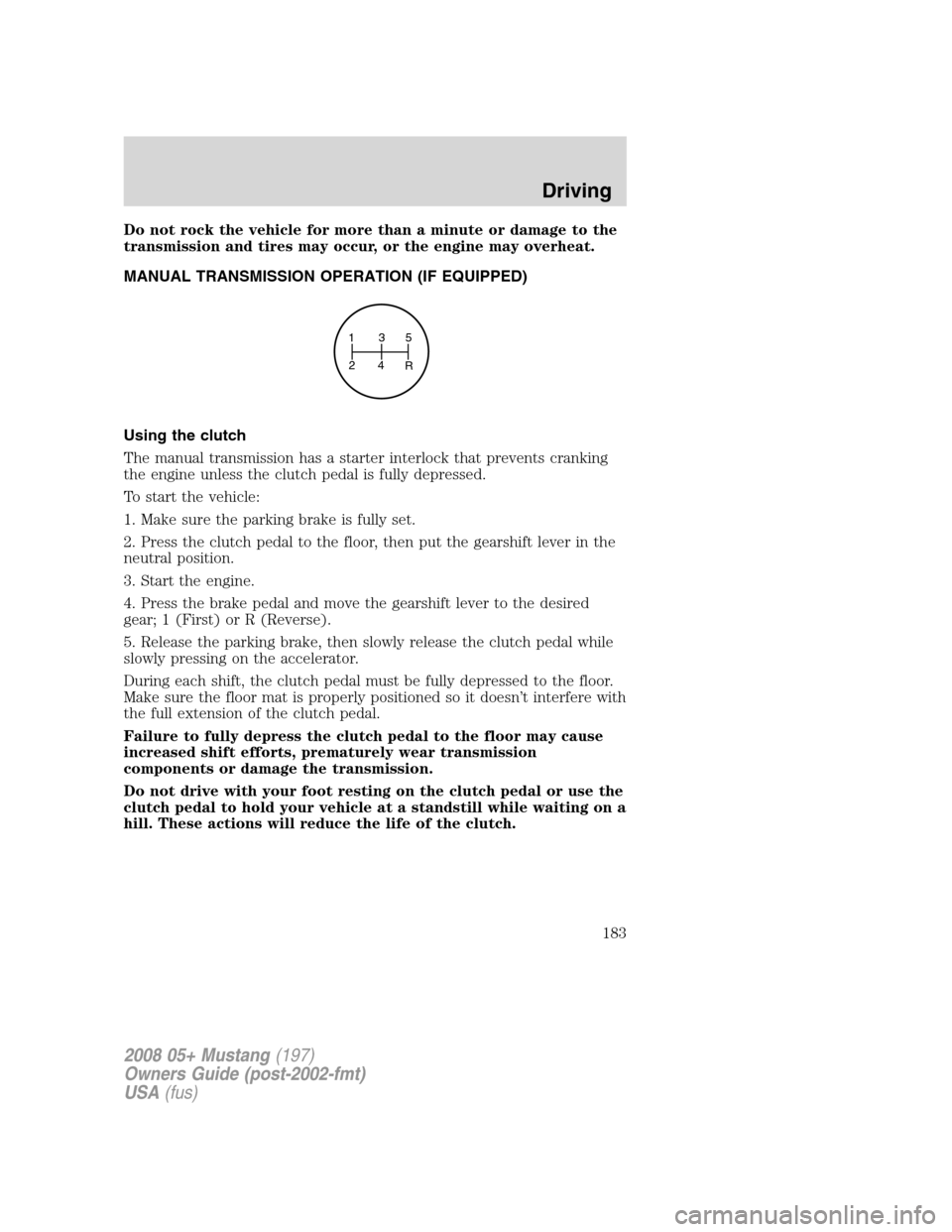
MANUAL TRANSMISSION OPERATION (IF EQUIPPED)
Using the clutch
The manual transmission has a starter interlock that prevents cranking
the engine unless the clutch pedal is fully depressed.
To start the vehicle:
1. Make sure the parking brake is fully set.
2. Press the clutch pedal to the floor, then put the gearshift lever in the
neutral position.
3. Start the engine.
4. Press the brake pedal and move the gearshift lever to the desired
gear; 1 (First) or R (Reverse).
5. Release the parking brake, then slowly release the clutch pedal while
slowly pressing on the accelerator.
During each shift, the clutch pedal must be fully depressed to the floor.
Make sure the floor mat is properly positioned so it doesn’t interfere with
the full extension of the clutch pedal.
Failure to fully depress the clutch pedal to the floor may cause
increased shift efforts, prematurely wear transmission
components or damage the transmission.
Do not drive with your foot resting on the clutch pedal or use the
clutch pedal to hold your vehicle at a standstill while waiting on a
hill. These actions will reduce the life of the clutch.
135
24
R
2008 05+ Mustang(197)
Owners Guide (post-2002-fmt)
USA(fus)
Driving
183
Page 185 of 280
DRIVING THROUGH WATER
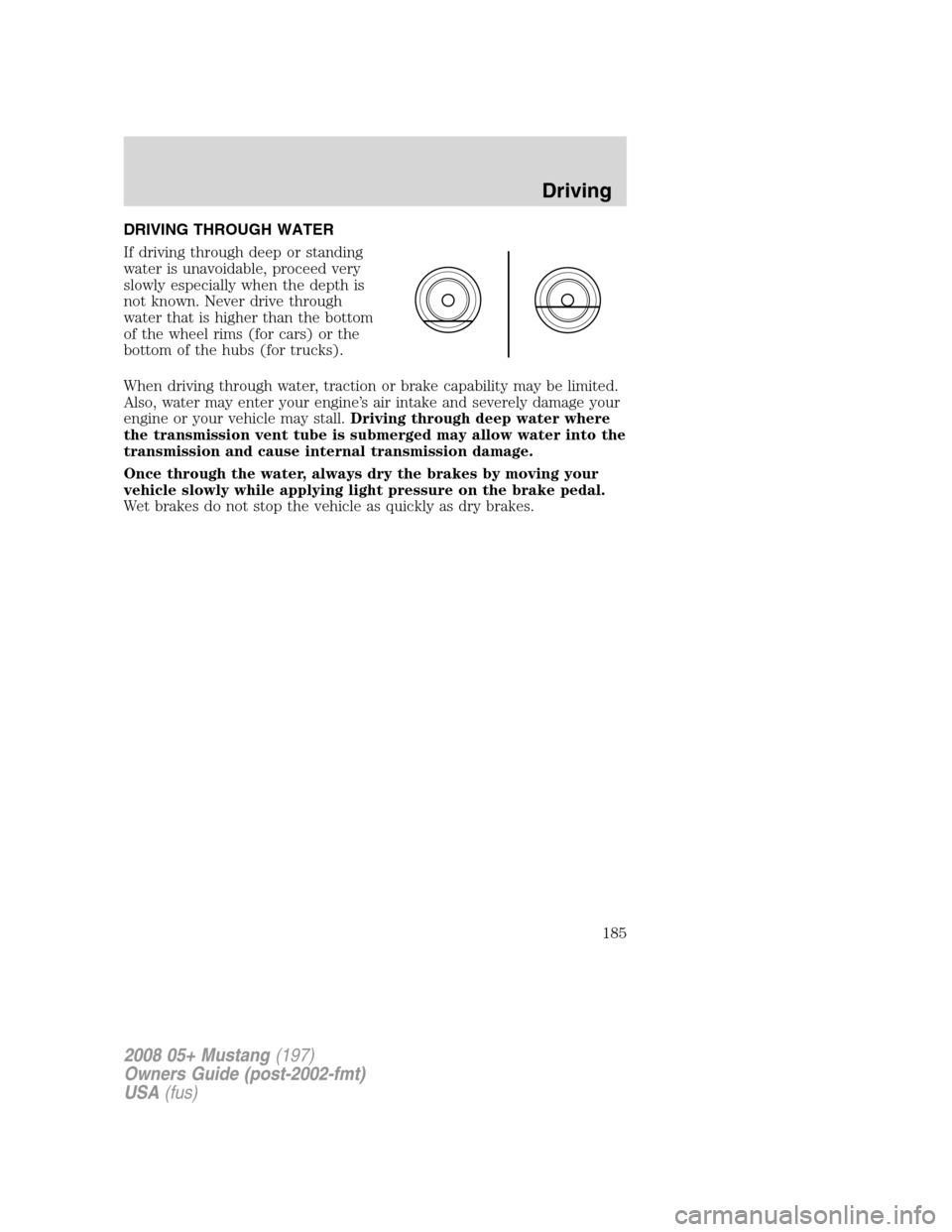
If driving through deep or standing
water is unavoidable, proceed very
slowly especially when the depth is
not known. Never drive through
water that is higher than the bottom
of the wheel rims (for cars) or the
bottom of the hubs (for trucks).
When driving through water, traction or brake capability may be limited.
Also, water may enter your engine’s air intake and severely damage your
engine or your vehicle may stall.Driving through deep water where
the transmission vent tube is submerged may allow water into the
transmission and cause internal transmission damage.
Once through the water, always dry the brakes by moving your
vehicle slowly while applying light pressure on the brake pedal.
Wet brakes do not stop the vehicle as quickly as dry brakes.
2008 05+ Mustang(197)
Owners Guide (post-2002-fmt)
USA(fus)
Driving
185
Page 188 of 280
HAZARD FLASHER CONTROL
The hazard flasher is located on the
instrument panel by the radio. The
hazard flashers will operate when
the ignition is in any position or if
the key is not in the ignition.
Push in the flasher control and all
front and rear direction signals will flash. Press the flasher control again
to turn them off. Use it when your vehicle is disabled and is creating a
safety hazard for other motorists.
Note:With extended use, the flasher may run down your battery.
FUEL PUMP SHUT-OFF SWITCH
FUEL
RESET
This device stops the electric fuel pump from sending fuel to the engine
when your vehicle has had a substantial jolt.
After an accident, if the engine cranks but does not start, this switch
may have been activated.
The fuel pump shut-off switch is
located in the driver’s footwell, by
the hood release
To reset the switch:
1. Turn the ignition OFF.
2. Check the fuel system for leaks.
3. If no leaks are apparent, reset the
switch by pushing in on the reset
button.
4. Turn the ignition ON.
5. Wait a few seconds and return the key to OFF.
6. Make another check for leaks.
2008 05+ Mustang(197)
Owners Guide (post-2002-fmt)
USA(fus)
Roadside Emergencies
188
Page 191 of 280
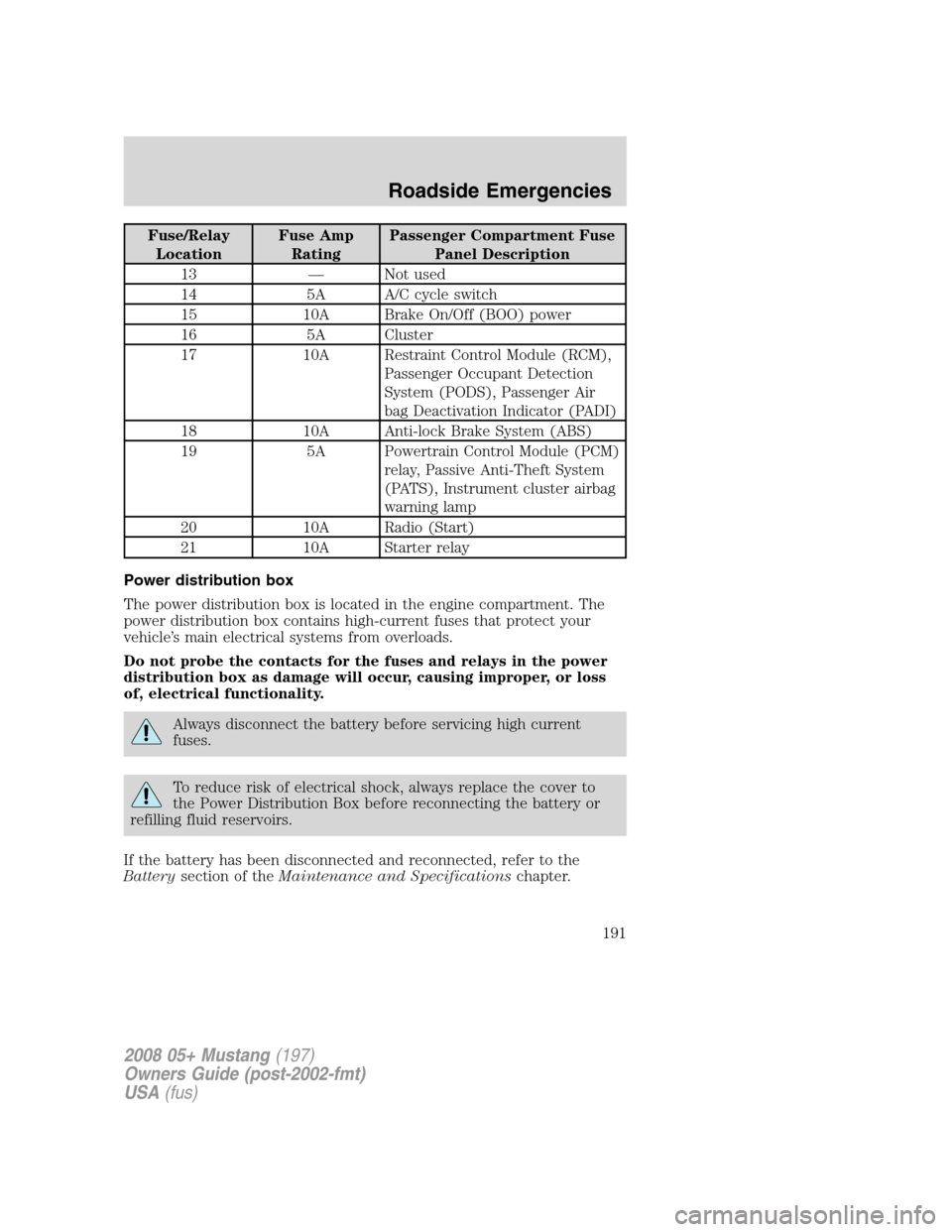
Fuse/Relay
LocationFuse Amp
RatingPassenger Compartment Fuse
Panel Description
13 — Not used
14 5A A/C cycle switch
15 10A Brake On/Off (BOO) power
16 5A Cluster
17 10A Restraint Control Module (RCM),
Passenger Occupant Detection
System (PODS), Passenger Air
bag Deactivation Indicator (PADI)
18 10A Anti-lock Brake System (ABS)
19 5A Powertrain Control Module (PCM)
relay, Passive Anti-Theft System
(PATS), Instrument cluster airbag
warning lamp
20 10A Radio (Start)
21 10A Starter relay
Power distribution box
The power distribution box is located in the engine compartment. The
power distribution box contains high-current fuses that protect your
vehicle’s main electrical systems from overloads.
Do not probe the contacts for the fuses and relays in the power
distribution box as damage will occur, causing improper, or loss
of, electrical functionality.
Always disconnect the battery before servicing high current
fuses.
To reduce risk of electrical shock, always replace the cover to
the Power Distribution Box before reconnecting the battery or
refilling fluid reservoirs.
If the battery has been disconnected and reconnected, refer to the
Batterysection of theMaintenance and Specificationschapter.
2008 05+ Mustang(197)
Owners Guide (post-2002-fmt)
USA(fus)
Roadside Emergencies
191
Page 193 of 280
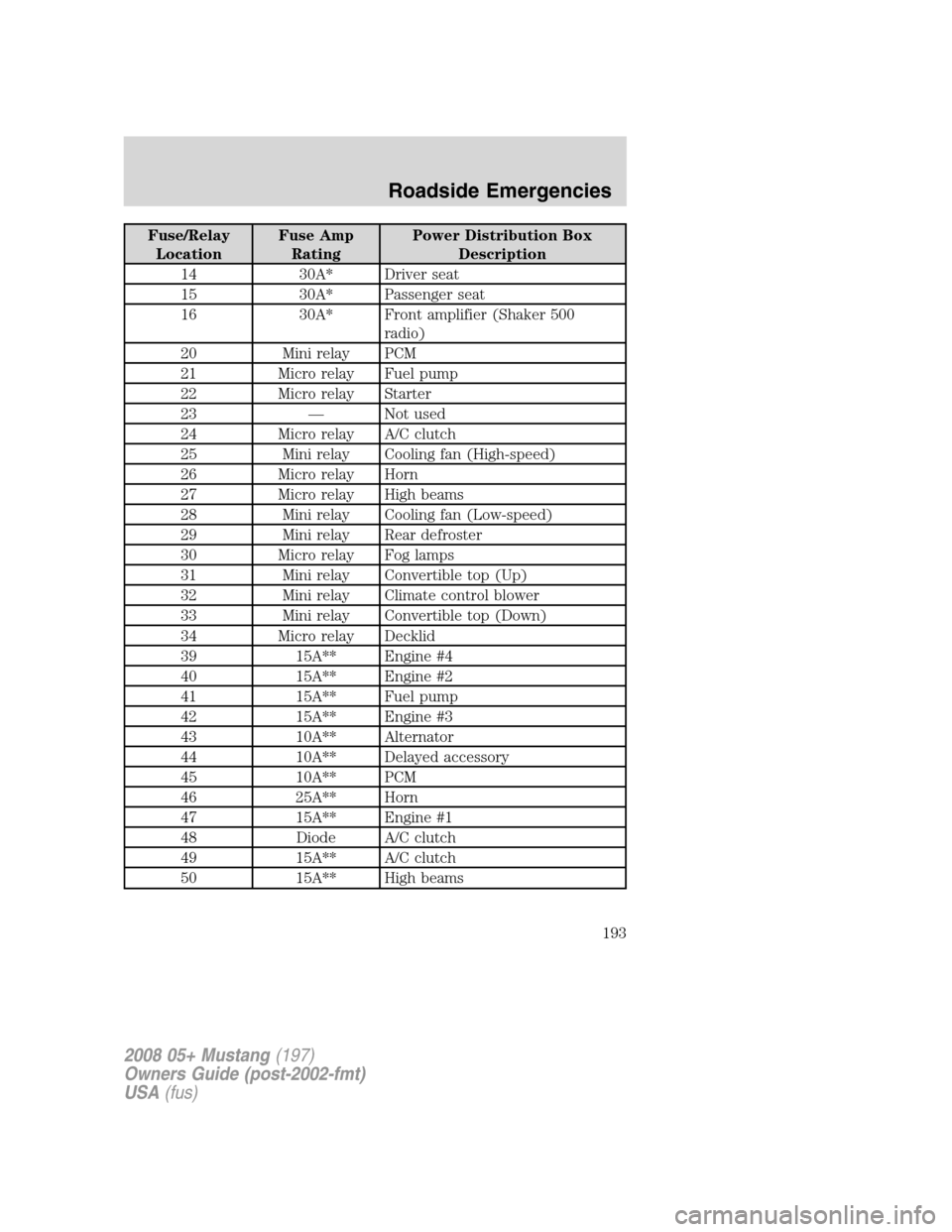
Fuse/Relay
LocationFuse Amp
RatingPower Distribution Box
Description
14 30A* Driver seat
15 30A* Passenger seat
16 30A* Front amplifier (Shaker 500
radio)
20 Mini relay PCM
21 Micro relay Fuel pump
22 Micro relay Starter
23 — Not used
24 Micro relay A/C clutch
25 Mini relay Cooling fan (High-speed)
26 Micro relay Horn
27 Micro relay High beams
28 Mini relay Cooling fan (Low-speed)
29 Mini relay Rear defroster
30 Micro relay Fog lamps
31 Mini relay Convertible top (Up)
32 Mini relay Climate control blower
33 Mini relay Convertible top (Down)
34 Micro relay Decklid
39 15A** Engine #4
40 15A** Engine #2
41 15A** Fuel pump
42 15A** Engine #3
43 10A** Alternator
44 10A** Delayed accessory
45 10A** PCM
46 25A** Horn
47 15A** Engine #1
48 Diode A/C clutch
49 15A** A/C clutch
50 15A** High beams
2008 05+ Mustang(197)
Owners Guide (post-2002-fmt)
USA(fus)
Roadside Emergencies
193