cooling FORD MUSTANG 2012 5.G User Guide
[x] Cancel search | Manufacturer: FORD, Model Year: 2012, Model line: MUSTANG, Model: FORD MUSTANG 2012 5.GPages: 346, PDF Size: 2.43 MB
Page 287 of 346
WARNING:Do not add engine coolant when the engine is hot.
Steam and scalding liquids released from a hot cooling system
can burn you badly. Also, you can be burned if you spill coolant on hot
engine parts.
WARNING:Do not put engine coolant in the windshield washer
fluid container. If sprayed on the windshield, engine coolant
could make it difficult to see through the windshield.
•DO NOT MIXdifferent colors or types of coolant in your vehicle.
Make sure the correct coolant is used.DO NOT MIXrecycled coolant
and new (unused) coolant together in the vehicle. Mixing of engine
coolants may harm your engine’s cooling system. The use of an
improper coolant may harm engine and cooling system components
and may void the warranty. Refer toMaintenance product
specifications and capacitiesin this chapter.
Note:Do not use stop leak pellets or cooling system sealants/additives
as they can cause damage to the engine cooling and/or heating systems.
This damage would not be covered under your vehicle’s warranty.
•A large amount of water without engine coolant may be added, in case
of emergency, to reach a vehicle service location. In this instance, the
cooling system must be drained and refilled with a 50/50 mixture of
engine coolant and distilled water as soon as possible. Water alone
(without engine coolant) can cause engine damage from corrosion,
overheating or freezing.
•Do not use alcohol, methanol, brine or any engine coolants
mixed with alcohol or methanol antifreeze (coolant).Alcohol
and other liquids can cause engine damage from overheating or
freezing.
•Do not add extra inhibitors or additives to the coolant.These
can be harmful and compromise the corrosion protection of the engine
coolant.
For vehicles with overflow coolant systems with a non-pressurized cap
on the coolant recovery system, add coolant to the coolant recovery
reservoir when the engine is cool. Add the proper mixture of coolant and
distilled water to the FULL COLD level. For all other vehicles which have
a coolant degas system with a pressurized cap, or if it is necessary to
remove the coolant pressure relief cap on the radiator of a vehicle with
an overflow system, follow these steps to add engine coolant.
Maintenance and Specifications
287
2012 05+ Mustang(197)
Owners Guide, 1st Printing
USA(fus)
Page 288 of 346
WARNING:To reduce the risk of personal injury, make sure the
engine is cool before unscrewing the coolant pressure relief cap.
The cooling system is under pressure; steam and hot liquid can come
out forcefully when the cap is loosened slightly.
Add the proper mixture of coolant and water to the cooling system by
following these steps:
1. Before you begin, turn the engine off and let it cool.
2. When the engine is cool, wrap a thick cloth around the coolant
pressure relief cap on the coolant reservoir (a translucent plastic bottle).
Slowly turn cap counterclockwise (left) until pressure begins to release.
3. Step back while the pressure releases.
4. When you are sure that all the pressure has been released, use the
cloth to turn it counterclockwise and remove the cap.
5. Fill the coolant reservoir slowly with the proper coolant mixture, to
within the COLD FILL RANGE or the FULL COLD level on the reservoir.
If you removed the radiator cap in an overflow system, fill the radiator
until the coolant is visible and radiator is almost full.
6. Replace the cap. Turn until tightly installed. Cap must be tightly
installed to prevent coolant loss.
After any coolant has been added, check the coolant concentration (refer
toChecking engine coolant). If the concentration is not 50/50, drain
some coolant and adjust the concentration. It may take several drains
and additions to obtain a 50/50 coolant concentration.
Whenever coolant has been added, the coolant level in the coolant
reservoir should be checked the next few times you drive the vehicle. If
necessary, add enough 50/50 concentration of engine coolant and
distilled water to bring the liquid level to the proper level.
If you have to add more than 1.0 quart (1.0 liter) of engine coolant per
month, have your authorized dealer check the engine cooling system.
Your cooling system may have a leak. Operating an engine with a low
level of coolant can result in engine overheating and possible engine
damage.
Recycled engine coolant
Ford Motor Company does NOT recommend the use of recycled engine
coolant since a Ford-approved recycling process is not yet available.
Maintenance and Specifications
288
2012 05+ Mustang(197)
Owners Guide, 1st Printing
USA(fus)
Page 289 of 346
Used engine coolant should be disposed of in an appropriate
manner. Follow your community’s regulations and standards for recycling
and disposing of automotive fluids.
Coolant refill capacity
To find out how much fluid your vehicle’s cooling system can hold, refer
toMaintenance product specifications and capacitiesin this chapter.
Fill your engine coolant reservoir as outlined inAdding engine coolant
in this section.
Severe climates
If you drive in extremely cold climates:
•It may be necessary to increase the coolant concentration
above 50%.
•NEVER increase the coolant concentration above 60%.
•A coolant concentration of 60% will provide improved freeze
point protection. Increased engine coolant concentrations
above 60% will decrease the overheat protection
characteristics of the engine coolant and may cause engine
damage.
•If available, refer to the chart on the coolant container to
ensure the coolant concentration in your vehicle will provide
adequate freeze protection at the temperatures in which you
drive in the winter months.
If you drive in extremely hot climates:
•It is still necessary to maintain the coolant concentration
above 40%.
•NEVER decrease the coolant concentration below 40%.
•Decreased engine coolant concentrations below 40% will
decrease the corrosion/freeze protection characteristics of the
engine coolant and may cause engine damage.
•If available, refer to the chart on the coolant container to
ensure the coolant concentration in your vehicle will provide
adequate protection at the temperatures in which you drive.
Vehicles driven year-round in non-extreme climates should use a 50/50
mixture of engine coolant and distilled water for optimum cooling system
and engine protection.
Maintenance and Specifications
289
2012 05+ Mustang(197)
Owners Guide, 1st Printing
USA(fus)
Page 290 of 346
What you should know about fail-safe cooling
If the engine coolant supply is depleted, this feature allows the vehicle to
be driven temporarily before incremental component damage is incurred.
The “fail-safe” distance depends on ambient temperatures, vehicle load
and terrain.
How fail-safe cooling works
If the engine begins to overheat:
•The engine coolant temperature gauge
will move to the red (hot)
area.
•The engine coolant temperature indicator will illuminate.
•The service engine soon indicator light will illuminate.
If the engine reaches a preset over-temperature condition, the engine
will automatically switch to alternating cylinder operation. Each disabled
cylinder acts as an air pump and cools the engine.
When this occurs the vehicle will still operate. However:
•The engine power will be limited.
•The air conditioning system will be disabled.
Continued operation will increase the engine temperature:
•The engine will completely shut down.
•Steering and braking effort will increase.
Once the engine temperature cools, the engine can be re-started. Take
your vehicle to an authorized dealer as soon as possible to minimize
engine damage.
When fail-safe mode is activated
You have limited engine power when in the fail-safe mode, so drive the
vehicle with caution. The vehicle will not be able to maintain high speed
operation and the engine will run rough. Remember that the engine is
capable of completely shutting down automatically to prevent engine
damage, therefore:
1. Pull off the road as soon as safely possible and turn off the engine.
2. Arrange for the vehicle to be taken to an authorized dealer.
3. If this is not possible, wait a short period for the engine to cool.
4. Check the coolant level and replenish if low.
Maintenance and Specifications
290
2012 05+ Mustang(197)
Owners Guide, 1st Printing
USA(fus)
Page 307 of 346
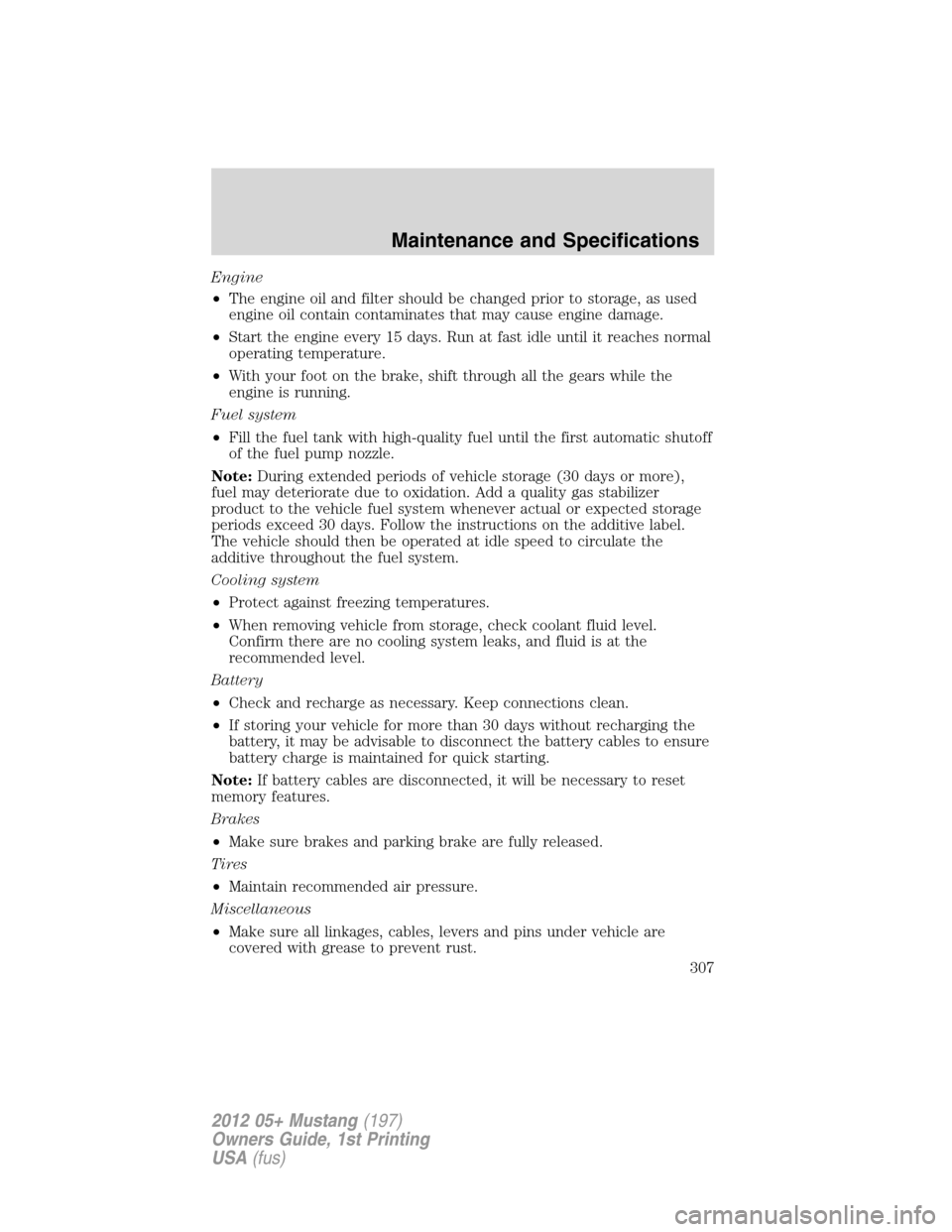
Engine
•The engine oil and filter should be changed prior to storage, as used
engine oil contain contaminates that may cause engine damage.
•Start the engine every 15 days. Run at fast idle until it reaches normal
operating temperature.
•With your foot on the brake, shift through all the gears while the
engine is running.
Fuel system
•Fill the fuel tank with high-quality fuel until the first automatic shutoff
of the fuel pump nozzle.
Note:During extended periods of vehicle storage (30 days or more),
fuel may deteriorate due to oxidation. Add a quality gas stabilizer
product to the vehicle fuel system whenever actual or expected storage
periods exceed 30 days. Follow the instructions on the additive label.
The vehicle should then be operated at idle speed to circulate the
additive throughout the fuel system.
Cooling system
•Protect against freezing temperatures.
•When removing vehicle from storage, check coolant fluid level.
Confirm there are no cooling system leaks, and fluid is at the
recommended level.
Battery
•Check and recharge as necessary. Keep connections clean.
•If storing your vehicle for more than 30 days without recharging the
battery, it may be advisable to disconnect the battery cables to ensure
battery charge is maintained for quick starting.
Note:If battery cables are disconnected, it will be necessary to reset
memory features.
Brakes
•Make sure brakes and parking brake are fully released.
Tires
•Maintain recommended air pressure.
Miscellaneous
•Make sure all linkages, cables, levers and pins under vehicle are
covered with grease to prevent rust.
Maintenance and Specifications
307
2012 05+ Mustang(197)
Owners Guide, 1st Printing
USA(fus)
Page 325 of 346
![FORD MUSTANG 2012 5.G User Guide Engine oil/coolant change intervals*
Engine oil (3.7L/5.0L)As indicated by the message center (can be
up to one year or 10,000 miles [16,000 km])
Engine coolant, initial
change (3.7L/5.0L)6 years or 1](/img/11/5236/w960_5236-324.png "FORD MUSTANG 2012 5.G User Guide Engine oil/coolant change intervals*
Engine oil (3.7L/5.0L)As indicated by the message center (can be
up to one year or 10,000 miles [16,000 km])
Engine coolant, initial
change (3.7L/5.0L)6 years or 1")
Engine oil/coolant change intervals*
Engine oil (3.7L/5.0L)As indicated by the message center (can be
up to one year or 10,000 miles [16,000 km])
Engine coolant, initial
change (3.7L/5.0L)6 years or 100,000 miles (160,000 km)
(whichever comes first)
Engine coolant, after
initial change
(3.7L/5.0L)Every 3 years or 50,000 miles (80,000 km)
*Owners of Shelby GT500 vehicles need to refer to theShelby GT500
supplement for engine oil/coolant change schedules.
Check every month
Engine oil level
Function of all interior and exterior lights
Tires for wear and proper pressure, including spare
Windshield washer fluid level
Check every six months
Battery connections; clean if necessary
Body and door drain holes for obstructions; clean if necessary
Cooling system fluid level and coolant strength
Door weatherstrips for wear; lubricate if necessary
Hinges/latches/outside locks for proper operation; lubricate if necessary
Parking brake for proper operation
Safety belts and seat latches for wear and function
Safety warning lamps (brake, ABS, airbag, safety belt) for operation
Washer spray/wiper operation; clean or replace blades as necessary
Scheduled Maintenance
325
2012 05+ Mustang(197)
Owners Guide, 1st Printing
USA(fus)
Page 329 of 346
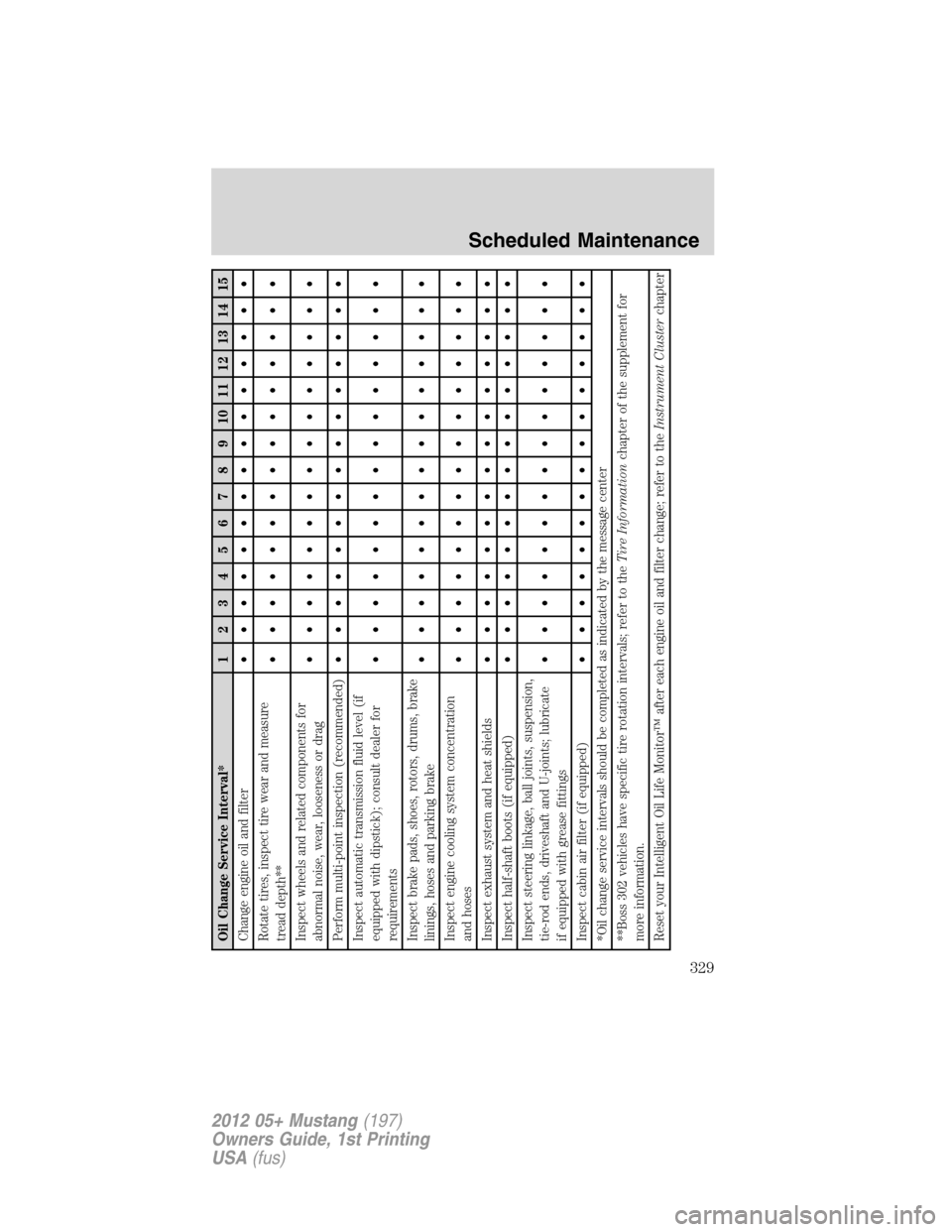
Oil Change Service Interval* 123456789101112131415
Change engine oil and filter• ••••••••••••••
Rotate tires, inspect tire wear and measure
tread depth**• ••••••••••••••
Inspect wheels and related components for
abnormal noise, wear, looseness or drag• ••••••••••••••
Perform multi-point inspection (recommended)• ••••••••••••••
Inspect automatic transmission fluid level (if
equipped with dipstick); consult dealer for
requirements• ••••••••••••••
Inspect brake pads, shoes, rotors, drums, brake
linings, hoses and parking brake• ••••••••••••••
Inspect engine cooling system concentration
and hoses• ••••••••••••••
Inspect exhaust system and heat shields• ••••••••••••••
Inspect half-shaft boots (if equipped)• ••••••••••••••
Inspect steering linkage, ball joints, suspension,
tie-rod ends, driveshaft and U-joints; lubricate
if equipped with grease fittings• ••••••••••••••
Inspect cabin air filter (if equipped)• ••••••••••••••
*Oil change service intervals should be completed as indicated by the message center
**Boss 302 vehicles have specific tire rotation intervals; refer to theTire Informationchapter of the supplement for
more information.
Reset your Intelligent Oil Life Monitor™ after each engine oil and filter change; refer to theInstrument Clusterchapter
Scheduled Maintenance
329
2012 05+ Mustang(197)
Owners Guide, 1st Printing
USA(fus)
Page 343 of 346
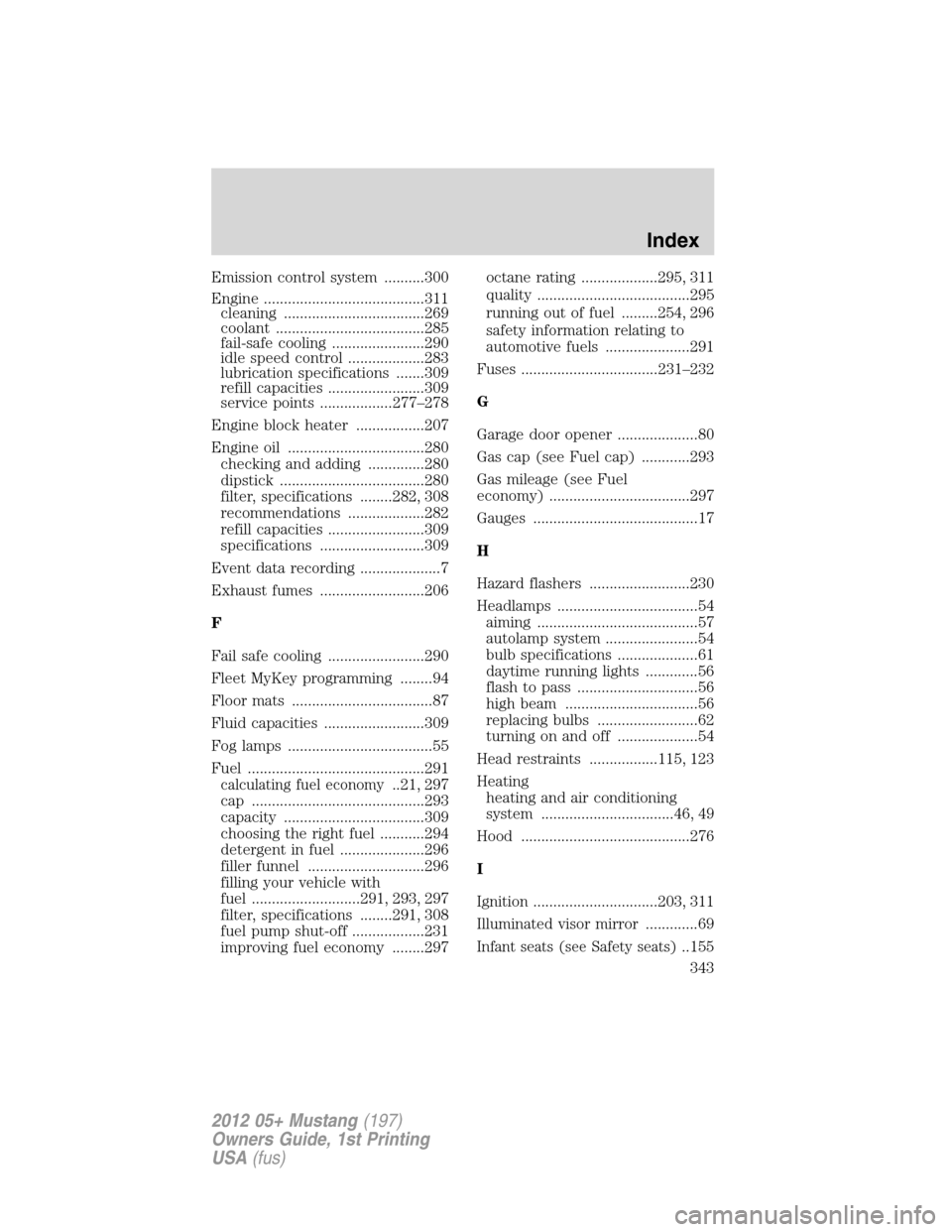
Emission control system ..........300
Engine ........................................311
cleaning ...................................269
coolant .....................................285
fail-safe cooling .......................290
idle speed control ...................283
lubrication specifications .......309
refill capacities ........................309
service points ..................277–278
Engine block heater .................207
Engine oil ..................................280
checking and adding ..............280
dipstick ....................................280
filter, specifications ........282, 308
recommendations ...................282
refill capacities ........................309
specifications ..........................309
Event data recording ....................7
Exhaust fumes ..........................206
F
Fail safe cooling ........................290
Fleet MyKey programming ........94
Floor mats ...................................87
Fluid capacities .........................309
Fog lamps ....................................55
Fuel ............................................291
calculating fuel economy..21, 297
cap ...........................................293
capacity ...................................309
choosing the right fuel ...........294
detergent in fuel .....................296
filler funnel .............................296
filling your vehicle with
fuel ...........................291, 293, 297
filter, specifications ........291, 308
fuel pump shut-off ..................231
improving fuel economy ........297octane rating ...................295, 311
quality ......................................295
running out of fuel .........254, 296
safety information relating to
automotive fuels .....................291
Fuses ..................................231–232
G
Garage door opener ....................80
Gas cap (see Fuel cap) ............293
Gas mileage (see Fuel
economy) ...................................297
Gauges .........................................17
H
Hazard flashers .........................230
Headlamps ...................................54
aiming ........................................57
autolamp system .......................54
bulb specifications ....................61
daytime running lights .............56
flash to pass ..............................56
high beam .................................56
replacing bulbs .........................62
turning on and off ....................54
Head restraints .................115, 123
Heating
heating and air conditioning
system .................................46, 49
Hood ..........................................276
I
Ignition ...............................203, 311
Illuminated visor mirror .............69
Infant seats (see Safety seats)..155
Index
343
2012 05+ Mustang(197)
Owners Guide, 1st Printing
USA(fus)