brakes FORD MUSTANG 2014 5.G Owners Manual
[x] Cancel search | Manufacturer: FORD, Model Year: 2014, Model line: MUSTANG, Model: FORD MUSTANG 2014 5.GPages: 461, PDF Size: 5.47 MB
Page 5 of 461
Storage Compartments 153
Center console.......................................153
Starting and Stopping the Engine 154
Ignition switch.......................................155
Engine block heater...................................157
Fuel and Refueling 159
Fuel quality.........................................160
Running out of fuel....................................161
Refueling...........................................163
Fuel consumption.....................................164
Transmission 169
Transmission operation.................................169
Automatic transmission.................................170
Manual transmission...................................173
Hill start assist.......................................176
Brakes 179
Brakes.............................................179
Hints on driving with anti-lock brakes......................180
Parking brake........................................180
Traction Control 181
TractionControl™ ....................................181
Stability Control 182
AdvanceTrac®.......................................183
Parking Aids 185
Sensing system.......................................185
Rear-view camera system...............................187
4Table of Contents
2014 05+ Mustang(197)
Owners Guide gf, 1st Printing, November 2012
USA(fus)
Page 38 of 461
WARNING:The belt and retractor assembly must be replaced if
the safety belt assembly automatic locking retractor feature or
any other safety belt function is not operating properly when checked
by an authorized dealer. Failure to replace the belt and retractor
assembly could increase the risk of injury in crashes.
All safety restraints in the vehicle are combination lap and shoulder
belts. The driver safety belt has the first type of locking mode, and the
front outboard passenger and rear seat safety belts have both types of
locking modes described as follows:
Vehicle Sensitive Mode
This is the normal retractor mode, which allows free shoulder belt length
adjustment to your movements and locking in response to vehicle
movement. For example, if the driver brakes suddenly or turns a corner
sharply, or the vehicle receives an impact of about 5 mph (8 km/h) or
more, the combination safety belts will lock to help reduce forward
movement of the driver and passengers.
In addition, the retractor is designed to lock if the webbing is pulled out
too quickly. If this occurs, let the belt retract slightly and pull webbing
out again in a slow and controlled manner.
Automatic Locking Mode
In this mode, the shoulder belt is automatically pre-locked. The belt will
still retract to remove any slack in the shoulder belt. The automatic
locking mode is not available on the driver safety belt.
When to Use the Automatic Locking Mode
This mode should be used any time a child safety seat, except a booster,
is installed in passenger front or rear seating positions. Children 12 years
old and under should be properly restrained in a rear seating position
whenever possible. See theChild Safetychapter.
Safety Belts37
2014 05+ Mustang(197)
Owners Guide gf, 1st Printing, November 2012
USA(fus)
Page 157 of 461
Note:Do not touch the accelerator pedal.
1. Fully press the brake pedal. If your vehicle is equipped with a manual
transmission, fully press the clutch pedal also.
2. Turn the key to the start position to start the engine. Release the key
when the engine starts.
Note:The engine may continue cranking for up to 15 seconds or until it
starts.
Note:If you cannot start the engine on the first try, wait for a short
period and try again.
If you have difficulty starting the engine when the temperature is below
-13°F (-25°C), press the accelerator pedal slightly and try again.
Failure to Start
If you cannot start the engine after three attempts, wait 10 seconds and
follow this procedure:
1. Fully press the brake pedal. If your vehicle is equipped with a manual
transmission, fully press the clutch pedal also.
2. Fully press the accelerator pedal and hold it there.
3. Start the engine.
Stopping the Engine When Your Vehicle is Stationary
1. Move the transmission selector lever to positionP(automatic
transmission) or1(manual transmission).
2. Turn the key to the off position.
3. Apply the parking brake.
Stopping the Engine When Your Vehicle is Moving
WARNING:When you switch off the engine when your vehicle is
still moving, this results in a loss of brake and steering assistance.
The steering does not lock, but higher effort is required. When you
switch off the ignition, some electrical circuits, warning lamps and
indicators may also be off.
1. Move the transmission selector lever to positionN(automatic
transmission) or neutral (manual transmission) and use the brakes to
bring your vehicle to a safe stop.
2. When your vehicle has stopped, move the transmission selector lever
to positionP(automatic transmission) or1(manual transmission)
and turn the key to the off position.
3. Apply the parking brake.
156Starting and Stopping the Engine
2014 05+ Mustang(197)
Owners Guide gf, 1st Printing, November 2012
USA(fus)
Page 172 of 461
Note:Some models have a blink feature (if equipped). If manually
selecting a gear that is out of the current vehicle speed range, the
vehicle will not make the requested shift and will blink the current gear.
Brake-shift interlock
WARNING:Do not drive your vehicle until you verify that the
brakelamps are working.
WARNING:When doing this procedure, you will be taking the
vehicle out of park which means the vehicle can roll freely. To
avoid unwanted vehicle movement, always fully set the parking brake
prior to doing this procedure. Use wheel chocks if appropriate.
WARNING:If the parking brake is fully released, but the brake
warning lamp remains illuminated, the brakes may not be
working properly. Contact your authorized dealer as soon as possible to
have the system serviced immediately.
This vehicle is equipped with a brake-shift interlock feature that prevents
the gearshift lever from being moved fromP(Park) when the ignition is
in the on position unless the brake pedal is pressed.
If you cannot move the gearshift lever out ofP(Park) with the ignition
on and the brake pedal pressed:
1. Apply the parking brake.
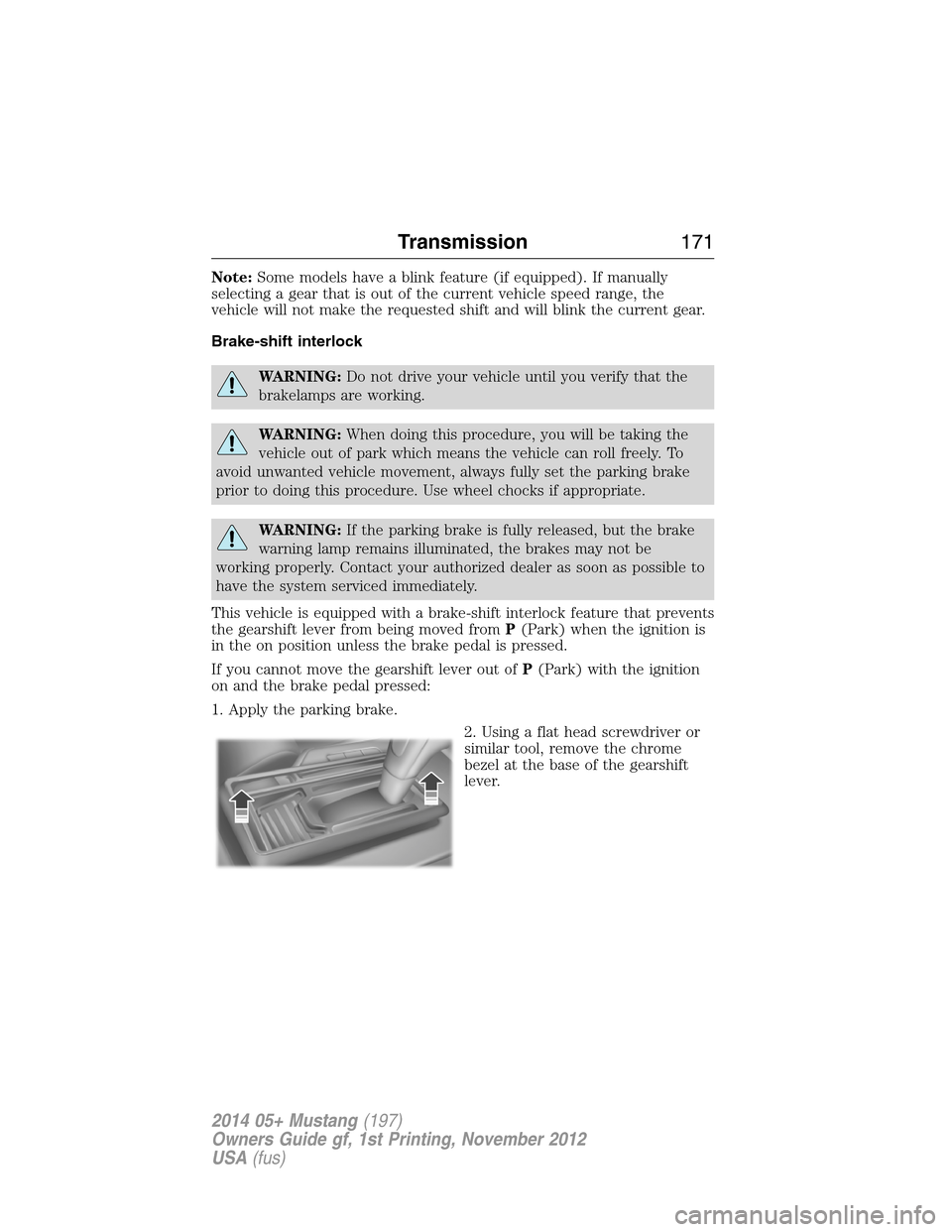
2. Using a flat head screwdriver or
similar tool, remove the chrome
bezel at the base of the gearshift
lever.
Transmission171
2014 05+ Mustang(197)
Owners Guide gf, 1st Printing, November 2012
USA(fus)
Page 173 of 461
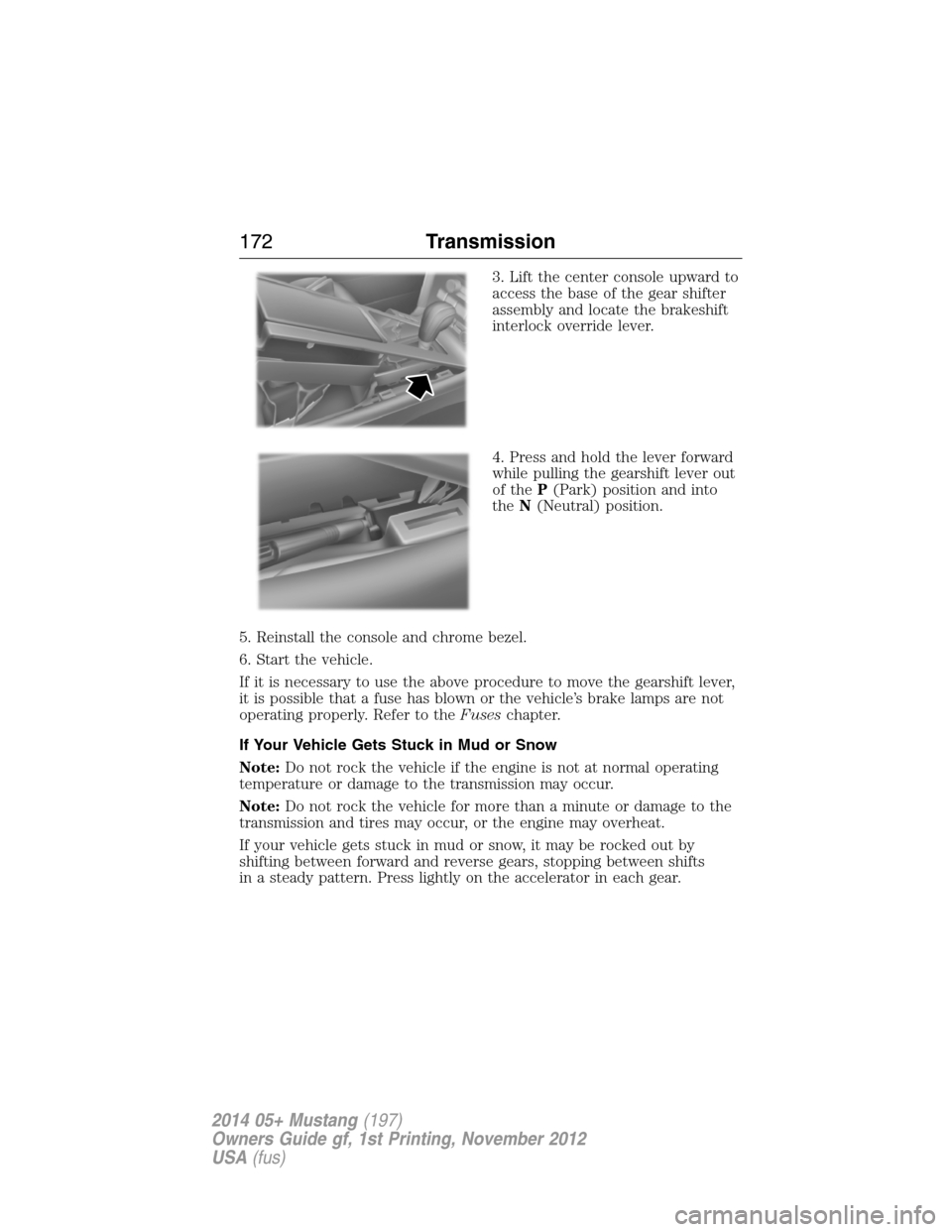
3. Lift the center console upward to
access the base of the gear shifter
assembly and locate the brakeshift
interlock override lever.
4. Press and hold the lever forward
while pulling the gearshift lever out
of theP(Park) position and into
theN(Neutral) position.
5. Reinstall the console and chrome bezel.
6. Start the vehicle.
If it is necessary to use the above procedure to move the gearshift lever,
it is possible that a fuse has blown or the vehicle’s brake lamps are not
operating properly. Refer to theFuseschapter.
If Your Vehicle Gets Stuck in Mud or Snow
Note:Do not rock the vehicle if the engine is not at normal operating
temperature or damage to the transmission may occur.
Note:Do not rock the vehicle for more than a minute or damage to the
transmission and tires may occur, or the engine may overheat.
If your vehicle gets stuck in mud or snow, it may be rocked out by
shifting between forward and reverse gears, stopping between shifts
in a steady pattern. Press lightly on the accelerator in each gear.
172Transmission
2014 05+ Mustang(197)
Owners Guide gf, 1st Printing, November 2012
USA(fus)
Page 178 of 461
This feature makes it easier to pull away when the vehicle is on a slope
without the need to use the parking brake. When this feature is active, the
vehicle will remain stationary on the slope for two to three seconds after
you release the brake pedal. This allows you time to move your foot from
the brake to the accelerator pedal. The brakes are released automatically
once the engine has developed sufficient drive to prevent the vehicle from
rolling down the slope. This is an advantage when pulling away on a slope,
(for example from a car park ramp, traffic lights or when reversing uphill
into a parking space).
This feature is activated automatically on any slope that can result in
significant vehicle rollback. This feature will not operate if the parking
brake is activated.
Using Hill Start Assist
Note:If the engine is revved excessively, hill start assist will be
deactivated.
1. Press the brake pedal to bring the vehicle to a complete standstill.
Keep the brake pedal pressed.
2. If the sensors detect that the vehicle is on a slope, the hill start assist
feature will be activated automatically.
3. When you remove your foot from the brake pedal, the vehicle will
remain on the slope without rolling away for approximately two or
three seconds. This hold time will automatically be extended if you are
in the process of driving off.
4. Drive off in the normal manner. The brakes will be released
automatically.
Disabling and Enabling the Hill Start Assist Feature
Your vehicle comes with hill start assist already enabled. If desired, you
can disable the feature by following the procedure below.
The following procedure must be completed within 45 seconds or the
process will have to be repeated. Begin this procedure with the ignition
turned off. This procedure is for both disabling and enabling the hill start
assist system.
1. Apply the parking brake to make sure the vehicle is not moving.
2. Turn the ignition on.
3. Place the vehicle in neutral gear.
4. Slowly press and release the brake pedal five times – make sure the
brake pedal is completely released each time.
Transmission177
2014 05+ Mustang(197)
Owners Guide gf, 1st Printing, November 2012
USA(fus)
Page 180 of 461
GENERAL INFORMATION
Note:Occasional brake noise is normal. If a metal-to-metal, continuous
grinding or continuous squeal sound is present, the brake linings may
be worn out and should be inspected by an authorized dealer. If your
vehicle has continuous vibration or shudder in the steering wheel while
braking, you should take it to an authorized dealer for inspection.
Note:Brake dust may accumulate on the wheels, even under normal
driving conditions. Some dust is inevitable as the brakes wear and does
not contribute to brake noise. See theVehicle Carechapter for wheel
cleaning instructions.
See theInstrument Clusterchapter for information on the
brake system warning light.
Wet brakes result in reduced braking efficiency. Gently press the brake
pedal a few times when driving from a car wash or standing water to dry
the brakes.
Brake Over Accelerator
If the accelerator pedal becomes stuck or entrapped, apply steady and firm
pressure to the brake pedal to slow your vehicle and reduce engine power.
If you experience this condition, apply the brakes and bring your vehicle to
a safe stop. Turn the engine off, shift to positionPand apply the parking
brake, then inspect the accelerator pedal for any interferences. If none are
found and the condition persists, have your vehicle towed to the nearest
authorized dealer.
Anti-Lock Brake System
This system helps you maintain steering control during emergency stops
by keeping the brakes from locking.
The anti-lock brake system lamp momentarily illuminates when
the ignition is turned on. If the light does not illuminate during
start-up, remains on or flashes, the anti-lock brake system may
be disabled and may need to be serviced.
If the anti-lock brake system is disabled, normal braking is still
effective. If the brake warning lamp illuminates with the parking
brake released, have your brake system serviced immediately.
Brakes179
2014 05+ Mustang(197)
Owners Guide gf, 1st Printing, November 2012
USA(fus)
Page 181 of 461
HINTS ON DRIVING WITH ANTI-LOCK BRAKES
When the system is operating, the brake pedal will pulse and may travel
further. Maintain pressure on the brake pedal. You may also hear a noise
from the system. This is normal.
The anti-lock braking system will not eliminate the dangers inherent
when:
•you drive too closely to the vehicle in front of you.
•your vehicle is hydroplaning.
•you take corners too fast.
•the road surface is poor.
PARKING BRAKE
WARNING:If the parking brake is fully released, but the brake
warning lamp remains illuminated, the brakes may not be
working properly. See your authorized dealer as soon as possible.
WARNING:Always set the parking brake fully and make sure
that the transmission selector lever is securely latched in position
P(automatic transmission) or position1(manual transmission).
To set the parking brake, pull the parking brake handle up as far as
possible.
To release the parking brake:
1. Press and hold the button located at the end of the parking brake
handle.
2. Pull the handle up slightly, then push the handle down.
180Brakes
2014 05+ Mustang(197)
Owners Guide gf, 1st Printing, November 2012
USA(fus)
Page 182 of 461
PRINCIPLES OF OPERATION
The traction control system helps avoid drive wheel spin and loss of
traction.
If your vehicle begins to slide, the system applies the brakes to individual
wheels and, when needed, reduces engine power at the same time. If the
wheels spin when accelerating on slippery or loose surfaces, the system
reduces engine power in order to increase traction.
USING TRACTION CONTROL
In certain situations (for example, stuck in snow or mud),
turning the traction control off may be beneficial as this allows
the wheels to spin with full engine power. Turn the traction
control system off by pressing the stability control button
located on the center console.
System Indicator Lights and Messages
WARNING:If a failure has been detected within the
AdvanceTrac® system, the stability control light and the stability
control off light will illuminate steadily. Verify that the traction control
system was not manually disabled through the information display. If
the stability control light still illuminates steadily, have the system
serviced by an authorized dealer immediately. Operating your vehicle
with AdvanceTrac® disabled could lead to an increased risk of loss of
vehicle control, vehicle rollover, personal injury and death.
The stability control light temporarily illuminates on engine
start-up and flashes when a driving condition activates the
stability system.
The stability control off light temporarily illuminates on engine
start-up and stays on when the system is in sport mode, the
traction control system is turned off, or AdvanceTrac® is
turned off.
When the traction control system is turned off or on, a message appears
in the information display showing system status.
OFF
Traction Control181
2014 05+ Mustang(197)
Owners Guide gf, 1st Printing, November 2012
USA(fus)
Page 184 of 461
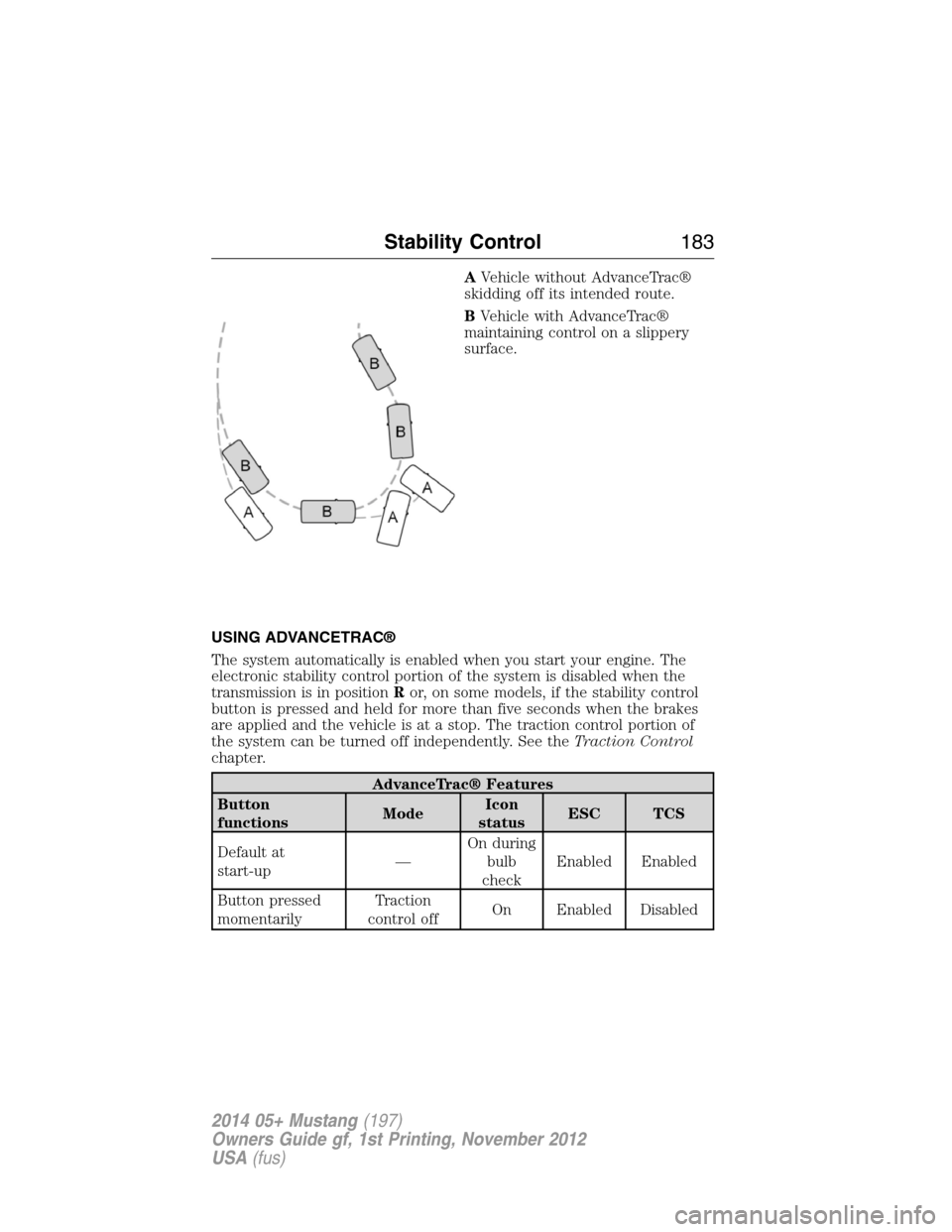
AVehicle without AdvanceTrac®
skidding off its intended route.
BVehicle with AdvanceTrac®
maintaining control on a slippery
surface.
USING ADVANCETRAC®
The system automatically is enabled when you start your engine. The
electronic stability control portion of the system is disabled when the
transmission is in positionRor, on some models, if the stability control
button is pressed and held for more than five seconds when the brakes
are applied and the vehicle is at a stop. The traction control portion of
the system can be turned off independently. See theTraction Control
chapter.
AdvanceTrac® Features
Button
functionsModeIcon
statusESC TCS
Default at
start-up—On during
bulb
checkEnabled Enabled
Button pressed
momentarilyTraction
control offOn Enabled Disabled
Stability Control183
2014 05+ Mustang(197)
Owners Guide gf, 1st Printing, November 2012
USA(fus)