tow FORD MUSTANG 2014 5.G Owners Manual
[x] Cancel search | Manufacturer: FORD, Model Year: 2014, Model line: MUSTANG, Model: FORD MUSTANG 2014 5.GPages: 461, PDF Size: 5.47 MB
Page 6 of 461
Cruise Control 190
Driving Aids 192
Steering............................................192
Load Carrying 194
Vehicle loading.......................................194
Towing 201
Trailertowing........................................201
Wrecker towing......................................205
Recreational towing...................................206
Convertible Top (If Equipped) 207
Driving Hints 212
Economical driving....................................212
Driving through water..................................213
Floormats..........................................214
Roadside Emergencies 216
Getting roadside assistance..............................216
Hazard warning flashers................................217
Fuel cut-off switch....................................218
Jump-starting the vehicle...............................218
Customer Assistance 222
Reporting safety defects (U.S. only).......................229
Reporting safety defects (Canada only).....................229
Fuses 230
Changing a fuse......................................230
Fuse specification chart................................231
Table of Contents5
2014 05+ Mustang(197)
Owners Guide gf, 1st Printing, November 2012
USA(fus)
Page 10 of 461
ABOUT THIS MANUAL
Thank you for choosing Ford. We recommend that you take some time to
get to know your vehicle by reading this manual. The more that you
know about it, the greater the safety and pleasure you will get from
driving it.
WARNING:Always drive with due care and attention when
using and operating the controls and features on your vehicle.
Note:This manual describes a range of product features and options,
sometimes before they are generally available. Therefore, you may find
options in this manual that are not found on your vehicle.
Note:Some of the illustrations in this manual may be used for different
models, so they may appear different than your vehicle. However, the
essential information in the illustrations is always correct.
Note:Always use and operate your vehicle in line with all applicable
laws and regulations.
Note:Pass on this manual when selling your vehicle. It is an integral
part of the vehicle.
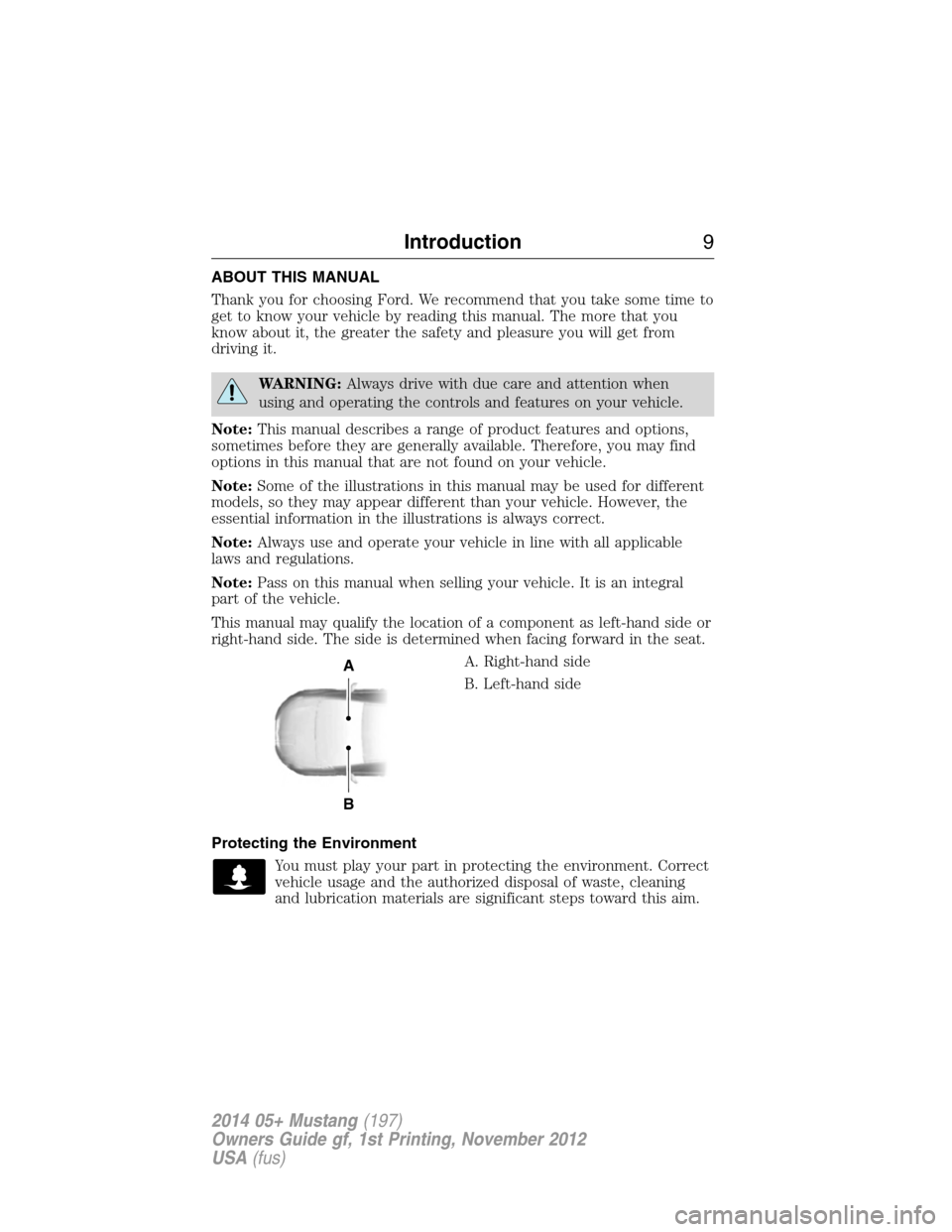
This manual may qualify the location of a component as left-hand side or
right-hand side. The side is determined when facing forward in the seat.
A. Right-hand side
B. Left-hand side
Protecting the Environment
You must play your part in protecting the environment. Correct
vehicle usage and the authorized disposal of waste, cleaning
and lubrication materials are significant steps toward this aim.
A
B
Introduction9
2014 05+ Mustang(197)
Owners Guide gf, 1st Printing, November 2012
USA(fus)
Page 20 of 461
CHILD SEAT POSITIONING
WARNING:Airbags can kill or injure a child in a child seat.
Never place a rear-facing child seat in front of an active airbag. If
you must use a forward-facing child seat in the front seat, move the
vehicle seat upon which the child seat is installed all the way back.
When possible, all children age 12 and under should be properly
restrained in a rear seating position. If all children cannot be seated and
restrained properly in a rear seating position, properly restrain the
largest child in the front seat.
WARNING:Always carefully follow the instructions and
warnings provided by the manufacturer of any child restraint to
determine if the restraint device is appropriate for your child’s size,
height, weight, or age. Follow the child restraint manufacturer’s
instructions and warnings provided for installation and use in
conjunction with the instructions and warnings provided by your
vehicle manufacturer. A safety seat that is improperly installed or
utilized, is inappropriate for your child’s height, age or weight, or does
not properly fit the child, may increase the risk of serious injury or
death.
WARNING:Never let a passenger hold a child on his or her lap
while your vehicle is moving. The passenger cannot protect the
child from injury in a crash, which may result in serious injury or death.
WARNING:Never use pillows, books, or towels to boost a child.
They can slide around and increase the likelihood of injury or
death in a crash.
WARNING:Always restrain an unoccupied child seat or booster
seat. These objects may become projectiles in a crash or sudden
stop, which may increase the risk of serious injury.
Child Safety19
2014 05+ Mustang(197)
Owners Guide gf, 1st Printing, November 2012
USA(fus)
Page 28 of 461
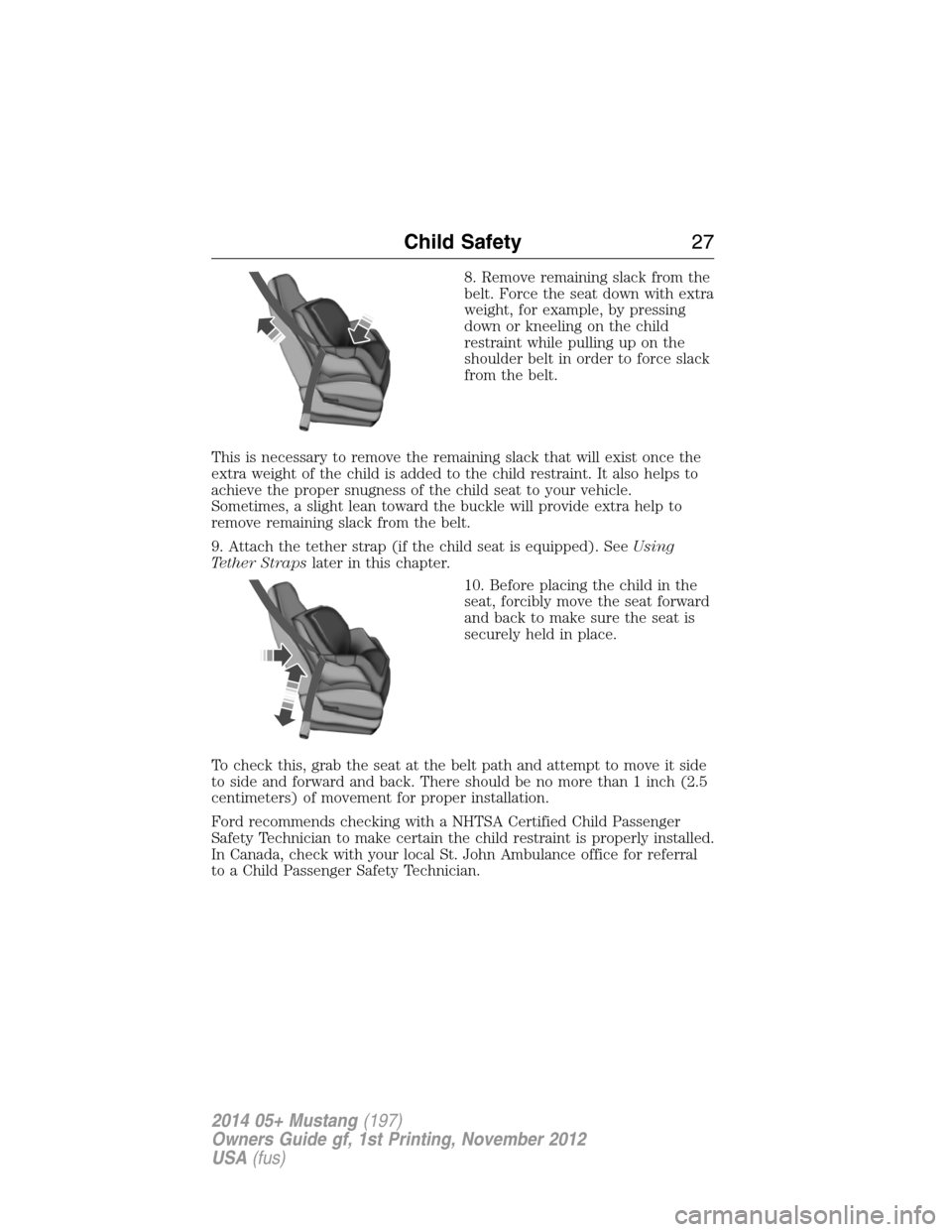
8. Remove remaining slack from the
belt. Force the seat down with extra
weight, for example, by pressing
down or kneeling on the child
restraint while pulling up on the
shoulder belt in order to force slack
from the belt.
This is necessary to remove the remaining slack that will exist once the
extra weight of the child is added to the child restraint. It also helps to
achieve the proper snugness of the child seat to your vehicle.
Sometimes, a slight lean toward the buckle will provide extra help to
remove remaining slack from the belt.
9. Attach the tether strap (if the child seat is equipped). SeeUsing
Tether Strapslater in this chapter.
10. Before placing the child in the
seat, forcibly move the seat forward
and back to make sure the seat is
securely held in place.
To check this, grab the seat at the belt path and attempt to move it side
to side and forward and back. There should be no more than 1 inch (2.5
centimeters) of movement for proper installation.
Ford recommends checking with a NHTSA Certified Child Passenger
Safety Technician to make certain the child restraint is properly installed.
In Canada, check with your local St. John Ambulance office for referral
to a Child Passenger Safety Technician.
Child Safety27
2014 05+ Mustang(197)
Owners Guide gf, 1st Printing, November 2012
USA(fus)
Page 36 of 461
The safety belt pretensioners are designed to activate in frontal,
near-frontal and side crashes. The safety belt pretensioners at the front
seating positions are designed to tighten the safety belts firmly against
the occupant’s body when activated. This helps increase the effectiveness
of the safety belts. In frontal crashes, the safety belt pretensioners can
be activated alone or, if the crash is of sufficient severity, together with
the front airbags.
FASTENING THE SAFETY BELTS
The front outboard and rear safety restraints in your vehicle are
combination lap and shoulder belts.
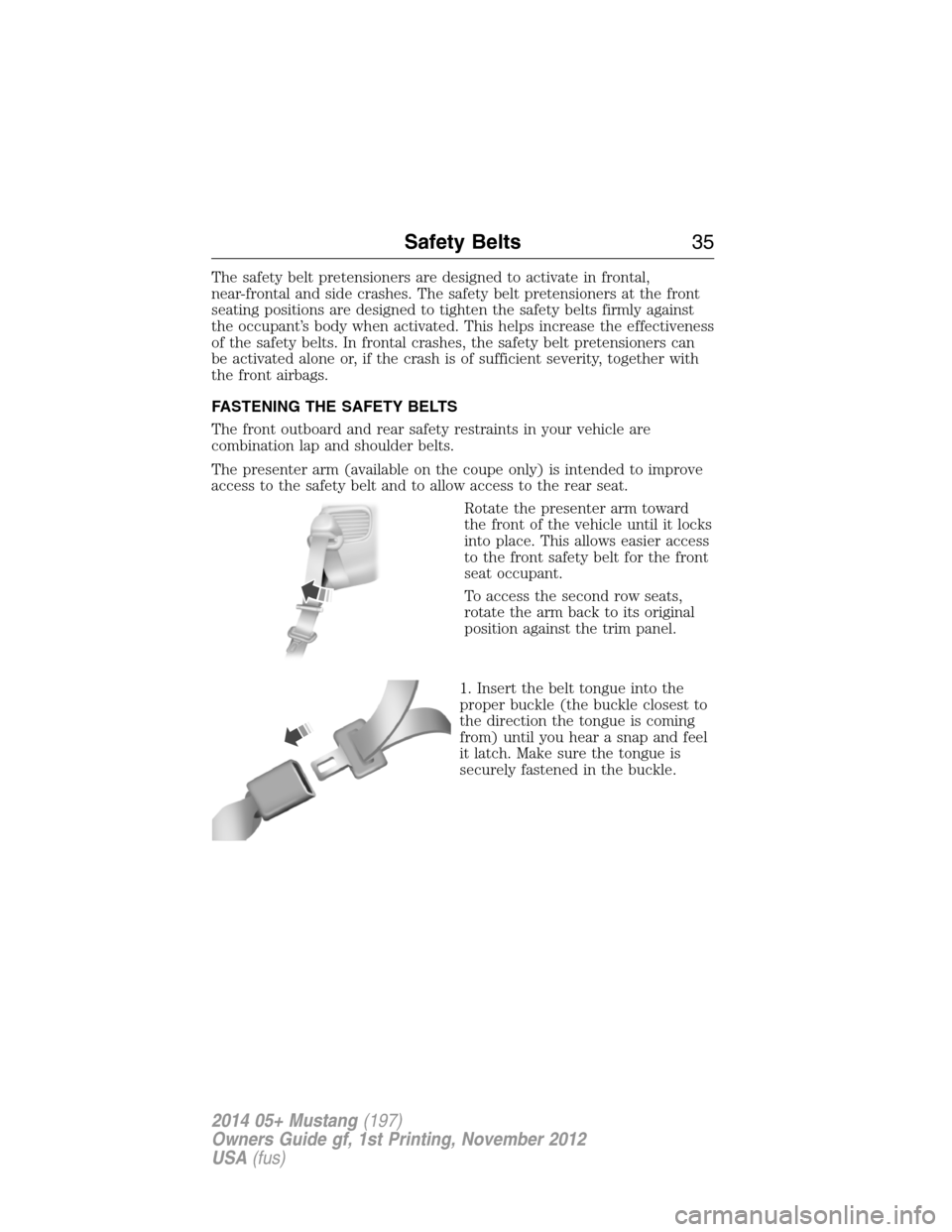
The presenter arm (available on the coupe only) is intended to improve
access to the safety belt and to allow access to the rear seat.
Rotate the presenter arm toward
the front of the vehicle until it locks
into place. This allows easier access
to the front safety belt for the front
seat occupant.
To access the second row seats,
rotate the arm back to its original
position against the trim panel.
1. Insert the belt tongue into the
proper buckle (the buckle closest to
the direction the tongue is coming
from) until you hear a snap and feel
it latch. Make sure the tongue is
securely fastened in the buckle.
Safety Belts35
2014 05+ Mustang(197)
Owners Guide gf, 1st Printing, November 2012
USA(fus)
Page 50 of 461
WARNING:To reduce the risk of possible serious injury:
Do not stow objects in seat back map pocket or hang objects off
seat back if a child is in the front passenger seat.
Do not place objects underneath the front passenger seat or between
the seat and the center console.
Check the passenger airbag off or pass airbag off indicator lamp for
proper airbag status.
Failure to follow these instructions may interfere with the passenger
seat sensing system.
WARNING:Any alteration or modification to the front passenger
seat may affect the performance of the front passenger sensing
system which could seriously increase the risk of injury or death.
This system works with sensors that are part of the front passenger’s
seat and safety belt to detect the presence of a properly-seated occupant
and determine if the front passenger’s frontal airbag should be enabled
(may inflate) or not.
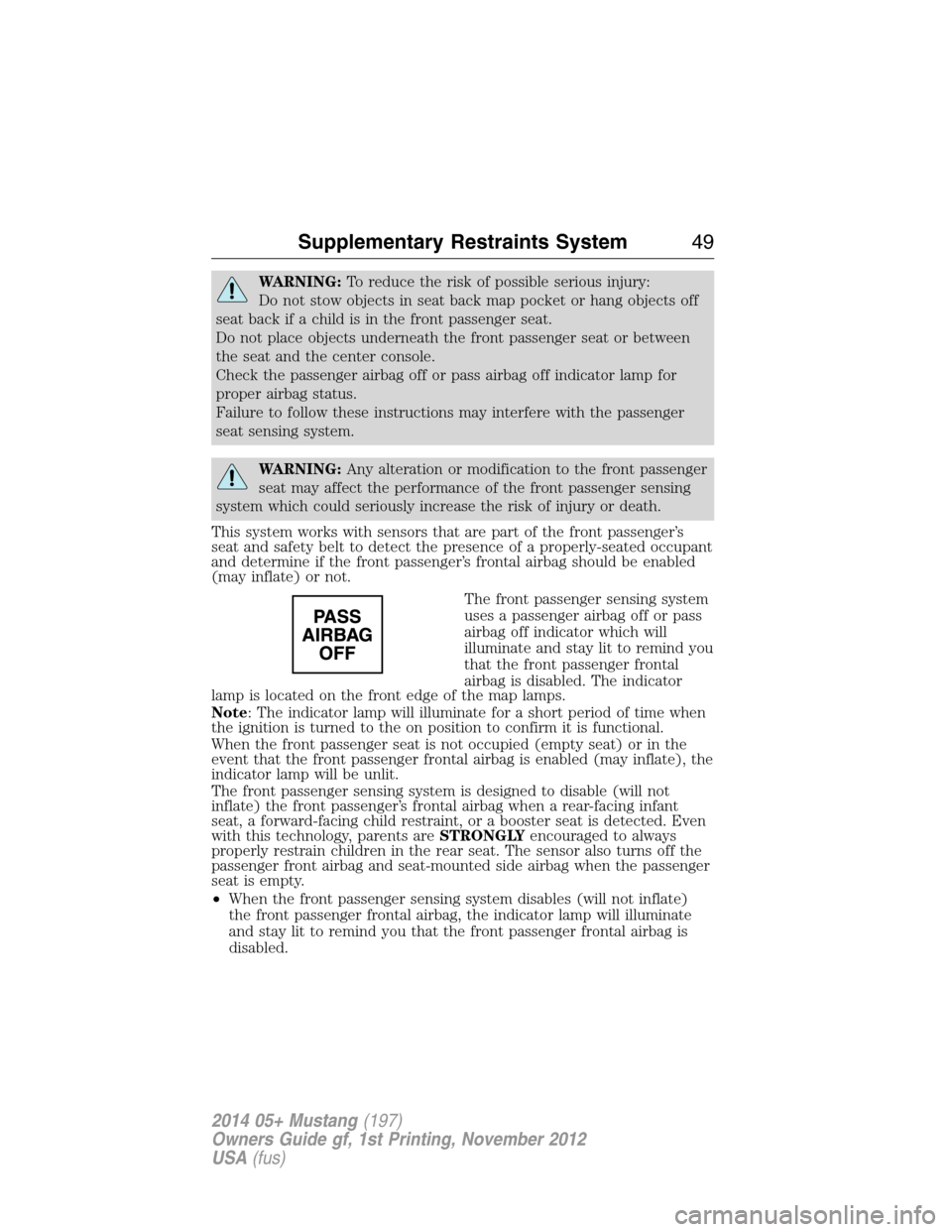
The front passenger sensing system
uses a passenger airbag off or pass
airbag off indicator which will
illuminate and stay lit to remind you
that the front passenger frontal
airbag is disabled. The indicator
lamp is located on the front edge of the map lamps.
Note: The indicator lamp will illuminate for a short period of time when
the ignition is turned to the on position to confirm it is functional.
When the front passenger seat is not occupied (empty seat) or in the
event that the front passenger frontal airbag is enabled (may inflate), the
indicator lamp will be unlit.
The front passenger sensing system is designed to disable (will not
inflate) the front passenger’s frontal airbag when a rear-facing infant
seat, a forward-facing child restraint, or a booster seat is detected. Even
with this technology, parents areSTRONGLYencouraged to always
properly restrain children in the rear seat. The sensor also turns off the
passenger front airbag and seat-mounted side airbag when the passenger
seat is empty.
•When the front passenger sensing system disables (will not inflate)
the front passenger frontal airbag, the indicator lamp will illuminate
and stay lit to remind you that the front passenger frontal airbag is
disabled.
Supplementary Restraints System49
2014 05+ Mustang(197)
Owners Guide gf, 1st Printing, November 2012
USA(fus)
Page 52 of 461
If you think that the status of the passenger airbag off indicator lamp is
incorrect, check for the following:
•objects lodged underneath the seat
•objects between the seat cushion and the center console (if equipped)
•objects hanging off the seat back
•objects stowed in the seat back map pocket (if equipped)
•objects placed on the occupant’s lap
•cargo interference with the seat
•other passengers pushing or pulling on the seat
•rear passenger feet and knees resting or pushing on the seat
The conditions listed above may cause the weight of a properly seated
occupant to be incorrectly interpreted by the front passenger sensing
system. The person in the front passenger seat may appear heavier or
lighter due to the conditions described in the list above.
To know if the front passenger sensing system is operating
properly, seeCrash Sensors and Airbag Indicatorlater in this
chapter.
If the airbag readiness lamp is lit, do the following:
The driver or adult passengers should check for any objects that may be
lodged underneath the front passenger seat or cargo interfering with the
seat.
If objects are lodged or cargo is interfering with the seat; take the
following steps to remove the obstruction:
•Pull your vehicle over.
•Turn your vehicle off.
•Driver or adult passengers should check for any objects lodged
underneath the front passenger seat or cargo interfering with the seat.
•Remove the obstruction(s) (if found).
•Restart your vehicle.
•Wait at least two minutes and verify that the airbag readiness light is
no longer illuminated.
•If the airbag readiness lamp remains illuminated, this may or may not
be a problem due to the front passenger sensing system.
Do not attempt to repair or service the system; take your vehicle
immediately to an authorized dealer.
Supplementary Restraints System51
2014 05+ Mustang(197)
Owners Guide gf, 1st Printing, November 2012
USA(fus)
Page 54 of 461
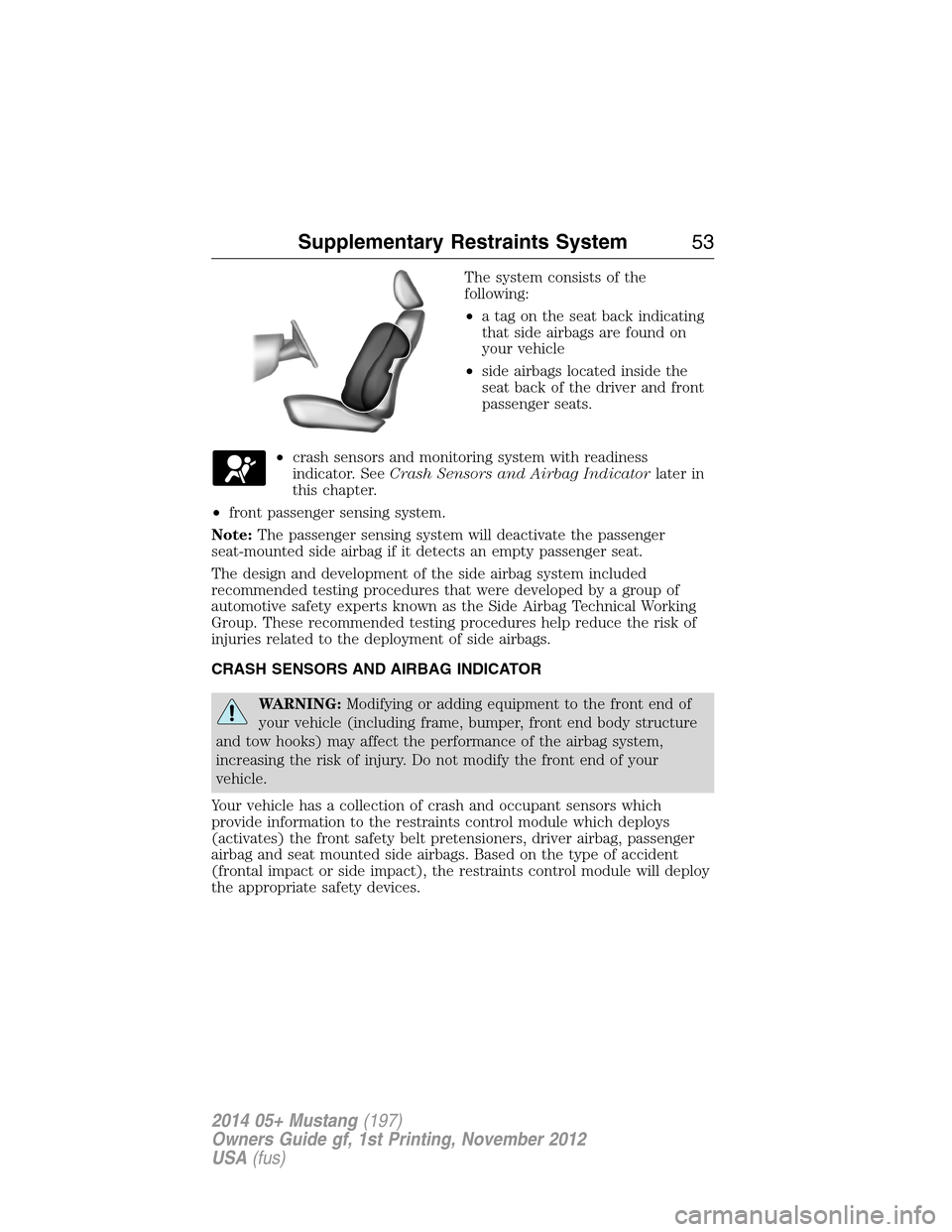
The system consists of the
following:
•a tag on the seat back indicating
that side airbags are found on
your vehicle
•side airbags located inside the
seat back of the driver and front
passenger seats.
•crash sensors and monitoring system with readiness
indicator. SeeCrash Sensors and Airbag Indicatorlater in
this chapter.
•front passenger sensing system.
Note:The passenger sensing system will deactivate the passenger
seat-mounted side airbag if it detects an empty passenger seat.
The design and development of the side airbag system included
recommended testing procedures that were developed by a group of
automotive safety experts known as the Side Airbag Technical Working
Group. These recommended testing procedures help reduce the risk of
injuries related to the deployment of side airbags.
CRASH SENSORS AND AIRBAG INDICATOR
WARNING:Modifying or adding equipment to the front end of
your vehicle (including frame, bumper, front end body structure
and tow hooks) may affect the performance of the airbag system,
increasing the risk of injury. Do not modify the front end of your
vehicle.
Your vehicle has a collection of crash and occupant sensors which
provide information to the restraints control module which deploys
(activates) the front safety belt pretensioners, driver airbag, passenger
airbag and seat mounted side airbags. Based on the type of accident
(frontal impact or side impact), the restraints control module will deploy
the appropriate safety devices.
Supplementary Restraints System53
2014 05+ Mustang(197)
Owners Guide gf, 1st Printing, November 2012
USA(fus)
Page 56 of 461
GENERAL INFORMATION ON RADIO FREQUENCIES
This device complies with part 15 of the FCC Rules and with Industry
Canada license-exempt RSS standard(s). Operation is subject to the
following two conditions: (1) This device may not cause harmful
interference, and (2) This device must accept any interference received,
including interference that may cause undesired operation.
Note:Changes or modifications not expressly approved by the party
responsible for compliance could void the user’s authority to operate the
equipment. The termICbefore the radio certification number only
signifies that Industry Canada technical specifications were met.
The typical operating range for your transmitter is approximately 33 feet
(10 meters). Vehicles with the remote start feature will have a greater
range. A decrease in operating range could be caused by:
•weather conditions
•nearby radio towers
•structures around your vehicle
•other vehicles parked next to your vehicle.
The radio frequency used by your remote control can also be used by
other short-distance radio transmissions, for example amateur radios,
medical equipment, wireless headphones, remote controls and alarm
systems. If the frequencies are jammed, you will not be able to use your
remote control. You can lock and unlock the doors with the key.
Note:Make sure your vehicle is locked before leaving it unattended.
Note:If you are in range, the remote control will operate if you press
any button unintentionally.
REMOTE CONTROL
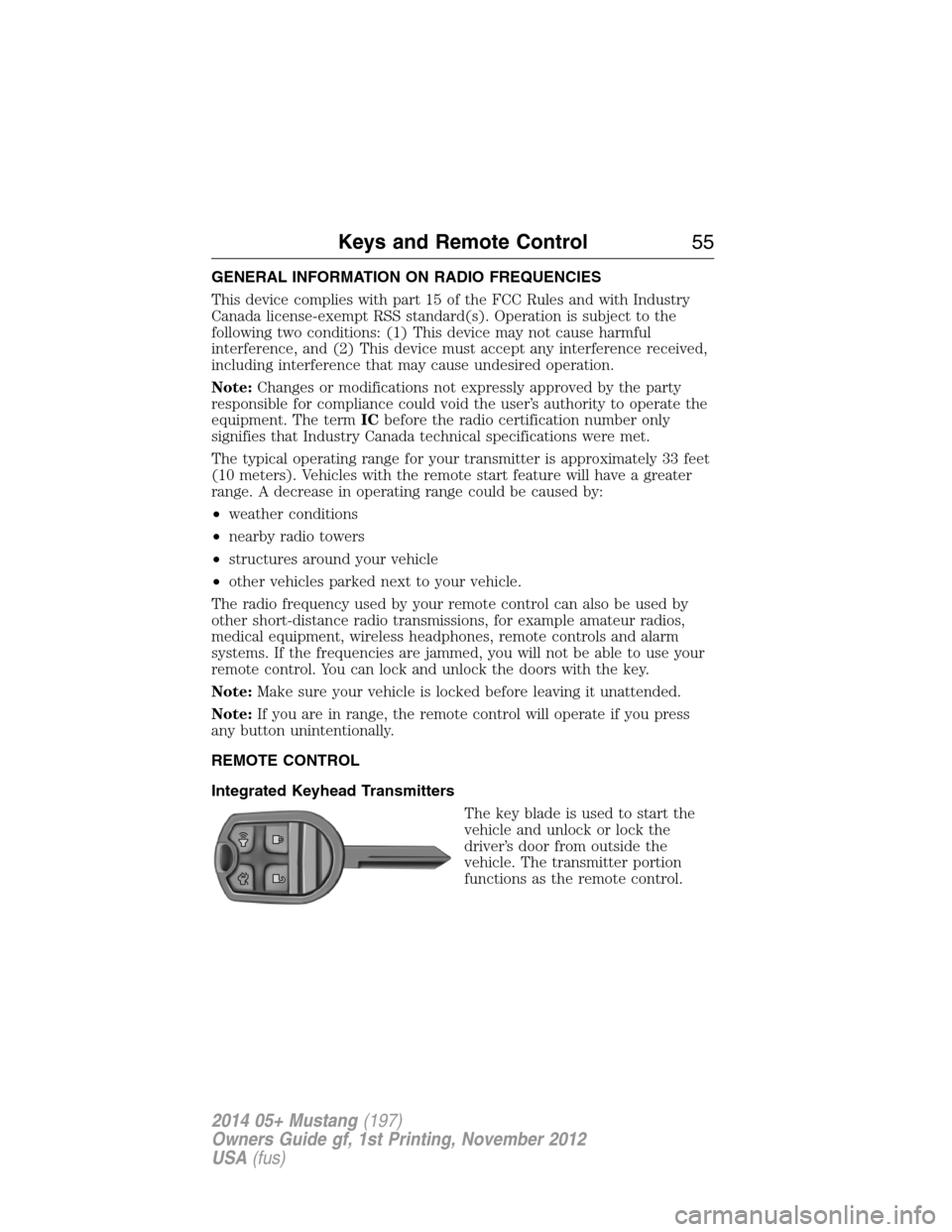
Integrated Keyhead Transmitters
The key blade is used to start the
vehicle and unlock or lock the
driver’s door from outside the
vehicle. The transmitter portion
functions as the remote control.
Keys and Remote Control55
2014 05+ Mustang(197)
Owners Guide gf, 1st Printing, November 2012
USA(fus)
Page 72 of 461
Replacement Keys
Note:Your vehicle comes with two integrated keyhead transmitters.
The integrated keyhead transmitter functions as a programmed ignition
key that operates all the locks and starts your vehicle, as well as a
remote control. A maximum of eight coded keys can be programmed to
your vehicle; only four of these eight keys can be integrated keyhead
transmitters with remote entry functionality.
If your integrated keyhead transmitters or standard SecuriLock coded
keys are lost or stolen and you do not have an extra coded key, you will
need to have your vehicle towed to an authorized dealer. The key codes
need to be erased from your vehicle and new coded keys will need to be
programmed.
Store an extra programmed key away from your vehicle in a safe place to
help prevent any inconveniences. See an authorized dealer to purchase
additional spare or replacement keys.
Programming a Spare Key
Note:A maximum of eight coded keys can be programmed to your
vehicle. Only four of these eight can be integrated keyhead transmitters.
You can program your own integrated keyhead transmitters or standard
SecuriLock coded keys to your vehicle. This procedure will program both
the engine immobilizer key code and the remote entry portion of the
remote control to your vehicle.
Only use integrated keyhead transmitters or standard SecuriLock keys.
You must have two previously programmed coded keys and the new
unprogrammed key readily accessible. See your authorized dealer to have
the spare key programmed if two previously programmed coded keys are
not available.
Read and understand the entire procedure before you begin.
1. Insert the first previously programmed coded key into the ignition.
2. Turn the ignition from off to on. Keep the ignition on for at least three
seconds, but no more than 10 seconds.
3. Turn the ignition off and remove the first coded key from the ignition.
4. After three seconds but within 10 seconds of turning the ignition off,
insert the second previously coded key into the ignition.
5. Turn the ignition from off to on. Keep the ignition on for at least three
seconds, but no more than 10 seconds.
6. Turn the ignition off and remove the second previously programmed
coded key from the ignition.
Security71
2014 05+ Mustang(197)
Owners Guide gf, 1st Printing, November 2012
USA(fus)