cooling FORD MUSTANG 2020 User Guide
[x] Cancel search | Manufacturer: FORD, Model Year: 2020, Model line: MUSTANG, Model: FORD MUSTANG 2020Pages: 464, PDF Size: 7.44 MB
Page 245 of 464
3. Add enough prediluted coolant to
reach the correct level.
4. Replace the coolant reservoir cap. Turn
the cap clockwise until it contacts the
hard stop.
5. Check the coolant level in the coolant reservoir the next few times you drive
your vehicle. If necessary, add enough
prediluted engine coolant to bring the
coolant level to the correct level.
If you have to add more than 1.1 qt (1 L) of
engine coolant per month, have your
vehicle checked as soon as possible.
Operating an engine with a low level of
coolant can result in engine overheating
and possible engine damage.
In case of emergency, you can add a large
amount of water without engine coolant
in order to reach a vehicle service location.
In this instance, qualified personnel:
1. Must drain the cooling system.
2. Chemically clean the coolant system.
3. Refill with engine coolant as soon as possible.
Water alone, without engine coolant, can
cause engine damage from corrosion,
overheating or freezing.
Do not use the following as a coolant
substitute:
• Alcohol.
• Methanol.
• Brine.
• Any coolant mixed with alcohol or
methanol antifreeze.
Alcohol and other liquids can cause engine
damage from overheating or freezing.
Do not add extra inhibitors or additives to
the coolant. These can be harmful and
compromise the corrosion protection of
the coolant. Recycled Coolant
We do not recommend the use of recycled
coolant as an approved recycling process
is not yet available.
Note:
Dispose of used coolant in the
appropriate manner.
Follow your community's regulations and
standards for recycling and disposing of
automotive fluids.
Severe Climates
If you drive in extremely cold climates:
• It may be necessary to increase the
coolant concentration above 50%.
• A coolant concentration of 60%
provides improved freeze point
protection. Coolant concentrations
above 60% decrease the overheat
protection characteristics of the
coolant and may cause engine
damage.
If you drive in extremely hot climates:
• You can decrease the coolant
concentration to 40%.
• Coolant concentrations below 40%
decrease the freeze and corrosion
protection characteristics of the
coolant and may cause engine
damage.
Vehicles driven year-round in non-extreme
climates should use prediluted coolant for
optimum cooling system and engine
protection.
Coolant Change
At specific mileage intervals, as listed in
the scheduled maintenance information,
the coolant should be changed. Add
prediluted coolant approved to the correct
specification. See
Capacities and
Specifications (page 297).
242
Mustang (CZG) Canada/United States of America, Vehicles Built From: 15-07-2019, enUSA, Edition date: 201906, Second-Printing Maintenance
Page 246 of 464
Fail-Safe Cooling
Fail-safe cooling allows you to temporarily
drive your vehicle before any incremental
component damage occurs. The fail-safe
distance depends on ambient
temperature, vehicle load and terrain.
How Fail-Safe Cooling Works
If the engine begins to overheat,
the coolant temperature gauge
moves toward the red zone:
A warning lamp illuminates and
a message may appear in the
information display.
If the engine reaches a preset
over-temperature condition, the engine
automatically switches to alternating
cylinder operation. Each disabled cylinder
acts as an air pump and cools the engine.
When this occurs, your vehicle still
operates, however:
• Engine power is limited.
• The air conditioning system turns off.
Continued operation increases the engine
temperature, causing the engine to
completely shut down. Your steering and
braking effort increases in this situation.
When the engine temperature cools, you
can re-start the engine. Have your vehicle
checked as soon as possible to minimize
engine damage.
When Fail-Safe Mode Is Activated WARNING: Fail-safe mode is for
use during emergencies only. Operate
your vehicle in fail-safe mode only as
long as necessary to bring your vehicle
to rest in a safe location and seek
immediate repairs. When in fail-safe
mode, your vehicle will have limited
power, will not be able to maintain high-speed operation, and may
completely shut down without warning,
potentially losing engine power, power
steering assist, and power brake assist,
which may increase the possibility of a
crash resulting in serious injury.
WARNING:
Do not remove the
coolant reservoir cap when the engine is
on or the cooling system is hot. Wait 10
minutes for the cooling system to cool
down. Cover the coolant reservoir cap
with a thick cloth to prevent the
possibility of scalding and slowly remove
the cap. Failure to follow this instruction
could result in personal injury.
Your vehicle has limited engine power
when in the fail-safe mode, drive your
vehicle with caution. Your vehicle does not
maintain high-speed operation and the
engine may operate poorly.
Remember that the engine is capable of
automatically shutting down to prevent
engine damage. In this situation:
1. Pull off the road as soon as safely possible and switch the engine off.
2. If you are a member of a roadside assistance program, we recommend
that you contact your roadside
assistance service provider.
3. If this is not possible, wait for a short period of time for the engine to cool.
4. Check the coolant level. If the coolant level is at or below the minimum mark,
add prediluted coolant immediately.
5. When the engine temperature cools, you can re-start the engine. Have your
vehicle checked as soon as possible to
minimize engine damage.
Note: Driving your vehicle without repair
increases the chance of engine damage.
243
Mustang (CZG) Canada/United States of America, Vehicles Built From: 15-07-2019, enUSA, Edition date: 201906, Second-Printing Maintenance
Page 264 of 464
•
Cover interior trim to prevent fading.
• Keep all rubber parts free from oil and
solvents.
Engine
• Change the engine oil and filter prior to
storage because used engine oil
contains contaminates which may
cause engine damage.
• Start the engine every 15 days for a
minimum of 15 minutes. Run at fast
idle with the climate controls set to
defrost until the engine reaches normal
operating temperature.
• With your foot on the brake, shift
through all the gears while the engine
is running.
• We recommend that you change the
engine oil before you use your vehicle
again.
Fuel system
• Fill the fuel tank with high-quality fuel
until the first automatic shutoff of the
fuel pump nozzle.
Cooling system
• Protect against freezing temperatures.
• When removing your vehicle from
storage, check coolant fluid level.
Confirm that there are no cooling
system leaks and that fluid is at the
recommended level.
Disconnecting Your 12 Volt Battery
• Check and recharge as necessary. Keep
connections clean.
• If storing your vehicle for more than 30
days without recharging the battery,
we recommend that you disconnect
the battery cables to maintain battery
charge for quick starting. Note:
It is necessary to reset memory
features if you disconnect the battery
cables.
Plugging in Your HYBRID
We recommend the following options for
your plug-in vehicle (PHEV) :
• Leave your vehicle plugged in. The 12
volt battery maintains power if left
plugged in. However, this periodically
uses electricity from the household
outlet.
• Connect a battery charger to your 12
volt battery and leave it on a
continuous, slow charge.
• Disconnect the 12 volt battery. If your
12 volt battery is located in the luggage
compartment, do not fully shut the
luggage compartment after
disconnecting the 12 volt battery. Only
leave the luggage compartment open
if your vehicle is stored in a locked
location.
Brakes
• Make sure the brakes and parking brake
release fully.
Tires
• Maintain recommended air pressure.
Miscellaneous
• Make sure all linkages, cables, levers
and pins under your vehicle are covered
with grease to prevent rust.
• Move vehicles at least 25 ft (7.5 m)
every 15 days to lubricate working parts
and prevent corrosion.
261
Mustang (CZG) Canada/United States of America, Vehicles Built From: 15-07-2019, enUSA, Edition date: 201906, Second-Printing Vehicle Care
Page 373 of 464
Supported USB file systems include: FAT,
exFAT, and NTFS.
SYNC 3 is also able to organize the media
from your USB device by metadata tags.
Metadata tags, which are descriptive
software identifiers embedded in the
media files, provide information about the
file.
If your indexed media files contain no
information embedded in these metadata
tags, SYNC 3 may classify the empty
metadata tags as unknown.
SYNC 3 is capable of indexing up to
50,000 songs per USB device, for up to 10
devices.
CLIMATE
Touch the climate button on the
touchscreen to access your climate control
features.
Note:
You can switch temperature units
between Fahrenheit and Celsius. See
Settings (page 382).
Accessing the Climate Control
Menu Touch the button to access
additional controls for the front
climate system.
Directing the Airflow Touch the button to direct
airflow to the windshield air
vents and de-mister.
Touch the button to direct
airflow to the instrument panel
air vents.
Touch the button to direct
airflow to the footwell air vents. You can direct air through any combination
of these air vents.
Setting the Blower Motor Speed Touch up or down to increase or
decrease the volume of air that
circulates in your vehicle.
Setting the Temperature
Touch up or down on the left-hand
temperature control to set the left-hand
temperature.
Note: This control also adjusts the
right-hand side temperature when you
switch off dual zone mode.
Touch up or down on the right-hand
temperature control to set the right-hand
temperature.
Switching Auto Mode On and Off Touch the button to switch on
automatic operation, then set
the temperature.
The system adjusts the blower motor
speed, air distribution, air conditioning
operation, and outside or recirculated air
to reach and maintain the temperature you
have set.
Switching the Air Conditioning On
and Off A pop-up appears on the screen
to display the air conditioning
options.
MAX A/C:
Touch the button to activate
and maximize cooling. The driver and
passenger temperatures are set to LO,
recirculated air flows through the
instrument panel vents, air conditioning
automatically turns on and the fan
automatically adjusts to the highest speed.
370
Mustang (CZG) Canada/United States of America, Vehicles Built From: 15-07-2019, enUSA, Edition date: 201906, Second-Printing SYNC™ 3
(If Equipped)E265038
Page 374 of 464
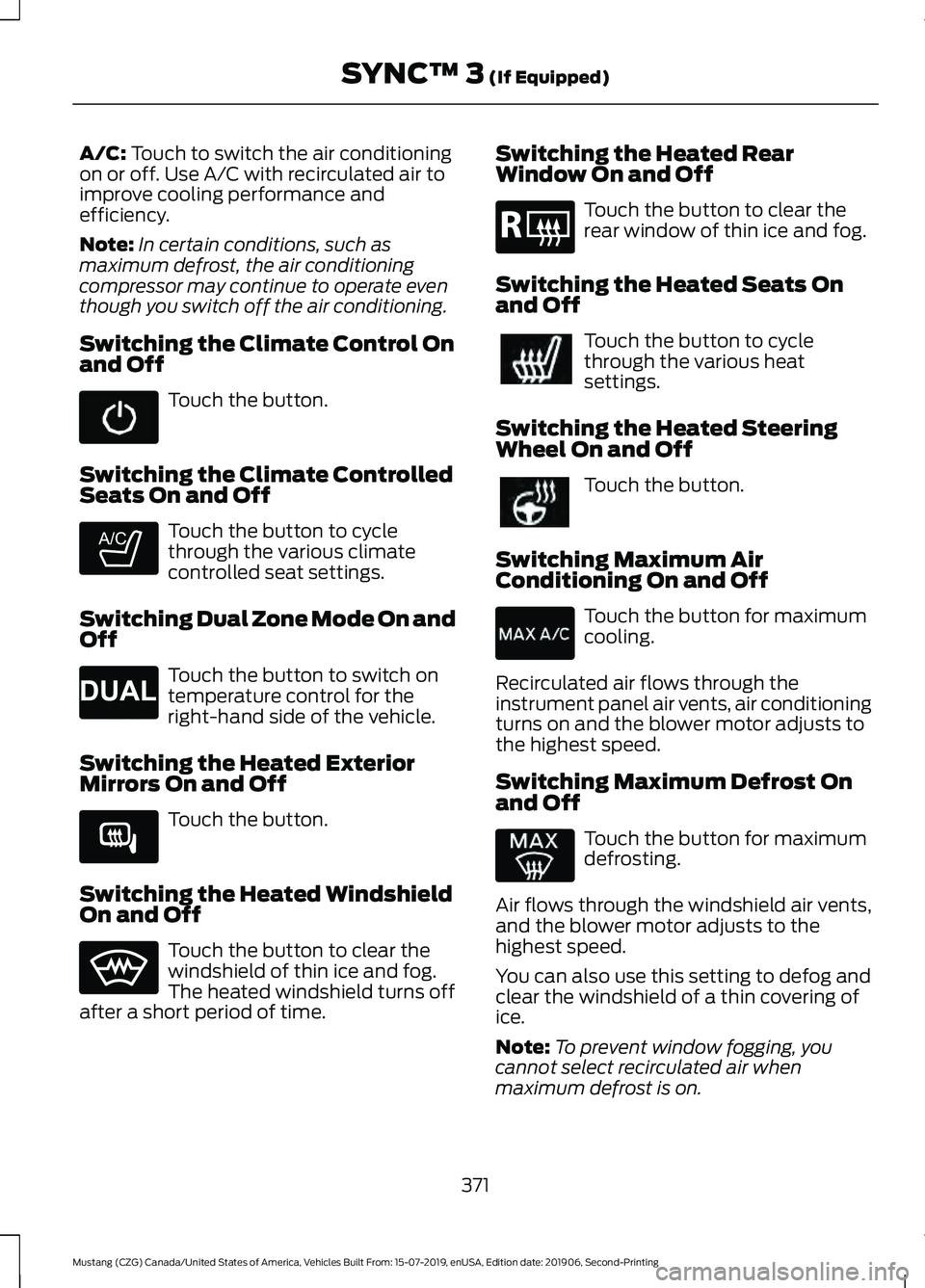
A/C: Touch to switch the air conditioning
on or off. Use A/C with recirculated air to
improve cooling performance and
efficiency.
Note: In certain conditions, such as
maximum defrost, the air conditioning
compressor may continue to operate even
though you switch off the air conditioning.
Switching the Climate Control On
and Off Touch the button.
Switching the Climate Controlled
Seats On and Off Touch the button to cycle
through the various climate
controlled seat settings.
Switching Dual Zone Mode On and
Off Touch the button to switch on
temperature control for the
right-hand side of the vehicle.
Switching the Heated Exterior
Mirrors On and Off Touch the button.
Switching the Heated Windshield
On and Off Touch the button to clear the
windshield of thin ice and fog.
The heated windshield turns off
after a short period of time. Switching the Heated Rear
Window On and Off Touch the button to clear the
rear window of thin ice and fog.
Switching the Heated Seats On
and Off Touch the button to cycle
through the various heat
settings.
Switching the Heated Steering
Wheel On and Off Touch the button.
Switching Maximum Air
Conditioning On and Off Touch the button for maximum
cooling.
Recirculated air flows through the
instrument panel air vents, air conditioning
turns on and the blower motor adjusts to
the highest speed.
Switching Maximum Defrost On
and Off Touch the button for maximum
defrosting.
Air flows through the windshield air vents,
and the blower motor adjusts to the
highest speed.
You can also use this setting to defog and
clear the windshield of a thin covering of
ice.
Note: To prevent window fogging, you
cannot select recirculated air when
maximum defrost is on.
371
Mustang (CZG) Canada/United States of America, Vehicles Built From: 15-07-2019, enUSA, Edition date: 201906, Second-Printing SYNC™ 3
(If Equipped) E265282 E265280 E266189 E184884
Page 375 of 464
Note:
The heated rear window also turns
on when you select maximum defrost.
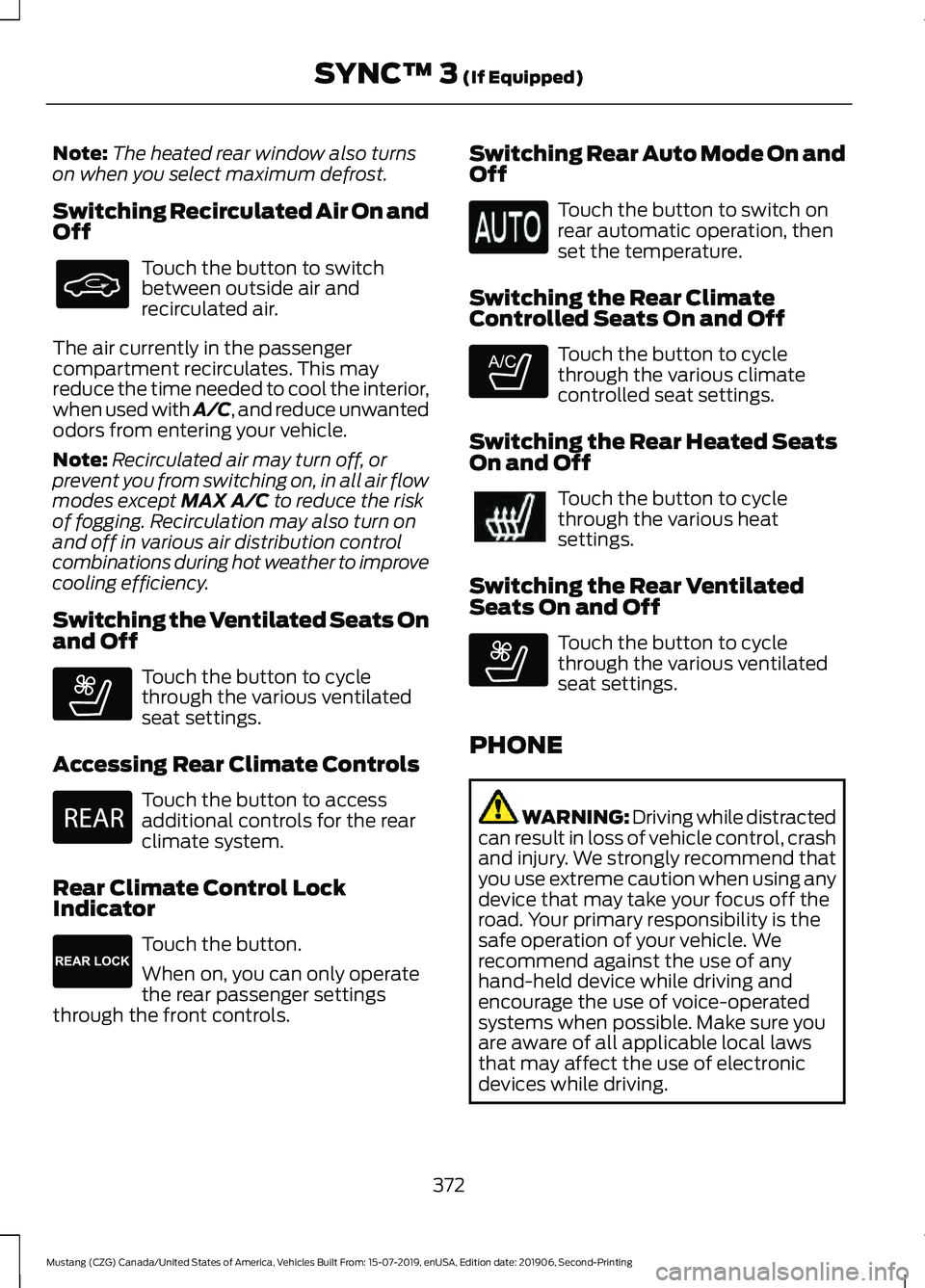
Switching Recirculated Air On and
Off Touch the button to switch
between outside air and
recirculated air.
The air currently in the passenger
compartment recirculates. This may
reduce the time needed to cool the interior,
when used with A/C, and reduce unwanted
odors from entering your vehicle.
Note: Recirculated air may turn off, or
prevent you from switching on, in all air flow
modes except MAX A/C to reduce the risk
of fogging. Recirculation may also turn on
and off in various air distribution control
combinations during hot weather to improve
cooling efficiency.
Switching the Ventilated Seats On
and Off Touch the button to cycle
through the various ventilated
seat settings.
Accessing Rear Climate Controls Touch the button to access
additional controls for the rear
climate system.
Rear Climate Control Lock
Indicator Touch the button.
When on, you can only operate
the rear passenger settings
through the front controls. Switching Rear Auto Mode On and
Off Touch the button to switch on
rear automatic operation, then
set the temperature.
Switching the Rear Climate
Controlled Seats On and Off Touch the button to cycle
through the various climate
controlled seat settings.
Switching the Rear Heated Seats
On and Off Touch the button to cycle
through the various heat
settings.
Switching the Rear Ventilated
Seats On and Off Touch the button to cycle
through the various ventilated
seat settings.
PHONE WARNING: Driving while distracted
can result in loss of vehicle control, crash
and injury. We strongly recommend that
you use extreme caution when using any
device that may take your focus off the
road. Your primary responsibility is the
safe operation of your vehicle. We
recommend against the use of any
hand-held device while driving and
encourage the use of voice-operated
systems when possible. Make sure you
are aware of all applicable local laws
that may affect the use of electronic
devices while driving.
372
Mustang (CZG) Canada/United States of America, Vehicles Built From: 15-07-2019, enUSA, Edition date: 201906, Second-Printing SYNC™ 3
(If Equipped) E268558 E270447 E265289 E265282 E268558
Page 405 of 464
Make sure to change your vehicle
’s oils and
fluids at the specified intervals or in
conjunction with a repair. Flushing is a
viable way to change fluid for many vehicle
sub-systems during scheduled
maintenance. It is critical that systems are
flushed only with new fluid that is the same
as that required to fill and operate the system or using a Ford-approved flushing
chemical.
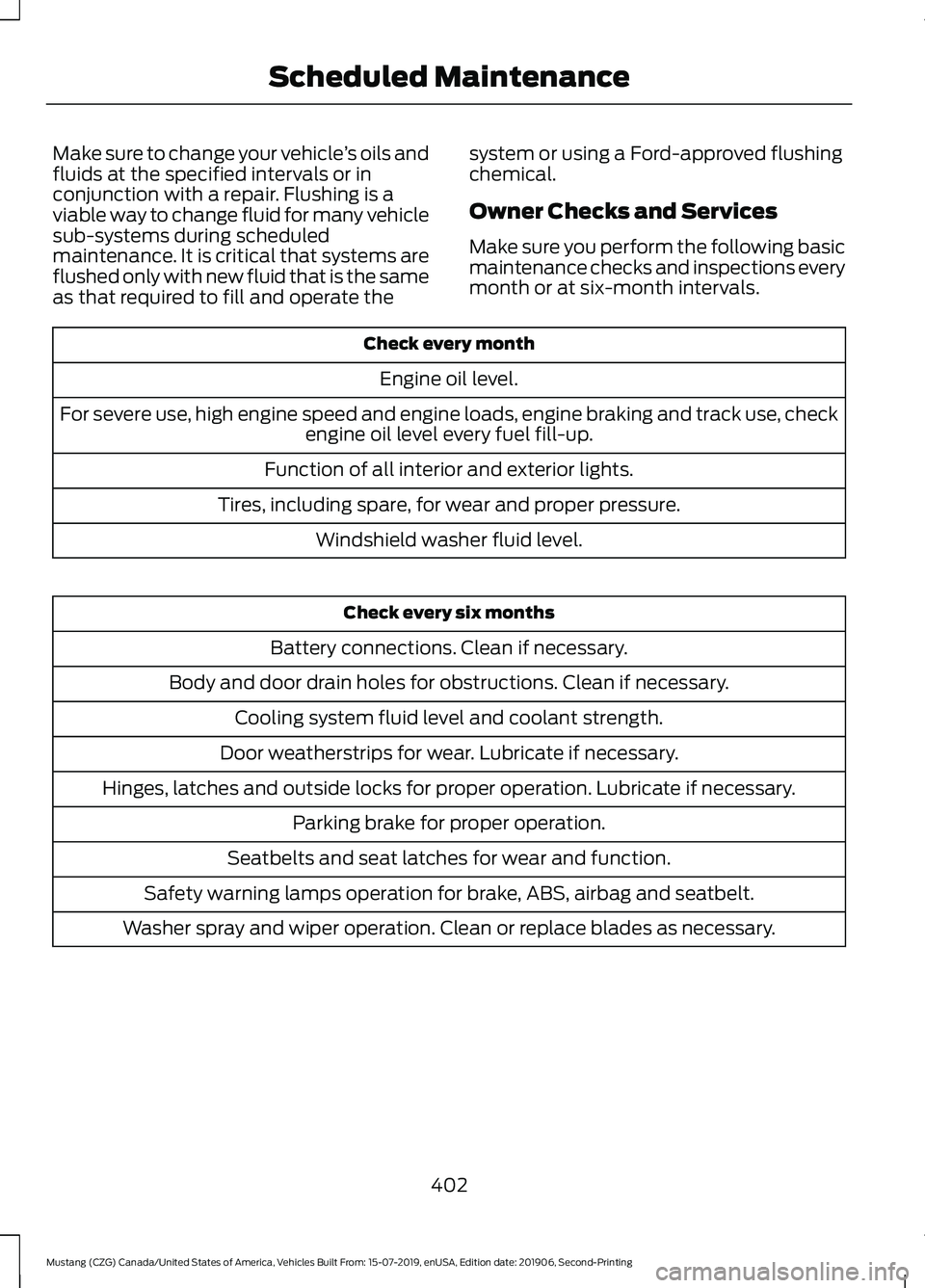
Owner Checks and Services
Make sure you perform the following basic
maintenance checks and inspections every
month or at six-month intervals.Check every month
Engine oil level.
For severe use, high engine speed and engine loads, engine braking and track use, check engine oil level every fuel fill-up.
Function of all interior and exterior lights.
Tires, including spare, for wear and proper pressure. Windshield washer fluid level. Check every six months
Battery connections. Clean if necessary.
Body and door drain holes for obstructions. Clean if necessary. Cooling system fluid level and coolant strength.
Door weatherstrips for wear. Lubricate if necessary.
Hinges, latches and outside locks for proper operation. Lubricate if necessary. Parking brake for proper operation.
Seatbelts and seat latches for wear and function.
Safety warning lamps operation for brake, ABS, airbag and seatbelt.
Washer spray and wiper operation. Clean or replace blades as necessary.
402
Mustang (CZG) Canada/United States of America, Vehicles Built From: 15-07-2019, enUSA, Edition date: 201906, Second-Printing Scheduled Maintenance
Page 407 of 464
This means you do not have to remember
to change the oil on a mileage-based
schedule. Your vehicle lets you know when
an oil change is due by displaying a
message in the information display.
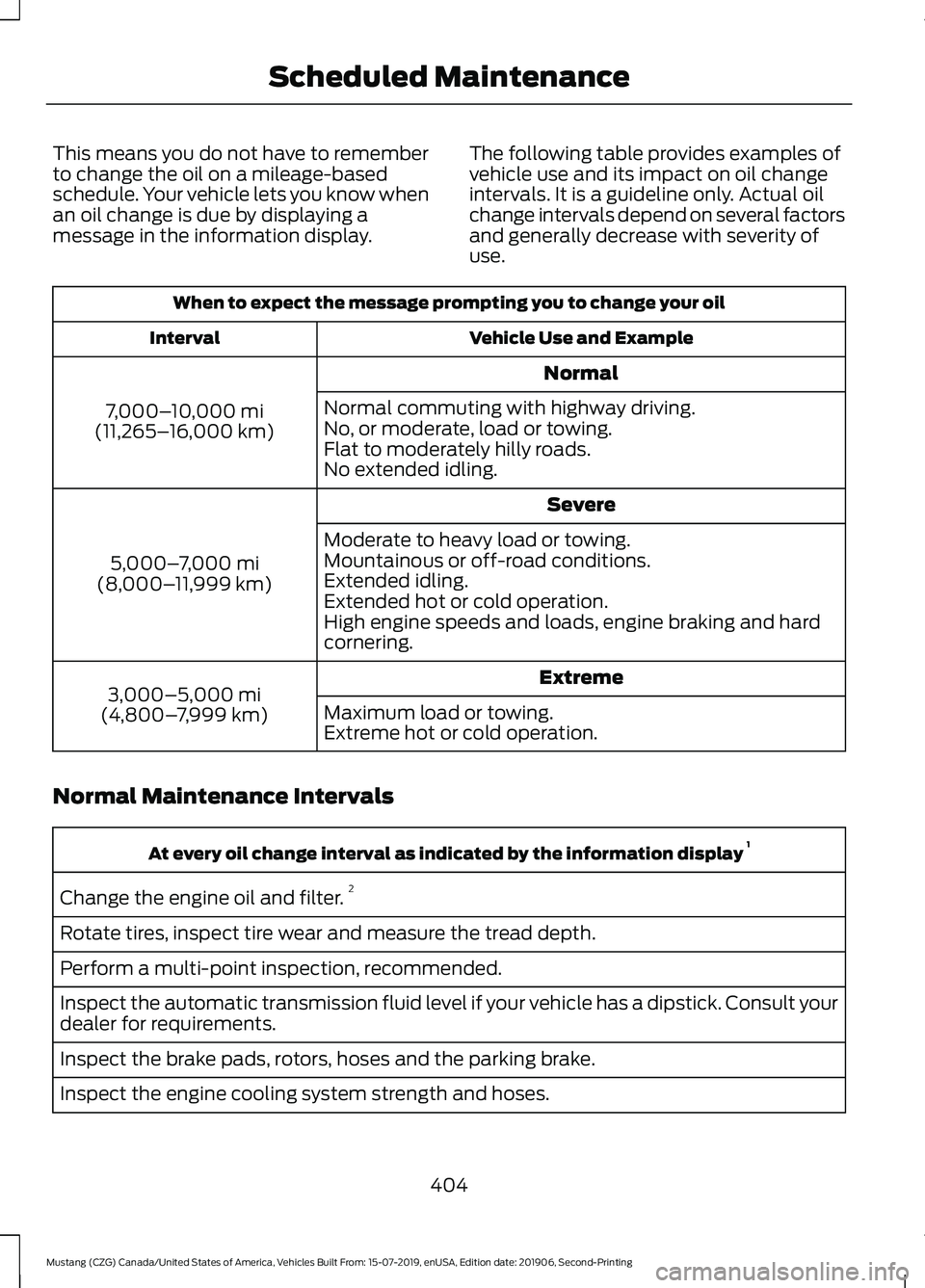
The following table provides examples of
vehicle use and its impact on oil change
intervals. It is a guideline only. Actual oil
change intervals depend on several factors
and generally decrease with severity of
use.When to expect the message prompting you to change your oil
Vehicle Use and Example
Interval
Normal
7,000– 10,000 mi
(11,265– 16,000 km) Normal commuting with highway driving.
No, or moderate, load or towing.
Flat to moderately hilly roads.
No extended idling.
Severe
5,000– 7,000 mi
(8,000– 11,999 km) Moderate to heavy load or towing.
Mountainous or off-road conditions.
Extended idling.
Extended hot or cold operation.
High engine speeds and loads, engine braking and hard
cornering.
Extreme
3,000–5,000 mi
(4,800– 7,999 km) Maximum load or towing.
Extreme hot or cold operation.
Normal Maintenance Intervals At every oil change interval as indicated by the information display
1
Change the engine oil and filter. 2
Rotate tires, inspect tire wear and measure the tread depth.
Perform a multi-point inspection, recommended.
Inspect the automatic transmission fluid level if your vehicle has a dipstick. Consult your
dealer for requirements.
Inspect the brake pads, rotors, hoses and the parking brake.
Inspect the engine cooling system strength and hoses.
404
Mustang (CZG) Canada/United States of America, Vehicles Built From: 15-07-2019, enUSA, Edition date: 201906, Second-Printing Scheduled Maintenance
Page 456 of 464
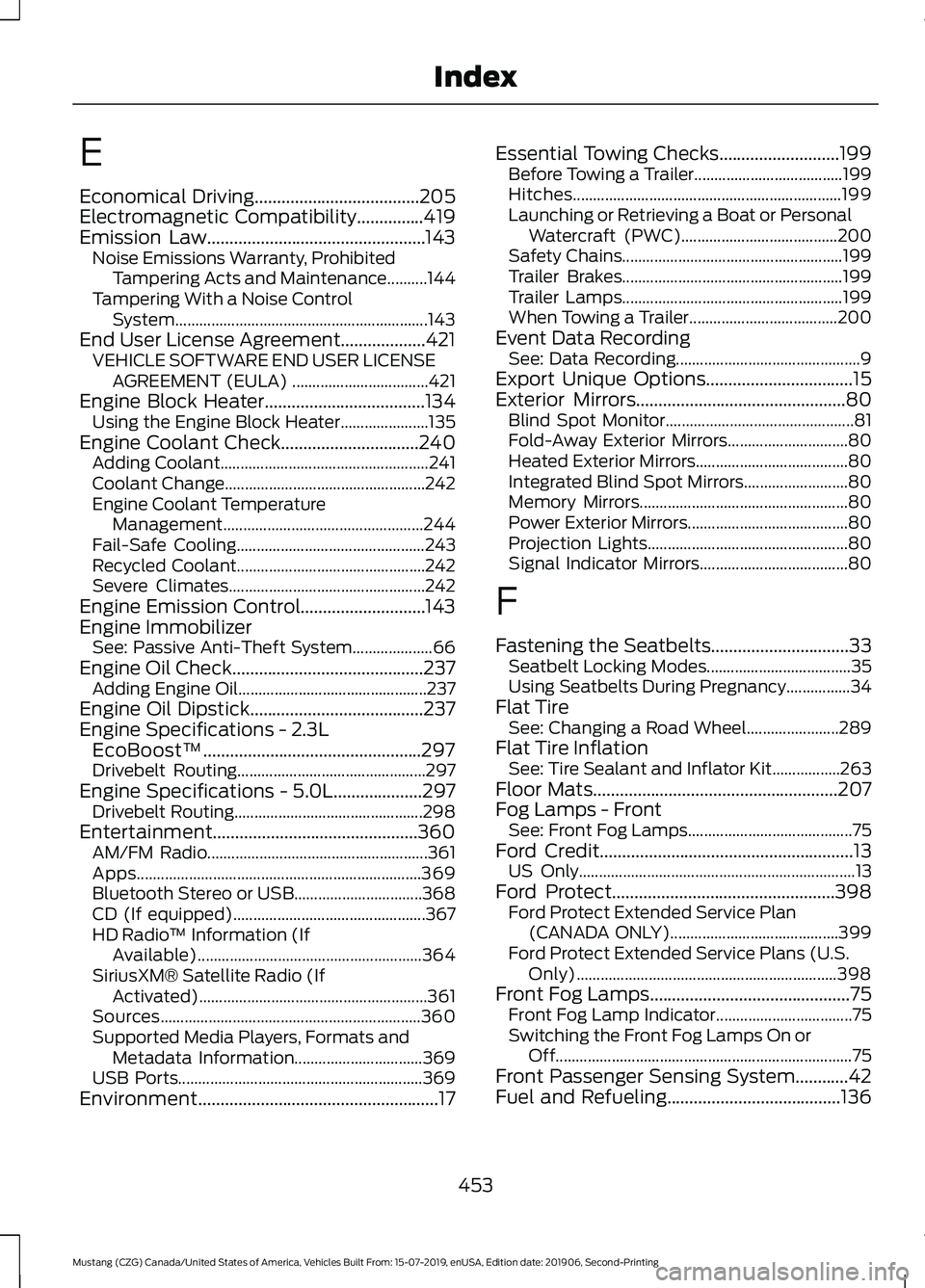
E
Economical Driving.....................................205
Electromagnetic Compatibility...............419
Emission Law.................................................143 Noise Emissions Warranty, Prohibited
Tampering Acts and Maintenance..........144
Tampering With a Noise Control System............................................................... 143
End User License Agreement...................421 VEHICLE SOFTWARE END USER LICENSE
AGREEMENT (EULA) .................................. 421
Engine Block Heater....................................134 Using the Engine Block Heater...................... 135
Engine Coolant Check...............................240 Adding Coolant.................................................... 241
Coolant Change.................................................. 242
Engine Coolant Temperature Management.................................................. 244
Fail-Safe Cooling............................................... 243
Recycled Coolant............................................... 242
Severe Climates................................................. 242
Engine Emission Control............................143
Engine Immobilizer See: Passive Anti-Theft System.................... 66
Engine Oil Check...........................................237 Adding Engine Oil............................................... 237
Engine Oil Dipstick.......................................237
Engine Specifications - 2.3L EcoBoost™.................................................297
Drivebelt Routing............................................... 297
Engine Specifications - 5.0L....................297 Drivebelt Routing............................................... 298
Entertainment..............................................360 AM/FM Radio....................................................... 361
Apps....................................................................... 369
Bluetooth Stereo or USB................................ 368
CD (If equipped)................................................ 367
HD Radio ™ Information (If
Available)........................................................ 364
SiriusXM® Satellite Radio (If Activated)......................................................... 361
Sources................................................................. 360
Supported Media Players, Formats and Metadata Information................................ 369
USB Ports............................................................. 369
Environment......................................................17 Essential Towing Checks...........................199
Before Towing a Trailer..................................... 199
Hitches................................................................... 199
Launching or Retrieving a Boat or Personal Watercraft (PWC)....................................... 200
Safety Chains....................................................... 199
Trailer Brakes....................................................... 199
Trailer Lamps....................................................... 199
When Towing a Trailer..................................... 200
Event Data Recording See: Data Recording.............................................. 9
Export Unique Options.................................15
Exterior Mirrors
...............................................80
Blind Spot Monitor............................................... 81
Fold-Away Exterior Mirrors.............................. 80
Heated Exterior Mirrors...................................... 80
Integrated Blind Spot Mirrors.......................... 80
Memory Mirrors.................................................... 80
Power Exterior Mirrors........................................ 80
Projection Lights.................................................. 80
Signal Indicator Mirrors..................................... 80
F
Fastening the Seatbelts...............................33 Seatbelt Locking Modes.................................... 35
Using Seatbelts During Pregnancy................34
Flat Tire See: Changing a Road Wheel....................... 289
Flat Tire Inflation See: Tire Sealant and Inflator Kit.................263
Floor Mats.......................................................207
Fog Lamps - Front See: Front Fog Lamps......................................... 75
Ford Credit
.........................................................13
US Only..................................................................... 13
Ford Protect
..................................................398
Ford Protect Extended Service Plan
(CANADA ONLY).......................................... 399
Ford Protect Extended Service Plans (U.S. Only)................................................................. 398
Front Fog Lamps.............................................75 Front Fog Lamp Indicator.................................. 75
Switching the Front Fog Lamps On or Off........................................................................\
.. 75
Front Passenger Sensing System............42
Fuel and Refueling.......................................136
453
Mustang (CZG) Canada/United States of America, Vehicles Built From: 15-07-2019, enUSA, Edition date: 201906, Second-Printing Index
Page 457 of 464
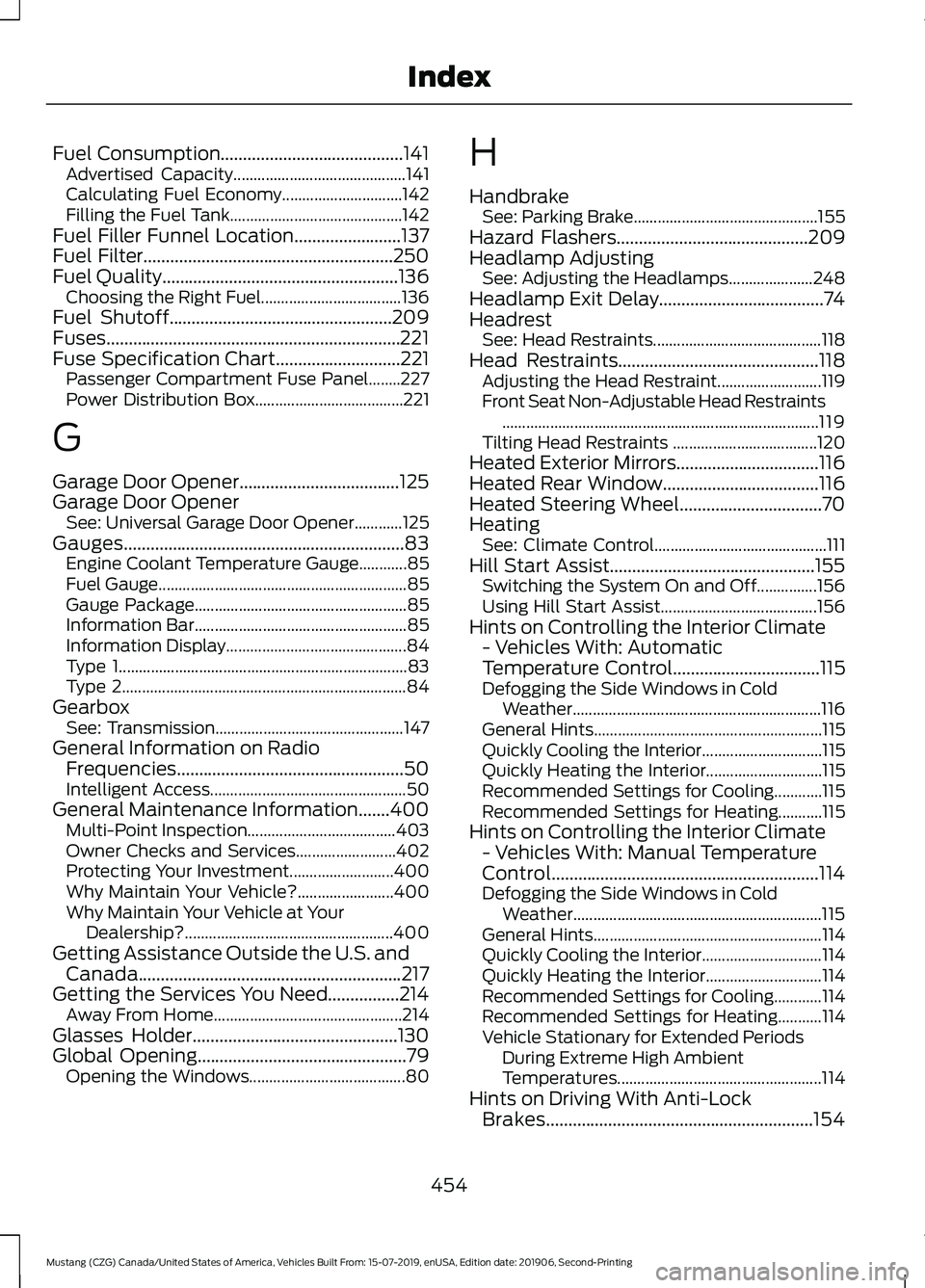
Fuel Consumption.........................................141
Advertised Capacity........................................... 141
Calculating Fuel Economy.............................. 142
Filling the Fuel Tank........................................... 142
Fuel Filler Funnel Location........................137
Fuel Filter
........................................................250
Fuel Quality.....................................................136 Choosing the Right Fuel................................... 136
Fuel Shutoff..................................................209
Fuses..................................................................221
Fuse Specification Chart............................221 Passenger Compartment Fuse Panel........227
Power Distribution Box..................................... 221
G
Garage Door Opener....................................125
Garage Door Opener See: Universal Garage Door Opener............125
Gauges...............................................................83 Engine Coolant Temperature Gauge............85
Fuel Gauge.............................................................. 85
Gauge Package..................................................... 85
Information Bar..................................................... 85
Information Display............................................. 84
Type 1........................................................................\
83
Type 2....................................................................... 84
Gearbox See: Transmission............................................... 147
General Information on Radio Frequencies...................................................50
Intelligent Access................................................. 50
General Maintenance Information.......400 Multi-Point Inspection..................................... 403
Owner Checks and Services......................... 402
Protecting Your Investment.......................... 400
Why Maintain Your Vehicle?........................ 400
Why Maintain Your Vehicle at Your Dealership?.................................................... 400
Getting Assistance Outside the U.S. and Canada
...........................................................217
Getting the Services You Need................214 Away From Home............................................... 214
Glasses Holder
..............................................130
Global Opening...............................................79
Opening the Windows....................................... 80H
Handbrake
See: Parking Brake.............................................. 155
Hazard Flashers...........................................209
Headlamp Adjusting See: Adjusting the Headlamps..................... 248
Headlamp Exit Delay.....................................74
Headrest See: Head Restraints.......................................... 118
Head Restraints
.............................................118
Adjusting the Head Restraint.......................... 119
Front Seat Non-Adjustable Head Restraints ........................................................................\
....... 119
Tilting Head Restraints .................................... 120
Heated Exterior Mirrors................................116
Heated Rear Window...................................116
Heated Steering Wheel................................70
Heating See: Climate Control........................................... 111
Hill Start Assist..............................................155 Switching the System On and Off...............156
Using Hill Start Assist....................................... 156
Hints on Controlling the Interior Climate - Vehicles With: Automatic
Temperature Control
.................................115
Defogging the Side Windows in Cold
Weather.............................................................. 116
General Hints......................................................... 115
Quickly Cooling the Interior.............................. 115
Quickly Heating the Interior............................. 115
Recommended Settings for Cooling............115
Recommended Settings for Heating...........115
Hints on Controlling the Interior Climate - Vehicles With: Manual Temperature
Control
............................................................114
Defogging the Side Windows in Cold
Weather.............................................................. 115
General Hints......................................................... 114
Quickly Cooling the Interior.............................. 114
Quickly Heating the Interior............................. 114
Recommended Settings for Cooling............114
Recommended Settings for Heating...........114
Vehicle Stationary for Extended Periods During Extreme High Ambient
Temperatures................................................... 114
Hints on Driving With Anti-Lock Brakes............................................................154
454
Mustang (CZG) Canada/United States of America, Vehicles Built From: 15-07-2019, enUSA, Edition date: 201906, Second-Printing Index