radio FORD RANGER 2004 2.G User Guide
[x] Cancel search | Manufacturer: FORD, Model Year: 2004, Model line: RANGER, Model: FORD RANGER 2004 2.GPages: 248, PDF Size: 6.16 MB
Page 31 of 248
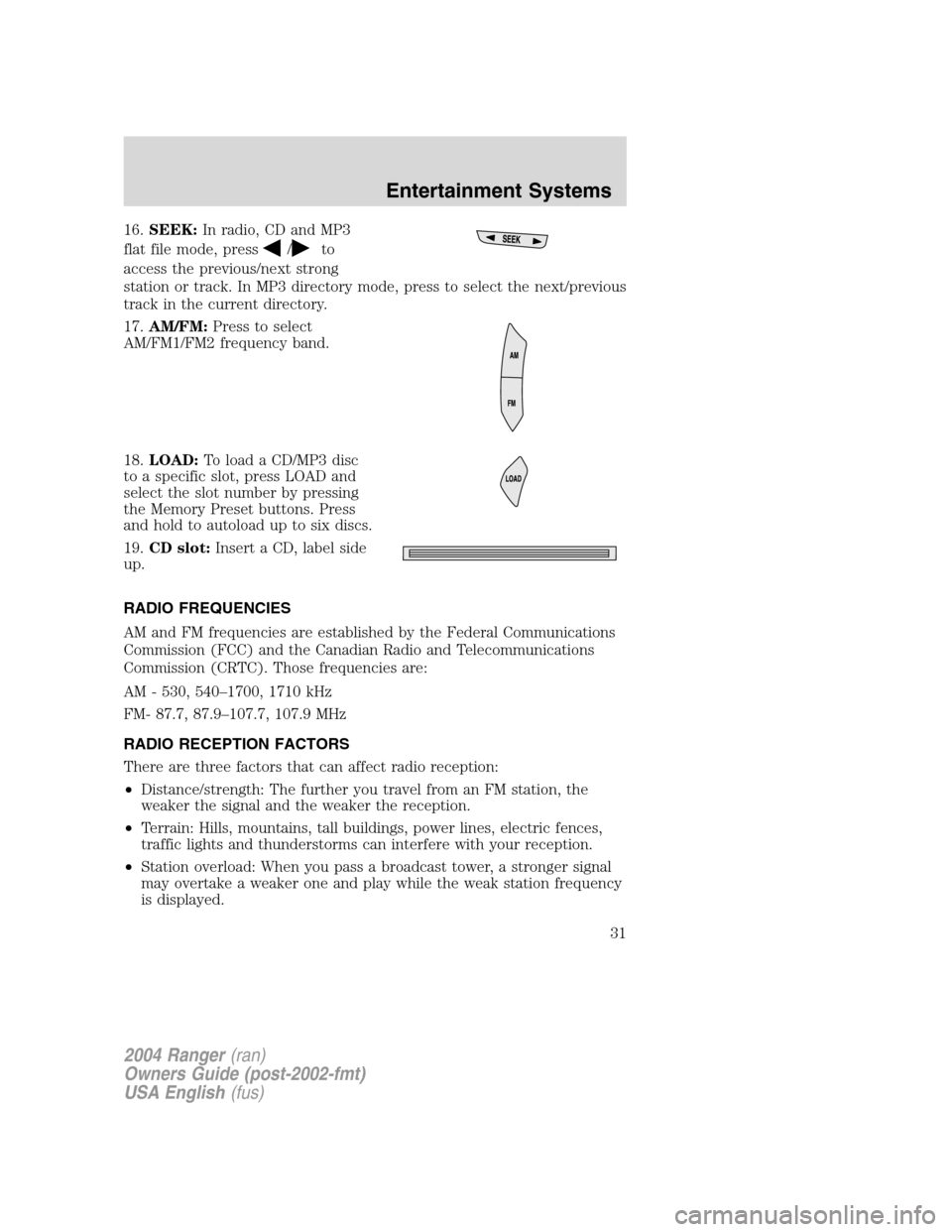
16.SEEK: In radio, CD and MP3
flat file mode, press
/to
access the previous/next strong
station or track. In MP3 directory mode, press to select the next/previous
track in the current directory.
17. AM/FM: Press to select
AM/FM1/FM2 frequency band.
18. LOAD: To load a CD/MP3 disc
to a specific slot, press LOAD and
select the slot number by pressing
the Memory Preset buttons. Press
and hold to autoload up to six discs.
19. CD slot: Insert a CD, label side
up.
RADIO FREQUENCIES
AM and FM frequencies are established by the Federal Communications
Commission (FCC) and the Canadian Radio and Telecommunications
Commission (CRTC). Those frequencies are:
AM - 530, 540 –1700, 1710 kHz
FM- 87.7, 87.9 –107.7, 107.9 MHz
RADIO RECEPTION FACTORS
There are three factors that can affect radio reception:
• Distance/strength: The further you travel from an FM station, the
weaker the signal and the weaker the reception.
• Terrain: Hills, mountains, tall buildings, power lines, electric fences,
traffic lights and thunderstorms can interfere with your reception.
• Station overload: When you pass a broadcast tower, a stronger signal
may overtake a weaker one and play while the weak station frequency
is displayed.
2004 Ranger (ran)
Owners Guide (post-2002-fmt)
USA English (fus)
Entertainment Systems
31
Page 50 of 248
Turning off speed control
There are two ways to turn off the
speed control:
•Press the speed control OFF
control.
• Turn OFF the ignition.
Note: When you turn off the speed
control or the ignition, your speed
control set speed memory is erased.
CENTER CONSOLE (IF EQUIPPED)
Your vehicle may be equipped with a
variety of console features. These
include:
• Utility compartment with
cassette/compact disc storage
• Cupholders
• Coin holder slots
• Flip up armrest
Use only soft cups in the cupholder. Hard objects can injure you
in a collision.
Cell phone use
The use of Mobile Communications Equipment has become increasingly
important in the conduct of business and personal affairs. However,
drivers must not compromise their own or others ’safety when using
such equipment. Mobile Communications can enhance personal safety
and security when appropriately used, particularly in emergency
situations. Safety must be paramount when using mobile communications
equipment to avoid negating these benefits.
Mobile Communication Equipment includes, but is not limited to cellular
phones, pagers, portable email devices, in vehicle communications
systems, telematics devices and portable two-way radios.
2004 Ranger (ran)
Owners Guide (post-2002-fmt)
USA English (fus)
Driver Controls
50
Page 54 of 248
Unlocking the doors
1. Pressand release to unlock the driver’s door. Note:The interior
lamps will illuminate.
2. Press
and release again within three seconds to unlock all the
doors.
Locking the doors
• Pressand release to lock all the doors. The park lamps will flash
once to confirm lock; if any of the doors are not properly closed, the
lamps will not flash.
Sounding a panic alarm
Press
to activate the alarm. The horn will sound for a maximum of
30 seconds and the parklamps will flash for a maximum of 3 minutes.
Press again or turn the ignition to ON to deactivate, or wait for the alarm
to timeout in 3 minutes.
Note: The panic alarm will only operate when the ignition is in the OFF
or ACC position.
Replacing the battery
The remote entry transmitter uses one coin type three-volt lithium
battery CR2032 or equivalent. The typical operating range for your
remote entry transmitter is approximately 10 meters (33 feet). A
decrease in the operating range could be caused by:
• weather conditions,
• nearby radio towers,
• structures around the vehicle and
• other vehicles parked next to the vehicle.
2004 Ranger (ran)
Owners Guide (post-2002-fmt)
USA English (fus)
Locks and Security
54
Page 96 of 248
STARTING
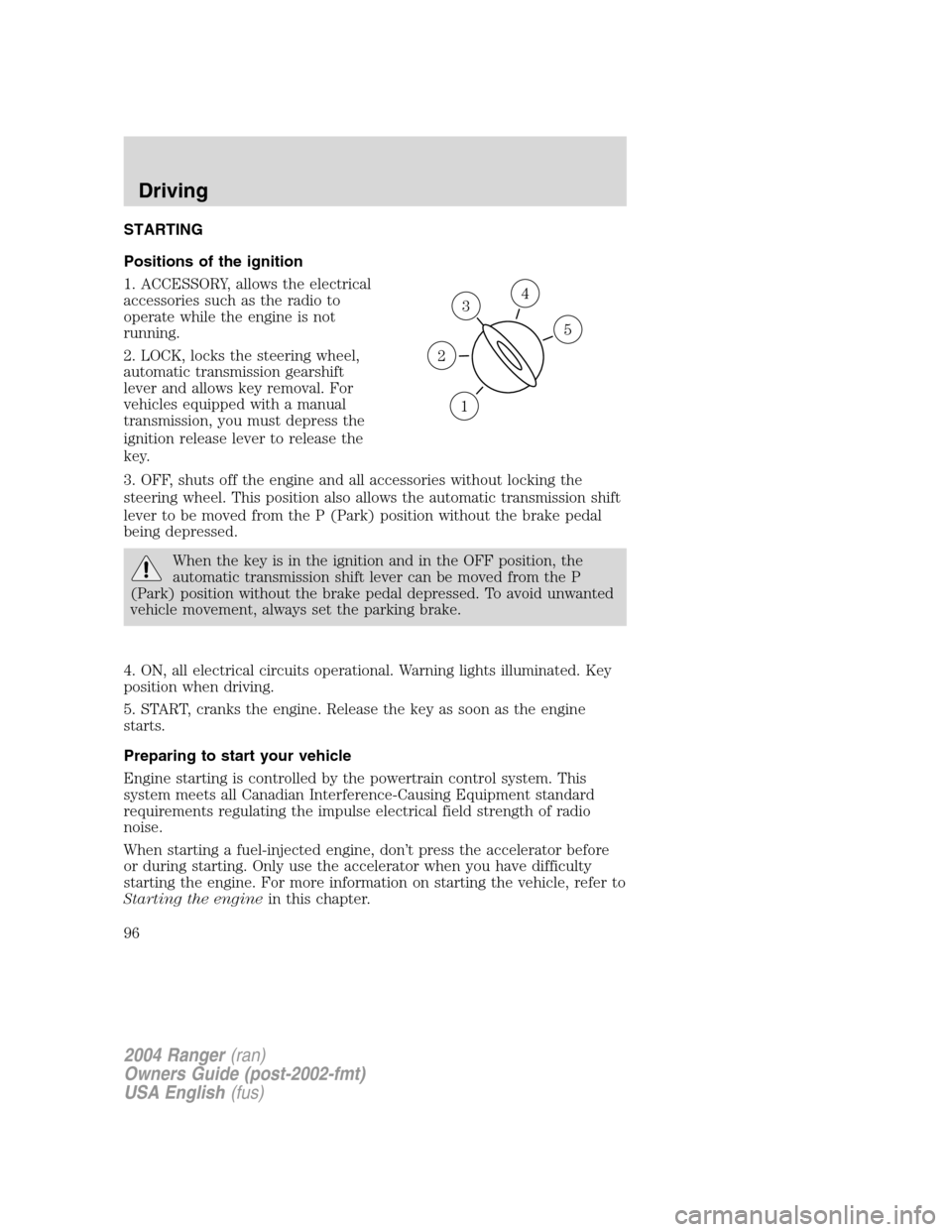
Positions of the ignition
1. ACCESSORY, allows the electrical
accessories such as the radio to
operate while the engine is not
running.
2. LOCK, locks the steering wheel,
automatic transmission gearshift
lever and allows key removal. For
vehicles equipped with a manual
transmission, you must depress the
ignition release lever to release the
key.
3. OFF, shuts off the engine and all accessories without locking the
steering wheel. This position also allows the automatic transmission shift
lever to be moved from the P (Park) position without the brake pedal
being depressed.
When the key is in the ignition and in the OFF position, the
automatic transmission shift lever can be moved from the P
(Park) position without the brake pedal depressed. To avoid unwanted
vehicle movement, always set the parking brake.
4. ON, all electrical circuits operational. Warning lights illuminated. Key
position when driving.
5. START, cranks the engine. Release the key as soon as the engine
starts.
Preparing to start your vehicle
Engine starting is controlled by the powertrain control system. This
system meets all Canadian Interference-Causing Equipment standard
requirements regulating the impulse electrical field strength of radio
noise.
When starting a fuel-injected engine, don ’t press the accelerator before
or during starting. Only use the accelerator when you have difficulty
starting the engine. For more information on starting the vehicle, refer to
Starting the engine in this chapter.
3
1
2
5
4
2004 Ranger(ran)
Owners Guide (post-2002-fmt)
USA English (fus)
Driving
Driving
96
Page 136 of 248
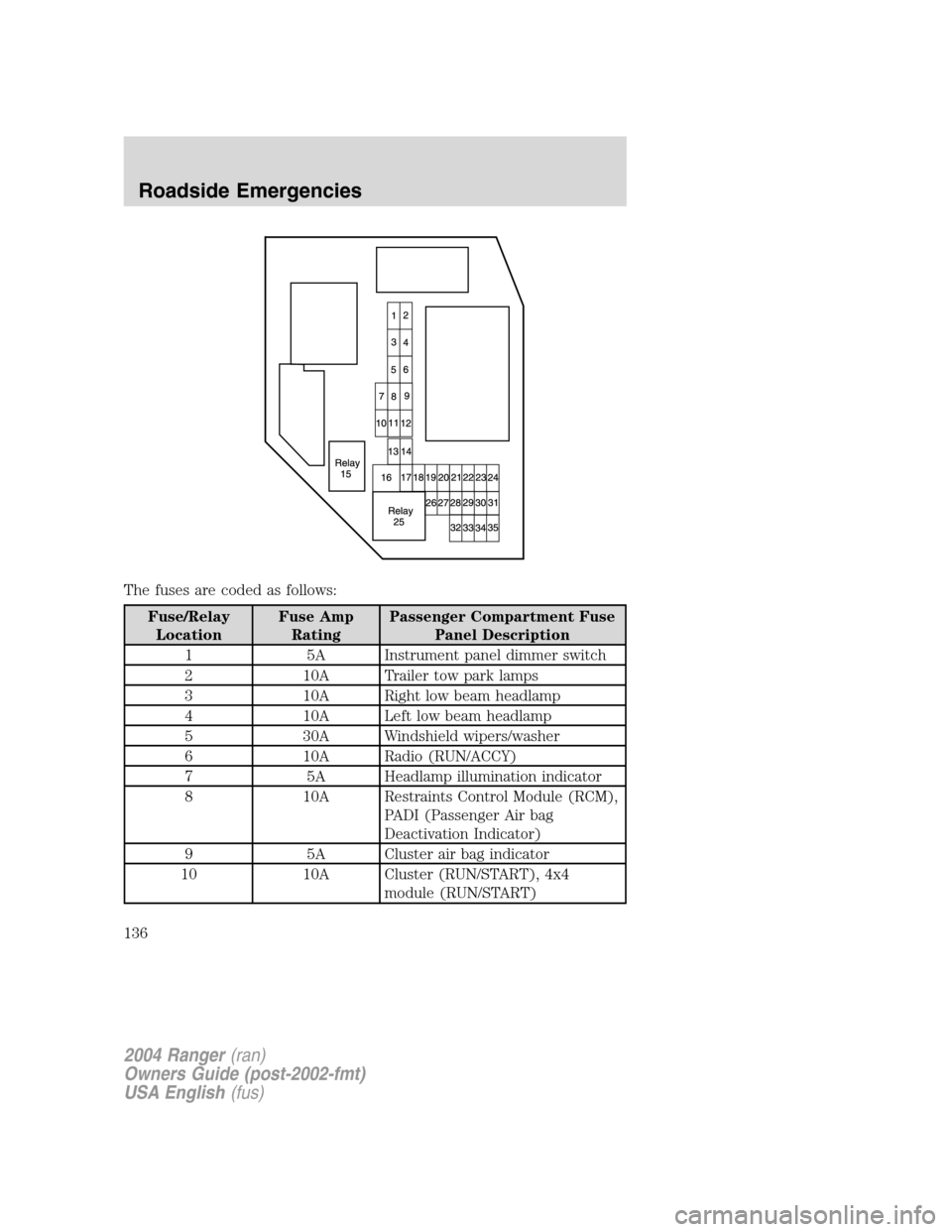
The fuses are coded as follows:
Fuse/RelayLocation Fuse Amp
Rating Passenger Compartment Fuse
Panel Description
1 5A Instrument panel dimmer switch
2 10A Trailer tow park lamps
3 10A Right low beam headlamp
4 10A Left low beam headlamp
5 30A Windshield wipers/washer
6 10A Radio (RUN/ACCY)
7 5A Headlamp illumination indicator
8 10A Restraints Control Module (RCM), PADI (Passenger Air bag
Deactivation Indicator)
9 5A Cluster air bag indicator
10 10A Cluster (RUN/START), 4x4 module (RUN/START)
2004 Ranger(ran)
Owners Guide (post-2002-fmt)
USA English (fus)
Roadside Emergencies
136
Page 137 of 248
Fuse/RelayLocation Fuse Amp
Rating Passenger Compartment Fuse
Panel Description
11 10A Smart Junction Box (SJB) (Logic power)
12 15A Center console subwoofer amplifier
13 15A Horn, Interior lamps
14 15A High beam headlamp, High beam indicator (cluster)
15 —One-touch down relay
16 30A cartridge fusePower windows
17 15A Turn signals/Hazards
18 —Not used
19 20A Center High-Mounted Stop Lamp (CHMSL)/Stop lamps
20 10A Anti-lock Brake System (ABS) module, Brake-shift interlock,
Speed control module, Back-up
lamps, Overdrive cancel switch,
Electronic flasher (turn/hazard)
21 5A Starter relay
22 5A Spare
23 30A Headlamps (low and high beam)
24 20A Radio
25 —Accessory relay
26 2A Brake pressure switch
27 10A Climate control blower relay/blend doors, 4x4 module
28 15A 4x4 module B+
29 20A Cigar lighter or power point, Diagnostic connector (OBD II)
30 5A Power mirrors
2004 Ranger (ran)
Owners Guide (post-2002-fmt)
USA English (fus)
Roadside Emergencies
137
Page 187 of 248
Because your vehicle’s engine is electronically controlled by a computer,
some control conditions are maintained by power from the battery. When
the battery is disconnected or a new battery is installed, the engine must
relearn its idle and fuel trim strategy for optimum driveability and
performance. To begin this process:
1. With the vehicle at a complete stop, set the parking brake.
2. Put the gearshift lever in P (Park), turn off all accessories and start
the engine.
3. Run the engine until it reaches normal operating temperature.
4. Allow the engine to idle for at least one minute.
5. Turn the A/C on and allow the engine to idle for at least one minute.
6. Drive the vehicle to complete the relearning process.
• The vehicle may need to be driven to relearn the idle and fuel trim
strategy.
• If you do not allow the engine to relearn its idle trim, the idle
quality of your vehicle may be adversely affected until the idle
trim is eventually relearned.
When the battery is disconnected or a new battery installed, the
transmission must relearn its adaptive strategy. As a result of this, the
transmission may shift firmly. This operation is considered normal and
will not affect function or durability of the transmission. Over time the
adaptive learning process will fully update transmission operation to its
optimum shift feel.
If the battery has been disconnected or a new battery has been installed,
the clock and the preset radio stations must be reset once the battery is
reconnected.
• Always dispose of automotive
batteries in a responsible manner.
Follow your local authorized
standards for disposal. Call your
local authorized recycling center
to find out more about recycling
automotive batteries.
LEAD
RETURN
RECYCLE
2004 Ranger (ran)
Owners Guide (post-2002-fmt)
USA English (fus)
Maintenance and Specifications
187
Page 238 of 248
Peace of mind
Airbag anti-theft locks
First aid and safety kits
Full vehicle covers
Locking gas cap
Navigation systems
Remote start
Vehicle security systems
For maximum vehicle performance, keep the following information in
mind when adding accessories or equipment to your vehicle:
•When adding accessories, equipment, passengers and luggage to your
vehicle, do not exceed the total weight capacity of the vehicle or of
the front or rear axle (GVWR or GAWR as indicated on the Safety
Compliance Certification label). Consult your dealer for specific weight
information.
• The Federal Communications Commission (FCC) and Canadian Radio
Telecommunications Commission (CRTC) regulate the use of mobile
communications systems —such as two-way radios, telephones and
theft alarms - that are equipped with radio transmitters. Any such
equipment installed in your vehicle should comply with FCC or CRTC
regulations and should be installed only by a qualified service
technician.
• Mobile communications systems may harm the operation of your
vehicle, particularly if they are not properly designed for automotive
use.
2004 Ranger (ran)
Owners Guide (post-2002-fmt)
USA English (fus)
Accessories
238
Page 239 of 248
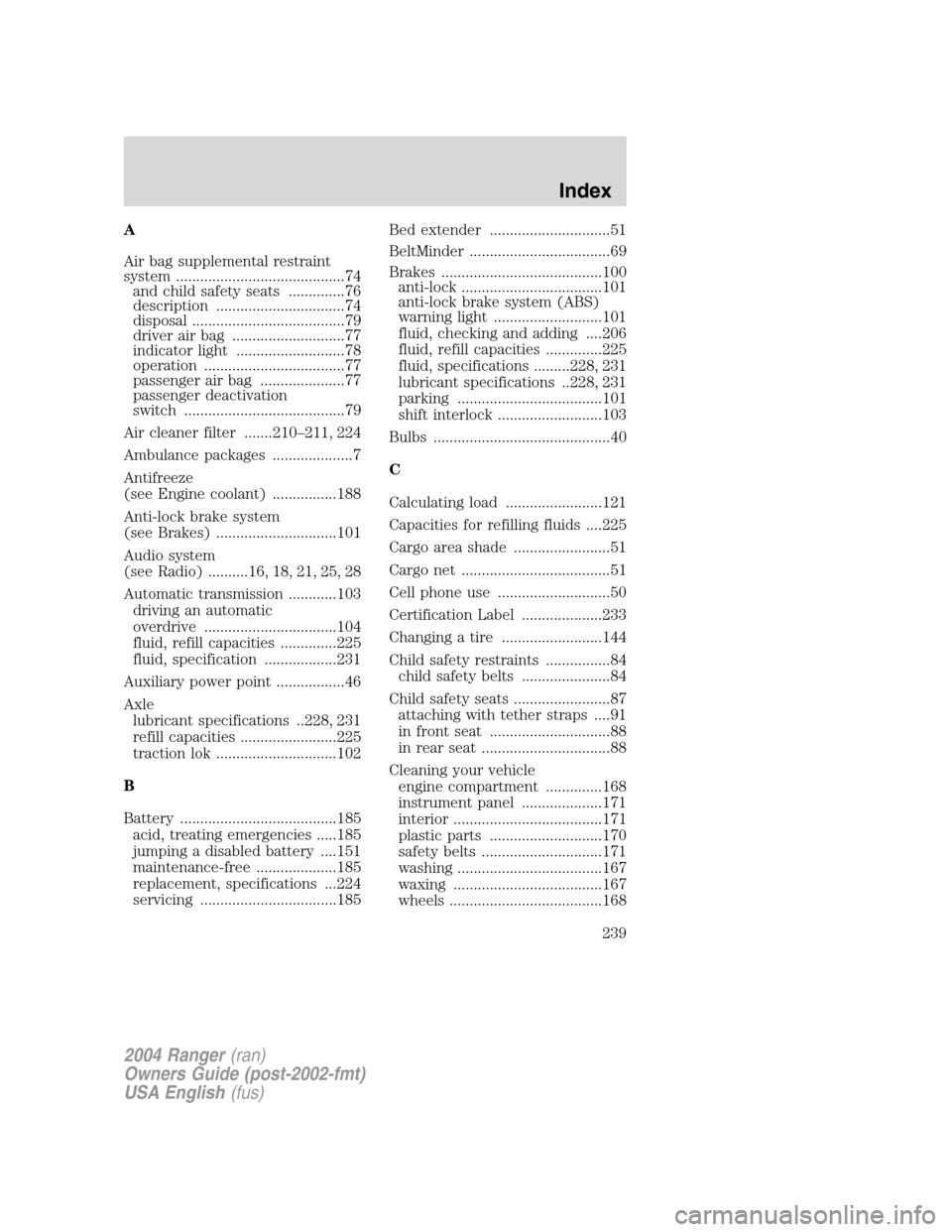
A
Air bag supplemental restraint
system ..........................................74and child safety seats ..............76
description ................................74
disposal ......................................79
driver air bag ............................77
indicator light ...........................78
operation ...................................77
passenger air bag .....................77
passenger deactivation
switch ........................................79
Air cleaner filter .......210 –211, 224
Ambulance packages ....................7
Antifreeze
(see Engine coolant) ................188
Anti-lock brake system
(see Brakes) ..............................101
Audio system
(see Radio) ..........16, 18, 21, 25, 28
Automatic transmission ............103 driving an automatic
overdrive .................................104
fluid, refill capacities ..............225
fluid, specification ..................231
Auxiliary power point .................46
Axle lubricant specifications ..228, 231
refill capacities ........................225
traction lok ..............................102
B
Battery .......................................185 acid, treating emergencies .....185
jumping a disabled battery ....151
maintenance-free ....................185
replacement, specifications ...224
servicing ..................................185 Bed extender ..............................51
BeltMinder ...................................69
Brakes ........................................100
anti-lock ...................................101
anti-lock brake system (ABS)
warning light ...........................101
fluid, checking and adding ....206
fluid, refill capacities ..............225
fluid, specifications .........228, 231
lubricant specifications ..228, 231
parking ....................................101
shift interlock ..........................103
Bulbs ............................................40
C
Calculating load ........................121
Capacities for refilling fluids ....225
Cargo area shade ........................51
Cargo net .....................................51
Cell phone use ............................50
Certification Label ....................233
Changing a tire .........................144
Child safety restraints ................84 child safety belts ......................84
Child safety seats ........................87 attaching with tether straps ....91
in front seat ..............................88
in rear seat ................................88
Cleaning your vehicle engine compartment ..............168
instrument panel ....................171
interior .....................................171
plastic parts ............................170
safety belts ..............................171
washing ....................................167
waxing .....................................167
wheels ......................................168
2004 Ranger (ran)
Owners Guide (post-2002-fmt)
USA English (fus)
Index
Index
239
Page 242 of 248
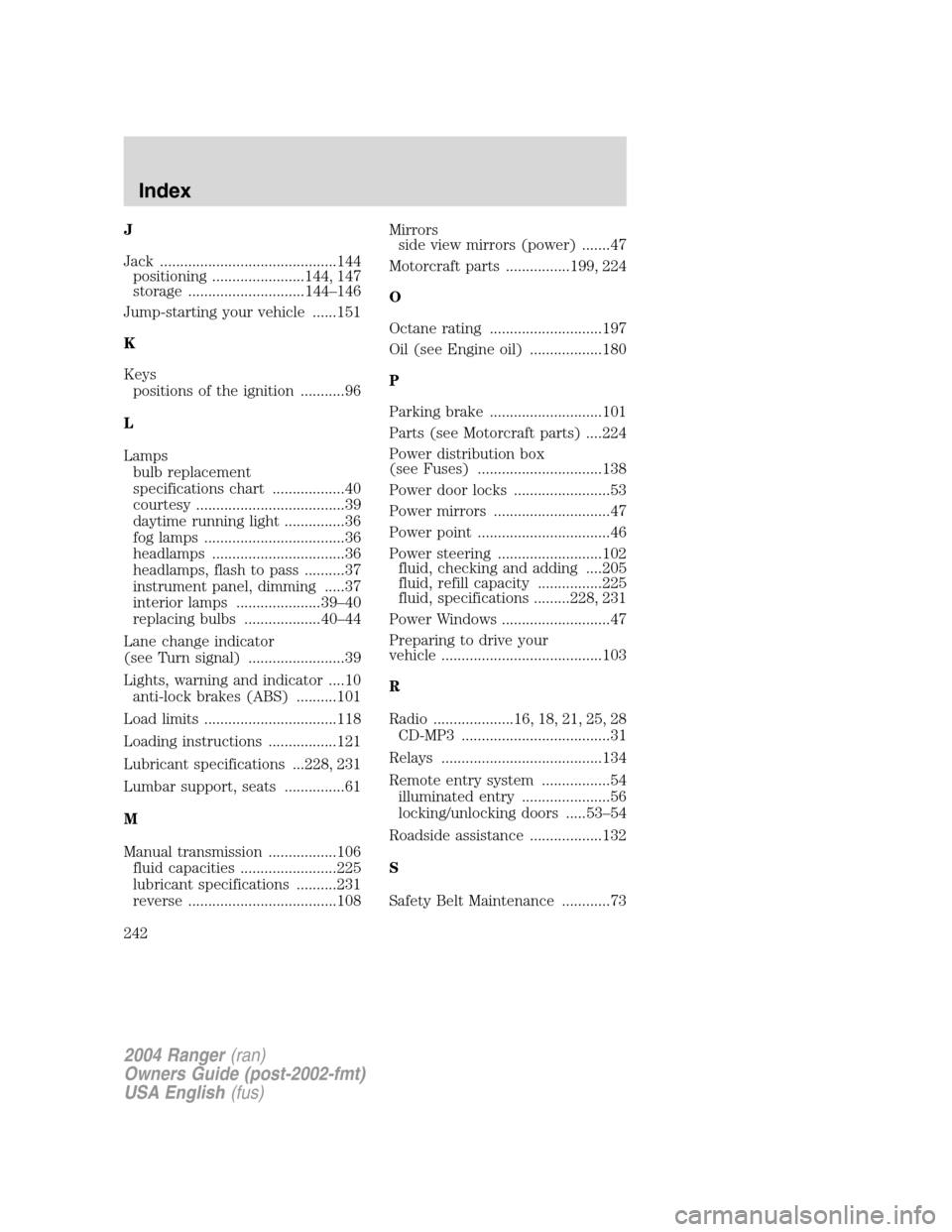
J
Jack ............................................144positioning .......................144, 147
storage .............................144 –146
Jump-starting your vehicle ......151
K
Keys positions of the ignition ...........96
L
Lamps bulb replacement
specifications chart ..................40
courtesy .....................................39
daytime running light ...............36
fog lamps ...................................36
headlamps .................................36
headlamps, flash to pass ..........37
instrument panel, dimming .....37
interior lamps .....................39 –40
replacing bulbs ...................40 –44
Lane change indicator
(see Turn signal) ........................39
Lights, warning and indicator ....10 anti-lock brakes (ABS) ..........101
Load limits .................................118
Loading instructions .................121
Lubricant specifications ...228, 231
Lumbar support, seats ...............61
M
Manual transmission .................106 fluid capacities ........................225
lubricant specifications ..........231
reverse .....................................108 Mirrors
side view mirrors (power) .......47
Motorcraft parts ................199, 224
O
Octane rating ............................197
Oil (see Engine oil) ..................180
P
Parking brake ............................101
Parts (see Motorcraft parts) ....224
Power distribution box
(see Fuses) ...............................138
Power door locks ........................53
Power mirrors .............................47
Power point .................................46
Power steering ..........................102 fluid, checking and adding ....205
fluid, refill capacity ................225
fluid, specifications .........228, 231
Power Windows ...........................47
Preparing to drive your
vehicle ........................................103
R
Radio ....................16, 18, 21, 25, 28 CD-MP3 .....................................31
Relays ........................................134
Remote entry system .................54 illuminated entry ......................56
locking/unlocking doors .....53 –54
Roadside assistance ..................132
S
Safety Belt Maintenance ............73
2004 Ranger (ran)
Owners Guide (post-2002-fmt)
USA English (fus)
Index
242