Valve FORD SIERRA 1987 2.G SOHC Engines User Guide
[x] Cancel search | Manufacturer: FORD, Model Year: 1987, Model line: SIERRA, Model: FORD SIERRA 1987 2.GPages: 24, PDF Size: 1.03 MB
Page 15 of 24
wires, hoses, pipes and cables, otherwise,
unbolt the manifold and move it to one side,
ensuring that it is adequately supported.
11If not already done, unclip any wires and
hoses from the camshaft cover, noting their
locations for use when refitting, and on fuel
injection models unbolt the bracing strut
securing the inlet manifold to the right-hand
side of the cylinder head.
12If desired, remove the thermostat and
housing, and the temperature gauge sender.
13Proceed as described in Section 21 for
cylinder head removal.
Refitting
14With the cylinder head refitted as
described in Section 21, proceed as follows.
15Where applicable, refit the temperature
gauge sender and the thermostat and
housing.
16Refit the manifolds and/or reconnect all
wires, hoses, pipes and cables, as applicable.
17Reconnect the exhaust downpipe to the
manifold, using a new gasket.
18Refit the coolant hose to the clip on the
exhaust manifold hot air shroud.
19Refit the spark plugs and reconnect the
HT leads.
20Reconnect the temperature gauge sender
wiring.
21Reconnect the coolant hoses to the
thermostat housing.
22Fill the cooling system.
23If not already done, refit any hoses and
wires to the camshaft cover, as noted during
removal, and on fuel injection models refit the
inlet manifold bracing strut. If splined type
cylinder head bolts have been used, leave
these operations until the bolts have been
finally tightened after running the engine.
24Refit the air cleaner on carburettor
models.
25Reconnect the battery negative lead.
26If splined type cylinder head bolts have
been used, start the engine and run it at 1000
rpm for 15 minutes, then stop the engine,
remove the air cleaner and the camshaft cover
as described previously, and finally tighten the
cylinder head bolts to the fourth stage (see
Specifications). Refit the camshaft cover on
completion, then refit any hoses and wires,
and on fuel injection models the inlet manifold
bracing strut. Refit the air cleaner.Note: Up to early 1984, splined type cylinder
head bolts were used, and from early 1984,
size T55 Torx bolts were used. Torx type bolts
must always be renewed after slackening. The
two types of bolts are interchangeable, but
only in complete sets - the two types must not
be mixed on the same engine. A suitable
special socket will be required for removal of
the bolts, and a new cylinder head gasket
must be used when refitting.
Removal
1With the manifolds removed, proceed as
follows.
2Remove the timing belt.
3Where applicable, disconnect the breather
hose from the camshaft cover.
4Unscrew the ten securing bolts and remove
the camshaft cover and gasket. Take care not
to lose the spacer plates which fit under the
bolt heads, where applicable.
5Using the relevant special socket, unscrew
the ten cylinder head bolts half a turn at a time
in the reverse order to that shown for
tightening.
6With the bolts removed, lift the cylinder
head from the block. If the cylinder head is
stuck, tap it free with a wooden mallet. Place
the cylinder head on blocks of wood to
prevent damage to the valves.
7Recover the gasket.
Refitting
8Commence refitting as follows.
9With the cylinder head supported on blocks
of wood, check and if necessary adjust thevalve clearances. This work is easier to carry
out on the bench rather than in the vehicle.
10Turn the crankshaft so that No 1 piston is
approximately 20 mm (0.8 in) before TDC.
This precaution will prevent any damage to
open valves.
11Make sure that the mating faces of the
cylinder block and cylinder head are perfectly
clean, then locate the new gasket on the
block making sure that all the internal holes
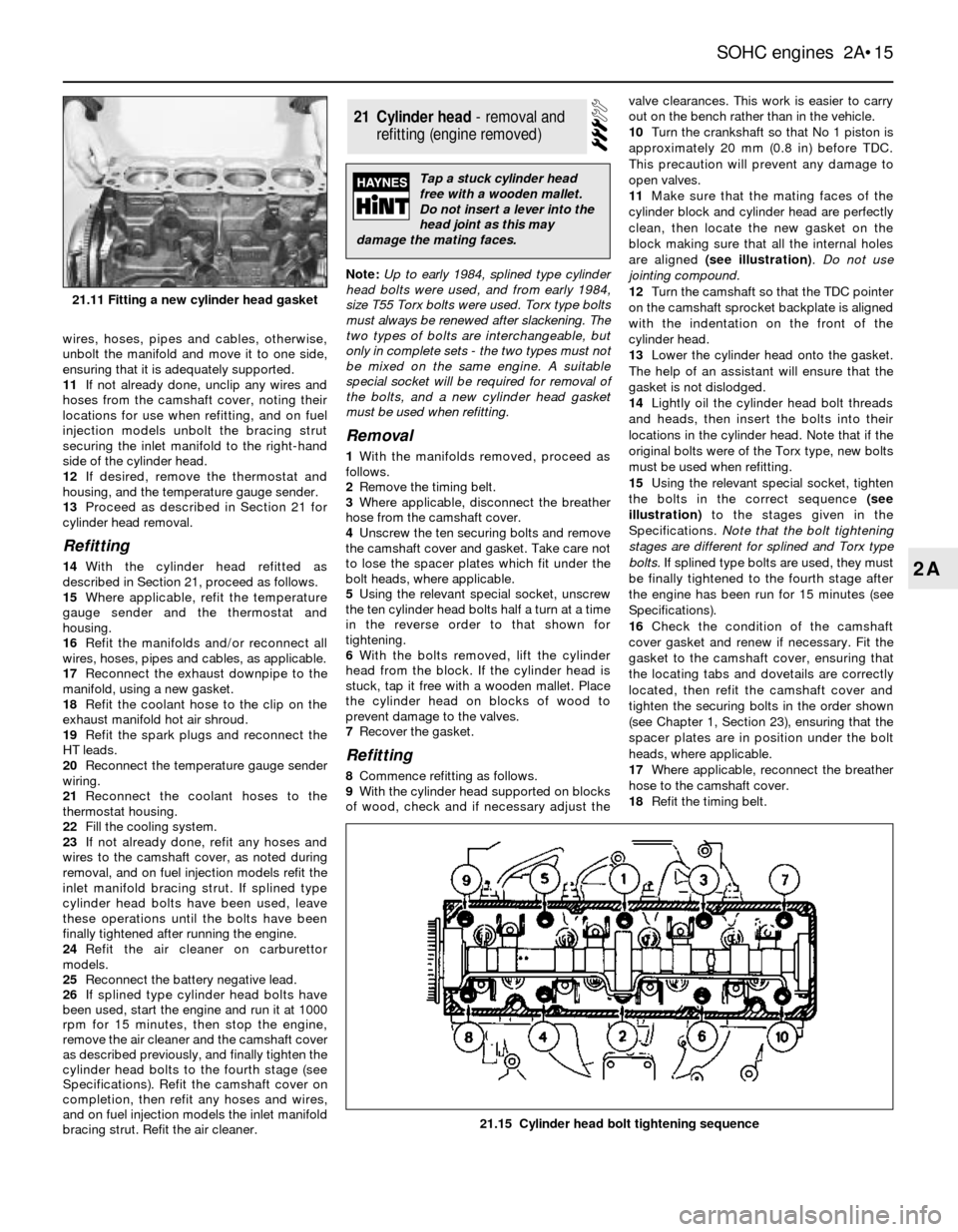
are aligned (see illustration). Do not use
jointing compound.
12Turn the camshaft so that the TDC pointer
on the camshaft sprocket backplate is aligned
with the indentation on the front of the
cylinder head.
13Lower the cylinder head onto the gasket.
The help of an assistant will ensure that the
gasket is not dislodged.
14Lightly oil the cylinder head bolt threads
and heads, then insert the bolts into their
locations in the cylinder head. Note that if the
original bolts were of the Torx type, new bolts
must be used when refitting.
15Using the relevant special socket, tighten
the bolts in the correct sequence (see
illustration)to the stages given in the
Specifications. Note that the bolt tightening
stages are different for splined and Torx type
bolts. If splined type bolts are used, they must
be finally tightened to the fourth stage after
the engine has been run for 15 minutes (see
Specifications).
16Check the condition of the camshaft
cover gasket and renew if necessary. Fit the
gasket to the camshaft cover, ensuring that
the locating tabs and dovetails are correctly
located, then refit the camshaft cover and
tighten the securing bolts in the order shown
(see Chapter 1, Section 23), ensuring that the
spacer plates are in position under the bolt
heads, where applicable.
17Where applicable, reconnect the breather
hose to the camshaft cover.
18Refit the timing belt.
21Cylinder head - removal and
refitting (engine removed)
SOHC engines 2A¥15
2A
21.15 Cylinder head bolt tightening sequence
21.11 Fitting a new cylinder head gasket
Tap a stuck cylinder head
free with a wooden mallet.
Do not insert a lever into the
head joint as this may
damage the mating faces.
Page 16 of 24
Note: A valve spring compressor will be
required during this procedure. New valve
stem oil seals should be used on reassembly.
Dismantling
1With the cylinder head removed, remove
the camshaft.
2Using a valve spring compressor, compress
one of the valve springs until the split collets
can be removed from the groove in the valve
stem. Release the compressor and remove
the cap and spring, identifying them for
location. If the cap is difficult to release, do
not continue to tighten the compressor, but
gently tap the top of the tool with a hammer.
Always make sure that the compressor is
firmly located on the valve head and the cap.
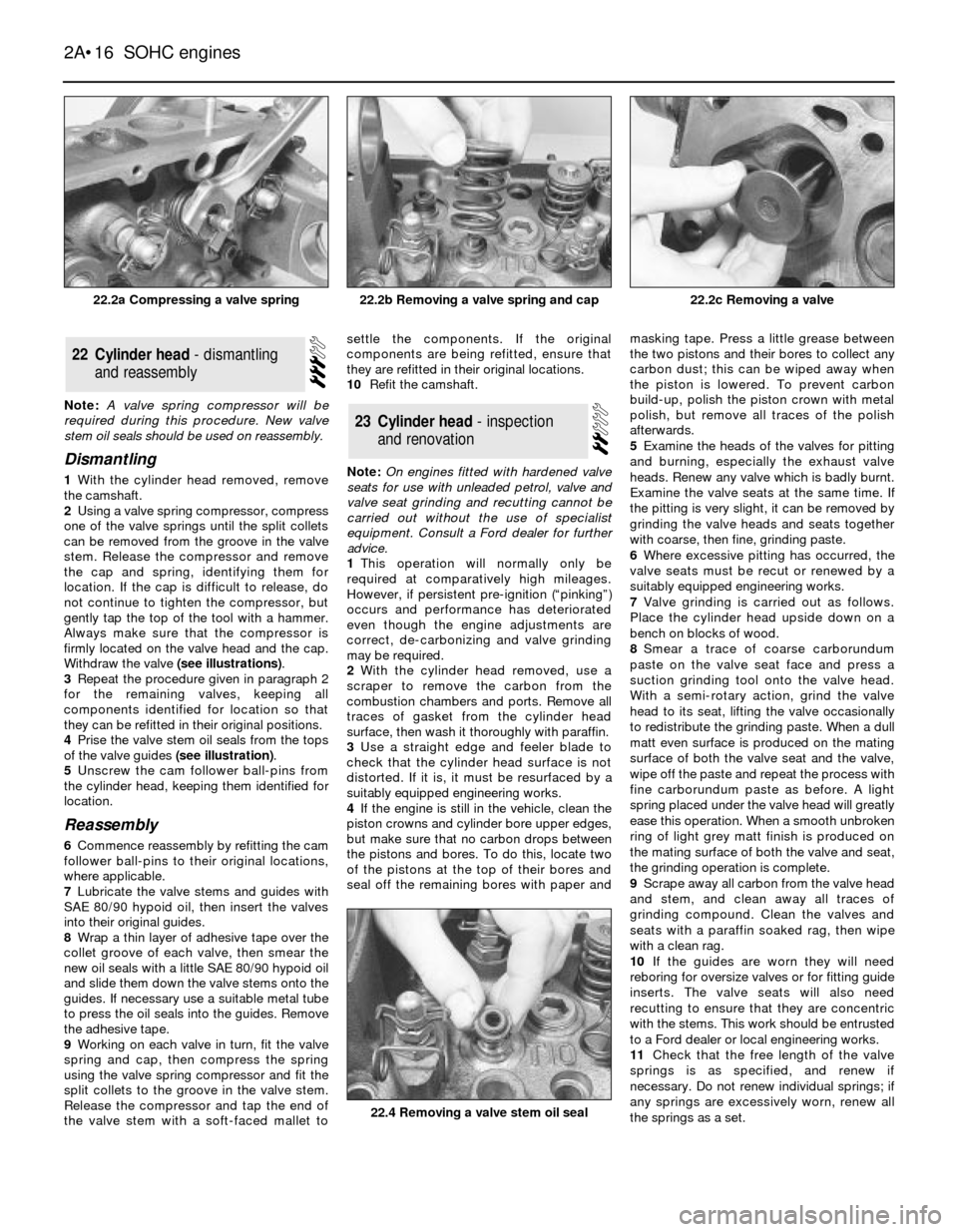
Withdraw the valve (see illustrations).
3Repeat the procedure given in paragraph 2
for the remaining valves, keeping all
components identified for location so that
they can be refitted in their original positions.
4Prise the valve stem oil seals from the tops
of the valve guides (see illustration).
5Unscrew the cam follower ball-pins from
the cylinder head, keeping them identified for
location.
Reassembly
6Commence reassembly by refitting the cam
follower ball-pins to their original locations,
where applicable.
7Lubricate the valve stems and guides with
SAE 80/90 hypoid oil, then insert the valves
into their original guides.
8Wrap a thin layer of adhesive tape over the
collet groove of each valve, then smear the
new oil seals with a little SAE 80/90 hypoid oil
and slide them down the valve stems onto the
guides. If necessary use a suitable metal tube
to press the oil seals into the guides. Remove
the adhesive tape.
9Working on each valve in turn, fit the valve
spring and cap, then compress the spring
using the valve spring compressor and fit the
split collets to the groove in the valve stem.
Release the compressor and tap the end of
the valve stem with a soft-faced mallet tosettle the components. If the original
components are being refitted, ensure that
they are refitted in their original locations.
10Refit the camshaft.
Note: On engines fitted with hardened valve
seats for use with unleaded petrol, valve and
valve seat grinding and recutting cannot be
carried out without the use of specialist
equipment. Consult a Ford dealer for further
advice.
1This operation will normally only be
required at comparatively high mileages.
However, if persistent pre-ignition (ÒpinkingÓ)
occurs and performance has deteriorated
even though the engine adjustments are
correct, de-carbonizing and valve grinding
may be required.
2With the cylinder head removed, use a
scraper to remove the carbon from the
combustion chambers and ports. Remove all
traces of gasket from the cylinder head
surface, then wash it thoroughly with paraffin.
3Use a straight edge and feeler blade to
check that the cylinder head surface is not
distorted. If it is, it must be resurfaced by a
suitably equipped engineering works.
4If the engine is still in the vehicle, clean the
piston crowns and cylinder bore upper edges,
but make sure that no carbon drops between
the pistons and bores. To do this, locate two
of the pistons at the top of their bores and
seal off the remaining bores with paper andmasking tape. Press a little grease between
the two pistons and their bores to collect any
carbon dust; this can be wiped away when
the piston is lowered. To prevent carbon
build-up, polish the piston crown with metal
polish, but remove all traces of the polish
afterwards.
5Examine the heads of the valves for pitting
and burning, especially the exhaust valve
heads. Renew any valve which is badly burnt.
Examine the valve seats at the same time. If
the pitting is very slight, it can be removed by
grinding the valve heads and seats together
with coarse, then fine, grinding paste.
6Where excessive pitting has occurred, the
valve seats must be recut or renewed by a
suitably equipped engineering works.
7Valve grinding is carried out as follows.
Place the cylinder head upside down on a
bench on blocks of wood.
8Smear a trace of coarse carborundum
paste on the valve seat face and press a
suction grinding tool onto the valve head.
With a semi-rotary action, grind the valve
head to its seat, lifting the valve occasionally
to redistribute the grinding paste. When a dull
matt even surface is produced on the mating
surface of both the valve seat and the valve,
wipe off the paste and repeat the process with
fine carborundum paste as before. A light
spring placed under the valve head will greatly
ease this operation. When a smooth unbroken
ring of light grey matt finish is produced on
the mating surface of both the valve and seat,
the grinding operation is complete.
9Scrape away all carbon from the valve head
and stem, and clean away all traces of
grinding compound. Clean the valves and
seats with a paraffin soaked rag, then wipe
with a clean rag.
10If the guides are worn they will need
reboring for oversize valves or for fitting guide
inserts. The valve seats will also need
recutting to ensure that they are concentric
with the stems. This work should be entrusted
to a Ford dealer or local engineering works.
11Check that the free length of the valve
springs is as specified, and renew if
necessary. Do not renew individual springs; if
any springs are excessively worn, renew all
the springs as a set.
23Cylinder head - inspection
and renovation
22Cylinder head - dismantling
and reassembly
2A¥16SOHC engines
22.2a Compressing a valve spring22.2c Removing a valve
22.4 Removing a valve stem oil seal
22.2b Removing a valve spring and cap
Page 17 of 24
Note: A new camshaft oil seal should be used
when refitting the camshaft.
Removal
1Remove the cylinder head.
2Hold the camshaft stationary using a
suitable spanner on the cast boss behind the
No 6 valve cam, and unscrew the camshaft
sprocket bolt and washer.
3Remove the camshaft sprocket, using a
suitable puller if necessary, and withdraw the
sprocket backplate, noting which way round it
is fitted.
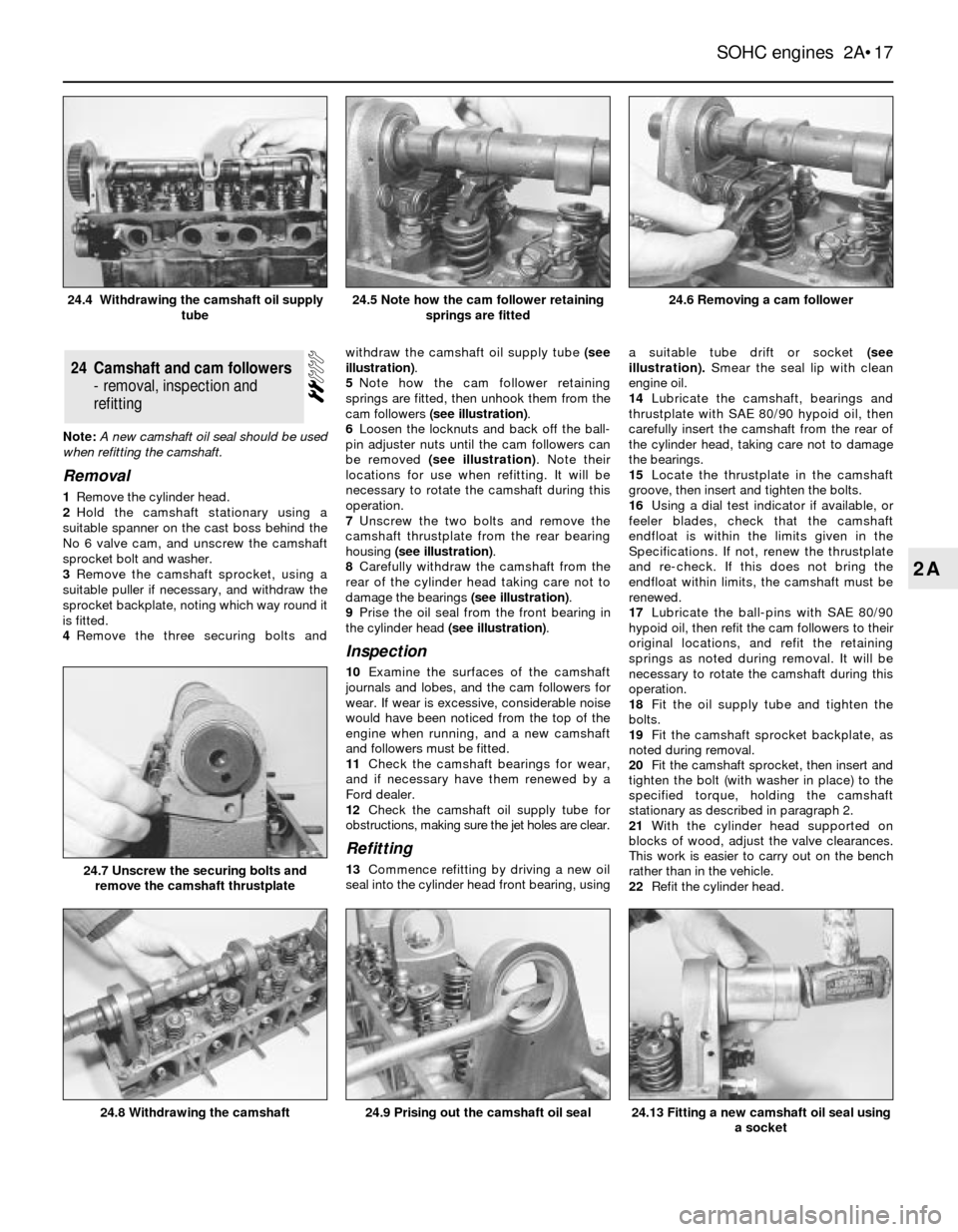
4Remove the three securing bolts andwithdraw the camshaft oil supply tube (see
illustration).
5Note how the cam follower retaining
springs are fitted, then unhook them from the
cam followers (see illustration).
6Loosen the locknuts and back off the ball-
pin adjuster nuts until the cam followers can
be removed (see illustration). Note their
locations for use when refitting. It will be
necessary to rotate the camshaft during this
operation.
7Unscrew the two bolts and remove the
camshaft thrustplate from the rear bearing
housing (see illustration).
8Carefully withdraw the camshaft from the
rear of the cylinder head taking care not to
damage the bearings (see illustration).
9Prise the oil seal from the front bearing in
the cylinder head (see illustration).
Inspection
10Examine the surfaces of the camshaft
journals and lobes, and the cam followers for
wear. If wear is excessive, considerable noise
would have been noticed from the top of the
engine when running, and a new camshaft
and followers must be fitted.
11Check the camshaft bearings for wear,
and if necessary have them renewed by a
Ford dealer.
12Check the camshaft oil supply tube for
obstructions, making sure the jet holes are clear.
Refitting
13Commence refitting by driving a new oil
seal into the cylinder head front bearing, usinga suitable tube drift or socket(see
illustration).Smear the seal lip with clean
engine oil.
14Lubricate the camshaft, bearings and
thrustplate with SAE 80/90 hypoid oil, then
carefully insert the camshaft from the rear of
the cylinder head, taking care not to damage
the bearings.
15Locate the thrustplate in the camshaft
groove, then insert and tighten the bolts.
16Using a dial test indicator if available, or
feelerblades, check that the camshaft
endfloat is within the limits given in the
Specifications. If not, renew the thrustplate
and re-check. If this does not bring the
endfloat within limits, the camshaft must be
renewed.
17Lubricate the ball-pins with SAE 80/90
hypoid oil, then refit the cam followers to their
original locations, and refit the retaining
springs as noted during removal. It will be
necessary to rotate the camshaft during this
operation.
18Fit the oil supply tube and tighten the
bolts.
19Fit the camshaft sprocket backplate, as
noted during removal.
20Fit the camshaft sprocket, then insert and
tighten the bolt (with washer in place) to the
specified torque, holding the camshaft
stationary as described in paragraph 2.
21With the cylinder head supported on
blocks of wood, adjust the valve clearances.
This work is easier to carry out on the bench
rather than in the vehicle.
22Refit the cylinder head.
24Camshaft and cam followers
- removal, inspection and
refitting
SOHC engines 2A¥17
2A
24.6 Removing a cam follower
24.13 Fitting a new camshaft oil seal using
a socket24.9 Prising out the camshaft oil seal24.8 Withdrawing the camshaft
24.7 Unscrew the securing bolts and
remove the camshaft thrustplate
24.5 Note how the cam follower retaining
springs are fitted24.4 Withdrawing the camshaft oil supply
tube
Page 21 of 24
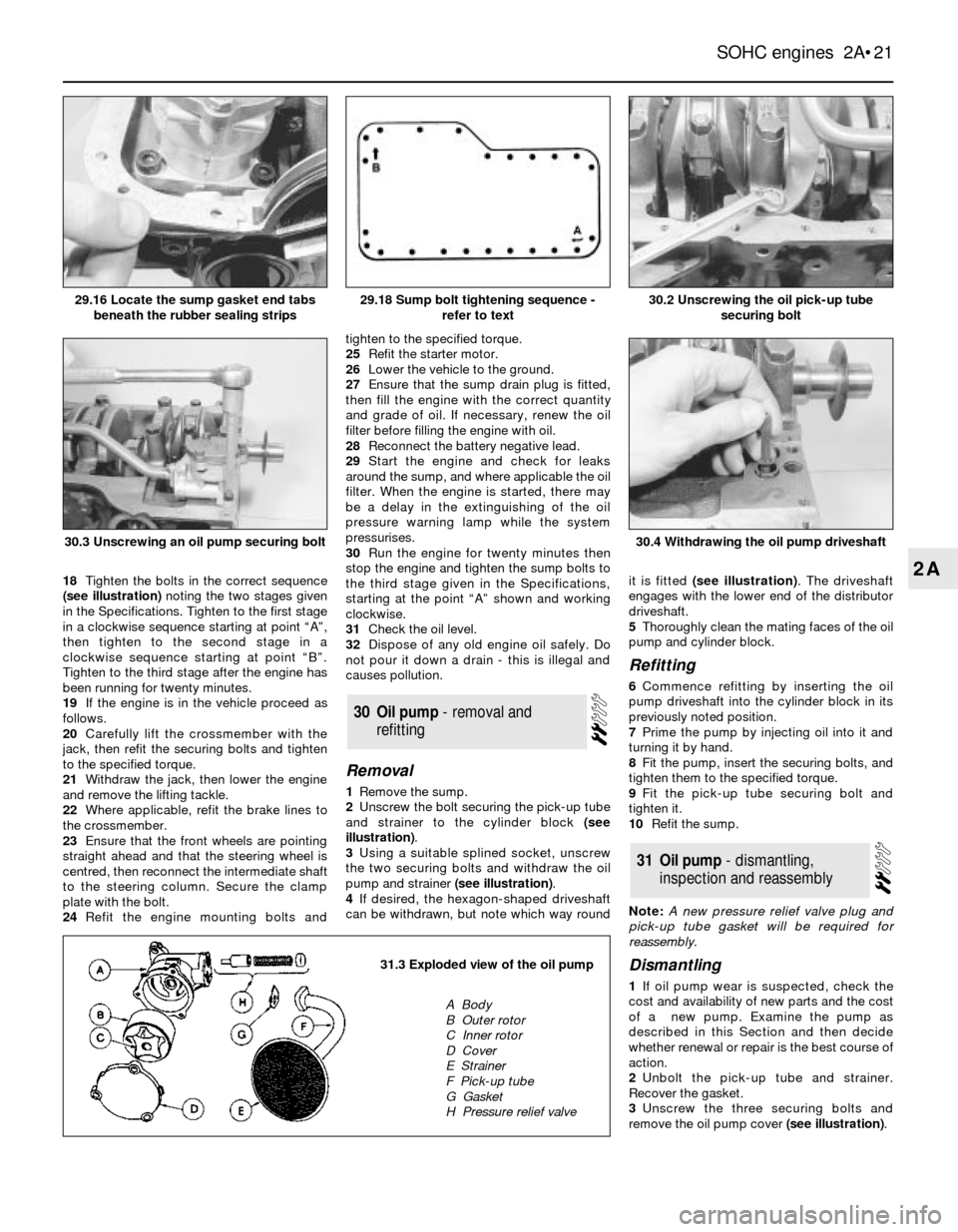
18Tighten the bolts in the correct sequence
(see illustration)noting the two stages given
in the Specifications. Tighten to the first stage
in a clockwise sequence starting at point ÒAÓ,
then tighten to the second stage in a
clockwise sequence starting at point ÒBÓ.
Tighten to the third stage after the engine has
been running for twenty minutes.
19If the engine is in the vehicle proceed as
follows.
20Carefully lift the crossmember with the
jack, then refit the securing bolts and tighten
to the specified torque.
21Withdraw the jack, then lower the engine
and remove the lifting tackle.
22Where applicable, refit the brake lines to
the crossmember.
23Ensure that the front wheels are pointing
straight ahead and that the steering wheel is
centred, then reconnect the intermediate shaft
to the steering column. Secure the clamp
plate with the bolt.
24Refit the engine mounting bolts andtighten to the specified torque.
25Refit the starter motor.
26Lower the vehicle to the ground.
27Ensure that the sump drain plug is fitted,
then fill the engine with the correct quantity
and grade of oil. If necessary, renew the oil
filter before filling the engine with oil.
28Reconnect the battery negative lead.
29Start the engine and check for leaks
around the sump, and where applicable the oil
filter. When the engine is started, there may
be a delay in the extinguishing of the oil
pressure warning lamp while the system
pressurises.
30Run the engine for twenty minutes then
stop the engine and tighten the sump bolts to
the third stage given in the Specifications,
starting at the point ÒAÓ shown and working
clockwise.
31Check the oil level.
32Dispose of any old engine oil safely. Do
not pour it down a drain - this is illegal and
causes pollution.
Removal
1Remove the sump.
2Unscrew the bolt securing the pick-up tube
and strainer to the cylinder block (see
illustration).
3Using a suitable splined socket, unscrew
the two securing bolts and withdraw the oil
pump and strainer (see illustration).
4If desired, the hexagon-shaped driveshaft
can be withdrawn, but note which way roundit is fitted (see illustration). The driveshaft
engages with the lower end of the distributor
driveshaft.
5Thoroughly clean the mating faces of the oil
pump and cylinder block.
Refitting
6Commence refitting by inserting the oil
pump driveshaft into the cylinder block in its
previously noted position.
7Prime the pump by injecting oil into it and
turning it by hand.
8Fit the pump, insert the securing bolts, and
tighten them to the specified torque.
9Fit the pick-up tube securing bolt and
tighten it.
10Refit the sump.
Note: A new pressure relief valve plug and
pick-up tube gasket will be required for
reassembly.
Dismantling
1If oil pump wear is suspected, check the
cost and availability of new parts and the cost
of a new pump. Examine the pump as
described in this Section and then decide
whether renewal or repair is the best course of
action.
2Unbolt the pick-up tube and strainer.
Recover the gasket.
3Unscrew the three securing bolts and
remove the oil pump cover (see illustration).
31Oil pump - dismantling,
inspection and reassembly
30Oil pump - removal and
refitting
SOHC engines 2A¥21
2A
30.2 Unscrewing the oil pick-up tube
securing bolt
30.4 Withdrawing the oil pump driveshaft30.3 Unscrewing an oil pump securing bolt
29.18 Sump bolt tightening sequence -
refer to text29.16 Locate the sump gasket end tabs
beneath the rubber sealing strips
31.3 Exploded view of the oil pump
A Body
B Outer rotor
C Inner rotor
D Cover
E Strainer
F Pick-up tube
G Gasket
H Pressure relief valve
Page 22 of 24
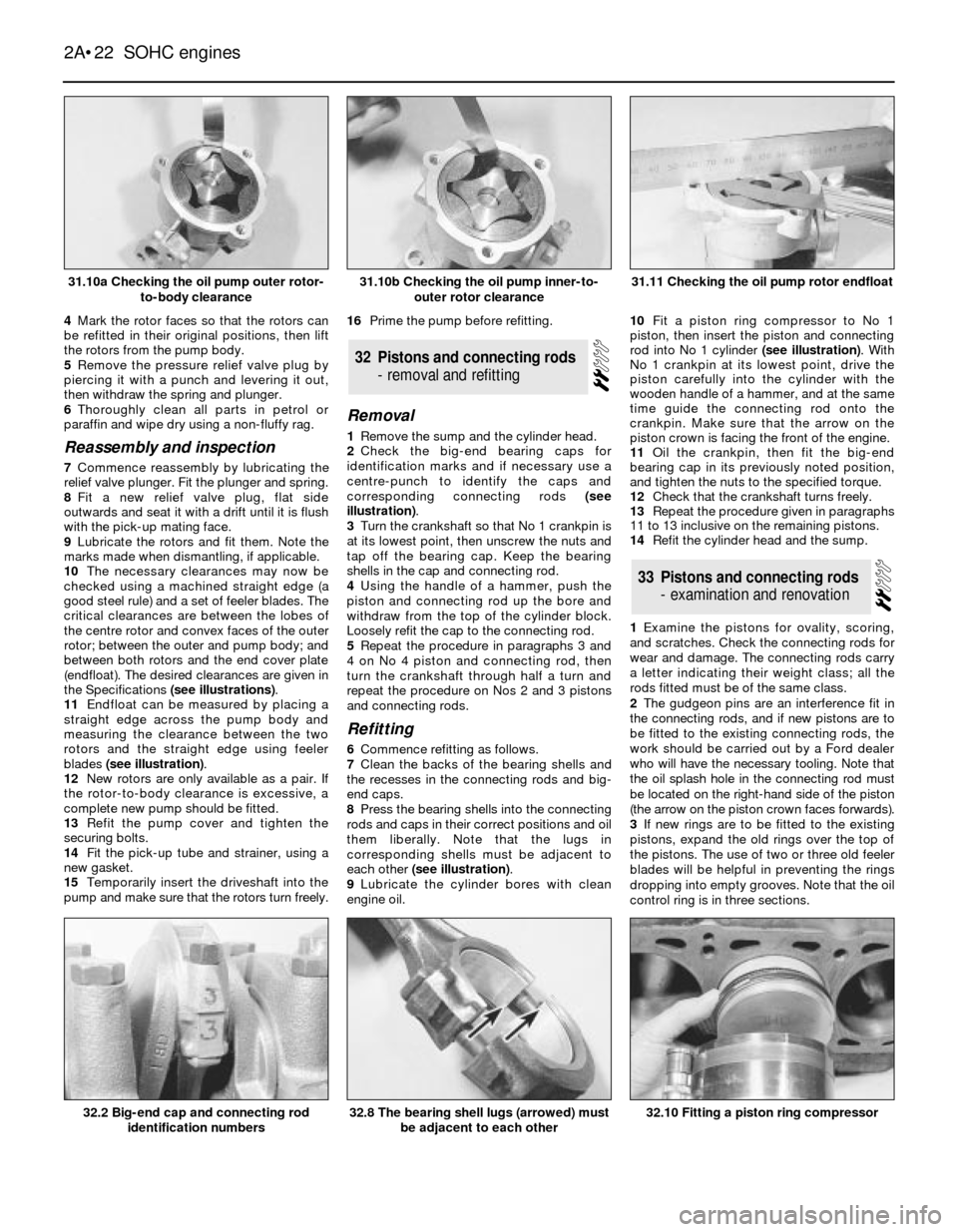
4Mark the rotor faces so that the rotors can
be refitted in their original positions, then lift
the rotors from the pump body.
5Remove the pressure relief valve plug by
piercing it with a punch and levering it out,
then withdraw the spring and plunger.
6Thoroughly clean all parts in petrol or
paraffin and wipe dry using a non-fluffy rag.
Reassembly and inspection
7Commence reassembly by lubricating the
relief valve plunger. Fit the plunger and spring.
8Fit a new relief valve plug, flat side
outwards and seat it with a drift until it is flush
with the pick-up mating face.
9Lubricate the rotors and fit them. Note the
marks made when dismantling, if applicable.
10The necessary clearances may now be
checked using a machined straight edge (a
good steel rule) and a set of feelerblades. The
critical clearances are between the lobes of
the centre rotor and convex faces of the outer
rotor; between the outer and pump body; and
between both rotors and the end cover plate
(endfloat). The desired clearances are given in
the Specifications (see illustrations).
11Endfloat can be measured by placing a
straight edge across the pump body and
measuring the clearance between the two
rotors and the straight edge using feeler
blades (see illustration).
12New rotors are only available as a pair. If
the rotor-to-body clearance is excessive, a
complete new pump should be fitted.
13Refit the pump cover and tighten the
securing bolts.
14Fit the pick-up tube and strainer, using a
new gasket.
15Temporarily insert the driveshaft into the
pump and make sure that the rotors turn freely.16Prime the pump before refitting.
Removal
1Remove the sump and the cylinder head.
2Check the big-end bearing caps for
identification marks and if necessary use a
centre-punch to identify the caps and
corresponding connecting rods (see
illustration).
3Turn the crankshaft so that No 1 crankpin is
at its lowest point, then unscrew the nuts and
tap off the bearing cap. Keep the bearing
shells in the cap and connecting rod.
4Using the handle of a hammer, push the
piston and connecting rod up the bore and
withdraw from the top of the cylinder block.
Loosely refit the cap to the connecting rod.
5Repeat the procedure in paragraphs 3 and
4 on No 4 piston and connecting rod, then
turn the crankshaft through half a turn and
repeat the procedure on Nos 2 and 3 pistons
and connecting rods.
Refitting
6Commence refitting as follows.
7Clean the backs of the bearing shells and
the recesses in the connecting rods and big-
end caps.
8Press the bearing shells into the connecting
rods and caps in their correct positions and oil
them liberally. Note that the lugs in
corresponding shells must be adjacent to
each other (see illustration).
9Lubricate the cylinder bores with clean
engine oil.10Fit a piston ring compressor to No 1
piston, then insert the piston and connecting
rod into No 1 cylinder (see illustration). With
No 1 crankpin at its lowest point, drive the
piston carefully into the cylinder with the
wooden handle of a hammer, and at the same
time guide the connecting rod onto the
crankpin. Make sure that the arrow on the
piston crown is facing the front of the engine.
11Oil the crankpin, then fit the big-end
bearing cap in its previously noted position,
and tighten the nuts to the specified torque.
12Check that the crankshaft turns freely.
13Repeat the procedure given in paragraphs
11 to 13 inclusive on the remaining pistons.
14Refit the cylinder head and the sump.
1Examine the pistons for ovality, scoring,
and scratches. Check the connecting rods for
wear and damage. The connecting rods carry
a letter indicating their weight class; all the
rods fitted must be of the same class.
2The gudgeon pins are an interference fit in
the connecting rods, and if new pistons are to
be fitted to the existing connecting rods, the
work should be carried out by a Ford dealer
who will have the necessary tooling. Note that
the oil splash hole in the connecting rod must
be located on the right-hand side of the piston
(the arrow on the piston crown faces forwards).
3If new rings are to be fitted to the existing
pistons, expand the old rings over the top of
the pistons. The use of two or three old feeler
blades will be helpful in preventing the rings
dropping into empty grooves. Note that the oil
control ring is in three sections.
33Pistons and connecting rods
- examination and renovation
32Pistons and connecting rods
- removal and refitting
2A¥22SOHC engines
31.10a Checking the oil pump outer rotor-
to-body clearance31.11 Checking the oil pump rotor endfloat
32.10 Fitting a piston ring compressor32.8 The bearing shell lugs (arrowed) must
be adjacent to each other32.2 Big-end cap and connecting rod
identification numbers
31.10b Checking the oil pump inner-to-
outer rotor clearance
Page 24 of 24
components, but there must be no tight spots
or binding.
28Check that the crankshaft endfloat is
within the specified limits by inserting a feeler
blade between the centre crankshaft web and
the thrustwashers.
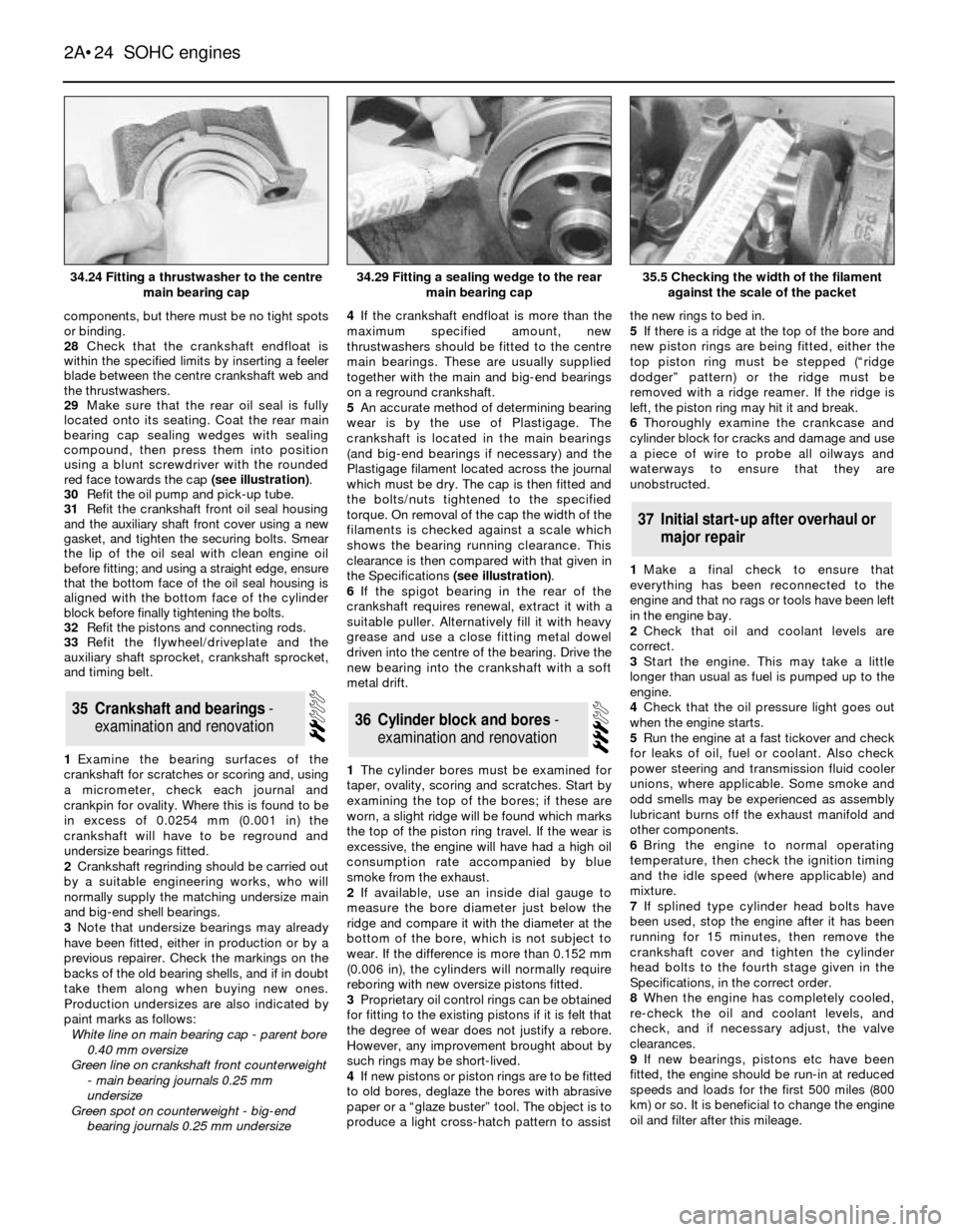
29Make sure that the rear oil seal is fully
located onto its seating. Coat the rear main
bearing cap sealing wedges with sealing
compound, then press them into position
using a blunt screwdriver with the rounded
red face towards the cap (see illustration).
30Refit the oil pump and pick-up tube.
31Refit the crankshaft front oil seal housing
and the auxiliary shaft front cover using a new
gasket, and tighten the securing bolts. Smear
the lip of the oil seal with clean engine oil
before fitting; and using a straight edge, ensure
that the bottom face of the oil seal housing is
aligned with the bottom face of the cylinder
block before finally tightening the bolts.
32Refit the pistons and connecting rods.
33Refit the flywheel/driveplate and the
auxiliary shaft sprocket, crankshaft sprocket,
and timing belt.
1Examine the bearing surfaces of the
crankshaft for scratches or scoring and, using
a micrometer, check each journal and
crankpin for ovality. Where this is found to be
in excess of 0.0254 mm (0.001 in) the
crankshaft will have to be reground and
undersize bearings fitted.
2Crankshaft regrinding should be carried out
by a suitable engineering works, who will
normally supply the matching undersize main
and big-end shell bearings.
3Note that undersize bearings may already
have been fitted, either in production or by a
previous repairer. Check the markings on the
backs of the old bearing shells, and if in doubt
take them along when buying new ones.
Production undersizes are also indicated by
paint marks as follows:
White line on main bearing cap - parent bore
0.40 mm oversize
Green line on crankshaft front counterweight
- main bearing journals 0.25 mm
undersize
Green spot on counterweight - big-end
bearing journals 0.25 mm undersize4If the crankshaft endfloat is more than the
maximum specified amount, new
thrustwashers should be fitted to the centre
main bearings. These are usually supplied
together with the main and big-end bearings
on a reground crankshaft.
5An accurate method of determining bearing
wear is by the use of Plastigage. The
crankshaft is located in the main bearings
(and big-end bearings if necessary) and the
Plastigage filament located across the journal
which must be dry. The cap is then fitted and
the bolts/nuts tightened to the specified
torque. On removal of the cap the width of the
filaments is checked against a scale which
shows the bearing running clearance. This
clearance is then compared with that given in
the Specifications (see illustration).
6If the spigot bearing in the rear of the
crankshaft requires renewal, extract it with a
suitable puller. Alternatively fill it with heavy
grease and use a close fitting metal dowel
driven into the centre of the bearing. Drive the
new bearing into the crankshaft with a soft
metal drift.
1The cylinder bores must be examined for
taper, ovality, scoring and scratches. Start by
examining the top of the bores; if these are
worn, a slight ridge will be found which marks
the top of the piston ring travel. If the wear is
excessive, the engine will have had a high oil
consumption rate accompanied by blue
smoke from the exhaust.
2If available, use an inside dial gauge to
measure the bore diameter just below the
ridge and compare it with the diameter at the
bottom of the bore, which is not subject to
wear. If the difference is more than 0.152 mm
(0.006 in), the cylinders will normally require
reboring with new oversize pistons fitted.
3Proprietary oil control rings can be obtained
for fitting to the existing pistons if it is felt that
the degree of wear does not justify a rebore.
However, any improvement brought about by
such rings may be short-lived.
4If new pistons or piston rings are to be fitted
to old bores, deglaze the bores with abrasive
paper or a Òglaze busterÓ tool. The object is to
produce a light cross-hatch pattern to assistthe new rings to bed in.
5If there is a ridge at the top of the bore and
new piston rings are being fitted, either the
top piston ring must be stepped (Òridge
dodgerÓ pattern) or the ridge must be
removed with a ridge reamer. If the ridge is
left, the piston ring may hit it and break.
6Thoroughly examine the crankcase and
cylinder block for cracks and damage and use
a piece of wire to probe all oilways and
waterways to ensurethatthey are
unobstructed.
1Make a final check to ensure that
everything has been reconnected to the
engine and that no rags or tools have been left
in the engine bay.
2Check that oil and coolant levels are
correct.
3Start the engine. This may take a little
longer than usual as fuel is pumped up to the
engine.
4Check that the oil pressure light goes out
when the engine starts.
5Run the engine at a fast tickover and check
for leaks of oil, fuel or coolant. Also check
power steering and transmission fluid cooler
unions, where applicable. Some smoke and
odd smells may be experienced as assembly
lubricant burns off the exhaust manifold and
other components.
6Bring the engine to normal operating
temperature, then check the ignition timing
and the idle speed (where applicable) and
mixture.
7If splined type cylinder head bolts have
been used, stop the engine after it has been
running for 15 minutes, then remove the
crankshaft cover and tighten the cylinder
head bolts to the fourth stage given in the
Specifications, in the correct order.
8When the engine has completely cooled,
re-check the oil and coolant levels, and
check, and if necessary adjust, the valve
clearances.
9If new bearings, pistons etc have been
fitted, the engine should be run-in at reduced
speeds and loads for the first 500 miles (800
km) or so. It is beneficial to change the engine
oil and filter after this mileage.
37Initial start-up after overhaul or
major repair
36Cylinder block and bores -
examination and renovation35Crankshaft and bearings -
examination and renovation
2A¥24SOHC engines
34.24 Fitting a thrustwasher to the centre
main bearing cap35.5 Checking the width of the filament
against the scale of the packet34.29 Fitting a sealing wedge to the rear
main bearing cap