fuel pump FORD SUPER DUTY 2014 3.G Diesel Supplement Manual
[x] Cancel search | Manufacturer: FORD, Model Year: 2014, Model line: SUPER DUTY, Model: FORD SUPER DUTY 2014 3.GPages: 82, PDF Size: 3.12 MB
Page 6 of 82
ABOUT THIS SUPPLEMENT
This supplement will acquaint you with the
Power Stroke diesel engine. It provides
recommendations on engine care and
operating procedures. For complete vehicle
information, also refer to your Owner
’s
Manual included with the vehicle. It also
describes equipment and gives
specifications for equipment that was in
effect when this guide was approved for
printing, and should be considered a
permanent part of the vehicle.
Note: Your vehicle ’s powertrain control
systems can detect and store information
about vehicle modifications that increase
horsepower and torque output such as
whether or not performance-enhancing
powertrain components commonly referred
to as performance chips have been used.
This information will stay in the system ’s
memory cannot be erased even if the
modification is removed. Ford Motor
Company, Ford of Canada, Ford of Mexico
and service or repair facilities can retrieve
this information when servicing your vehicle.
Ford Motor Company may use this
information to determine if your warranty
covers any needed repairs.
Note: Some aftermarket products may
cause severe engine/transmission and/or
exhaust system damage; refer to your
warranty information for more information.
Your new diesel engine will feel, drive and
function somewhat differently than a
gasoline engine. Therefore it is very
important that you read and thoroughly
familiarize yourself and others operating
the vehicle with this guide. A special
procedure for turning off the diesel engine
is in the Starting and Stopping the Engine
chapter, See Starting a Diesel Engine
(page 9). It is important to read and
understand this material in order to
maintain the best service life for your
engine. Ford may discontinue models or change
specifications without any notice and
without incurring obligations.
Warnings WARNING
Throughout this guide, you will find
warnings identified by the warning
symbol. Warnings remind you to be
especially careful to reduce the risk of
personal injury. Breaking-In Your Vehicle
Your vehicle does not need an extensive
break-in. Try not to drive continuously at
the same speed for the first 1000 miles
(1600 kilometers) of new vehicle
operation. Vary your speed to allow parts
to adjust themselves to other parts.
Drive your new vehicle at least 500 miles
(800 kilometers) before towing a trailer.
Make sure you use the specified engine oil.
See Technical Specifications (page 56
).
Do not add friction modifier compounds
or special break-in oils during the first few
thousand miles (kilometers) of operation,
since these additives may prevent piston
ring seating. See Engine Oil Check (page
42
).
Diesel Engine Information
The diesel engine fuel system is a
pressurized two-stage filtration system
and consists of:
• A frame-mounted Fuel and Water
Separator primary filter with an electric
fuel pump and water drain
• An engine-mounted secondary fuel
filter
• A fuel injector for each cylinder (8
total)
• A high-pressure fuel pump
3
Super Duty (TFA) Introduction
Page 7 of 82
•
A high-pressure fuel rail for each
cylinder bank (2 total)
• Numerous high-pressure pipes from
the high-pressure pump to the rails,
and rails to the injectors
The fuel and water separator removes
both water and impurities from the fuel.
The engine mounted filter filters finer
impurities from the diesel fuel. The
engine-mounted fuel filter and the fuel and
water separator filter should be changed
at the recommended service interval or
when indicated by the information display
LOW FUEL PRESSURE message. Refer to
the scheduled maintenance information
in this supplement for more information.
The fuel and water separator should be
drained at regular intervals (recommended
at every oil change) or when indicated by
the information display and water in fuel
indicator light. See Fuel Quality (page
14).
Proper fuel filter maintenance and prompt
water draining when the water in fuel light
illuminates is essential to prevent injection
equipment damage. Ignoring the water in
fuel light can cause your vehicle to go into
a reduced power mode.
A frame-mounted electric fuel pump
located inside the fuel and water separator
draws fuel from the fuel tank to provide
pressurized fuel to the engine. The fuel
pump contains a pressure relief valve for
overpressure protection in the event of
restricted flow.
The fuel injection system is controlled
through the powertrain control module. Engine protection mode
Ford diesel engines are equipped with
engine protection and emission control
systems. These systems monitor critical
temperatures and pressures, and modify
engine operation accordingly. These
modified engine performance
characteristics are normal.
If these modified engine performance
characteristics persist for an extended
period and either the service engine soon
or powertrain malfunction,reduced power,
electronic throttle control light is
illuminated, have the system checked by
an authorized dealer.
Service engine soon
Powertrain malfunction, reduced
power, electronic throttle control
Lubrication system
It is important to change the engine oil at
the recommended service intervals to
maintain oil viscosity. Extending the oil and
filter change interval beyond the
recommended interval can negatively
affect engine performance, fuel economy
and engine life. See
Engine Oil Check
(page 42).
Fast start glow plug system
The diesel engine glow system consists of:
• Eight glow plugs (one per cylinder)
• Glow Plug Control Module
• Engine Coolant Temperature sensor
• Barometric pressure sensor
• Environmental temperature sensor
4
Super Duty (TFA) Introduction
Page 9 of 82
•
The gearshift lever must be in P (Park)
or N (Neutral) in order for the starter
to operate.
• Try operating the starter switch several
times. This operation may clean
potentially corroded contacts or make
the switch temporarily operable until
you can reach the dealer.
• If all electrical connections are tight
and you need assistance to start, refer
to Jump Starting in the Roadside
Emergencies chapter of your Owner ’s
Manual.
If engine cranks but won ’t start
Prolonged starter cranking (in excess of 10
seconds) could cause damage to the
starter motor or the high-pressure fuel
pump.
• Check the fuel gauge. You may be out
of fuel. If the gauge shows that there
is fuel in the tank, the trouble may be
in the electrical system or the fuel
system. If equipped with an auxiliary
tank, be sure that the tank control
switch is set for the tank with fuel and
not on an empty tank.
• Leaving your ignition key turned to on
for over two minutes without starting
may make starting difficult because
the glow plugs will cease activation.
Reset the system by turning the ignition
key to off and then back to on again.
Note: If the system is out of fuel and the
engine will not start, do not continue
cranking the engine. Continued cranking can
damage the high-pressure fuel pump.
If the engine runs hot
The following could cause the engine to
overheat:
• Lack of coolant
• Dirty cooling system. •
Plugged radiator fins, A/C condenser
and/or oil cooler
• Malfunctioning fan drive
• Driving with frozen coolant
• Sticking thermostat
• Overloading or pulling heavy trailers
during hot weather
• Grill or radiator air blockage
• Slipping or missing drive belt
• Plugged or very dirty air filter
If fuses burn out WARNING
Replacement fuses and circuit
breakers must always be the same
rating as the original equipment
shown. Never replace a fuse or circuit
breaker with one of a higher rating. Higher
rated fuses or circuit breakers could allow
circuit overloading in the event of a circuit
malfunction, resulting in severe vehicle
damage or personal injury due to fire. Burned-out or blown fuses usually indicate
an electrical short-circuit, although a fuse
may occasionally burn out from vibration.
Insert a second fuse. If this fuse
immediately burns out and you cannot
locate the cause, return your vehicle to
your dealer for a circuit check.
Refer to the Owner
’s Manual for
replacement of fuses.
Selective catalytic reduction system
speed limit and Idle-only modes
If the vehicle ’s speed is limited or in an
idle-only mode, the selective catalytic
reduction system may be limiting the
vehicle ’s functions due to low or
contaminated diesel exhaust fluid. Check
the diesel exhaust fluid. See
Selective
Catalytic Reduction System (page 20).
6
Super Duty (TFA) Introduction
Page 11 of 82
Glow Plug Pre-Heat
With the key in the on position,
this light illuminates if glow plug
heat is necessary as a starting
aid. Wait until the light goes off before
starting. See Starting a Diesel Engine
(page 9).
After the engine starts, the light should turn
off. The light should always momentarily
illuminate when the engine is cold and you
turn the ignition to on.
Water In Fuel During refueling, it is possible for
water-contaminated diesel fuel
to be pumped into your tank.
Your vehicle ’s fuel system is equipped with
a fuel filter/water separator to remove
water from the fuel. The Water In Fuel
(WIF) light will illuminate when the Fuel
and Water Separator has a significant
quantity of water in it and requires
immediate draining.
If the water in fuel light illuminates when
the engine is running, stop your vehicle as
soon as safely possible, shut off the engine,
then drain the fuel and water separator.
See
Fuel Quality (page 14). Allowing
water to stay in the fuel system, after the
water in fuel light has illuminated, could
result in extensive damage or failure of the
fuel injection system. WARNING
Do not drain the fuel and water
separator while the engine is running.
Fuel may ignite if the separator is
drained while the engine is running or the
vehicle is moving. Note:
If you drain the fuel and water
separator while the system is running air will
enter into the fuel system. The engine will
not operate properly if air enters the system.
8
Super Duty (TFA) Instrument Cluster
Page 18 of 82
Biodiesel
WARNING
Do not use home heating oil,
agricultural fuel, raw fats and oils,
waste cooking greases, biodiesel
fuels greater than 20% or any diesel fuel
not intended for highway use. Damage to
the fuel injection system, engine and
exhaust catalyst can occur if an improper
fuel is used. Do not add gasoline, gasohol
or alcohol to diesel fuel. This practice
creates a serious fire hazard and engine
performance problems. You may operate your vehicle on diesel
fuels containing up to 20% biodiesel, also
known as B20.
Biodiesel fuel is a chemically converted
product from renewable fuel sources, such
as vegetable oils, animal fats and waste
cooking greases.
To help achieve acceptable engine
performance and durability when using
biodiesel in your vehicle:
•
Confirm the biodiesel content of the
fuel to be B20 (20% biodiesel) or less
• Only use biodiesel fuel of good quality
that complies with industry standards
• Follow the recommended service
maintenance intervals. See General
Maintenance Information (page 58).
• Do not store biodiesel fuel in the fuel
tank for more than 1 month
• Consider changing brands or reducing
biodiesel content if you have cold
temperature fuel gelling issues or a
frequent LOW FUEL PRESSURE
message appearing
• Do NOT use raw oils, fats or waste
cooking greases Use of biodiesel in concentrations greater
than 20% may cause damage to your
vehicle, including engine and/or exhaust
after-treatment hardware (exhaust
catalyst and particulate filter) failures.
Concentrations greater than 20% can also
cause fuel filter restrictions that may result
in a lack of power or damage to fuel
system components, including fuel pump
and fuel injector failures.
SAE 5W-40 or SAE 15W-40 oil is
recommended for fuels with greater than
5% biodiesel (B5). Refer to the Special
operating conditions section under the
Schedule Maintenance chapter for more
information about oil change intervals and
other maintenance when operating on
biodiesel.
Look for a label on the fuel pump to
confirm the amount of biodiesel contained
in a diesel fuel. Biodiesel content is often
indicated with the letter B followed by the
percent of biodiesel in the fuel. For
example, B20 indicates a fuel containing
20% biodiesel. Ask the service station
attendant to confirm the biodiesel content
of a diesel fuel if you do not see a label on
the fuel pump.
Biodiesel fuels degrade more easily than
diesel fuels not containing biodiesel and
should not be stored in the fuel tank for
more than 1 month. If you plan to park or
store your vehicle for more than 1 month,
then you should empty your vehicle fuel
tank of biodiesel fuel. You should fill the
tank with a pure petroleum-based diesel
fuel and run your vehicle for a minimum of
30 minutes.
Note:
Degraded or oxidized biodiesel can
damage fuel system seals and plastics and
corrode steel parts.
During cold weather, if you have problems
operating on biodiesel, you may need to
use a diesel fuel with lower biodiesel
content, try another brand, or discontinue
the use of biodiesel.
15
Super Duty (TFA) Fuel and Refueling
Page 31 of 82
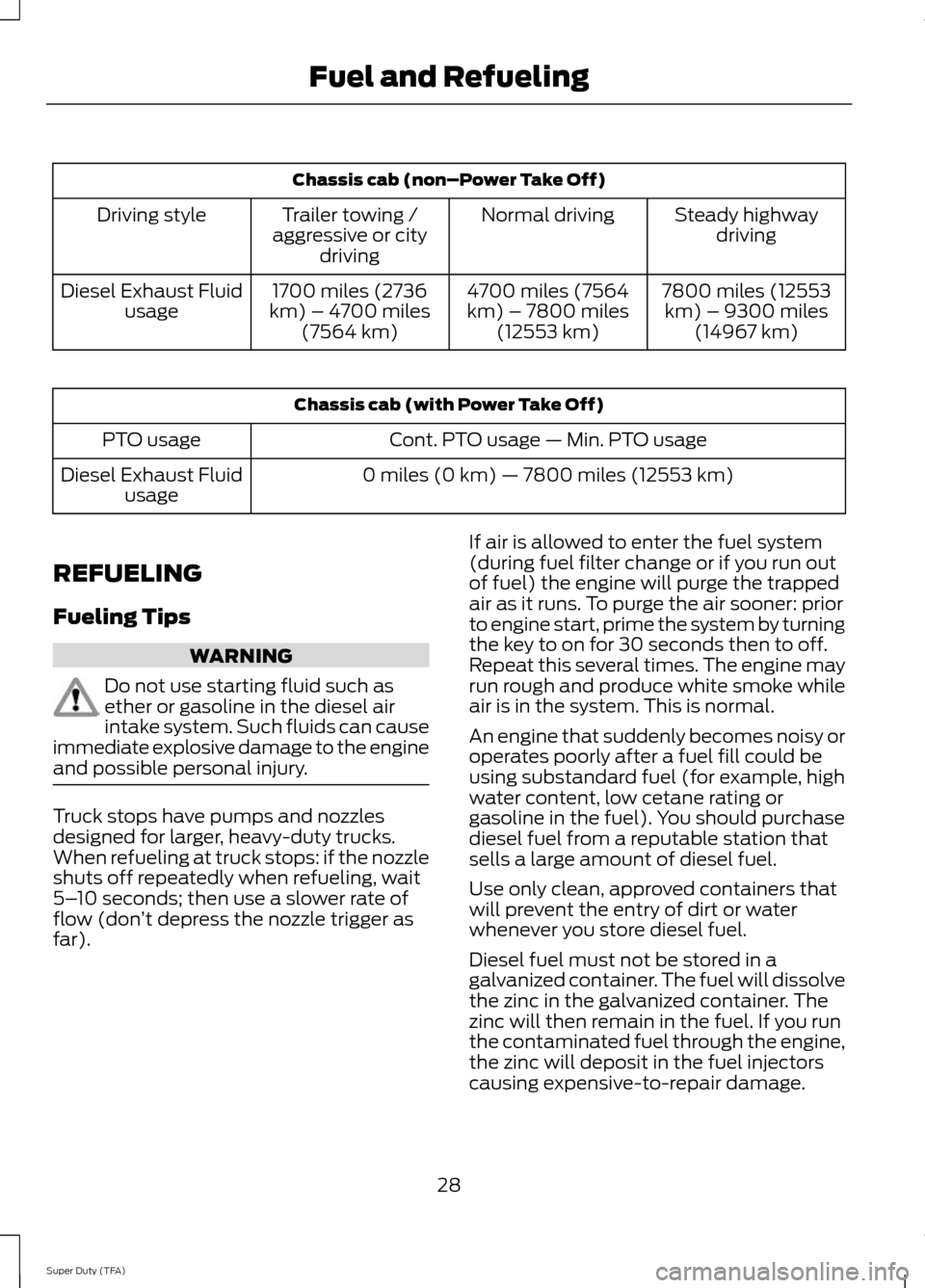
Chassis cab (non–Power Take Off)
Steady highwaydriving
Normal driving
Trailer towing /
aggressive or city driving
Driving style
7800 miles (12553km) – 9300 miles (14967 km)
4700 miles (7564
km) – 7800 miles (12553 km)
1700 miles (2736
km) – 4700 miles (7564 km)
Diesel Exhaust Fluid
usage Chassis cab (with Power Take Off)
Cont. PTO usage — Min. PTO usage
PTO usage
0 miles (0 km) — 7800 miles (12553 km)
Diesel Exhaust Fluid
usage
REFUELING
Fueling Tips WARNING
Do not use starting fluid such as
ether or gasoline in the diesel air
intake system. Such fluids can cause
immediate explosive damage to the engine
and possible personal injury. Truck stops have pumps and nozzles
designed for larger, heavy-duty trucks.
When refueling at truck stops: if the nozzle
shuts off repeatedly when refueling, wait
5–
10 seconds; then use a slower rate of
flow (don ’t depress the nozzle trigger as
far). If air is allowed to enter the fuel system
(during fuel filter change or if you run out
of fuel) the engine will purge the trapped
air as it runs. To purge the air sooner: prior
to engine start, prime the system by turning
the key to on for 30 seconds then to off.
Repeat this several times. The engine may
run rough and produce white smoke while
air is in the system. This is normal.
An engine that suddenly becomes noisy or
operates poorly after a fuel fill could be
using substandard fuel (for example, high
water content, low cetane rating or
gasoline in the fuel). You should purchase
diesel fuel from a reputable station that
sells a large amount of diesel fuel.
Use only clean, approved containers that
will prevent the entry of dirt or water
whenever you store diesel fuel.
Diesel fuel must not be stored in a
galvanized container. The fuel will dissolve
the zinc in the galvanized container. The
zinc will then remain in the fuel. If you run
the contaminated fuel through the engine,
the zinc will deposit in the fuel injectors
causing expensive-to-repair damage.
28
Super Duty (TFA) Fuel and Refueling
Page 32 of 82
Diesel fuel dispensing nozzle fill rate
Your truck is equipped with a fuel fill pipe
that is able to accept fuel up to 20 gallons
per minute from an 11⁄8 fuel-dispensing
nozzle. Pumping fuel at greater flow rates
may result in premature nozzle shut-off or
spit back.
Fuel filler cap
WARNINGS
The fuel system may be under
pressure. If the fuel filler cap is
venting vapor or if you hear a hissing
sound, wait until it stops before completely
removing the fuel filler cap. Otherwise, fuel
may spray out and injure you or others. If you do not use the proper fuel filler
cap, excessive pressure or vacuum
in the fuel tank may damage the fuel
system or cause the fuel cap to disengage
in a collision, which may result in possible
personal injury. Note:
If you must replace the fuel filler cap,
replace it with a fuel filler cap designed for
your vehicle. The vehicle warranty may be
void for any damage to the fuel tank or fuel
system if the correct genuine Ford or
Motorcraft® fuel filler cap is not used.
Your fuel tank filler cap has an indexed
design with a 1/4 turn on/off feature.
When fueling your vehicle:
1. Turn the engine off.
2. Carefully turn the filler cap counterclockwise until it spins off.
3. Pull to remove the cap from the fuel filler pipe.
4. To install the cap, align the tabs on the
cap with the notches on the filler pipe.
5. Turn the filler cap clockwise 1/4 of a turn until it clicks at least once. EMISSION CONTROL SYSTEM
Diesel Exhaust System: Oxidation
Catalyst And Diesel Particulate
Filter System (If Equipped)
Your vehicle is equipped with a diesel
particulate filter. The diesel particulate
filter is an inline filter in the exhaust system
that reduces carbon emissions by trapping
exhaust particles before they reach the
tailpipe. The diesel particulate filter looks
similar to a traditional exhaust catalyst,
except larger, and is part of the exhaust
system under the vehicle. The filter couples
to a diesel oxidation catalyst that reduces
the amount of harmful exhaust emitted
from the tailpipe. As soot gathers in the
system, it begins to restrict the filter. You
need to periodically clean the soot that
gathers inside the. You can clean the soot
in two different ways, passive regeneration
and active regeneration. Both methods
occur automatically and require no actions
from the driver. During either one of these
regeneration methods, you may notice a
change in exhaust tone. At certain times,
the information display will display various
messages related to the diesel particulate
filter. See the Information Displays chapter
in the Owner Guide for more information.
Passive regeneration
In passive regeneration, the high
temperature of the exhaust system
automatically cleans the filter, or reduces
the soot level, by burning (oxidizing) the
soot. This high exhaust temperature occurs
naturally because of normal engine
operating conditions (at varying levels, due
to driving patterns.
29
Super Duty (TFA) Fuel and Refueling
Page 41 of 82
FUEL SHUTOFF
In the event of a moderate to severe
collision, this vehicle is equipped with a
fuel pump shut-off feature that stops the
flow of fuel to the engine. Not every impact
will cause a shut-off.
After an accident, if the engine cranks but
does not start, this switch may have been
activated.
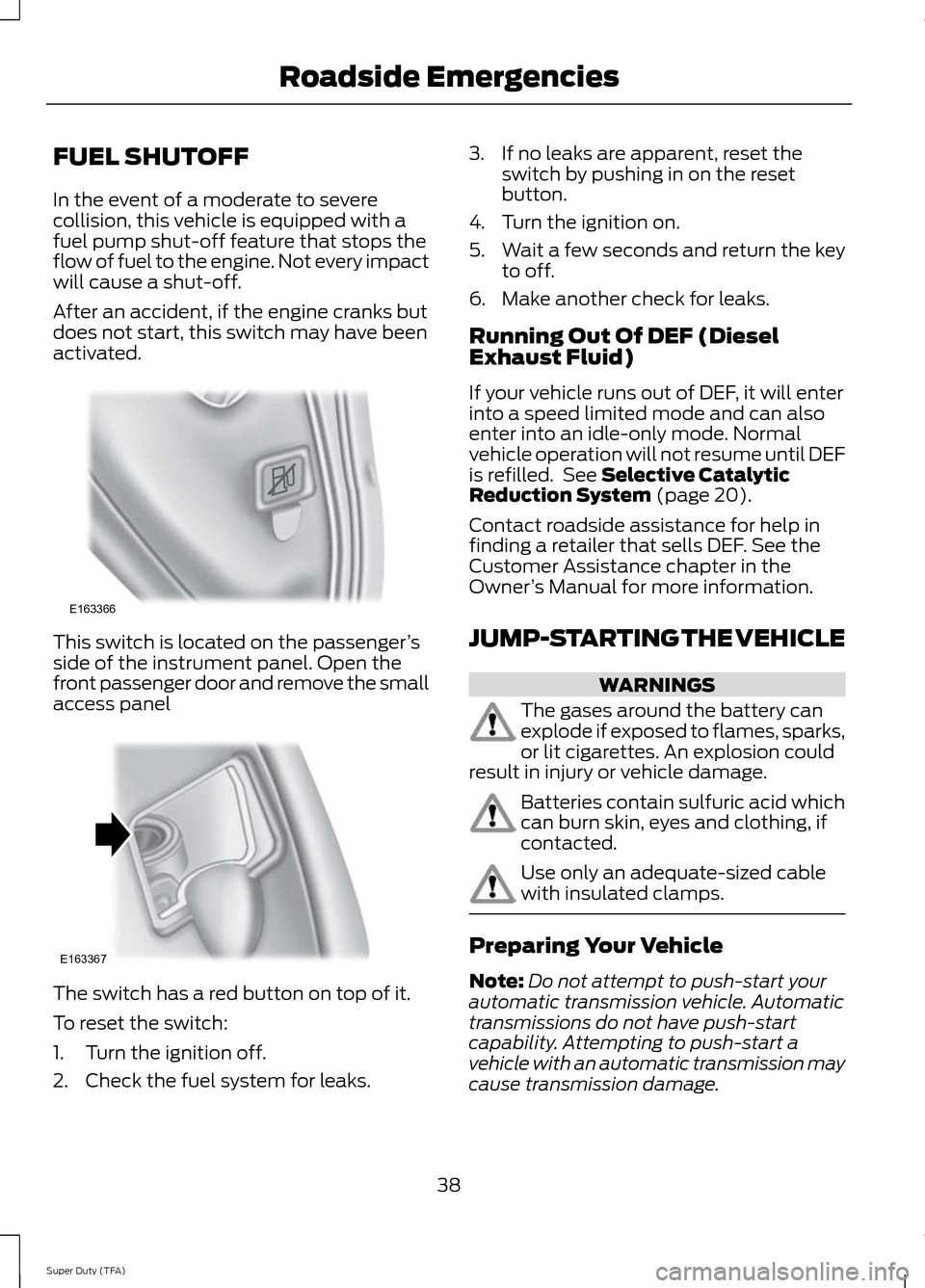
This switch is located on the passenger
’s
side of the instrument panel. Open the
front passenger door and remove the small
access panel The switch has a red button on top of it.
To reset the switch:
1. Turn the ignition off.
2. Check the fuel system for leaks. 3. If no leaks are apparent, reset the
switch by pushing in on the reset
button.
4. Turn the ignition on.
5. Wait a few seconds and return the key
to off.
6. Make another check for leaks.
Running Out Of DEF (Diesel
Exhaust Fluid)
If your vehicle runs out of DEF, it will enter
into a speed limited mode and can also
enter into an idle-only mode. Normal
vehicle operation will not resume until DEF
is refilled. See Selective Catalytic
Reduction System (page 20).
Contact roadside assistance for help in
finding a retailer that sells DEF. See the
Customer Assistance chapter in the
Owner ’s Manual for more information.
JUMP-STARTING THE VEHICLE WARNINGS
The gases around the battery can
explode if exposed to flames, sparks,
or lit cigarettes. An explosion could
result in injury or vehicle damage. Batteries contain sulfuric acid which
can burn skin, eyes and clothing, if
contacted.
Use only an adequate-sized cable
with insulated clamps.
Preparing Your Vehicle
Note:
Do not attempt to push-start your
automatic transmission vehicle. Automatic
transmissions do not have push-start
capability. Attempting to push-start a
vehicle with an automatic transmission may
cause transmission damage.
38
Super Duty (TFA) Roadside EmergenciesE163366 E163367