Def FORD SUPER DUTY 2015 3.G Diesel Supplement Manual
[x] Cancel search | Manufacturer: FORD, Model Year: 2015, Model line: SUPER DUTY, Model: FORD SUPER DUTY 2015 3.GPages: 84, PDF Size: 13.36 MB
Page 28 of 84
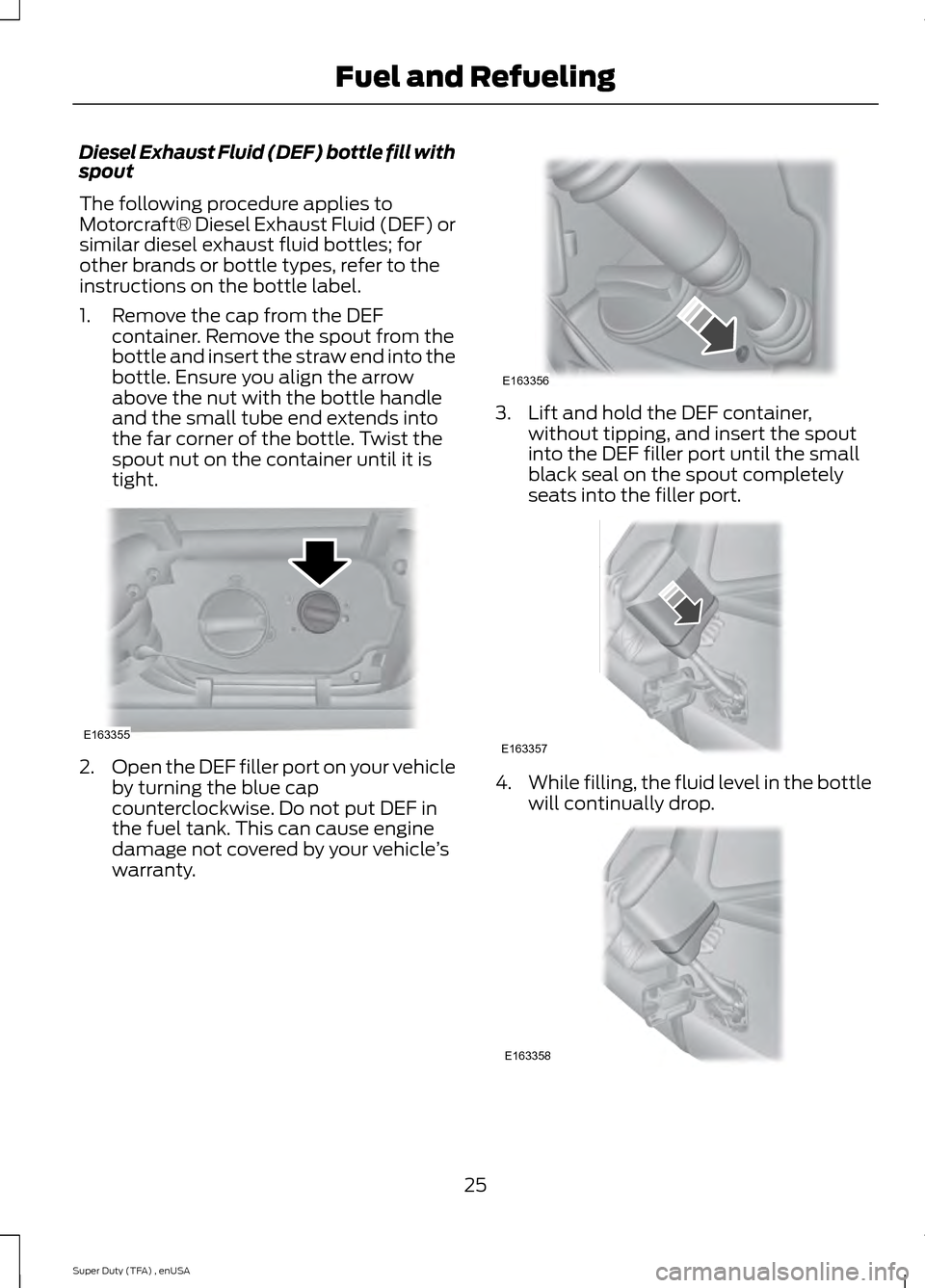
Diesel Exhaust Fluid (DEF) bottle fill with
spout
The following procedure applies to
Motorcraft® Diesel Exhaust Fluid (DEF) or
similar diesel exhaust fluid bottles; for
other brands or bottle types, refer to the
instructions on the bottle label.
1. Remove the cap from the DEF
container. Remove the spout from the
bottle and insert the straw end into the
bottle. Ensure you align the arrow
above the nut with the bottle handle
and the small tube end extends into
the far corner of the bottle. Twist the
spout nut on the container until it is
tight. 2.
Open the DEF filler port on your vehicle
by turning the blue cap
counterclockwise. Do not put DEF in
the fuel tank. This can cause engine
damage not covered by your vehicle ’s
warranty. 3. Lift and hold the DEF container,
without tipping, and insert the spout
into the DEF filler port until the small
black seal on the spout completely
seats into the filler port. 4.
While filling, the fluid level in the bottle
will continually drop. 25
Super Duty (TFA) , enUSA Fuel and RefuelingE163355 E163356 E163357 E163358
Page 29 of 84
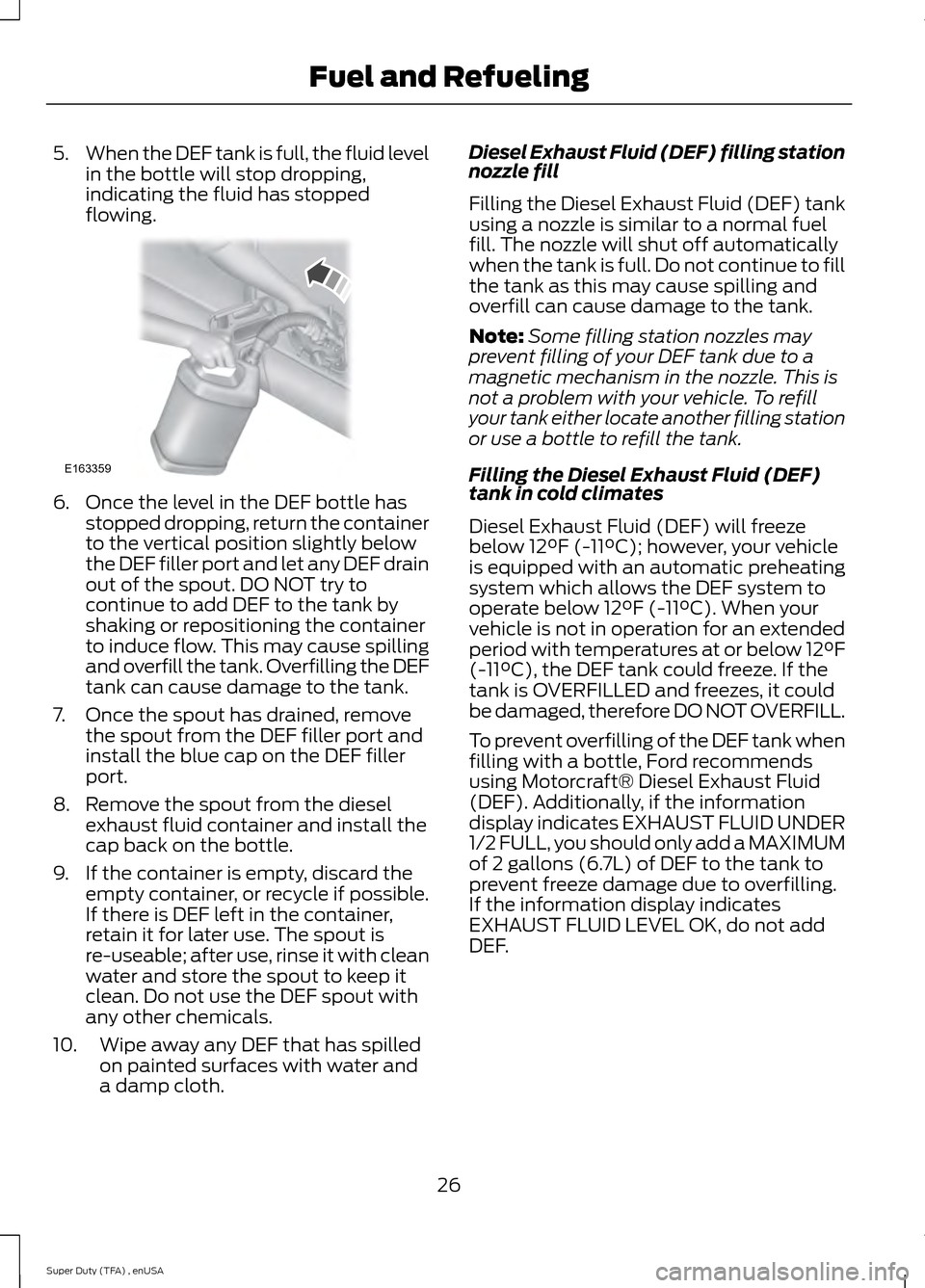
5.
When the DEF tank is full, the fluid level
in the bottle will stop dropping,
indicating the fluid has stopped
flowing. 6. Once the level in the DEF bottle has
stopped dropping, return the container
to the vertical position slightly below
the DEF filler port and let any DEF drain
out of the spout. DO NOT try to
continue to add DEF to the tank by
shaking or repositioning the container
to induce flow. This may cause spilling
and overfill the tank. Overfilling the DEF
tank can cause damage to the tank.
7. Once the spout has drained, remove the spout from the DEF filler port and
install the blue cap on the DEF filler
port.
8. Remove the spout from the diesel exhaust fluid container and install the
cap back on the bottle.
9. If the container is empty, discard the empty container, or recycle if possible.
If there is DEF left in the container,
retain it for later use. The spout is
re-useable; after use, rinse it with clean
water and store the spout to keep it
clean. Do not use the DEF spout with
any other chemicals.
10. Wipe away any DEF that has spilled on painted surfaces with water and
a damp cloth. Diesel Exhaust Fluid (DEF) filling station
nozzle fill
Filling the Diesel Exhaust Fluid (DEF) tank
using a nozzle is similar to a normal fuel
fill. The nozzle will shut off automatically
when the tank is full. Do not continue to fill
the tank as this may cause spilling and
overfill can cause damage to the tank.
Note:
Some filling station nozzles may
prevent filling of your DEF tank due to a
magnetic mechanism in the nozzle. This is
not a problem with your vehicle. To refill
your tank either locate another filling station
or use a bottle to refill the tank.
Filling the Diesel Exhaust Fluid (DEF)
tank in cold climates
Diesel Exhaust Fluid (DEF) will freeze
below 12°F (-11°C); however, your vehicle
is equipped with an automatic preheating
system which allows the DEF system to
operate below 12°F (-11°C). When your
vehicle is not in operation for an extended
period with temperatures at or below 12°F
(-11°C), the DEF tank could freeze. If the
tank is OVERFILLED and freezes, it could
be damaged, therefore DO NOT OVERFILL.
To prevent overfilling of the DEF tank when
filling with a bottle, Ford recommends
using Motorcraft® Diesel Exhaust Fluid
(DEF). Additionally, if the information
display indicates EXHAUST FLUID UNDER
1/2 FULL, you should only add a MAXIMUM
of 2 gallons (6.7L) of DEF to the tank to
prevent freeze damage due to overfilling.
If the information display indicates
EXHAUST FLUID LEVEL OK, do not add
DEF.
26
Super Duty (TFA) , enUSA Fuel and RefuelingE163359
Page 30 of 84
Contaminated Diesel Exhaust Fluid
(DEF) or inoperative Selective
Catalytic Reduction system
Selective catalytic reduction
systems are sensitive to
contamination of the Diesel
Exhaust Fluid (DEF). USE ONLY API or ISO
22241 CERTIFIED DIESEL EXHAUST FLUID
(DEF). If the selective catalytic reduction
system becomes contaminated or
inoperative, the Diesel Exhaust Fluid (DEF)
light will illuminate and exhaust fluid
system fault messages will appear in the
information display.
Continued driving without replacing DEF
or having the selective catalytic reduction
system repaired will result in the following
actions as required by the California Air
Resources Board (CARB) and U.S.
Environmental Protection Agency (EPA):
• Within a certain number of miles
(kilometers) to empty, speed will be
limited upon restart. Prior to this
occurring a message will appear in the
information display.
• Further vehicle operation without
replacing contaminated DEF will cause
the engine to enter an idle-only
condition. This will only occur upon
vehicle refueling, vehicle idling in park
for 1 hour, or engine shutdown for 10
minutes or more and will be indicated
by a message in the information display
indicating required actions to resume
normal operation.
For either vehicle speed limiting or idle-only
condition, normal vehicle operation will
resume when you repair the contaminated
system. To service a contaminated or
inoperative system, see an authorized
dealer. Diesel Exhaust Fluid (DEF) guidelines
and information
•
Use only Diesel Exhaust Fluid that
carries the trademark: American
Petroleum Institute (API) certified DEF
or ISO 22241.
• Do not put DEF in the diesel fuel tank.
• Do not overfill the DEF tank.
• Do not re-use the DEF container once
it is emptied.
• Avoid spilling DEF on painted surfaces,
carpeting or plastic components.
Immediately wipe away any DEF that
has spilled with a damp cloth and
water. If it has already crystallized, use
warm water and a sponge.
• Store DEF out of direct sunlight and in
temperatures between 23°F (-5°C) —
68°F (20°C).
• DEF will freeze below 12°F (-11°C).
• Do not store the DEF bottle in your
vehicle. If it leaks it could cause
damage to interior components or
release an ammonia odor inside your
vehicle.
• DEF is non-flammable, non-toxic,
colorless and water-soluble liquid.
• Do not dilute DEF with water or any
other liquid.
• An ammonia odor may be smelled
when the cap is removed or during
refill. Refill DEF in a well ventilated
area.
Typical Diesel Exhaust Fluid (DEF)
Usage
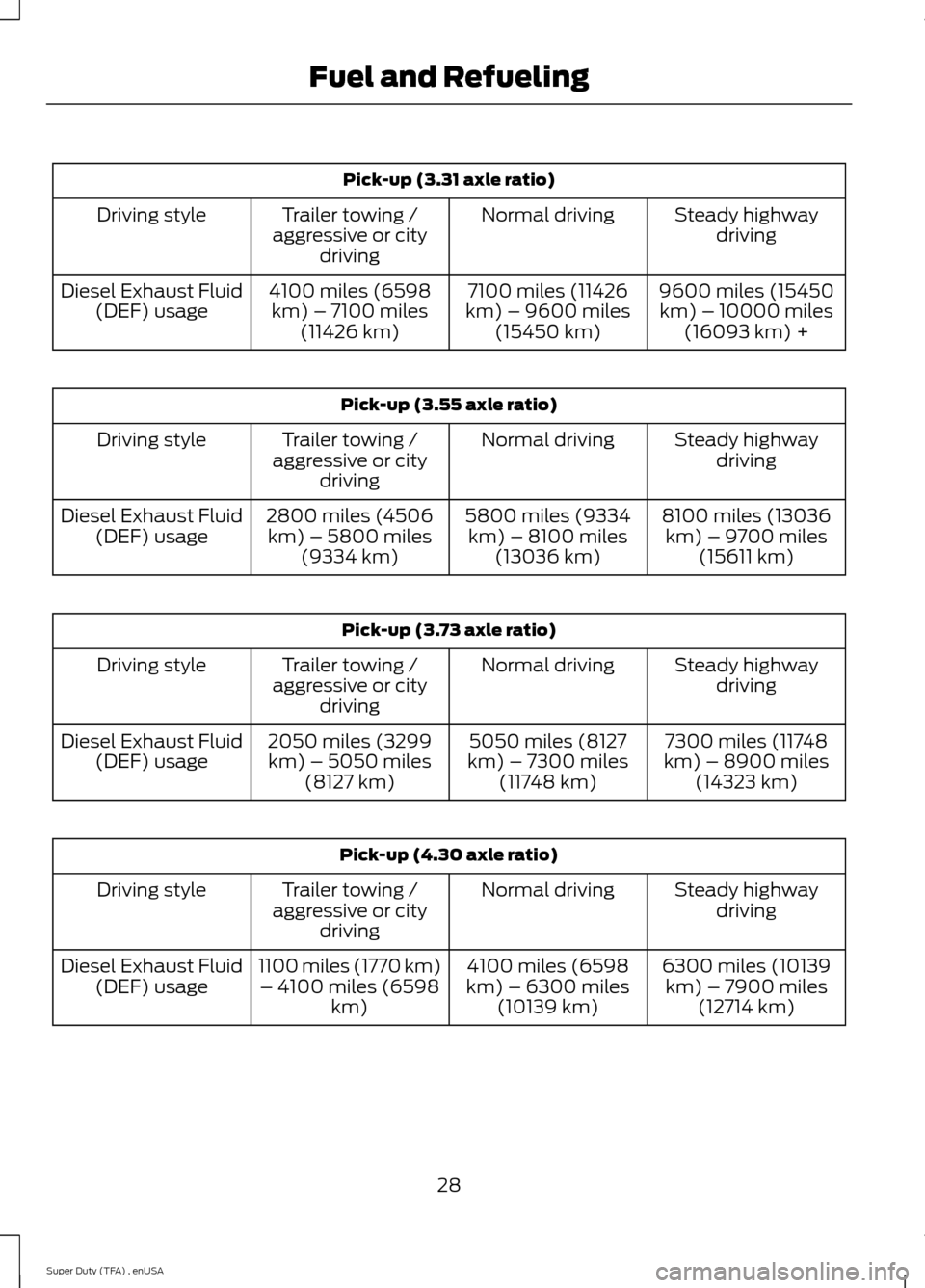
The charts below illustrate approximate
Diesel Exhaust Fluid (DEF) usage for the
given distances traveled under various
driving conditions and when using the
power take off. Your usage may vary
depending on: driving style, trailer towing,
loaded vehicle weight, weather, idle time,
PTO usage.
27
Super Duty (TFA) , enUSA Fuel and RefuelingE163176
Page 31 of 84
Pick-up (3.31 axle ratio)
Steady highwaydriving
Normal driving
Trailer towing /
aggressive or city driving
Driving style
9600 miles (15450km) – 10000 miles (16093 km) +
7100 miles (11426
km) – 9600 miles (15450 km)
4100 miles (6598
km) – 7100 miles (11426 km)
Diesel Exhaust Fluid
(DEF) usage Pick-up (3.55 axle ratio)
Steady highwaydriving
Normal driving
Trailer towing /
aggressive or city driving
Driving style
8100 miles (13036km) – 9700 miles (15611 km)
5800 miles (9334
km) – 8100 miles (13036 km)
2800 miles (4506
km) – 5800 miles (9334 km)
Diesel Exhaust Fluid
(DEF) usage Pick-up (3.73 axle ratio)
Steady highwaydriving
Normal driving
Trailer towing /
aggressive or city driving
Driving style
7300 miles (11748
km) – 8900 miles (14323 km)
5050 miles (8127
km) – 7300 miles (11748 km)
2050 miles (3299
km) – 5050 miles (8127 km)
Diesel Exhaust Fluid
(DEF) usage Pick-up (4.30 axle ratio)
Steady highwaydriving
Normal driving
Trailer towing /
aggressive or city driving
Driving style
6300 miles (10139km) – 7900 miles (12714 km)
4100 miles (6598
km) – 6300 miles (10139 km)
1100 miles (1770 km)
– 4100 miles (6598 km)
Diesel Exhaust Fluid
(DEF) usage
28
Super Duty (TFA) , enUSA Fuel and Refueling
Page 32 of 84
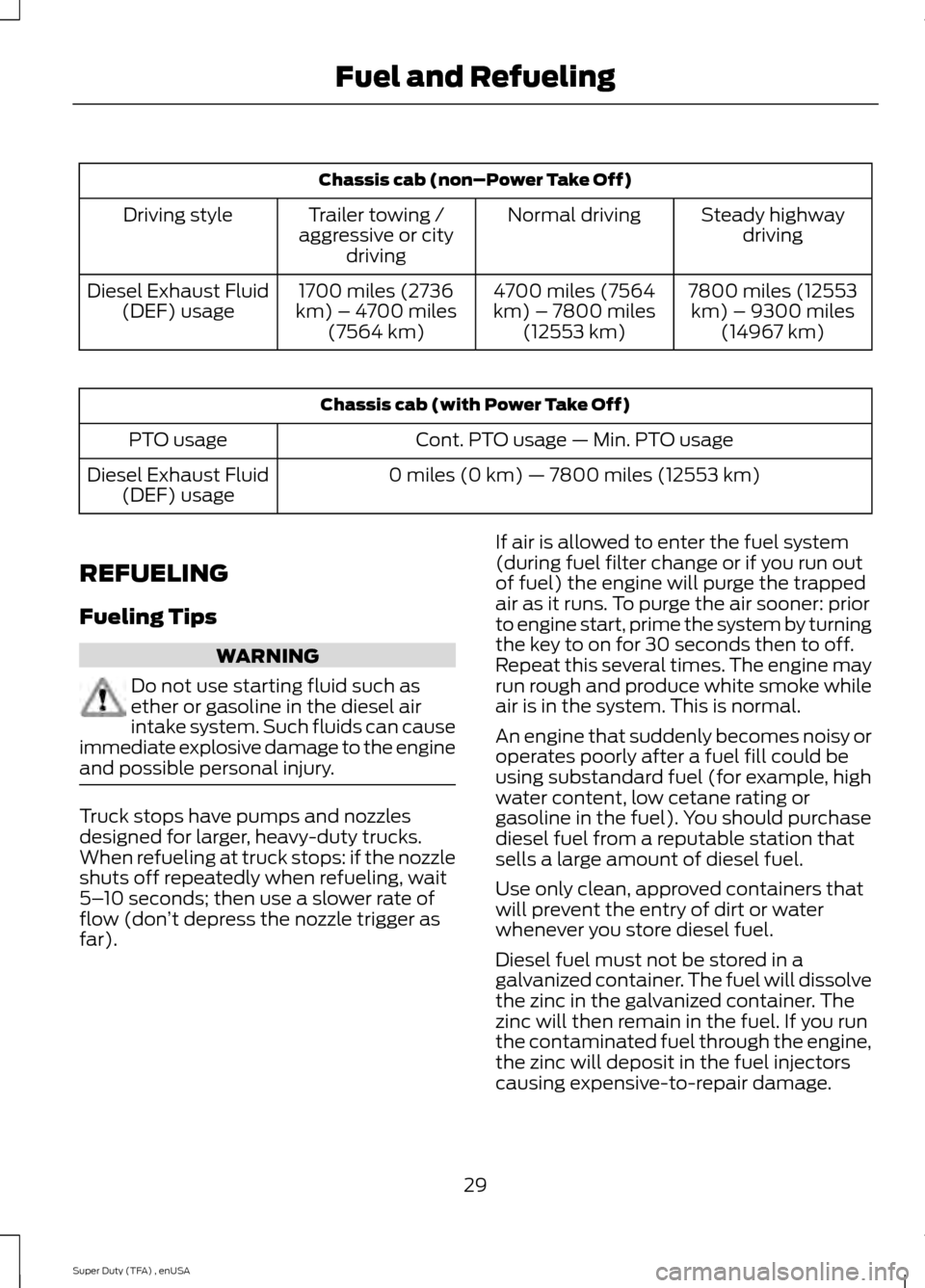
Chassis cab (non–Power Take Off)
Steady highwaydriving
Normal driving
Trailer towing /
aggressive or city driving
Driving style
7800 miles (12553km) – 9300 miles (14967 km)
4700 miles (7564
km) – 7800 miles (12553 km)
1700 miles (2736
km) – 4700 miles (7564 km)
Diesel Exhaust Fluid
(DEF) usage Chassis cab (with Power Take Off)
Cont. PTO usage — Min. PTO usage
PTO usage
0 miles (0 km) — 7800 miles (12553 km)
Diesel Exhaust Fluid
(DEF) usage
REFUELING
Fueling Tips WARNING
Do not use starting fluid such as
ether or gasoline in the diesel air
intake system. Such fluids can cause
immediate explosive damage to the engine
and possible personal injury. Truck stops have pumps and nozzles
designed for larger, heavy-duty trucks.
When refueling at truck stops: if the nozzle
shuts off repeatedly when refueling, wait
5–
10 seconds; then use a slower rate of
flow (don ’t depress the nozzle trigger as
far). If air is allowed to enter the fuel system
(during fuel filter change or if you run out
of fuel) the engine will purge the trapped
air as it runs. To purge the air sooner: prior
to engine start, prime the system by turning
the key to on for 30 seconds then to off.
Repeat this several times. The engine may
run rough and produce white smoke while
air is in the system. This is normal.
An engine that suddenly becomes noisy or
operates poorly after a fuel fill could be
using substandard fuel (for example, high
water content, low cetane rating or
gasoline in the fuel). You should purchase
diesel fuel from a reputable station that
sells a large amount of diesel fuel.
Use only clean, approved containers that
will prevent the entry of dirt or water
whenever you store diesel fuel.
Diesel fuel must not be stored in a
galvanized container. The fuel will dissolve
the zinc in the galvanized container. The
zinc will then remain in the fuel. If you run
the contaminated fuel through the engine,
the zinc will deposit in the fuel injectors
causing expensive-to-repair damage.
29
Super Duty (TFA) , enUSA Fuel and Refueling
Page 38 of 84
Emission Control System(s) Laws
WARNING
Do not remove or alter the original
equipment floor covering or
insulation between it and the metal
floor of the vehicle. The floor covering and
insulation protect occupants of the vehicle
from the engine and exhaust system heat
and noise. On vehicles with no original
equipment floor covering insulation, do not
carry passengers in a manner that permits
prolonged skin contact with the metal
floor. Provide adequate insulation. Failure
to follow these instructions may result in
fire or personal injury. In the U.S. federal law and certain state
laws prohibit removing or rendering
inoperative emission control system(s).
Similar federal or provincial laws may
apply in Canada. Ford recommends
against any vehicle modification without
determining applicable law.
Tampering with emissions
control systems (including
related sensors and the Diesel
Exhaust Fluid (DEF) injection system) can
result in reduced engine power and the
illumination of the service engine soon
light.
Tampering with a Noise Control
System
Federal law prohibits the following acts or
the causing thereof: (1) The removal or
rendering inoperative by any person other
than for purposes of maintenance, repair
or replacement of any device or element
of design incorporated into any new vehicle
for the purpose of noise control prior to its
sale or delivery to the ultimate purchaser
or while it is in use, or (2) the use of the
vehicle after such device or element of
design has been removed or rendered
inoperative by any person. Among those acts, which the U.S.
Environmental Protection Agency may
presume to constitute tampering are the
acts listed below:
•
Removal of hood blanket, fender apron
absorbers, fender apron barriers,
underbody noise shields or acoustically
absorptive material.
• Tampering or rendering inoperative the
engine speed governor, to allow engine
speed to exceed manufacturer ’s
specifications.
The complexity of the diesel engine makes
it so the owner is discouraged from
attempting to perform maintenance other
than the services described in this
supplement.
If you experience difficult starting the
engine, rough idling, excessive exhaust
smoke, a decrease in engine performance
or excess fuel consumption, perform the
following checks:
• A plugged or disconnected air inlet
system or engine air filter element
• Water in the fuel filter and water
separator
• A clogged fuel filter
• Contaminated fuel
• Air in the fuel system, due to loose
connections
• An open or pinched sensor hose
• Check engine oil level
• Wrong fuel or oil viscosity for climactic
conditions
If these checks do not help you correct the
engine performance problem you are
experiencing, consult an authorized dealer.
35
Super Duty (TFA) , enUSA Fuel and Refueling
Page 42 of 84
FUEL SHUTOFF
In the event of a moderate to severe
collision, this vehicle is equipped with a
fuel pump shut-off feature that stops the
flow of fuel to the engine. Not every impact
will cause a shut-off.
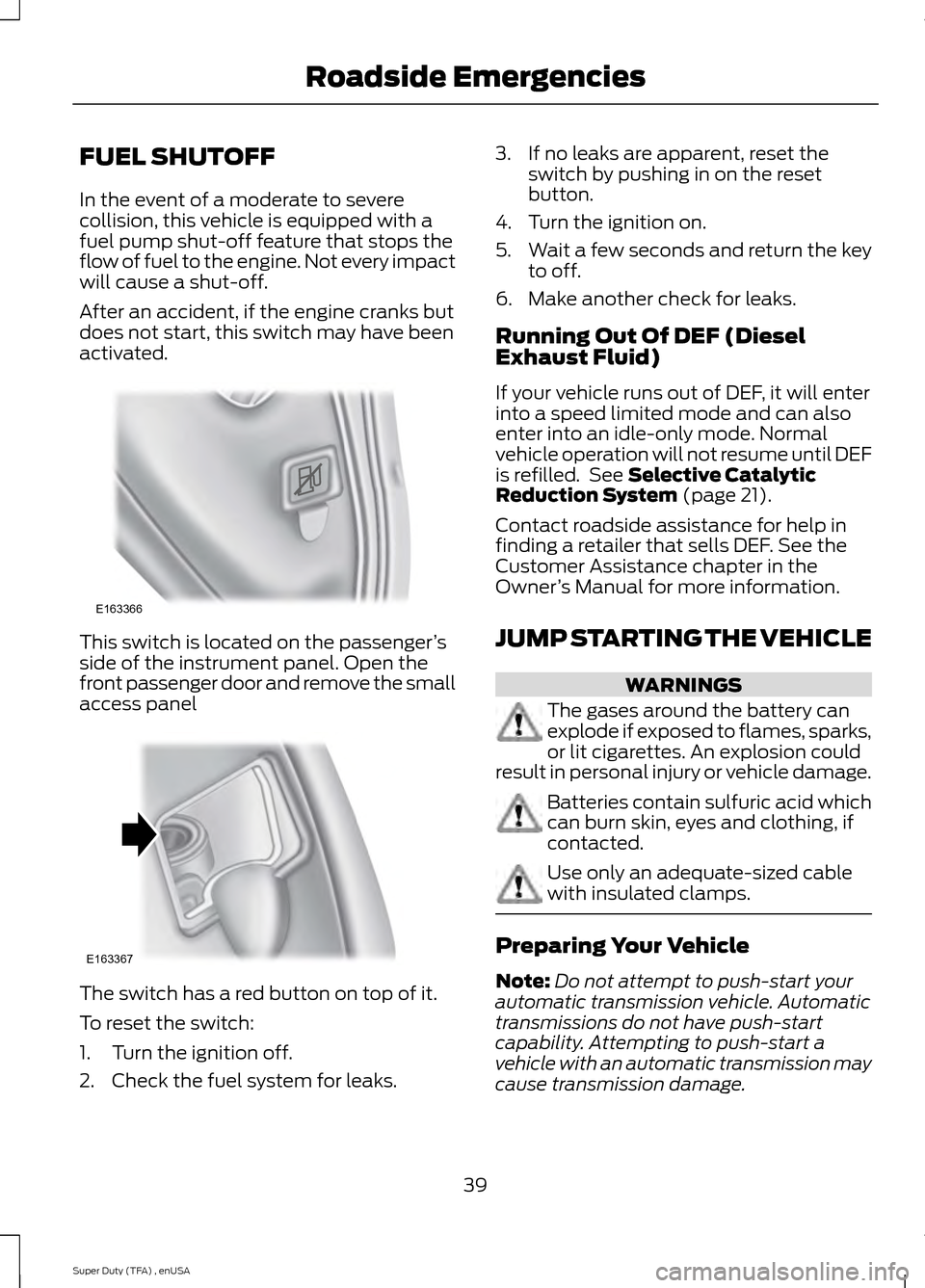
After an accident, if the engine cranks but
does not start, this switch may have been
activated.
This switch is located on the passenger
’s
side of the instrument panel. Open the
front passenger door and remove the small
access panel The switch has a red button on top of it.
To reset the switch:
1. Turn the ignition off.
2. Check the fuel system for leaks. 3. If no leaks are apparent, reset the
switch by pushing in on the reset
button.
4. Turn the ignition on.
5. Wait a few seconds and return the key
to off.
6. Make another check for leaks.
Running Out Of DEF (Diesel
Exhaust Fluid)
If your vehicle runs out of DEF, it will enter
into a speed limited mode and can also
enter into an idle-only mode. Normal
vehicle operation will not resume until DEF
is refilled. See Selective Catalytic
Reduction System (page 21).
Contact roadside assistance for help in
finding a retailer that sells DEF. See the
Customer Assistance chapter in the
Owner ’s Manual for more information.
JUMP STARTING THE VEHICLE WARNINGS
The gases around the battery can
explode if exposed to flames, sparks,
or lit cigarettes. An explosion could
result in personal injury or vehicle damage. Batteries contain sulfuric acid which
can burn skin, eyes and clothing, if
contacted.
Use only an adequate-sized cable
with insulated clamps.
Preparing Your Vehicle
Note:
Do not attempt to push-start your
automatic transmission vehicle. Automatic
transmissions do not have push-start
capability. Attempting to push-start a
vehicle with an automatic transmission may
cause transmission damage.
39
Super Duty (TFA) , enUSA Roadside EmergenciesE163366 E163367
Page 48 of 84
5.
Reset the Intelligent Oil Life Monitor™.
See the Information Displays chapter
in the Owner's Manual for more
information.
Engine lubrication for severe service
operation
The following conditions define severe
operation for which engine operation with
SAE 5W-40 API CJ-4 is recommended. Oil
and oil filter change intervals will be
determined by the Intelligent Oil Life
Monitor™ as noted previously.
• Frequent or extended idling (over 10
minutes per hour of normal driving)
• Low-speed operation/stationary use
• If vehicle is operated in sustained
ambient temperatures below -10°F
(-23°C) or above 100°F (38°C)
• Frequent low-speed operation,
consistent heavy traffic less than 25
mph (40 km/h)
• Operating in severe dust conditions
• Operating the vehicle off road
• Towing a trailer over 1,000 miles (1,600
km)
• Sustained, high-speed driving at Gross
Vehicle Weight Rating (maximum
loaded weight for vehicle operation)
• Use of fuels with sulfur content other
than ultra-low sulfur diesel (ULSD)
• Use of high-sulfur diesel fuel
ENGINE COOLANT CHECK
Checking the Engine Coolant
When the engine is cold, check the
concentration and level of engine coolant
at the intervals listed in the scheduled
maintenance chapter. See Scheduled
Maintenance (page 59). Note:
Make sure that the level is between
the MIN and MAX marks on the coolant
reservoirs.
Note: Coolant expands when it is hot. The
level may extend beyond the MAX mark
Note: If the level is at the MIN mark, below
the MIN mark, or empty, add coolant
immediately. See
Adding Engine Coolant
in this chapter.
Note: The coolant concentration should be
maintained within 48% to 50%, which
equates to a freeze point between -30 °F
(-34 °C) and -34 °F (-37 °C).
Note: For best results, the coolant
concentration should be tested with a
refractometer such as Rotunda tool
300-ROB75240 available from your dealer.
Ford does not recommend the use of
hydrometers or coolant test strips for
measuring coolant concentrations.
Note: Automotive fluids are not
interchangeable. Do not use engine coolant
or antifreeze or windshield washer fluid
outside of its specified function and vehicle
location.
Adding Engine Coolant WARNINGS
Do not add engine coolant when the
engine is hot. Steam and scalding
liquids released from a hot cooling
system can burn you badly. Also, you can
be burned if you spill coolant on hot engine
parts. Do not put engine coolant in the
windshield washer fluid container. If
sprayed on the windshield, engine
coolant could make it difficult to see
through the windshield.
45
Super Duty (TFA) , enUSA Maintenance
Page 60 of 84
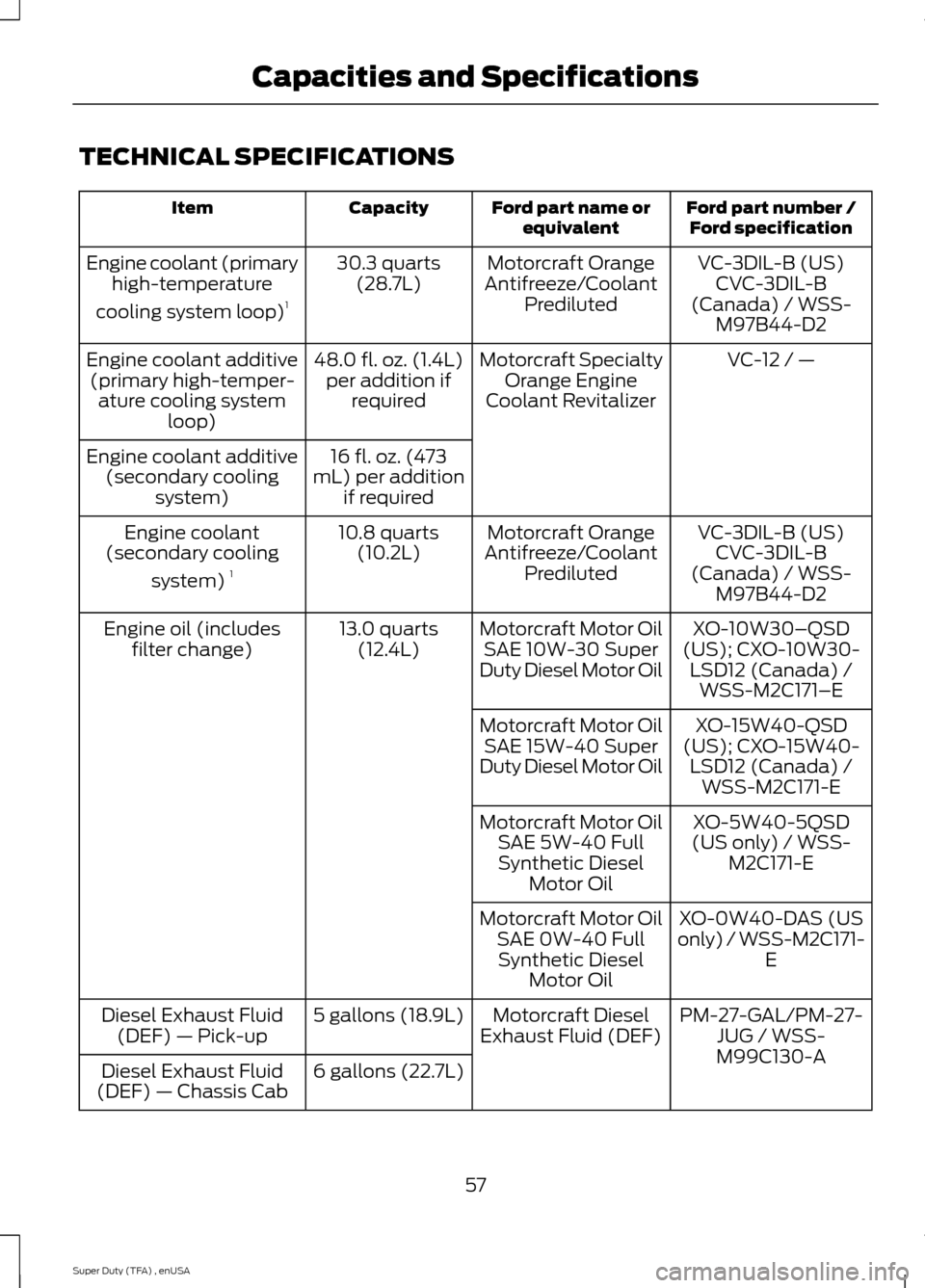
TECHNICAL SPECIFICATIONS
Ford part number /
Ford specification
Ford part name or
equivalent
Capacity
Item
VC-3DIL-B (US)CVC-3DIL-B
(Canada) / WSS- M97B44-D2
Motorcraft Orange
Antifreeze/Coolant Prediluted
30.3 quarts
(28.7L)
Engine coolant (primary
high-temperature
cooling system loop) 1
VC-12 / —
Motorcraft Specialty
Orange Engine
Coolant Revitalizer
48.0 fl. oz. (1.4L)
per addition if required
Engine coolant additive
(primary high-temper- ature cooling system loop)
16 fl. oz. (473
mL) per addition if required
Engine coolant additive
(secondary cooling system)
VC-3DIL-B (US)CVC-3DIL-B
(Canada) / WSS- M97B44-D2
Motorcraft Orange
Antifreeze/Coolant Prediluted
10.8 quarts
(10.2L)
Engine coolant
(secondary cooling
system) 1
XO-10W30–QSD
(US); CXO-10W30- LSD12 (Canada) / WSS-M2C171–E
Motorcraft Motor Oil
SAE 10W-30 Super
Duty Diesel Motor Oil
13.0 quarts
(12.4L)
Engine oil (includes
filter change)
XO-15W40-QSD
(US); CXO-15W40- LSD12 (Canada) / WSS-M2C171-E
Motorcraft Motor Oil
SAE 15W-40 Super
Duty Diesel Motor Oil
XO-5W40-5QSD
(US only) / WSS- M2C171-E
Motorcraft Motor Oil
SAE 5W-40 FullSynthetic Diesel Motor Oil
XO-0W40-DAS (US
only) / WSS-M2C171- E
Motorcraft Motor Oil
SAE 0W-40 FullSynthetic Diesel Motor Oil
PM-27-GAL/PM-27-JUG / WSS-
M99C130-A
Motorcraft Diesel
Exhaust Fluid (DEF)
5 gallons (18.9L)
Diesel Exhaust Fluid
(DEF) — Pick-up
6 gallons (22.7L)
Diesel Exhaust Fluid
(DEF) — Chassis Cab
57
Super Duty (TFA) , enUSA Capacities and Specifications
Page 82 of 84
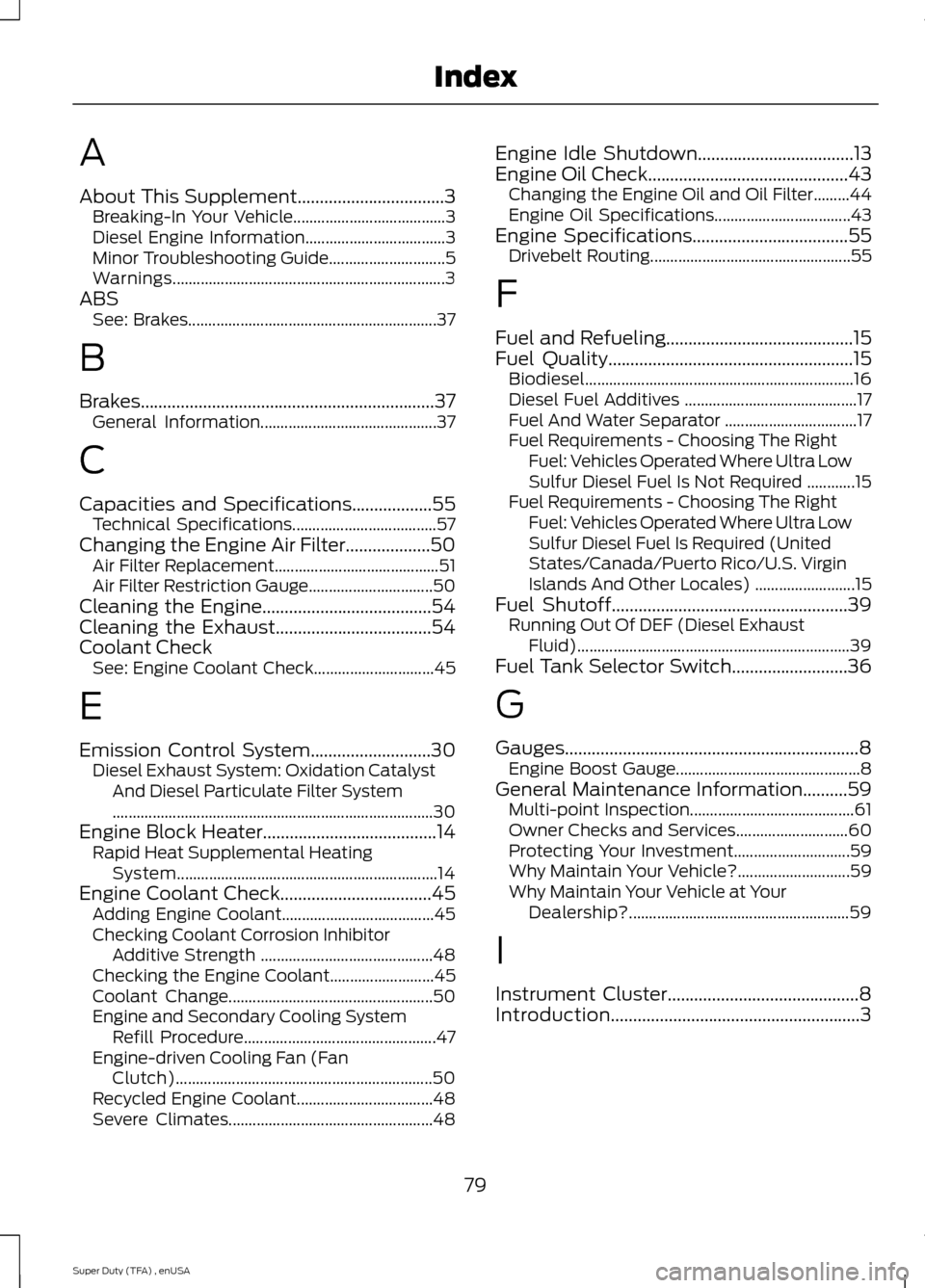
A
About This Supplement.................................3
Breaking-In Your Vehicle...................................... 3
Diesel Engine Information................................... 3
Minor Troubleshooting Guide............................. 5
Warnings.................................................................... 3
ABS See: Brakes.............................................................. 37
B
Brakes
..................................................................37
General Information............................................ 37
C
Capacities and Specifications
..................55
Technical Specifications.................................... 57
Changing the Engine Air Filter...................50 Air Filter Replacement......................................... 51
Air Filter Restriction Gauge............................... 50
Cleaning the Engine......................................54
Cleaning the Exhaust...................................54
Coolant Check See: Engine Coolant Check.............................. 45
E
Emission Control System
...........................30
Diesel Exhaust System: Oxidation Catalyst
And Diesel Particulate Filter System
........................................................................\
........ 30
Engine Block Heater
.......................................14
Rapid Heat Supplemental Heating
System................................................................. 14
Engine Coolant Check..................................45 Adding Engine Coolant...................................... 45
Checking Coolant Corrosion Inhibitor Additive Strength ........................................... 48
Checking the Engine Coolant.......................... 45
Coolant Change................................................... 50
Engine and Secondary Cooling System Refill Procedure................................................ 47
Engine-driven Cooling Fan (Fan Clutch)................................................................ 50
Recycled Engine Coolant.................................. 48
Severe Climates................................................... 48Engine Idle Shutdown
...................................13
Engine Oil Check.............................................43 Changing the Engine Oil and Oil Filter.........44
Engine Oil Specifications.................................. 43
Engine Specifications
...................................55
Drivebelt Routing.................................................. 55
F
Fuel and Refueling
..........................................15
Fuel Quality.......................................................15
Biodiesel................................................................... 16
Diesel Fuel Additives ........................................... 17
Fuel And Water Separator ................................. 17
Fuel Requirements - Choosing The Right Fuel: Vehicles Operated Where Ultra Low
Sulfur Diesel Fuel Is Not Required ............15
Fuel Requirements - Choosing The Right Fuel: Vehicles Operated Where Ultra Low
Sulfur Diesel Fuel Is Required (United
States/Canada/Puerto Rico/U.S. Virgin
Islands And Other Locales) ......................... 15
Fuel Shutoff.....................................................39 Running Out Of DEF (Diesel Exhaust
Fluid).................................................................... 39
Fuel Tank Selector Switch..........................36
G
Gauges..................................................................8 Engine Boost Gauge.............................................. 8
General Maintenance Information
..........59
Multi-point Inspection......................................... 61
Owner Checks and Services............................ 60
Protecting Your Investment............................. 59
Why Maintain Your Vehicle?............................ 59
Why Maintain Your Vehicle at Your Dealership?....................................................... 59
I
Instrument Cluster...........................................8
Introduction........................................................3
79
Super Duty (TFA) , enUSA Index