Def FORD SUPER DUTY 2015 3.G Diesel Supplement Manual
[x] Cancel search | Manufacturer: FORD, Model Year: 2015, Model line: SUPER DUTY, Model: FORD SUPER DUTY 2015 3.GPages: 84, PDF Size: 13.36 MB
Page 8 of 84
The powertrain and glow plug control
modules electronically control the glow
plug system. After you switch the ignition
on the glow plug control module
immediately energizes the glow plugs. The
glow plug control module using the engine
coolant temperature, barometric pressure
sensor and environmental temperature
sensor will determine how long the glow
plugs stay energized. The required time for
the glow plugs to be energized decreases
as the coolant temperature, barometric
pressure and environmental temperature
increase.
Glow Plug
Engine and secondary cooling system
The cooling system contains a primary
cooling loop to cool the engine and a
secondary cooling loop to cool the
transmission, charge air, and fuel. The
coolant serves three primary purposes: to
provide heat transfer, freeze point
protection, and corrosion protection using
additives.
Vehicles with diesel engines typically are
used to carry heavy loads and accumulate
mileage rapidly. These two factors may
cause the additives in the coolant to wear
out in a shorter time. For more information
about coolant additives and coolant
change intervals See Engine Coolant
Check (page 45). . Operating the engine
with insufficient coolant or coolant additive
can cause severe engine damage
Diesel Particulate Filter system
Your vehicle is equipped with a diesel
particulate filter in the exhaust system. The
diesel particulate filter reduces carbon
emissions by trapping exhaust particulates
(soot) before they reach the tailpipe. You
must properly maintain your diesel
particulate filter in order for it to function properly. Regeneration of the diesel
particulate filter occurs automatically
during operation above 30 mph (48 km/h)
and requires no actions from the driver. If
you do a lot of idling or stop and go driving,
pay attention to maintenance messages
that alert you when you need to drive to
clean the diesel particulate filter, or
perform operator commanded
regeneration. See
Emission Control
System (page 30).
Selective catalytic reduction system
Your vehicle is equipped with a selective
catalytic reduction system designed to
reduce emission levels of nitrogen oxides
from the exhaust of your diesel engine. This
system relies on the use of Diesel Exhaust
Fluid (DEF) that you must replenish at
certain intervals. Failure to maintain proper
DEF levels or if the DEF becomes
contaminated will result in vehicle speed
limitations or result in your vehicle entering
an idle-only mode. See
Selective
Catalytic Reduction System (page 21).
Speed control
If your vehicle speed goes outside a
predetermined range from the set speed,
the RSM (Resume) function will not reset
your vehicle speed. You will need to reset
your vehicle speed with the SET+ or SET-
button after reaching the desired speed
using the accelerator pedal.
Minor Troubleshooting Guide
If the engine won ’t crank WARNING
Battery posts, terminals and related
accessories contain lead and lead
compounds. Wash hands after
handling. 5
Super Duty (TFA) , enUSA Introduction
Page 10 of 84
If fuses burn out
WARNING
Replacement fuses and circuit
breakers must always be the same
rating as the original equipment
shown. Never replace a fuse or circuit
breaker with one of a higher rating. Higher
rated fuses or circuit breakers could allow
circuit overloading in the event of a circuit
malfunction, resulting in severe vehicle
damage or personal injury due to fire. Burned-out or blown fuses usually indicate
an electrical short-circuit, although a fuse
may occasionally burn out from vibration.
Insert a second fuse. If this fuse
immediately burns out and you cannot
locate the cause, return your vehicle to
your dealer for a circuit check.
Refer to the Owner
’s Manual for
replacement of fuses.
Selective catalytic reduction system
speed limit and Idle-only modes
If the vehicle ’s speed is limited or in an
idle-only mode, the selective catalytic
reduction system may be limiting the
vehicle ’s functions due to low or
contaminated DEF. Check the DEF. See
Selective Catalytic Reduction System
(page 21).
7
Super Duty (TFA) , enUSA Introduction
Page 12 of 84
Diesel Exhaust Fluid (DEF) (If
Equipped) With the key in the on position,
lights when the DEF is
contaminated or low. See
Selective Catalytic Reduction System
(page
21).
Glow Plug Pre-Heat With the key in the on position,
lights when the glow plug heat
is necessary as a starting aid.
Wait until the light goes off before starting.
See
Starting a Diesel Engine (page 10).
After you start the engine, the light should
turn off. When the engine is cold, the light
should always light for a short period.
Water In Fuel During refueling, it is possible for
you to pump
water-contaminated diesel fuel
into your fuel tank. Your vehicle ’s fuel
system is equipped with a fuel filter and
water separator to remove water from the
fuel. The water in fuel indicator lights when
the fuel and water separator has a
significant quantity of water in it and
requires immediate draining.
If the water in fuel lights when the engine
is running, stop your vehicle as soon as
safely possible, shut off the engine, then
drain the fuel and water separator. See
Fuel Quality
(page 15). Allowing water
to stay in the fuel system, after the water
in fuel indicator lights, could result in
extensive damage or failure of the fuel
injection system. WARNING
Do not drain the fuel and water
separator while the engine is running.
Fuel may ignite if the separator is
drained while the engine is running or the
vehicle is moving. Note:
Do not drain the fuel and water
separator while the engine is running. Air will
enter into the fuel system causing the engine
not to operate properly.
9
Super Duty (TFA) , enUSA Instrument ClusterE163176
Page 14 of 84
2.
When the glow plug pre-heat indicator
turns off, turn the key to start and
release the key as soon as the engine
starts. After starting the engine, the
glow plugs may remain on for a period.
If you do not start the engine before
the glow plug activation time ends, you
will need to reset the glow plugs by
turning the key to off.
3. After the engine starts, allow it to idle for about 15 seconds. This is to protect
the engine. Do not increase engine
speed until the oil pressure gauge
indicates normal pressure.
Cold Weather Operation
Note: Idling in cold weather does not heat
the engine to its normal operating
temperature. Long periods of idling,
especially in cold weather, can cause a
buildup of deposits which can cause engine
damage.
Changing to a lighter grade engine oil also
makes starting easier under these
conditions. Refer to Engine oil
specifications. See Technical
Specifications (page 57).
Diesel fuel is adjusted seasonally for cold
temperatures. Diesel fuel which has not
been properly formulated for the ambient
conditions may gel which can clog the fuel
filters. One indication that the fuel filter(s)
may be clogged is if the engine starts, stalls
after a short time, and then does not
restart. If you have been using biodiesel,
you may need to use a fuel with lower
biodiesel content, try another brand, or
discontinue using biodiesel. Do not use
alcohol based additives to correct fuel
gelling. This may result in damage to the
fuel injectors and system. Use the proper
anti-gel and performance improvement
product. See
Technical Specifications
(page 57). Your vehicle is equipped with a fuel and
water separator that recirculates fuel from
the engine to help prevent fuel filter
clogging. To avoid engine fuel starvation
during cold weather operation of 32°F
(0°C) or below, we recommended that
the fuel level in your tank should not drop
below 1⁄4 full. This helps prevent air from
entering the fuel system and stalling the
engine.
Your vehicle is equipped with a selective
catalyst reduction system that uses Diesel
Exhaust Fluid (DEF) to operate properly.
You need to replenish your vehicle
’s DEF
at certain intervals. When filling your
vehicle ’s DEF tank in cold weather, you
must take special care to prevent damage
to the tank. See
Selective Catalytic
Reduction System (page 21).
In cold weather below 32°F (0°C), the
engine may slowly increase to a higher idle
speed if left idling in P (Park). As the engine
warms-up, the engine sound level
decreases due to the activation of
PCM-controlled sound reduction features.
If you operate your vehicle in a heavy
snowstorm or blowing snow conditions,
snow and ice can clog the engine air
induction. If this occurs, the engine may
experience a significant reduction in power
output. At the earliest opportunity, clear
all the snow and/or ice away from inside
the air filter assembly. Remove the air
cleaner cover and the pleated paper filter,
leaving the foam filter in and remove any
snow or ice. Make sure you install the foam
filter correctly in place. Remove any debris,
snow or ice on the foam filter by brushing
the surface with soft brush. Once you have
cleared all of the debris, reinstall the air
filter and assembly.
Do not use water, solvents, or a hard brush
for cleaning the foam filter.
11
Super Duty (TFA) , enUSA Starting and Stopping the Engine
Page 21 of 84
Note:
If you drain the diesel fuel conditioner
module while the system is running air will
enter into the fuel system. The engine will
not operate properly if air enters the system.
Note: With fuel tank levels above 3⁄4 tank
it may be necessary to loosen the bowl 3
turns before opening the drain. This will
actuate an anti-siphon valve at the fuel and
water separator inlet and prevent the fuel
from siphoning out of the tank.
Note: A loose drain valve can allow air to
enter the fuel system and cause drivetrain
issues. The engine will not operate properly.
Be sure that you fully tighten the drain valve.
1. Stop your vehicle and shut off the engine.
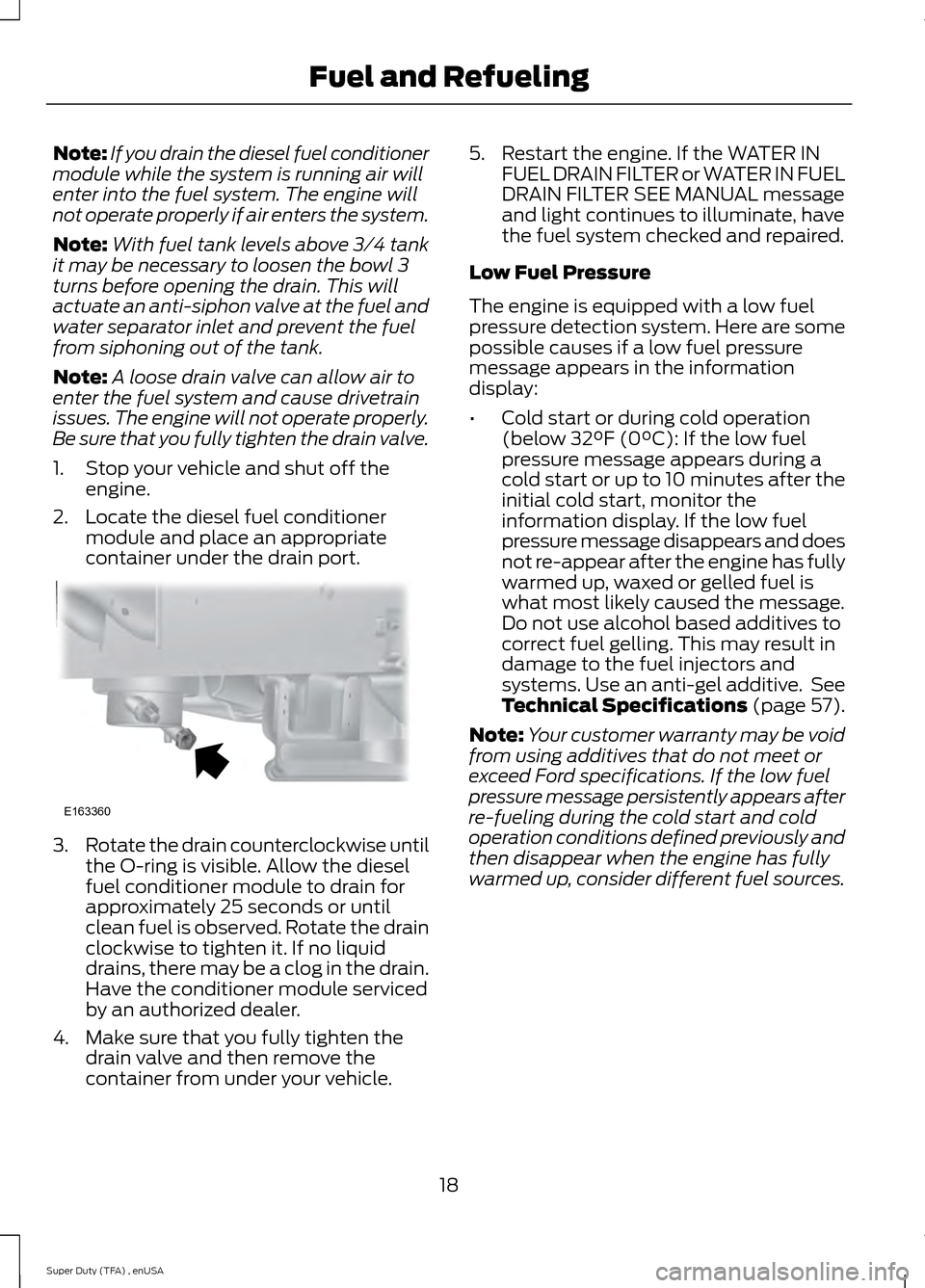
2. Locate the diesel fuel conditioner module and place an appropriate
container under the drain port. 3.
Rotate the drain counterclockwise until
the O-ring is visible. Allow the diesel
fuel conditioner module to drain for
approximately 25 seconds or until
clean fuel is observed. Rotate the drain
clockwise to tighten it. If no liquid
drains, there may be a clog in the drain.
Have the conditioner module serviced
by an authorized dealer.
4. Make sure that you fully tighten the drain valve and then remove the
container from under your vehicle. 5. Restart the engine. If the WATER IN
FUEL DRAIN FILTER or WATER IN FUEL
DRAIN FILTER SEE MANUAL message
and light continues to illuminate, have
the fuel system checked and repaired.
Low Fuel Pressure
The engine is equipped with a low fuel
pressure detection system. Here are some
possible causes if a low fuel pressure
message appears in the information
display:
• Cold start or during cold operation
(below 32°F (0°C): If the low fuel
pressure message appears during a
cold start or up to 10 minutes after the
initial cold start, monitor the
information display. If the low fuel
pressure message disappears and does
not re-appear after the engine has fully
warmed up, waxed or gelled fuel is
what most likely caused the message.
Do not use alcohol based additives to
correct fuel gelling. This may result in
damage to the fuel injectors and
systems. Use an anti-gel additive. See
Technical Specifications (page 57).
Note: Your customer warranty may be void
from using additives that do not meet or
exceed Ford specifications. If the low fuel
pressure message persistently appears after
re-fueling during the cold start and cold
operation conditions defined previously and
then disappear when the engine has fully
warmed up, consider different fuel sources.
18
Super Duty (TFA) , enUSA Fuel and RefuelingE163360
Page 22 of 84
•
Low fuel operation: If the low fuel
pressure message appears when your
vehicle is warm and during low fuel
tank level operation (near empty),
refuel your vehicle. If the message
reappears after fueling, see below. If
the message does not come back, the
low fuel pressure condition was due to
low fuel levels in the fuel tank.
• Normal operation: If the low fuel
pressure message appears during
normal operation when the engine is
fully warm, and fuel level is not low,
you must change the fuel filters
regardless of the maintenance
schedule interval.
• If replacement of the fuel filter does
not remedy the low fuel pressure
message during normal operation as
defined above, take the vehicle to an
authorized dealer.
Changing the Engine-Mounted and
Diesel Fuel Conditioner Module Fuel
Filters
Your vehicle is equipped with two fuel
filters. The first filter mounts on top of the
engine on the driver ’s side. The second
filter, inside the diesel fuel conditioner
module, is mounted on the frame rail under
the driver ’s side floorboard near the
transmission. You should replace both
filters at the same time. Regular fuel filter
changes are an important part of engine
maintenance; failing to keep with the
scheduled maintenance could lead to
engine performance issues and fuel
injection system damage. Refer to the
scheduled maintenance information of this
supplement for more information. See
General Maintenance Information
(page 59). Refer to Motorcraft part numbers in the
Capacities and Specifications chapter for
the fuel filter replacement part number.
See Motorcraft Parts (page 55). This part
number includes filters and seals for both
the engine-mounted and frame-mounted
filters.
Removal - Diesel Fuel Conditioner
Module filter
The diesel fuel conditioner module filter is
located in the lower portion of the housing.
1. Drain the diesel fuel conditioner
module. See Draining the Fuel and
Water Separator earlier in this chapter.
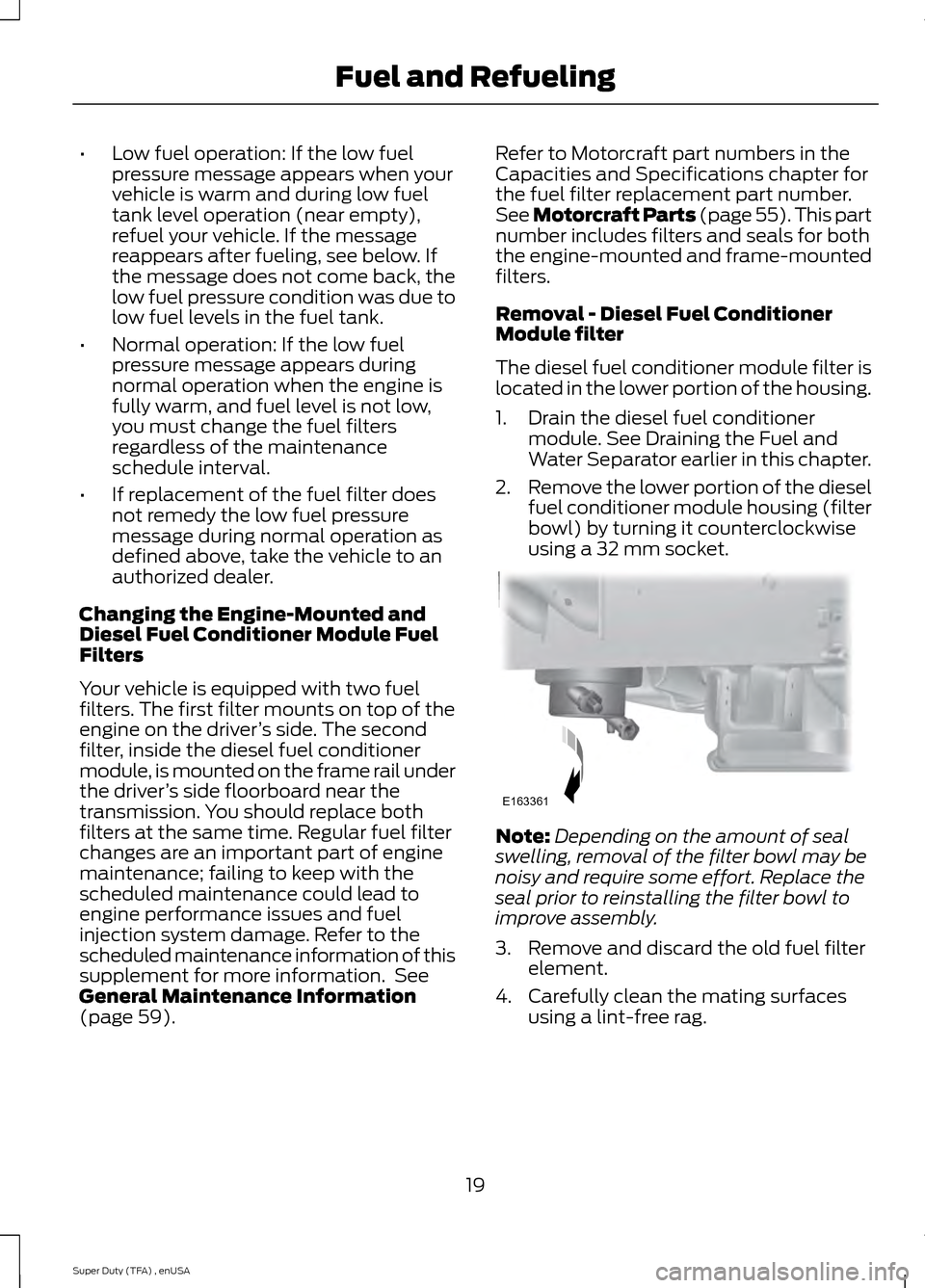
2. Remove the lower portion of the diesel
fuel conditioner module housing (filter
bowl) by turning it counterclockwise
using a 32 mm socket. Note:
Depending on the amount of seal
swelling, removal of the filter bowl may be
noisy and require some effort. Replace the
seal prior to reinstalling the filter bowl to
improve assembly.
3. Remove and discard the old fuel filter element.
4. Carefully clean the mating surfaces using a lint-free rag.
19
Super Duty (TFA) , enUSA Fuel and RefuelingE163361
Page 24 of 84
Installation – Engine-mounted fuel
filter
1. Install the new filter into the filter
bracket. Turn the filter clockwise to
lock it in place.
2. Reconnect both fuel lines.
Note: Using a fuel that has more than
average impurities may require you to
replace the fuel filter more frequently than
the service interval specifies.
Note: You will need to purge the system of
air after removal or changing of the filter.
See purging air from the fuel system later
in this chapter.
Purging air from the fuel system
Turn the ignition key to on for 30 seconds,
then turn it to off. Do this six times in a row
to purge any trapped air from the fuel
system.
After filter service, a no start or rough
running engine may indicate that air is
entering the system through the filter bowl
seal or drain. Make sure the drain is tight
and you tightened the filter bowl to the
mechanical stop.
SELECTIVE CATALYTIC
REDUCTION SYSTEM
Your vehicle is equipped with a selective
catalytic reduction system to help reduce
emission levels of oxides of nitrogen from
the exhaust of the diesel engine. The
system automatically injects Diesel
Exhaust Fluid (DEF) into the exhaust
system to enable proper selective catalytic
reduction function. Importance of maintaining the
Diesel Exhaust Fluid (DEF) level
In order for the selective catalytic reduction
system to operate properly, the DEF level
must be maintained. Generally, the DEF
tank should be filled during the oil change
service interval. See General
Maintenance Information (page 59).
However, certain conditions or driving
styles, such as trailer towing or fast rates
of acceleration, will require the refilling of
the DEF tank more often.
The engine control unit will monitor the
amount of fluid available in the DEF tank.
Running a system check in the information
display will indicate whether the DEF level
is ok or if it is less than 1/2 full. A message
will display in the information display when
the DEF level is low and needs to be
refilled. When you see this message, you
should refill your tank. See the Information
displays chapter of your Owner ’s Manual
for information display functions. For
instructions on refilling your DEF tank, see
filling the Diesel Exhaust Fluid (DEF) tank
in this supplement.
Diesel Exhaust Fluid (DEF)
warning messages and vehicle
operations WARNINGS
Diesel Exhaust Fluid (DEF) must be
refilled when low or replaced when
contaminated or your vehicle speed
will be speed limited to 50 mph (80 km/h).
In these conditions, drive with caution and
refill DEF immediately. If the DEF becomes
empty or contaminated and fluid is not
replaced, your vehicle will become limited
to idle speed only once stopped. In these
conditions, be cautious where you stop
your vehicle because you may not be able
to drive long distances and will not be able
to maintain highway speeds until you refill
or replace the DEF.
21
Super Duty (TFA) , enUSA Fuel and Refueling
Page 25 of 84
WARNINGS
Tampering or disabling your vehicle
’s
exhaust aftertreatment system will
result in severe vehicle performance
limitation including eventual speed limiting
to 5 mph. Your vehicle
’s information display will
display a series of messages regarding the
amount of DEF available. A systems check
will display messages indicating the
amount of DEF available (OK or under 1⁄2
full) or will produce a warning message
that displays the mileage (kilometers)
remaining as the fluid in the DEF tank nears
empty. For more information on warning
messages, see the Information Displays
chapter of your Owner ’s Manual. As the DEF level nears empty,
the DEF warning symbol will be
displayed and a series of tones
will sound with the messages starting at
500 miles (805 km) remaining before DEF
is depleted. The warning symbol and
messages will continue until you refill the
DEF tank. Continued driving without refilling will
result in the following actions as required
by the California Air Resources Board
(CARB) and the U.S. Environmental
Protection Agency (EPA):
•
Within a certain number of miles
(kilometers) to empty, speed will be
limited upon vehicle restart. Prior to
this occurring a message will appear in
the information display.
• Further vehicle operation without
refilling your DEF tank will cause the
engine to enter an idle-only condition.
This will only occur upon vehicle
refueling or at an extended idle. A
message will indicate the required
actions to resume normal operation. It
is required to add a minimum of 0.5
gallons (1.9L) of DEF to the tank to exit
the idle-only condition, but your vehicle
will still be in the speed-limiting mode
until you refill the tank completely.
For either vehicle speed limiting or idle-only
condition, normal vehicle operation will
resume when you refill the DEF tank.
Note: When filling the DEF tank from
empty, there may be a short delay before
detecting the increased level of fluid. The
increased level detection must occur before
your vehicle returns to full power. Low DEF Warnings and Actions — Instrument Cluster Messages (Optional information
display messages shown, base information display messages similar)
Vehicle Actions
Customer
Requested Actions
Distance/Exhaust
Fluid Level or Action
Cluster Message
None
Drive normally
Full exhaust fluid
tank
Exhaust Fluid Level
OK
None
Drive normally
Exhaust fluid tank
below 1⁄2 full
Exhaust Fluid Under
1⁄2 Full
22
Super Duty (TFA) , enUSA Fuel and RefuelingE163176
Page 26 of 84
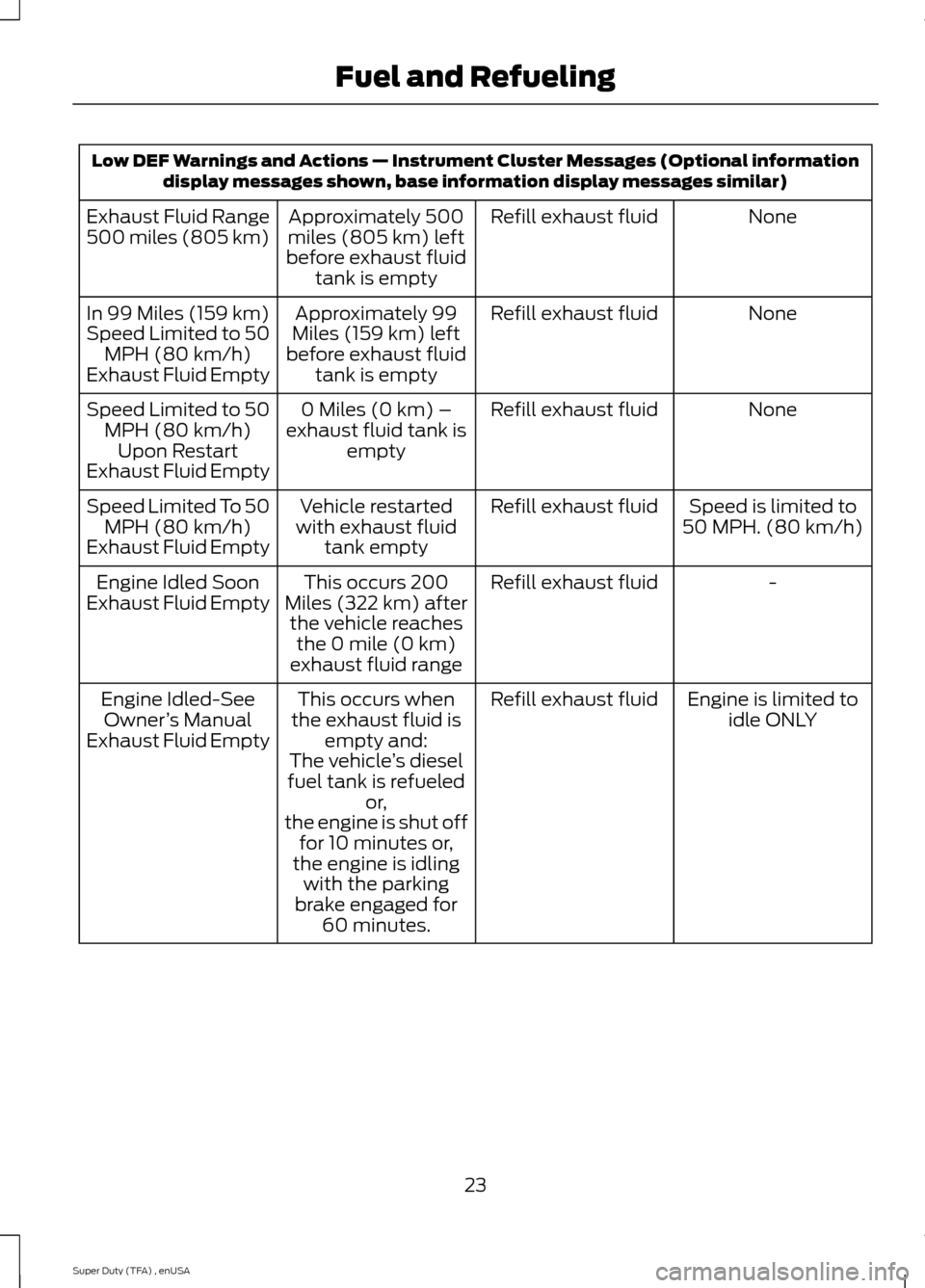
Low DEF Warnings and Actions — Instrument Cluster Messages (Optional information
display messages shown, base information display messages similar)
None
Refill exhaust fluid
Approximately 500
miles (805 km) left
before exhaust fluid tank is empty
Exhaust Fluid Range
500 miles (805 km)
None
Refill exhaust fluid
Approximately 99
Miles (159 km) left
before exhaust fluid tank is empty
In 99 Miles (159 km)
Speed Limited to 50
MPH (80 km/h)
Exhaust Fluid Empty
None
Refill exhaust fluid
0 Miles (0 km) –
exhaust fluid tank is empty
Speed Limited to 50
MPH (80 km/h)Upon Restart
Exhaust Fluid Empty
Speed is limited to
50 MPH. (80 km/h)
Refill exhaust fluid
Vehicle restarted
with exhaust fluid tank empty
Speed Limited To 50
MPH (80 km/h)
Exhaust Fluid Empty
-
Refill exhaust fluid
This occurs 200
Miles (322 km) after the vehicle reaches the 0 mile (0 km)
exhaust fluid range
Engine Idled Soon
Exhaust Fluid Empty
Engine is limited toidle ONLY
Refill exhaust fluid
This occurs when
the exhaust fluid is empty and:
Engine Idled-See
Owner ’s Manual
Exhaust Fluid Empty The vehicle’s diesel
fuel tank is refueled or,
the engine is shut off for 10 minutes or,
the engine is idling with the parking
brake engaged for 60 minutes.
23
Super Duty (TFA) , enUSA Fuel and Refueling
Page 27 of 84
Filling the Diesel Exhaust Fluid (DEF)
tank
WARNINGS
Make sure that Diesel Exhaust Fluid
(DEF) does not come into contact
with eyes, skin or clothing. Should
any DEF contact your eyes, flush them with
plenty of water and contact a physician.
Clean affected skin with soap and water.
If any DEF is swallowed, drink plenty of
water and contact a physician immediately Refill DEF in a well-ventilated area.
When opening the cap on the DEF
tank or bottle containing DEF,
ammonia vapors may escape. The vapors
can be irritating to skin, eyes and mucous
membranes. Inhaling ammonia vapors can
cause burning to the eyes, throat and nose
and cause coughing and watery eyes. Note:
Do not put DEF in the fuel tank. This
can cause engine damage not covered by
your vehicle ’s warranty.
Note: Immediately wipe away any DEF that
has spilled on painted surfaces with water
and a damp cloth to prevent damage to the
paint.
Your vehicle is equipped with a DEF tank
with a blue-capped filler port located next
to the diesel fuel fill inlet. The tank can be
filled using a nozzle at a DEF filling station
(similar to fuel fill) or using a DEF bottle
with a spout. We recommend Motorcraft®
DEF bottles since they are designed to be
spill proof and will stop the flow of DEF
when the tank is full. You can use other
aftermarket bottles, but they should have
a seal on the spout and an internal vent
tube to achieve best fill performance and
prevent overfilling. Overfilling your DEF
tank can cause damage to the tank. For
your DEF tank capacity. See Technical
Specifications (page 57). You can purchase Diesel Exhaust Fluid
(DEF) at an authorized dealer, most
highway truck stops or you can contact
roadside assistance for help in finding a
retailer that sells DEF. See the Customer
Assistance chapter in the Owner
’s Manual
for more information. In addition, there is
a government website locator for DEF at
the following web address to find the
nearest location to purchase DEF:
http://www.afdc.energy.gov/afdc/
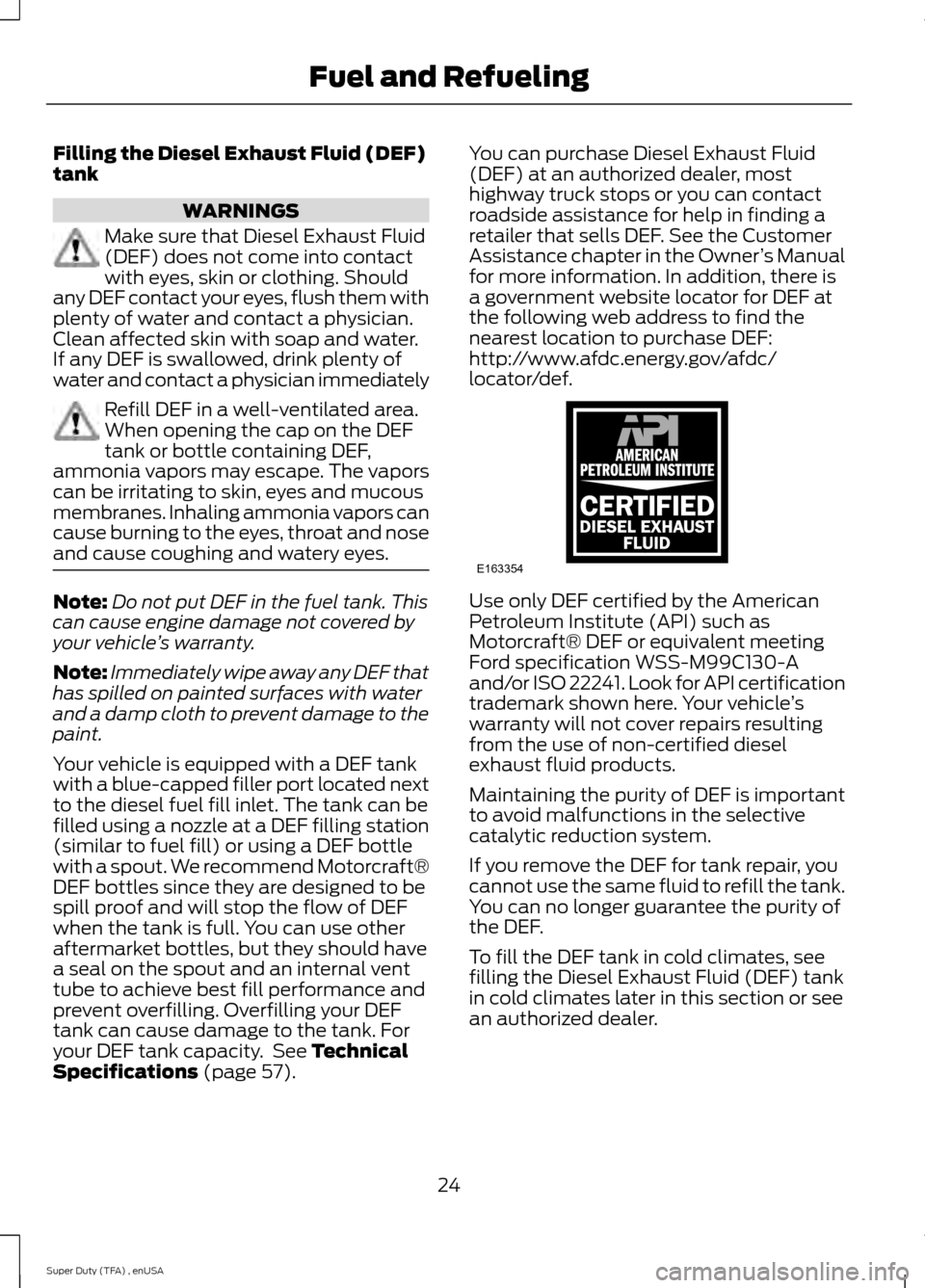
locator/def. Use only DEF certified by the American
Petroleum Institute (API) such as
Motorcraft® DEF or equivalent meeting
Ford specification WSS-M99C130-A
and/or ISO 22241. Look for API certification
trademark shown here. Your vehicle
’s
warranty will not cover repairs resulting
from the use of non-certified diesel
exhaust fluid products.
Maintaining the purity of DEF is important
to avoid malfunctions in the selective
catalytic reduction system.
If you remove the DEF for tank repair, you
cannot use the same fluid to refill the tank.
You can no longer guarantee the purity of
the DEF.
To fill the DEF tank in cold climates, see
filling the Diesel Exhaust Fluid (DEF) tank
in cold climates later in this section or see
an authorized dealer.
24
Super Duty (TFA) , enUSA Fuel and RefuelingE163354)E163354