tow FORD SUPER DUTY 2023 Owners Manual
[x] Cancel search | Manufacturer: FORD, Model Year: 2023, Model line: SUPER DUTY, Model: FORD SUPER DUTY 2023Pages: 738, PDF Size: 18.49 MB
Page 430 of 738
Your vehicle has limited engine powerwhen in the fail-safe mode, drive yourvehicle with caution. Your vehicle does notmaintain high-speed operation and theengine may operate poorly.
Remember that the engine is capable ofautomatically shutting down to preventengine damage. In this situation:
1.Pull off the road as soon as safelypossible and switch the engine off.
2.If you are a member of a roadsideassistance program, we recommendthat you contact your roadsideassistance service provider.
3.If this is not possible, wait for a shortperiod of time for the engine to cool.
4.Check the coolant level. If the coolantlevel is at or below the minimum mark,add prediluted coolant immediately.
5.When the engine temperature cools,you can re-start the engine. Have yourvehicle checked as soon as possible tominimize engine damage.
Note:Driving your vehicle without repairincreases the chance of engine damage.
FAIL-SAFE COOLING INDICATORS
If the engine begins to overheat,the coolant temperature gaugemoves toward the red zone.
A warning lamp illuminates anda message may appear in theinstrument cluster display.
426
2023 Super Duty (TFH) Canada/United States of America, enUSA, Edition date: 202211, DOMCrash and Breakdown InformationE103308 E67028
Page 431 of 738
TOWING YOUR VEHICLE
PRECAUTIONS
Use the following guidelines when towingyour vehicle. Failure to follow thisinstruction could result in vehicle damagenot covered by the vehicle warranty.
Note:Make sure you properly secure yourvehicle to the tow vehicle.
Note:If you are unsure of the vehicle’sconfiguration, contact an authorized dealer.
RECREATIONALLY TOWING
YOUR VEHICLE - 4X4
WARNING: Do not disconnect thebattery when recreationally towing yourvehicle. This prevents the transfer casefrom shifting properly and could causethe vehicle to roll, even if thetransmission is in park (P).
WARNING: Placing the transfercase in its neutral position could causeyour vehicle to freely roll. Make sure youpress and hold the brake pedal and thevehicle is in a secure, safe position whenyou place the transfer case in its neutralposition.
Follow these guidelines if you have a needfor recreational towing. An example ofrecreational towing would be towing yourvehicle behind a motorhome. Theseguidelines are to make sure that you donot damage the transmission.
You can only tow your vehicle with allwheels on the ground by placing thetransfer case in its neutral position andengaging the recreational tow feature.Perform the following steps afterpositioning your vehicle behind the towvehicle and properly securing themtogether.
Note:Put your climate control system inrecirculated air mode to prevent exhaustfumes from entering your vehicle.
Note:Failure to put the transfer case in itsneutral position can damage vehiclecomponents.
Note: You can check the towing status atany time by opening the driver door orturning the ignition to the accessory or onposition.Neutral Tow Enabled LeaveTransmission in Neutral appears in theinstrument cluster display to confirm youcan recreationally tow your vehicle.
Note:If your vehicle has an anti-theftalarm, make sure you switch perimetersensing on when towing. See Setting theAlarm Security Level (page 104).
Switching Neutral Tow On
1.Place your vehicle in accessory modeby pressing the push button ignitionswitch once without pressing the brakepedal or by turning the ignition key tothe on position.
2.Press and hold the brake pedal.
3.Press the 2H button on the four-wheeldrive mode control.
4.Shift the transmission into neutral (N).
5.Using the instrument cluster controlson the steering wheel, select Settings.
6.Select Neutral Tow.
7.Press and hold the OK button until aconfirmation message appears in theinformation display.
427
2023 Super Duty (TFH) Canada/United States of America, enUSA, Edition date: 202211, DOMTowing Your Vehicle
Page 432 of 738
Note: If completed successfully, theinformation display shows Neutral TowEnabled Leave Transmission in Neutral.This indicates that your vehicle is safe totow with all wheels on the ground.
Note:If you do not see a confirmationmessage in the instrument cluster display,you must perform the procedure again fromthe beginning.
Note:You may hear noise as the transfercase shifts into its neutral position. This isnormal.
8.Release the brake pedal and leave thetransmission in neutral (N) and switchyour vehicle off by pressing the pushbutton ignition switch once withoutpressing the brake pedal or turning thekey as far toward the off position.
Note:Vehicles with keys do not turn to theoff position when the transmission is inneutral (N). You must leave the key in theignition when towing. Use the keyless entrykeypad or an extra set of keys to lock andunlock your vehicle.
Switching Neutral Tow Off
1.With your vehicle properly secured tothe tow vehicle, place your vehicle inaccessory mode by pressing the pushbutton ignition switch once withoutpressing the brake pedal or by turningthe ignition key to the on position.
2.Press and hold the brake pedal.
3.Shift the transmission to Park (P) andcontinue holding the brake pedal untilthe instrument cluster display shows2H and Neutral Tow Disabled.
4.Release the brake pedal.
Note:If completed successfully, theinstrument cluster displays 2H and NeutralTow Disabled.
Note:You must perform the switchingneutral tow on and switching neutral towoff procedures again from the beginning ifthe indicator light and message do notdisplay.
Note:You may hear a noise as the transfercase shifts out of its neutral position. Thisis normal.
5.Apply the parking brake, thendisconnect your vehicle from the towvehicle.
6.Release the parking brake, start theengine, and shift into drive (D) to makesure the transfer case is out of theneutral tow position.
7.If the transfer case does notsuccessfully shift out of its neutralposition, set the parking brake. Haveyour vehicle checked as soon aspossible.
Resolving the Shift Delayed PullForward Message
1.Press and hold the brake pedal.
2.Start your vehicle.
3.Shift into neutral (N).
4.With the vehicle running, shift into drive(D) and let the vehicle roll forward upto 3 ft (1 m).
Note:You may hear a noise as the transfercase shifts out of its neutral position. Thisis normal.
5.Make sure the instrument clusterdisplays Neutral Tow Disabled.
428
2023 Super Duty (TFH) Canada/United States of America, enUSA, Edition date: 202211, DOMTowing Your Vehicle
Page 433 of 738
RECREATIONALLY TOWING
YOUR VEHICLE - 4X2
You cannot recreational tow your vehiclewith all wheels on the ground becausevehicle or transmission damage couldoccur. You must recreational tow yourvehicle with all four wheels off the ground,such as when using a car-hauling trailer.Otherwise, you cannot recreational towyour vehicle.
EMERGENCY TOWING
If your vehicle becomes inoperable withoutaccess to wheel dollies or a vehicletransport trailer, it can be flat-towed withall wheels on the ground, regardless of thepowertrain and transmission configuration,under the following conditions:
•Your vehicle is facing forward fortowing in a forward direction.
•The transmission is in neutral (N).
•Maximum speed is 35 mph (56 km/h).
•Maximum distance is 50 mi (80 km).
TOWING YOUR VEHICLE – TROUBLESHOOTING
TOWING YOUR VEHICLE – INFORMATION MESSAGES
DetailsMessage
The transfer case is in the neutral position and your vehicle is safeto tow with all four wheels on the ground.Neutral TowEnabled LeaveTransmission inNeutral
There is a transfer case gear tooth blockage present. With yourvehicle on, shift the transmission into drive (D) and let the vehicleroll forward, up to 3 ft (1 m).
Shift Delayed PullForward
The transfer case is not in the neutral position and your vehicle isnot safe to tow with all four wheels on the ground.Neutral TowDisabled
429
2023 Super Duty (TFH) Canada/United States of America, enUSA, Edition date: 202211, DOMTowing Your Vehicle
Page 436 of 738
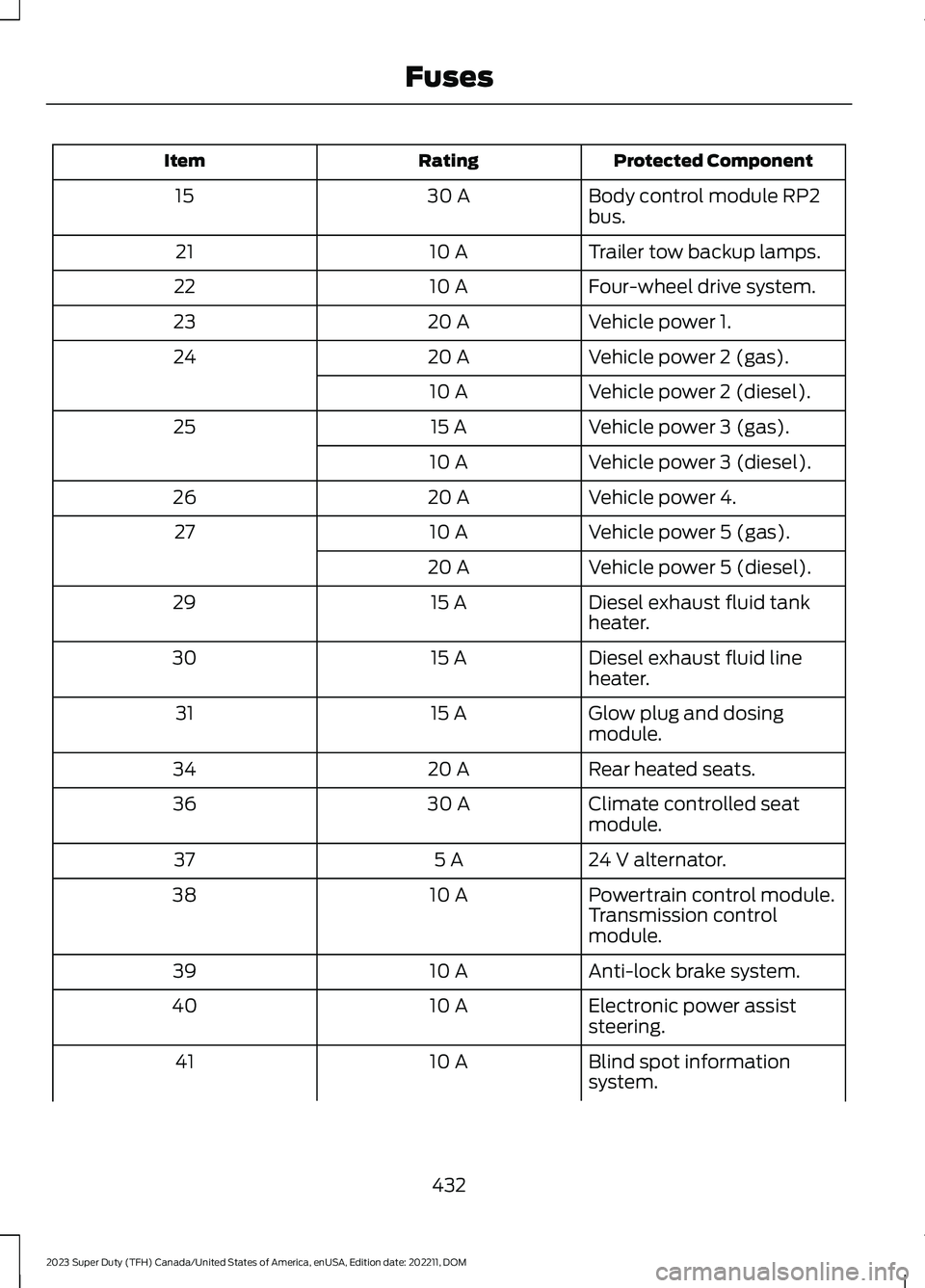
Protected ComponentRatingItem
Body control module RP2bus.30 A15
Trailer tow backup lamps.10 A21
Four-wheel drive system.10 A22
Vehicle power 1.20 A23
Vehicle power 2 (gas).20 A24
Vehicle power 2 (diesel).10 A
Vehicle power 3 (gas).15 A25
Vehicle power 3 (diesel).10 A
Vehicle power 4.20 A26
Vehicle power 5 (gas).10 A27
Vehicle power 5 (diesel).20 A
Diesel exhaust fluid tankheater.15 A29
Diesel exhaust fluid lineheater.15 A30
Glow plug and dosingmodule.15 A31
Rear heated seats.20 A34
Climate controlled seatmodule.30 A36
24 V alternator.5 A37
Powertrain control module.10 A38Transmission controlmodule.
Anti-lock brake system.10 A39
Electronic power assiststeering.10 A40
Blind spot informationsystem.10 A41
432
2023 Super Duty (TFH) Canada/United States of America, enUSA, Edition date: 202211, DOMFuses
Page 437 of 738
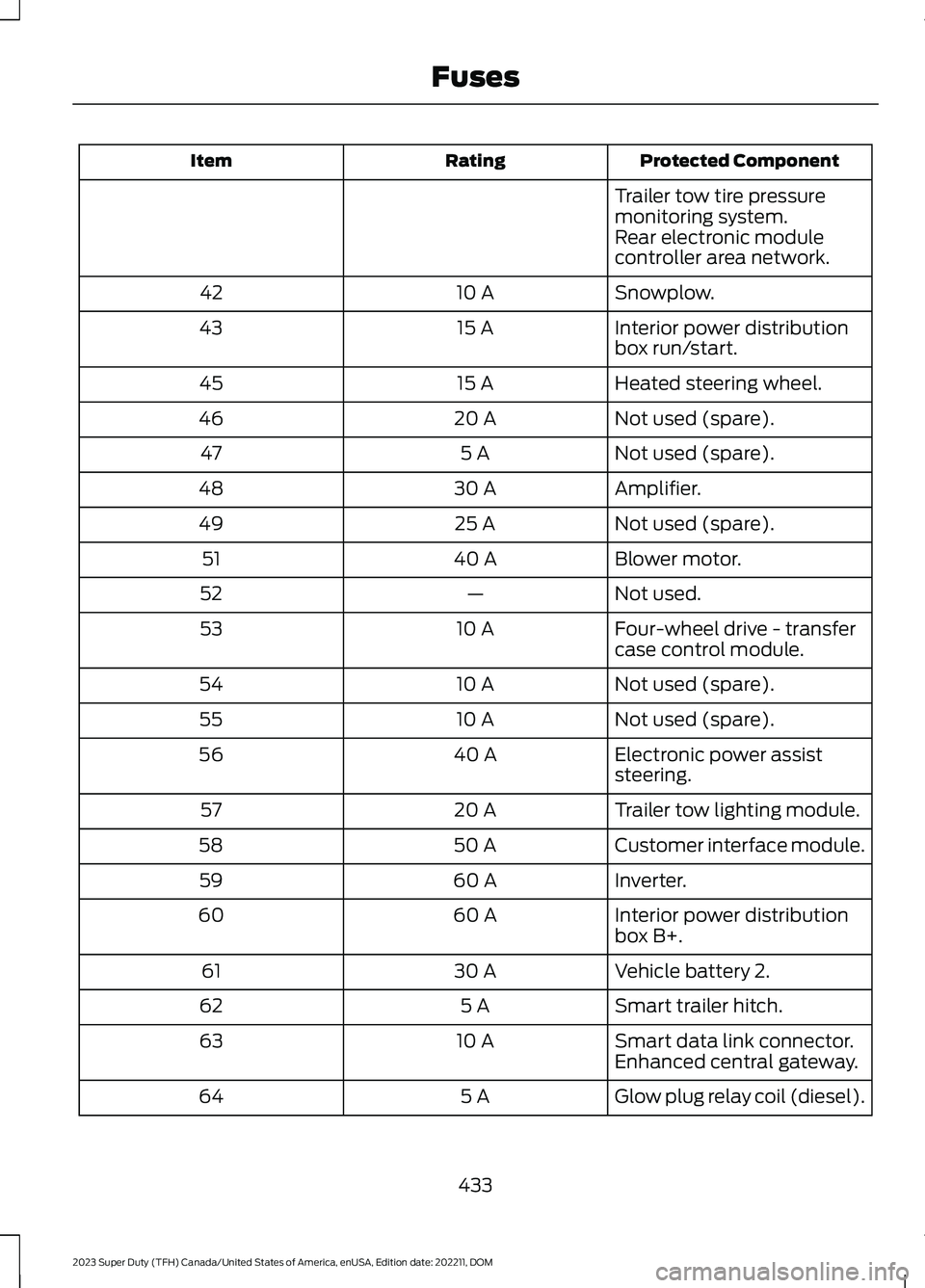
Protected ComponentRatingItem
Trailer tow tire pressuremonitoring system.Rear electronic modulecontroller area network.
Snowplow.10 A42
Interior power distributionbox run/start.15 A43
Heated steering wheel.15 A45
Not used (spare).20 A46
Not used (spare).5 A47
Amplifier.30 A48
Not used (spare).25 A49
Blower motor.40 A51
Not used.—52
Four-wheel drive - transfercase control module.10 A53
Not used (spare).10 A54
Not used (spare).10 A55
Electronic power assiststeering.40 A56
Trailer tow lighting module.20 A57
Customer interface module.50 A58
Inverter.60 A59
Interior power distributionbox B+.60 A60
Vehicle battery 2.30 A61
Smart trailer hitch.5 A62
Smart data link connector.10 A63Enhanced central gateway.
Glow plug relay coil (diesel).5 A64
433
2023 Super Duty (TFH) Canada/United States of America, enUSA, Edition date: 202211, DOMFuses
Page 438 of 738
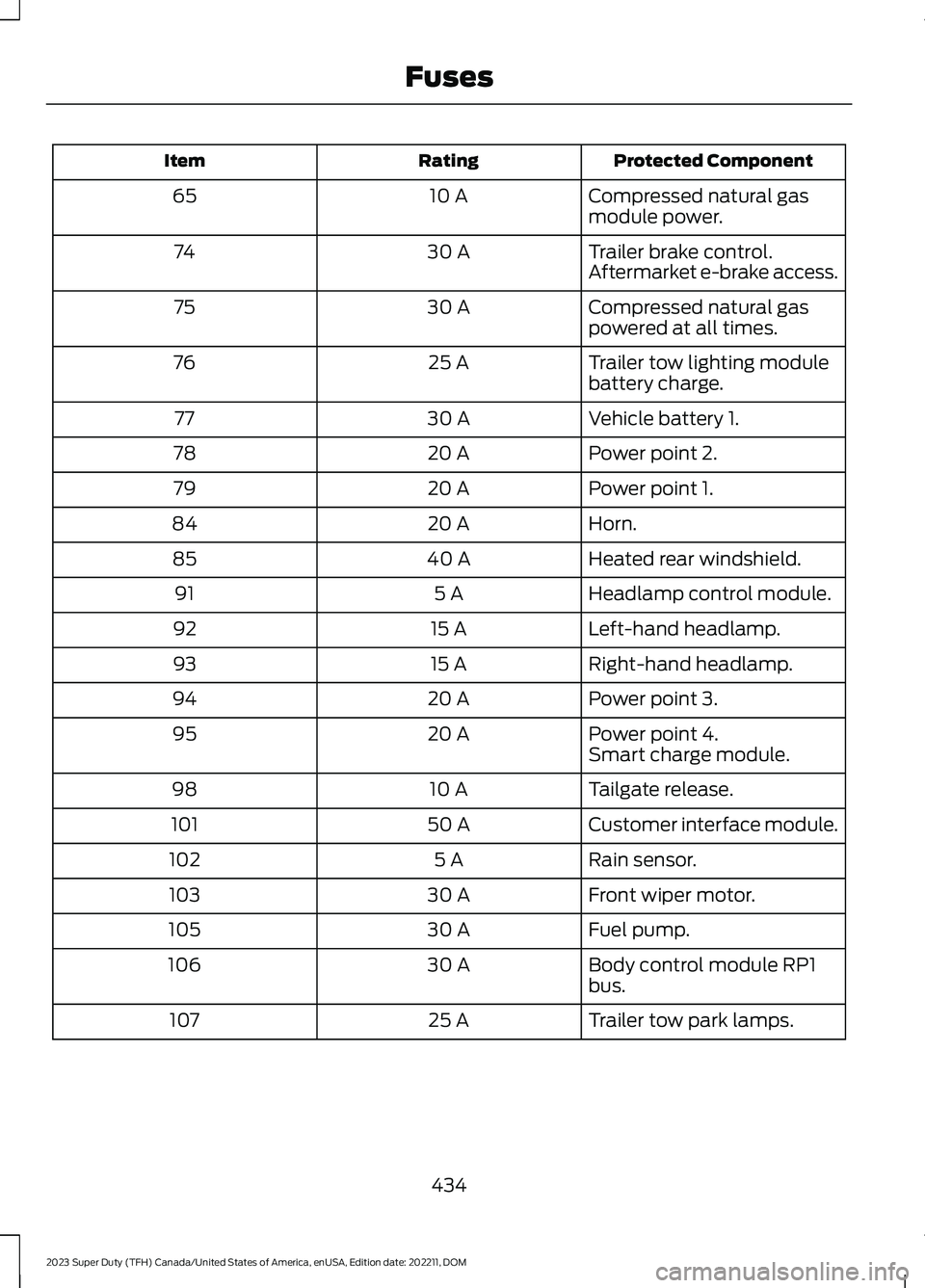
Protected ComponentRatingItem
Compressed natural gasmodule power.10 A65
Trailer brake control.30 A74Aftermarket e-brake access.
Compressed natural gaspowered at all times.30 A75
Trailer tow lighting modulebattery charge.25 A76
Vehicle battery 1.30 A77
Power point 2.20 A78
Power point 1.20 A79
Horn.20 A84
Heated rear windshield.40 A85
Headlamp control module.5 A91
Left-hand headlamp.15 A92
Right-hand headlamp.15 A93
Power point 3.20 A94
Power point 4.20 A95Smart charge module.
Tailgate release.10 A98
Customer interface module.50 A101
Rain sensor.5 A102
Front wiper motor.30 A103
Fuel pump.30 A105
Body control module RP1bus.30 A106
Trailer tow park lamps.25 A107
434
2023 Super Duty (TFH) Canada/United States of America, enUSA, Edition date: 202211, DOMFuses
Page 456 of 738
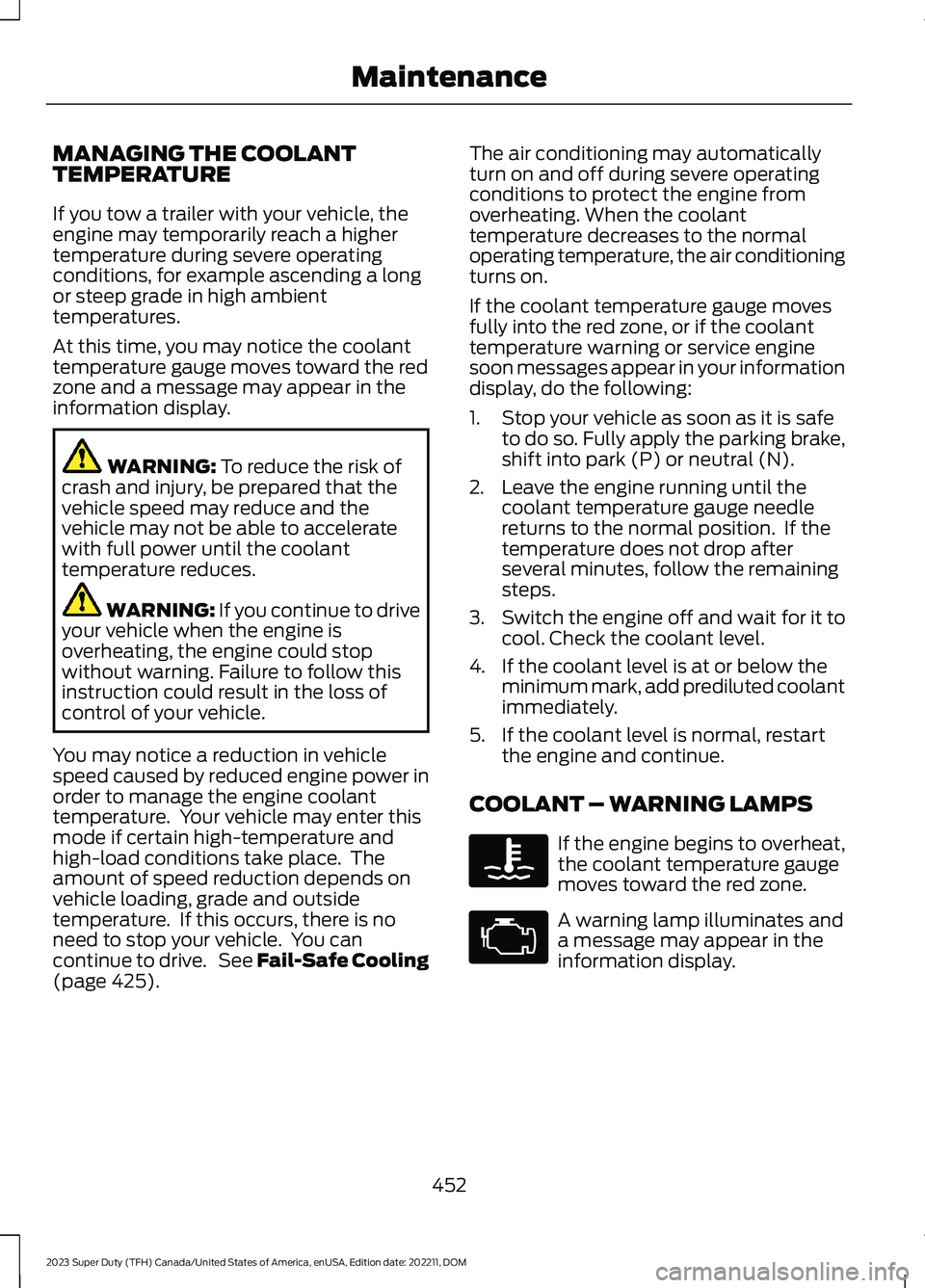
MANAGING THE COOLANTTEMPERATURE
If you tow a trailer with your vehicle, theengine may temporarily reach a highertemperature during severe operatingconditions, for example ascending a longor steep grade in high ambienttemperatures.
At this time, you may notice the coolanttemperature gauge moves toward the redzone and a message may appear in theinformation display.
WARNING: To reduce the risk ofcrash and injury, be prepared that thevehicle speed may reduce and thevehicle may not be able to acceleratewith full power until the coolanttemperature reduces.
WARNING: If you continue to driveyour vehicle when the engine isoverheating, the engine could stopwithout warning. Failure to follow thisinstruction could result in the loss ofcontrol of your vehicle.
You may notice a reduction in vehiclespeed caused by reduced engine power inorder to manage the engine coolanttemperature. Your vehicle may enter thismode if certain high-temperature andhigh-load conditions take place. Theamount of speed reduction depends onvehicle loading, grade and outsidetemperature. If this occurs, there is noneed to stop your vehicle. You cancontinue to drive. See Fail-Safe Cooling(page 425).
The air conditioning may automaticallyturn on and off during severe operatingconditions to protect the engine fromoverheating. When the coolanttemperature decreases to the normaloperating temperature, the air conditioningturns on.
If the coolant temperature gauge movesfully into the red zone, or if the coolanttemperature warning or service enginesoon messages appear in your informationdisplay, do the following:
1.Stop your vehicle as soon as it is safeto do so. Fully apply the parking brake,shift into park (P) or neutral (N).
2.Leave the engine running until thecoolant temperature gauge needlereturns to the normal position. If thetemperature does not drop afterseveral minutes, follow the remainingsteps.
3.Switch the engine off and wait for it tocool. Check the coolant level.
4.If the coolant level is at or below theminimum mark, add prediluted coolantimmediately.
5.If the coolant level is normal, restartthe engine and continue.
COOLANT – WARNING LAMPS
If the engine begins to overheat,the coolant temperature gaugemoves toward the red zone.
A warning lamp illuminates anda message may appear in theinformation display.
452
2023 Super Duty (TFH) Canada/United States of America, enUSA, Edition date: 202211, DOMMaintenanceE103308 E67028
Page 464 of 738
ADJUSTING THE HEADLAMPS
Vertical Aim Adjustment
The headlamps on your vehicle areproperly aimed at the assembly plant. Ifyour vehicle has been in an accident, haveyour vehicle checked as soon as possible.
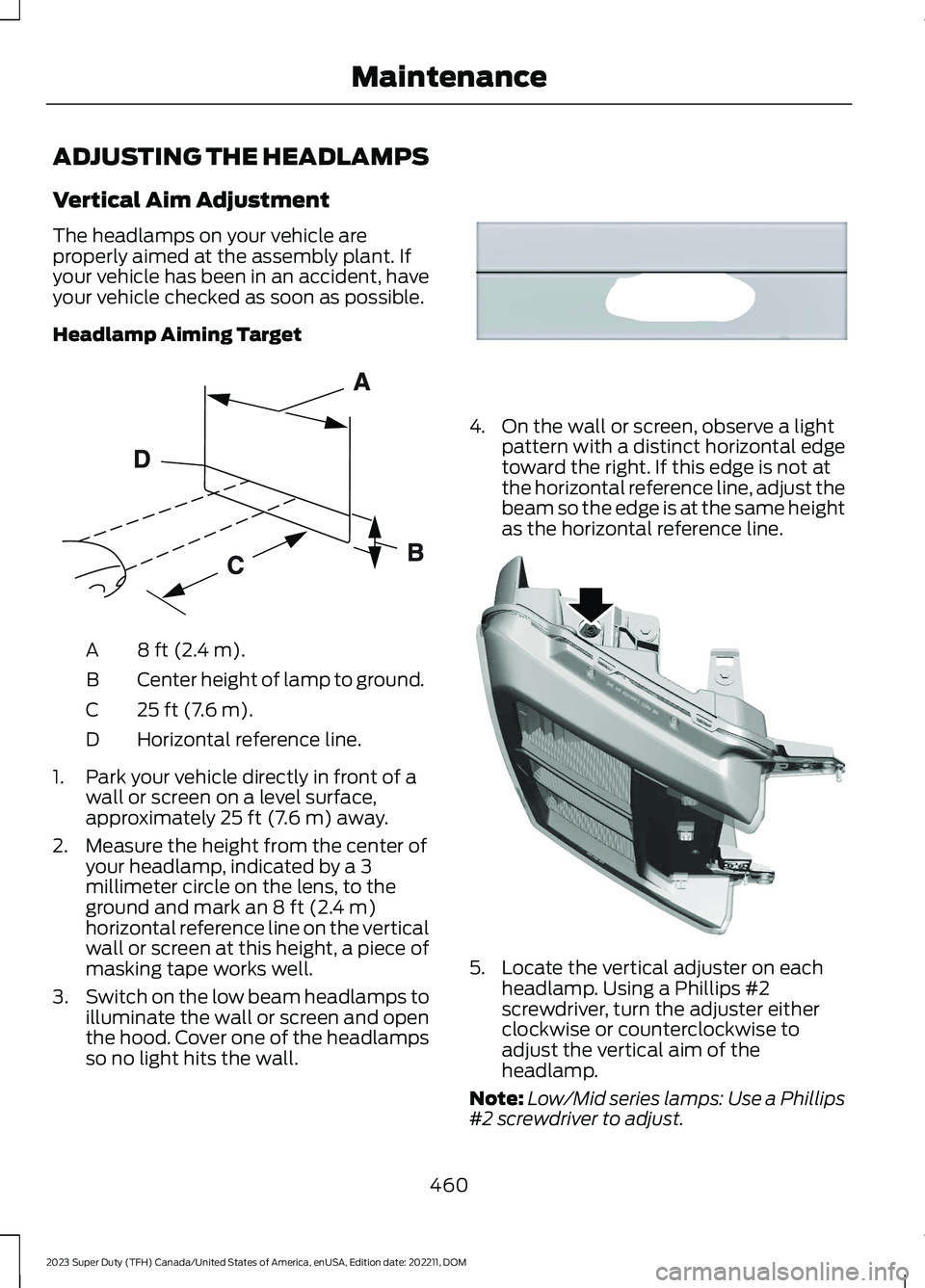
Headlamp Aiming Target
8 ft (2.4 m).A
Center height of lamp to ground.B
25 ft (7.6 m).C
Horizontal reference line.D
1.Park your vehicle directly in front of awall or screen on a level surface,approximately 25 ft (7.6 m) away.
2.Measure the height from the center ofyour headlamp, indicated by a 3millimeter circle on the lens, to theground and mark an 8 ft (2.4 m)horizontal reference line on the verticalwall or screen at this height, a piece ofmasking tape works well.
3.Switch on the low beam headlamps toilluminate the wall or screen and openthe hood. Cover one of the headlampsso no light hits the wall.
4.On the wall or screen, observe a lightpattern with a distinct horizontal edgetoward the right. If this edge is not atthe horizontal reference line, adjust thebeam so the edge is at the same heightas the horizontal reference line.
5.Locate the vertical adjuster on eachheadlamp. Using a Phillips #2screwdriver, turn the adjuster eitherclockwise or counterclockwise toadjust the vertical aim of theheadlamp.
Note:Low/Mid series lamps: Use a Phillips#2 screwdriver to adjust.
460
2023 Super Duty (TFH) Canada/United States of America, enUSA, Edition date: 202211, DOMMaintenanceE142592 E167358 E386873
Page 474 of 738
CLEANING THE EXTERIOR
CLEANING THE EXTERIORPRECAUTIONS
Immediately remove fuel spillages, additiveresiduals, bird droppings, insect depositsand road tar. These may cause damage toyour vehicle’s paintwork or trim over time.Remove any exterior accessories, forexample antennas, before entering a carwash.
CLEANING HEADLAMPS ANDREAR LAMPS
We recommend that you only use cold orlukewarm water containing car shampooto clean the headlamps and the rearlamps.
Do not scrape the lamps.
Do not wipe lamps when they are dry.
CLEANING WINDOWS AND WIPERBLADES
To clean the windshield and wiper blades:
•Clean the windshield with anon-abrasive glass cleaner.
Note:When cleaning the interior of thewindshield, avoid getting any glass cleaneron the instrument panel or door panels.Wipe any glass cleaner off these surfacesimmediately.
•Clean the wiper blades with washerfluid or water applied with a softsponge or cloth.
Note: Do not use razor blades or othersharp objects to clean or remove decalsfrom the inside of the heated rear window.This can cause damage not covered by thevehicle Warranty.
CLEANING CHROME, ALUMINIUMOR STAINLESS STEEL
We recommend that you only use a carshampoo, a soft cloth and water onbumpers and other chrome, aluminium orstainless steel parts.
Note:For additional information andassistance, we recommend that you contactan authorized dealer.
Note:Rinse the area well after cleaning.
Note:Do not use abrasive materials, forexample steel wool or plastic pads, as theycan scratch these surfaces.
Note:Do not use chrome cleaner, metalcleaner or polish on wheels or wheel covers.
CLEANING WHEELS
Only use a recommended wheel and tirecleaner to clean the wheels weekly. Foradditional information and assistance,contact an authorized dealer.
1.Use a sponge to remove heavydeposits of dirt and brake dust.
2.Rinse well after cleaning.
Note:Do not apply a cleaning chemical towarm or hot wheel rims and covers.
If you intend on parking your vehicle for anextended period after cleaning the wheelswith a wheel cleaner, drive your vehicle fora few minutes before parking your vehicle.This reduces the risk of corrosion of thebrake discs, brake pads and linings.
Do not clean the wheels when they are hot.
Note: Some car washes could damagewheel rims and covers.
Note: Using non-recommended cleaners,harsh cleaning products, chrome wheelcleaners or abrasive materials coulddamage wheel rims and covers.
470
2023 Super Duty (TFH) Canada/United States of America, enUSA, Edition date: 202211, DOMVehicle Care