recommended FORD SUPER DUTY 2023 Owners Manual
[x] Cancel search | Manufacturer: FORD, Model Year: 2023, Model line: SUPER DUTY, Model: FORD SUPER DUTY 2023Pages: 738, PDF Size: 18.49 MB
Page 44 of 738
CHILD RESTRAINTS RECOMMENDATION
Recommended Restraint TypeChild Size, Height, Weight, or Age
Use a child restraint (sometimescalled an infant carrier, convertibleseat, or toddler seat).
Children weighing 40 lb (18 kg) or less (generallyage four or younger).
Use a belt-positioning boosterseat.
Children who have outgrown or no longer properlyfit in a child restraint (generally children who areless than 57 in (1.45 m) tall, are greater than agefour and less than age 12, and between 40 lb (18 kg)and 80 lb (36 kg) and upward to 100 lb (45 kg) ifrecommended by your child restraint manufacturer).
Use a vehicle seatbelt having thelap belt snug and low across thehips, shoulder belt centered acrossthe shoulder and chest, and seatbackrest upright.
Children who have outgrown or no longer properlyfit in a belt-positioning booster seat (generally chil-dren who are at least 57 in (1.45 m) tall or greaterthan 80 lb (36 kg) or 100 lb (45 kg) if recommendedby child restraint manufacturer).
You are required by law to properly usechild restraints for infants and toddlers inthe United States, Canada and Mexico.
Many states and provinces require thatsmall children use approved booster seatsuntil they reach age eight, a height of 57 in(1.45 m) tall, or 80 lb (36 kg). Check yourlocal and state or provincial laws forspecific requirements about the safety ofchildren in your vehicle.
When possible, properly restrain children12 years of age and under in a rear seatingposition of your vehicle. Accident statisticssuggest that children are safer whenproperly restrained in the rear seatingpositions than in a front seating position.
When installing a rear facing child restraint,adjust the vehicle seats to avoidinterference between the child restraintand the vehicle seat in front of the childrestraint.
INSTALLING CHILD
RESTRAINTS
USING SEATBELTS
WARNING: Depending on whereyou secure a child restraint, anddepending on the child restraint design,you may block access to certain seatbeltbuckle assemblies and LATCH loweranchors, rendering those featurespotentially unusable. To avoid risk ofinjury, make sure occupants only useseating positions where they are able tobe properly restrained.
Note:The following does not apply to thefront center position of Super Cab and CrewCab vehicles.
Note:Although the child restraintillustrated is a forward facing child restraint,the steps are the same for installing a rearfacing child restraint.
40
2023 Super Duty (TFH) Canada/United States of America, enUSA, Edition date: 202211, DOMChild Safety
Page 100 of 738
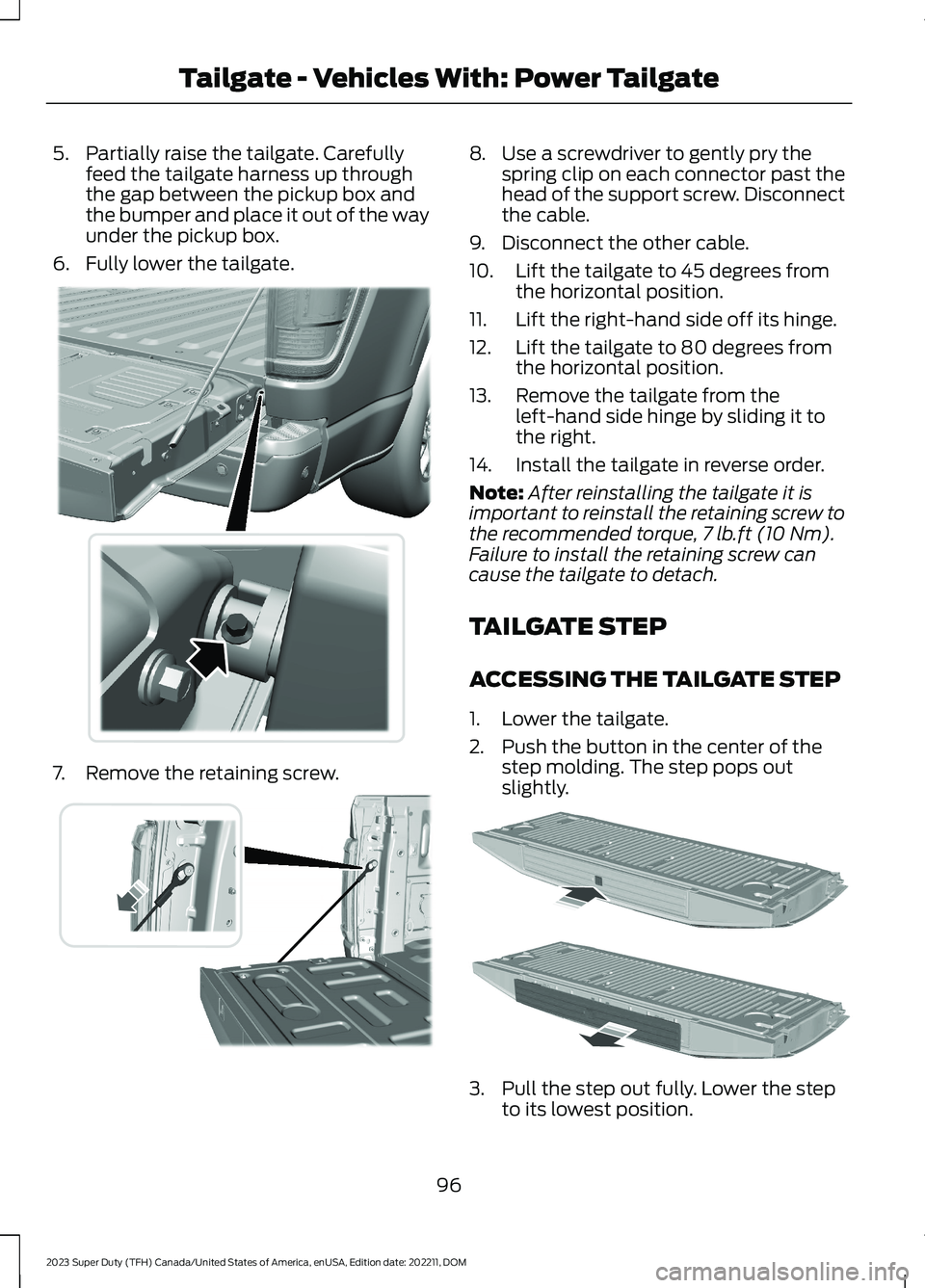
5.Partially raise the tailgate. Carefullyfeed the tailgate harness up throughthe gap between the pickup box andthe bumper and place it out of the wayunder the pickup box.
6.Fully lower the tailgate.
7.Remove the retaining screw.
8.Use a screwdriver to gently pry thespring clip on each connector past thehead of the support screw. Disconnectthe cable.
9.Disconnect the other cable.
10.Lift the tailgate to 45 degrees fromthe horizontal position.
11.Lift the right-hand side off its hinge.
12.Lift the tailgate to 80 degrees fromthe horizontal position.
13.Remove the tailgate from theleft-hand side hinge by sliding it tothe right.
14.Install the tailgate in reverse order.
Note:After reinstalling the tailgate it isimportant to reinstall the retaining screw tothe recommended torque,7 lb.ft (10 Nm).Failure to install the retaining screw cancause the tailgate to detach.
TAILGATE STEP
ACCESSING THE TAILGATE STEP
1.Lower the tailgate.
2.Push the button in the center of thestep molding. The step pops outslightly.
3.Pull the step out fully. Lower the stepto its lowest position.
96
2023 Super Duty (TFH) Canada/United States of America, enUSA, Edition date: 202211, DOMTailgate - Vehicles With: Power Tailgate E310339 E311529 E187718
Page 159 of 738
Automatic Climate Control
•Adjusting the settings when yourvehicle interior is extremely hot or coldis not necessary. Automatic mode isbest recommended to maintain settemperature.
•The system adjusts to heat or cool theinterior to the temperature you selectas quickly as possible.
•For the system to function efficiently,the instrument panel and side air ventsshould be fully open.
•If you press AUTO during cold outsidetemperatures, the system directs airflow to the windshield and side windowair vents.In addition, the blower motormay run at a slower speed until theengine warms up.
•If you press AUTO during hottemperatures and the inside of thevehicle is hot, the system usesrecirculated air to maximize interiorcooling. Blower motor speed may alsoreduce until the air cools.
Quickly Heating the Interior
1.Press AUTO.
2.Adjust the temperature function to thesetting you prefer.
Recommended Settings forHeating
1.Press AUTO.
2.Adjust the temperature function to thesetting you prefer. Use 72°F (22°C) asa starting point, then adjust the settingas necessary.
Quickly Cooling the Interior
1.Press MAX A/C.
2.Drive with the windows open for a shortperiod of time.
Recommended Settings forCooling
1.Press AUTO.
2.Adjust the temperature function to thesetting you prefer. Use 72°F (22°C) asa starting point, then adjust the settingas necessary.
Defogging the Side Windows inCold Weather
1.Press and release defrost or maximumdefrost.
2.Adjust the temperature control to thesetting you prefer. Use 72°F (22°C) asa starting point, then adjust the settingas necessary.
CLIMATE CONTROL VIDEOS
Heated Mirrors
155
2023 Super Duty (TFH) Canada/United States of America, enUSA, Edition date: 202211, DOMClimate Control - Vehicles With: Automatic Temperature
Control
Page 163 of 738
Recommended Settings forHeating
1.Adjust the blower motor speed to thecenter setting.
2.Adjust the temperature control to themidway point of the hot settings.
3.Direct air to the footwell air vents.
Quickly Cooling the Interior
1.Turn the temperature controlcounterclockwise past the lowestsetting.
2.Drive with the windows open for a shortperiod of time.
Recommended Settings forCooling
1.Adjust the blower motor speed to thecenter setting.
2.Adjust the temperature control to themidway point of the cold settings.
3.Direct air to the instrument panel airvents.
Defogging the Side Windows inCold Weather
1.Direct air to the instrument panel andwindshield air vents.
2.Press and release A/C.
3.Adjust the temperature control to thesetting you prefer.
4.Adjust the blower motor speed to thehighest setting.
5.Direct air toward the side windows.
6.Close the instrument panel air vents.
CLIMATE CONTROL VIDEOS
Heated Mirrors
159
2023 Super Duty (TFH) Canada/United States of America, enUSA, Edition date: 202211, DOMClimate Control - Vehicles With: Manual Temperature Control
Page 206 of 738
STARTING AND STOPPING
THE ENGINE – PRECAUTIONS
WARNING: Extended idling at highengine speeds can produce very hightemperatures in the engine and exhaustsystem, creating the risk of fire or otherdamage.
WARNING: Do not park, idle ordrive your vehicle on dry grass or otherdry ground cover. The emission systemheats up the engine compartment andexhaust system, creating the risk of fire.
WARNING: Do not start the enginein a closed garage or in other enclosedareas. Exhaust fumes are toxic. Alwaysopen the garage door before you startthe engine. Failure to follow thisinstruction could result in personal injuryor death.
WARNING: Do not use startingfluid, for example ether, in the air intakesystem. Such fluid could causeimmediate explosive damage to theengine and possible personal injury.
WARNING: Exhaust leaks mayresult in entry of harmful and potentiallylethal fumes into the passengercompartment. If you smell exhaustfumes inside your vehicle, have yourvehicle inspected immediately. Do notdrive if you smell exhaust fumes.
The powertrain control system meets allCanadian interference-causing equipmentstandard requirements regulating theimpulse electrical field or radio noise.
Note:If you use your vehicle regularly abovethe altitude of 5,000 ft (1,524 m) and underthe temperature of -4.0°F (-20°C), it isrecommended to use the alternative engineoil. See Capacities and Specifications(page 520).
If you stop your vehicle and leave theengine idling for long periods, werecommend that you do one of thefollowing:
•Open the windows at least 1 in(2.5 cm).
•Set your climate control to outside air.
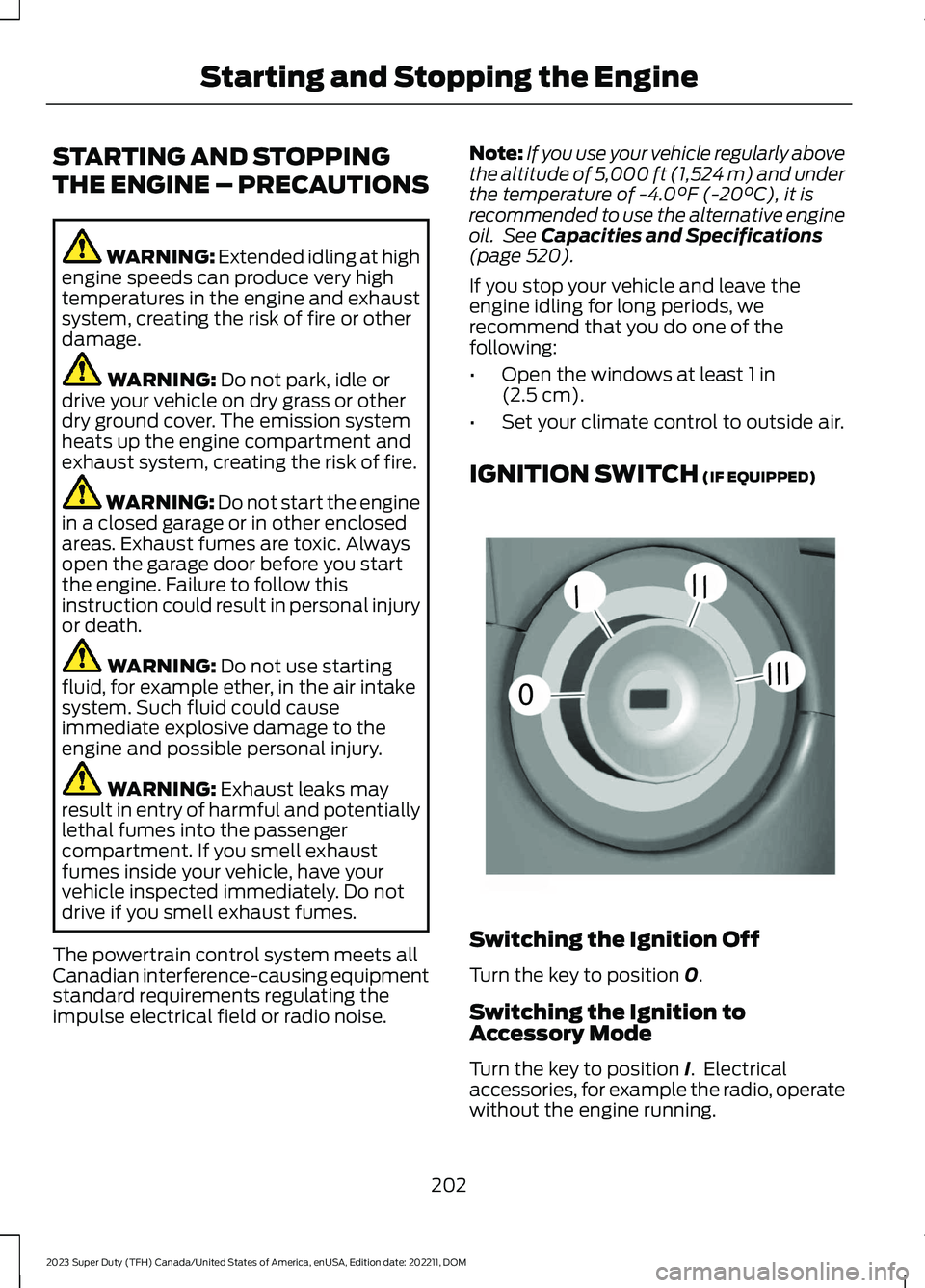
IGNITION SWITCH (IF EQUIPPED)
Switching the Ignition Off
Turn the key to position 0.
Switching the Ignition toAccessory Mode
Turn the key to position I. Electricalaccessories, for example the radio, operatewithout the engine running.
202
2023 Super Duty (TFH) Canada/United States of America, enUSA, Edition date: 202211, DOMStarting and Stopping the Engine0//////E252522
Page 219 of 738
For best overall vehicle and engineperformance, premium fuel with an octanerating of 91 or higher is recommended. Theperformance gained by using premium fuelis most noticeable in hot weather as wellas other conditions, for example whentowing a trailer. See Towing a Trailer(page 365).
Do not be concerned if the enginesometimes knocks lightly. However, if theengine knocks heavily while using fuel withthe recommended octane rating, contactan authorized dealer to prevent any enginedamage.
We recommend Top Tier detergentgasolines, where available to help minimizeengine deposits and maintain optimalvehicle and engine performance.
For additional information, visitwww.toptiergas.com.
Note:Use of any fuel for which the vehiclewas not designed can impair the emissioncontrol system, cause loss of vehicleperformance, and cause damage to theengine which may not be covered by thevehicle Warranty.
Do not use:
•Diesel fuel.
•Fuels containing kerosene or paraffin.
•Fuel containing more than 15% ethanolor E85 fuel.
•Fuels containing methanol.
•Fuels containing metallic-basedadditives, including manganese-basedcompounds.
•Fuels containing the octane boosteradditive, methylcyclopentadienylmanganese tricarbonyl (MMT).
•Leaded fuel, using leaded fuel isprohibited by law.
The use of fuels with metallic compoundssuch as methylcyclopentadienylmanganese tricarbonyl, which is amanganese-based fuel additive, will impairengine performance and affect theemission control system.
SELECTING THE CORRECT FUELFOR COLD WEATHER
Choosing the Right Fuel: VehiclesOperated Where Ultra Low SulfurDiesel Fuel Is Required (UnitedStates/Canada/Puerto Rico/U.S.Virgin Islands And Other Locales)
Note:Your Warranty will not cover damagecaused by using an improper type of fuel orfuel additive.
Note:Do not blend used engine oil withdiesel fuel under any circumstances.Blending used oil with the fuel significantlyincreases your vehicle’s exhaust emissionsand reduce engine life due to increasedinternal wear.
We recommend Top Tier diesel fuel whereavailable to help minimize engine depositsand maintain optimal vehicle and engineperformance.
For additional information, visitwww.toptiergas.com.
You should use ultra-low sulfur diesel fueldesignated as number 1-D or 2-D with amaximum of 15-ppm sulfur in your dieselvehicle. You can operate your vehicle ondiesel fuels containing up to 20%biodiesel, also known as B20. These fuelsshould meet the ASTM D975 diesel or theASTM D7467 B6-B20 biodiesel industryspecifications. Outside of North America,use fuels meeting EN590 or equivalentlocal market standard.
215
2023 Super Duty (TFH) Canada/United States of America, enUSA, Edition date: 202211, DOMFuel and Refueling
Page 221 of 738
•Follow the recommended servicemaintenance intervals. See GeneralMaintenance Information (page 594).
•Do not store biodiesel fuel in the fueltank for more than 1 month.
•Consider changing brands or reducingbiodiesel content if you have coldtemperature fuel gelling issues or afrequently appearing LOW FUELPRESSURE message.
Use of biodiesel in concentrations greaterthan 20% can cause damage to yourvehicle, including engine and/or exhaustafter-treatment hardware (exhaustcatalyst and particulate filter) failures.Concentrations greater than 20% can alsocause fuel filter restrictions that couldresult in a lack of power or damage to fuelsystem components, including fuel pumpand fuel injector failures.
We recommend SAE 5W-40 oil for fuelswith greater than 5% biodiesel (B5). Formore information about oil changeintervals and other maintenance whenoperating on biodiesel. See SpecialOperating Conditions ScheduledMaintenance (page 603).
Look for a label on the fuel pump toconfirm the amount of biodiesel containedin diesel fuel. Ask the service stationattendant to confirm the biodiesel contentof diesel fuel, if you do not see a label onthe fuel pump.
If you plan to park or store your vehicle formore than 1 month, then you should emptyyour vehicle fuel tank of biodiesel fuel. Youshould fill the tank with a purepetroleum-based diesel fuel and run yourvehicle for a minimum of 30 minutes.
Note:Degraded or oxidized biodiesel candamage fuel system seals and plastics andcorrode steel parts.
During cold weather, if you have problemsoperating on biodiesel, you may need touse diesel fuel with lower biodieselcontent, try another brand or discontinuethe use of biodiesel.
Diesel Fuel Additives
It should not be necessary to add anyaftermarket additives to your fuel if youuse a high-quality diesel fuel that conformsto ASTM industry specifications.Aftermarket additives can damage the fuelinjector system or engine.
Use Motorcraft® cetane booster or anequivalent cetane booster additive if yoususpect fuel has low cetane. UseMotorcraft® anti-gel and performanceimprover or an equivalent additive if thereis fuel gelling.
Do not use alcohol-based additives toimprove cetane quality, to prevent fuelgelling or any other use. The use of alcoholadditives could result in damage to the fuelinjectors and system.
Your Warranty may not cover repairsneeded to correct the effects of using anaftermarket product that does not meetour specifications in your fuel.
RUNNING OUT OF FUEL
FILLING A PORTABLE FUELCONTAINER
WARNING: Flow of fuel through afuel pump nozzle can produce staticelectricity. This can cause a fire if you arefilling an ungrounded fuel container.
217
2023 Super Duty (TFH) Canada/United States of America, enUSA, Edition date: 202211, DOMFuel and Refueling
Page 242 of 738
HOW DOES FOUR-WHEEL
DRIVE WORK
Using the Electronic Shift On theFly System (If Equipped)
This four-wheel drive system utilizes a2-speed Electronic Shift On the Fly (ESOF)transfer case which is also known as apart-time system. This system offers thedriver two-wheel drive high, four-wheeldrive high, and four-wheel drive low asavailable modes of operation. When youselect either four-wheel drive high orfour-wheel drive low, the system providesmechanically locked four-wheel drivepower to both the front and rear wheelsfor use in off-road or slippery conditionssuch as deep snow, sand or mud. Whenyou select four-wheel drive low, the systemprovides additional gearing for increasedtorque multiplication for conditions likedeep sand, steep slopes, or pulling heavyobjects. Additionally, the system is capableof recreational flat towing by putting thetransfer case into a neutral position. SeeRecreationally Towing Your Vehicle(page 427).
There is further information available ondriving in unique driving conditions. SeeOff-Road Driving (page 412).
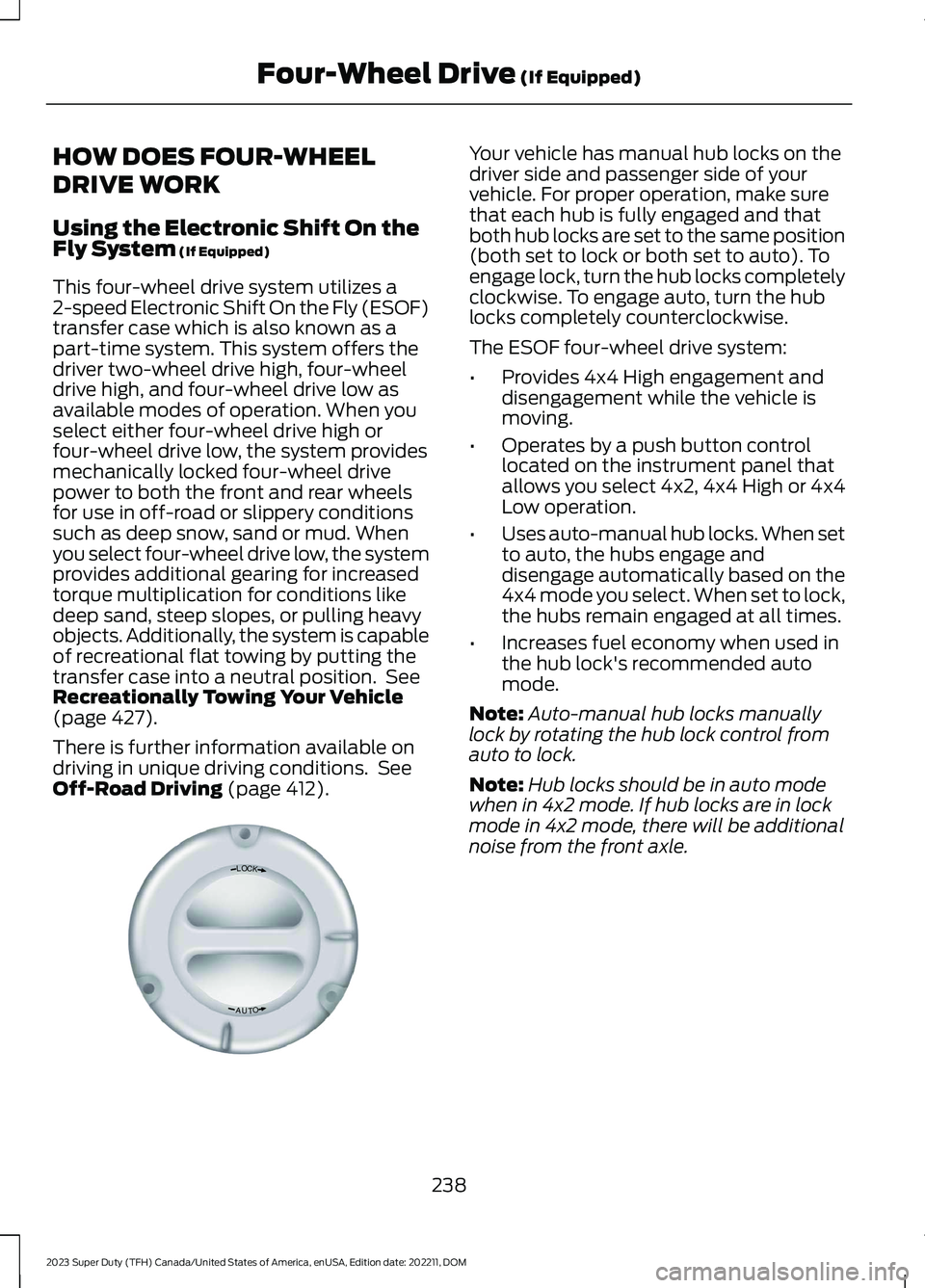
Your vehicle has manual hub locks on thedriver side and passenger side of yourvehicle. For proper operation, make surethat each hub is fully engaged and thatboth hub locks are set to the same position(both set to lock or both set to auto). Toengage lock, turn the hub locks completelyclockwise. To engage auto, turn the hublocks completely counterclockwise.
The ESOF four-wheel drive system:
•Provides 4x4 High engagement anddisengagement while the vehicle ismoving.
•Operates by a push button controllocated on the instrument panel thatallows you select 4x2, 4x4 High or 4x4Low operation.
•Uses auto-manual hub locks. When setto auto, the hubs engage anddisengage automatically based on the4x4 mode you select. When set to lock,the hubs remain engaged at all times.
•Increases fuel economy when used inthe hub lock's recommended automode.
Note:Auto-manual hub locks manuallylock by rotating the hub lock control fromauto to lock.
Note:Hub locks should be in auto modewhen in 4x2 mode. If hub locks are in lockmode in 4x2 mode, there will be additionalnoise from the front axle.
238
2023 Super Duty (TFH) Canada/United States of America, enUSA, Edition date: 202211, DOMFour-Wheel Drive (If Equipped)LOCKOTUAE339076
Page 253 of 738
BRAKE PRECAUTIONS
Wet brakes result in reduced brakingefficiency. Gently press the brake pedal afew times when leaving a car wash ordriving from standing water to dry thebrakes.
Note:Depending on applicable laws andregulations in the country where your vehiclewas originally built, the stoplamps couldflash during heavy braking. The hazardwarning flashers could also turn on whenyour vehicle comes to a stop.
ANTI-LOCK BRAKING SYSTEM
ANTI-LOCK BRAKING SYSTEMLIMITATIONS
The anti-lock braking system does noteliminate the risk of crash when:
•You drive too closely to the vehicle infront of you.
•Your vehicle is hydroplaning.
•You take corners too fast.
•The road surface is poor.
Note: If the system activates, the brakepedal could pulse and travel further.Maintain pressure on the brake pedal.
BRAKE OVER ACCELERATOR
In the event the accelerator pedalbecomes stuck or entrapped, apply steadyand firm pressure to the brake pedal toslow the vehicle and reduce engine power.If you experience this condition, apply thebrakes and bring your vehicle to a safestop. Move the transmission to park (P),switch the engine off and apply the parkingbrake. Inspect the accelerator pedal forany interference. If none are found and thecondition persists, have your vehicle towedto the nearest authorized dealer.
LOCATING THE BRAKE FLUID
RESERVOIR
See Under Hood Overview (page 441).
CHECKING THE BRAKE FLUID
WARNING: Do not use any fluidother than the recommended brake fluidas this will reduce brake efficiency. Useof incorrect fluid could result in the lossof vehicle control, serious personal injuryor death.
WARNING: Only use brake fluidfrom a sealed container. Contaminationwith dirt, water, petroleum products orother materials may result in brakesystem damage or failure. Failure toadhere to this warning could result in theloss of vehicle control, serious personalinjury or death.
WARNING: Do not allow the fluidto touch your skin or eyes. If thishappens, rinse the affected areasimmediately with plenty of water andcontact your physician.
WARNING: The brake systemcould be affected if the brake fluid levelis below the MIN mark or above the MAXmark on the brake fluid reservoir.
249
2023 Super Duty (TFH) Canada/United States of America, enUSA, Edition date: 202211, DOMBrakes
Page 300 of 738
HOW DOES ADAPTIVE CRUISE
CONTROL WITH STOP AND GO
WORK
Adaptive cruise control with stop and gouses radar and camera sensors to maintaina set gap between your vehicle and thevehicle in front of you while following it toa complete stop. Stop and go can also beset to follow a vehicle directly in front ofyou and adjust the set speed, while you areat a complete stop.
ADAPTIVE CRUISE CONTROL
PRECAUTIONS
WARNING: You are responsible forcontrolling your vehicle at all times. Thesystem is designed to be an aid and doesnot relieve you of your responsibility todrive with due care and attention. Failureto follow this instruction could result inthe loss of control of your vehicle,personal injury or death.
WARNING: Do not use adaptivecruise control on winding roads, in heavytraffic or when the road surface isslippery. This could result in loss ofvehicle control, serious injury or death.
WARNING: Pay close attention tochanging road conditions such asentering or leaving a highway, on roadswith intersections or roundabouts, roadswithout visible lanes of travel, roads thatare winding, slippery, unpaved, or steepslopes.
WARNING: The system is not acrash warning or avoidance system.
WARNING: Do not use the systemwhen towing a trailer that hasaftermarket electronic trailer brakecontrols. Failure to follow this instructioncould result in the loss of control of yourvehicle, personal injury or death.
WARNING: Do not use tire sizesother than those recommended becausethis can affect the normal operation ofthe system. Failure to do so may resultin a loss of vehicle control, which couldresult in serious injury.
WARNING: Do not use the systemwith a snow plow blade installed.
WARNING: Do not use the systemin poor visibility, for example fog, heavyrain, spray or snow.
When Following a Vehicle
WARNING: When following avehicle that is braking, your vehicle doesnot always decelerate quickly enough toavoid a crash without driver intervention.Apply the brakes when necessary. Failureto follow this instruction could result inpersonal injury or death.
Hilly Condition and Trailer TowUsage
You should select a lower gear when thesystem is active in situations such asprolonged downhill driving on steep slopes,for example in mountainous areas. Thesystem needs additional engine braking inthese situations to reduce the load on thevehicle’s regular brake system to preventit from overheating.
296
2023 Super Duty (TFH) Canada/United States of America, enUSA, Edition date: 202211, DOMAdaptive Cruise Control (If Equipped)