recommended FORD SUPER DUTY 2023 Owner's Guide
[x] Cancel search | Manufacturer: FORD, Model Year: 2023, Model line: SUPER DUTY, Model: FORD SUPER DUTY 2023Pages: 738, PDF Size: 18.49 MB
Page 486 of 738
*Treadwear: The treadweargrade is a comparative ratingbased on the wear rate of the tirewhen tested under controlledconditions on a specifiedgovernment test course. Forexample, a tire graded 150 wouldwear one and one-half times aswell on the government course asa tire graded 100.
*Traction: The traction grades,from highest to lowest are AA, A,B, and C. The grades represent thetire's ability to stop on wetpavement as measured undercontrolled conditions on specifiedgovernment test surfaces ofasphalt and concrete. A tiremarked C may have poor tractionperformance.
*Temperature: The temperaturegrades are A (the highest), B andC, representing the tire'sresistance to the generation ofheat and its ability to dissipateheat when tested under controlledconditions on a specified indoorlaboratory test wheel.
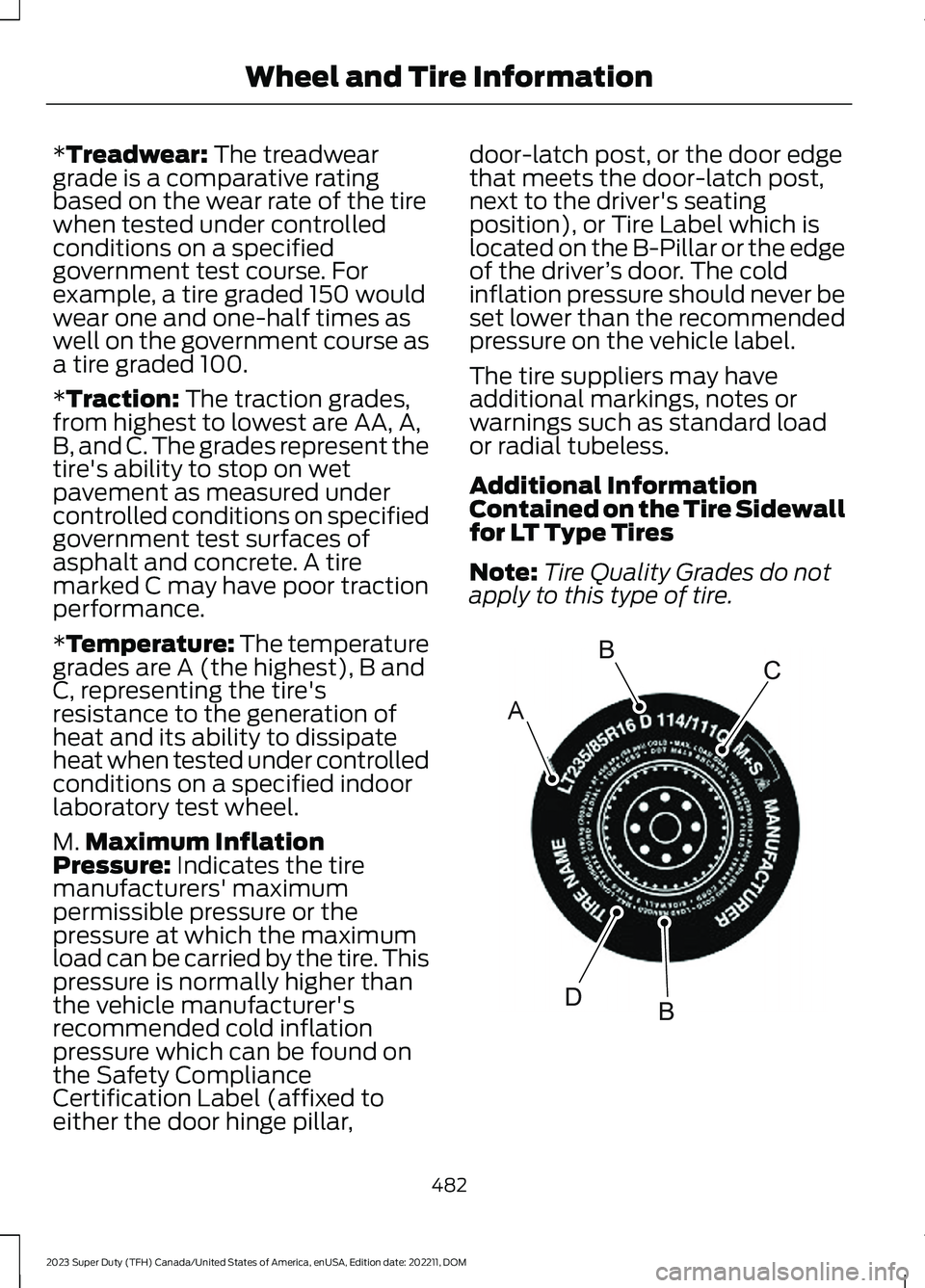
M.Maximum InflationPressure: Indicates the tiremanufacturers' maximumpermissible pressure or thepressure at which the maximumload can be carried by the tire. Thispressure is normally higher thanthe vehicle manufacturer'srecommended cold inflationpressure which can be found onthe Safety Compliance
Certification Label (affixed toeither the door hinge pillar,
door-latch post, or the door edgethat meets the door-latch post,next to the driver's seatingposition), or Tire Label which islocated on the B-Pillar or the edgeof the driver’s door. The coldinflation pressure should never beset lower than the recommendedpressure on the vehicle label.
The tire suppliers may haveadditional markings, notes orwarnings such as standard loador radial tubeless.
Additional InformationContained on the Tire Sidewallfor LT Type Tires
Note:Tire Quality Grades do notapply to this type of tire.
482
2023 Super Duty (TFH) Canada/United States of America, enUSA, Edition date: 202211, DOMWheel and Tire InformationABCBDE142544
Page 488 of 738
C.80: Indicates the aspect ratiowhich gives the tire's ratio ofheight to width. Numbers of 70 orlower indicate a short sidewall.
D.D: Indicates a diagonal type tire.
R: Indicates a radial type tire.
E.16: Indicates the wheel or rimdiameter in inches. If you changeyour wheel size, you will have topurchase new tires to match thenew wheel diameter.
GLOSSARY OF TIRE
TERMINOLOGY
*Tire label: A label showing theoriginal equipment tire sizes,recommended inflation pressureand the maximum weight thevehicle can carry.
*Tire Identification Number(TIN): A number on the sidewallof each tire providing informationabout the tire brand andmanufacturing plant, tire size anddate of manufacture. Also referredto as DOT code.
*Inflation pressure: A measureof the amount of air in a tire.
*Standard load: A class ofP-metric or Metric tires designedto carry a maximum load at setpressure. For example: ForP-metric tires 35 psi (2.4 bar) andfor Metric tires 36 psi (2.5 bar).Increasing the inflation pressurebeyond this pressure will not
increase the tire’s load carryingcapability.
*Extra load: A class of P-metricor Metric tires designed to carry aheavier maximum load at 42 psi(2.9 bar). Increasing the inflationpressure beyond this pressure willnot increase the tire’s loadcarrying capability.
*kPa: Kilopascal, a metric unit ofair pressure.
*PSI: Pounds per square inch, astandard unit of air pressure.
*Cold tire pressure: The tirepressure when the vehicle hasbeen stationary and out of directsunlight for an hour or more andprior to the vehicle being driven for1 mi (1.6 km).
*Recommended inflationpressure: The cold inflationpressure found on the SafetyCompliance Certification Label(affixed to either the door hingepillar, door-latch post, or the dooredge that meets the door-latchpost, next to the driver's seatingposition), or Tire Label located onthe B-Pillar or the edge of thedriver door.
* B-pillar: The structural memberat the side of the vehicle behindthe front door.
*Bead area of the tire: Area ofthe tire next to the rim.
* Sidewall of the tire: Areabetween the bead area and thetread.
484
2023 Super Duty (TFH) Canada/United States of America, enUSA, Edition date: 202211, DOMWheel and Tire Information
Page 490 of 738
WARNING: Only usereplacement tires and wheelsthat are the same size, loadindex, speed rating and type(such as P-metric versusLT-metric or all-season versusall-terrain) as those originallyprovided by Ford. Therecommended tire and wheelsize may be found on either theSafety Compliance CertificationLabel (affixed to either the doorhinge pillar, door-latch post, orthe door edge that meets thedoor-latch post, next to thedriver's seating position), or theTire Label which is located onthe B-Pillar or edge of thedriver's door. If this informationis not found on these labels, thenyou should contact yourauthorized dealer as soon aspossible. Use of any tire or wheelnot recommended by Ford canaffect the safety andperformance of your vehicle,which could result in anincreased risk of loss of vehiclecontrol, vehicle rollover, personalinjury and death.
WARNING: To reduce therisk of serious injury, whenmounting replacement tires andwheels, you should not exceedthe maximum pressure indicatedon the sidewall of the tire to setthe beads without additionalprecautions listed below. If thebeads do not seat at themaximum pressure indicated,re-lubricate and try again.
WARNING: For a mountingpressure more than 20 psi(1.38 bar) greater than themaximum pressure, a Forddealer or other tire serviceprofessional should do themounting.
WARNING: Always inflatesteel carcass tires with a remoteair fill with the person inflatingstanding at a minimum of 12 ft(3.66 m) away from the wheeland tire assembly.
WARNING: When inflatingthe tire for mounting pressuresup to 20 psi (1.38 bar) greaterthan the maximum pressure onthe tire sidewall, the followingprecautions must be taken toprotect the person mounting thetire:
•Make sure that you have thecorrect tire and wheel size.
•Lubricate the tire bead andwheel bead seat area again.
486
2023 Super Duty (TFH) Canada/United States of America, enUSA, Edition date: 202211, DOMWheel and Tire Information
Page 491 of 738
•Stand at a minimum of 12 ft(3.66 m) away from the wheeland tire assembly.
•Use both eye and earprotection.
Important: Remember to replacethe wheel valve stems when theroad tires are replaced on yourvehicle.
It is recommended that the twofront tires or two rear tiresgenerally be replaced as a pair ifthe worn tires still have usabledepth.
To avoid potential Four-WheelDrive (4WD) malfunction or(4WD) system damage, it isrecommended to replace all fourtires rather than mixing
significantly worn tires with newtires.
The tire pressure sensors mountedin the wheels (originally installedon your vehicle) are not designedto be used in aftermarket wheels.
The use of wheels or tires notrecommended may affect theoperation of your tire pressuremonitoring system.
If the tire pressure monitoringsystem indicator is flashing, yoursystem is malfunctioning. Yourreplacement tire might beincompatible with your tirepressure monitoring system, orsome component of the systemmay be damaged.
Tire can be damaged duringoff-road use, so inspection afteroff-road use is alsorecommended.
Replacing a Tire That IsGreenhouse Gas Certified
The tires installed on this vehicleat the factory as originalequipment are certified forGreenhouse Gas and FuelEfficiency regulations.Replacement tires must be ofequal or lower rolling resistancelevel (TRRL or Crr). Consult withyour tire supplier(s) forappropriate replacement tires.
USING SNOW CHAINS
WARNING: Do not exceed 30 mph(50 km/h). Failure to follow thisinstruction could result in the loss ofcontrol of your vehicle, personal injury ordeath.
WARNING: Do not use snow chainson snow-free roads.
WARNING: Only fit snow chains tospecified tires.
WARNING: If your vehicle is fittedwith wheel trims, remove them beforefitting snow chains.
WARNING: Wheels and tires mustbe the same size, load index and speedrating as those originally fitted on thevehicle. Use of any other tire or wheelcan affect the safety and performanceof your vehicle. Additionally, the use ofnon-recommended tires and wheels can
487
2023 Super Duty (TFH) Canada/United States of America, enUSA, Edition date: 202211, DOMWheel and Tire Information
Page 492 of 738
cause steering, suspension, axle, transfercase or power transfer unit failure.Follow the recommended tire inflationpressures found on the SafetyCompliance Certification label, or theTire Label on the B-Pillar or the edge ofthe driver door. Failure to follow thisinstruction could result in loss of vehiclecontrol, vehicle rollover, or personal injuryor death.
Note:Do not use snow chains on vehicleswith LT275/65R20 or LT 285/75R18 sizedtires.
Note:The suspension insulation andbumpers will help prevent vehicle damage.Do not remove these components from yourvehicle when using snow tires and chains.
The tires on your vehicle have all-weathertreads to provide traction in rain and snow.However, in some climates, you may needto use snow tires and cables. If you needto use cables, we recommend that you usesteel wheels of the same size andspecification, as cables may chipaluminum wheels.
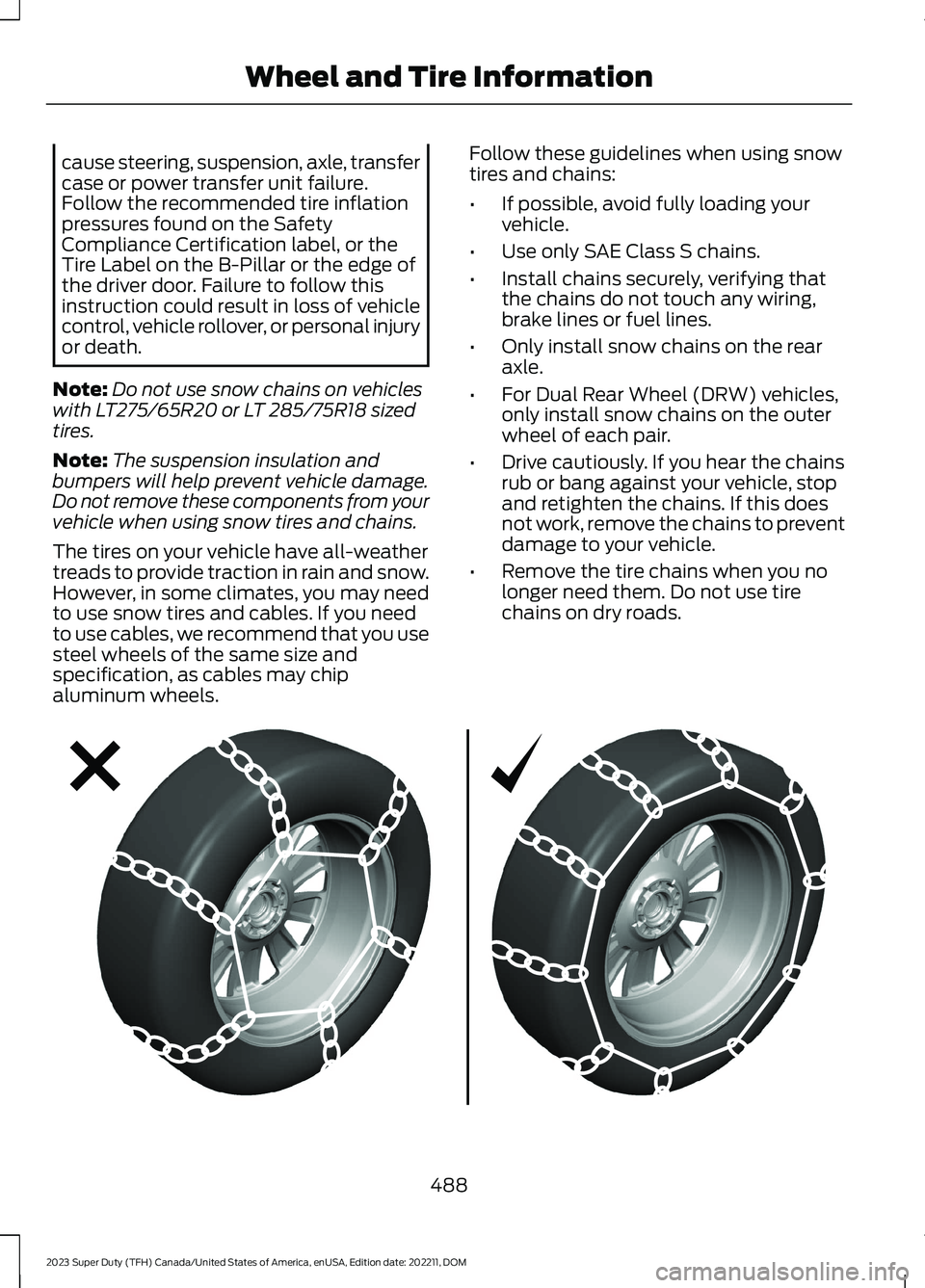
Follow these guidelines when using snowtires and chains:
•If possible, avoid fully loading yourvehicle.
•Use only SAE Class S chains.
•Install chains securely, verifying thatthe chains do not touch any wiring,brake lines or fuel lines.
•Only install snow chains on the rearaxle.
•For Dual Rear Wheel (DRW) vehicles,only install snow chains on the outerwheel of each pair.
•Drive cautiously. If you hear the chainsrub or bang against your vehicle, stopand retighten the chains. If this doesnot work, remove the chains to preventdamage to your vehicle.
•Remove the tire chains when you nolonger need them. Do not use tirechains on dry roads.
488
2023 Super Duty (TFH) Canada/United States of America, enUSA, Edition date: 202211, DOMWheel and Tire InformationE292547
Page 494 of 738
CHECKING THE TIRE
PRESSURES
Safe operation of your vehiclerequires that your tires areproperly inflated. Every day beforeyou drive, check your tires.
At least once a month and beforelong trips, inspect each tire andcheck the tire pressure with a tiregauge. Inflate all tires to therecommended inflation pressure.See Inflating the Tires (page490).
INFLATING THE TIRES
WARNING: Under-inflationis the most common cause oftire failures and may result insevere tire cracking, treadseparation or blowout, withunexpected loss of vehiclecontrol and increased risk ofinjury. Under-inflation increasessidewall flexing and rollingresistance, resulting in heatbuildup and internal damage tothe tire. It also may result inunnecessary tire stress, irregularwear, loss of vehicle control andaccidents. A tire can lose up tohalf of its air pressure and notappear to be flat!
Use the recommended coldinflation pressure for optimum tireperformance and wear.Under-inflation or over-inflationmay cause uneven treadwearpatterns.
Always inflate your tires to therecommended inflation pressureeven if it is less than the maximuminflation pressure informationfound on the tire. You will find aTire Label containing themanufacturer's recommended tireinflation pressure by the tire sizeand other important informationlocated on the B-Pillar or the edgeof the driver door.
The recommended tire inflationpressure is also found on theSafety Compliance CertificationLabel, affixed to either the doorhinge pillar, door-latch post, or thedoor edge that meets thedoor-latch on the B-pillar, or onthe edge of the driver door.
Failure to follow the tire pressurerecommendations can causeuneven treadwear patterns andadversely affect the way yourvehicle handles.
Note:If you have to drive adistance to get air for your tire(s),check and record the tire pressurefirst and add the appropriate airpressure when you get to thepump. It is normal for tires to heatup and the air pressure inside to goup as you drive.
To check the pressure in yourtire(s):
490
2023 Super Duty (TFH) Canada/United States of America, enUSA, Edition date: 202211, DOMTire Care
Page 495 of 738
![FORD SUPER DUTY 2023 Owners Guide 1. Make sure the tires are cool,meaning they are not hot fromdriving even a mile.
Note:If you are checking tirepressure when the tire is hot, (forexample, driven more than 1 mile[1.6 kilometers]), nev](/img/11/58820/w960_58820-494.png "FORD SUPER DUTY 2023 Owners Guide 1. Make sure the tires are cool,meaning they are not hot fromdriving even a mile.
Note:If you are checking tirepressure when the tire is hot, (forexample, driven more than 1 mile[1.6 kilometers]), nev")
1. Make sure the tires are cool,meaning they are not hot fromdriving even a mile.
Note:If you are checking tirepressure when the tire is hot, (forexample, driven more than 1 mile[1.6 kilometers]), never bleed orreduce air pressure. The tires arehot from driving and it is normal forpressures to increase aboverecommended cold pressures. Ahot tire at or below recommendedcold inflation pressure could besignificantly under-inflated.
2. Remove the cap from the valveon one tire, then firmly press thetire gauge onto the valve andmeasure the pressure.
3. Add enough air to reach therecommended air pressure.
Note:If you overfill the tire, releaseair by pressing on the metal stemin the center of the valve. Thenrecheck the pressure with your tiregauge.
4. Replace the valve cap.
5. Repeat this procedure for eachtire, including the spare.
Note:Some spare tires operate ata higher inflation pressure than theother tires. For T type mini-sparetires, (see the Dissimilar sparewheel and tire assemblyinformation for a description. Storeand maintain at 60 psi(4.15 bar)60 psi (4.15 bar). Forfull-size and dissimilar spare tires,see the Dissimilar spare wheel andtire assembly information for adescription. Store and maintain atthe higher of the front and rearinflation pressure as shown on theSafety Compliance CertificationLabel or Tire Label.
Note:Do not reduce tire pressureto change the ride characteristicsof the vehicle. If you do notmaintain the inflation pressure atthe levels specified by Ford, yourvehicle may experience a conditionknown as shimmy. Shimmy is asevere vibration and oscillation inthe steering wheel after the vehicletravels over a bump or dip in theroad that does not dampen out byitself. Shimmy may result fromsignificant under-inflation of thetires, improper tires (load range,size, or type), or vehiclemodifications such as lift-kits. Inthe event that your vehicleexperiences shimmy, you shouldslowly reduce speed by either liftingoff the accelerator pedal or lightlyapplying the brakes. The shimmywill cease as the vehicle speeddecreases.
491
2023 Super Duty (TFH) Canada/United States of America, enUSA, Edition date: 202211, DOMTire Care
Page 496 of 738
When weather temperaturechanges occur, tire inflationpressures also change. A 10°F(6°C) temperature drop cancause a corresponding drop of 1psi (7 kPa) in inflation pressure.Check your tire pressuresfrequently and adjust them to theproper pressure which can befound on the Safety ComplianceCertification Label or Tire Label.
Checking Pressure when tiresare hot:
If pressures are checked after tireshave been driven for more thanthree minutes or more than 1 mile,(2 km) the tires become hot andthe pressures will increase byapproximately 4 psi (27.6 kPa).Therefore when the tire pressure
is adjusted under these conditions,it should be increased to a gaugereading of 4 psi (27.6 kPa) greaterthan the recommended coldinflation pressure.
For Example Only
33 psi (230kPa)Gauge readingof hot tire
32 psi (220kPa)If recom-mended, coldinflation pres-sure is
The hot tire pressure is only 1 psi(10 kPa) greater than therecommended cold inflationpressure. Therefore, add 3 psi(20 kPa) more to increase thehot pressure to 4 psi (30 kPa)over the recommended coldinflation pressure.
36 psi (250kPa)New hot pres-sure
Steel Carcass Plies
WARNING: An inflated tireand rim can be very dangerousif improperly used, serviced ormaintained. To reduce the riskof serious injury, never attemptto re-inflate a tire which hasbeen run flat or seriouslyunder-inflated without firstremoving the tire from the wheelassembly for inspection. Do notattempt to add air to tires orreplace tires or wheels withoutfirst taking precautions toprotect persons and property.
All tires with Steel Carcass Plies(if equipped):
492
2023 Super Duty (TFH) Canada/United States of America, enUSA, Edition date: 202211, DOMTire Care
Page 498 of 738
INSPECTING THE TIRE FOR
WEAR
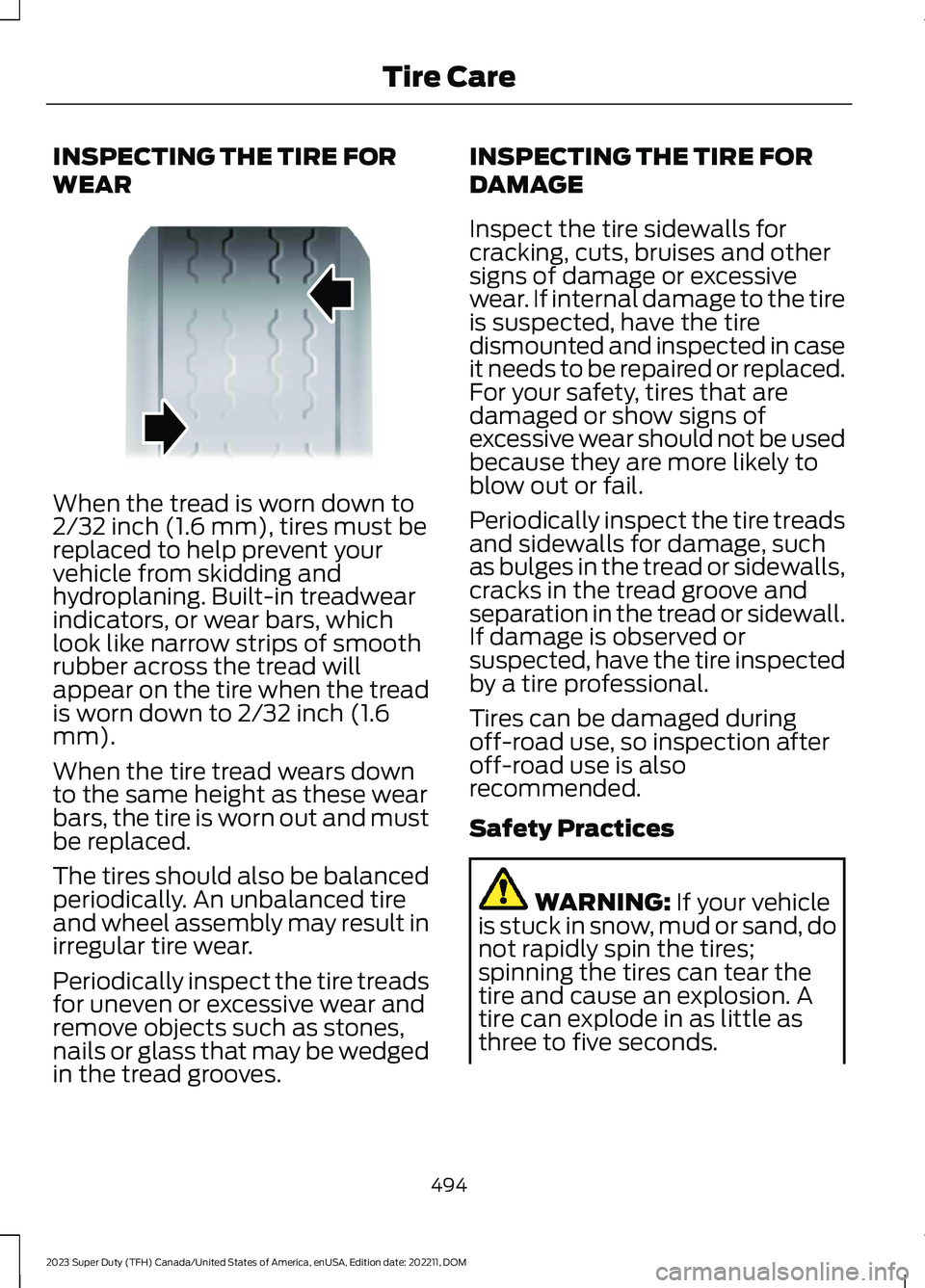
When the tread is worn down to2/32 inch (1.6 mm), tires must bereplaced to help prevent yourvehicle from skidding andhydroplaning. Built-in treadwearindicators, or wear bars, whichlook like narrow strips of smoothrubber across the tread willappear on the tire when the treadis worn down to 2/32 inch (1.6mm).
When the tire tread wears downto the same height as these wearbars, the tire is worn out and mustbe replaced.
The tires should also be balancedperiodically. An unbalanced tireand wheel assembly may result inirregular tire wear.
Periodically inspect the tire treadsfor uneven or excessive wear andremove objects such as stones,nails or glass that may be wedgedin the tread grooves.
INSPECTING THE TIRE FOR
DAMAGE
Inspect the tire sidewalls forcracking, cuts, bruises and othersigns of damage or excessivewear. If internal damage to the tireis suspected, have the tiredismounted and inspected in caseit needs to be repaired or replaced.For your safety, tires that aredamaged or show signs ofexcessive wear should not be usedbecause they are more likely toblow out or fail.
Periodically inspect the tire treadsand sidewalls for damage, suchas bulges in the tread or sidewalls,cracks in the tread groove andseparation in the tread or sidewall.If damage is observed orsuspected, have the tire inspectedby a tire professional.
Tires can be damaged duringoff-road use, so inspection afteroff-road use is alsorecommended.
Safety Practices
WARNING: If your vehicleis stuck in snow, mud or sand, do
not rapidly spin the tires;spinning the tires can tear thetire and cause an explosion. Atire can explode in as little asthree to five seconds.
494
2023 Super Duty (TFH) Canada/United States of America, enUSA, Edition date: 202211, DOMTire CareE142546
Page 500 of 738
REPAIRS - WHEREVERPOSSIBLE, SEE YOUR TIRERETAILER AT ONCE
If any tire sustains a puncture,have the tire demounted andthoroughly inspected by a tireretailer for possible damage thatmay have occurred. A tread areapuncture in any passenger or lighttruck tire can be repaired providedthat the puncture hole is not morethan 1/4” in diameter, not morethan one radial cable per casingply is damaged, and the tire hasnot been damaged further by thepuncturing object or by runningunderinflated. Tire puncturesconsistent with these guidelinesshould only be repaired byfollowing the US TireManufacturers Association(USTMA) recommended repairprocedures. Plug-only repairsdone on-the-wheel are consideredimproper and therefore, notrecommended. Such repairs arenot reliable and may cause furtherdamage to the tire.
STORAGE
Tires contain waxes andemollients to protect their outersurfaces from ozone and weatherchecking. As the tire rolls andflexes, the waxes and emollientscontinually migrate to the surface,replenishing this protectionthroughout the normal use of thetire. Consequently, when tires situnused for long periods of time (amonth or more) their surfaces
become dry and more susceptibleto ozone and weather checkingand the casing becomessusceptible to flat spotting.Forthis reason, tires should alwaysbe stored in a cool, dry, clean,indoor environment. If storageis for one month or more,eliminate the weight from thetires by raising the vehicle or byremoving the tires from thevehicle. Failure to store tires inaccordance with theseinstructions could result indamage to your tires orpremature aging of the tiresand sudden tire failure.
When tires are stored, be sure theyare placed away from sources ofheat and ozone such as directsunlight, hot pipes and electricgenerators. Be sure that surfaceson which tires are stored are cleanand free from grease, gasoline orother substances, which coulddeteriorate the rubber. Failure tostore tires in accordance withthese instructions could result indamage to your tires or prematureaging of the tires and sudden tirefailure.
496
2023 Super Duty (TFH) Canada/United States of America, enUSA, Edition date: 202211, DOMTire Care