brake FORD TAURUS 1997 Owner's Manual
[x] Cancel search | Manufacturer: FORD, Model Year: 1997, Model line: TAURUS, Model: FORD TAURUS 1997Pages: 167, PDF Size: 1.48 MB
Page 91 of 167
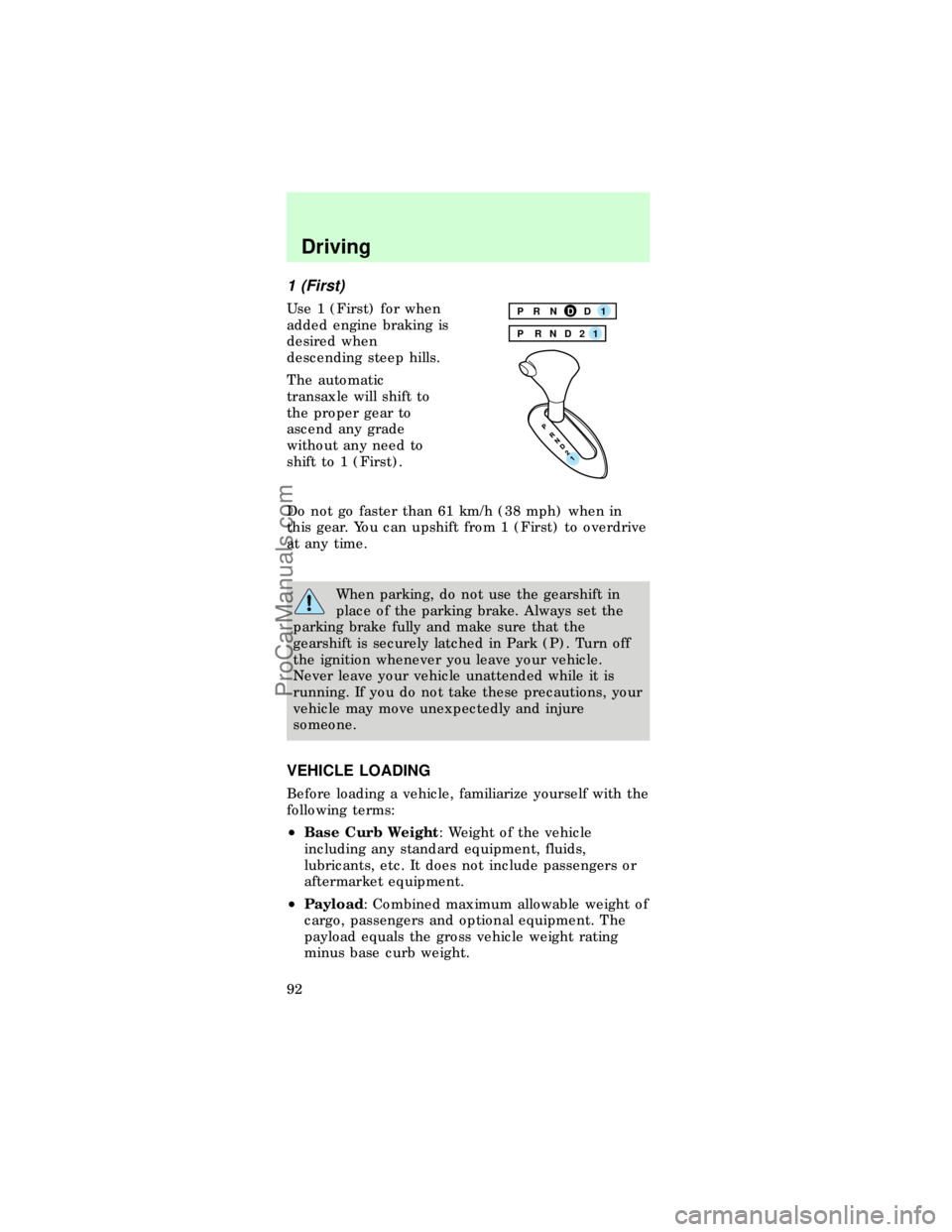
1 (First)
Use 1 (First) for when
added engine braking is
desired when
descending steep hills.
The automatic
transaxle will shift to
the proper gear to
ascend any grade
without any need to
shift to 1 (First).
Do not go faster than 61 km/h (38 mph) when in
this gear. You can upshift from 1 (First) to overdrive
at any time.
When parking, do not use the gearshift in
place of the parking brake. Always set the
parking brake fully and make sure that the
gearshift is securely latched in Park (P). Turn off
the ignition whenever you leave your vehicle.
Never leave your vehicle unattended while it is
running. If you do not take these precautions, your
vehicle may move unexpectedly and injure
someone.
VEHICLE LOADING
Before loading a vehicle, familiarize yourself with the
following terms:
²Base Curb Weight: Weight of the vehicle
including any standard equipment, fluids,
lubricants, etc. It does not include passengers or
aftermarket equipment.
²Payload: Combined maximum allowable weight of
cargo, passengers and optional equipment. The
payload equals the gross vehicle weight rating
minus base curb weight.
PRNDD1
P RND21
Driving
92
ProCarManuals.com
Page 93 of 167
Do not exceed the GVWR or the GAWR
specified on the Safety Compliance
Certification Label.
Do not use replacement tires with lower weight
capacities than the originals because they may lower
the vehicle's GVWR and GAWR limitations.
Replacement tires with a higher weight limit than
the originals do not increase the GVWR and GAWR
limitations.
TRAILER TOWING
Your vehicle is classified as a light duty towing the
vehicle. The amount of weight you can safely tow
depends on the type of engine you have in your
vehicle. Your vehicle does not come from the factory
fully equipped to tow. No towing packages are
available through Ford or Mercury/Lincoln dealers.
Do not tow a trailer until your vehicle has been
driven at least 800 km (500 miles). If towing with a
station wagon, inflate the rear tires to 35 psi.
Towing a trailer places an additional load on your
vehicle's engine, transaxle, brakes, tires and
suspension. Inspect these components carefully after
towing.
The amount of weight that you can tyow depends on
the type of engine in your vehicle. See the following
charts:
3.0L 2-Valve Vulcan Engine
Model Passenger
Load #/kg
(lbs.)Luggage
Load kg
(lbs.)Max Trailer
Wt. kg
(lbs.)
Sedan 5/340 (750) 0 365 (800)
4/270 (600) 70 (150) 365 (800)
2/135 (300) 70 (150) 500 (1100)
2/135 (300) 0 565 (1250)
Driving
94
ProCarManuals.com
Page 95 of 167
Preparing to tow
Use the proper equipment for towing a trailer, and
make sure it is properly attached to your vehicle.
See your dealer or a reliable trailer dealer if you
require assistance.
Hitches
Your vehicle has a load carrying hitch. This type of
hitch places the tongue load of a trailer on the rear
wheels of your vehicle. You must distribute the load
in your trailer so that 10±15% of the total weight of
the trailer is on the tongue.
Safety chains
Always connect the trailer's safety chains to the
vehicle. To connect the trailer's safety chains, cross
the chains under the trailer tongue and allow slack
for turning corners.
If your use a rental trailer, follow the instructions
that the rental agency gives to you.
Trailer brakes
Electric brakes and manual, automatic or surge-type
brakes are safe if installed properly and adjust them
to the manufacturer's specifications. The trailer
brakes must meet local and Federal regulations.
Do not connect a trailer's hydraulic brake
system directly to your vehicle's brake
system. Your vehicle may not have enough braking
power and your chances of having a collision
greatly increase.
Trailer lamps
Trailer lamps are required on most towed vehicles.
Make sure your trailer lamps conform to local and
Federal regulations. See your dealer or trailer rental
agency for proper instructions and equipment for
hooking up trailer lamps.
Driving
96
ProCarManuals.com
Page 96 of 167

Driving while you tow
Do not drive faster than 72 km/h (45 mph) with any
weight on the trailer while towing on a hot day or in
hilly country.
Cruise control may shut off if you are towing on
long, steep grades.
When towing a trailer:
²Use 2 (Second) (if equipped) or 1 (First) when
towing up or down steep hills. This will eliminate
excessive downshifting and upshifting for
optimum fuel economy and transaxle cooling.
²Anticipate stops and brake gradually.
Servicing after towing
If you tow a trailer for long distances, your vehicle
will require more frequent service intervals. Refer to
theService Guidefor more information.
Trailer towing tips
²Practice turning, stopping and backing up in an
area before starting on a trip to get the feel of the
vehicle trailer combination. When turning, drive
slightly beyond the normal turning point so the
trailer wheels will clear curbs and other obstacles.
²Allow more room for stopping with a trailer
attached.
²The trailer tongue weight should be 10±15% of
the loaded trailer weight.
²After you have traveled 80 km (50 miles),
thoroughly check your hitch, electrical
connections and trailer wheel lug nuts.
²When stopped in traffic for long periods of time in
hot weather, place the gearshift in P (Park) and
increase idle speed. This aids engine cooling and
air conditioner efficiency.
²Vehicles with trailers should not be parked on a
grade. If you must park on a grade, place wheel
chocks under the trailer's wheels.
Driving
97
ProCarManuals.com
Page 100 of 167
Standard fuse amperage rating and color
Fuse rating Color
10 amp Red
15 amp Blue
20 amp Yellow
30 amp Light Green
30 amp fuse link Pink
40 amp Amber
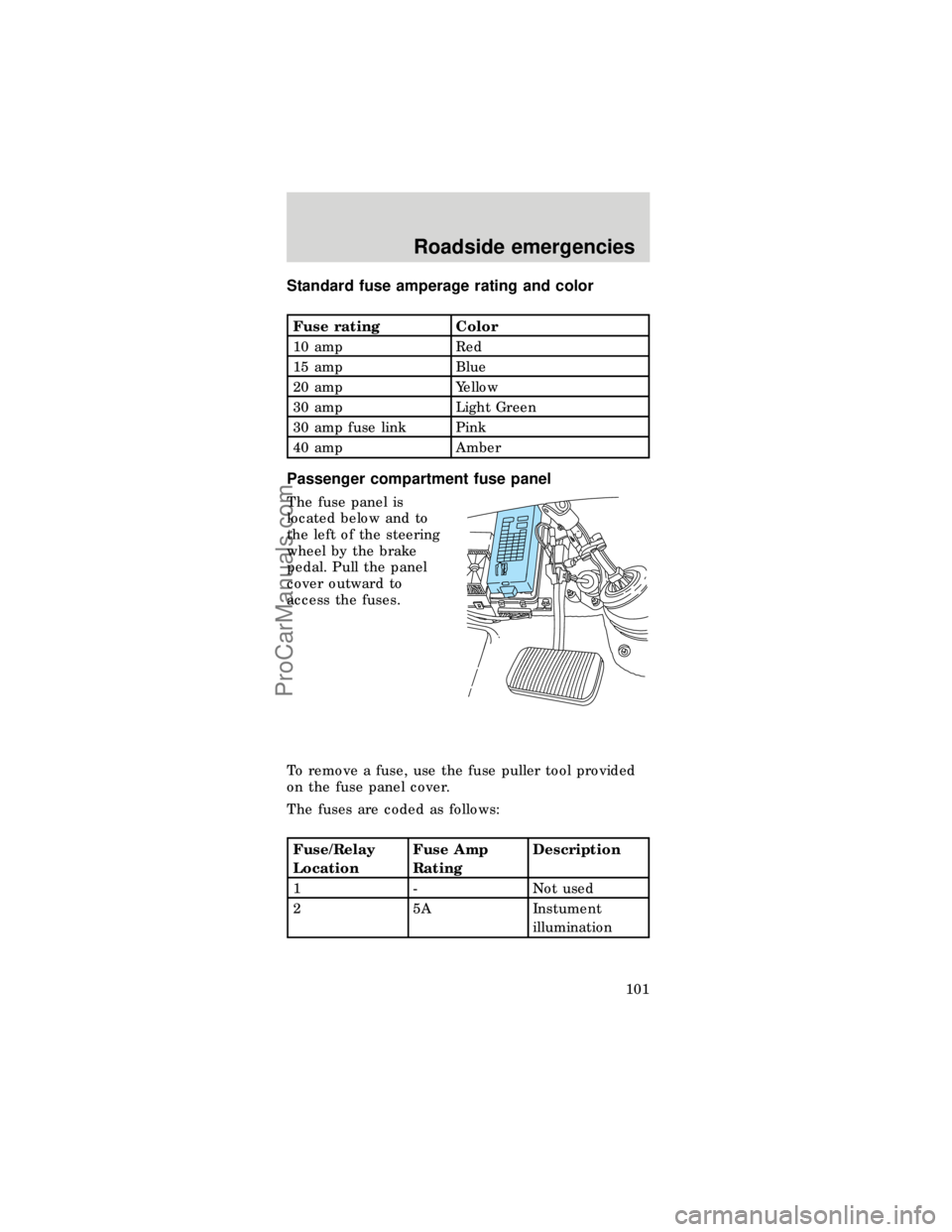
Passenger compartment fuse panel
The fuse panel is
located below and to
the left of the steering
wheel by the brake
pedal. Pull the panel
cover outward to
access the fuses.
To remove a fuse, use the fuse puller tool provided
on the fuse panel cover.
The fuses are coded as follows:
Fuse/Relay
LocationFuse Amp
RatingDescription
1 - Not used
2 5A Instument
illumination
Roadside emergencies
101
ProCarManuals.com
Page 101 of 167

Fuse/Relay
LocationFuse Amp
RatingDescription
3 10A Left low beam
headlamp
4 10A Right low beam
headlamp
5 5A Brake shift
interlock , rear
defroster
6 15A MLPS switch,
backup lamps,
speed control,
climate control
7 10A MLPS switch,
starter relay
8 5A Power antenna,
radio control
unit, GEM
9 10A Anti-lock
brakes system,
Central
Temperature
Monitor
10 20A EEEC relay,
ignition coil,
passive
anti-theft
system, radio
11 5A Air bag
indicator,
instrument
cluster
Roadside emergencies
102
ProCarManuals.com
Page 103 of 167

Fuse/Relay
LocationFuse Amp
RatingDescription
21 20A Cigar lighter
22 5A Power mirrors,
power antenna,
decklid lamps,
autolamps
23 5A Wiper system,
variable assist
steering,
remote entry,
anti-theft
24 5A Integrated
control panel,
speedometer,
electronic
automatic
temperature
control module
25 15A Data link
connector
26 15A Trunklid
27 10A Battery saver
relay
28 15A Brake lamps,
stop control
29 15A Multi-function
switch, hazard
flashers
30 15A High beams,
daytime
running lamps,
instrument
cluster
31 5A Tail lamp feed
Roadside emergencies
104
ProCarManuals.com
Page 106 of 167

Fuse/Relay
LocationFuse Amp
RatingCircuits
protected
15 15A** Daytime
running lamps
(DRL) module
16 10A** Air bag
diagnostic
monitor
17 20A** Rear control
unit, CD
changer
18 30A** Anti-lock brake
module
19 15A** Horn relay,
powertrain
control module
20 15A** Headlamp
switch,
autolamp park
relay
21 - Not used
22 30A** Autolamps
relay,
multi-function
switch,
headlamp
switch
23 - N/A
24 - N/A
25 - N/A
26 30A** Generator/
Voltage
regulator
27 - N/A
Roadside emergencies
107
ProCarManuals.com
Page 109 of 167
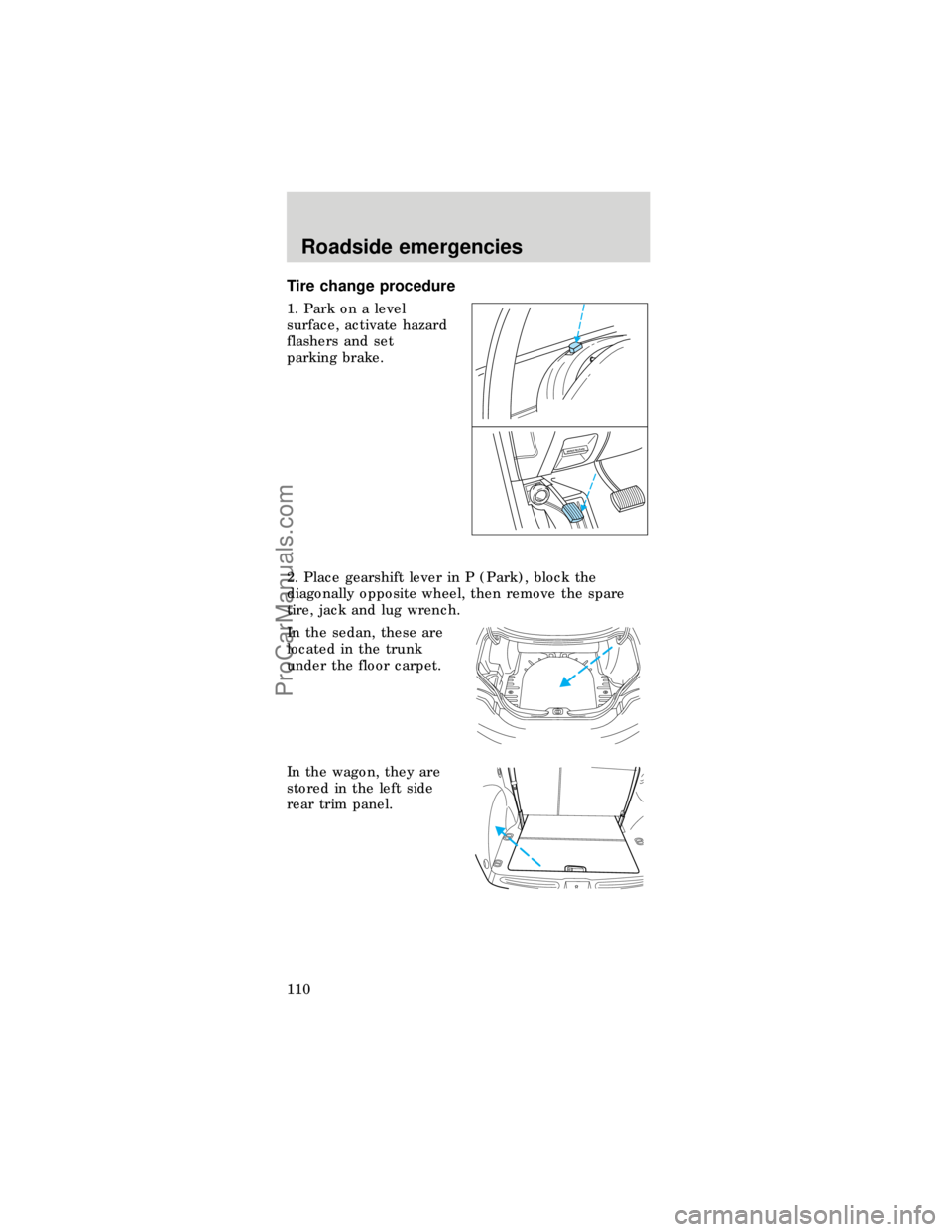
Tire change procedure
1. Park on a level
surface, activate hazard
flashers and set
parking brake.
2. Place gearshift lever in P (Park), block the
diagonally opposite wheel, then remove the spare
tire, jack and lug wrench.
In the sedan, these are
located in the trunk
under the floor carpet.
In the wagon, they are
stored in the left side
rear trim panel.
BRAKE RELEASE
Roadside emergencies
110
ProCarManuals.com
Page 116 of 167
TOWING YOUR VEHICLE BEHIND ANOTHER
VEHICLE
At times, you may want to tow your vehicle behind
another vehicle, such as a recreational vehicle, car
or a truck.
Before you have your vehicle towed:
²Release the parking brake.
²Move the gearshift to N (Neutral).
²Turn the key in the ignition to OFF.
²Unlock the steering wheel.
Do not tow your vehicle at a speed faster than 56
km/h (35 mph) or for a distance greater than 80 km
(50 miles), unless the drive wheels are placed on
dollies.
Never use a tow bar that attaches to the
bumper when you tow your vehicle. This
could damage the bumper and cause an accident.
Roadside emergencies
117
ProCarManuals.com