seats FORD TAURUS 1998 3.G User Guide
[x] Cancel search | Manufacturer: FORD, Model Year: 1998, Model line: TAURUS, Model: FORD TAURUS 1998 3.GPages: 192, PDF Size: 1.66 MB
Page 74 of 192
Children and safety belts
If the child is the proper size, restrain the child in a
safety seat.
Children who are too large for child safety seats (as
specified by your child safety seat manufacturer)
should always wear safety belts.
Follow all the important safety restraint and air bag
precautions that apply to adult passengers in your
vehicle.
If the shoulder belt portion of a combination lap and
shoulder belt can be positioned so it does not cross
or rest in front of the child's face or neck, the child
should wear the lap and shoulder belt. Moving the
child closer to the center of the vehicle may help
provide a good shoulder belt fit.
Do not leave children, unreliable adults, or
pets unattended in your vehicle.
To improve the fit of lap and shoulder belts on
children who have outgrown child safety seats, Ford
recommends use of a belt-positioning booster seat
that is labelled as conforming to all Federal motor
vehicle safety standards. Belt-positioning booster
seats raise the child and provide a shorter, firmer
seating cushion that encourages safer seating
posture and better fit of lap and shoulder belts on
the child.
A belt-positioning booster should be used if the
shoulder belt rests in front of the child's face or
neck, or if the lap belt does not fit snugly on both
thighs, or if the thighs are too short to let the child
sit all the way back on the seat cushion when the
lower legs hang over the edge of the seat cushion.
You may wish to discuss the special needs of your
child with your pediatrician.
Seating and safety restraints
74
Page 75 of 192
SAFETY SEATS FOR CHILDREN
Child and infant or child safety seats
Use a safety seat that is recommended for the size
and weight of the child. Carefully follow all of the
manufacturer's instructions with the safety seat you
put in your vehicle. If you do not install and use the
safety seat properly, the child may be injured in a
sudden stop or collision.
When installing a child safety seat:
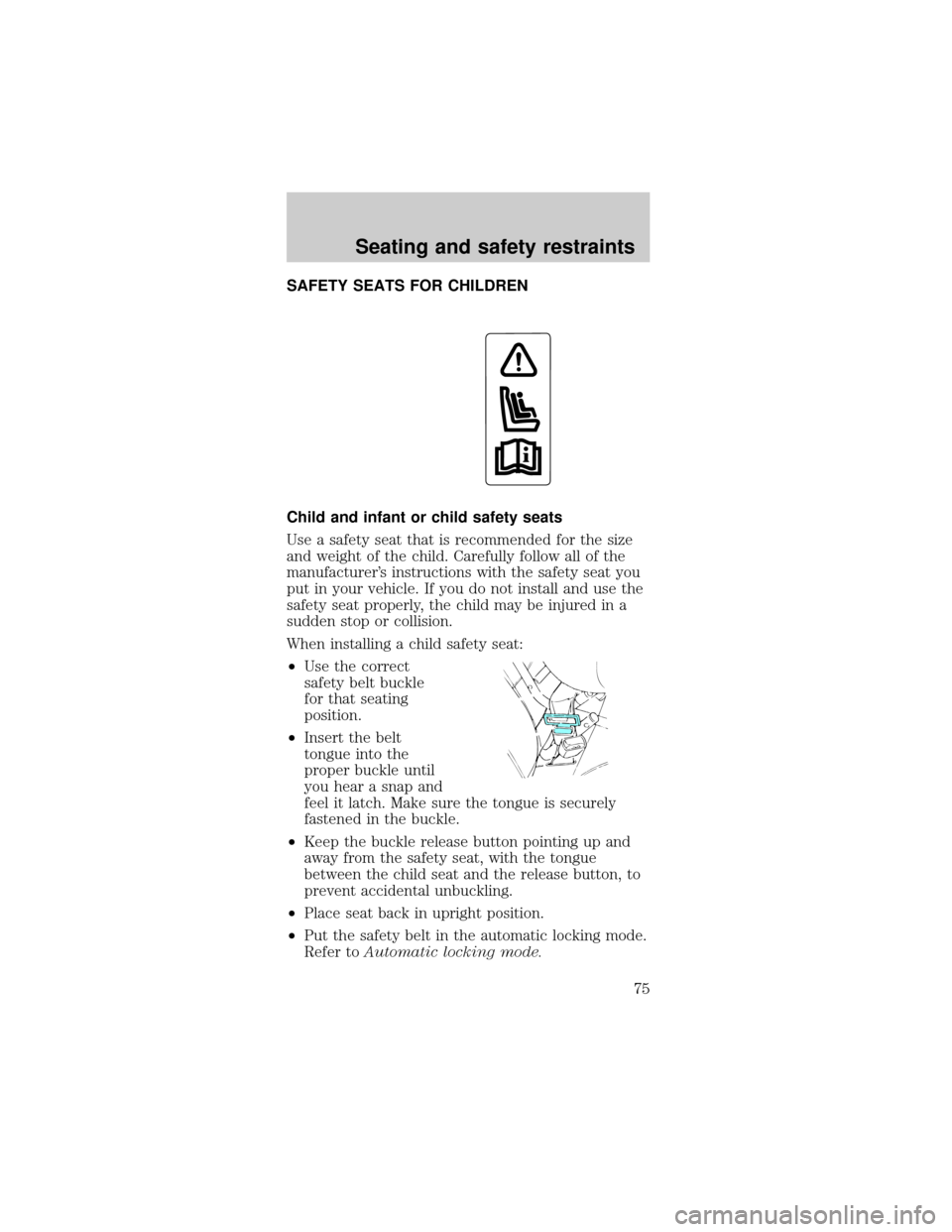
²Use the correct
safety belt buckle
for that seating
position.
²Insert the belt
tongue into the
proper buckle until
you hear a snap and
feel it latch. Make sure the tongue is securely
fastened in the buckle.
²Keep the buckle release button pointing up and
away from the safety seat, with the tongue
between the child seat and the release button, to
prevent accidental unbuckling.
²Place seat back in upright position.
²Put the safety belt in the automatic locking mode.
Refer toAutomatic locking mode.
Seating and safety restraints
75
Page 76 of 192
Ford recommends the use of a child safety seat
having a top tether strap. Install the child safety seat
in a seating position which is capable of providing a
tether anchorage. For more information on top
tether straps, refer toAttaching safety seats with
tether straps.
Carefully follow all of the manufacturer's
instructions included with the safety seat
you put in your vehicle. If you do not install and
use the safety seat properly, the child may be
injured in a sudden stop or collision.
Installing child safety seats in combination lap
and shoulder belt seating positions
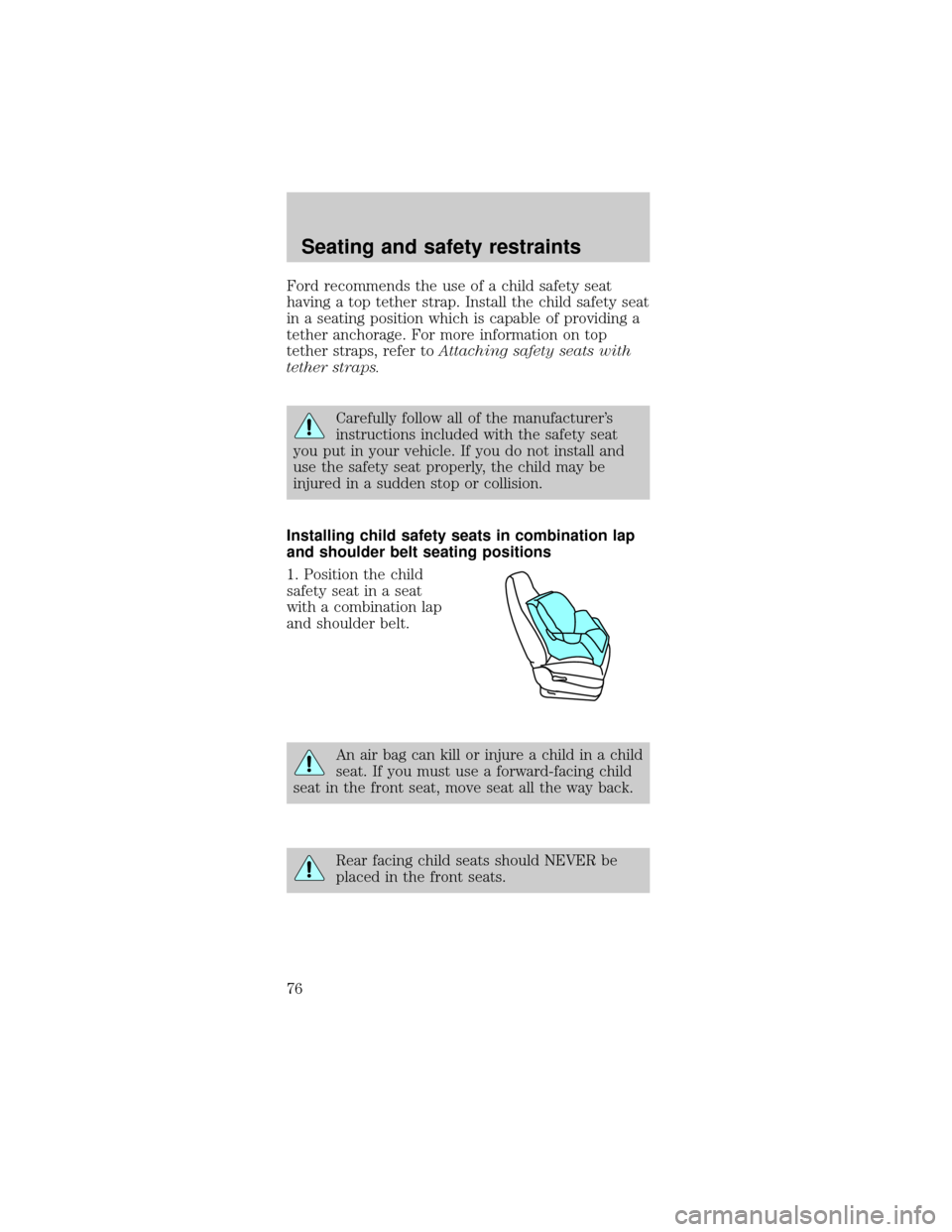
1. Position the child
safety seat in a seat
with a combination lap
and shoulder belt.
An air bag can kill or injure a child in a child
seat. If you must use a forward-facing child
seat in the front seat, move seat all the way back.
Rear facing child seats should NEVER be
placed in the front seats.
Seating and safety restraints
76
Page 79 of 192
fastened to the buckle by pulling on tongue.
5. Push down on the child seat while pulling on the
loose end of the lap belt webbing to tighten the belt.
6. Before placing the child into the child seat,
forcibly tilt the child seat from side to side and in
forward direction to make sure that the seat is held
securely in place. If the child seat moves excessively,
repeat steps 5 through 6, or properly install the
child seat in a different position.
Attaching safety seats with tether straps
Some manufacturers make safety seats that include
a tether strap that goes over the back of the vehicle
seat and attaches to an anchoring point. Other
manufacturers offer the tether strap as an accessory.
Contact the manufacturer of your child safety seat
for information about ordering a tether strap.
Tether anchorage hardware
Attachment holes (at each rear outboard seating
position) have been provided in your vehicle to
attach anchor hardware, if required. Tether
anchorage hardware kits (part number 613D74)
including instructions, may be obtained at no charge
from any Ford or Lincoln-Mercury dealer. All
vehicles built for sale in Canada include a tether
anchor hardware kit.
Be sure to follow the child safety seat
manufacturer's instructions.
Tighten the anchor according to
specifications. Otherwise, the safety seat
may not be properly secured and the child may be
injured in a sudden stop or collision.
If you have a station wagon, tether anchors are
already installed for each of the second row seating
positions.
Seating and safety restraints
79
Page 80 of 192
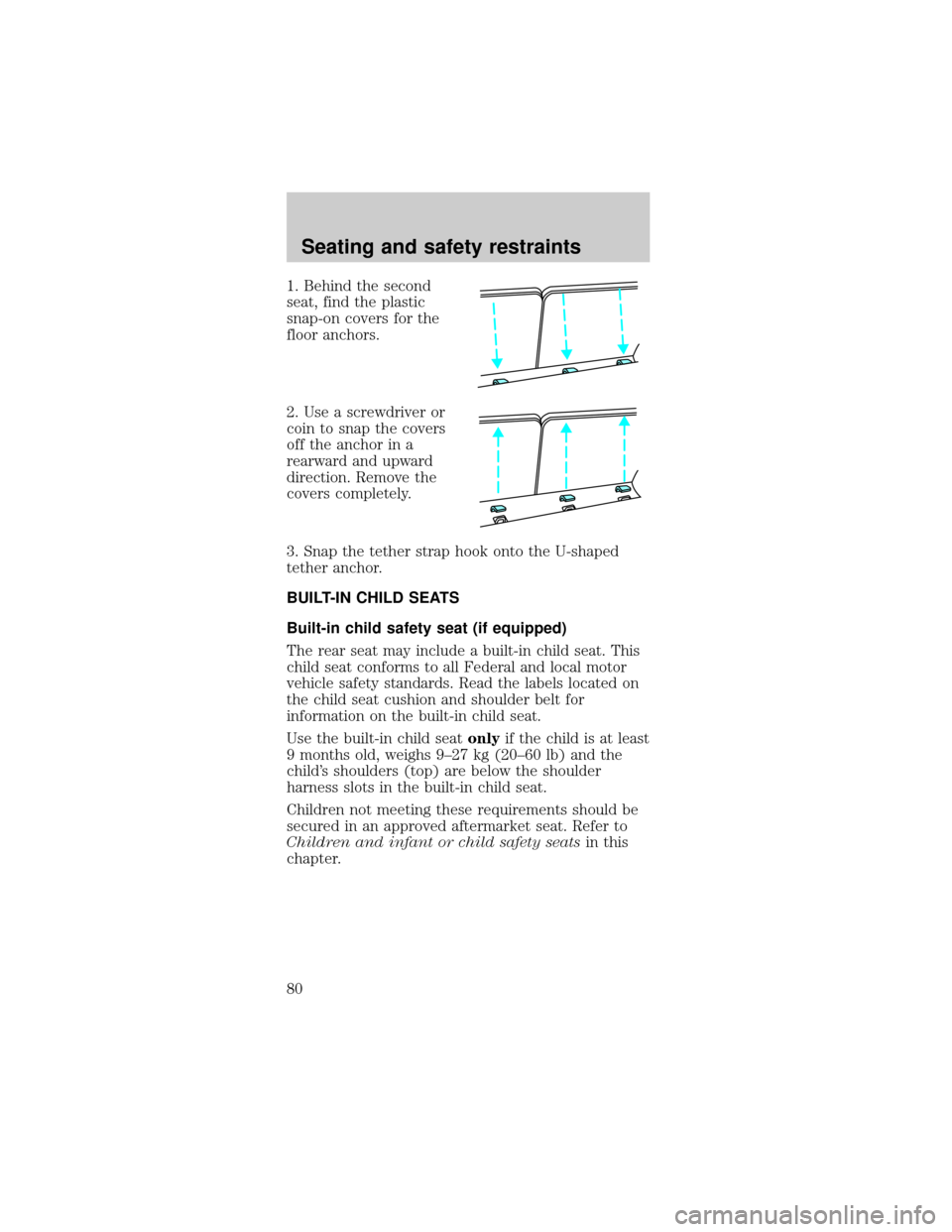
1. Behind the second
seat, find the plastic
snap-on covers for the
floor anchors.
2. Use a screwdriver or
coin to snap the covers
off the anchor in a
rearward and upward
direction. Remove the
covers completely.
3. Snap the tether strap hook onto the U-shaped
tether anchor.
BUILT-IN CHILD SEATS
Built-in child safety seat (if equipped)
The rear seat may include a built-in child seat. This
child seat conforms to all Federal and local motor
vehicle safety standards. Read the labels located on
the child seat cushion and shoulder belt for
information on the built-in child seat.
Use the built-in child seatonlyif the child is at least
9 months old, weighs 9±27 kg (20±60 lb) and the
child's shoulders (top) are below the shoulder
harness slots in the built-in child seat.
Children not meeting these requirements should be
secured in an approved aftermarket seat. Refer to
Children and infant or child safety seatsin this
chapter.
Seating and safety restraints
80
Page 81 of 192
Built-in child seat retractors
The belts on built-in child seats are equipped with a
retractor that locks when both tongues are latched
into the crotch safety belt buckle. The retractor will
automatically snug the belts around the child. If the
belts do not remain snug, take the vehicle to the
dealer for child seat repair. The belts will not snug
during a collision.
Placing your child in the built-in child seat
Failure to follow all of the instructions on
the use of this child restraint system can
result in your child striking the vehicle's interior
during a sudden stop or crash.
Never use the Built-In Child Seat as a
booster cushion with the adult safety belts.
A child using the adult belts could slide forward
and out from under the safety belts.
The rear seatback must be fully locked
before operating the child restraint system.
Seating and safety restraints
81
Page 84 of 192
Removing your child from the built-in child seat
1. Squeeze the tabs on the top and the bottom of
the chest clip and pull the halves apart to open the
chest clip.
2. Press the release button on the crotch safety belt
buckle.
3. Slide the shoulder belts off the child's shoulders
and remove the child.
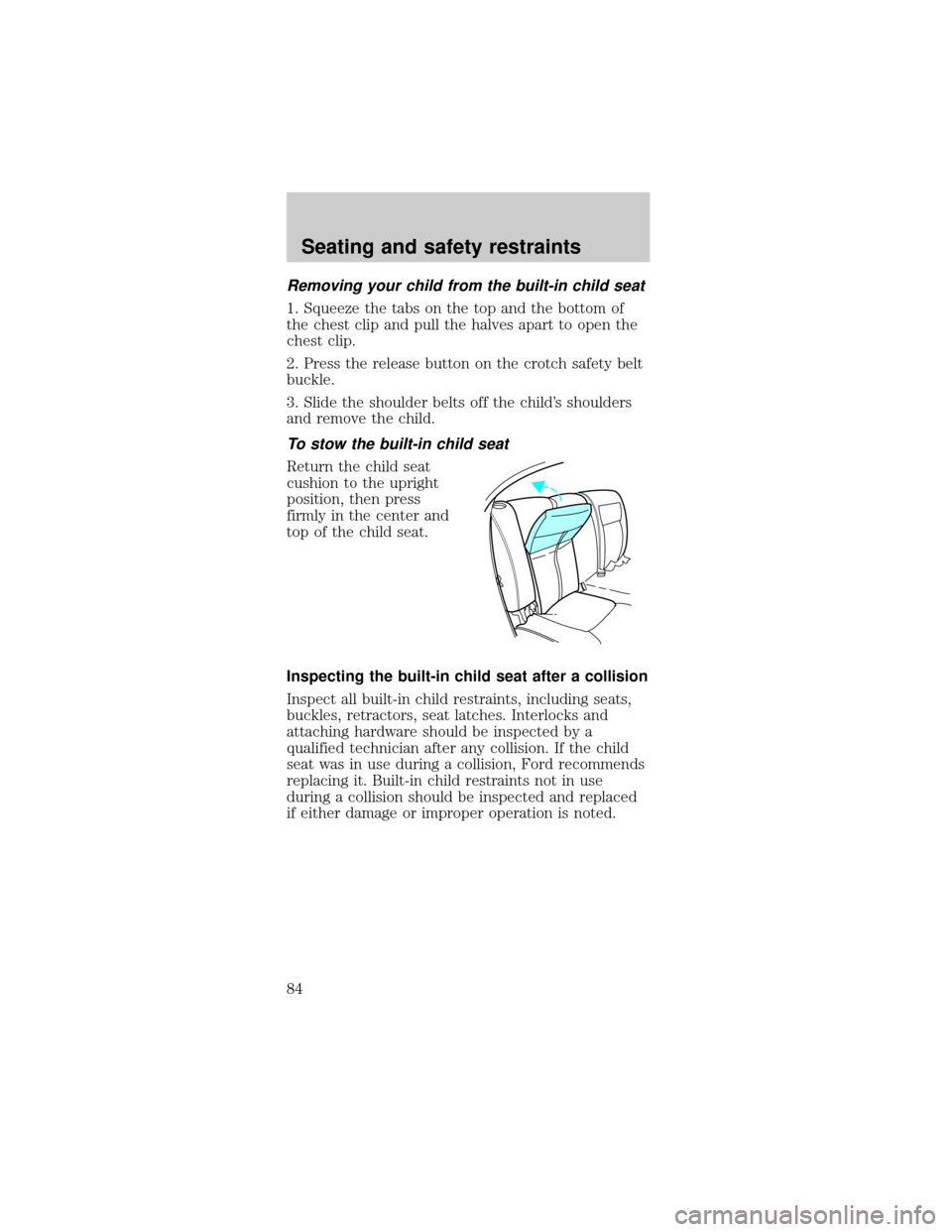
To stow the built-in child seat
Return the child seat
cushion to the upright
position, then press
firmly in the center and
top of the child seat.
Inspecting the built-in child seat after a collision
Inspect all built-in child restraints, including seats,
buckles, retractors, seat latches. Interlocks and
attaching hardware should be inspected by a
qualified technician after any collision. If the child
seat was in use during a collision, Ford recommends
replacing it. Built-in child restraints not in use
during a collision should be inspected and replaced
if either damage or improper operation is noted.
Seating and safety restraints
84
Page 114 of 192
Always disconnect the battery before
servicing high current fuses.
Always replace the cover to the Power
Distribution Box before reconnecting the
battery or refilling fluid reservoirs.
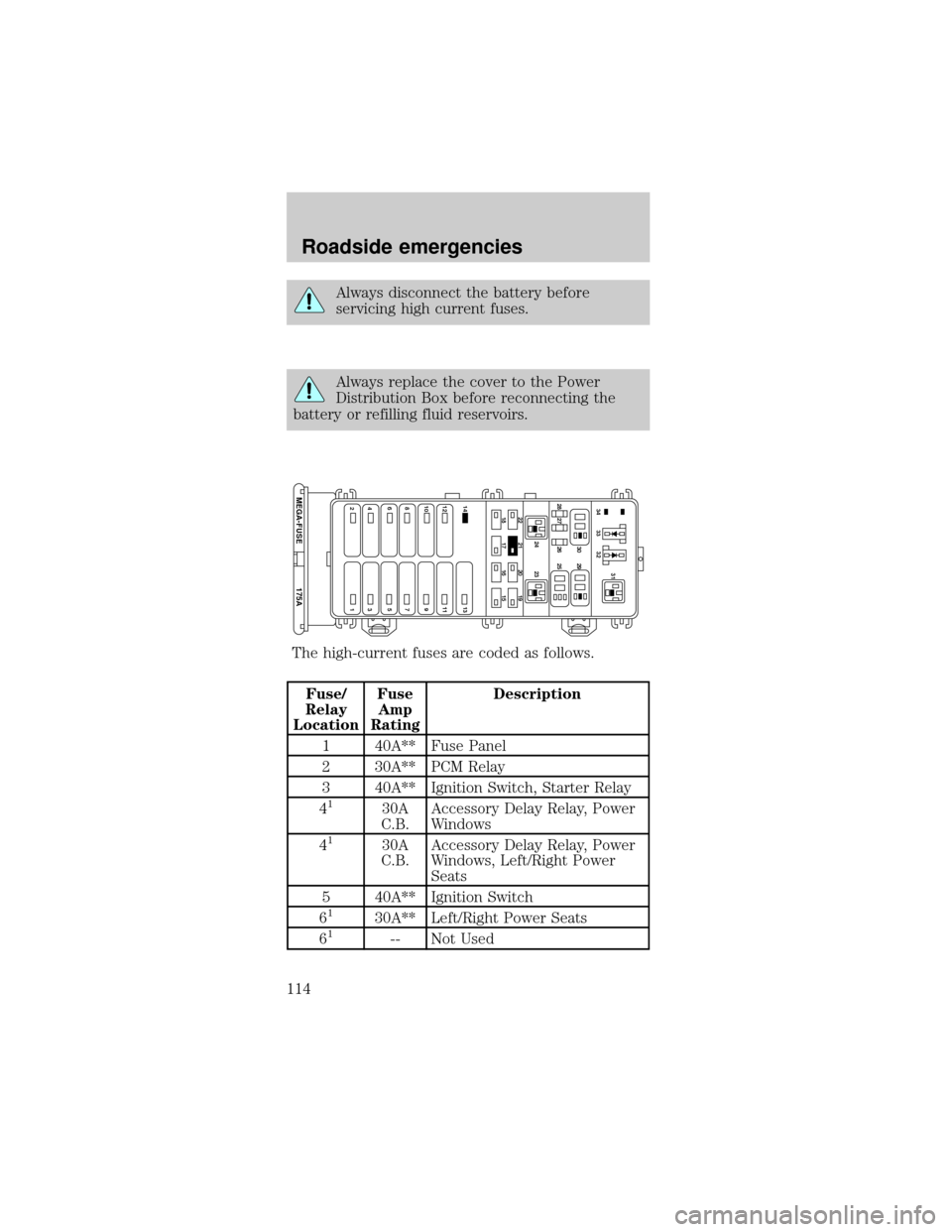
The high-current fuses are coded as follows.
Fuse/
Relay
LocationFuse
Amp
RatingDescription
1 40A** Fuse Panel
2 30A** PCM Relay
3 40A** Ignition Switch, Starter Relay
4
130A
C.B.Accessory Delay Relay, Power
Windows
4
130A
C.B.Accessory Delay Relay, Power
Windows, Left/Right Power
Seats
5 40A** Ignition Switch
6
130A** Left/Right Power Seats
61-- Not Used
22
14 13
12 11
10 9
87
175A MEGA-FUSE
65
43
2121 24 23 28 27 26 2530 2931
33 3432
20 19
18 17 16 15
Roadside emergencies
114
Page 174 of 192

Cleaning leather seats (if equipped)
For routine cleaning, wipe the surface with a soft,
damp cloth. For more thorough cleaning, wipe the
surface with a mild soap.
If the leather cannot be completely cleaned using a
mild soap and water solution, the leather may be
cleaned using a commercially available cleaning
product ªTanners Preserve Leather Cleanerº and a
3M ªType T' scrubbing pad by using the following
steps;
The type of scrubbing pad is very critical
because the common 3M ªScotch Briteº green
pad is too aggressive and will damage the
leather surface
²Spray a small amount of the leather cleaner on
the pad and rub the area to be cleaned with the
pad using a circular motion. Only clean 1/4 of the
area at a time. For heavily soiled areas, spray the
cleaner directly onto the leather (two squirts
should be adequate) and rub with the pad. Repeat
if necessary.
²Use a soft, damp cloth to remove the loosened
dirt and foam.
²Dry with a soft cloth.
Do not use household cleaners, glass cleaner,
alcohol solutions or cleaner intended for vinyl,
rubber or plastics. These products can damage
the leather.
In some instances, color or dye transfer can
occur when wet clothing (wool, denim, leathers
or other non-colorfast garments) comes in
contact with leather upholstery. If this occurs,
the leather should be cleaned immediately to
avoid permanent staining.
ªTanners Preserve Leather Cleanerº (product
number AS-300) is available from ªFirst Brandsº by
calling 1±800±726±1001. This product may also be
Maintenance and care
174
Page 186 of 192

Air bag supplemental
restraint system ........ 67
and child safety
seats ......................... 69
description .............. 67
disposal .................... 72
indicator light ......... 72
passenger air bag ... 70
Air conditioning
automatic temperature
control
system . 22,23,24,25,27
Anti-theft system ...... 47
arming the system .. 47
Automatic transaxle . 94
driving
with ......... 97,98,99,100
Brakes ........................ 90
anti-lock ................... 90
anti-lock brake
system (ABS)
warning light ........... 91
fluid, checking and
adding .................... 136
shift interlock .......... 94
Break-in period ........... 3
Cargo cover .......... 42,43
Cargo net .............. 41,42
Cellular telephone
(see your Cellular
Phone Guide) ............ 40
Child safety seats
attaching with tether
straps ....................... 79
in rear seat ......... 76,78
tether anchorage
hardware ................. 79
Cleaning your
vehicle ...................... 169
built-in
child seat ....... 80,81,84engine
compartment .. 170,172
exterior lamps ....... 173
plastic parts .......... 172
washing .................. 169
waxing ................... 170
wheels .................... 170
wiper blades .......... 173
Console ...................... 39
Controls
power seat ............... 56
Coolant .................... 140
checking
and adding ............ 138
refill capacities ...... 140
Defrost
rear window ............ 18
Doors
central
unlocking ............ 37,38
Emission control
system ...................... 160
Engine
coolant ................... 137
idle speed control . 144
service
points ....... 130,131,132
starting after a
collision ................. 109
Engine block heater . 88
Engine oil
checking and
adding .................... 134
dipstick .................. 133
specifications . 133,135
Exhaust fumes .......... 88
Floor mats ................. 40
Fuel
choosing the
right fuel ................ 158
detergent in fuel ... 160
Index
186