power steering FORD TAURUS 2002 4.G Owners Manual
[x] Cancel search | Manufacturer: FORD, Model Year: 2002, Model line: TAURUS, Model: FORD TAURUS 2002 4.GPages: 248, PDF Size: 2.12 MB
Page 1 of 248
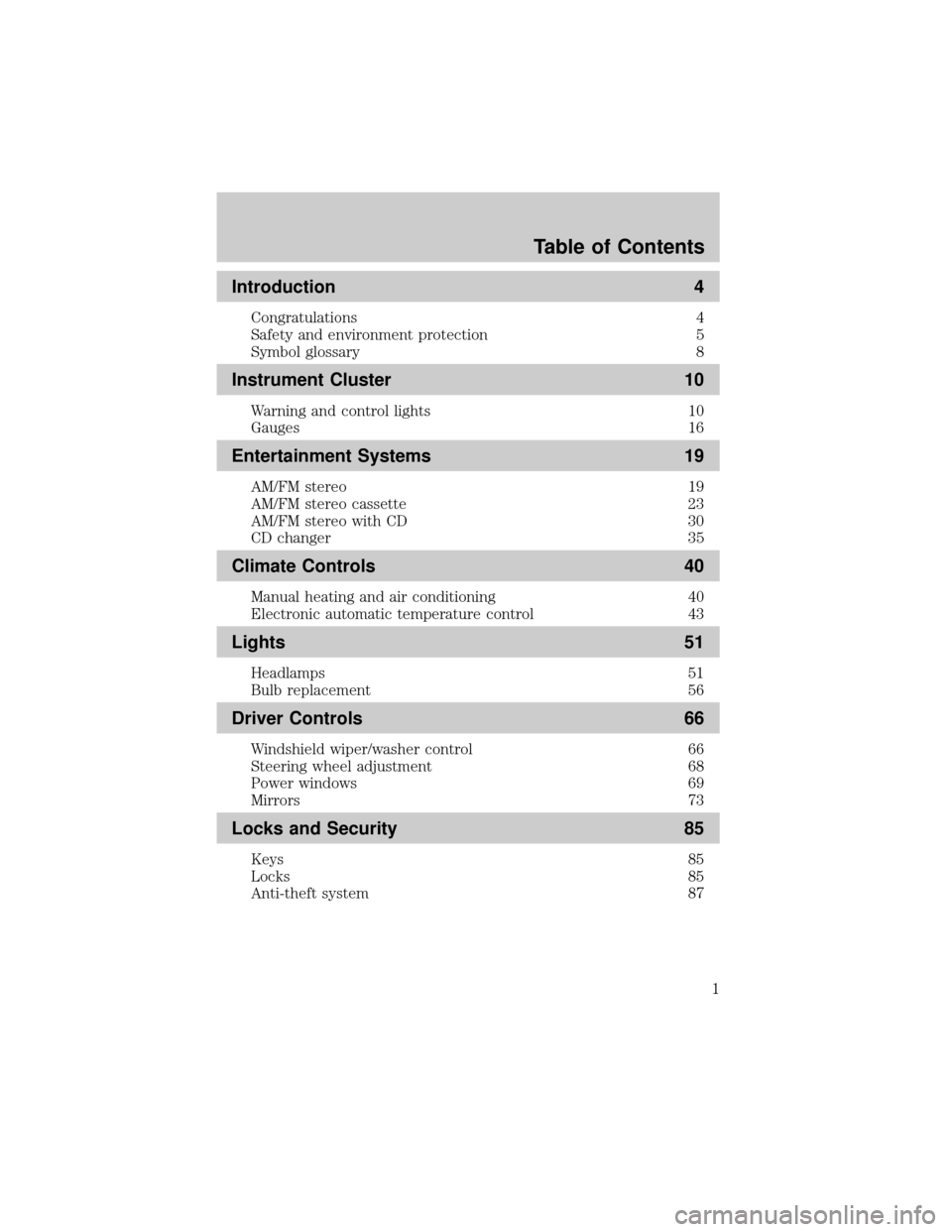
Introduction 4
Congratulations 4
Safety and environment protection 5
Symbol glossary 8
Instrument Cluster 10
Warning and control lights 10
Gauges 16
Entertainment Systems 19
AM/FM stereo 19
AM/FM stereo cassette 23
AM/FM stereo with CD 30
CD changer 35
Climate Controls 40
Manual heating and air conditioning 40
Electronic automatic temperature control 43
Lights 51
Headlamps 51
Bulb replacement 56
Driver Controls 66
Windshield wiper/washer control 66
Steering wheel adjustment 68
Power windows 69
Mirrors 73
Locks and Security 85
Keys 85
Locks 85
Anti-theft system 87
Table of Contents
1
Page 9 of 248
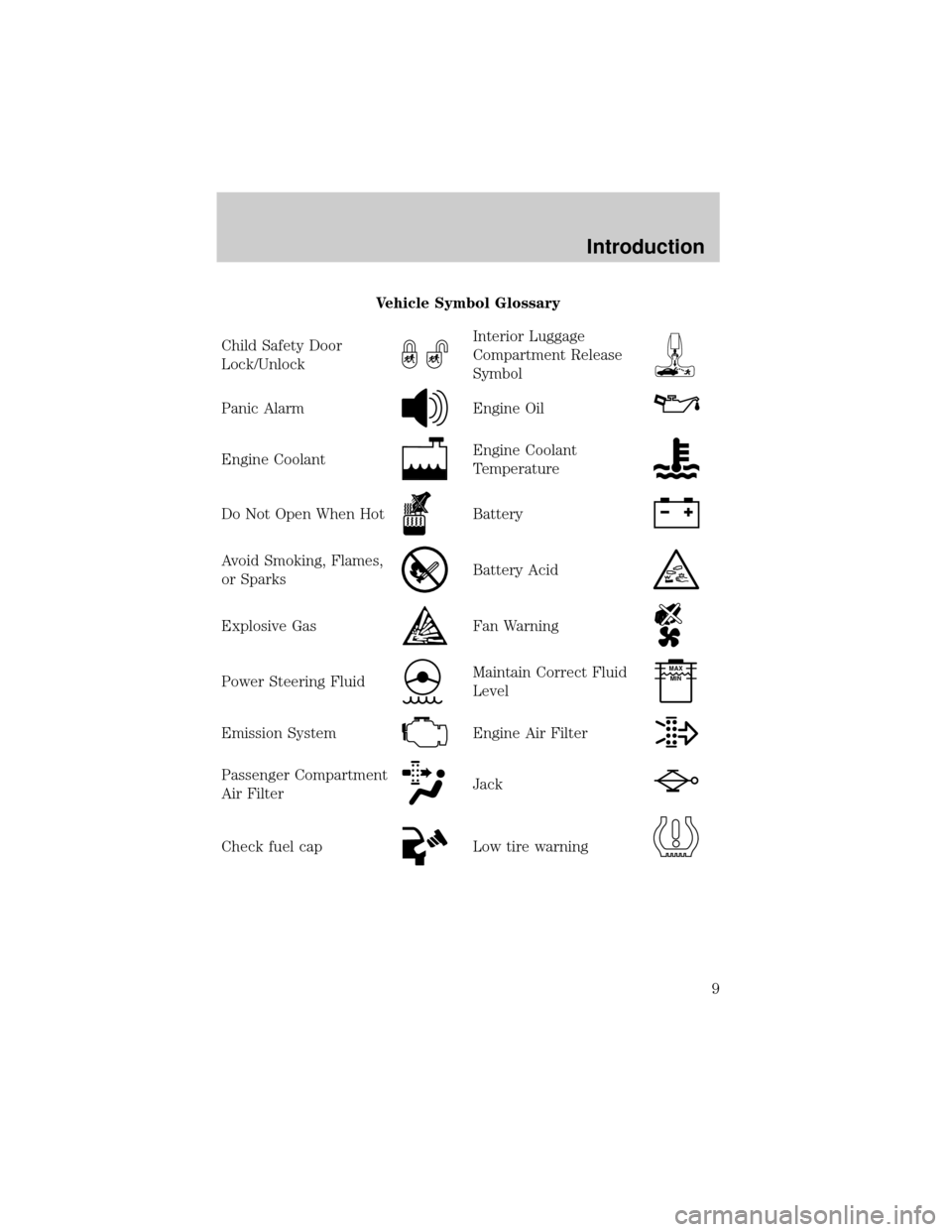
Vehicle Symbol Glossary
Child Safety Door
Lock/Unlock
Interior Luggage
Compartment Release
Symbol
Panic AlarmEngine Oil
Engine CoolantEngine Coolant
Temperature
Do Not Open When HotBattery
Avoid Smoking, Flames,
or SparksBattery Acid
Explosive GasFan Warning
Power Steering FluidMaintain Correct Fluid
LevelMAX
MIN
Emission SystemEngine Air Filter
Passenger Compartment
Air FilterJack
Check fuel capLow tire warning
Introduction
9
Page 138 of 248
STARTING
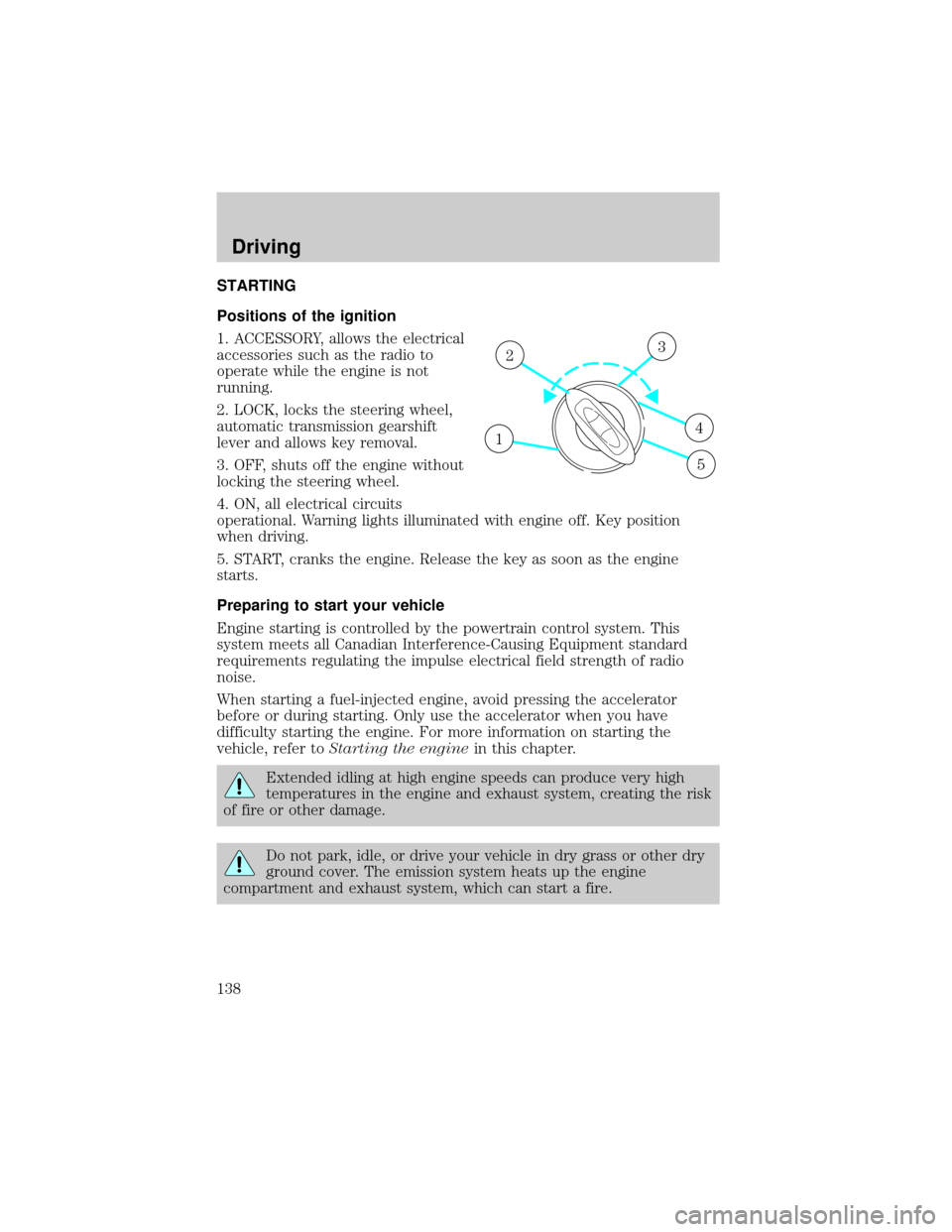
Positions of the ignition
1. ACCESSORY, allows the electrical
accessories such as the radio to
operate while the engine is not
running.
2. LOCK, locks the steering wheel,
automatic transmission gearshift
lever and allows key removal.
3. OFF, shuts off the engine without
locking the steering wheel.
4. ON, all electrical circuits
operational. Warning lights illuminated with engine off. Key position
when driving.
5. START, cranks the engine. Release the key as soon as the engine
starts.
Preparing to start your vehicle
Engine starting is controlled by the powertrain control system. This
system meets all Canadian Interference-Causing Equipment standard
requirements regulating the impulse electrical field strength of radio
noise.
When starting a fuel-injected engine, avoid pressing the accelerator
before or during starting. Only use the accelerator when you have
difficulty starting the engine. For more information on starting the
vehicle, refer toStarting the enginein this chapter.
Extended idling at high engine speeds can produce very high
temperatures in the engine and exhaust system, creating the risk
of fire or other damage.
Do not park, idle, or drive your vehicle in dry grass or other dry
ground cover. The emission system heats up the engine
compartment and exhaust system, which can start a fire.
1
23
4
5
Driving
138
Page 147 of 248
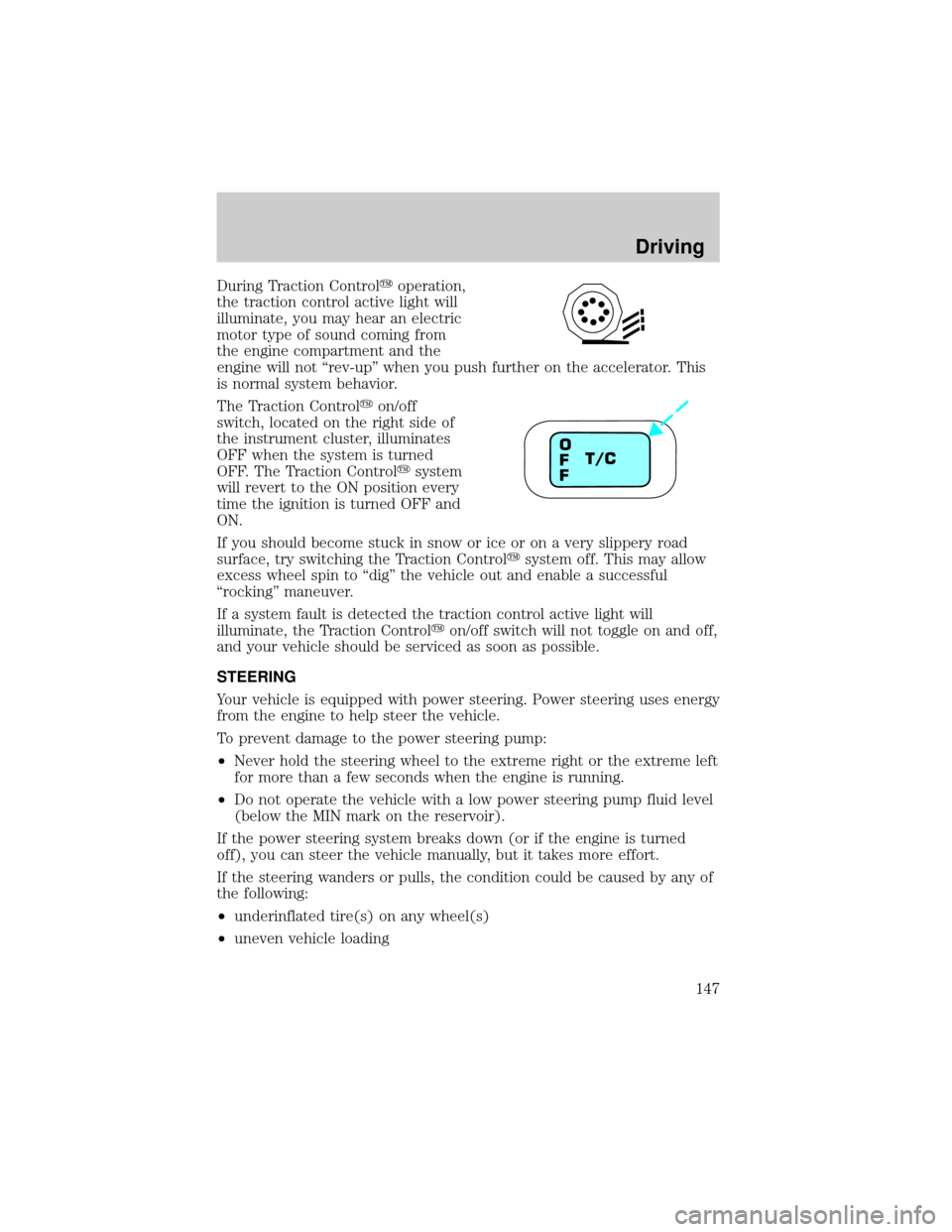
During Traction Controlyoperation,
the traction control active light will
illuminate, you may hear an electric
motor type of sound coming from
the engine compartment and the
engine will not ªrev-upº when you push further on the accelerator. This
is normal system behavior.
The Traction Controlyon/off
switch, located on the right side of
the instrument cluster, illuminates
OFF when the system is turned
OFF. The Traction Controlysystem
will revert to the ON position every
time the ignition is turned OFF and
ON.
If you should become stuck in snow or ice or on a very slippery road
surface, try switching the Traction Controlysystem off. This may allow
excess wheel spin to ªdigº the vehicle out and enable a successful
ªrockingº maneuver.
If a system fault is detected the traction control active light will
illuminate, the Traction Controlyon/off switch will not toggle on and off,
and your vehicle should be serviced as soon as possible.
STEERING
Your vehicle is equipped with power steering. Power steering uses energy
from the engine to help steer the vehicle.
To prevent damage to the power steering pump:
²Never hold the steering wheel to the extreme right or the extreme left
for more than a few seconds when the engine is running.
²Do not operate the vehicle with a low power steering pump fluid level
(below the MIN mark on the reservoir).
If the power steering system breaks down (or if the engine is turned
off), you can steer the vehicle manually, but it takes more effort.
If the steering wanders or pulls, the condition could be caused by any of
the following:
²underinflated tire(s) on any wheel(s)
²uneven vehicle loading
T/C O
F
F
Driving
147
Page 163 of 248
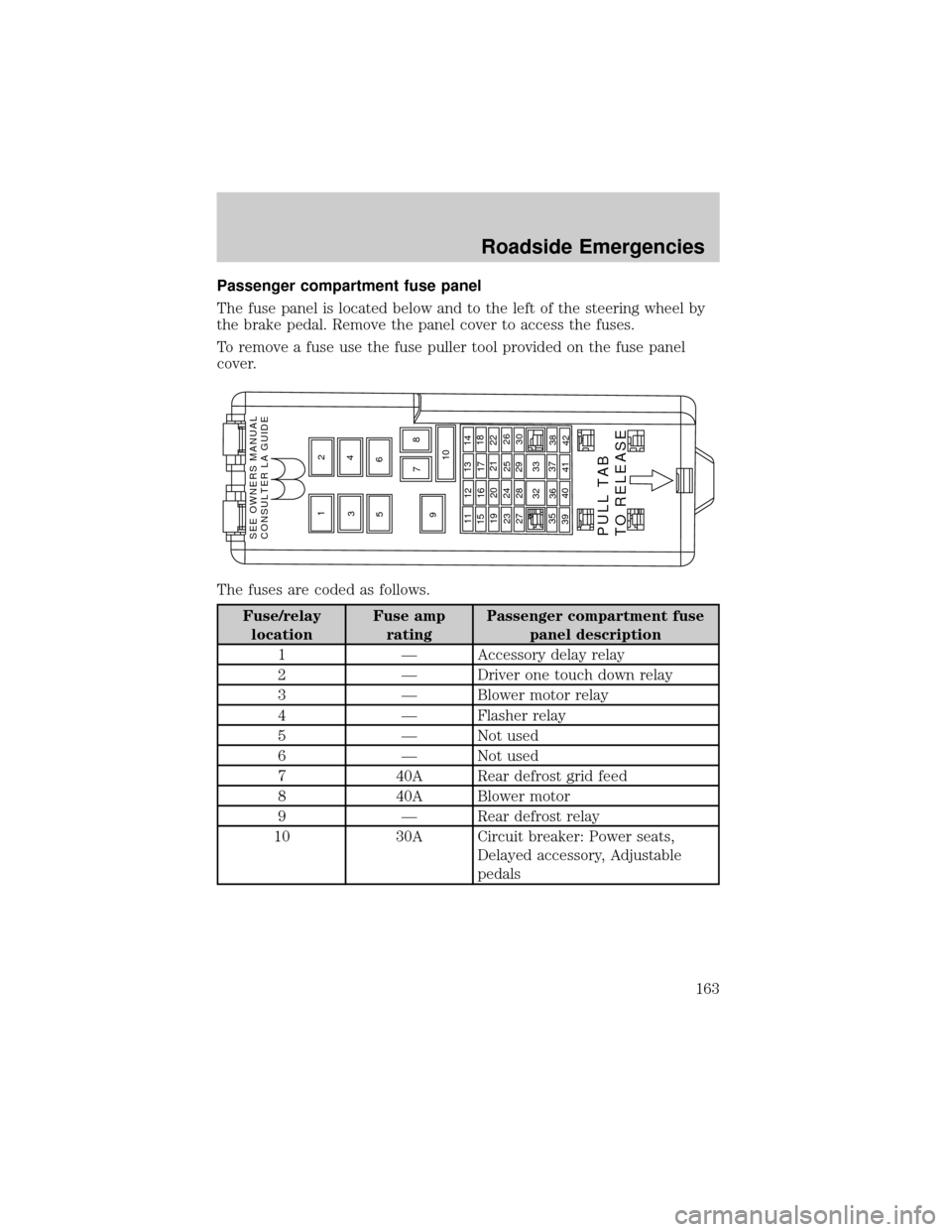
Passenger compartment fuse panel
The fuse panel is located below and to the left of the steering wheel by
the brake pedal. Remove the panel cover to access the fuses.
To remove a fuse use the fuse puller tool provided on the fuse panel
cover.
The fuses are coded as follows.
Fuse/relay
locationFuse amp
ratingPassenger compartment fuse
panel description
1 Ð Accessory delay relay
2 Ð Driver one touch down relay
3 Ð Blower motor relay
4 Ð Flasher relay
5 Ð Not used
6 Ð Not used
7 40A Rear defrost grid feed
8 40A Blower motor
9 Ð Rear defrost relay
10 30A Circuit breaker: Power seats,
Delayed accessory, Adjustable
pedals
12
34
56
78
9
10
11 1213 14
15
16 1718
19 2021 22
2324
2526
27 2829
30
32 33
35
3637
38
39 40
41
42
PULL TAB
TO RELEASE SEE OWNERS MANUAL
CONSULTER LA GUIDE
Roadside Emergencies
163
Page 168 of 248
Fuse/relay
locationFuse amp
ratingPower distribution box
description
28 15A* HEGO sensor transmission shift
solenoid, Canister vent, A/C
clutch relay
29 Ð Wiper park relay
30 Ð Fuel pump relay
31 Ð PCM power relay
32 Ð Fan relay
33 Ð A/C clutch relay
* Mini Fuses ** Maxi Fuses
Relays
Relays are located in the power distribution box and should be replaced
by qualified technicians.
CHANGING THE TIRES
If you get a flat tire while driving, do not apply the brake heavily.
Instead, gradually decrease your speed. Hold the steering wheel firmly
and slowly move to a safe place on the side of the road.
Temporary spare tire information
The temporary spare tire for your vehicle is labeled as such. It is smaller
than a regular tire and is designed for emergency use only.
If you use the temporary spare tire continuously or do not follow
these precautions, the tire could fail, causing you to lose control
of the vehicle, possibly injuring yourself or others.
When driving with the temporary spare tiredo not:
²exceed 80 km/h (50 mph) under any circumstances
²load the vehicle beyond maximum vehicle load rating listed on the
Safety Compliance Label
²tow a trailer
²use tire chains
Roadside Emergencies
168
Page 199 of 248
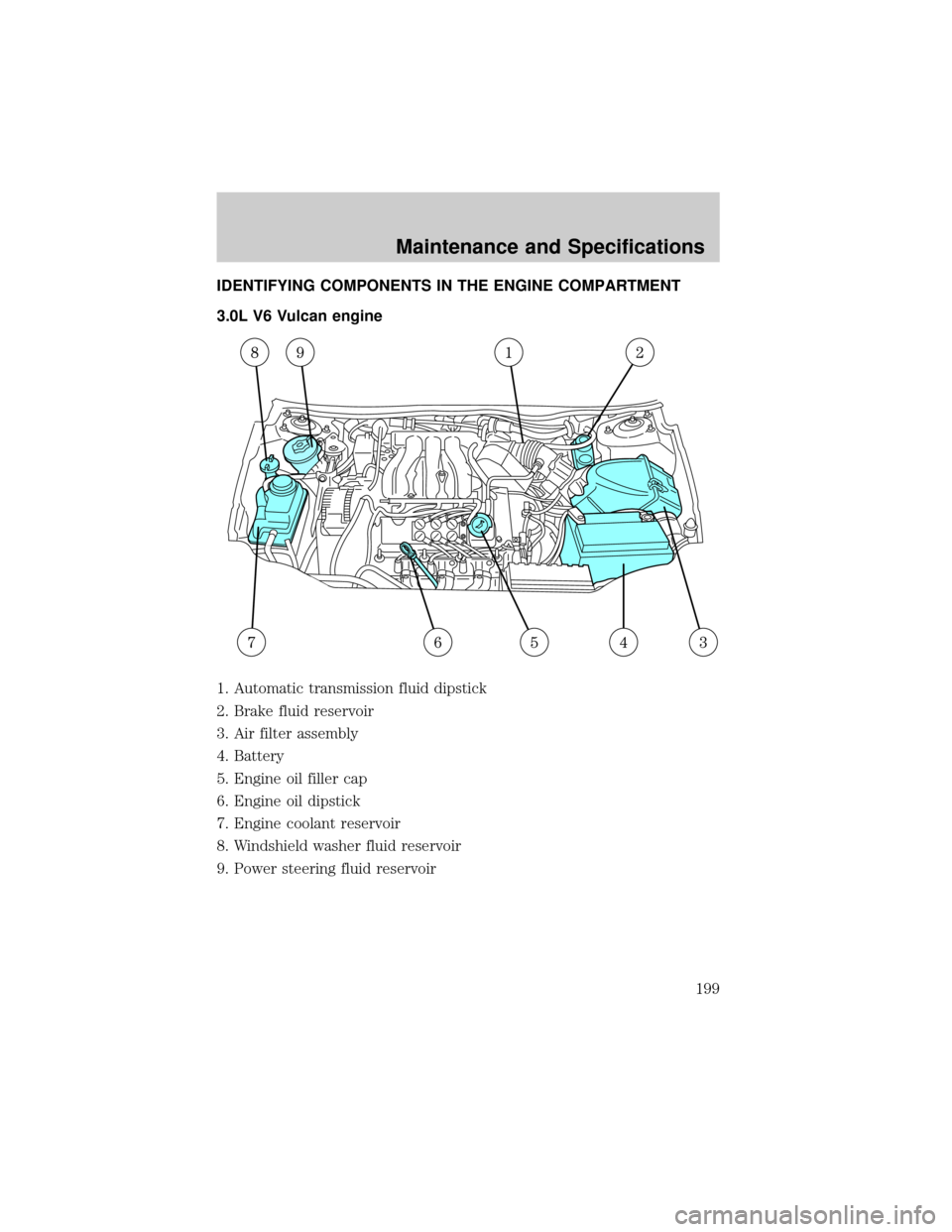
IDENTIFYING COMPONENTS IN THE ENGINE COMPARTMENT
3.0L V6 Vulcan engine
1. Automatic transmission fluid dipstick
2. Brake fluid reservoir
3. Air filter assembly
4. Battery
5. Engine oil filler cap
6. Engine oil dipstick
7. Engine coolant reservoir
8. Windshield washer fluid reservoir
9. Power steering fluid reservoir
Maintenance and Specifications
199
Page 200 of 248
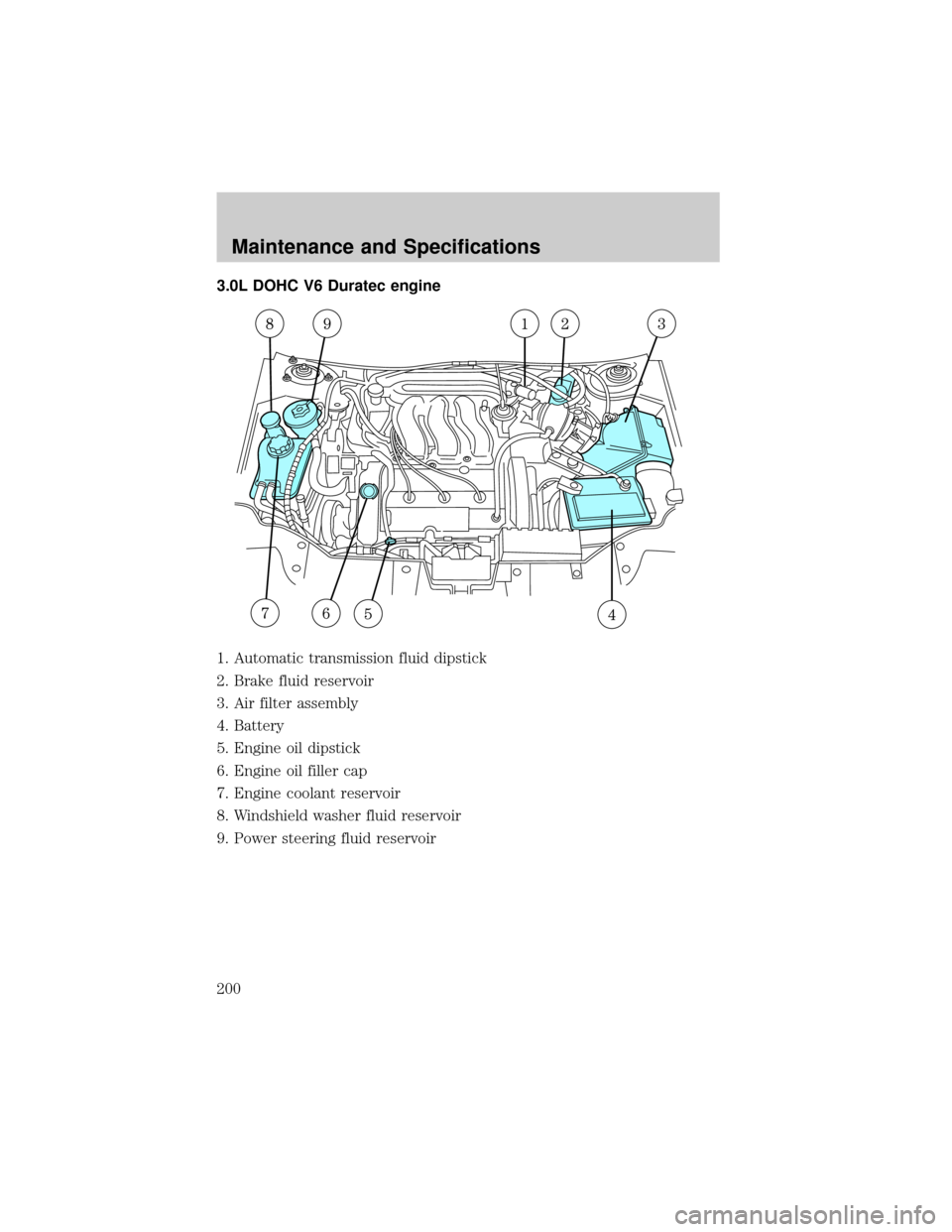
3.0L DOHC V6 Duratec engine
1. Automatic transmission fluid dipstick
2. Brake fluid reservoir
3. Air filter assembly
4. Battery
5. Engine oil dipstick
6. Engine oil filler cap
7. Engine coolant reservoir
8. Windshield washer fluid reservoir
9. Power steering fluid reservoir
Maintenance and Specifications
200
Page 224 of 248
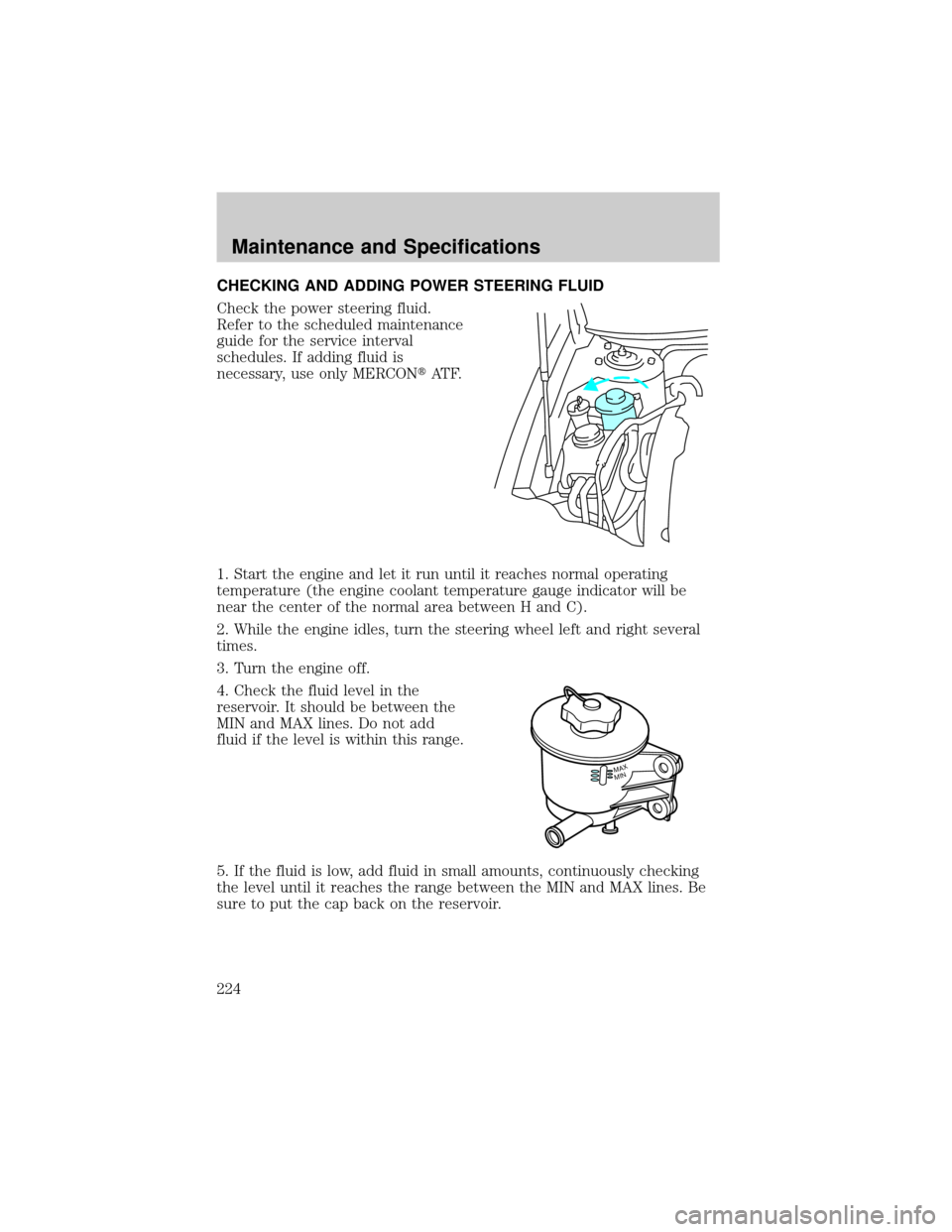
CHECKING AND ADDING POWER STEERING FLUID
Check the power steering fluid.
Refer to the scheduled maintenance
guide for the service interval
schedules. If adding fluid is
necessary, use only MERCONtAT F.
1. Start the engine and let it run until it reaches normal operating
temperature (the engine coolant temperature gauge indicator will be
near the center of the normal area between H and C).
2. While the engine idles, turn the steering wheel left and right several
times.
3. Turn the engine off.
4. Check the fluid level in the
reservoir. It should be between the
MIN and MAX lines. Do not add
fluid if the level is within this range.
5. If the fluid is low, add fluid in small amounts, continuously checking
the level until it reaches the range between the MIN and MAX lines. Be
sure to put the cap back on the reservoir.
MINMAX
Maintenance and Specifications
224
Page 233 of 248
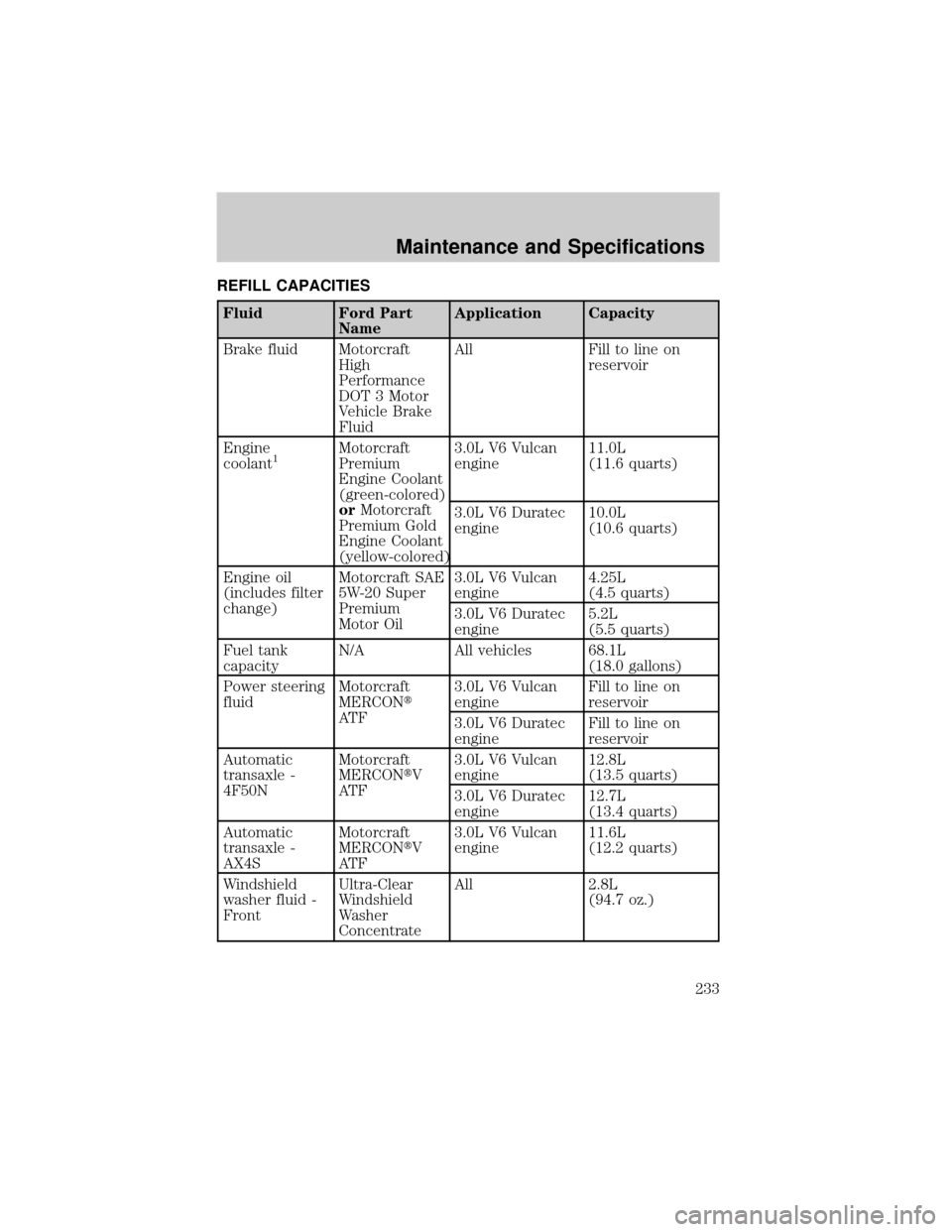
REFILL CAPACITIES
Fluid Ford Part
NameApplication Capacity
Brake fluid Motorcraft
High
Performance
DOT 3 Motor
Vehicle Brake
FluidAll Fill to line on
reservoir
Engine
coolant
1Motorcraft
Premium
Engine Coolant
(green-colored)
orMotorcraft
Premium Gold
Engine Coolant
(yellow-colored)3.0L V6 Vulcan
engine11.0L
(11.6 quarts)
3.0L V6 Duratec
engine10.0L
(10.6 quarts)
Engine oil
(includes filter
change)Motorcraft SAE
5W-20 Super
Premium
Motor Oil3.0L V6 Vulcan
engine4.25L
(4.5 quarts)
3.0L V6 Duratec
engine5.2L
(5.5 quarts)
Fuel tank
capacityN/A All vehicles 68.1L
(18.0 gallons)
Power steering
fluidMotorcraft
MERCONt
AT F3.0L V6 Vulcan
engineFill to line on
reservoir
3.0L V6 Duratec
engineFill to line on
reservoir
Automatic
transaxle -
4F50NMotorcraft
MERCONtV
AT F3.0L V6 Vulcan
engine12.8L
(13.5 quarts)
3.0L V6 Duratec
engine12.7L
(13.4 quarts)
Automatic
transaxle -
AX4SMotorcraft
MERCONtV
AT F3.0L V6 Vulcan
engine11.6L
(12.2 quarts)
Windshield
washer fluid -
FrontUltra-Clear
Windshield
Washer
ConcentrateAll 2.8L
(94.7 oz.)
Maintenance and Specifications
233