lock FORD TAURUS 2012 6.G Owners Manual
[x] Cancel search | Manufacturer: FORD, Model Year: 2012, Model line: TAURUS, Model: FORD TAURUS 2012 6.GPages: 406, PDF Size: 2.69 MB
Page 288 of 406
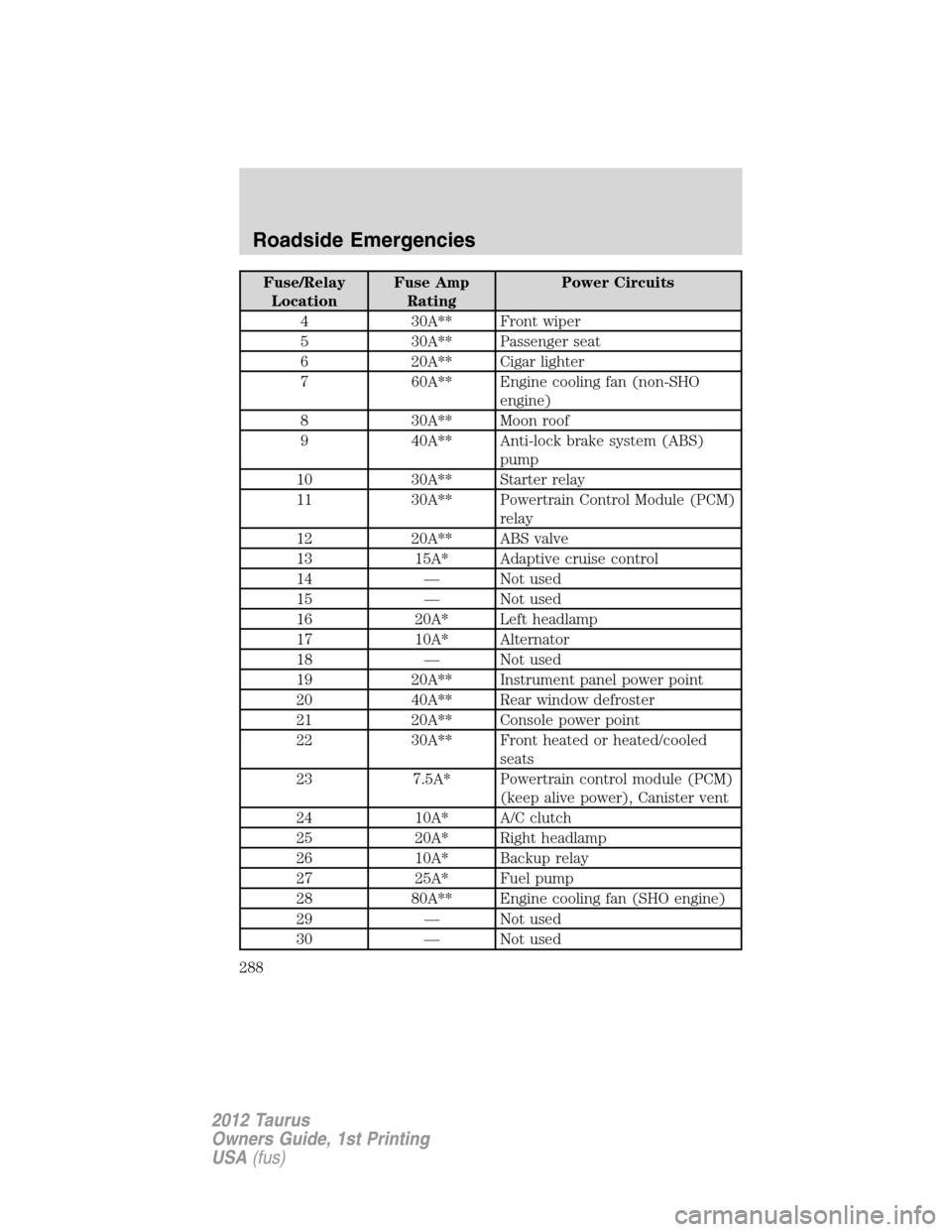
Fuse/Relay
LocationFuse Amp
RatingPower Circuits
4 30A** Front wiper
5 30A** Passenger seat
6 20A** Cigar lighter
7 60A** Engine cooling fan (non-SHO
engine)
8 30A** Moon roof
9 40A** Anti-lock brake system (ABS)
pump
10 30A** Starter relay
11 30A** Powertrain Control Module (PCM)
relay
12 20A** ABS valve
13 15A* Adaptive cruise control
14 — Not used
15 — Not used
16 20A* Left headlamp
17 10A* Alternator
18 — Not used
19 20A** Instrument panel power point
20 40A** Rear window defroster
21 20A** Console power point
22 30A** Front heated or heated/cooled
seats
23 7.5A* Powertrain control module (PCM)
(keep alive power), Canister vent
24 10A* A/C clutch
25 20A* Right headlamp
26 10A* Backup relay
27 25A* Fuel pump
28 80A** Engine cooling fan (SHO engine)
29 — Not used
30 — Not used
Roadside Emergencies
288
2012 Taurus
Owners Guide, 1st Printing
USA(fus)
Page 293 of 406
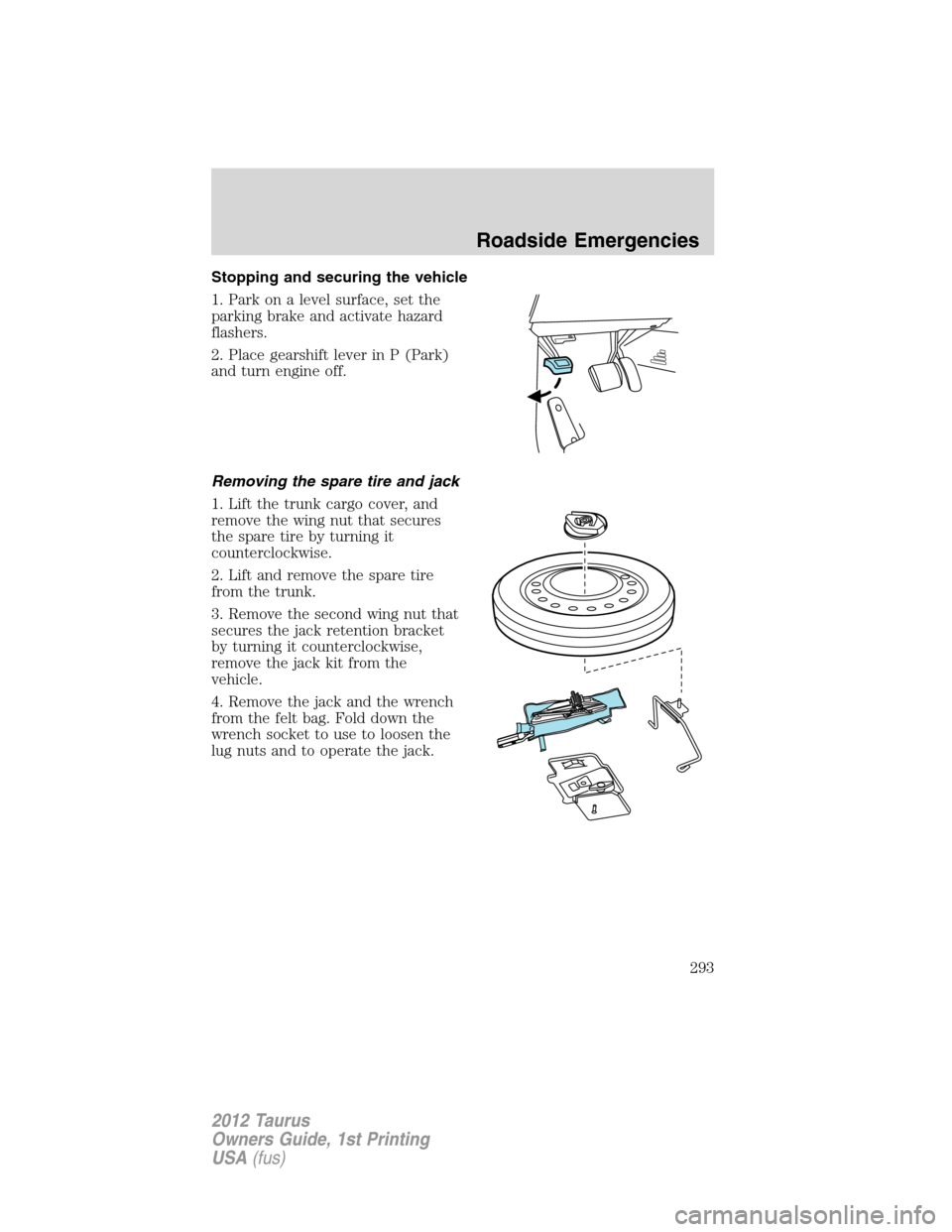
Stopping and securing the vehicle
1. Park on a level surface, set the
parking brake and activate hazard
flashers.
2. Place gearshift lever in P (Park)
and turn engine off.
Removing the spare tire and jack
1. Lift the trunk cargo cover, and
remove the wing nut that secures
the spare tire by turning it
counterclockwise.
2. Lift and remove the spare tire
from the trunk.
3. Remove the second wing nut that
secures the jack retention bracket
by turning it counterclockwise,
remove the jack kit from the
vehicle.
4. Remove the jack and the wrench
from the felt bag. Fold down the
wrench socket to use to loosen the
lug nuts and to operate the jack.
Roadside Emergencies
293
2012 Taurus
Owners Guide, 1st Printing
USA(fus)
Page 294 of 406
Tire change procedure
WARNING:When one of the front wheels is off the ground, the
transmission alone will not prevent the vehicle from moving or
slipping off the jack, even if the vehicle is in P (Park).
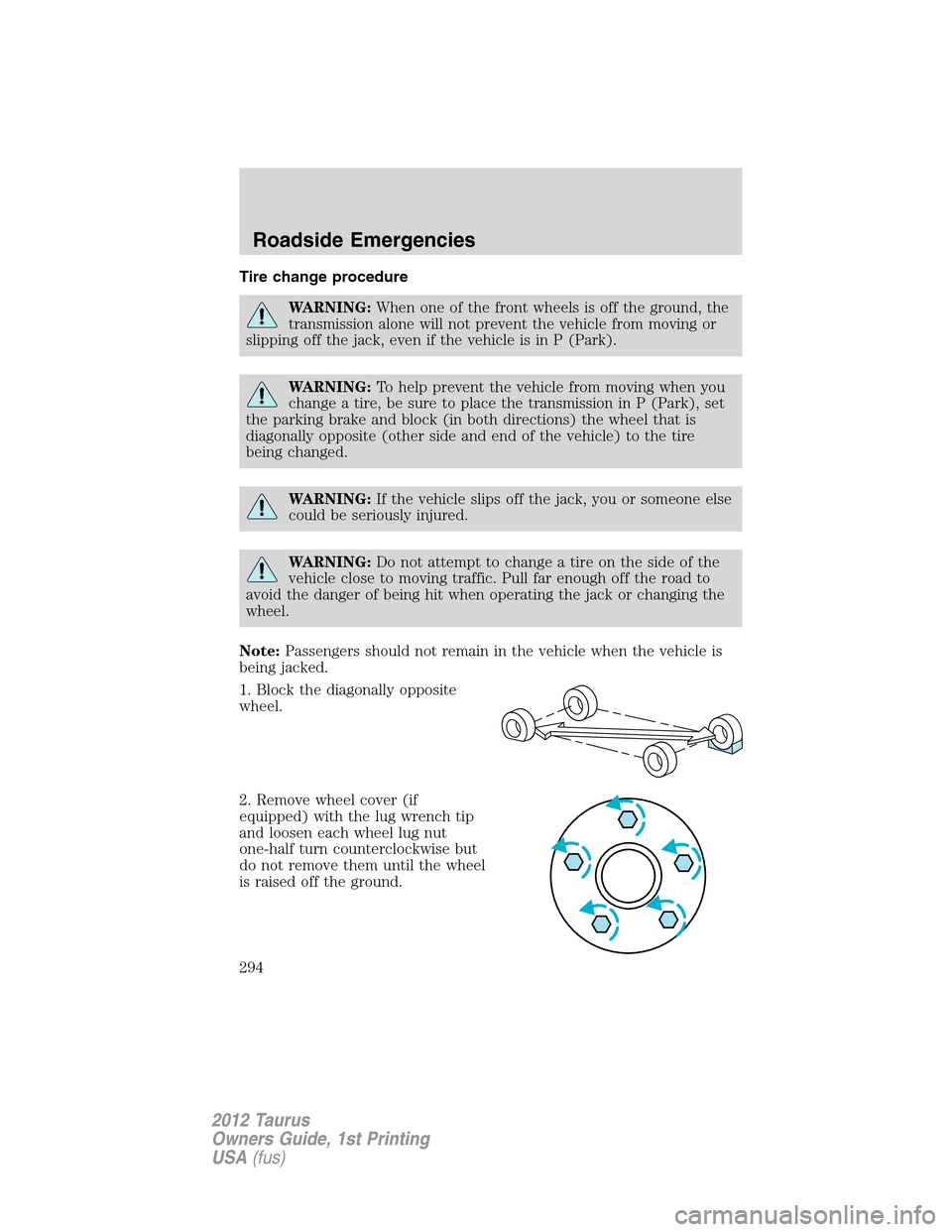
WARNING:To help prevent the vehicle from moving when you
change a tire, be sure to place the transmission in P (Park), set
the parking brake and block (in both directions) the wheel that is
diagonally opposite (other side and end of the vehicle) to the tire
being changed.
WARNING:If the vehicle slips off the jack, you or someone else
could be seriously injured.
WARNING:Do not attempt to change a tire on the side of the
vehicle close to moving traffic. Pull far enough off the road to
avoid the danger of being hit when operating the jack or changing the
wheel.
Note:Passengers should not remain in the vehicle when the vehicle is
being jacked.
1. Block the diagonally opposite
wheel.
2. Remove wheel cover (if
equipped) with the lug wrench tip
and loosen each wheel lug nut
one-half turn counterclockwise but
do not remove them until the wheel
is raised off the ground.
Roadside Emergencies
294
2012 Taurus
Owners Guide, 1st Printing
USA(fus)
Page 295 of 406
WARNING:To lessen the risk of personal injury, do not put any
part of your body under the vehicle while changing a tire. Do not
start the engine when your vehicle is on the jack. The jack is only
meant for changing the tire.
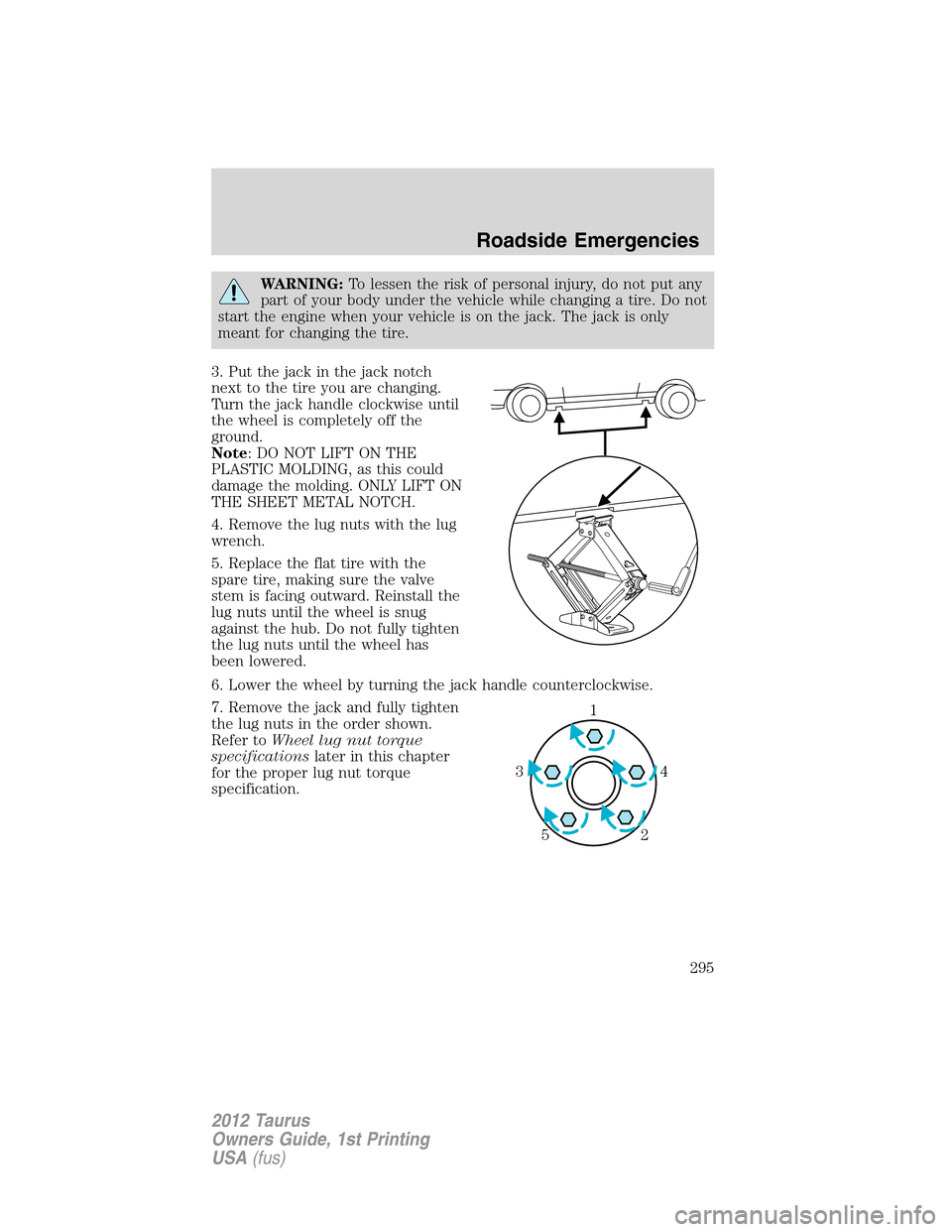
3. Put the jack in the jack notch
next to the tire you are changing.
Turn the jack handle clockwise until
the wheel is completely off the
ground.
Note: DO NOT LIFT ON THE
PLASTIC MOLDING, as this could
damage the molding. ONLY LIFT ON
THE SHEET METAL NOTCH.
4. Remove the lug nuts with the lug
wrench.
5. Replace the flat tire with the
spare tire, making sure the valve
stem is facing outward. Reinstall the
lug nuts until the wheel is snug
against the hub. Do not fully tighten
the lug nuts until the wheel has
been lowered.
6. Lower the wheel by turning the jack handle counterclockwise.
7. Remove the jack and fully tighten
the lug nuts in the order shown.
Refer toWheel lug nut torque
specificationslater in this chapter
for the proper lug nut torque
specification.
1
4 3
2 5
Roadside Emergencies
295
2012 Taurus
Owners Guide, 1st Printing
USA(fus)
Page 300 of 406
•When inflating a tire or other objects, use the black air hose only. Do
not use the transparent hose which is designed for sealant application
only.
•Operating the temporary mobility kit could cause an electrical
disturbance in radio, CD, and DVD player operation (if equipped).
What to do when a tire is punctured
A tire puncture within the tire’s tread area can be repaired in two stages
with the temporary mobility kit:
•In the first stage, the tire will be reinflated with a sealing compound
and air. After the tire has been reinflated, you will need to drive the
vehicle a short distance (approximately 4 miles [6 km]) to distribute
the sealant in the tire.
•In the second stage, you will need to check the tire pressure and
adjust, if necessary, to the vehicle’s tire inflation pressure.
First stage: Reinflating the tire with sealing compound and air
Preparation
Park the vehicle in a safe, level and secure area, away from moving
traffic. Turn the hazard lights on. Apply the parking brake and turn the
engine off. Inspect the flat tire for visible damage.
Sealant compound contains latex. To avoid any allergic reactions, use the
non-latex gloves located in the accessory box on the underside of the
temporary mobility kit housing.
Do not remove any foreign object that has pierced the tire. If a puncture
is located in the tire sidewall, stop and call roadside assistance.
1. Remove the valve cap from the tire valve.
2. Unwrap the clear tube from the compressor housing.
3. Remove the tube cap and fasten the metal connector of the tube to
the tire valve, turning clockwise. Make sure the connection is tightly
fastened.
Roadside Emergencies
300
2012 Taurus
Owners Guide, 1st Printing
USA(fus)
Page 301 of 406
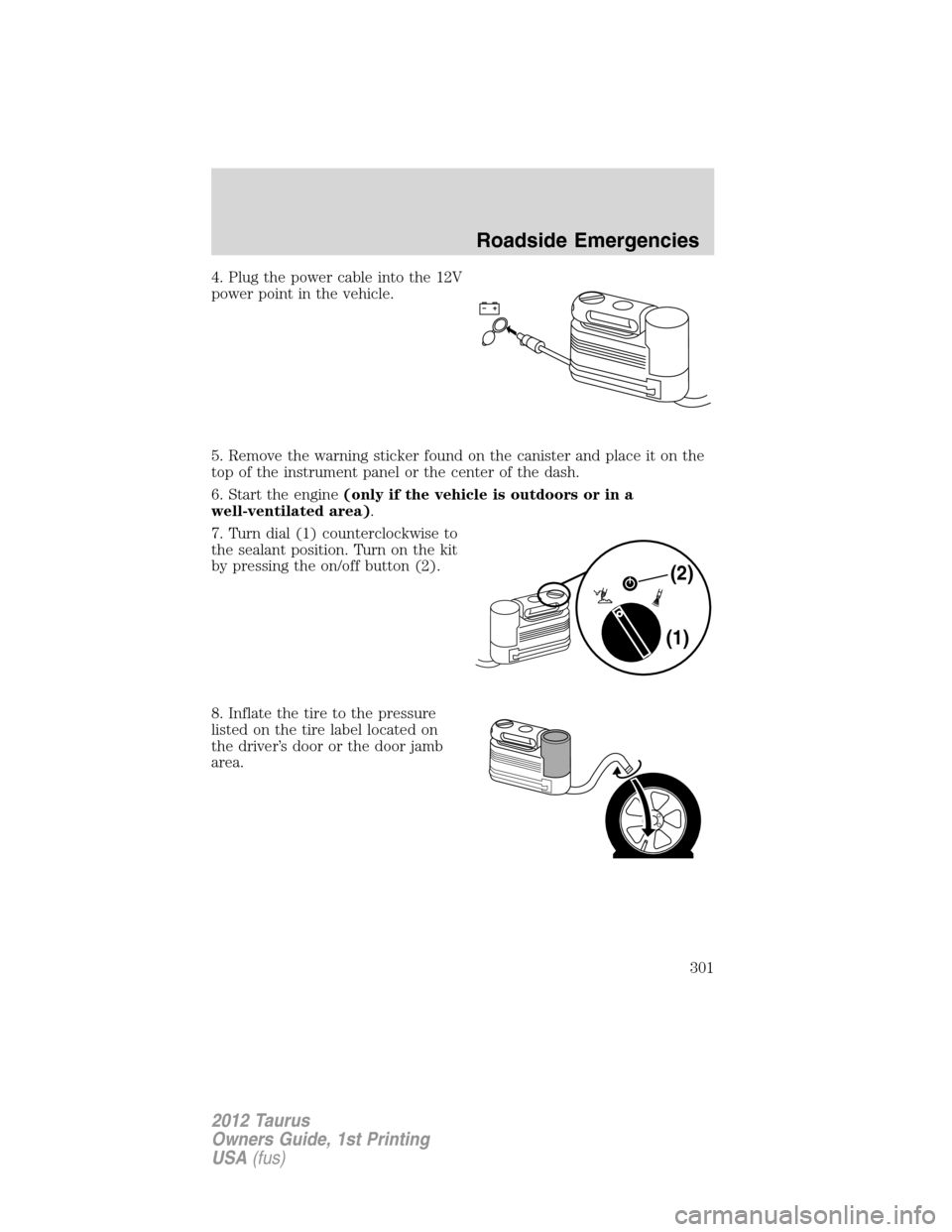
4. Plug the power cable into the 12V
power point in the vehicle.
5. Remove the warning sticker found on the canister and place it on the
top of the instrument panel or the center of the dash.
6. Start the engine(only if the vehicle is outdoors or in a
well-ventilated area).
7. Turn dial (1) counterclockwise to
the sealant position. Turn on the kit
by pressing the on/off button (2).
8. Inflate the tire to the pressure
listed on the tire label located on
the driver’s door or the door jamb
area.
(2)
(1)
Roadside Emergencies
301
2012 Taurus
Owners Guide, 1st Printing
USA(fus)
Page 302 of 406
Note: When the sealing compound is first added into the tire, the
air pressure gauge reading on the compressor unit may indicate a
higher value; this is normal and should be no reason for concern.
The pressure will drop after about 30 seconds of operation. The
tire pressure has to be checked with the compressor in the OFF
position to get the correct tire pressure reading.
WARNING:Do not stand directly over the temporary mobility
kit while inflating the tire. If you notice any unusual bulges or
deformations in the tire’s sidewall during inflation, stop and call
roadside assistance.
WARNING:If the tire doesn’t inflate to the recommended tire
pressure within 15 minutes, stop and call roadside assistance.
9. When the recommended tire pressure is reached, turn off the kit by
pressing the on/off button; disconnect the kit from the tire valve and the
power point. Re-install the valve cap on the tire valve, place the tube cap
on the metal connector, and return the kit to the stowage area.
10.Immediately and cautiously, drive the vehicle 4 miles (6 km)
to distribute the sealant evenly inside the tire. Do not exceed
50 mph (80 km/h).
Note:If you experience any unusual vibration, ride disturbance or
noise while driving, reduce your speed until you can safely pull off to
the side of the road to call for roadside assistance.Do not proceed
to the second stage of this operation.
11. After 4 miles (6 km), stop and check the tire pressure. SeeSecond
stage: Checking tire pressure.
Second stage: Checking tire pressure
Check the air pressure of your tires as follows:
1. Remove the valve cap from the tire valve.
2. Unhook the black hose from the side of the compressor and fasten
firmly on the valve stem by turning clockwise.
WARNING:If you are proceeding from theFirst stage:
Reinflating the tire with sealing compound and airsection
and have injected sealant in the tire and the pressure is below 20 psi
(1.4 bar),stop and call roadside assistance.If tire pressure is
above 20 psi (1.4 bar), continue to the next step.
Roadside Emergencies
302
2012 Taurus
Owners Guide, 1st Printing
USA(fus)
Page 303 of 406
3. Turn the dial clockwise to the air position. Turn on the kit by pressing
the on/off button.
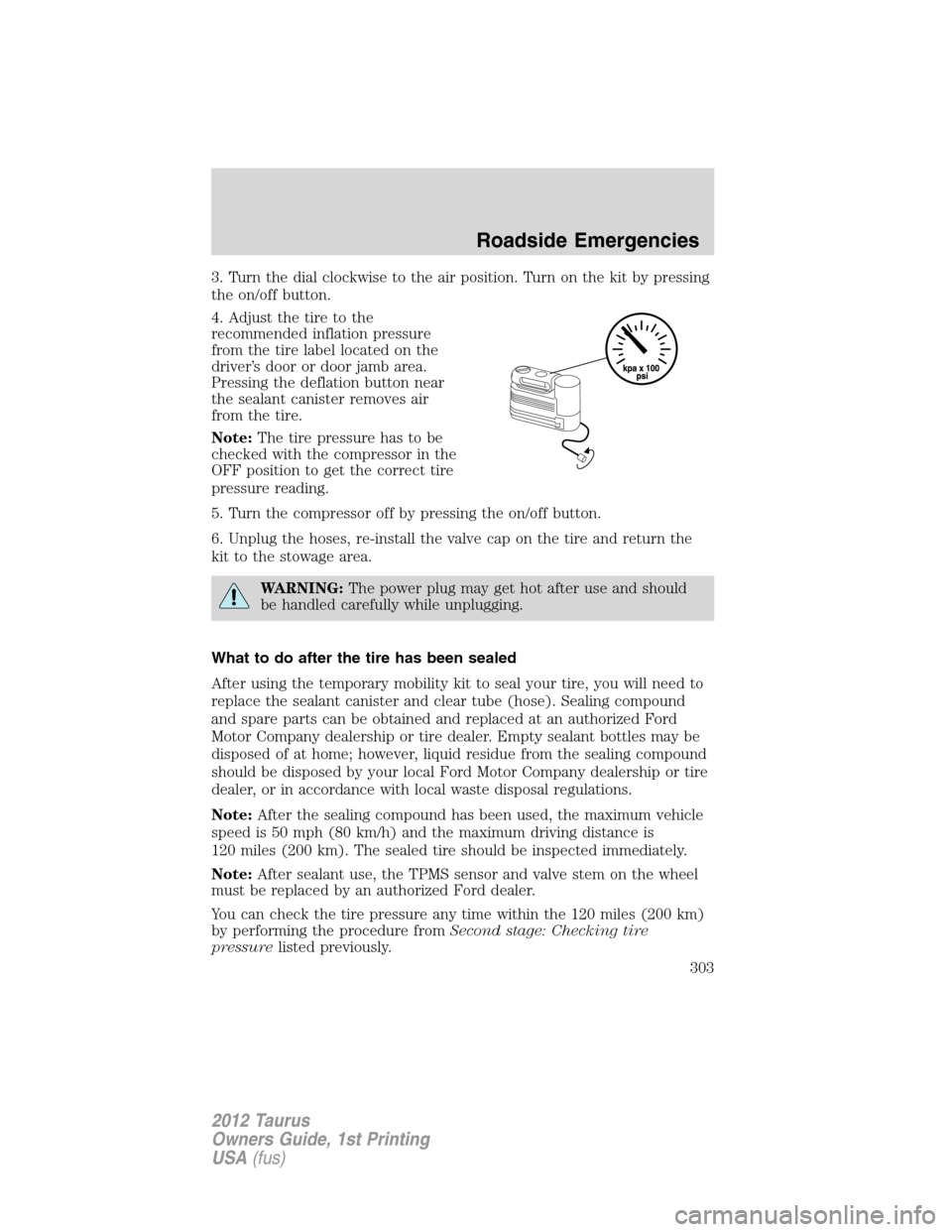
4. Adjust the tire to the
recommended inflation pressure
from the tire label located on the
driver’s door or door jamb area.
Pressing the deflation button near
the sealant canister removes air
from the tire.
Note:The tire pressure has to be
checked with the compressor in the
OFF position to get the correct tire
pressure reading.
5. Turn the compressor off by pressing the on/off button.
6. Unplug the hoses, re-install the valve cap on the tire and return the
kit to the stowage area.
WARNING:The power plug may get hot after use and should
be handled carefully while unplugging.
What to do after the tire has been sealed
After using the temporary mobility kit to seal your tire, you will need to
replace the sealant canister and clear tube (hose). Sealing compound
and spare parts can be obtained and replaced at an authorized Ford
Motor Company dealership or tire dealer. Empty sealant bottles may be
disposed of at home; however, liquid residue from the sealing compound
should be disposed by your local Ford Motor Company dealership or tire
dealer, or in accordance with local waste disposal regulations.
Note:After the sealing compound has been used, the maximum vehicle
speed is 50 mph (80 km/h) and the maximum driving distance is
120 miles (200 km). The sealed tire should be inspected immediately.
Note:After sealant use, the TPMS sensor and valve stem on the wheel
must be replaced by an authorized Ford dealer.
You can check the tire pressure any time within the 120 miles (200 km)
by performing the procedure fromSecond stage: Checking tire
pressurelisted previously.
Roadside Emergencies
303
2012 Taurus
Owners Guide, 1st Printing
USA(fus)
Page 311 of 406
If the vehicle is towed by other means or incorrectly, vehicle
damage may occur.
Ford Motor Company produces a towing manual for all authorized tow
truck operators. Have your tow truck operator refer to this manual for
proper hook-up and towing procedures for your vehicle.
Emergency towing
In case of a roadside emergency with a disabled vehicle (without access
to wheel dollies, car hauling trailer, or flatbed transport vehicle) your
vehicle (regardless of transmission powertrain configuration) can be flat
towed (all wheels on the ground) under the following conditions:
•Vehicle is facing forward so that it is being towed in a forward
direction.
•Place the transmission in N (Neutral). Refer toBrake-shift interlock
in theDrivingchapter for specific instructions if you cannot move the
gear shift lever into N (Neutral).
•Maximum speed is not to exceed 35 mph (56 km/h).
•Maximum distance is 50 miles (80 km).
Roadside Emergencies
311
2012 Taurus
Owners Guide, 1st Printing
USA(fus)
Page 322 of 406
ENGINE
Engines are more efficient when they are clean because grease and dirt
buildup keep the engine warmer than normal. When washing:
•Take care when using a power washer to clean the engine. The
high-pressure fluid could penetrate the sealed parts and cause
damage.
•Do not spray a hot engine with cold water to avoid cracking the
engine block or other engine components.
•Spray Motorcraft Engine Shampoo and Degreaser (ZC-20) on all parts
that require cleaning and pressure rinse clean. In Canada use
Motorcraft Engine Shampoo (CXC-66-A).
•Never wash or rinse the engine while it is hot or running; water in the
running engine may cause internal damage.
•Never wash or rinse any ignition coil, spark plug wire or spark plug
well, or the area in and around these locations.
•Cover the highlighted areas to prevent water damage when cleaning
the engine.
Cleaning
322
2012 Taurus
Owners Guide, 1st Printing
USA(fus)