climate control FORD TRANSIT 2015 5.G Owners Manual
[x] Cancel search | Manufacturer: FORD, Model Year: 2015, Model line: TRANSIT, Model: FORD TRANSIT 2015 5.GPages: 461, PDF Size: 5.82 MB
Page 5 of 461
Lighting
General Information.....................................66
Lighting C
ontrol..............................................66
Autolamps........................................................67
Instrument Lighting Dimmer.....................
68
Daytime Running Lamps............................
68
Direction Indicators.......................................
69
Interior Lamps.................................................69
W
indows and Mirrors
Power Windows..............................................
70
Exterior Mirrors..................................................71
Interior Mirror.....................................................71
Rear Quarter Windows
.................................72
Instrument Cluster
Gauges................................................................73
Warning Lamps and Indicators.................75
Audible Warnings and Indicators
..............77
Information Displays
General Information
......................................79
Trip Computer.................................................
82
Personalized Settings..................................
83
Information Messages.................................84
Climate Control
Principle of Operation..................................89
Air Vents............................................................89
Manual Climate Control..............................90
Hints on Controlling the Interior Climate...........................................................91
Rear Passenger Climate Controls............93
Heated Windows and Mirrors....................93
S
eats
Sitting in the Correct Position...................95
Head Restraints..............................................95
Manual Seats...................................................
97 Power Seats.....................................................98
R
ear Seats........................................................
99
Auxiliary Power Points
Auxiliary Power Points................................103
Cigar Lighter
...................................................104
Storage Compartments
Cup Holders....................................................105
Ov
erhead Console.......................................
105
Bottle Holder..................................................
105
Starting and Stopping the Engine
General Information....................................106
Ignition Switch..............................................106
Starting a Gasoline Engine
.......................106
Starting a Diesel Engine.............................107
Diesel Particulate Filter..............................108
Switching Off the Engine
..........................109
Engine Block Heater....................................109
Fuel and Refueling
Safety Precautions.........................................111
Fuel Quality - Gasoline................................112
Fuel Quality - Diesel
......................................113
Running Out of Fuel......................................115
Catalytic Converter.......................................116
Selective Catalytic Reduction System...........................................................117
Refueling..........................................................120
Fuel Consumption........................................122
Emission Control System...........................122
Transmission
Automatic Transmission
............................133
Brakes
General Information.....................................137
2 Transit (TTH) Canada/United States of America, enUSA, Edition date: 03/2014 Table of Contents
Page 92 of 461
PRINCIPLE OF OPERATION
Outside Air
Keep the air intakes in front of the
windshield free from obstruction (such as
snow or leaves) to allow the climate
control system to function effectively.
Recirculated Air
WARNING
Prolonged use of recirculated air may
cause the windows to mist up. If the
windows mist up, follow the settings
for demisting the windshield. The air currently in the passenger
compartment recirculates. Outside air does
not enter your vehicle.
Heating
Heating performance depends on the
temperature of the engine coolant.
General Information on Controlling
the Interior Climate
Fully close all the windows.
Warming the Interior
Direct the air toward your feet. In cold or
humid weather conditions, direct some of
the air toward the windshield and the door
windows.
Cooling the Interior
Direct the air toward your face. Air Conditioning
The system directs air through the
evaporator for cooling. The evaporator
extracts humidity from the air to help keep
the windows free of mist. The system
directs the resulting condensation to the
outside of your vehicle, which may cause
a small pool to form under your vehicle.
This is normal.
Note:
The air conditioning operates only
when the temperature is above 39°F (4°C).
Note: When you use air conditioning, your
vehicle uses more fuel.
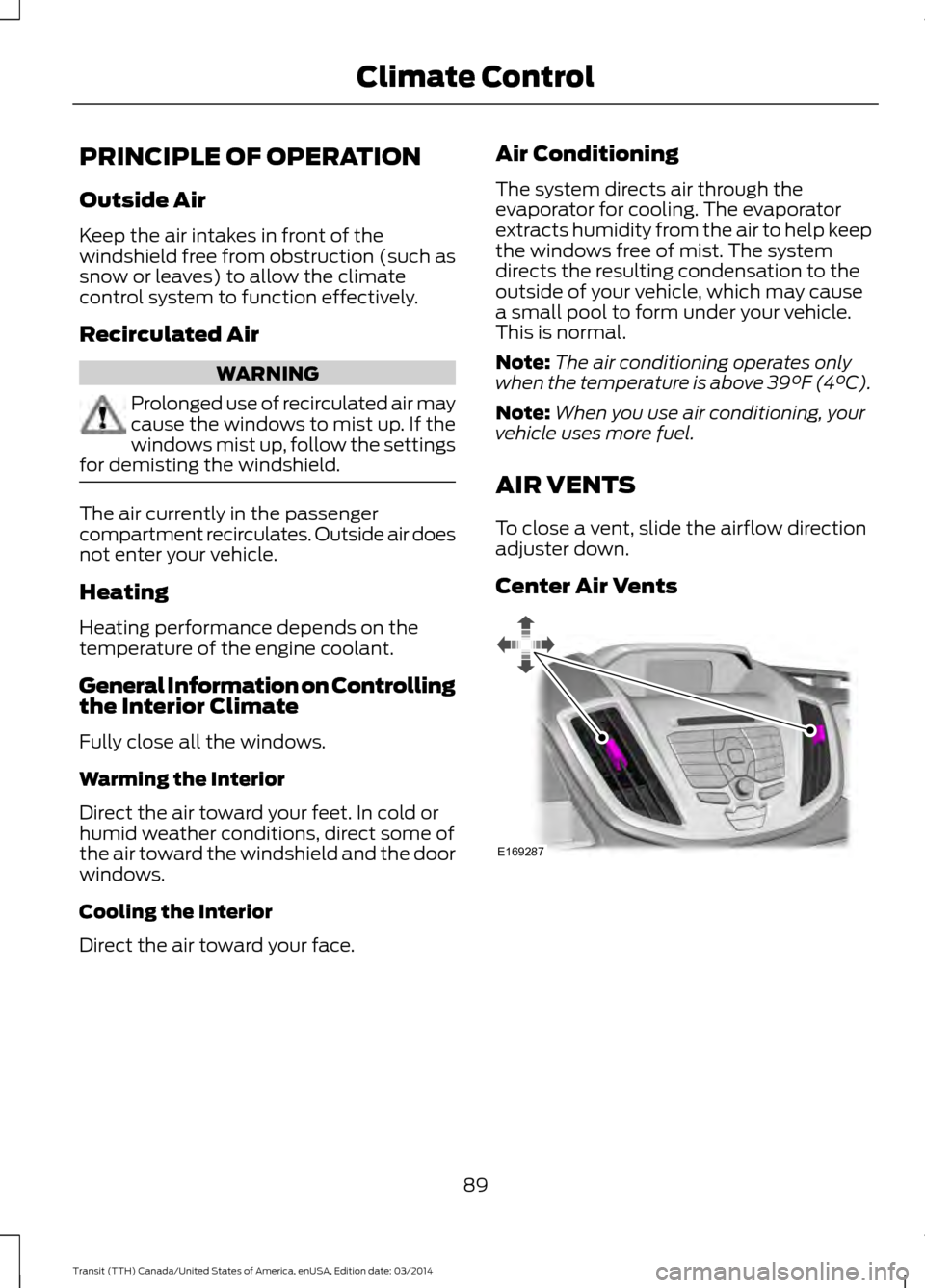
AIR VENTS
To close a vent, slide the airflow direction
adjuster down.
Center Air Vents 89
Transit (TTH) Canada/United States of America, enUSA, Edition date: 03/2014 Climate ControlE169287
Page 93 of 461
Side Air Vent
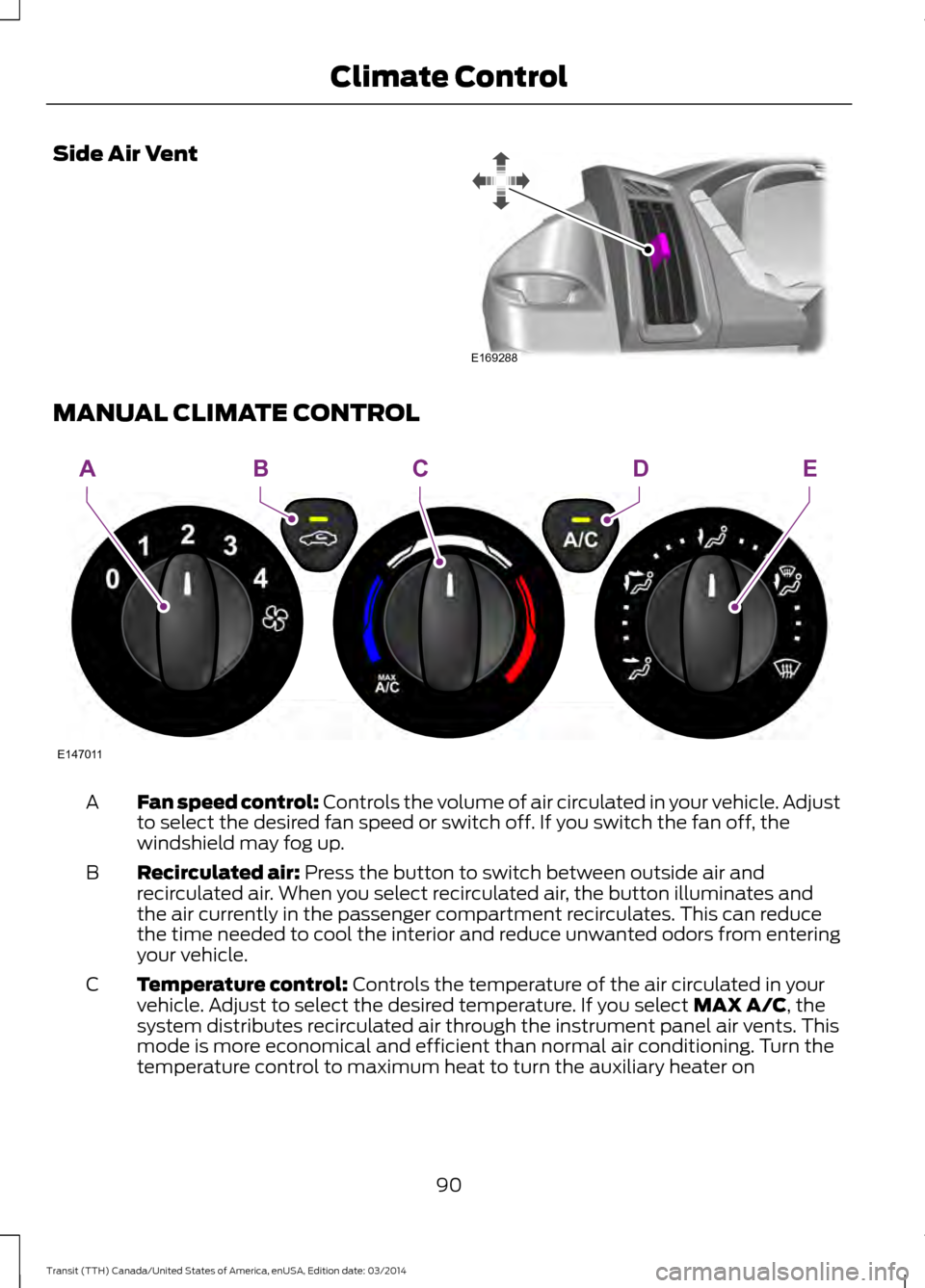
MANUAL CLIMATE CONTROL
Fan speed control: Controls the volume of air circulated in your vehicle. Adjust
to select the desired fan speed or switch off. If you switch the fan off, the
windshield may fog up.
A
Recirculated air: Press the button to switch between outside air and
recirculated air. When you select recirculated air, the button illuminates and
the air currently in the passenger compartment recirculates. This can reduce
the time needed to cool the interior and reduce unwanted odors from entering
your vehicle.
B
Temperature control: Controls the temperature of the air circulated in your
vehicle. Adjust to select the desired temperature. If you select MAX A/C, the
system distributes recirculated air through the instrument panel air vents. This
mode is more economical and efficient than normal air conditioning. Turn the
temperature control to maximum heat to turn the auxiliary heater on
C
90Transit (TTH) Canada/United States of America, enUSA, Edition date: 03/2014 Climate ControlE169288 E147011
AEBDC
Page 94 of 461
Air conditioning: Press the button to switch the air conditioning on or off. To
improve air conditioning when starting your vehicle, drive with the windows
open for two to three minutes.
D
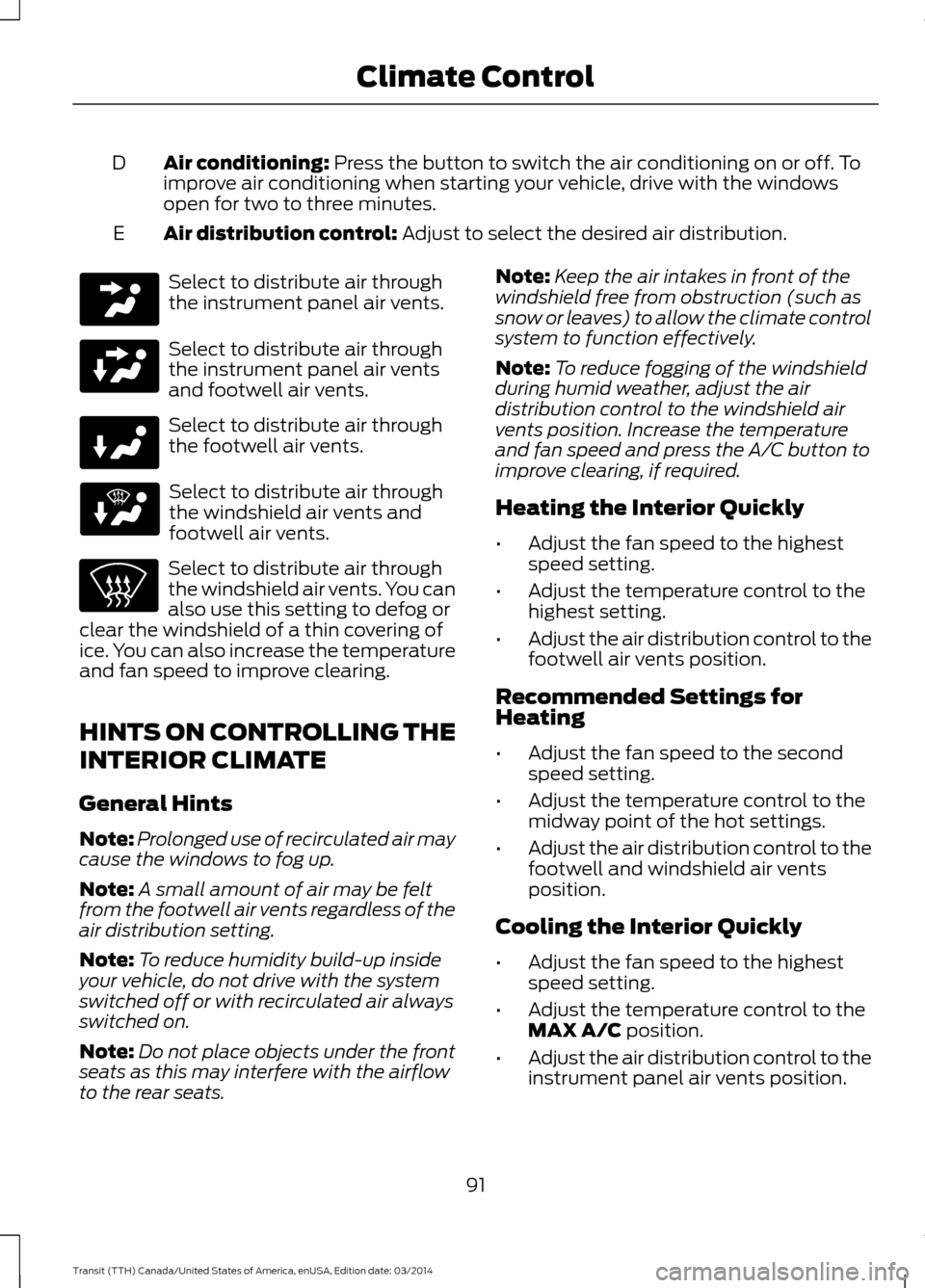
Air distribution control:
Adjust to select the desired air distribution.
E Select to distribute air through
the instrument panel air vents.
Select to distribute air through
the instrument panel air vents
and footwell air vents.
Select to distribute air through
the footwell air vents.
Select to distribute air through
the windshield air vents and
footwell air vents.
Select to distribute air through
the windshield air vents. You can
also use this setting to defog or
clear the windshield of a thin covering of
ice. You can also increase the temperature
and fan speed to improve clearing.
HINTS ON CONTROLLING THE
INTERIOR CLIMATE
General Hints
Note: Prolonged use of recirculated air may
cause the windows to fog up.
Note: A small amount of air may be felt
from the footwell air vents regardless of the
air distribution setting.
Note: To reduce humidity build-up inside
your vehicle, do not drive with the system
switched off or with recirculated air always
switched on.
Note: Do not place objects under the front
seats as this may interfere with the airflow
to the rear seats. Note:
Keep the air intakes in front of the
windshield free from obstruction (such as
snow or leaves) to allow the climate control
system to function effectively.
Note: To reduce fogging of the windshield
during humid weather, adjust the air
distribution control to the windshield air
vents position. Increase the temperature
and fan speed and press the A/C button to
improve clearing, if required.
Heating the Interior Quickly
• Adjust the fan speed to the highest
speed setting.
• Adjust the temperature control to the
highest setting.
• Adjust the air distribution control to the
footwell air vents position.
Recommended Settings for
Heating
• Adjust the fan speed to the second
speed setting.
• Adjust the temperature control to the
midway point of the hot settings.
• Adjust the air distribution control to the
footwell and windshield air vents
position.
Cooling the Interior Quickly
• Adjust the fan speed to the highest
speed setting.
• Adjust the temperature control to the
MAX A/C position.
• Adjust the air distribution control to the
instrument panel air vents position.
91 Transit (TTH) Canada/United States of America, enUSA, Edition date: 03/2014 Climate Control
Page 95 of 461
Recommended Settings for
Cooling
•
Adjust the fan speed to the second
speed setting.
• Adjust the temperature control to the
midway point of the cold settings.
• Adjust the air distribution control to the
instrument panel air vents position.
Vehicle Stationary for Extended
Periods During Extreme High
Ambient Temperatures
• Apply the parking brake.
• Move the transmission selector lever
to position P or neutral.
• Adjust the temperature control to the
MAX A/C position.
• Adjust the fan speed to the lowest
speed setting. Side Window Defogging in Cold
Weather
•
Adjust the air distribution control to the
instrument panel and windshield air
vents positions.
• Press the
A/C button.
• Adjust the temperature control to the
desired setting.
• Adjust the fan speed to the highest
setting.
• Direct the instrument panel side air
vents toward the side windows.
• Close the instrument panel vents.
Maximum Cooling Performance in
Instrument Panel or Instrument
Panel and Footwell Positions
• Adjust the temperature control to the
lowest setting.
• Press the
A/C and recirculated air
buttons.
• Adjust the fan speed to the highest
setting initially and then adjust it to suit
the desired comfort level.
92 Transit (TTH) Canada/United States of America, enUSA, Edition date: 03/2014 Climate Control
Page 96 of 461
REAR PASSENGER CLIMATE CONTROLS
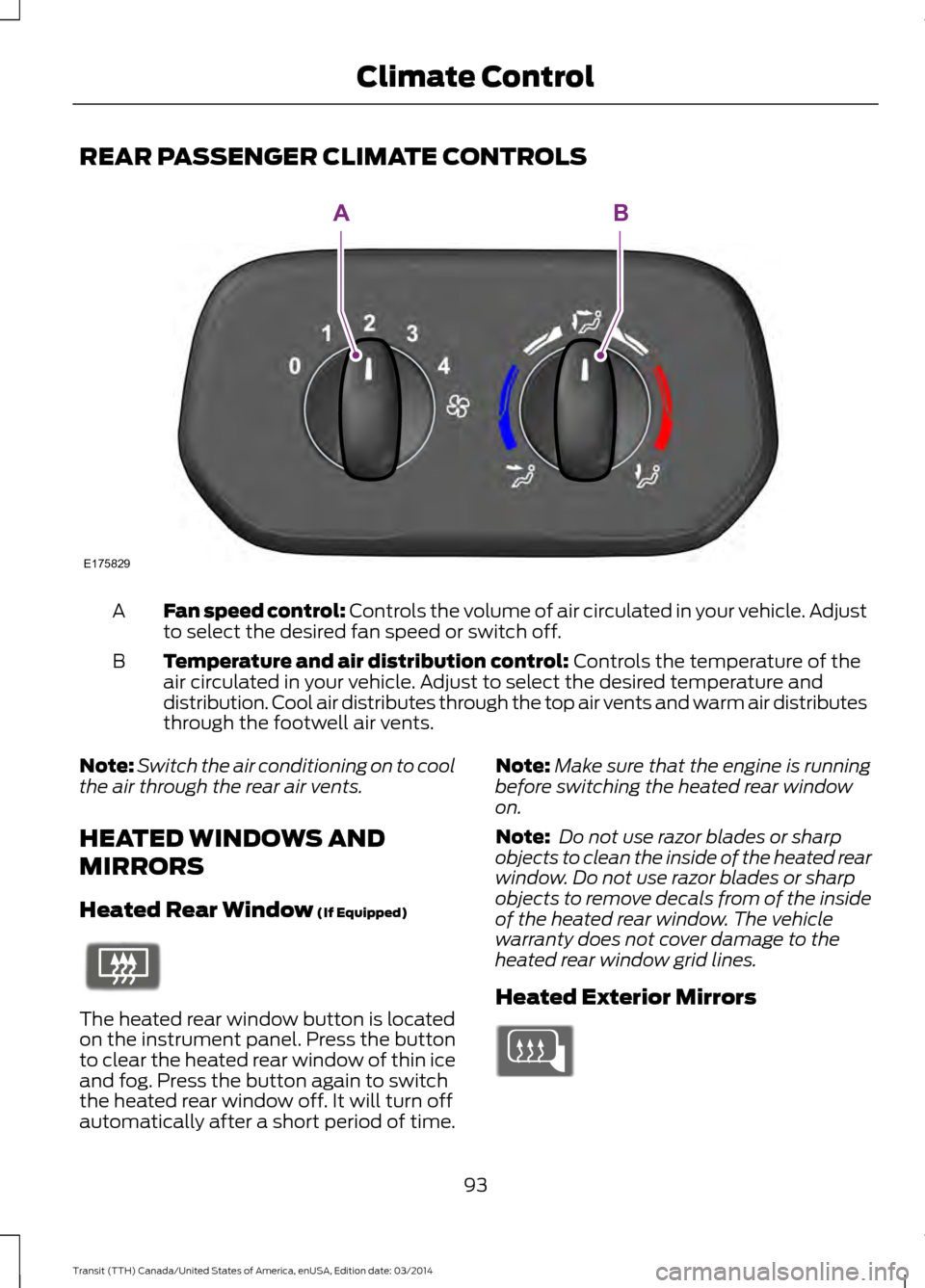
Fan speed control: Controls the volume of air circulated in your vehicle. Adjust
to select the desired fan speed or switch off.
A
Temperature and air distribution control:
Controls the temperature of the
air circulated in your vehicle. Adjust to select the desired temperature and
distribution. Cool air distributes through the top air vents and warm air distributes
through the footwell air vents.
B
Note: Switch the air conditioning on to cool
the air through the rear air vents.
HEATED WINDOWS AND
MIRRORS
Heated Rear Window
(If Equipped) The heated rear window button is located
on the instrument panel. Press the button
to clear the heated rear window of thin ice
and fog. Press the button again to switch
the heated rear window off. It will turn off
automatically after a short period of time. Note:
Make sure that the engine is running
before switching the heated rear window
on.
Note: Do not use razor blades or sharp
objects to clean the inside of the heated rear
window. Do not use razor blades or sharp
objects to remove decals from of the inside
of the heated rear window. The vehicle
warranty does not cover damage to the
heated rear window grid lines.
Heated Exterior Mirrors 93
Transit (TTH) Canada/United States of America, enUSA, Edition date: 03/2014 Climate ControlE175829
AB E72507
Page 97 of 461
The heated exterior mirrors will clear the
mirror glass of thin ice and fog. They will
turn off automatically after a short period
of time.
Note:
Do not use razor blades or sharp
objects to remove ice from the mirror glass
or attempt to adjust the mirror glass when
it is frozen in place. The vehicle warranty
does not cover damage to the mirror glass
or mirror assembly.
Note: Do not clean the mirror glass or mirror
assembly with harsh abrasives, fuel or other
petroleum-based cleaning products.
Note: On vehicles without a heated exterior
mirror switch, they will turn on automatically
when you switch the heated rear window
on.
94Transit (TTH) Canada/United States of America, enUSA, Edition date: 03/2014 Climate Control
Page 110 of 461
When you start the engine, the idle speed
increases, this helps to warm up the
engine. If the engine idle speed does not
slow down automatically, have your
vehicle checked by an authorized dealer.
Note:
You can only operate the starter for
a limited period of time, for example 10
seconds. The number of start attempts is
limited to approximately six. If you exceed
this limit, the system will not allow you to
try again until a period of time has elapsed,
for example 30 minutes.
1. Fully press the brake pedal.
2. Turn the ignition key to position II to
switch the ignition on.
3. Turn the ignition key to position
III to
start your vehicle. Release the key
when the engine starts.
Note: Do not touch the accelerator pedal.
Engine Idle Speed after Starting
The speed at which the engine idles
immediately after starting will adjust
automatically to minimize vehicle
emissions and maximize cabin comfort
and fuel economy.
The idle speed will vary depending on
certain factors. These include vehicle
component and ambient temperatures as
well as electrical and climate system
demands.
Cold or Hot Engine
If the engine does not start within 10
seconds, wait for a short period and try
again.
If the engine does not start after three
attempts, wait 10 seconds and follow the
flooded engine procedure.
If you have difficulty starting the engine
when the temperature is below -13°F
(-25°C), press the accelerator pedal to the
mid-way point of its travel and try again. Flooded Engine
1. Move the transmission selector lever
to position
P.
2. Fully depress the accelerator pedal and
hold it there.
3. Start the engine.
Note: If the engine does not start, repeat
the cold or hot engine procedure.
STARTING A DIESEL ENGINE WARNINGS
Do not use starting fluid, for example
ether, in the air intake system (see
air filter decal). Starting fluids could
cause immediate explosive damage to the
engine. Failure to follow this warning could
result in fire, serious personal injury or
death. Do not add gasoline, gasohol, alcohol
or Kerosene to diesel fuel. This action
creates a serious fire hazard and will
result in poor engine performance. Engine
damage caused by the use of incorrect fuel
is not covered by the vehicle warranty. Note:
Avoid shutting the engine down after
an extensive idling period. Drive your vehicle
for several miles with the engine at normal
operating temperatures under a moderate
load.
Engine Glow Plugs The powertrain control and glow plug
control modules operate the glow plug
system. When you switch the ignition on
the glow plug control module immediately
energizes the glow plugs. The glow plug
control module using the engine coolant
temperature, barometric pressure sensor
107 Transit (TTH) Canada/United States of America, enUSA, Edition date: 03/2014Starting and Stopping the Engine
Page 113 of 461

WARNINGS
Do not use your heater with
ungrounded electrical systems or
two-pronged adapters. There is a risk
of electrical shock. Note:
The heater is most effective when
outdoor temperatures are below 0°F
(-18°C).
The heater acts as a starting aid by
warming the engine coolant. This allows
the climate control system to respond
quickly. The equipment includes a heater
element (installed in the engine block) and
a wire harness. You can connect the
system to a grounded 120-volt AC
electrical source.
We recommend that you do the following
for a safe and correct operation:
• Use a 16-gauge outdoor extension cord
that is product certified by
Underwriter ’s Laboratory (UL) or
Canadian Standards Association
(CSA). This extension cord must be
suitable for use outdoors, in cold
temperatures, and be clearly marked
Suitable for Use with Outdoor
Appliances. Do not use an indoor
extension cord outdoors. This could
result in an electric shock or become a
fire hazard.
• Use as short an extension cord as
possible.
• Do not use multiple extension cords.
• Make sure that when in operation, the
extension cord plug and heater cord
plug connections are free and clear of
water. This could cause an electric
shock or fire.
• Make sure your vehicle is parked in a
clean area, clear of combustibles.
• Make sure the heater, heater cord and
extension cord are firmly connected. •
Check for heat anywhere in the
electrical hookup once the system has
been operating for approximately 30
minutes.
• Make sure the system is unplugged and
properly stowed before driving your
vehicle. Make sure the protective cover
seals the prongs of the block heater
cord plug when not in use.
• Make sure the heater system is
checked for proper operation before
winter.
Using the Engine Block Heater
Make sure the receptacle terminals are
clean and dry prior to use. Clean them with
a dry cloth if necessary.
The heater uses 0.4 to 1.0 kilowatt-hours
of energy per hour of use. The system does
not have a thermostat. It achieves
maximum temperature after
approximately three hours of operation.
Using the heater longer than three hours
does not improve system performance and
unnecessarily uses electricity.
110 Transit (TTH) Canada/United States of America, enUSA, Edition date: 03/2014Starting and Stopping the Engine
Page 175 of 461
Your vehicle cannot be flat-towed with all
wheels on the ground beyond the limits
set out above as vehicle or transmission
damage may occur. See Emergency
Towing. You must place your vehicle on
a car-hauling trailer, or place the front
wheels of your vehicle on a tow dolly. If you
are using a tow dolly, follow the
instructions specified by the equipment
provider.
Note: Put your vehicle's climate control
system in recirculated air mode to prevent
exhaust fumes from entering the vehicle.
See
Climate Control (page 89).
172Transit (TTH) Canada/United States of America, enUSA, Edition date: 03/2014 Towing