washer fluid FORD TRANSIT 2015 5.G Owners Manual
[x] Cancel search | Manufacturer: FORD, Model Year: 2015, Model line: TRANSIT, Model: FORD TRANSIT 2015 5.GPages: 461, PDF Size: 5.82 MB
Page 7 of 461
Engine Oil Dipstick - 3.5L.........................204
Engine Oil Dipstick - 3.7L..........................204
Engine Oil Dipstick - 3.2L Power Stroke
Diesel...........................................................204
Engine Oil Check..........................................204
Changing the Engine Oil and Oil Filter.............................................................205
Engine Coolant Check
...............................206
Automatic Transmission Fluid Check...........................................................209
Brake Fluid Check.........................................210
P
ower Steering Fluid Check.....................210
Washer Fluid Check.....................................210
Draining the Fuel Filter Water Trap........210
Fuel Filter - Gasoline....................................212
Changing the 12V Ba
ttery
..........................213
Checking the Wiper Blades.......................215
Changing the Wiper Blades......................
215
Adjusting the Headlamps
..........................215
Removing a Headlamp...............................216
Changing a Bulb
............................................217
Bulb Specification Chart............................221
Changing the Engine Air Filter - 3.5L.....223
Changing the Engine Air Filter - 3.7L......224
Changing the Engine Air Filter - 3.2L Power Stroke Diesel................................225
Vehicle Care
Cleaning Products........................................227
Cleaning the Exterior...................................227
W
axing.............................................................228
Cleaning the Engine....................................228
Cleaning the Windows and Wiper Blades..........................................................229
Cleaning the Interior...................................229
Cleaning the Instrument Panel and Instrument Cluster Lens.......................229
R
epairing Minor Paint Damage..............230
Cleaning the Alloy Wheels.......................230
Vehicle Storage..............................................231 Wheels and Tires
General Information...................................
233
Tire Care..........................................................234
Using W
inter Tires.......................................250
Using S
now Chains......................................251
Tire Pressure Monitoring System............251
Changing a Road Wheel...........................256
T
echnical Specifications
...........................264
Capacities and Specific- ations
Engine Specifications - 3.5L....................265
Engine Specifications - 3.7L....................265
Engine Specifications - 3.2L Power Stroke Diesel.............................................
266
Motorcraft Parts - 3.5L..............................267
Motorcraft Parts - 3.7L..............................268
Mot
orcraft Parts -
3.2L Power Stroke
Diesel...........................................................269
Vehicle Identification Number
................270
Vehicle Certification Label
.......................270
Transmission Code Designation
..............271
Capacities and Specifications - 3.5L......271
Capacities and Specifications - 3.7L.....274
Capacities and Specifications - 3.2L Power Stroke Diesel................................278
A
udio System
General Information...................................282
Audio Unit - Vehicles With: AM/FM......283
Audio Unit - Vehicles With: Premium AM/ FM/CD.........................................................286
A
udio Unit - Vehicles With: AM/FM/CD/ S
YNC............................................................288
Audio Unit -
Vehicles With: AM/FM/CD/
SYNC/Satellite Radio............................290
Digital Radio..................................................292
S
atellite Radio..............................................294
Audio Input Jack...........................................297
USB Port..........................................................297
Media Hub......................................................298
4 Transit (TTH) Canada/United States of America, enUSA, Edition date: 03/2014 Table of Contents
Page 70 of 461
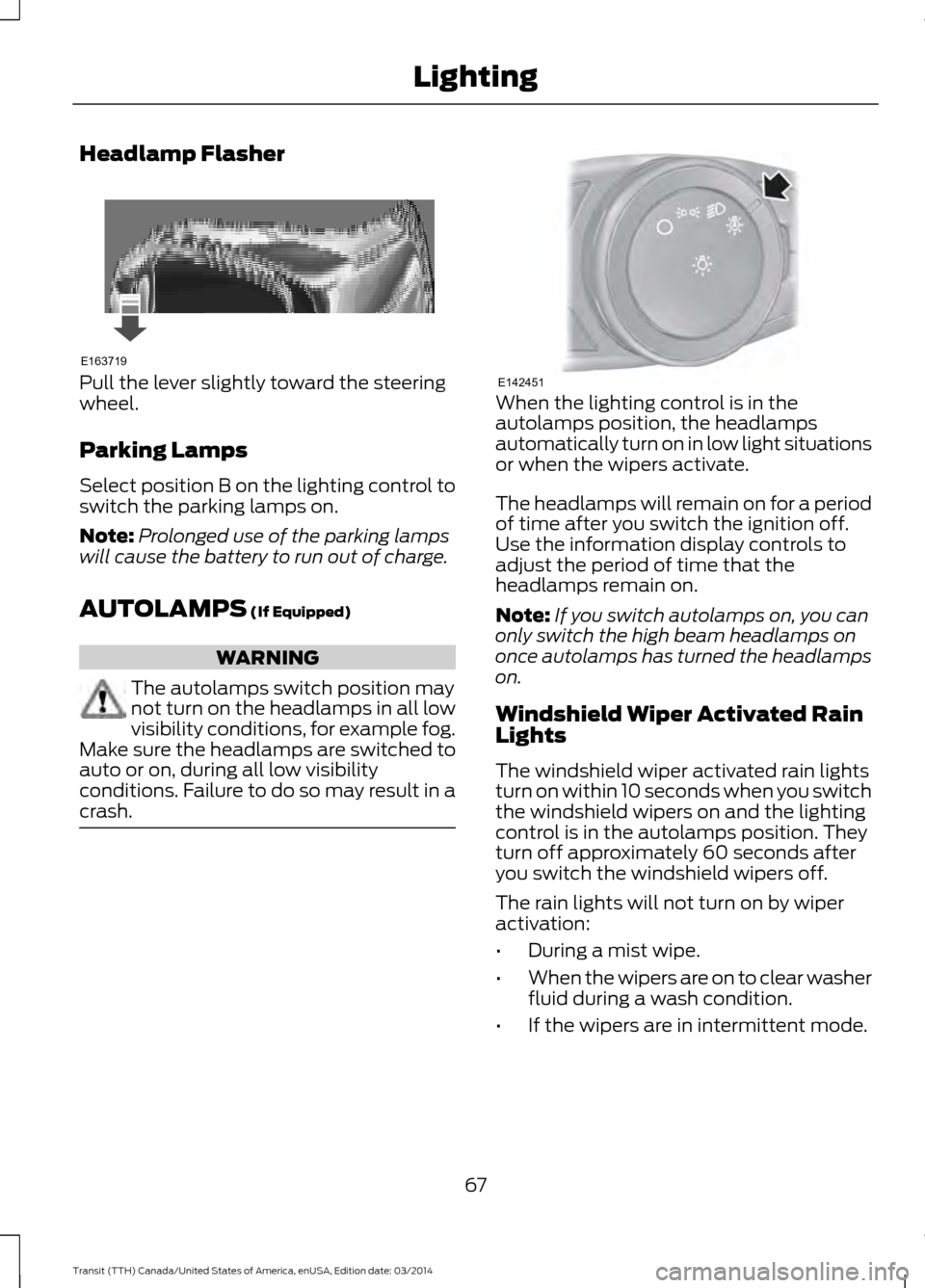
Headlamp Flasher
Pull the lever slightly toward the steering
wheel.
Parking Lamps
Select position B on the lighting control to
switch the parking lamps on.
Note:
Prolonged use of the parking lamps
will cause the battery to run out of charge.
AUTOLAMPS (If Equipped) WARNING
The autolamps switch position may
not turn on the headlamps in all low
visibility conditions, for example fog.
Make sure the headlamps are switched to
auto or on, during all low visibility
conditions. Failure to do so may result in a
crash. When the lighting control is in the
autolamps position, the headlamps
automatically turn on in low light situations
or when the wipers activate.
The headlamps will remain on for a period
of time after you switch the ignition off.
Use the information display controls to
adjust the period of time that the
headlamps remain on.
Note:
If you switch autolamps on, you can
only switch the high beam headlamps on
once autolamps has turned the headlamps
on.
Windshield Wiper Activated Rain
Lights
The windshield wiper activated rain lights
turn on within 10 seconds when you switch
the windshield wipers on and the lighting
control is in the autolamps position. They
turn off approximately 60 seconds after
you switch the windshield wipers off.
The rain lights will not turn on by wiper
activation:
• During a mist wipe.
• When the wipers are on to clear washer
fluid during a wash condition.
• If the wipers are in intermittent mode.
67 Transit (TTH) Canada/United States of America, enUSA, Edition date: 03/2014 LightingE163719 E142451
Page 90 of 461
Lighting
Description and Action
Message
Indicates that a brake lamp bulb has burned out. See Main-
tenance (page 200).
Brake lamp Bulb fault
Indicates that a low beam headlamp bulb has burned out.
See
Maintenance (page 200).
Low beam Bulb fault
The system has detected a fault that requires service.
Headlamp fault Service
required
Maintenance Description and Action
Message
The engine oil has exceeded the service time or distance limit.
Renew the engine oil and oil filter as soon as possible. See
Engine Oil Check
(page 204).
Oil change required
The system has detected a fault that requires service. See
Brake Fluid Check
(page 210).
Brake fluid level low
Service now
Refill the washer fluid reservoir as soon as possible. See
Washer Fluid Check
(page 210).
Washer fluid level low
Parking Aid Description and Action
Message
The system has detected a fault that requires service. See
Parking Aid
(page 143).
Parking aid fault Service
required
Parking Brake Description and Action
Message
The parking brake is applied and your vehicle speed is above
3 mph (5 km/h). If the warning remains on when you have
released the parking brake, the system has detected a fault
that requires service.
Park brake applied
87Transit (TTH) Canada/United States of America, enUSA, Edition date: 03/2014 Information Displays
Page 205 of 461
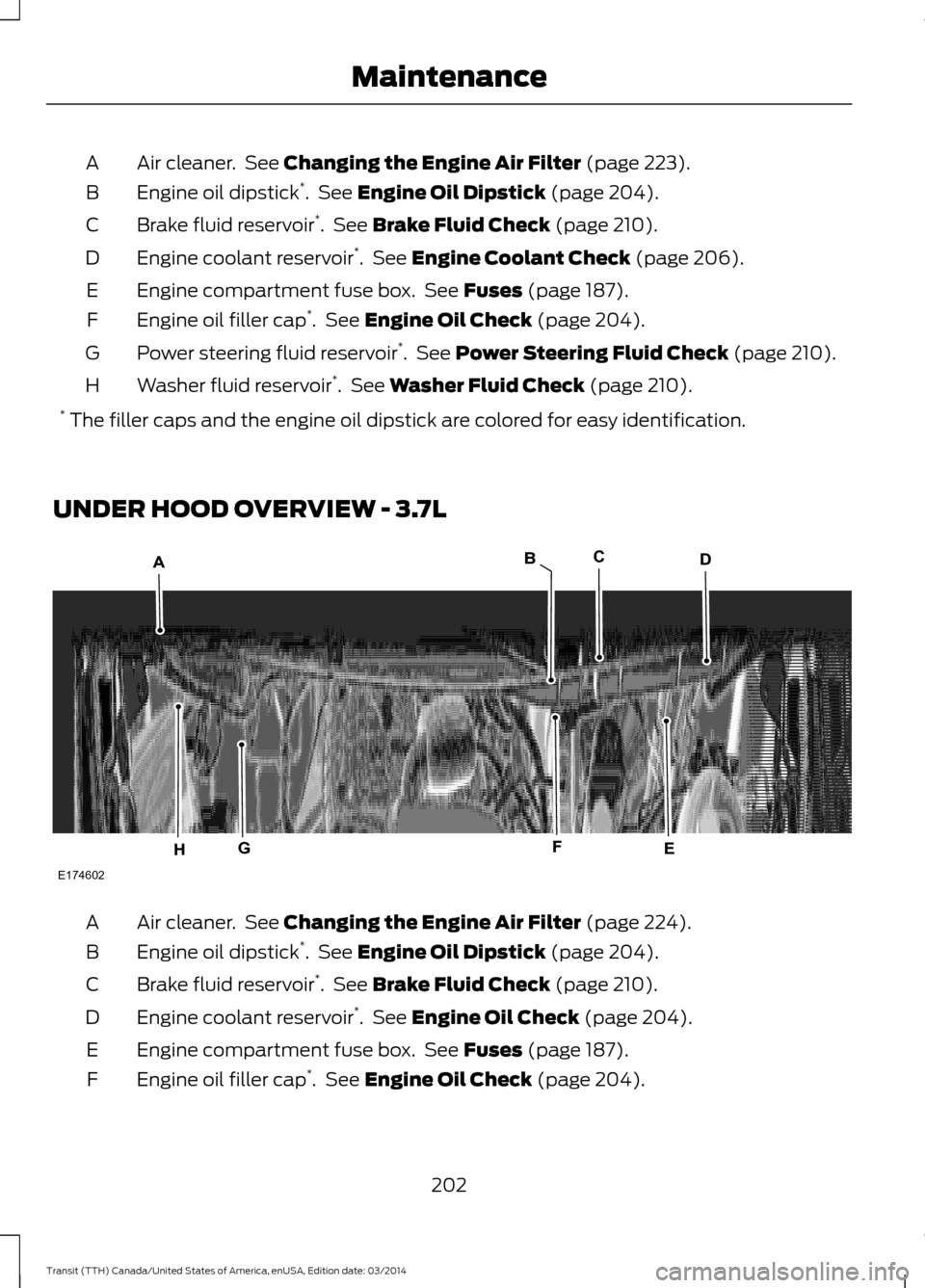
Air cleaner. See Changing the Engine Air Filter (page 223).
A
Engine oil dipstick *
. See
Engine Oil Dipstick (page 204).
B
Brake fluid reservoir *
. See
Brake Fluid Check (page 210).
C
Engine coolant reservoir *
. See
Engine Coolant Check (page 206).
D
Engine compartment fuse box. See
Fuses (page 187).
E
Engine oil filler cap *
. See
Engine Oil Check (page 204).
F
Power steering fluid reservoir *
. See
Power Steering Fluid Check (page 210).
G
Washer fluid reservoir *
. See
Washer Fluid Check (page 210).
H
* The filler caps and the engine oil dipstick are colored for easy identification.
UNDER HOOD OVERVIEW - 3.7L Air cleaner. See Changing the Engine Air Filter (page 224
).
A
Engine oil dipstick *
. See
Engine Oil Dipstick (page 204).
B
Brake fluid reservoir *
. See Brake Fluid Check
(page 210).
C
Engine coolant reservoir *
. See
Engine Oil Check (page 204).
D
Engine compartment fuse box. See Fuses
(page 187).
E
Engine oil filler cap *
. See
Engine Oil Check (page 204).
F
202Transit (TTH) Canada/United States of America, enUSA, Edition date: 03/2014 MaintenanceE174602
ACD
EGH
B
F
Page 206 of 461
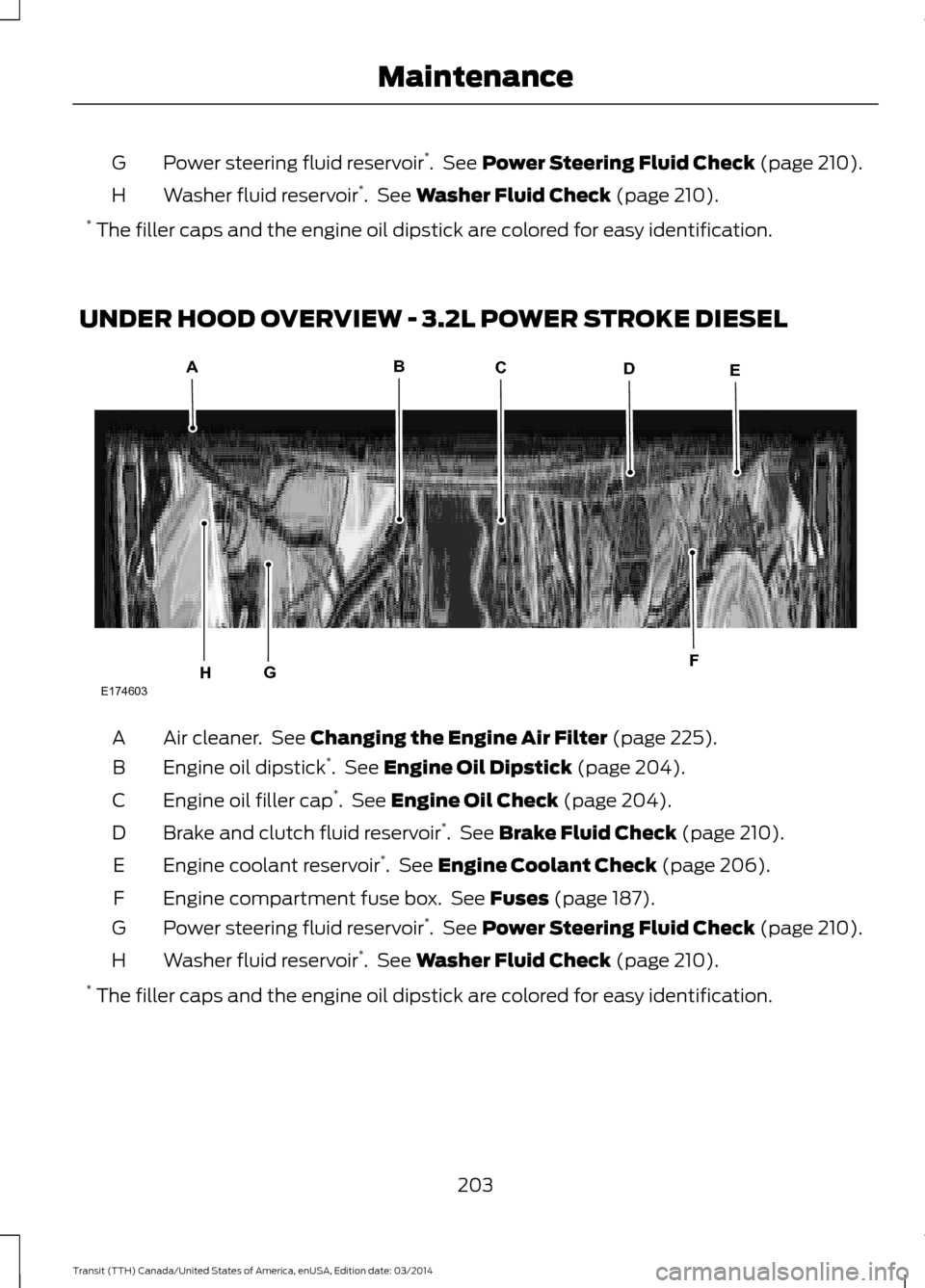
Power steering fluid reservoir
*
. See Power Steering Fluid Check (page 210).
G
Washer fluid reservoir *
. See
Washer Fluid Check (page 210).
H
* The filler caps and the engine oil dipstick are colored for easy identification.
UNDER HOOD OVERVIEW - 3.2L POWER STROKE DIESEL Air cleaner. See Changing the Engine Air Filter (page 225
).
A
Engine oil dipstick *
. See Engine Oil Dipstick (page 204).
B
Engine oil filler cap *
. See
Engine Oil Check (page 204).
C
Brake and clutch fluid reservoir *
. See
Brake Fluid Check (page 210).
D
Engine coolant reservoir *
. See Engine Coolant Check (page 206).
E
Engine compartment fuse box. See Fuses
(page 187).
F
Power steering fluid reservoir *
. See
Power Steering Fluid Check (page 210).
G
Washer fluid reservoir *
. See Washer Fluid Check
(page 210).
H
* The filler caps and the engine oil dipstick are colored for easy identification.
203Transit (TTH) Canada/United States of America, enUSA, Edition date: 03/2014 MaintenanceE174603
ABCDE
FGH
Page 209 of 461
•
Sustained high-speed driving at Gross
Vehicle Weight Rating (maximum
loaded weight for vehicle operation).
• Sustained use of diesel fuel other than
ultra-low sulfur diesel (ULSD). Resetting the Oil Life Monitoring
System The indicator lamp will
illuminate when the engine oil
and oil filter requires changing.
To reset the Oil Life Monitoring System, switch the ignition on, do not start the
engine and scroll to: Action and Description
Message
Fully press the accelerator and brake pedals. Keep both
pedals fully pressed.
Oil change required
The information display will show this message after a short
period of time.
Oil reset in prog.
The information display will show this message after a short
period of time.
Oil reset complete
Release the accelerator and brake pedals and switch the
ignition off.
ENGINE COOLANT CHECK
Checking the Engine Coolant
When the engine is cold, check the
concentration and level of the engine
coolant at the intervals listed in the
scheduled maintenance information. See
Scheduled Maintenance (page 433).
Note: Make sure that the level is between
the MIN and MAX marks on the coolant
reservoir.
Note: Coolant expands when it is hot. The
level may extend beyond the MAX mark.
Note: If the level is at the MIN mark, below
the MIN mark, or empty, add coolant
immediately. See
Adding Engine Coolant
in this chapter.
The coolant concentration should be
maintained within 48% to 50%, which
equates to a freeze point between -29.2°F
(-34°C)
and -34.5°F (-37°C). Note:
For best results, coolant
concentration should be tested with a
refractometer, for example Robinair®
coolant and battery refractometer 75240.
We do not recommend the use of
hydrometers or coolant test strips for
measuring coolant concentrations.
Note: Automotive fluids are not
interchangeable. Do not use engine coolant,
antifreeze or windshield washer fluid outside
of its specified function and vehicle location.
Adding Engine Coolant WARNINGS
Do not add engine coolant when the
engine is hot. Steam and scalding
liquids released from a hot cooling
system can burn you badly. Also, spilling
coolant on hot engine parts can burn you. Do not put engine coolant in the
windshield washer fluid reservoir. If
sprayed on the windshield, engine
coolant could make it difficult to see
through the windshield.
206 Transit (TTH) Canada/United States of America, enUSA, Edition date: 03/2014 Maintenance
Page 213 of 461
Have an authorized dealer check and
change the transmission fluid and filter at
the correct service interval. See
Scheduled Maintenance (page 433). Your
transmission does not consume fluid.
However, the fluid level should be checked
if the transmission is not working properly,
(i.e., if the transmission slips or shifts
slowly) or if you notice some sign of fluid
leakage.
Do not use supplemental transmission
fluid additives, treatments or cleaning
agents. The use of these materials may
affect transmission operation and result
in damage to internal transmission
components.
BRAKE FLUID CHECK
Fluid levels between the MIN and MAX
lines are within the normal operating range;
there is no need to add fluid. If the fluid
levels are outside of the normal operating
range, the performance of the system
could be compromised; seek service from
your authorized dealer immediately.
POWER STEERING FLUID
CHECK
WARNING
Do not allow the fluid to touch your
skin or eyes. This could cause serious
personal injury. Rinse the affected
areas immediately with plenty of water
and consult a physician. If the power steering fluid level is not
between the MAX and MIN marks, add
power steering fluid that meets the correct
specification. See
Capacities and
Specifications (page 271). Adding Power Steering Fluid
1. Remove the filler cap.
2. Add power steering fluid to the
MAX
mark. Do not overfill.
3. Replace the filler cap. Turn it until you feel a strong resistance.
WASHER FLUID CHECK
Note: The reservoir supplies the front and
rear washer systems.
When adding fluid, use a mixture of washer
fluid and water to help prevent freezing in
cold weather and improve the cleaning
capability. We recommend that you use
only high quality washer fluid.
For information on fluid dilution, refer to
the product instructions.
DRAINING THE FUEL FILTER
WATER TRAP WARNING
Do not dispose of fuel in the
household refuse or the public
sewage system. Use an authorized
waste disposal facility. Your vehicle is fitted with a diesel fuel
conditioner module located behind the fuel
tank. A warning lamp will illuminate and a
message will be displayed when
approximately
3.38 (100 ml) of water
accumulates in the module. If you allow
the water level to exceed this level, the
water may pass through to the engine and
may cause fuel injection equipment
damage.
Note: To drain the fuel filter water trap,
access the underside of your vehicle.
210 Transit (TTH) Canada/United States of America, enUSA, Edition date: 03/2014 Maintenance
Page 218 of 461
Install in the reverse order.
CHECKING THE WIPER
BLADES
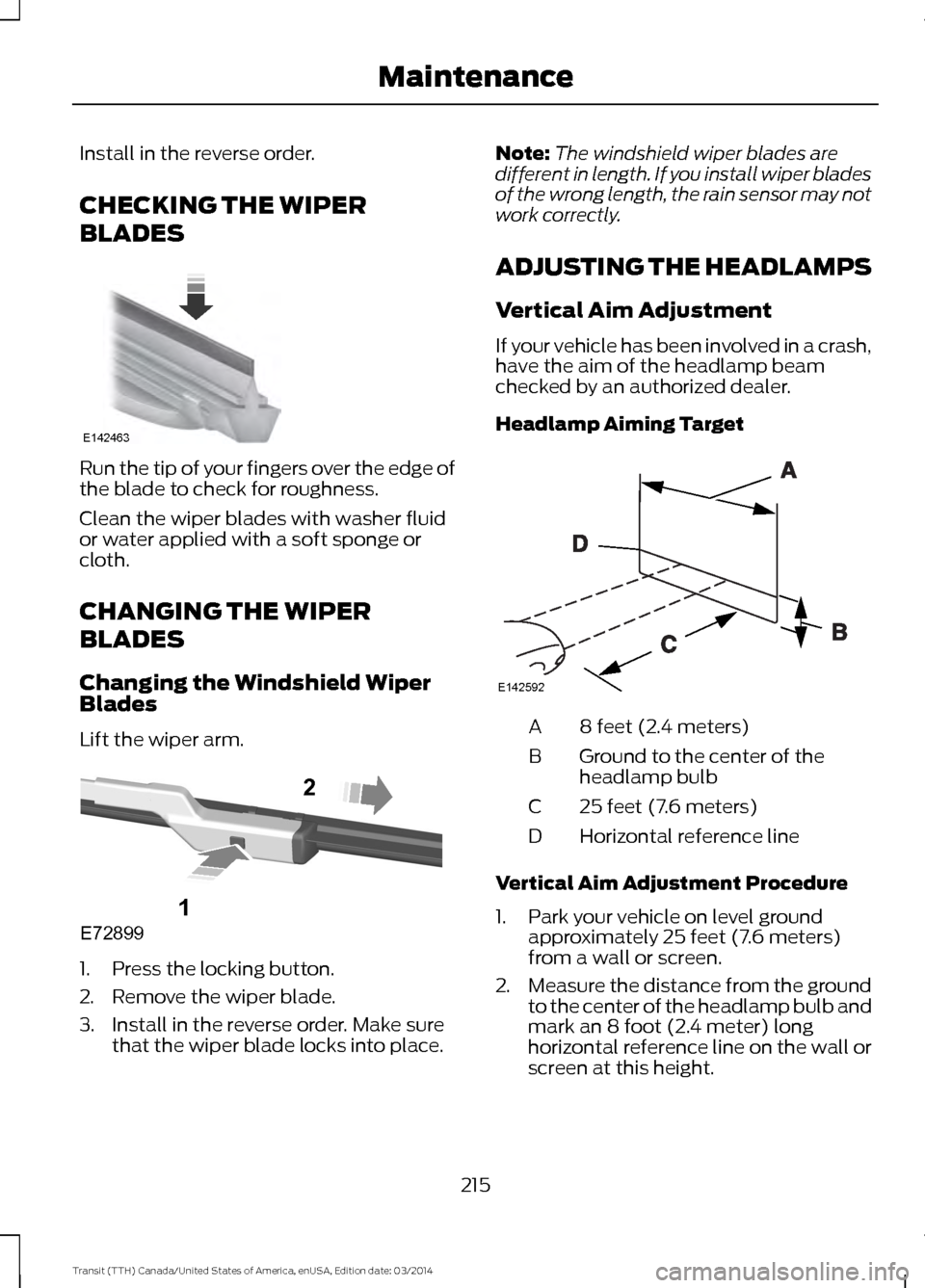
Run the tip of your fingers over the edge of
the blade to check for roughness.
Clean the wiper blades with washer fluid
or water applied with a soft sponge or
cloth.
CHANGING THE WIPER
BLADES
Changing the Windshield Wiper
Blades
Lift the wiper arm.
1. Press the locking button.
2. Remove the wiper blade.
3. Install in the reverse order. Make sure
that the wiper blade locks into place. Note:
The windshield wiper blades are
different in length. If you install wiper blades
of the wrong length, the rain sensor may not
work correctly.
ADJUSTING THE HEADLAMPS
Vertical Aim Adjustment
If your vehicle has been involved in a crash,
have the aim of the headlamp beam
checked by an authorized dealer.
Headlamp Aiming Target 8 feet (2.4 meters)
A
Ground to the center of the
headlamp bulb
B
25 feet (7.6 meters)
C
Horizontal reference line
D
Vertical Aim Adjustment Procedure
1. Park your vehicle on level ground approximately 25 feet (7.6 meters)
from a wall or screen.
2. Measure the distance from the ground
to the center of the headlamp bulb and
mark an 8 foot (2.4 meter) long
horizontal reference line on the wall or
screen at this height.
215 Transit (TTH) Canada/United States of America, enUSA, Edition date: 03/2014 MaintenanceE142463 E72899
1
2 E142592
Page 230 of 461
CLEANING PRODUCTS
For best results, use the following products
or products of equivalent quality:
•
Motorcraft Bug and Tar Remover
(ZC-42)
• Motorcraft Custom Bright Metal
Cleaner (ZC-15)
• Motorcraft Detail Wash (ZC-3-A)
• Motorcraft Dusting Cloth (ZC-24)
• Motorcraft Engine Shampoo and
Degreaser (U.S. only) (ZC-20)
• Motorcraft Engine Shampoo (Canada
only) (CXC-66-A)
• Motorcraft Multi-Purpose Cleaner
(Canada only) (CXC-101)
• Motorcraft Premium Glass Cleaner
(Canada only) (CXC-100)
• Motorcraft Premium Quality
Windshield Washer Fluid (Canada
only) [CXC-37-(A, B, D or F)]
• Motorcraft Premium Windshield Wash
Concentrate with Bitterant (U.S. only)
(ZC-32-B2)
• Motorcraft Professional Strength
Carpet & Upholstery Cleaner (ZC-54)
• Motorcraft Premium Leather and Vinyl
Cleaner (ZC-56)
• Motorcraft Spot and Stain Remover
(U.S. only) (ZC-14)
• Motorcraft Ultra-Clear Spray Glass
Cleaner (ZC-23)
• Motorcraft Wheel and Tire Cleaner
(ZC-37-A)
CLEANING THE EXTERIOR WARNINGS
If you use a car wash with a waxing
cycle, make sure that you remove the
wax from the windshield. WARNINGS
Prior to using a car wash facility
check the suitability of it for your
vehicle.
Some car wash installations use
water at high pressure. This could
damage certain parts of your vehicle.
Remove the aerial before using an
automatic car wash.
Switch the heater blower off to
prevent contamination of the fresh
air filter.
We recommend that you wash your vehicle
with a sponge and lukewarm water
containing a car shampoo.
Cleaning the Headlamps
WARNINGS
Do not scrape the headlamp lenses
or use abrasives, alcoholic solvents
or chemical solvents to clean them.
Do not wipe the headlamps when
they are dry.
Cleaning the Rear Window
WARNING
Do not scrape the inside of the rear
window or use abrasives or chemical
solvents to clean it.
Use a clean, lint free cloth or a damp
chamois leather to clean the inside of the
rear window.
Cleaning the Chrome Trim
WARNINGS
Do not use abrasives or chemical
solvents. Use soapy water.
227 Transit (TTH) Canada/United States of America, enUSA, Edition date: 03/2014 Vehicle Care
Page 231 of 461
WARNINGS
Do not apply cleaning product to hot
surfaces and do not leave cleaning
product on chrome surfaces for a
period of time exceeding that which is
recommended. Industrial-strength (heavy-duty)
cleaners, or cleaning chemicals, may
cause damage over a period of time.
Body Paintwork Preservation
WARNINGS
Do not polish your vehicle in strong
sunshine.
Do not allow polish to touch plastic
surfaces. It could be difficult to
remove.
Do not apply polish to the windshield
or rear window. This could cause the
wipers to become noisy and they
may not clear the window properly. We recommend that you wax the
paintwork once or twice a year.
WAXING
Regular waxing is necessary to protect your
car's paint from the elements. We
recommend that you wash and wax the
painted surface once or twice a year.
When washing and waxing, park your
vehicle in a shaded area out of direct
sunlight. Always wash your vehicle before
applying wax.
•
Use a quality wax that does not contain
abrasives.
• Follow the manufacturer ’s instructions
to apply and remove the wax.
• Apply a small amount of wax in a
back-and-forth motion, not in circles. •
Do not allow wax to come in contact
with any non-body (low-gloss black)
colored trim. The wax will discolor or
stain the parts over time.
•Roof racks.
• Bumpers.
• Grained door handles.
• Side moldings.
• Mirror housings.
• Windshield cowl area.
• Do not apply wax to glass areas.
• After waxing, your car's paint should
feel smooth, and be free of streaks and
smudges.
CLEANING THE ENGINE
Engines are more efficient when they are
clean because grease and dirt buildup keep
the engine warmer than normal.
When washing:
• Take care when using a power washer
to clean the engine. The high-pressure
fluid could penetrate the sealed parts
and cause damage.
• Do not spray a hot engine with cold
water to avoid cracking the engine
block or other engine components.
• Spray Motorcraft Engine Shampoo and
Degreaser on all parts that require
cleaning and pressure rinse clean. In
Canada, use Motorcraft Engine
Shampoo.
• Never wash or rinse the engine while it
is hot or running; water in the running
engine may cause internal damage.
228 Transit (TTH) Canada/United States of America, enUSA, Edition date: 03/2014 Vehicle Care