brake light FORD TRANSIT 2016 5.G Owner's Manual
[x] Cancel search | Manufacturer: FORD, Model Year: 2016, Model line: TRANSIT, Model: FORD TRANSIT 2016 5.GPages: 411, PDF Size: 5.65 MB
Page 202 of 411
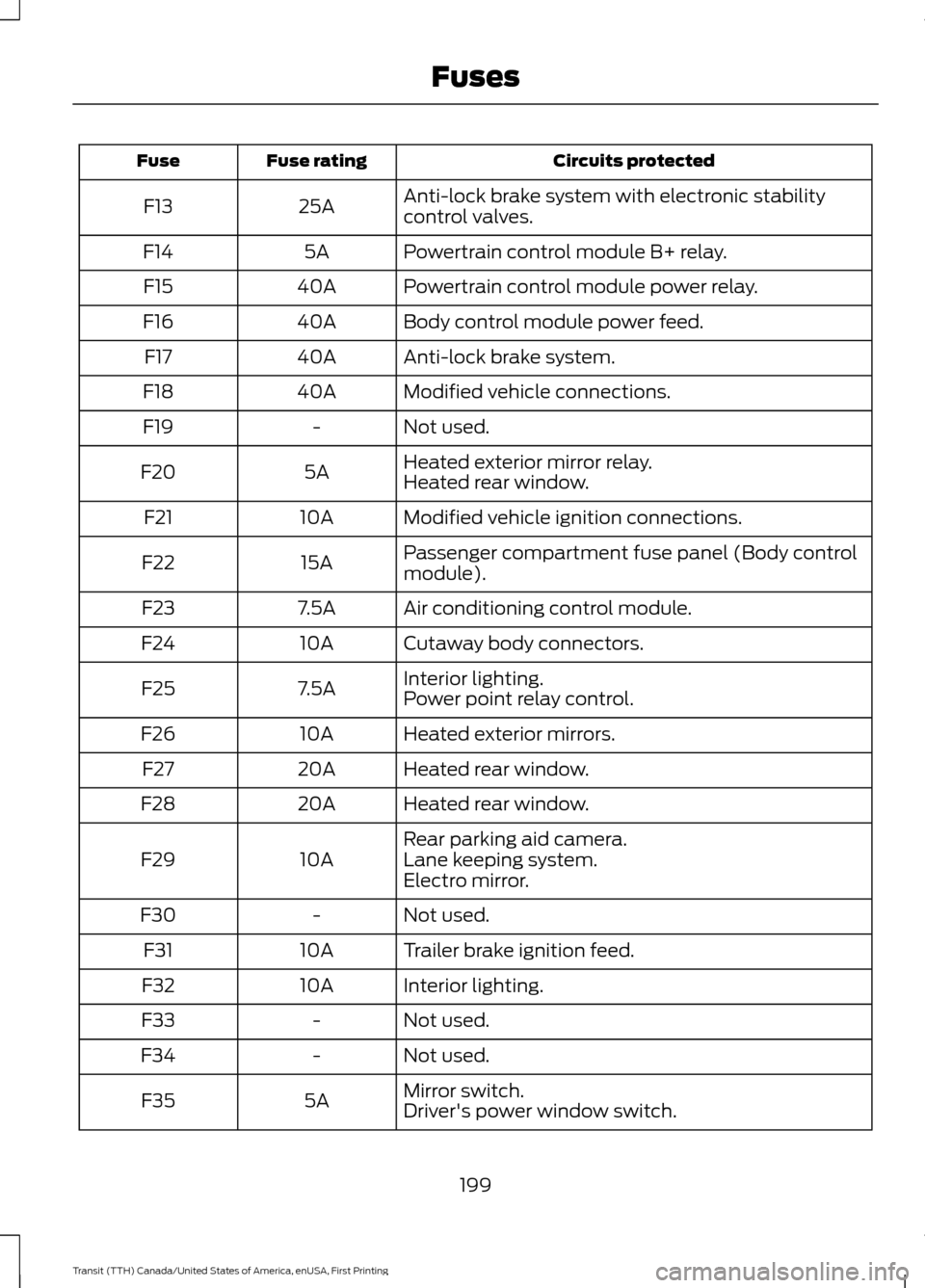
Circuits protected
Fuse rating
Fuse
Anti-lock brake system with electronic stability
control valves.
25A
F13
Powertrain control module B+ relay.
5A
F14
Powertrain control module power relay.
40A
F15
Body control module power feed.
40A
F16
Anti-lock brake system.
40A
F17
Modified vehicle connections.
40A
F18
Not used.
-
F19
Heated exterior mirror relay.
5A
F20
Heated rear window.
Modified vehicle ignition connections.
10A
F21
Passenger compartment fuse panel (Body control
module).
15A
F22
Air conditioning control module.
7.5A
F23
Cutaway body connectors.
10A
F24
Interior lighting.
7.5A
F25
Power point relay control.
Heated exterior mirrors.
10A
F26
Heated rear window.
20A
F27
Heated rear window.
20A
F28
Rear parking aid camera.
10A
F29 Lane keeping system.
Electro mirror.
Not used.
-
F30
Trailer brake ignition feed.
10A
F31
Interior lighting.
10A
F32
Not used.
-
F33
Not used.
-
F34
Mirror switch.
5A
F35
Driver's power window switch.
199
Transit (TTH) Canada/United States of America, enUSA, First Printing Fuses
Page 219 of 411
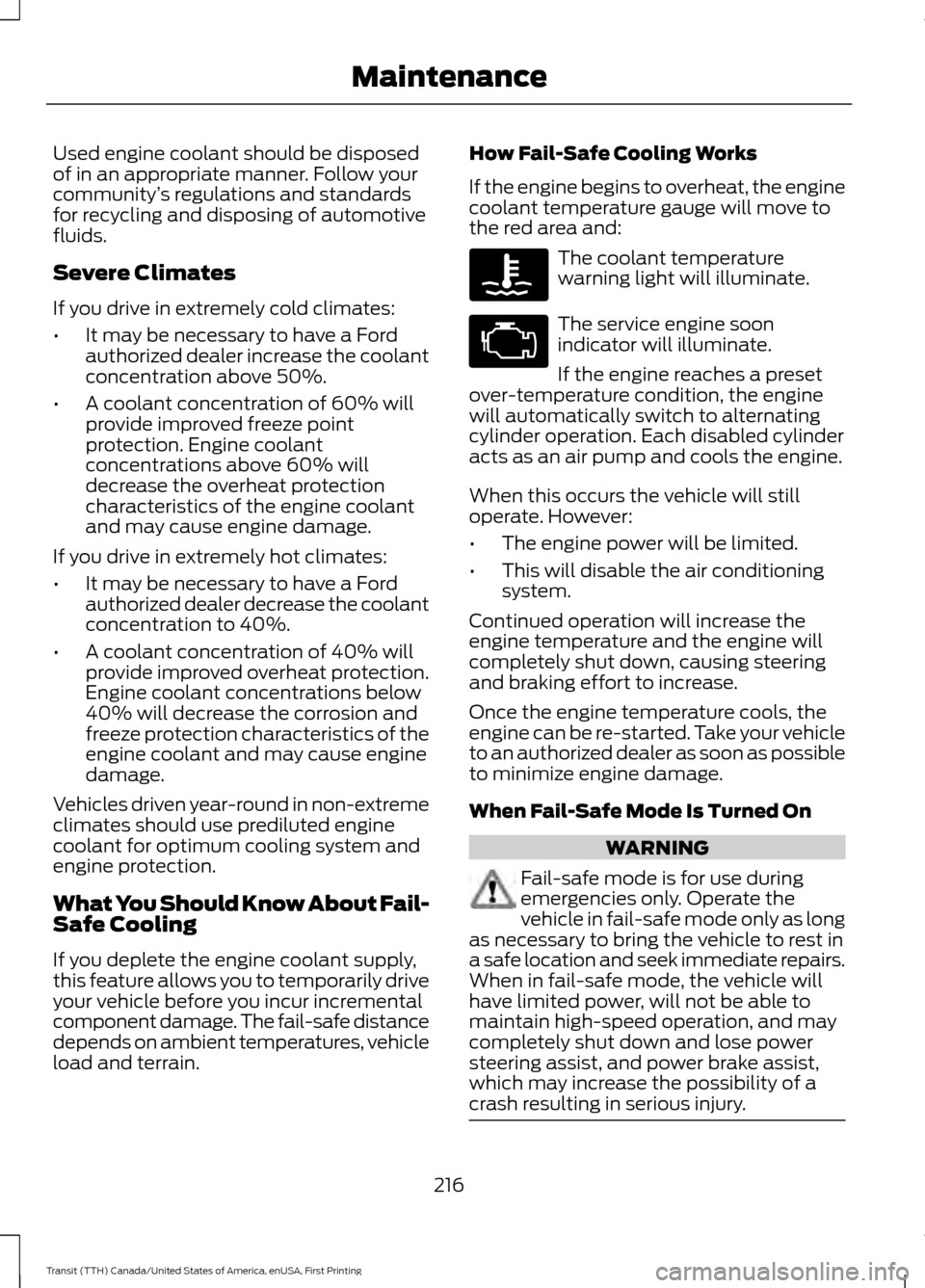
Used engine coolant should be disposed
of in an appropriate manner. Follow your
community
’s regulations and standards
for recycling and disposing of automotive
fluids.
Severe Climates
If you drive in extremely cold climates:
• It may be necessary to have a Ford
authorized dealer increase the coolant
concentration above 50%.
• A coolant concentration of 60% will
provide improved freeze point
protection. Engine coolant
concentrations above 60% will
decrease the overheat protection
characteristics of the engine coolant
and may cause engine damage.
If you drive in extremely hot climates:
• It may be necessary to have a Ford
authorized dealer decrease the coolant
concentration to 40%.
• A coolant concentration of 40% will
provide improved overheat protection.
Engine coolant concentrations below
40% will decrease the corrosion and
freeze protection characteristics of the
engine coolant and may cause engine
damage.
Vehicles driven year-round in non-extreme
climates should use prediluted engine
coolant for optimum cooling system and
engine protection.
What You Should Know About Fail-
Safe Cooling
If you deplete the engine coolant supply,
this feature allows you to temporarily drive
your vehicle before you incur incremental
component damage. The fail-safe distance
depends on ambient temperatures, vehicle
load and terrain. How Fail-Safe Cooling Works
If the engine begins to overheat, the engine
coolant temperature gauge will move to
the red area and: The coolant temperature
warning light will illuminate.
The service engine soon
indicator will illuminate.
If the engine reaches a preset
over-temperature condition, the engine
will automatically switch to alternating
cylinder operation. Each disabled cylinder
acts as an air pump and cools the engine.
When this occurs the vehicle will still
operate. However:
• The engine power will be limited.
• This will disable the air conditioning
system.
Continued operation will increase the
engine temperature and the engine will
completely shut down, causing steering
and braking effort to increase.
Once the engine temperature cools, the
engine can be re-started. Take your vehicle
to an authorized dealer as soon as possible
to minimize engine damage.
When Fail-Safe Mode Is Turned On WARNING
Fail-safe mode is for use during
emergencies only. Operate the
vehicle in fail-safe mode only as long
as necessary to bring the vehicle to rest in
a safe location and seek immediate repairs.
When in fail-safe mode, the vehicle will
have limited power, will not be able to
maintain high-speed operation, and may
completely shut down and lose power
steering assist, and power brake assist,
which may increase the possibility of a
crash resulting in serious injury. 216
Transit (TTH) Canada/United States of America, enUSA, First Printing Maintenance
Page 241 of 411
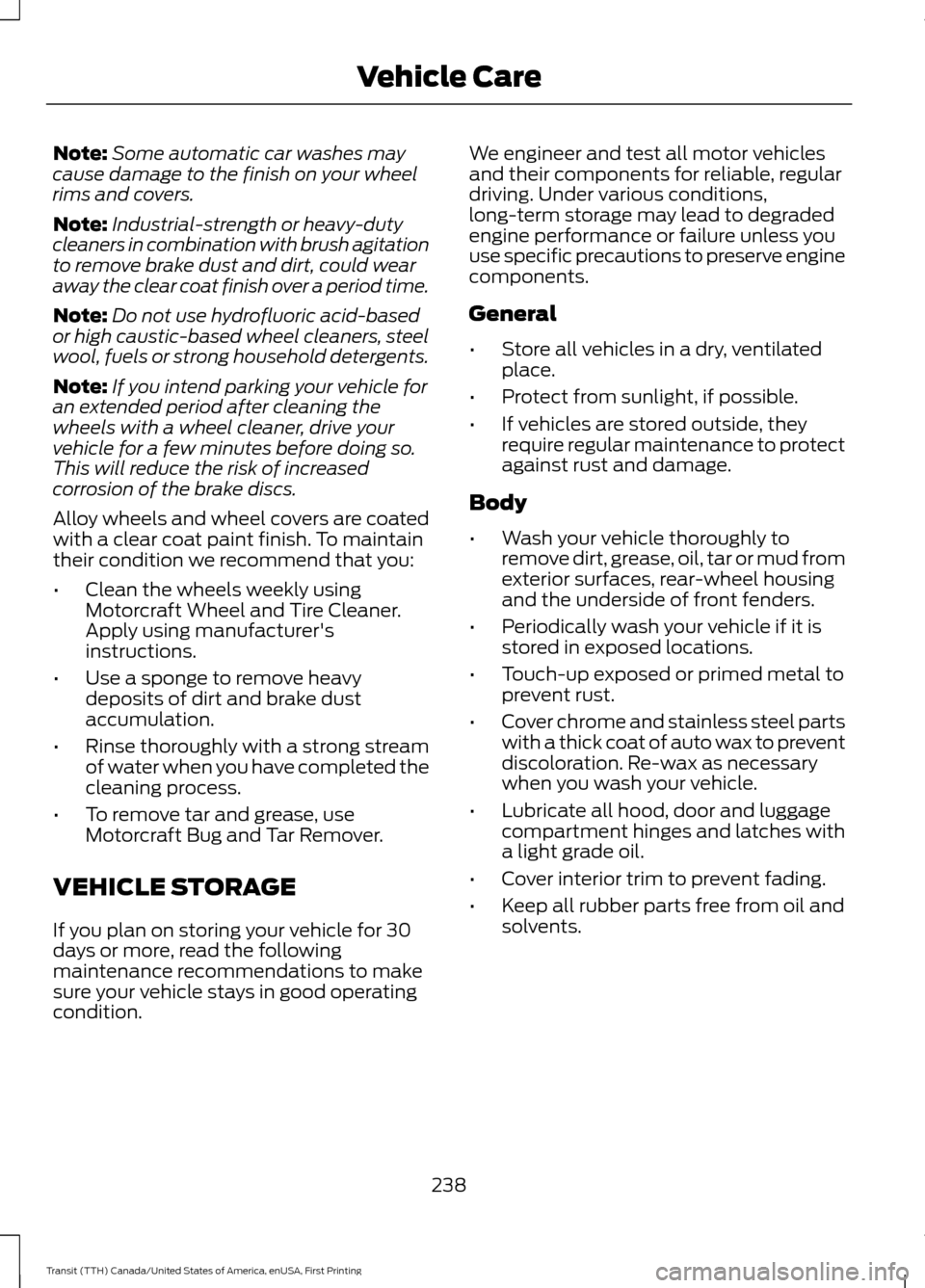
Note:
Some automatic car washes may
cause damage to the finish on your wheel
rims and covers.
Note: Industrial-strength or heavy-duty
cleaners in combination with brush agitation
to remove brake dust and dirt, could wear
away the clear coat finish over a period time.
Note: Do not use hydrofluoric acid-based
or high caustic-based wheel cleaners, steel
wool, fuels or strong household detergents.
Note: If you intend parking your vehicle for
an extended period after cleaning the
wheels with a wheel cleaner, drive your
vehicle for a few minutes before doing so.
This will reduce the risk of increased
corrosion of the brake discs.
Alloy wheels and wheel covers are coated
with a clear coat paint finish. To maintain
their condition we recommend that you:
• Clean the wheels weekly using
Motorcraft Wheel and Tire Cleaner.
Apply using manufacturer's
instructions.
• Use a sponge to remove heavy
deposits of dirt and brake dust
accumulation.
• Rinse thoroughly with a strong stream
of water when you have completed the
cleaning process.
• To remove tar and grease, use
Motorcraft Bug and Tar Remover.
VEHICLE STORAGE
If you plan on storing your vehicle for 30
days or more, read the following
maintenance recommendations to make
sure your vehicle stays in good operating
condition. We engineer and test all motor vehicles
and their components for reliable, regular
driving. Under various conditions,
long-term storage may lead to degraded
engine performance or failure unless you
use specific precautions to preserve engine
components.
General
•
Store all vehicles in a dry, ventilated
place.
• Protect from sunlight, if possible.
• If vehicles are stored outside, they
require regular maintenance to protect
against rust and damage.
Body
• Wash your vehicle thoroughly to
remove dirt, grease, oil, tar or mud from
exterior surfaces, rear-wheel housing
and the underside of front fenders.
• Periodically wash your vehicle if it is
stored in exposed locations.
• Touch-up exposed or primed metal to
prevent rust.
• Cover chrome and stainless steel parts
with a thick coat of auto wax to prevent
discoloration. Re-wax as necessary
when you wash your vehicle.
• Lubricate all hood, door and luggage
compartment hinges and latches with
a light grade oil.
• Cover interior trim to prevent fading.
• Keep all rubber parts free from oil and
solvents.
238
Transit (TTH) Canada/United States of America, enUSA, First Printing Vehicle Care
Page 403 of 411
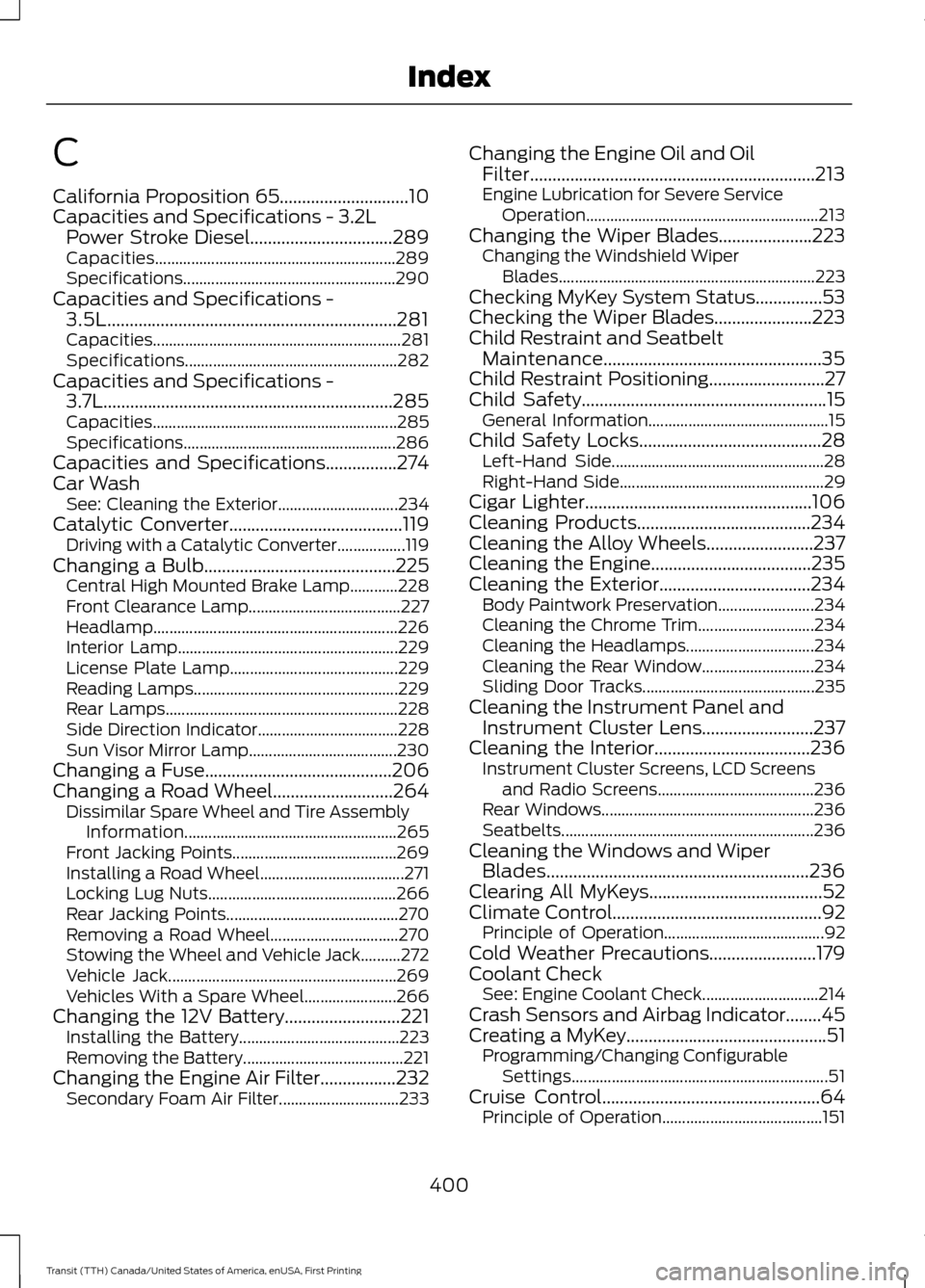
C
California Proposition 65.............................10
Capacities and Specifications - 3.2L
Power Stroke Diesel................................289
Capacities............................................................ 289
Specifications..................................................... 290
Capacities and Specifications - 3.5L.................................................................281
Capacities.............................................................. 281
Specifications..................................................... 282
Capacities and Specifications - 3.7L.................................................................285
Capacities............................................................. 285
Specifications..................................................... 286
Capacities and Specifications
................274
Car Wash See: Cleaning the Exterior.............................. 234
Catalytic Converter
.......................................119
Driving with a Catalytic Converter.................119
Changing a Bulb...........................................225 Central High Mounted Brake Lamp............228
Front Clearance Lamp...................................... 227
Headlamp............................................................. 226
Interior Lamp....................................................... 229
License Plate Lamp.......................................... 229
Reading Lamps................................................... 229
Rear Lamps.......................................................... 228
Side Direction Indicator................................... 228
Sun Visor Mirror Lamp..................................... 230
Changing a Fuse..........................................206
Changing a Road Wheel...........................264 Dissimilar Spare Wheel and Tire Assembly
Information..................................................... 265
Front Jacking Points......................................... 269
Installing a Road Wheel.................................... 271
Locking Lug Nuts............................................... 266
Rear Jacking Points........................................... 270
Removing a Road Wheel................................ 270
Stowing the Wheel and Vehicle Jack..........272
Vehicle Jack......................................................... 269
Vehicles With a Spare Wheel....................... 266
Changing the 12V Battery
..........................221
Installing the Battery........................................ 223
Removing the Battery........................................ 221
Changing the Engine Air Filter.................232 Secondary Foam Air Filter.............................. 233Changing the Engine Oil and Oil
Filter................................................................213
Engine Lubrication for Severe Service Operation.......................................................... 213
Changing the Wiper Blades.....................223 Changing the Windshield Wiper
Blades................................................................ 223
Checking MyKey System Status...............53
Checking the Wiper Blades......................223
Child Restraint and Seatbelt Maintenance.................................................35
Child Restraint Positioning
..........................27
Child Safety.......................................................15
General Information............................................. 15
Child Safety Locks.........................................28 Left-Hand Side..................................................... 28
Right-Hand Side................................................... 29
Cigar Lighter
...................................................106
Cleaning Products.......................................234
Cleaning the Alloy Wheels........................237
Cleaning the Engine....................................235
Cleaning the Exterior..................................234 Body Paintwork Preservation........................ 234
Cleaning the Chrome Trim............................. 234
Cleaning the Headlamps................................ 234
Cleaning the Rear Window............................ 234
Sliding Door Tracks........................................... 235
Cleaning the Instrument Panel and Instrument Cluster Lens.........................237
Cleaning the Interior...................................236 Instrument Cluster Screens, LCD Screens
and Radio Screens....................................... 236
Rear Windows..................................................... 236
Seatbelts............................................................... 236
Cleaning the Windows and Wiper Blades...........................................................236
Clearing All MyKeys.......................................52
Climate Control
...............................................92
Principle of Operation........................................ 92
Cold Weather Precautions
........................179
Coolant Check See: Engine Coolant Check............................. 214
Crash Sensors and Airbag Indicator
........45
Creating a MyKey.............................................51 Programming/Changing Configurable
Settings................................................................ 51
Cruise Control.................................................64 Principle of Operation........................................ 151
400
Transit (TTH) Canada/United States of America, enUSA, First Printing Index
Page 406 of 411
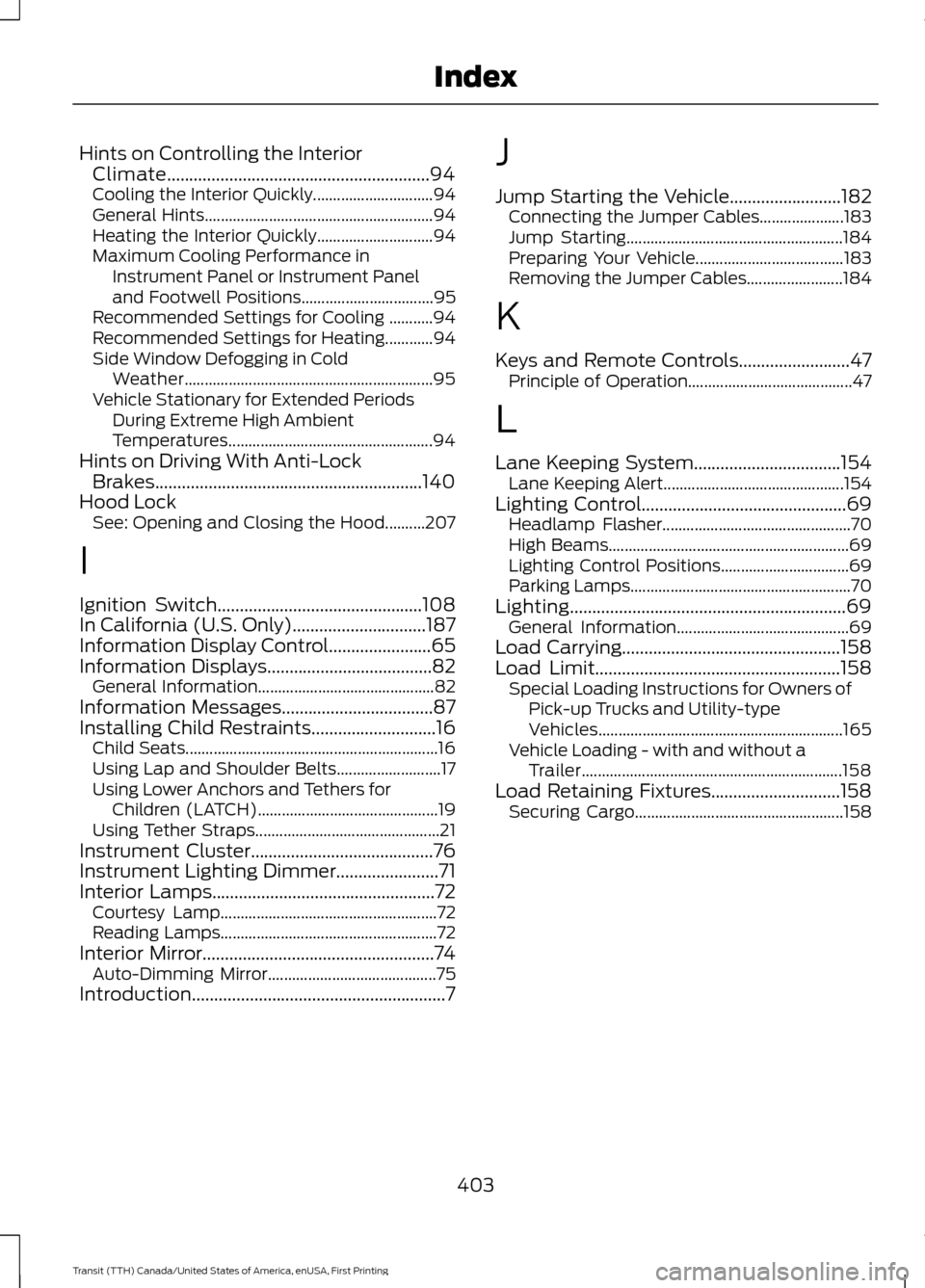
Hints on Controlling the Interior
Climate...........................................................94
Cooling the Interior Quickly.............................. 94
General Hints......................................................... 94
Heating the Interior Quickly............................. 94
Maximum Cooling Performance in Instrument Panel or Instrument Panel
and Footwell Positions................................. 95
Recommended Settings for Cooling ...........94
Recommended Settings for Heating............94
Side Window Defogging in Cold Weather.............................................................. 95
Vehicle Stationary for Extended Periods During Extreme High Ambient
Temperatures................................................... 94
Hints on Driving With Anti-Lock Brakes............................................................140
Hood Lock See: Opening and Closing the Hood..........207
I
Ignition Switch..............................................108
In California (U.S. Only)..............................187
Information Display Control.......................65
Information Displays
.....................................82
General Information............................................ 82
Information Messages
..................................87
Installing Child Restraints............................16
Child Seats............................................................... 16
Using Lap and Shoulder Belts.......................... 17
Using Lower Anchors and Tethers for Children (LATCH)............................................. 19
Using Tether Straps.............................................. 21
Instrument Cluster
.........................................76
Instrument Lighting Dimmer.......................71
Interior Lamps
..................................................72
Courtesy Lamp...................................................... 72
Reading Lamps...................................................... 72
Interior Mirror
....................................................74
Auto-Dimming Mirror.......................................... 75
Introduction.........................................................7 J
Jump Starting the Vehicle
.........................182
Connecting the Jumper Cables..................... 183
Jump Starting...................................................... 184
Preparing Your Vehicle..................................... 183
Removing the Jumper Cables........................ 184
K
Keys and Remote Controls.........................47 Principle of Operation......................................... 47
L
Lane Keeping System.................................154 Lane Keeping Alert............................................. 154
Lighting Control
..............................................69
Headlamp Flasher............................................... 70
High Beams............................................................ 69
Lighting Control Positions................................ 69
Parking Lamps....................................................... 70
Lighting..............................................................69 General Information........................................... 69
Load Carrying
.................................................158
Load Limit.......................................................158
Special Loading Instructions for Owners of
Pick-up Trucks and Utility-type
Vehicles............................................................. 165
Vehicle Loading - with and without a Trailer................................................................. 158
Load Retaining Fixtures.............................158 Securing Cargo.................................................... 158
403
Transit (TTH) Canada/United States of America, enUSA, First Printing Index