seats FORD TRANSIT 2016 5.G Owner's Manual
[x] Cancel search | Manufacturer: FORD, Model Year: 2016, Model line: TRANSIT, Model: FORD TRANSIT 2016 5.GPages: 411, PDF Size: 5.65 MB
Page 100 of 411
SITTING IN THE CORRECT
POSITION
WARNINGS
Do not recline the seat backrest too
far as this can cause the occupant
to slide under the safety belt,
resulting in serious injury in the event of a
crash. Sitting improperly, out of position or
with the seat backrest reclined too
far, can result in serious injury or
death in the event of a crash. Always sit
upright against your seat backrest, with
your feet on the floor. Do not place objects higher than the
seat backrest to reduce the risk of
serious injury in the event of a crash
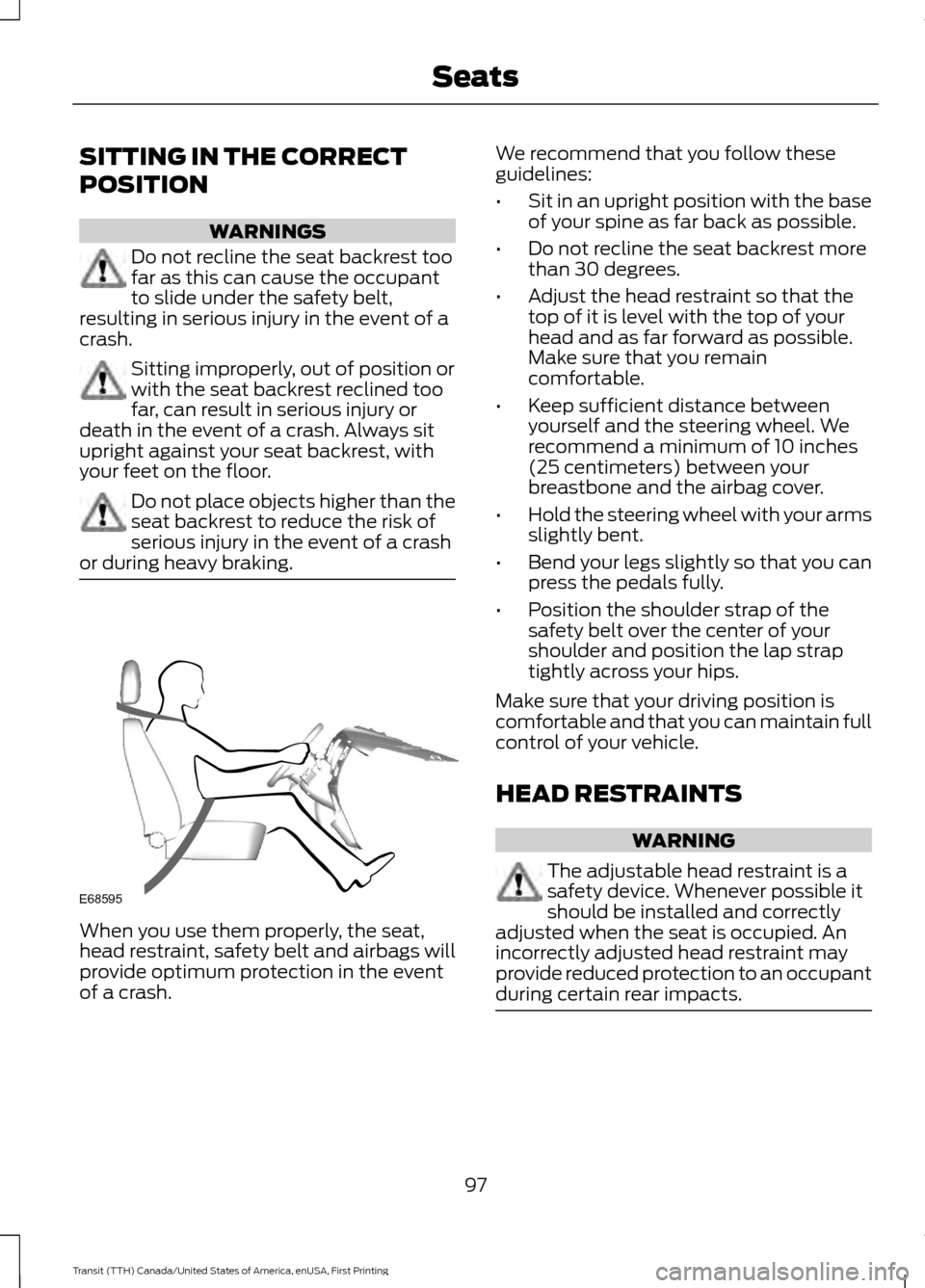
or during heavy braking. When you use them properly, the seat,
head restraint, safety belt and airbags will
provide optimum protection in the event
of a crash. We recommend that you follow these
guidelines:
•
Sit in an upright position with the base
of your spine as far back as possible.
• Do not recline the seat backrest more
than 30 degrees.
• Adjust the head restraint so that the
top of it is level with the top of your
head and as far forward as possible.
Make sure that you remain
comfortable.
• Keep sufficient distance between
yourself and the steering wheel. We
recommend a minimum of 10 inches
(25 centimeters) between your
breastbone and the airbag cover.
• Hold the steering wheel with your arms
slightly bent.
• Bend your legs slightly so that you can
press the pedals fully.
• Position the shoulder strap of the
safety belt over the center of your
shoulder and position the lap strap
tightly across your hips.
Make sure that your driving position is
comfortable and that you can maintain full
control of your vehicle.
HEAD RESTRAINTS WARNING
The adjustable head restraint is a
safety device. Whenever possible it
should be installed and correctly
adjusted when the seat is occupied. An
incorrectly adjusted head restraint may
provide reduced protection to an occupant
during certain rear impacts. 97
Transit (TTH) Canada/United States of America, enUSA, First Printing SeatsE68595
Page 101 of 411
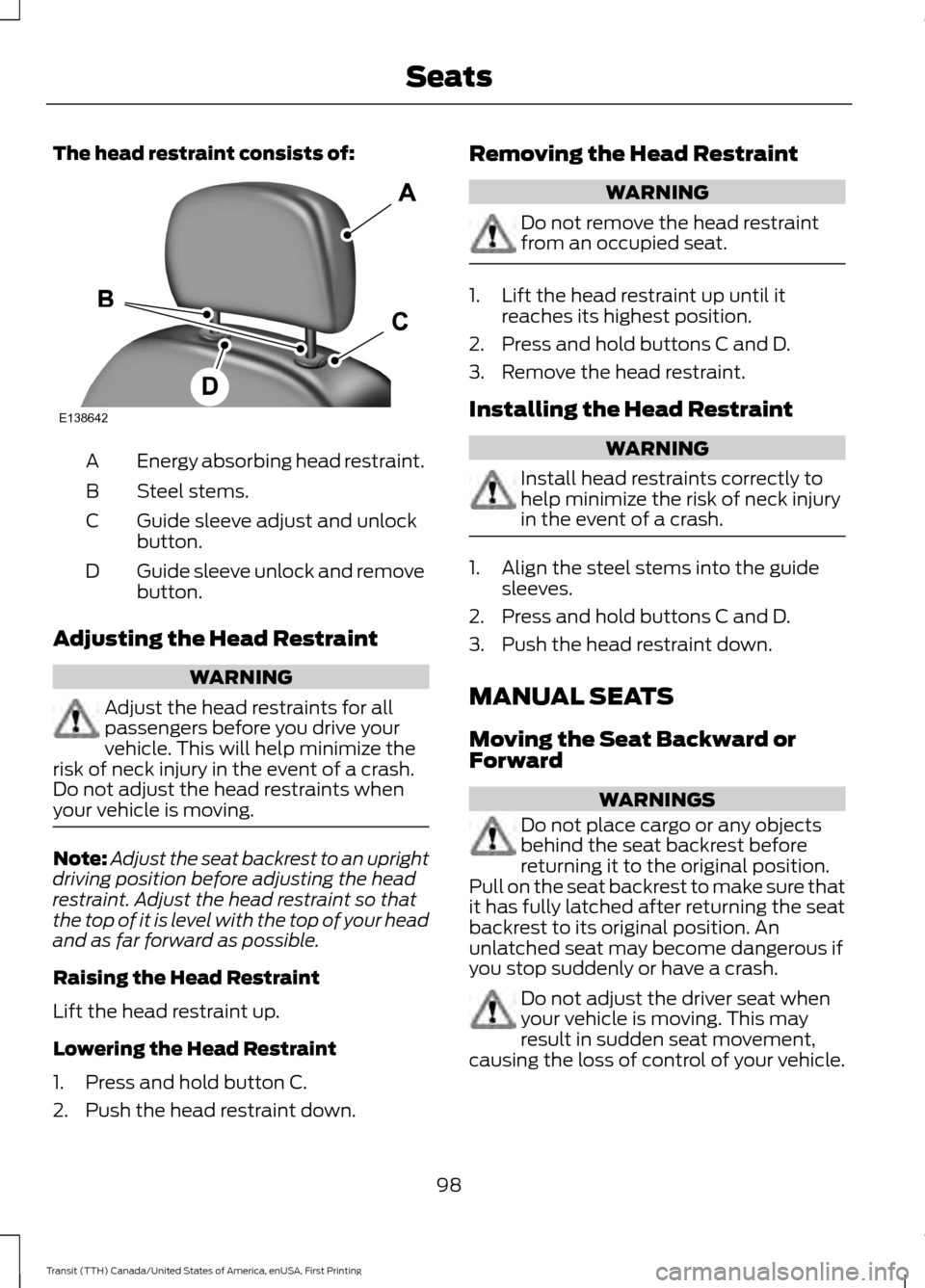
The head restraint consists of:
Energy absorbing head restraint.
A
Steel stems.
B
Guide sleeve adjust and unlock
button.
C
Guide sleeve unlock and remove
button.
D
Adjusting the Head Restraint WARNING
Adjust the head restraints for all
passengers before you drive your
vehicle. This will help minimize the
risk of neck injury in the event of a crash.
Do not adjust the head restraints when
your vehicle is moving. Note:
Adjust the seat backrest to an upright
driving position before adjusting the head
restraint. Adjust the head restraint so that
the top of it is level with the top of your head
and as far forward as possible.
Raising the Head Restraint
Lift the head restraint up.
Lowering the Head Restraint
1. Press and hold button C.
2. Push the head restraint down. Removing the Head Restraint WARNING
Do not remove the head restraint
from an occupied seat.
1. Lift the head restraint up until it
reaches its highest position.
2. Press and hold buttons C and D.
3. Remove the head restraint.
Installing the Head Restraint WARNING
Install head restraints correctly to
help minimize the risk of neck injury
in the event of a crash.
1. Align the steel stems into the guide
sleeves.
2. Press and hold buttons C and D.
3. Push the head restraint down.
MANUAL SEATS
Moving the Seat Backward or
Forward WARNINGS
Do not place cargo or any objects
behind the seat backrest before
returning it to the original position.
Pull on the seat backrest to make sure that
it has fully latched after returning the seat
backrest to its original position. An
unlatched seat may become dangerous if
you stop suddenly or have a crash. Do not adjust the driver seat when
your vehicle is moving. This may
result in sudden seat movement,
causing the loss of control of your vehicle.
98
Transit (TTH) Canada/United States of America, enUSA, First Printing SeatsE138642
Page 102 of 411
WARNINGS
Make sure the driver seat fully locks
into place by rocking it backward and
forward.
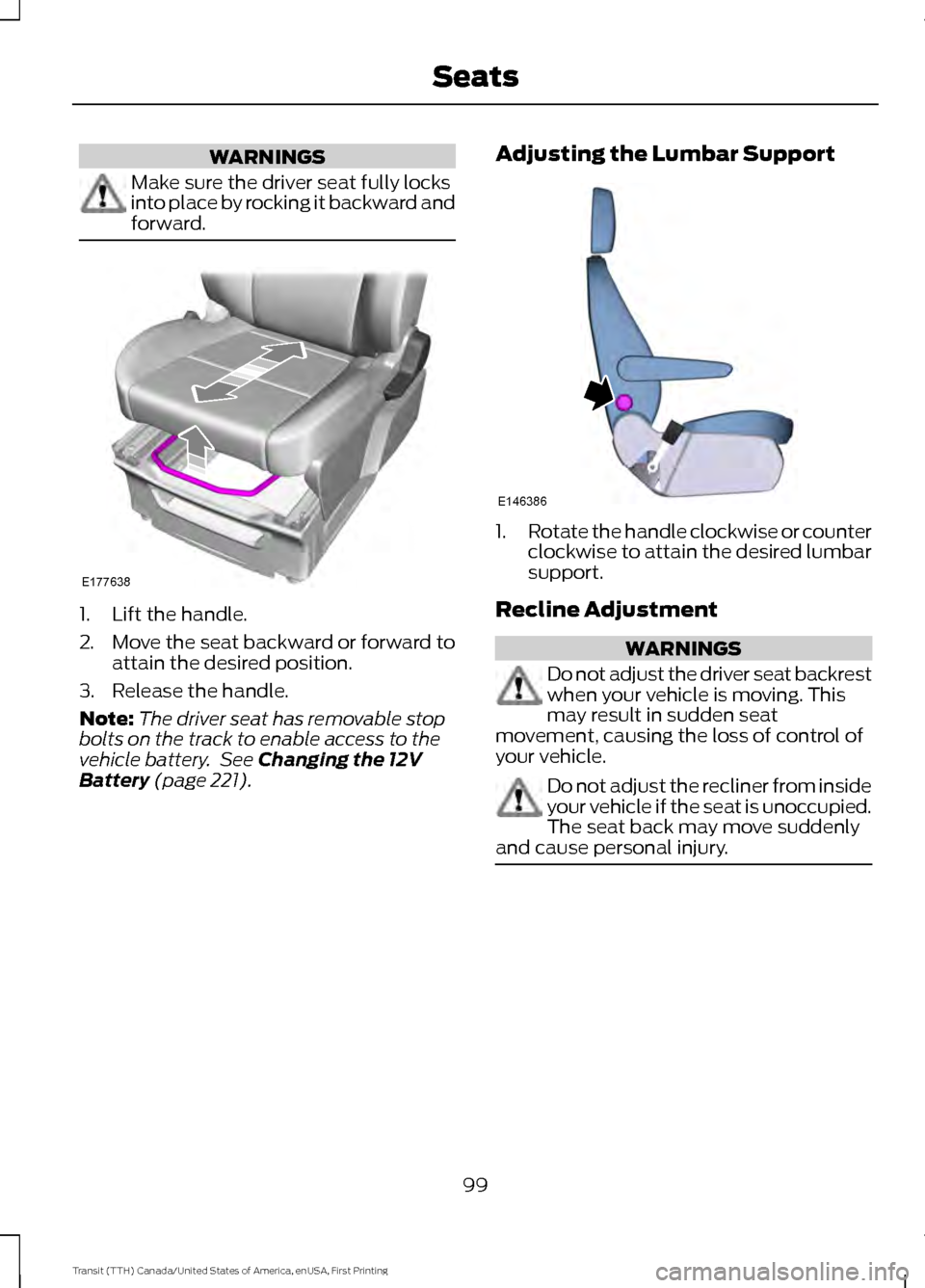
1. Lift the handle.
2. Move the seat backward or forward to
attain the desired position.
3. Release the handle.
Note: The driver seat has removable stop
bolts on the track to enable access to the
vehicle battery. See Changing the 12V
Battery (page 221). Adjusting the Lumbar Support 1.
Rotate the handle clockwise or counter
clockwise to attain the desired lumbar
support.
Recline Adjustment WARNINGS
Do not adjust the driver seat backrest
when your vehicle is moving. This
may result in sudden seat
movement, causing the loss of control of
your vehicle. Do not adjust the recliner from inside
your vehicle if the seat is unoccupied.
The seat back may move suddenly
and cause personal injury. 99
Transit (TTH) Canada/United States of America, enUSA, First Printing SeatsE177638 E146386
Page 103 of 411
1. Lift the handle.
2. Move the seat back backward or
forward to attain the desired position.
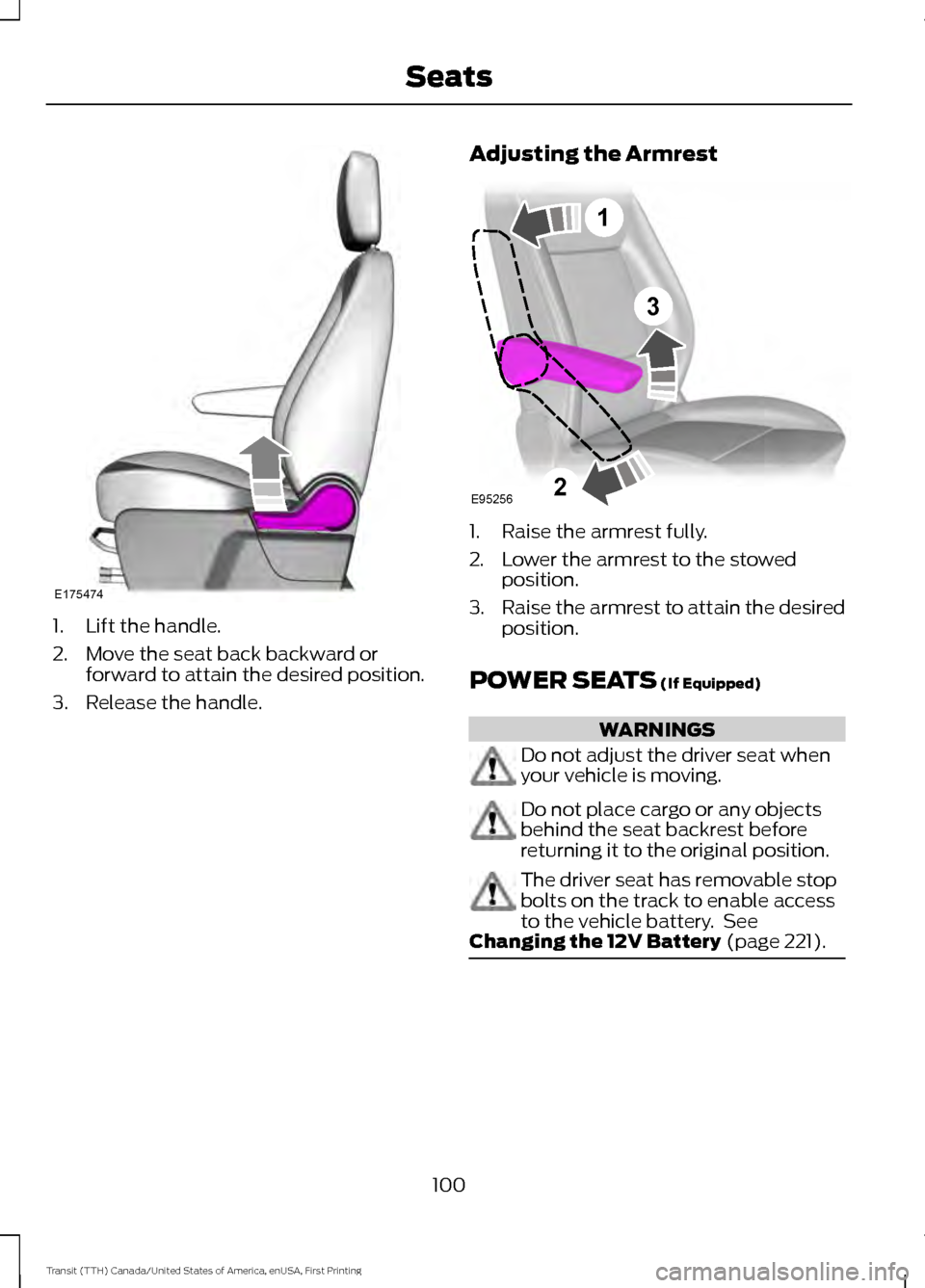
3. Release the handle. Adjusting the Armrest 1. Raise the armrest fully.
2. Lower the armrest to the stowed
position.
3. Raise the armrest to attain the desired
position.
POWER SEATS (If Equipped) WARNINGS
Do not adjust the driver seat when
your vehicle is moving.
Do not place cargo or any objects
behind the seat backrest before
returning it to the original position.
The driver seat has removable stop
bolts on the track to enable access
to the vehicle battery. See
Changing the 12V Battery
(page 221). 100
Transit (TTH) Canada/United States of America, enUSA, First Printing SeatsE175474 3
E95256
1
2
Page 104 of 411
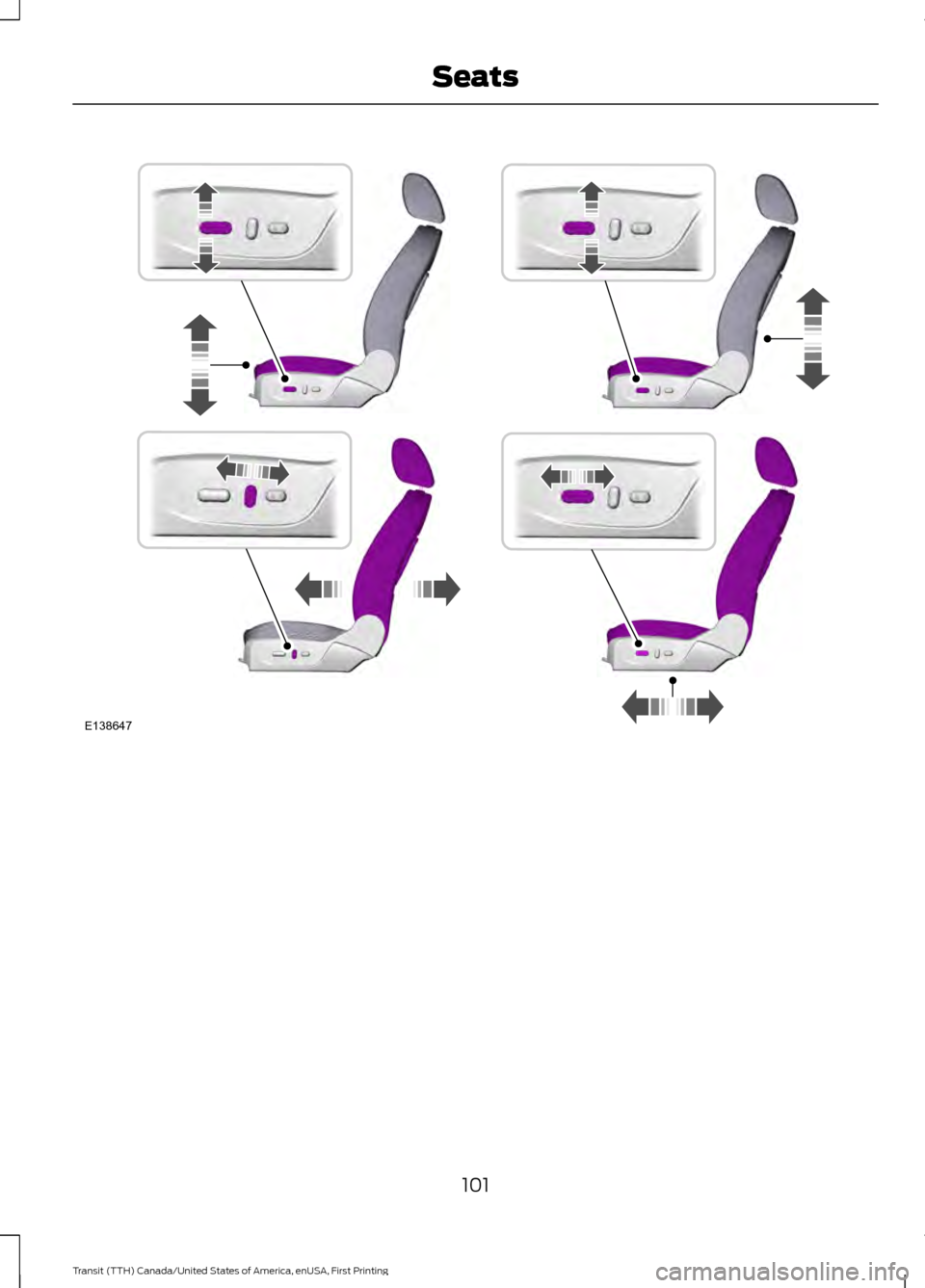
101
Transit (TTH) Canada/United States of America, enUSA, First Printing SeatsE138647
Page 105 of 411
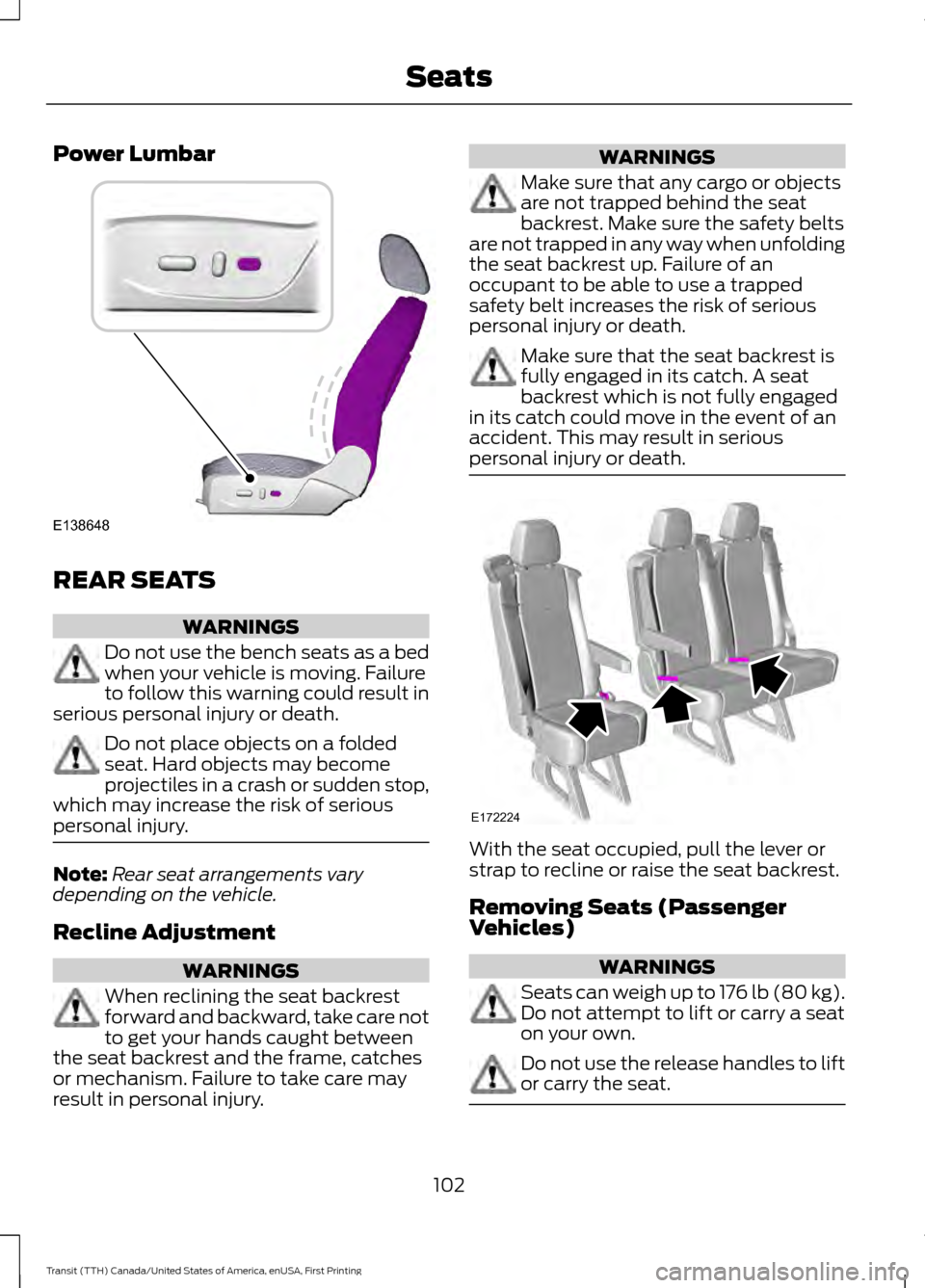
Power Lumbar
REAR SEATS
WARNINGS
Do not use the bench seats as a bed
when your vehicle is moving. Failure
to follow this warning could result in
serious personal injury or death. Do not place objects on a folded
seat. Hard objects may become
projectiles in a crash or sudden stop,
which may increase the risk of serious
personal injury. Note:
Rear seat arrangements vary
depending on the vehicle.
Recline Adjustment WARNINGS
When reclining the seat backrest
forward and backward, take care not
to get your hands caught between
the seat backrest and the frame, catches
or mechanism. Failure to take care may
result in personal injury. WARNINGS
Make sure that any cargo or objects
are not trapped behind the seat
backrest. Make sure the safety belts
are not trapped in any way when unfolding
the seat backrest up. Failure of an
occupant to be able to use a trapped
safety belt increases the risk of serious
personal injury or death. Make sure that the seat backrest is
fully engaged in its catch. A seat
backrest which is not fully engaged
in its catch could move in the event of an
accident. This may result in serious
personal injury or death. With the seat occupied, pull the lever or
strap to recline or raise the seat backrest.
Removing Seats (Passenger
Vehicles)
WARNINGS
Seats can weigh up to 176 lb (80 kg).
Do not attempt to lift or carry a seat
on your own. Do not use the release handles to lift
or carry the seat.
102
Transit (TTH) Canada/United States of America, enUSA, First Printing SeatsE138648 E172224
Page 106 of 411
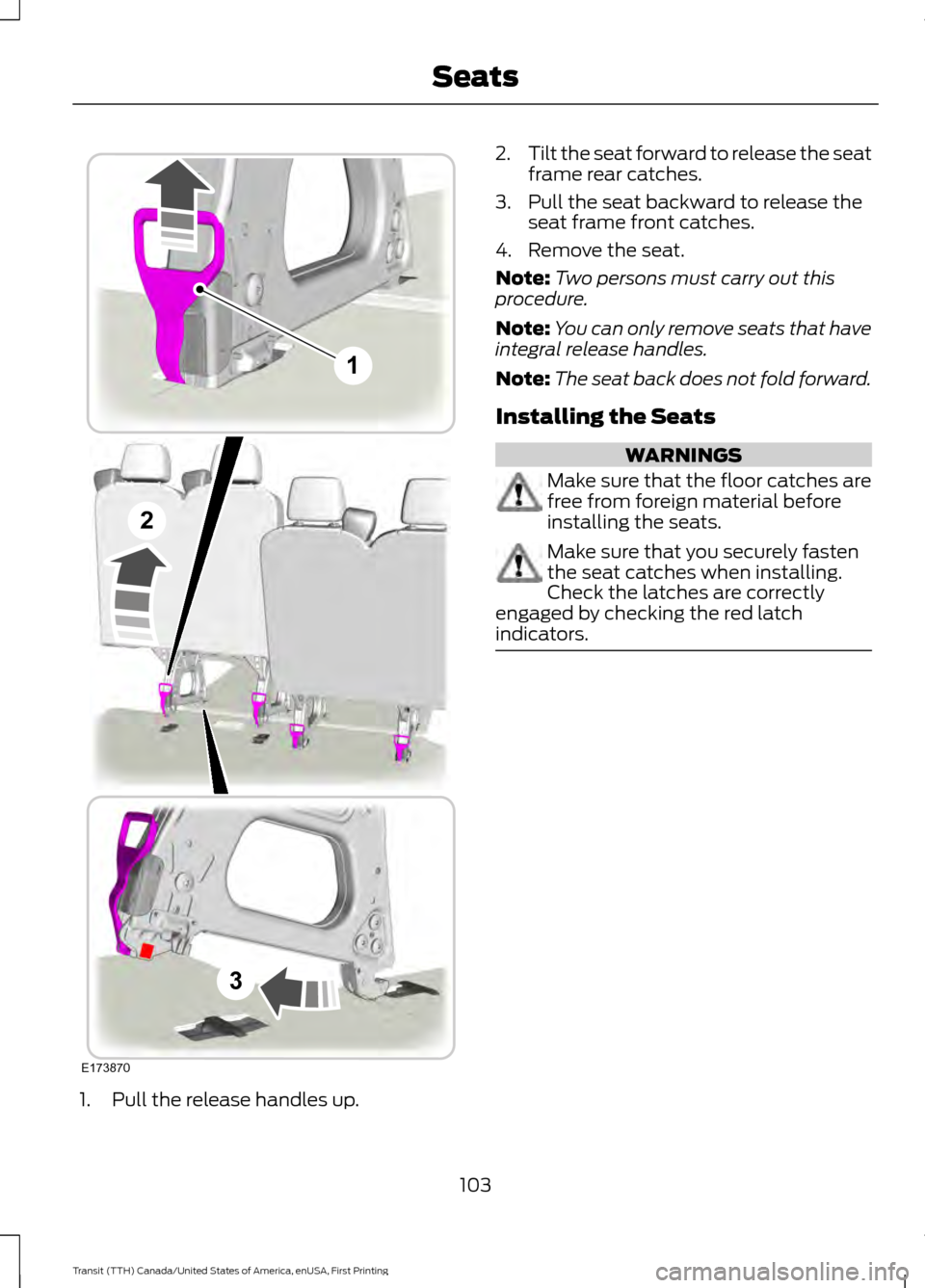
1. Pull the release handles up. 2.
Tilt the seat forward to release the seat
frame rear catches.
3. Pull the seat backward to release the seat frame front catches.
4. Remove the seat.
Note: Two persons must carry out this
procedure.
Note: You can only remove seats that have
integral release handles.
Note: The seat back does not fold forward.
Installing the Seats WARNINGS
Make sure that the floor catches are
free from foreign material before
installing the seats.
Make sure that you securely fasten
the seat catches when installing.
Check the latches are correctly
engaged by checking the red latch
indicators. 103
Transit (TTH) Canada/United States of America, enUSA, First Printing SeatsE173870
1
2
3
Page 107 of 411
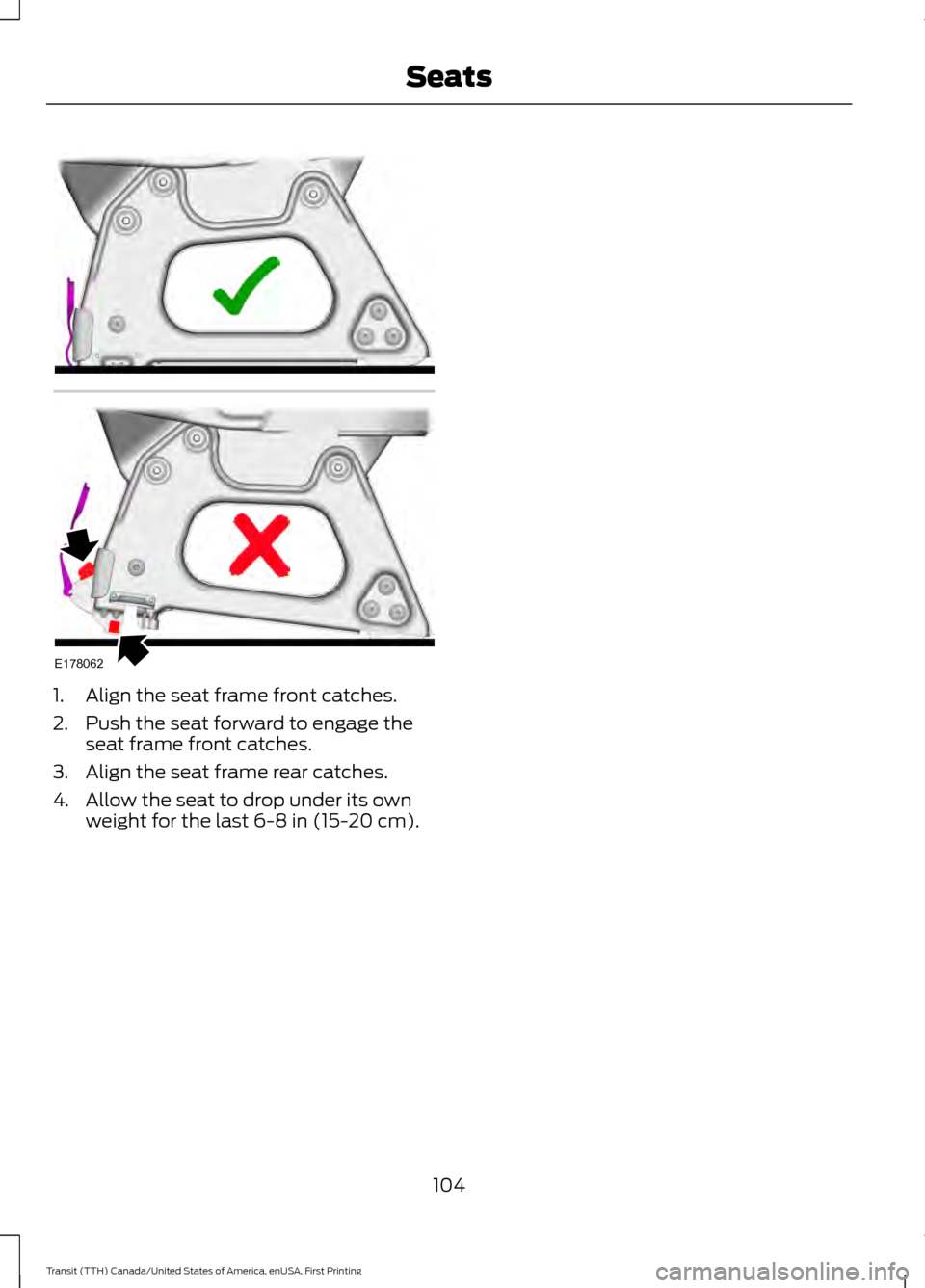
1. Align the seat frame front catches.
2. Push the seat forward to engage the
seat frame front catches.
3. Align the seat frame rear catches.
4. Allow the seat to drop under its own weight for the last 6-8 in (15-20 cm).
104
Transit (TTH) Canada/United States of America, enUSA, First Printing SeatsE178062
Page 124 of 411
Note:
Immediately wash off any diesel
exhaust fluid that has spilled on to a painted
surface with soapy water.
Filling the Diesel Exhaust Fluid Tank
Using a Fuel Station Pump
Filling the diesel exhaust fluid tank using
a pump is similar to a refuelling your
vehicle. The diesel exhaust fluid pump
nozzle will shut off automatically when the
tank is full.
Note: Some filling stations utilize a
magnetic mechanism in the pump nozzle
that may prevent refilling the diesel exhaust
fluid tank. To overcome this issue you will
need to locate another filling station or use
a refill container.
Filling the Diesel Exhaust Fluid Tank
Using a Container
The following procedure applies to
Motorcraft diesel exhaust fluid or similar
fluid containers. Always follow the
manufacturer's instructions.
1. Remove the diesel exhaust fluid container cap. Place the spout on to
the container and tighten it until you
feel a strong resistance.
2. Remove the diesel exhaust fluid tank filler cap.
3. Insert the spout in to the filler neck until
the seal on the spout seats on to the
filler neck. Pour the fluid in to the tank.
When the tank is full the fluid will stop
flowing automatically.
4. Return the container to the vertical position slightly below the diesel
exhaust fluid filler neck. Allow any fluid
remaining in the spout to drain back in
to the container.
5. Remove the spout from the diesel exhaust fluid filler neck. Replace the
diesel exhaust fluid tank cap. 6. Remove the spout from the diesel
exhaust fluid container and replace the
cap.
Note: If there is diesel exhaust fluid left in
the container retain it for later use. The
spout is re-useable. Wash the spout with
clean water prior to storage. Do not use the
diesel exhaust fluid spout with any other
fluid.
Filling the Diesel Exhaust Fluid Tank in
Cold Climates
Diesel exhaust fluid may freeze if the
ambient temperature is below 12°F (-11°C).
Your vehicle has a preheating system
which allows diesel exhaust fluid to
operate below 12°F (-11°C). If you do not
use your vehicle for an extended period
when the ambient temperature is below
12°F (-11°C)
, the fluid in the tank may
freeze. If the tank is overfilled and the fluid
freezes it may damage the tank. This is not
covered by the vehicle warranty.
Contaminated Diesel Exhaust
Fluid or Inoperative Selective
Catalytic Reduction System If the system becomes
contaminated or inoperative, the
diesel exhaust fluid warning
lamp will illuminate and a message will
appear in the information display.
Continued driving without replacing the
fluid or not having the system repaired will
result in:
• Vehicle speed being limited. Prior to
this occurring a message will appear in
the information display.
• Further vehicle operation without
replacing contaminated diesel exhaust
fluid will cause the engine to run at idle
speed.
121
Transit (TTH) Canada/United States of America, enUSA, First Printing Fuel and RefuelingE163176
Page 147 of 411
PRINCIPLE OF OPERATION
WARNINGS
Vehicle modifications involving
braking system, aftermarket roof
racks, suspension, steering system,
tire construction and wheel and tire size
may change the handling characteristics
of your vehicle and may adversely affect
the performance of the electronic stability
control system. In addition, installing any
stereo loudspeakers may interfere with
and adversely affect the electronic stability
control system. Install any aftermarket
stereo loudspeaker as far as possible from
the front center console, the tunnel, and
the front seats in order to minimize the risk
of interfering with the electronic stability
control sensors. Reducing the
effectiveness of the electronic stability
control system could lead to an increased
risk of loss of vehicle control, vehicle
rollover, personal injury and death. Remember that even advanced
technology cannot defy the laws of
physics. It’
s always possible to lose
control of a vehicle due to inappropriate
driver input for the conditions. Aggressive
driving on any road condition can cause
you to lose control of your vehicle
increasing the risk of personal injury or
property damage. Activation of the
electronic stability control system is an
indication that at least some of the tires
have exceeded their ability to grip the road;
this could reduce the operator ’s ability to
control the vehicle potentially resulting in
a loss of vehicle control, vehicle rollover,
personal injury and death. If your electronic
stability control system activates, SLOW
DOWN. The system automatically turns on each
time you switch the ignition on. If a driving condition activates either the
stability control or the traction control
system you may experience the following
conditions:
•
The stability and traction control light
flashes.
• Your vehicle slows down.
• Reduced engine power.
• A vibration in the brake pedal.
• The brake pedal is stiffer than usual.
• If the driving condition is severe and
your foot is not on the brake, the brake
pedal may move as the systems
applies higher brake forces.
The stability control system has several
features built into it to help you maintain
control of your vehicle:
Electronic Stability Control
The system enhances your vehicle ’s ability
to prevent skids or lateral slides by
applying brakes to one or more of the
wheels individually and, if necessary,
reducing engine power.
Roll Stability Control
The system enhances your vehicle ’s ability
to prevent rollovers by detecting your
vehicle ’s roll motion and the rate at which
it changes by applying the brakes to one
or more wheels individually.
Traction Control
The system enhances your vehicle ’s ability
to maintain traction of the wheels by
detecting and controlling wheel spin. See
Using Traction Control (page 143).
144
Transit (TTH) Canada/United States of America, enUSA, First Printing Stability Control