washer fluid FORD TRANSIT 2017 5.G Owners Manual
[x] Cancel search | Manufacturer: FORD, Model Year: 2017, Model line: TRANSIT, Model: FORD TRANSIT 2017 5.GPages: 484, PDF Size: 11.45 MB
Page 7 of 484
Opening and Closing the Hood................211
Under Hood Overview - 3.5L
Ecoboost™.................................................213
Under Hood Overview - 3.7L....................214
Under Hood Overview - 3.2L Power Stroke Diesel..............................................215
Engine Oil Dipstick - 3.5L Ecoboost™.................................................216
Engine Oil Dipstick - 3.7L...........................216
Engine Oil Dipstick - 3.2L Power Stroke Diesel............................................................216
Engine Oil Check...........................................216
Changing the Engine Oil and Oil Filter...............................................................217
Oil Change Indicator Reset.......................218
Engine Cooling Fan - E85/Gasoline......218
Engine Cooling Fan - Diesel......................218
Engine Coolant Check
................................218
Automatic Transmission Fluid Check............................................................222
Brake Fluid Check
........................................223
Power Steering Fluid Check.....................223
Washer Fluid Check....................................223
Draining the Fuel Filter Water Trap - 3.2L Power Stroke Diesel
...............................224
Fuel Filter - Gasoline
...................................226
Changing the 12V Battery.........................226
Checking the Wiper Blades......................228
Changing the Wiper Blades.....................228
Adjusting the Headlamps.........................229
Removing a Headlamp
.............................230
Changing a Bulb
............................................231
Bulb Specification Chart...........................236
Changing the Engine Air Filter.................237
Vehicle Care
Cleaning Products
.......................................239
Cleaning the Exterior..................................240
Waxing.............................................................240
Cleaning the Engine.....................................241 Cleaning the Windows and Wiper
Blades...........................................................241
Cleaning the Interior...................................242
Cleaning the Instrument Panel and Instrument Cluster Lens.......................243
Repairing Minor Paint Damage..............244
Cleaning the Wheels..................................244
Vehicle Storage
............................................244
Wheels and Tires
General Information....................................247
Tire Care
..........................................................248
Using Winter Tires.......................................265
Using Snow Chains.....................................265
Tire Pressure Monitoring System..........266
Changing a Road Wheel...........................270
Technical Specifications...........................279
Capacities and Specific- ations
Engine Specifications - 3.5L Ecoboost™.................................................281
Engine Specifications - 3.7L.....................281
Engine Specifications - 3.2L Power Stroke Diesel.............................................282
Motorcraft Parts - 3.5L Ecoboost™
......283
Motorcraft Parts - 3.7L..............................284
Motorcraft Parts - 3.2L Power Stroke Diesel...........................................................285
Vehicle Identification Number
...............286
Vehicle Certification Label.......................287
Transmission Code Designation............287
Capacities and Specifications - 3.5L Ecoboost™................................................288
Capacities and Specifications - 3.7L......291
Capacities and Specifications - 3.2L Power Stroke Diesel...............................294
Audio System
General Information...................................298
Audio Unit - Vehicles With: AM/FM
......299
4
Transit (TTH) Canada/United States of America, HK3J 19A321 AA enUSA, Edition date: 04/2016, First Printing Table of Contents
Page 74 of 484
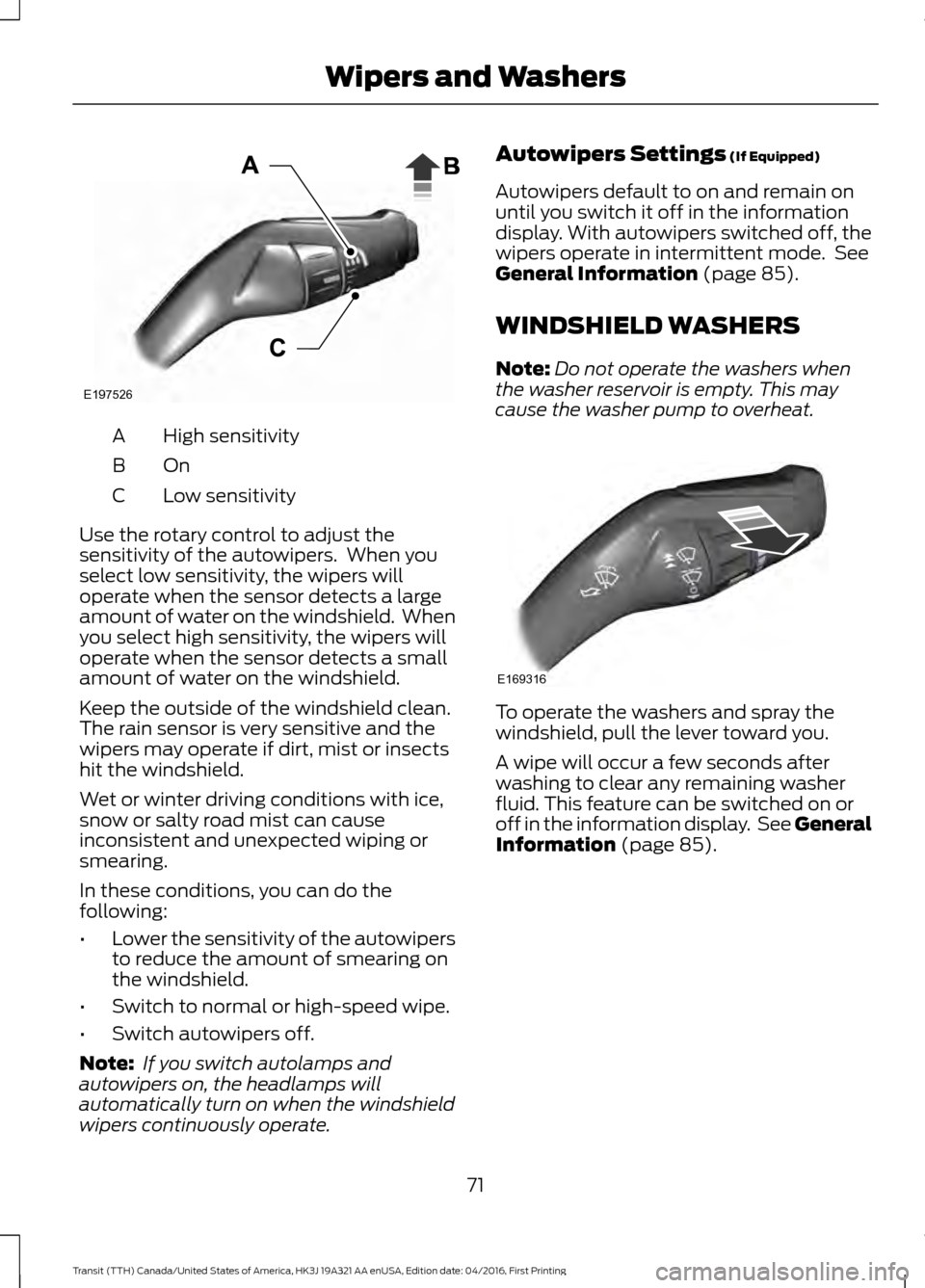
High sensitivity
A
OnB
Low sensitivity
C
Use the rotary control to adjust the
sensitivity of the autowipers. When you
select low sensitivity, the wipers will
operate when the sensor detects a large
amount of water on the windshield. When
you select high sensitivity, the wipers will
operate when the sensor detects a small
amount of water on the windshield.
Keep the outside of the windshield clean.
The rain sensor is very sensitive and the
wipers may operate if dirt, mist or insects
hit the windshield.
Wet or winter driving conditions with ice,
snow or salty road mist can cause
inconsistent and unexpected wiping or
smearing.
In these conditions, you can do the
following:
• Lower the sensitivity of the autowipers
to reduce the amount of smearing on
the windshield.
• Switch to normal or high-speed wipe.
• Switch autowipers off.
Note: If you switch autolamps and
autowipers on, the headlamps will
automatically turn on when the windshield
wipers continuously operate. Autowipers Settings (If Equipped)
Autowipers default to on and remain on
until you switch it off in the information
display. With autowipers switched off, the
wipers operate in intermittent mode. See
General Information
(page 85).
WINDSHIELD WASHERS
Note: Do not operate the washers when
the washer reservoir is empty. This may
cause the washer pump to overheat. To operate the washers and spray the
windshield, pull the lever toward you.
A wipe will occur a few seconds after
washing to clear any remaining washer
fluid. This feature can be switched on or
off in the information display. See General
Information
(page 85).
71
Transit (TTH) Canada/United States of America, HK3J 19A321 AA enUSA, Edition date: 04/2016, First Printing Wipers and WashersE197526 E169316
Page 76 of 484
Headlamp High Beam
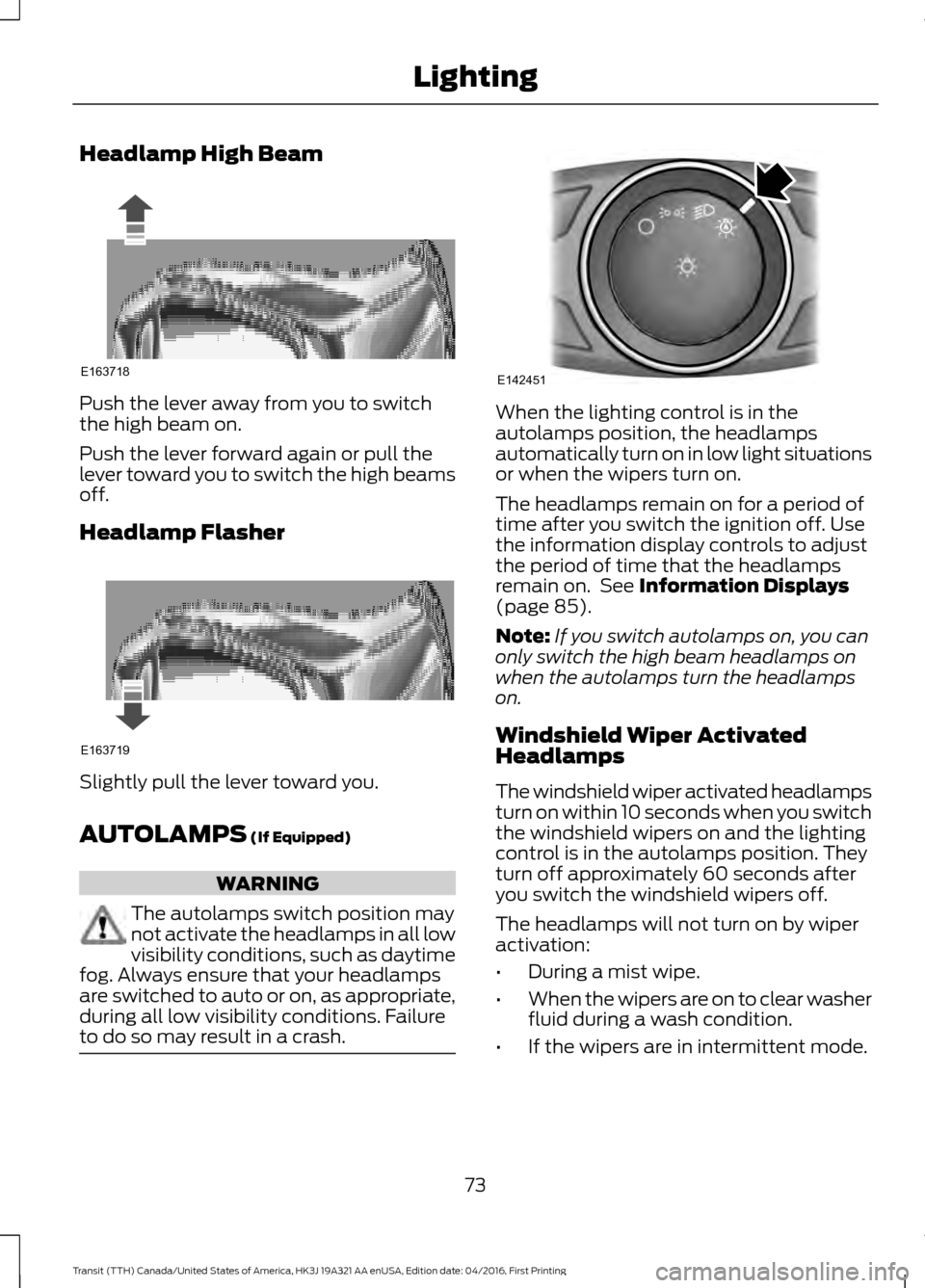
Push the lever away from you to switch
the high beam on.
Push the lever forward again or pull the
lever toward you to switch the high beams
off.
Headlamp Flasher
Slightly pull the lever toward you.
AUTOLAMPS (If Equipped)
WARNING
The autolamps switch position may
not activate the headlamps in all low
visibility conditions, such as daytime
fog. Always ensure that your headlamps
are switched to auto or on, as appropriate,
during all low visibility conditions. Failure
to do so may result in a crash. When the lighting control is in the
autolamps position, the headlamps
automatically turn on in low light situations
or when the wipers turn on.
The headlamps remain on for a period of
time after you switch the ignition off. Use
the information display controls to adjust
the period of time that the headlamps
remain on. See
Information Displays
(page 85).
Note: If you switch autolamps on, you can
only switch the high beam headlamps on
when the autolamps turn the headlamps
on.
Windshield Wiper Activated
Headlamps
The windshield wiper activated headlamps
turn on within 10 seconds when you switch
the windshield wipers on and the lighting
control is in the autolamps position. They
turn off approximately 60 seconds after
you switch the windshield wipers off.
The headlamps will not turn on by wiper
activation:
• During a mist wipe.
• When the wipers are on to clear washer
fluid during a wash condition.
• If the wipers are in intermittent mode.
73
Transit (TTH) Canada/United States of America, HK3J 19A321 AA enUSA, Edition date: 04/2016, First Printing LightingE163718 E163719 E142451
Page 86 of 484
It illuminates when the system is not
available and may indicate that the system
requires service. Have your vehicle
checked as soon as possible.
Low Fuel Level Warning Lamp
If it illuminates when you are
driving, refuel as soon as
possible.
Low Tire Pressure Warning Lamp
(If Equipped) It illuminates if the tire pressure
in one or more tires is below the
correct pressure.
See Tire Pressure Monitoring System
(page 266).
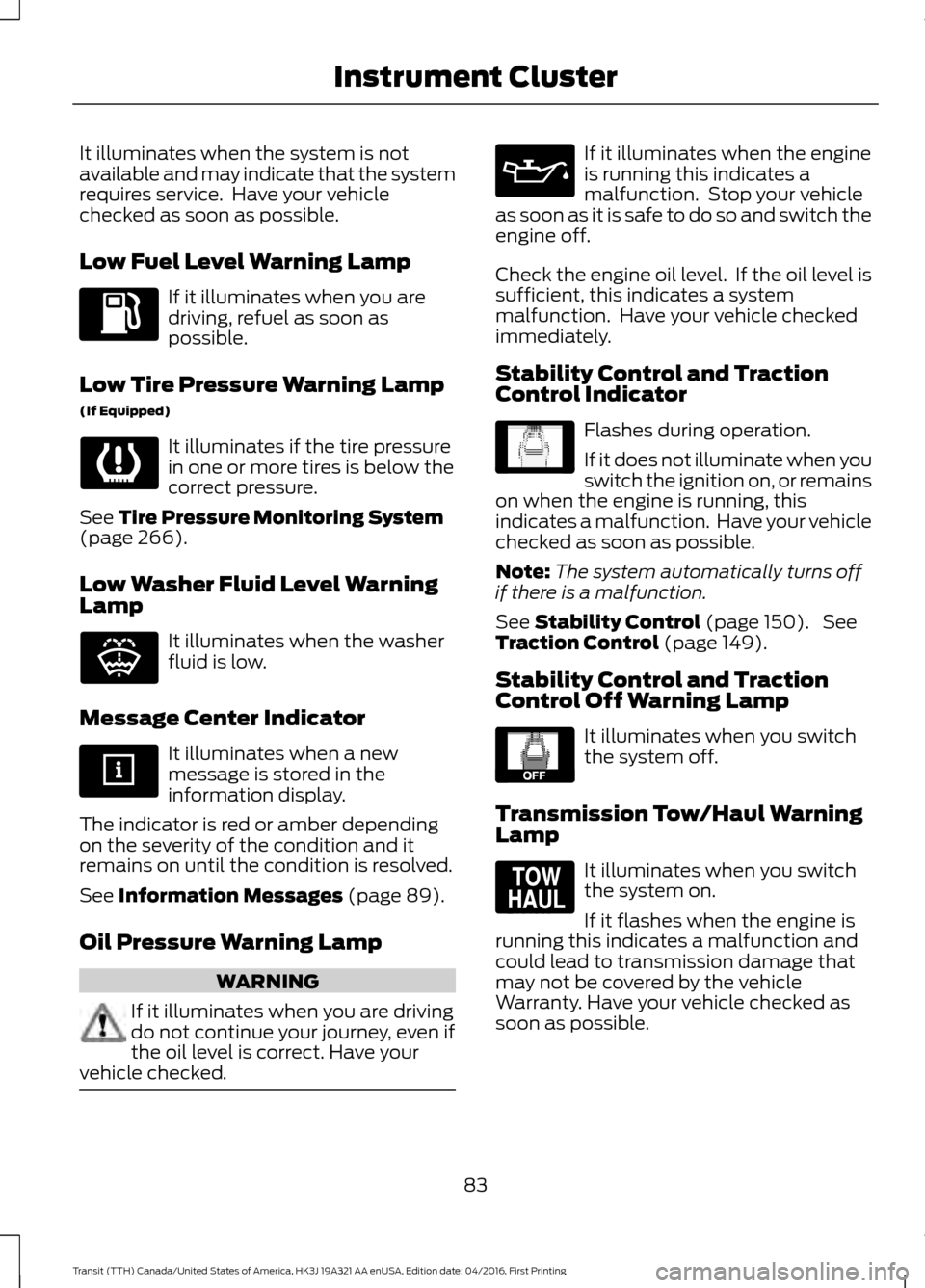
Low Washer Fluid Level Warning
Lamp It illuminates when the washer
fluid is low.
Message Center Indicator It illuminates when a new
message is stored in the
information display.
The indicator is red or amber depending
on the severity of the condition and it
remains on until the condition is resolved.
See
Information Messages (page 89).
Oil Pressure Warning Lamp WARNING
If it illuminates when you are driving
do not continue your journey, even if
the oil level is correct. Have your
vehicle checked. If it illuminates when the engine
is running this indicates a
malfunction. Stop your vehicle
as soon as it is safe to do so and switch the
engine off.
Check the engine oil level. If the oil level is
sufficient, this indicates a system
malfunction. Have your vehicle checked
immediately.
Stability Control and Traction
Control Indicator Flashes during operation.
If it does not illuminate when you
switch the ignition on, or remains
on when the engine is running, this
indicates a malfunction. Have your vehicle
checked as soon as possible.
Note: The system automatically turns off
if there is a malfunction.
See
Stability Control (page 150). See
Traction Control (page 149).
Stability Control and Traction
Control Off Warning Lamp It illuminates when you switch
the system off.
Transmission Tow/Haul Warning
Lamp It illuminates when you switch
the system on.
If it flashes when the engine is
running this indicates a malfunction and
could lead to transmission damage that
may not be covered by the vehicle
Warranty. Have your vehicle checked as
soon as possible.
83
Transit (TTH) Canada/United States of America, HK3J 19A321 AA enUSA, Edition date: 04/2016, First Printing Instrument Cluster E132353 E138639 E130458 E161509
Page 95 of 484
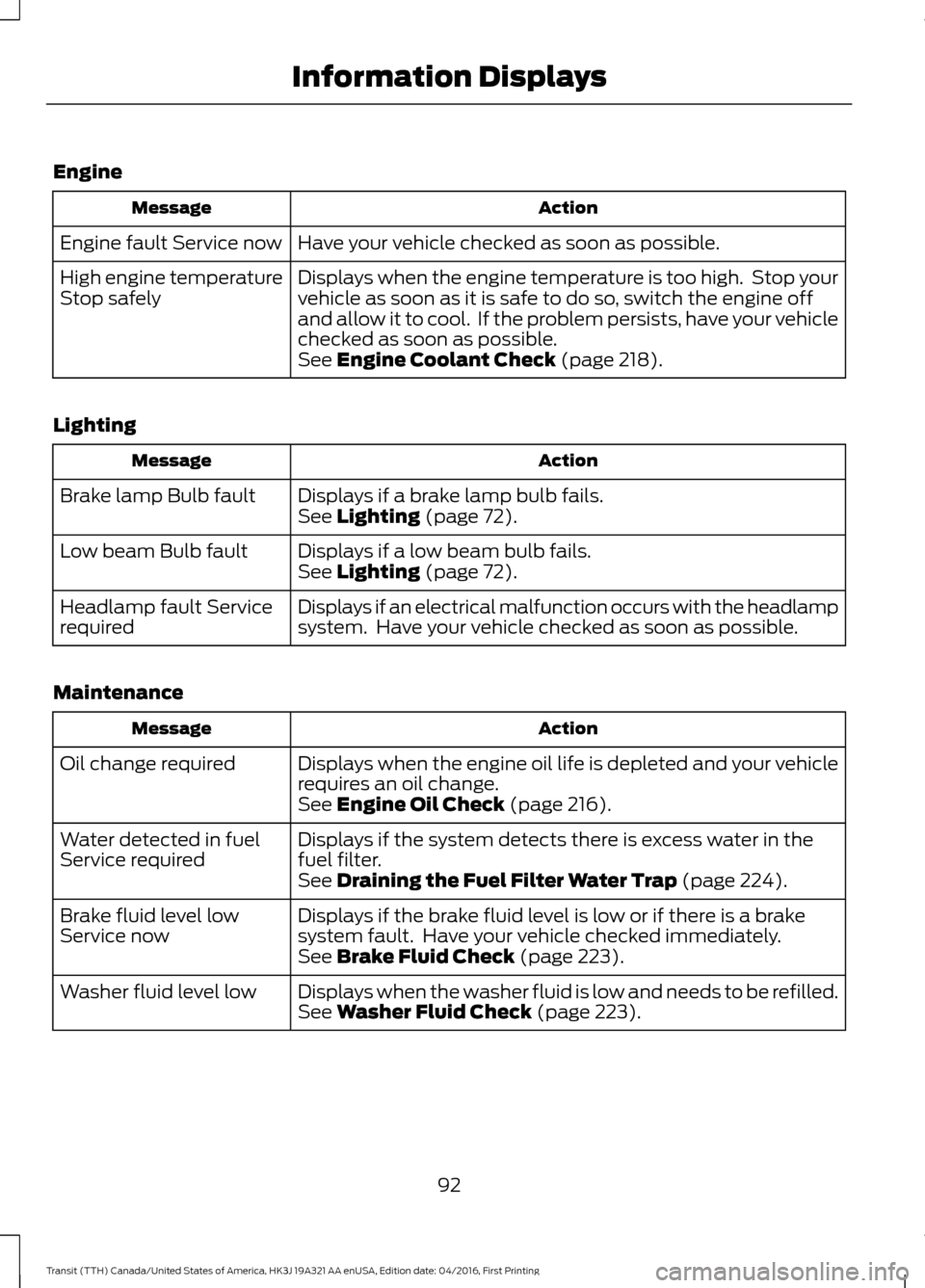
Engine
Action
Message
Have your vehicle checked as soon as possible.
Engine fault Service now
Displays when the engine temperature is too high. Stop your
vehicle as soon as it is safe to do so, switch the engine off
and allow it to cool. If the problem persists, have your vehicle
checked as soon as possible.
High engine temperature
Stop safely
See Engine Coolant Check (page 218).
Lighting Action
Message
Displays if a brake lamp bulb fails.
Brake lamp Bulb fault
See
Lighting (page 72).
Displays if a low beam bulb fails.
Low beam Bulb fault
See
Lighting (page 72).
Displays if an electrical malfunction occurs with the headlamp
system. Have your vehicle checked as soon as possible.
Headlamp fault Service
required
Maintenance Action
Message
Displays when the engine oil life is depleted and your vehicle
requires an oil change.
Oil change required
See
Engine Oil Check (page 216).
Displays if the system detects there is excess water in the
fuel filter.
Water detected in fuel
Service required
See
Draining the Fuel Filter Water Trap (page 224).
Displays if the brake fluid level is low or if there is a brake
system fault. Have your vehicle checked immediately.
Brake fluid level low
Service now
See
Brake Fluid Check (page 223).
Displays when the washer fluid is low and needs to be refilled.
Washer fluid level low
See
Washer Fluid Check (page 223).
92
Transit (TTH) Canada/United States of America, HK3J 19A321 AA enUSA, Edition date: 04/2016, First Printing Information Displays
Page 216 of 484
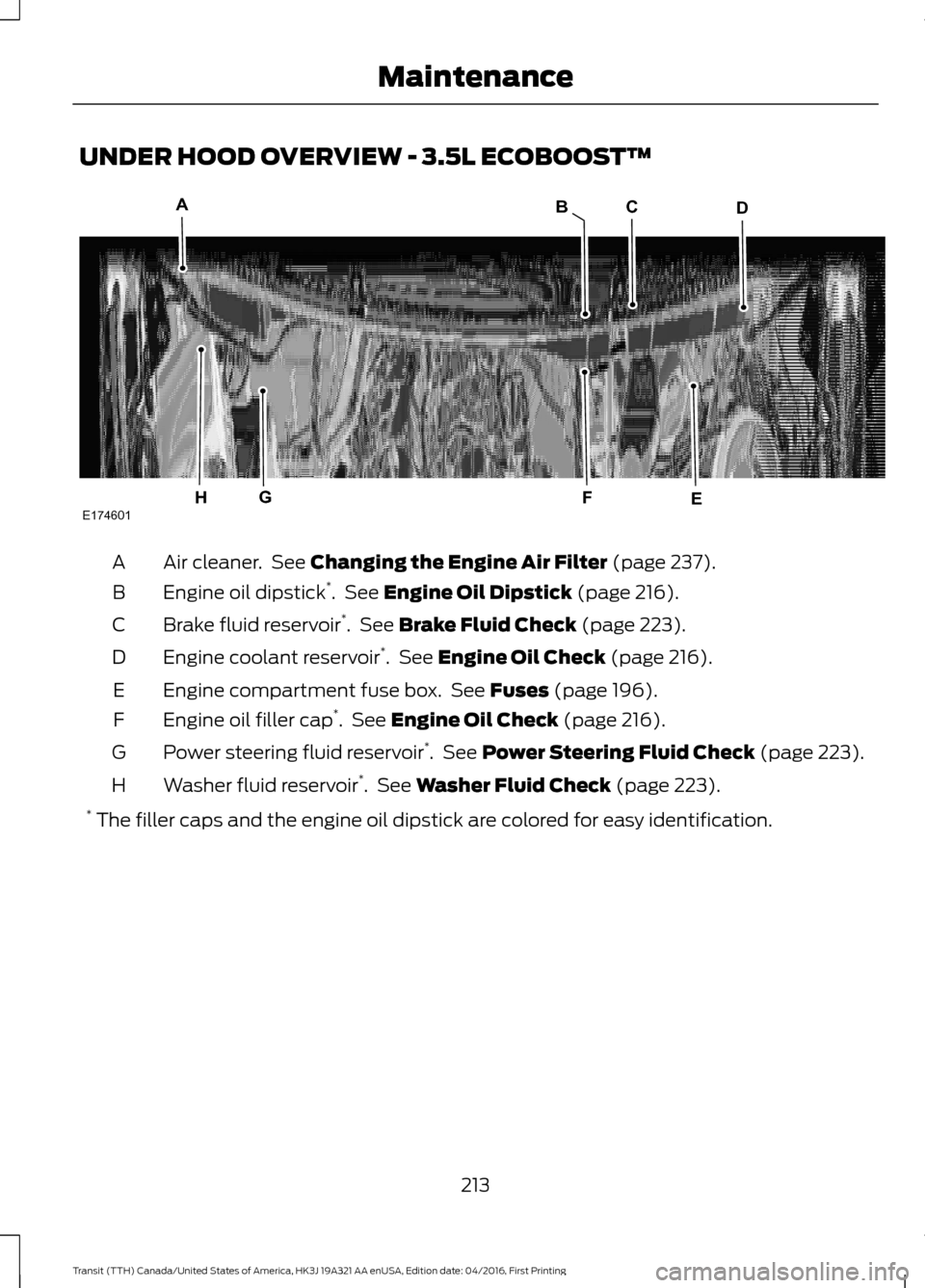
UNDER HOOD OVERVIEW - 3.5L ECOBOOST™
Air cleaner. See Changing the Engine Air Filter (page 237).
A
Engine oil dipstick *
. See
Engine Oil Dipstick (page 216).
B
Brake fluid reservoir *
. See
Brake Fluid Check (page 223).
C
Engine coolant reservoir *
. See
Engine Oil Check (page 216).
D
Engine compartment fuse box. See
Fuses (page 196).
E
Engine oil filler cap *
. See
Engine Oil Check (page 216).
F
Power steering fluid reservoir *
. See
Power Steering Fluid Check (page 223).
G
Washer fluid reservoir *
. See
Washer Fluid Check (page 223).
H
* The filler caps and the engine oil dipstick are colored for easy identification.
213
Transit (TTH) Canada/United States of America, HK3J 19A321 AA enUSA, Edition date: 04/2016, First Printing MaintenanceE174601
ACD
EGH
B
F
Page 217 of 484
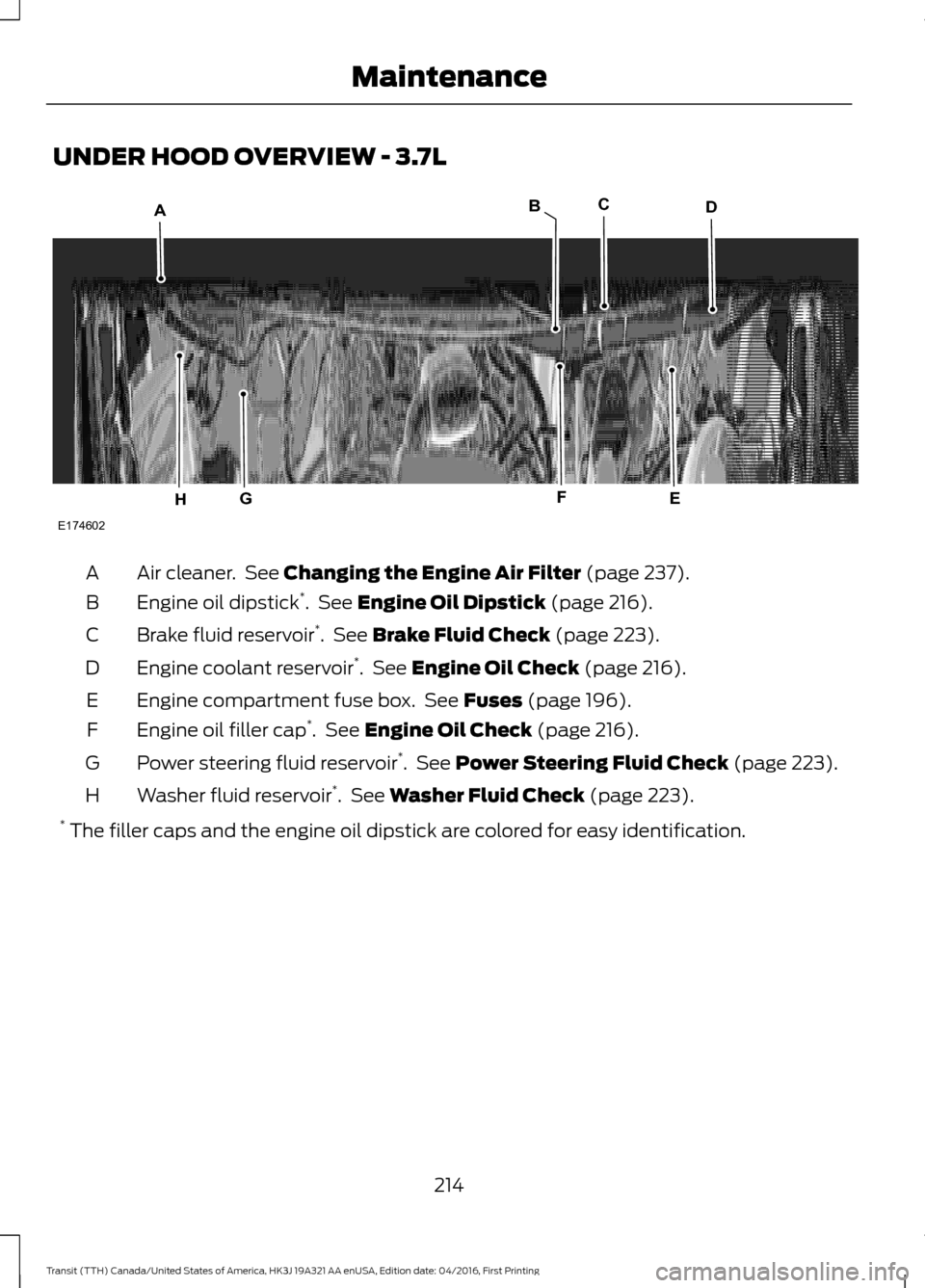
UNDER HOOD OVERVIEW - 3.7L
Air cleaner. See Changing the Engine Air Filter (page 237).
A
Engine oil dipstick *
. See
Engine Oil Dipstick (page 216).
B
Brake fluid reservoir *
. See
Brake Fluid Check (page 223).
C
Engine coolant reservoir *
. See
Engine Oil Check (page 216).
D
Engine compartment fuse box. See
Fuses (page 196).
E
Engine oil filler cap *
. See
Engine Oil Check (page 216).
F
Power steering fluid reservoir *
. See
Power Steering Fluid Check (page 223).
G
Washer fluid reservoir *
. See
Washer Fluid Check (page 223).
H
* The filler caps and the engine oil dipstick are colored for easy identification.
214
Transit (TTH) Canada/United States of America, HK3J 19A321 AA enUSA, Edition date: 04/2016, First Printing MaintenanceE174602
ACD
EGH
B
F
Page 218 of 484
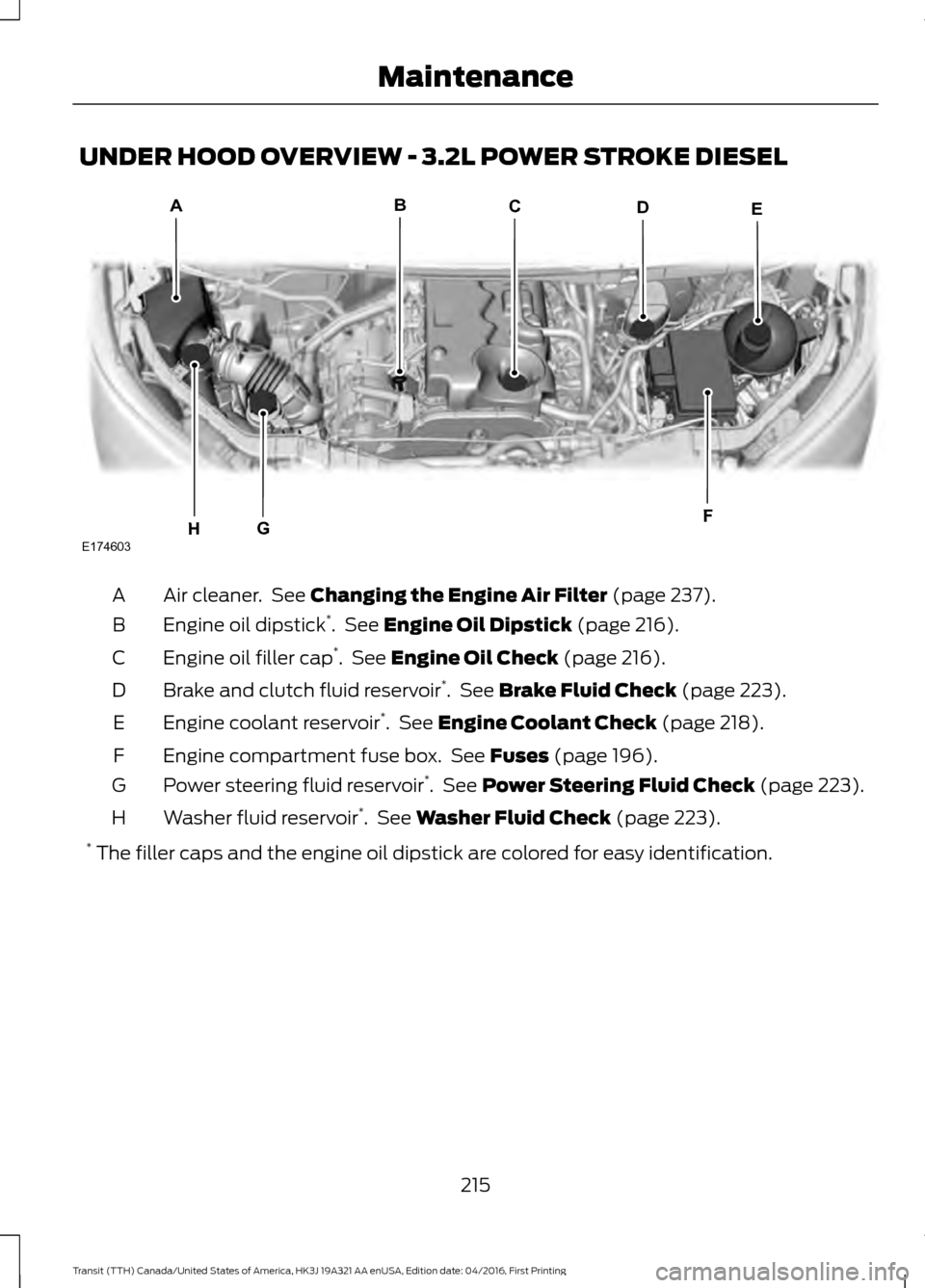
UNDER HOOD OVERVIEW - 3.2L POWER STROKE DIESEL
Air cleaner. See Changing the Engine Air Filter (page 237).
A
Engine oil dipstick *
. See
Engine Oil Dipstick (page 216).
B
Engine oil filler cap *
. See
Engine Oil Check (page 216).
C
Brake and clutch fluid reservoir *
. See
Brake Fluid Check (page 223).
D
Engine coolant reservoir *
. See
Engine Coolant Check (page 218).
E
Engine compartment fuse box. See
Fuses (page 196).
F
Power steering fluid reservoir *
. See
Power Steering Fluid Check (page 223).
G
Washer fluid reservoir *
. See
Washer Fluid Check (page 223).
H
* The filler caps and the engine oil dipstick are colored for easy identification.
215
Transit (TTH) Canada/United States of America, HK3J 19A321 AA enUSA, Edition date: 04/2016, First Printing MaintenanceE174603
ABCDE
FGH
Page 221 of 484
•
Sustained high-speed driving at Gross
Vehicle Weight Rating (maximum
loaded weight for vehicle operation).
• Sustained use of diesel fuel other than
ultra-low sulfur diesel (ULSD).
OIL CHANGE INDICATOR
RESET
Resetting the Oil Life Monitoring
System
Only reset the oil life monitoring system
after changing the engine oil and oil filter.
1. Switch the ignition on. Do not start the
engine. For vehicles with push-button
start, press and hold the start button
for two seconds without pressing the
brake pedal. Do not start the engine.
2. Press the accelerator and brake pedals
at the same time.
3. Keep the accelerator and brake pedals
fully pressed.
4. After three seconds, a message confirming that the reset is in progress
will be displayed.
5. After 25 seconds, a message confirming that the reset is complete
will be displayed.
6. Release the accelerator and brake pedals.
7. The message confirming that the reset
is complete will no longer be displayed.
8. Switch the ignition off. For vehicles with
push-button start, press the start
button to switch the ignition off.
ENGINE COOLING FAN - E85/
GASOLINE WARNING
Keep your hands and clothing clear
of the engine cooling fan. Under certain conditions, the engine
cooling fan may continue to run for several
minutes after you switch your vehicle off.
ENGINE COOLING FAN -
DIESEL
WARNING
Keep your hands and clothing clear
of the engine cooling fan.
Under certain conditions, the engine
cooling fan may continue to run for several
minutes after you switch your vehicle off.
This could happen in low ambient
temperatures and independent of the
engine coolant temperature, for example
short journeys or low coolant temperature.
See Diesel Particulate Filter (page 115).
ENGINE COOLANT CHECK
WARNINGS
Do not add engine coolant when the
engine is hot. Steam and scalding
liquids released from a hot cooling
system can burn you badly. Also, spilling
coolant on hot engine parts can burn you. Do not put engine coolant in the
windshield washer fluid container. If
sprayed on the windshield, engine
coolant could make it difficult to see
through the windshield. To reduce the risk of personal injury,
make sure the engine is cool before
unscrewing the coolant pressure
relief cap. The cooling system is under
pressure. Steam and hot liquid can come
out forcefully when you loosen the cap
slightly. Do not add coolant further than the
MAX mark.
218
Transit (TTH) Canada/United States of America, HK3J 19A321 AA enUSA, Edition date: 04/2016, First Printing Maintenance
Page 222 of 484
When the engine is cold, check the
concentration and level of the coolant at
the intervals listed in the scheduled
maintenance information. See Scheduled
Maintenance (page 427).
Note: Make sure that the coolant level is
between the
MIN and MAX marks on the
coolant reservoir.
Note: Coolant expands when it is hot. The
level may extend beyond the
MAX mark.
Maintain coolant concentration within
48% to 50%, which equates to a freeze
point between -30°F (-34°C) and -34°F
(-37°C). Coolant concentration should be
checked using a refractometer. We do not
recommend the use of hydrometers or
coolant test strips for measuring coolant
concentration.
Adding Coolant WARNING
Never remove the coolant reservoir
cap when the engine is running or
hot.
Note:
Automotive fluids are not
interchangeable. Take care not to put
engine coolant in the windshield washer
fluid reservoir or windshield washer fluid in
the engine coolant reservoir.
Note: Do not use stop leak pellets, cooling
system sealants, or non-specified additives
as they can cause damage to the engine
cooling or heating systems. Resulting
component damage may not be covered by
the vehicle Warranty. It is very important to use prediluted
coolant approved to the correct
specification in order to avoid plugging the
small passageways in the engine cooling
system. See
Capacities and
Specifications (page 281). Do not mix
different colors or types of coolant in your
vehicle. Mixing of engine coolants or using
an incorrect coolant may harm the engine
or cooling system components and may
not be covered by the vehicle Warranty.
Note: If prediluted coolant is not available,
use the approved concentrated coolant
diluting it to 50/50 with distilled water. See
Capacities and Specifications (page 281).
Using water that has not been deionised
may contribute to deposit formation,
corrosion and plugging of the small cooling
system passageways.
Note: Coolants marketed for all makes and
models may not be approved to Ford
specifications and may cause damage to
the cooling system. Resulting component
damage may not be covered by the vehicle
Warranty.
If the coolant level is at or below the
minimum mark, add prediluted coolant
immediately.
To top up the coolant level do the
following:
1. Unscrew the cap slowly. Any pressure escapes as you unscrew the cap.
2. Add prediluted coolant approved to the correct specification. See
Capacities and Specifications (page
281
).
3. Add enough prediluted coolant to reach the correct level.
4. Replace the coolant reservoir cap, turn
it clockwise until you feel a strong
resistance.
219
Transit (TTH) Canada/United States of America, HK3J 19A321 AA enUSA, Edition date: 04/2016, First Printing Maintenance