ECU FORD TRANSIT 2021 Owners Manual
[x] Cancel search | Manufacturer: FORD, Model Year: 2021, Model line: TRANSIT, Model: FORD TRANSIT 2021Pages: 509, PDF Size: 8.21 MB
Page 5 of 509
Sliding Door - Vehicles
Without: Power Sliding Door
Sliding Door Precautions ...........................80
Opening the Sliding Door ..........................
80
Closing the Sliding Door ............................
80
Sliding Door - Vehicles With: Power Sliding Door
Sliding Door Precautions ...........................
82
Opening the Sliding Door ...........................
82
Closing the Sliding Door .............................
83
Stopping the Sliding Door Movement ........................................................................\
..
84
Resetting the Power Sliding Door ..........
84
Sliding Door – Troubleshooting ..............
85
Keyless Entry
Locating the Keyless Entry Keypad ........
87
Master Access Code .....................................
87
Keyless Entry Settings .................................
87
Locking and Unlocking the Doors Using Keyless Entry ..............................................
88
Keyless Entry – Troubleshooting ............
88
Security
Passive Anti-Theft System - Vehicles With: Passive Anti-Theft System
(PATS) ..........................................................
89
Anti-Theft Alarm - Vehicles Without: Anti-Theft Alarm Horn with Integral
Battery ..........................................................
90
Anti-Theft Alarm - Vehicles With: Anti-Theft Alarm Horn with Integral
Battery ...........................................................
91
Power Running Boards
Using Power Running Boards ...................
93
Steering Wheel
Adjusting the Steering Wheel ..................
96Locking the Steering Wheel
......................
96
Wipers and Washers
Windshield Wipers ........................................
97
Autowipers .......................................................
97
Windshield Washers ....................................
99
Lighting
General Information ..................................
100
Lighting Control ...........................................
100
Autolamps ......................................................
101
Instrument Lighting Dimmer ...................
102
Daytime Running Lamps ..........................
102
Automatic High Beam Control ...............
103
Front Fog Lamps .........................................
104
Direction Indicators ....................................
105
Interior Lamps - Van ...................................
105
Cargo Lamps ................................................
106
Windows and Mirrors
Power Windows ...........................................
107
Exterior Mirrors .............................................
108
Interior Mirror ................................................
109
Instrument Cluster
Gauges .............................................................
110
Warning Lamps and Indicators ................
111
Information Displays
General Information ....................................
115
Trip Computer ................................................
117
Personalized Settings .................................
118
Remote Start
What Is Remote Start ................................
120
Remote Start Limitations .........................
120
Enabling Remote Start ..............................
120
Remotely Starting and Stopping the Vehicle .........................................................
120
2
2021 Transit (TTH) Canada/United States of America, MK3J 19A321 AA enUSA, Edition date: 202010, Second-Printing Table of Contents
Page 22 of 509
GENERAL INFORMATION
See the following sections for directions
on how to properly use safety restraints
for children.
WARNING: Always make sure your
child is secured properly in a device that
is appropriate for their height, age and
weight. Child safety restraints must be
bought separately from your vehicle.
Failure to follow these instructions and
guidelines may result in an increased risk
of serious injury or death to your child. WARNING: All children are shaped
differently. The National Highway Traffic
Safety Administration and other safety
organizations, base their
recommendations for child restraints on
probable child height, age and weight
thresholds, or on the minimum
requirements of the law. We recommend
that you check with a NHTSA Certified
Child Passenger Safety Technician (CPST) to make sure that you properly
install the child restraint in your vehicle
and that you consult your pediatrician to
make sure you have a child restraint
appropriate for your child. To locate a
child restraint fitting station and CPST,
contact NHTSA toll free at
1-888-327-4236 or go to
www.nhtsa.dot.gov. In Canada, contact
Transport Canada toll free at
1-800-333-0371 or go to www.tc.gc.ca
to find a Child Car Seat Clinic in your
area. Failure to properly restrain children
in child restraints made especially for
their height, age and weight, may result
in an increased risk of serious injury or
death to your child.
WARNING:
On hot days, the
temperature inside the vehicle can rise
very quickly. Exposure of people or
animals to these high temperatures for
even a short time can cause death or
serious heat related injuries, including
brain damage. Small children are
particularly at risk.
19
2021 Transit (TTH) Canada/United States of America, MK3J 19A321 AA enUSA, Edition date: 202010, Second-Printing Child Safety
Page 24 of 509
INSTALLING CHILD
RESTRAINTS
Child Safety Restraint
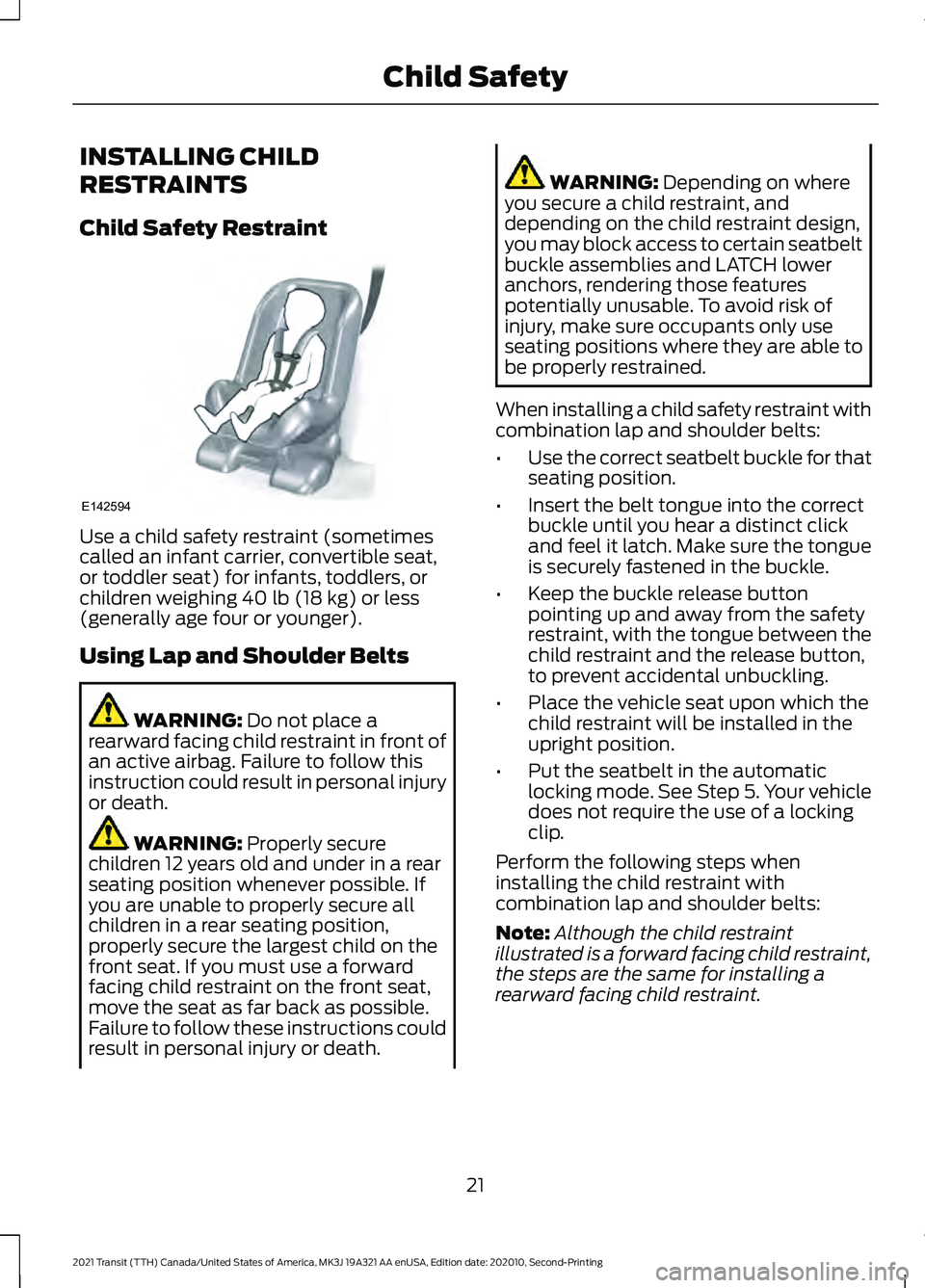
Use a child safety restraint (sometimes
called an infant carrier, convertible seat,
or toddler seat) for infants, toddlers, or
children weighing 40 lb (18 kg) or less
(generally age four or younger).
Using Lap and Shoulder Belts WARNING:
Do not place a
rearward facing child restraint in front of
an active airbag. Failure to follow this
instruction could result in personal injury
or death. WARNING:
Properly secure
children 12 years old and under in a rear
seating position whenever possible. If
you are unable to properly secure all
children in a rear seating position,
properly secure the largest child on the
front seat. If you must use a forward
facing child restraint on the front seat,
move the seat as far back as possible.
Failure to follow these instructions could
result in personal injury or death. WARNING:
Depending on where
you secure a child restraint, and
depending on the child restraint design,
you may block access to certain seatbelt
buckle assemblies and LATCH lower
anchors, rendering those features
potentially unusable. To avoid risk of
injury, make sure occupants only use
seating positions where they are able to
be properly restrained.
When installing a child safety restraint with
combination lap and shoulder belts:
• Use the correct seatbelt buckle for that
seating position.
• Insert the belt tongue into the correct
buckle until you hear a distinct click
and feel it latch. Make sure the tongue
is securely fastened in the buckle.
• Keep the buckle release button
pointing up and away from the safety
restraint, with the tongue between the
child restraint and the release button,
to prevent accidental unbuckling.
• Place the vehicle seat upon which the
child restraint will be installed in the
upright position.
• Put the seatbelt in the automatic
locking mode. See Step 5. Your vehicle
does not require the use of a locking
clip.
Perform the following steps when
installing the child restraint with
combination lap and shoulder belts:
Note: Although the child restraint
illustrated is a forward facing child restraint,
the steps are the same for installing a
rearward facing child restraint.
21
2021 Transit (TTH) Canada/United States of America, MK3J 19A321 AA enUSA, Edition date: 202010, Second-Printing Child SafetyE142594
Page 25 of 509
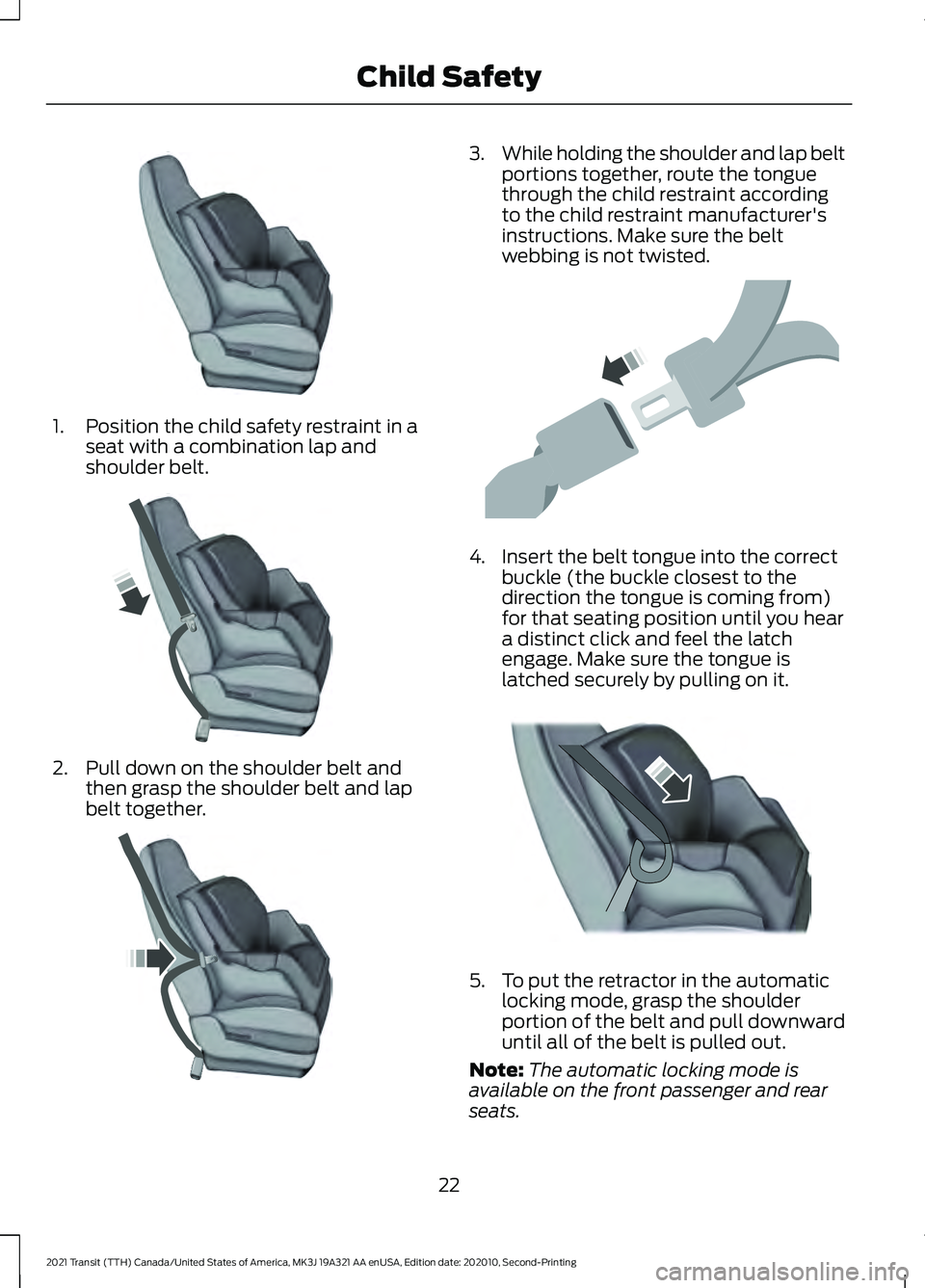
1. Position the child safety restraint in a
seat with a combination lap and
shoulder belt. 2. Pull down on the shoulder belt and
then grasp the shoulder belt and lap
belt together. 3.
While holding the shoulder and lap belt
portions together, route the tongue
through the child restraint according
to the child restraint manufacturer's
instructions. Make sure the belt
webbing is not twisted. 4. Insert the belt tongue into the correct
buckle (the buckle closest to the
direction the tongue is coming from)
for that seating position until you hear
a distinct click and feel the latch
engage. Make sure the tongue is
latched securely by pulling on it. 5. To put the retractor in the automatic
locking mode, grasp the shoulder
portion of the belt and pull downward
until all of the belt is pulled out.
Note: The automatic locking mode is
available on the front passenger and rear
seats.
22
2021 Transit (TTH) Canada/United States of America, MK3J 19A321 AA enUSA, Edition date: 202010, Second-Printing Child SafetyE142528 E142529 E142530 E142531 E142875
Page 26 of 509
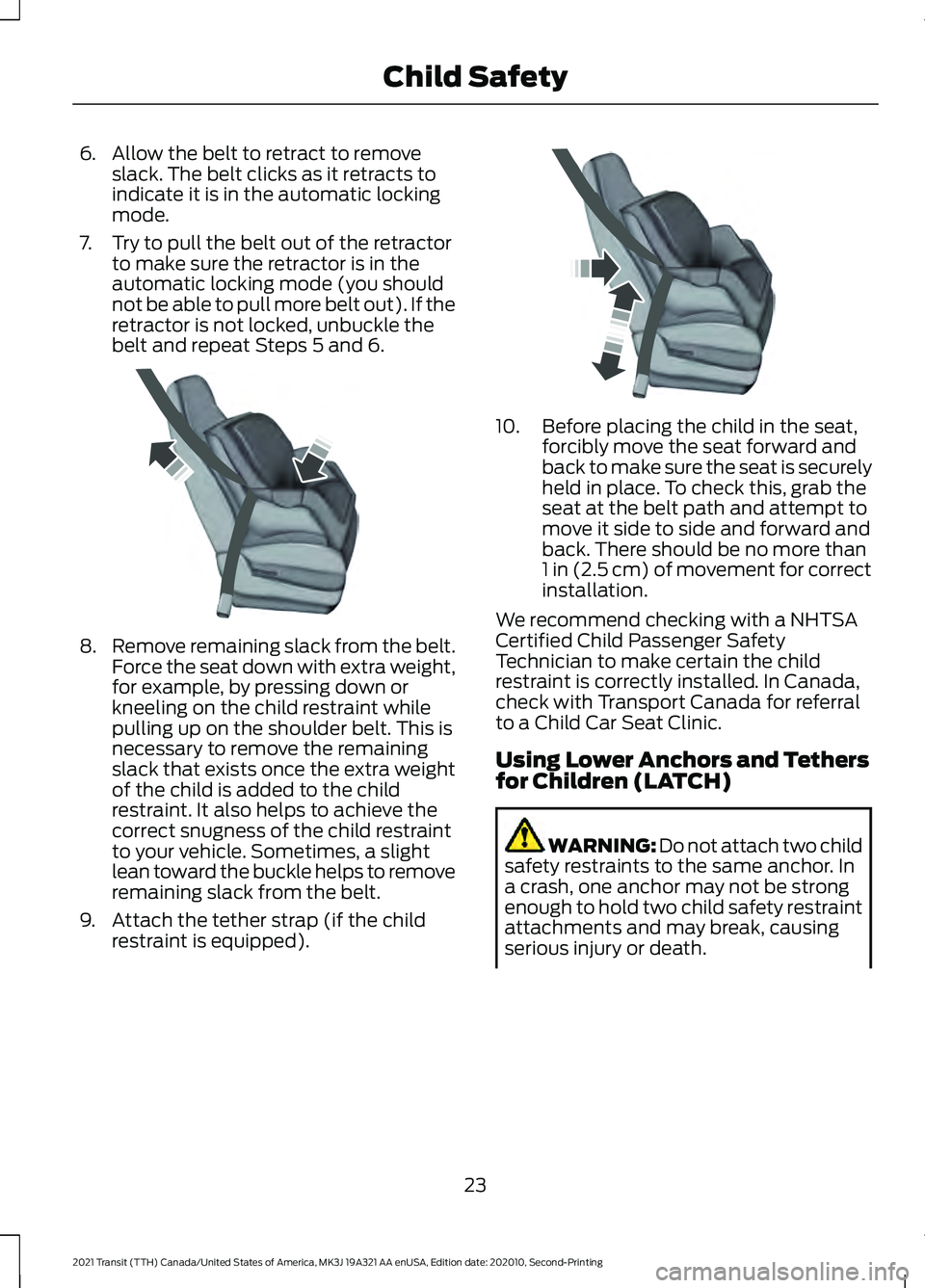
6. Allow the belt to retract to remove
slack. The belt clicks as it retracts to
indicate it is in the automatic locking
mode.
7. Try to pull the belt out of the retractor to make sure the retractor is in the
automatic locking mode (you should
not be able to pull more belt out). If the
retractor is not locked, unbuckle the
belt and repeat Steps 5 and 6. 8.
Remove remaining slack from the belt.
Force the seat down with extra weight,
for example, by pressing down or
kneeling on the child restraint while
pulling up on the shoulder belt. This is
necessary to remove the remaining
slack that exists once the extra weight
of the child is added to the child
restraint. It also helps to achieve the
correct snugness of the child restraint
to your vehicle. Sometimes, a slight
lean toward the buckle helps to remove
remaining slack from the belt.
9. Attach the tether strap (if the child restraint is equipped). 10. Before placing the child in the seat,
forcibly move the seat forward and
back to make sure the seat is securely
held in place. To check this, grab the
seat at the belt path and attempt to
move it side to side and forward and
back. There should be no more than
1 in (2.5 cm) of movement for correct
installation.
We recommend checking with a NHTSA
Certified Child Passenger Safety
Technician to make certain the child
restraint is correctly installed. In Canada,
check with Transport Canada for referral
to a Child Car Seat Clinic.
Using Lower Anchors and Tethers
for Children (LATCH) WARNING: Do not attach two child
safety restraints to the same anchor. In
a crash, one anchor may not be strong
enough to hold two child safety restraint
attachments and may break, causing
serious injury or death.
23
2021 Transit (TTH) Canada/United States of America, MK3J 19A321 AA enUSA, Edition date: 202010, Second-Printing Child SafetyE142533 E142534
Page 27 of 509
WARNING: Depending on where
you secure a child restraint, and
depending on the child restraint design,
you may block access to certain seatbelt
buckle assemblies and LATCH lower
anchors, rendering those features
potentially unusable. To avoid risk of
injury, make sure occupants only use
seating positions where they are able to
be properly restrained.
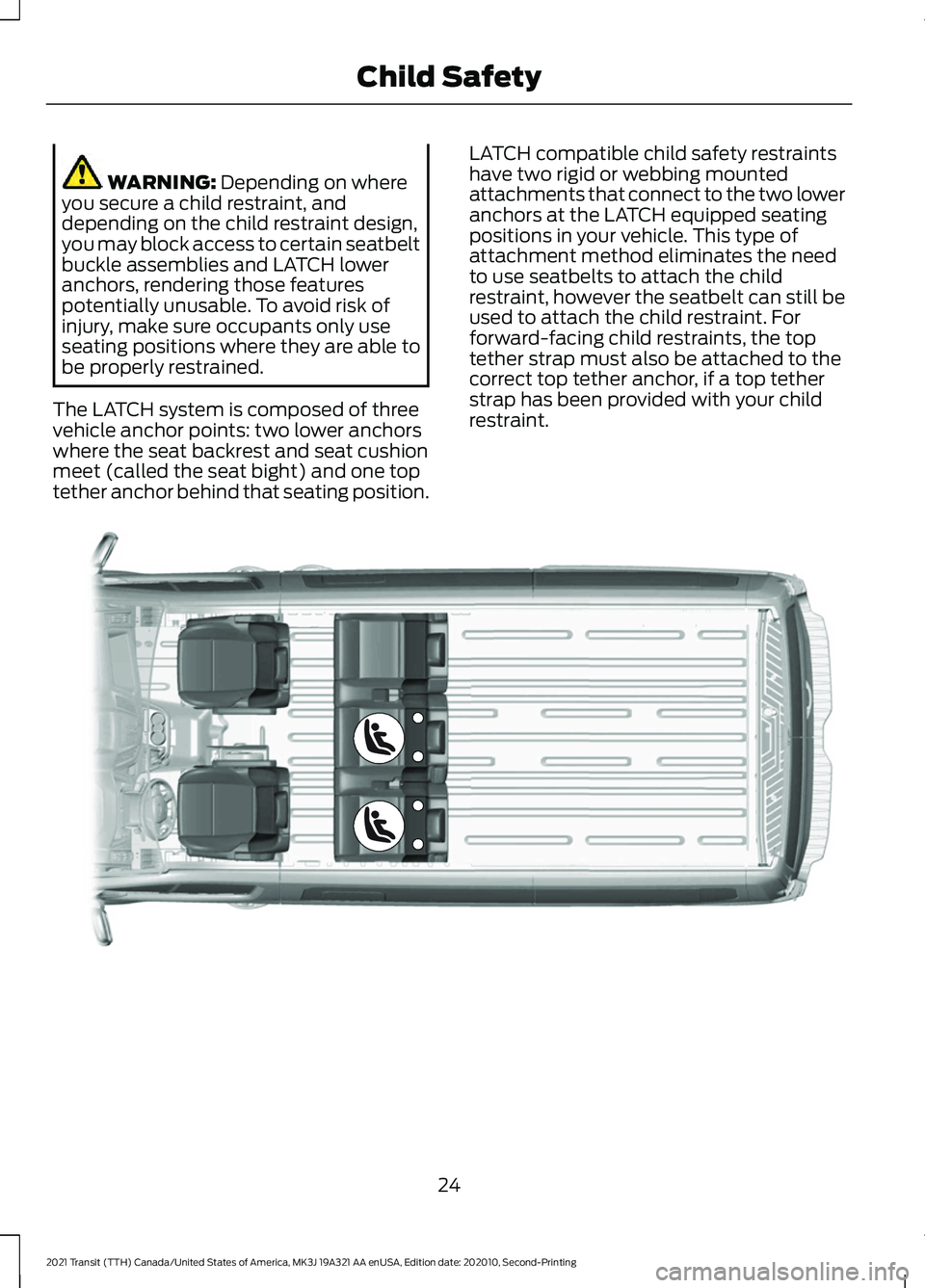
The LATCH system is composed of three
vehicle anchor points: two lower anchors
where the seat backrest and seat cushion
meet (called the seat bight) and one top
tether anchor behind that seating position. LATCH compatible child safety restraints
have two rigid or webbing mounted
attachments that connect to the two lower
anchors at the LATCH equipped seating
positions in your vehicle. This type of
attachment method eliminates the need
to use seatbelts to attach the child
restraint, however the seatbelt can still be
used to attach the child restraint. For
forward-facing child restraints, the top
tether strap must also be attached to the
correct top tether anchor, if a top tether
strap has been provided with your child
restraint.
24
2021 Transit (TTH) Canada/United States of America, MK3J 19A321 AA enUSA, Edition date: 202010, Second-Printing Child SafetyE311548
Page 32 of 509
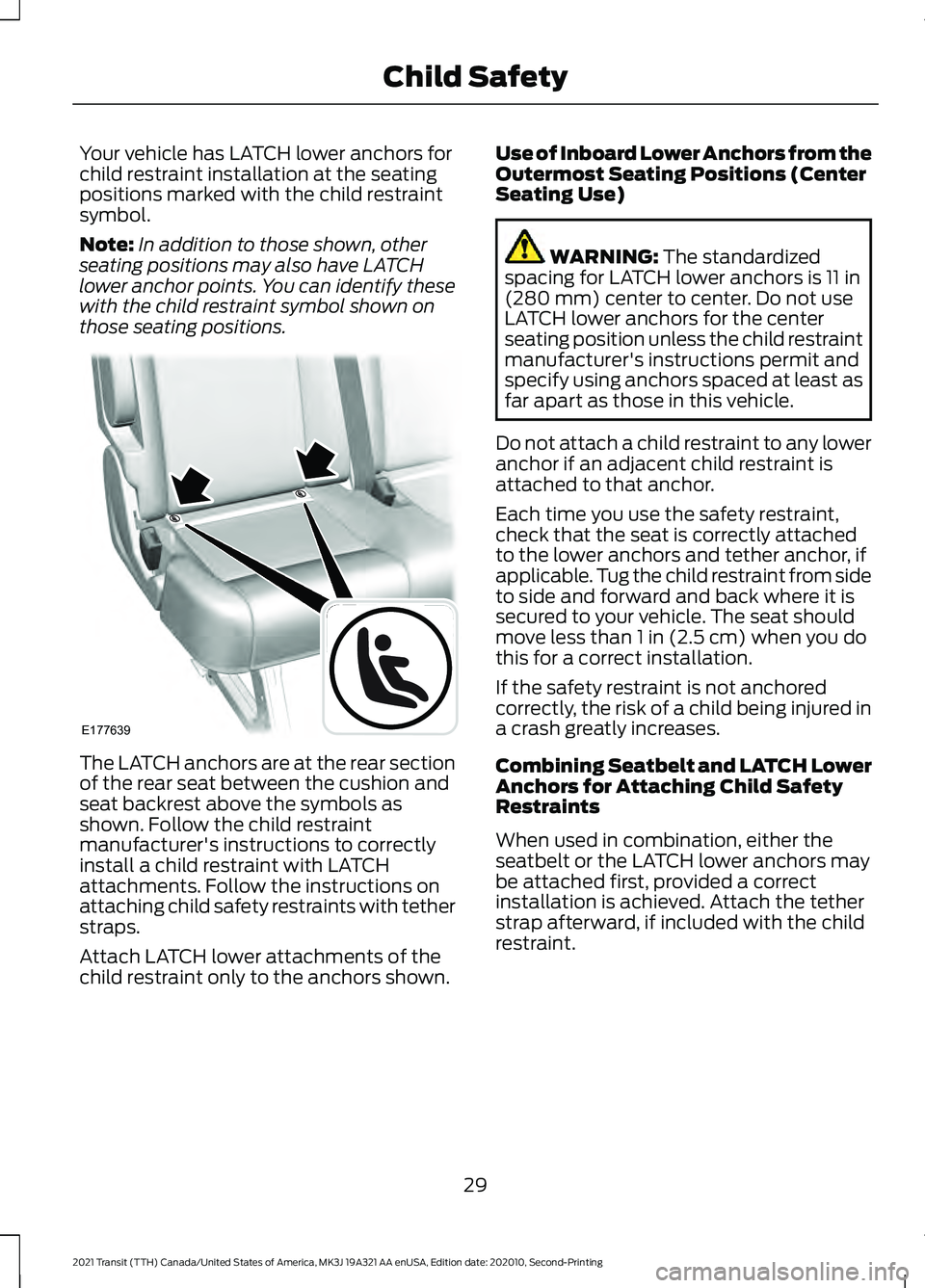
Your vehicle has LATCH lower anchors for
child restraint installation at the seating
positions marked with the child restraint
symbol.
Note:
In addition to those shown, other
seating positions may also have LATCH
lower anchor points. You can identify these
with the child restraint symbol shown on
those seating positions. The LATCH anchors are at the rear section
of the rear seat between the cushion and
seat backrest above the symbols as
shown. Follow the child restraint
manufacturer's instructions to correctly
install a child restraint with LATCH
attachments. Follow the instructions on
attaching child safety restraints with tether
straps.
Attach LATCH lower attachments of the
child restraint only to the anchors shown. Use of Inboard Lower Anchors from the
Outermost Seating Positions (Center
Seating Use) WARNING: The standardized
spacing for LATCH lower anchors is 11 in
(280 mm) center to center. Do not use
LATCH lower anchors for the center
seating position unless the child restraint
manufacturer's instructions permit and
specify using anchors spaced at least as
far apart as those in this vehicle.
Do not attach a child restraint to any lower
anchor if an adjacent child restraint is
attached to that anchor.
Each time you use the safety restraint,
check that the seat is correctly attached
to the lower anchors and tether anchor, if
applicable. Tug the child restraint from side
to side and forward and back where it is
secured to your vehicle. The seat should
move less than
1 in (2.5 cm) when you do
this for a correct installation.
If the safety restraint is not anchored
correctly, the risk of a child being injured in
a crash greatly increases.
Combining Seatbelt and LATCH Lower
Anchors for Attaching Child Safety
Restraints
When used in combination, either the
seatbelt or the LATCH lower anchors may
be attached first, provided a correct
installation is achieved. Attach the tether
strap afterward, if included with the child
restraint.
29
2021 Transit (TTH) Canada/United States of America, MK3J 19A321 AA enUSA, Edition date: 202010, Second-Printing Child SafetyE177639
Page 42 of 509
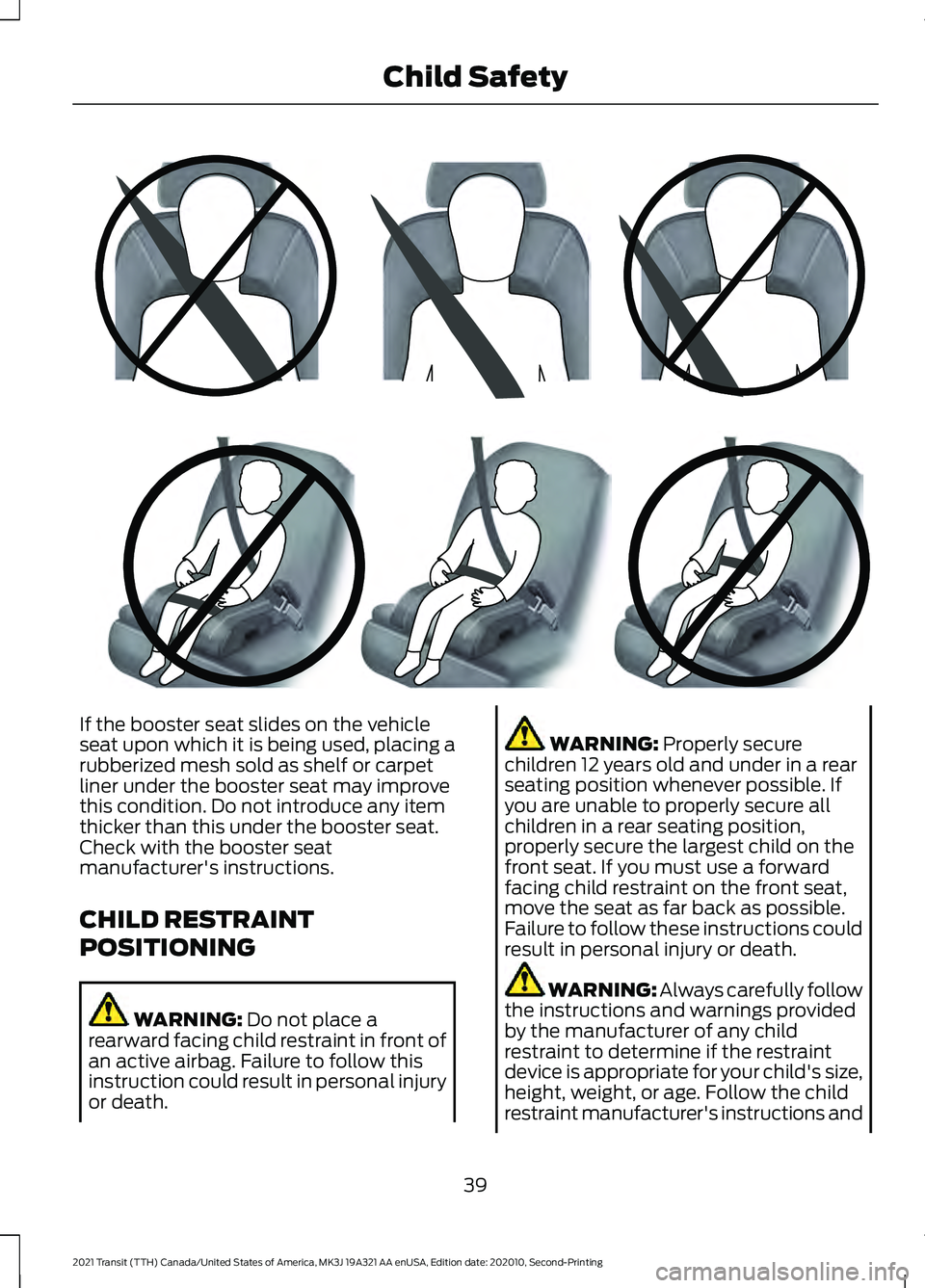
If the booster seat slides on the vehicle
seat upon which it is being used, placing a
rubberized mesh sold as shelf or carpet
liner under the booster seat may improve
this condition. Do not introduce any item
thicker than this under the booster seat.
Check with the booster seat
manufacturer's instructions.
CHILD RESTRAINT
POSITIONING
WARNING: Do not place a
rearward facing child restraint in front of
an active airbag. Failure to follow this
instruction could result in personal injury
or death. WARNING:
Properly secure
children 12 years old and under in a rear
seating position whenever possible. If
you are unable to properly secure all
children in a rear seating position,
properly secure the largest child on the
front seat. If you must use a forward
facing child restraint on the front seat,
move the seat as far back as possible.
Failure to follow these instructions could
result in personal injury or death. WARNING: Always carefully follow
the instructions and warnings provided
by the manufacturer of any child
restraint to determine if the restraint
device is appropriate for your child's size,
height, weight, or age. Follow the child
restraint manufacturer's instructions and
39
2021 Transit (TTH) Canada/United States of America, MK3J 19A321 AA enUSA, Edition date: 202010, Second-Printing Child SafetyE142596 E142597
Page 43 of 509
warnings provided for installation and
use in conjunction with the instructions
and warnings provided by your vehicle
manufacturer. A safety seat that is
improperly installed or utilized, is
inappropriate for your child's height, age,
or weight or does not properly fit the
child may increase the risk of serious
injury or death.
WARNING: Do not allow a
passenger to hold a child on their lap
when your vehicle is moving. Failure to
follow this instruction could result in
personal injury or death in the event of a
sudden stop or crash. WARNING:
Do not use pillows,
books or towels to boost your child's
height. Failure to follow this instruction
could result in personal injury or death. WARNING:
Properly secure child
restraints or booster seats when they are
not in use. They could become projectiles
in a sudden stop or crash. Failure to
follow this instruction could result in
personal injury or death. WARNING: Do not put the shoulder
section of the seatbelt or allow the child
to put the shoulder section of the
seatbelt under their arm or behind their
back. Failure to follow this instruction
could reduce the effectiveness of the
seatbelt and increase the risk of injury or
death in a crash. WARNING:
Do not leave children
or pets unattended in your vehicle.
Failure to follow this instruction could
result in personal injury or death.
40
2021 Transit (TTH) Canada/United States of America, MK3J 19A321 AA enUSA, Edition date: 202010, Second-Printing Child Safety
Page 59 of 509
•
My vehicle has no rear seat;
• Athough children age 12 and under ride
in the rear seat whenever possible,
children age 12 and under have no
option but to sometimes ride in the
front seat because rear seat space is
insufficient;
• The child has a medical condition that,
according to the child's physician,
makes it necessary for the child to ride
in the front seat so that the driver can
monitor the child's condition.
3. Medical condition: A passenger has a
medical condition that, according to his or
her physician:
• Poses a special risk for the passenger
if the airbag deploys; and
• Makes the potential harm from the
passenger airbag deployment greater
than the potential harm from turning
off the airbag and experiencing a crash
without the protection offered by the
airbag
Proper Driver and Front Passenger
Seating Adjustment WARNING:
National Highway
Traffic Safety Administration (NHTSA)
recommends a minimum distance of at
least
10 in (25 cm) between an
occupant's chest and the driver airbag
module.
To properly position yourself away from
the airbag:
• Move your seat to the rear as far as you
can while still reaching the pedals
comfortably.
• Recline the seat slightly (one or two
degrees) from the upright position. After all occupants have adjusted their
seats and put on seatbelts, it is very
important that they continue to sit
properly. Properly seated occupants sit
upright, lean against the seat back, and
center themselves on the seat cushion,
with their feet comfortably extended on
the floor. Sitting improperly can increase
the chance of injury in a crash event. For
example, if an occupant slouches, lies
down, turns sideways, sits forward, leans
forward or sideways, or puts one or both
feet up, the chance of injury during a crash
is greatly increased.
Children and Airbags
WARNING:
Do not place a
rearward facing child restraint in front of
an active airbag. Failure to follow this
instruction could result in personal injury
or death. WARNING:
Properly secure
children 12 years old and under in a rear
seating position whenever possible. If
you are unable to properly secure all
children in a rear seating position,
properly secure the largest child on the
front seat. If you must use a forward
facing child restraint on the front seat,
move the seat as far back as possible.
Failure to follow these instructions could
result in personal injury or death.
56
2021 Transit (TTH) Canada/United States of America, MK3J 19A321 AA enUSA, Edition date: 202010, Second-Printing Supplementary Restraints System