brake GENESIS G80 2021 Owner's Manual
[x] Cancel search | Manufacturer: GENESIS, Model Year: 2021, Model line: G80, Model: GENESIS G80 2021Pages: 604, PDF Size: 11.47 MB
Page 547 of 604

Maintenance
9-32
Tire Rotation
To equalize tread wear, Genesis
Branded Vehicle recommends that
the tires be rotated according to the
maintenance schedule or sooner if
irregular wear develops.
During rotation, check the tires for
correct balance.
When rotating tires, check for uneven
wear and damage. Abnormal wear
is usually caused by incorrect tire
pressure, improper wheel alignment,
out-of-balance wheels, severe braking
or severe cornering. Look for bumps or
bulges in the tread or side of the tire.
Replace the tire if you find any of these
conditions. Replace the tire if fabric or
cord is visible. After rotation, be sure to
bring the front and rear tire pressures
to specification and check wheel bolt
tightness (proper torque is 79~94 lbf·ft
[11~13 kgf·m].
„„18 inch tire
OHI078078
„„19, 20 inch tire
OHI078079
Disc brake pads should be inspected
for wear whenever tires are rotated.
Information
The outside and inside of the
unsymmetrical tire is distinguishable.
When installing an unsymmetrical
tire, be sure to install the side marked
“outside” face the outside. If the side
marked “inside” is installed on the
outside, it will have a negative effect
on vehicle performance.
WARNING
• Do not use the compact spare
tire for tire rotation.
• Do not mix bias ply and radial ply
tires under any circumstances.
This may cause unusual handling
characteristics that may cause
loss of vehicle control resulting in
an accident.
Page 548 of 604
09
9-33
Wheel Alignment and Tire
Balance
The wheels on your vehicle were
aligned and balanced carefully at the
factory to give you the longest tire
life and best overall performance.
In most cases, you will not need to
have your wheels aligned again.
However, if you notice unusual tire
wear or your vehicle pulling one way
or the other, the alignment may need
to be reset.
If you notice your vehicle vibrating
when driving on a smooth road, your
wheels may need to be rebalanced.
NOTICE
Incorrect wheel weights can
damage your vehicle’s aluminum
wheels. Use only approved wheel
weights.
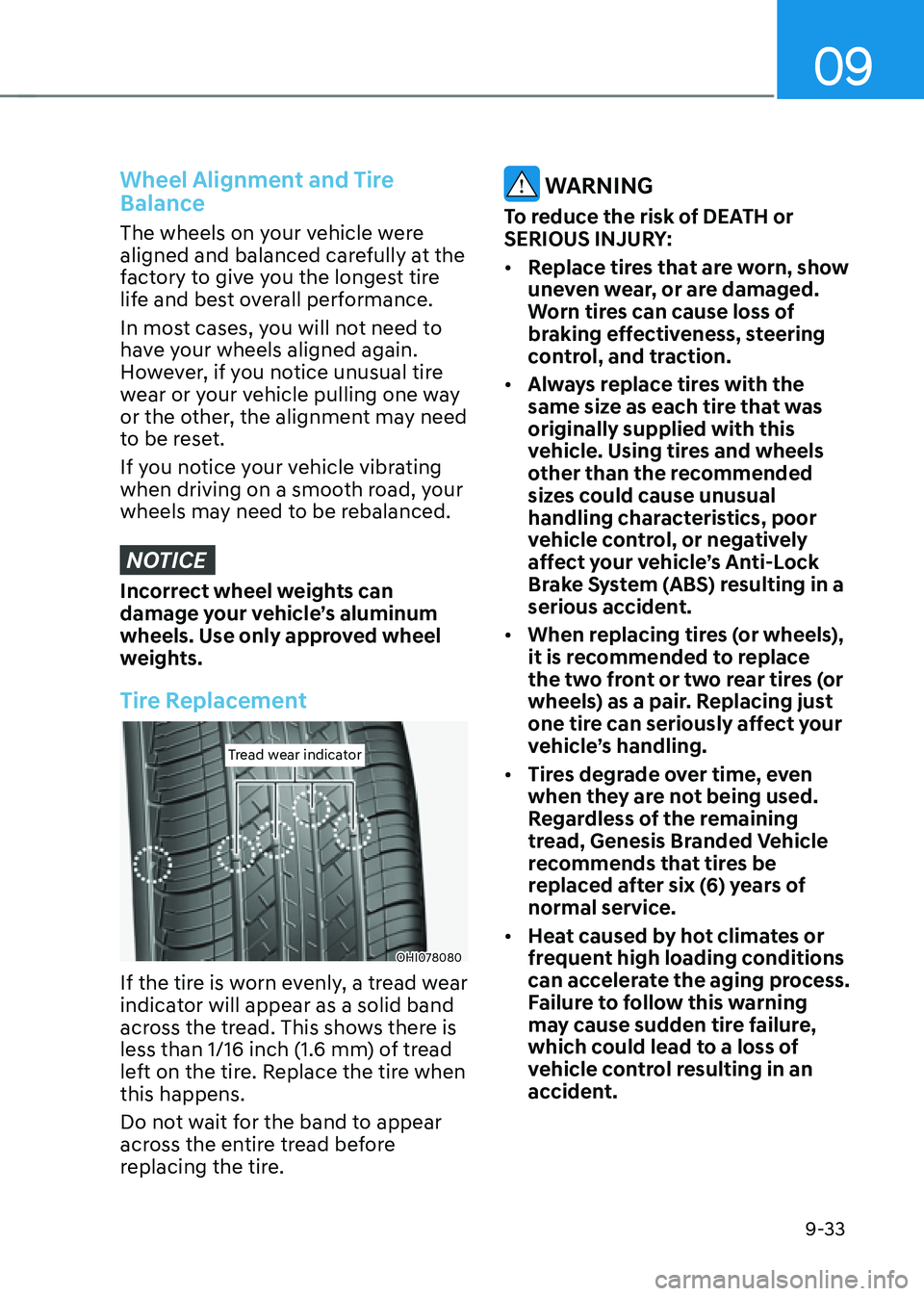
Tire Replacement
Tread wear indicatorTread wear indicator
OHI078080
If the tire is worn evenly, a tread wear
indicator will appear as a solid band
across the tread. This shows there is
less than 1/16 inch (1.6 mm) of tread
left on the tire. Replace the tire when
this happens.
Do not wait for the band to appear
across the entire tread before
replacing the tire.
WARNING
To reduce the risk of DEATH or
SERIOUS INJURY:
• Replace tires that are worn, show
uneven wear, or are damaged.
Worn tires can cause loss of
braking effectiveness, steering
control, and traction.
• Always replace tires with the
same size as each tire that was
originally supplied with this
vehicle. Using tires and wheels
other than the recommended
sizes could cause unusual
handling characteristics, poor
vehicle control, or negatively
affect your vehicle’s Anti-Lock
Brake System (ABS) resulting in a
serious accident.
• When replacing tires (or wheels),
it is recommended to replace
the two front or two rear tires (or
wheels) as a pair. Replacing just
one tire can seriously affect your
vehicle’s handling.
• Tires degrade over time, even
when they are not being used.
Regardless of the remaining
tread, Genesis Branded Vehicle
recommends that tires be
replaced after six (6) years of
normal service.
• Heat caused by hot climates or
frequent high loading conditions
can accelerate the aging process.
Failure to follow this warning
may cause sudden tire failure,
which could lead to a loss of
vehicle control resulting in an
accident.
Page 563 of 604

Maintenance
9-48
Instrument panel fuse panel
Fuse NameFuse Rating Circuit Protected
MODULE8 10ARear Radar LH/RH, ECS Unit, RWS Module, ADAS Unit
(Driving), ADAS Unit (Parking), Crash Pad Switch, Front
Console Switch, Steering Tilt & Telescopic Unit, LKAS Unit
MODULE5 10A
ICU Junction Block (ESU), Hazard Switch
MODULE3 10ARear Seat Console Remote Control Switch Switch, Active
Air Flap Module, Clock Spring, Steering Tilt & Telescopic
Unit, Multifunction Switch
P/WINDOW LH 30ADriver Power Window Module, Rear Power Window Module
LH
CURTAIN 10A
IBU
P/SEAT PASS2 25A
Passenger Power Seat Module
TRUNK 10A
Trunk Release Relay
AIR BAG1 15A
SRS Control Module
E-SHIFTER1 10A
Electronic ATM Shift Lever Dial
MODULE4 10A
Driver Door Module, Data Link Connector
P/SEAT DRV1 25A
Driver Power Seat Module
P/SEAT 10A
Driver/Passenger Lumbar Support Unit (3/5/7CELL)
POWER
HANDLE 15A
Steering Tilt & Telescopic Unit
IBU1 10AIAU, IBU, BLE Unit, Driver Door Outside Handle, Passenger
Door Outside Handle
POWER
OUTLET 20A
Armrest Power Outlet
P/SEAT DRV2 25A
Driver Power Seat Module
P/SEAT PASS1 25A
Passenger Power Seat Module
S/HEATER DRV 20A
Driver Power Seat Module
S/HEATER PASS 20A
Passenger Power Seat Module
DOOR LOCK 10A
Center Door Lock/Unlock Relay, Driver Door Unlock Relay
SPARE(B+) 10A
Not Used
MODULE6 10AArmrest Lamp, IBU, Low DC-DC Converter(AUX/AMP),
Electronic ATM Shift Lever Dial, Front Tray Lamp, IAU,
BRAKE SWITCH 10A
Stop Lamp Switch, IBU
Page 570 of 604

09
9-55
Rear junction block
Fuse NameFuse
Rating Circuit Protected
B+4 50AICU Junction Block(Fuse(P/Seat PASS2, Module4, Sunroof,
Door Lock, Trunk))
B+2 30AICU Junction Block(Fuse(IBU1, E-Shifter1, Spare(B+),
Module5, Air Bag1), IPS2, IPS5)
B+1 50AICU Junction Block(Fuse(Brake Switch)),
IPS1, IPS3, IPS4, IPS7, Long/Short Term Load Latch Relay
B+3 50AICU Junction Block(Fuse(P/Window LH, S/Heater DRV,
S/Heater PASS, P/Seat DRV1, P/Seat DRV2, P/Seat PASS1,
Curtain, Power Handle, P/Seat))
DCU3 20ANot Used
DCU4 10ANot Used
CHILD LOCK 15AChild Lock/Unlock Relay
DCU1 20ANot Used
P/WINDOW RH 30APassenger Power Window Module, Rear Power Window
Module RH
DCU2 20ANot Used
AMP 25ALow DC-DC Converter (AMP)
P/DOOR RR LH 15ARear Door Latch LH
P/DOOR PASS 15APassenger Door Latch
PRESAFETY SEAT BELT1 30A
Pre-Active Seat Belt Unit
P/DOOR RR RH 15ARear Door Latch RH
ECS 15AECS Unit
P/DOOR DRV 15ADriver Door Latch
PRESAFETY SEAT BELT2 30A
Pre-Active Seat Belt Unit
P/SEAT RR 20ANot Used
S/HEATER RR LH 20ARear Seat LH Heater Unit
POWER TRUNK 30APTL Unit (Power Trunk Lid)
S/HEATER RR RH 20ARear Seat RH Heater Unit
Page 573 of 604

Maintenance
9-58
Consult an authorized retailer of
Genesis Branded products to replace
most vehicle light bulbs. It is difficult
to replace vehicle light bulbs because
other parts of the vehicle must be
removed before you can get to the bulb.
This is especially true for removing the
headlamp assembly to get to the bulb(s).
Removing/installing the headlamp
assembly can result in damage to the
vehicle.
WARNING
• Prior to working on a light, depress
the foot brake, shift to P (Park), apply
the parking brake, press the Engine
Start/Stop button to the OFF position
and take the key with you when
leaving the vehicle to avoid sudden
movement of the vehicle and to
prevent possible electric shock.
• Be aware the bulbs may be hot and
may burn your fingers.
NOTICE
Be sure to replace the burned-out bulb
with one of the same wattage rating.
Otherwise, it may cause damage to the
fuse or electrical wiring system.
NOTICE
To prevent damage, do not clean the
headlamp lens with chemical solvents
or strong detergents.
Information
The headlamp and tail lamp lenses could
appear frosty if the vehicle is washed after
driving or the vehicle is driven at night in
wet weather. This condition is caused by
temperature difference between the lamp
inside and outside and, it does not indicate
a problem with your vehicle. When
moisture condenses in the lamp, it will be
removed after driving with the headlamp
on. The removable level may differ
depending on lamp size, lamp position
and environmental condition. However, if
moisture is not removed, have the vehicle
inspected by an authorized retailer of
Genesis Branded products.
Information
• A normally functioning lamp may
flicker momentarily to stabilize the
vehicle’s electrical control system.
However, if the lamp goes out after
flickering momentarily, or continues to
flicker, have the system checked by an
authorized retailer of Genesis Branded
products.
• The parking lamp may not turn on
when the parking lamp switch is turned
on, but the parking lamp and headlamp
switch may turn on when the headlamp
switch is turned on. This may be caused
by network failure or vehicle electrical
control system malfunction. If this
occurs, have the system checked by an
authorized retailer of Genesis Branded
products.
Information
The headlamp aiming should be adjusted
after an accident or after the headlamp
assembly is reinstalled at an authorized
retailer of Genesis Branded products.
LIGHT BULBS
Page 578 of 604

09
9-63
Exterior Care
Exterior general caution
It is very important to follow the label
directions when using any chemical
cleaner or polish. Read all warning and
caution statements that appear on the
label.
Finish maintenance
Washing
To help protect your vehicle’s finish from
rust and deterioration, wash it thoroughly
and frequently at least once a month
with lukewarm or cold water.
If you use your vehicle for off-road
driving, you should wash it after each
off-road trip. Pay special attention to the
removal of any accumulation of salt, dirt,
mud, and other foreign materials. Make
sure the drain holes in the lower edges
of the doors and rocker panels are kept
clear and clean.
Insects, tar, tree sap, bird droppings,
industrial pollution and similar deposits
can damage your vehicle’s finish if not
removed immediately.
Even prompt washing with plain water
may not completely remove all these
deposits. A mild soap, safe for use on
painted surfaces, should be used.
After washing, rinse the vehicle
thoroughly with lukewarm or cold water.
Do not allow soap to dry on the finish.High-pressure washing
• When using high-pressure washers,
make sure to maintain sufficient
distance from the vehicle.
Insufficient clearance or excessive
pressure can lead to component
damage or water penetration.
• Do not spray the camera, sensors or
its surrounding area directly with a
high pressure washer. Shock applied
from high pressure water may cause
the device to not operate normally.
• Do not bring the nozzle tip close to
boots (rubber or plastic covers) or
connectors as they may be damaged
if they come into contact with high
pressure water.
WARNING
After washing the vehicle, test the
brakes while driving slowly to see
if they have been affected by water
before getting on the road. If braking
performance is impaired, dry the
brakes by applying them lightly while
maintaining a slow forward speed.
APPEARANCE CARE
Page 581 of 604

Maintenance
9-66
Bright-metal maintenance
• To remove road tar and insects, use
a tar remover, not a scraper or other
sharp object.
• To protect the surfaces of brightmetal
parts from corrosion, apply a coating
of wax or chrome preservative and rub
to a high luster.
• During winter weather or in coastal
areas, cover the bright metal parts
with a heavier coating of wax or
preservative. If necessary, coat the
parts with non-corrosive petroleum
jelly or other protective compound.
Underbody maintenance
Corrosive materials used for ice and
snow removal and dust control may
collect on the underbody. If these
materials are not removed, accelerated
rusting can occur on underbody parts
such as the fuel lines, frame, floor pan
and exhaust system, even though they
have been treated with rust protection.
Thoroughly flush the vehicle underbody
and wheel openings with lukewarm or
cold water once a month, after off-road
driving and at the end of each winter.
Pay special attention to these areas
because it will do more harm than good
if the road grime becomes wet without
removing it. The lower edges of doors,
rocker panels, and frame members have
drain holes that should not be allowed
to clog with dirt; trapped water in these
areas can cause rusting.
WARNING
After washing the vehicle, test the
brakes while driving slowly to see if
they have been affected by water. If
braking performance is impaired, dry
the brakes by applying them lightly
while maintaining a slow forward
speed.
Aluminum wheel maintenance
The aluminum wheels are coated with a
clear protective finish.
• Do not use abrasive cleaner, polishing
compound, solvent, or wire brushes
on aluminum wheels.
• Clean the wheel when it has cooled.
• Use only a mild soap or neutral
detergent, and rinse thoroughly with
water. Also, clean the wheels after
driving on salted roads.
• Do not wash the wheels with high-
speed car wash brushes.
• Do not use any cleaners containing
acid or alkaline detergents.
Page 592 of 604

I
I-3
B
Battery
........................................................................\
.........................................9-27
Battery Recharging
........................................................................\
..................9-28
Battery Usage Recommendations
...................................................................9-28
Reset Items
........................................................................\
..............................9-29
Before Driving
........................................................................\
...............................6-4
Before Entering the Vehicle
........................................................................\
......6-4
Before Starting
........................................................................\
..........................6-4
Blind-Spot Collision-Avoidance Assist (BCA)
..................................................7-32
System Malfunction and Limitations
..............................................................7-40
System Operation
........................................................................\
....................7-36
System Settings
........................................................................\
.......................7-34
Blind-Spot View Monitor (BVM)
......................................................................7-67
System Malfunction
........................................................................\
................7-68
System Operation
........................................................................\
....................7-68
System Settings
........................................................................\
.......................7-68
Brake Fluid
........................................................................\
..................................9-21
Checking the Brake Fluid Level
.....................................................................9-21
Braking System
........................................................................\
............................6-21
Anti-Lock Brake System (ABS)
.....................................................................6-30
Auto Hold
........................................................................\
................................6-26
Disc Brakes Wear Indicator
........................................................................\
.....6-21
Electronic Parking Brake (EPB)
.....................................................................6-22
Electronic Stability Control (ESC) .................................................................. 6-31
Good Braking Practices ........................................................................\
........... 6-36
Hill-Start Assist Control (HAC)
......................................................................6-35
Power-Assist brakes
........................................................................\
................6-21
Vehicle Stability Management (VSM)
............................................................6-34
Bulb Wattage
........................................................................\
..................................2-9