Seat GENESIS G90 2017 Repair Manual
[x] Cancel search | Manufacturer: GENESIS, Model Year: 2017, Model line: G90, Model: GENESIS G90 2017Pages: 524, PDF Size: 19.3 MB
Page 82 of 524
2-62
Safety system of your vehicle
Curtain air bags
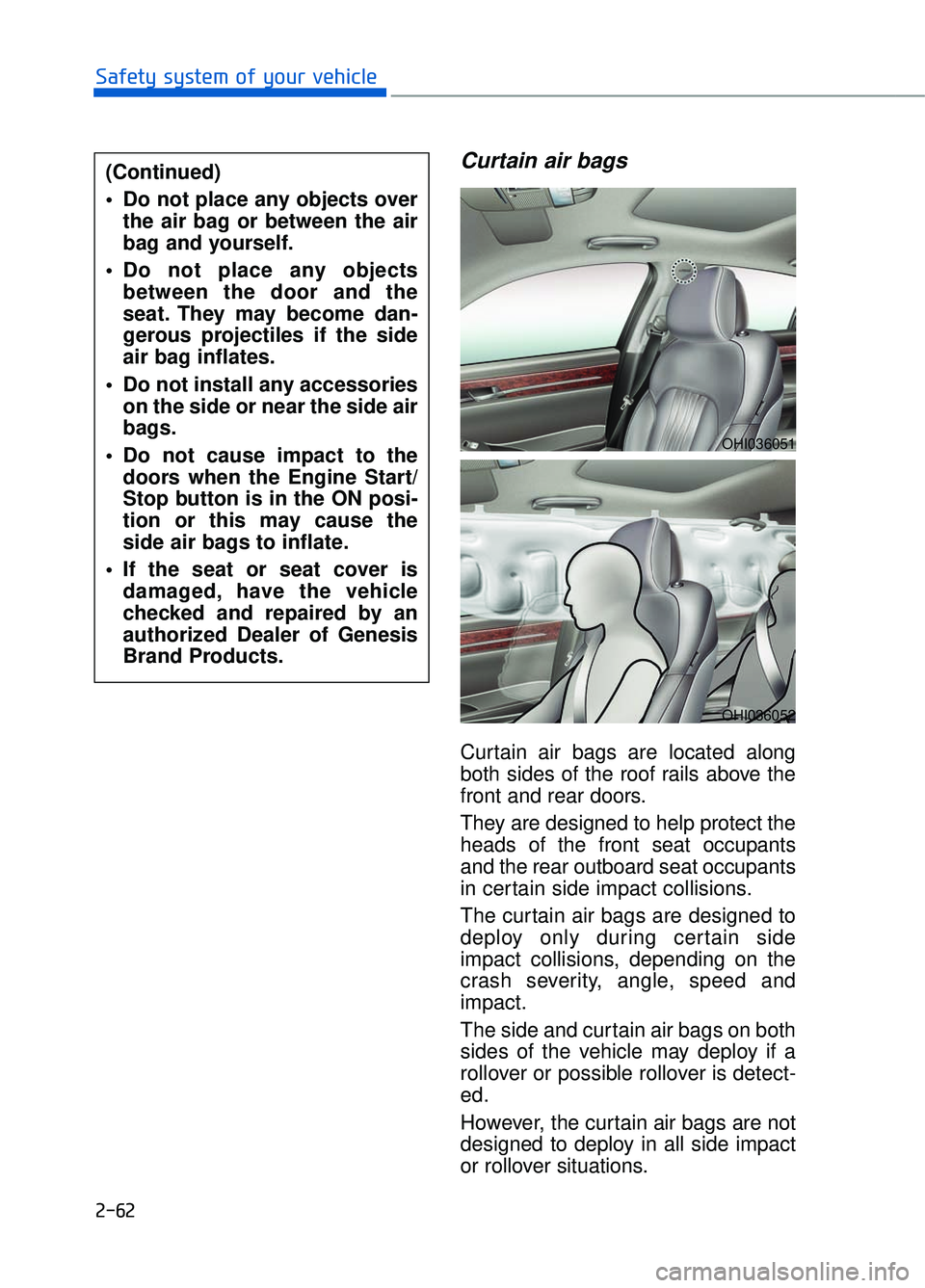
Curtain air bags are located along
both sides of the roof rails above the
front and rear doors.
They are designed to help protect the
heads of the front seat occupants
and the rear outboard seat occupants
in certain side impact collisions.
The curtain air bags are designed to
deploy only during certain side
impact collisions, depending on the
crash severity, angle, speed and
impact.
The side and curtain air bags on both
sides of the vehicle may deploy if a
rollover or possible rollover is detect-
ed.
However, the curtain air bags are not
designed to deploy in all side impact
or rollover situations.
(Continued)
Do not place any objects over
the air bag or between the air
bag and yourself.
Do not place any objects between the door and the
seat. They may become dan-
gerous projectiles if the side
air bag inflates.
Do not install any accessories on the side or near the side air
bags.
Do not cause impact to the doors when the Engine Start/
Stop button is in the ON posi-
tion or this may cause the
side air bags to inflate.
If the seat or seat cover is damaged, have the vehicle
checked and repaired by an
authorized Dealer of Genesis
Brand Products.
OHI036051
OHI036052
Page 83 of 524

2-63
02
How Does the Air Bags
System Operate?
The SRS consists of the following
components:
1. Driver's front air bag module
2. Passenger's front air bag module
3. Side air bag modules
4. Curtain air bag modules
5. Side impact sensor(acceleration type)
6. Air bag warning light
7. SRS control module (SRSCM) /Rollover sensor
8. Front impact sensors
9. Retractor pre-tensioner assemblies
10. Driver's knee air bag module
11. Driver's and front passenger's seat belt buckle sensors
12. Emergency fastening device
13. Side impact sensor (pressure type)
14. Occupant classification system
To reduce the risk of serious
injury or death from an inflating
curtain air bags, take the follow-
ing precautions:
All seat occupants must wear
seat belts at all times to help
keep occupants positioned
properly.
Properly secure child restraints as far away from the
door as possible.
Do not allow passengers to lean their heads or bodies
onto doors, put their arms on
the doors, stretch their arms
out of the window, or place
objects between the doors
and seats.
Do not open or repair the side curtain air bags.
WARNING
OHI036042
Page 84 of 524
2-64
Safety system of your vehicle
The SRSCM (Supplemental Restraint
System Control Module) continually
monitors all SRS components while
the Engine Start/Stop button is in the
ON position to determine if a crash
impact is severe enough to require air
bag deployment or pre-tensioner seat
belt deployment.
SRS warning light
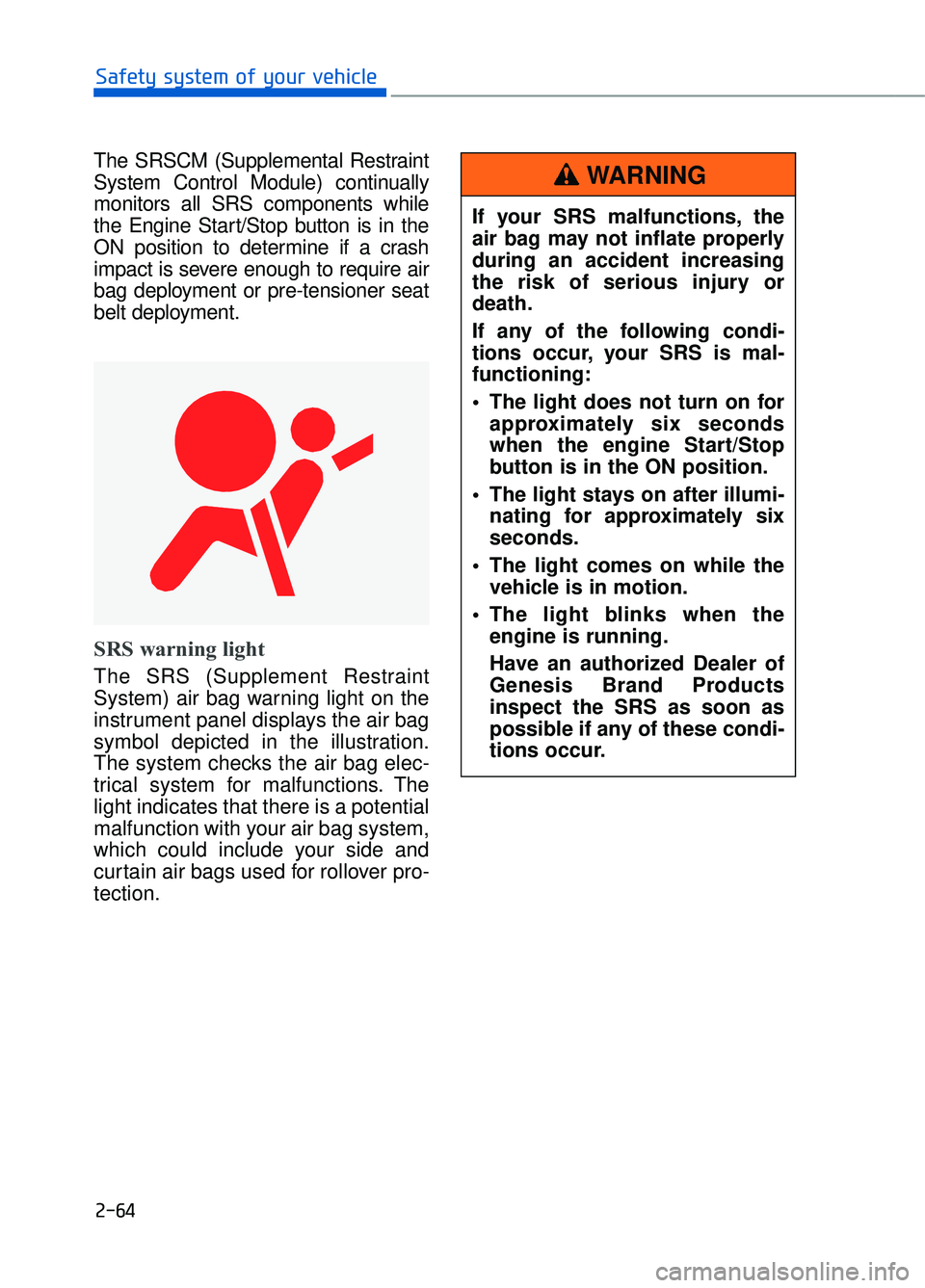
The SRS (Supplement Restraint
System) air bag warning light on the
instrument panel displays the air bag
symbol depicted in the illustration.
The system checks the air bag elec-
trical system for malfunctions. The
light indicates that there is a potential
malfunction with your air bag system,
which could include your side and
curtain air bags used for rollover pro-
tection.
If your SRS malfunctions, the
air bag may not inflate properly
during an accident increasing
the risk of serious injury or
death.
If any of the following condi-
tions occur, your SRS is mal-
functioning:
The light does not turn on for approximately six seconds
when the engine Start/Stop
button is in the ON position.
The light stays on after illumi- nating for approximately six
seconds.
The light comes on while the vehicle is in motion.
The light blinks when the engine is running.
Have an authorized Dealer of
Genesis Brand Products
inspect the SRS as soon as
possible if any of these condi-
tions occur.
WARNING
Page 85 of 524
2-65
02
During a frontal collision, sensors will
detect the vehicle's deceleration. If
the rate of deceleration is high
enough, the control unit will inflate
the front air bags.
The front air bags help protect the
driver and front passenger by
responding to frontal impacts in
which seat belts alone cannot pro-
vide adequate restraint. When need-
ed, the side air bags help provide
protection in the event of a side
impact or rollover.
Air bags are activated (able toinflate if necessary) only when the
engine Start/Stop button is in the
ON position.
Air bags inflate in the event of cer- tain frontal or side collisions to help
protect the occupants from serious
physical injury.
Generally, air bags are designed to inflate based upon the severity of a
collision, its direction, etc. These
two factors determine whether the
sensors produce an electronic
deployment/inflation signal.
Air bag deployment depends on a number of factors including vehicle
speed, angles of impact and the
density and stiffness of the vehicles
or objects which your vehicle
impacts during a collision. The
determining factors are not limited
to those mentioned above.
The front air bags will completely inflate and deflate in an instant. It is
virtually impossible for you to see
the air bags inflate during an acci-
dent. It is much more likely that you
will simply see the deflated air bags
hanging out of their storage com-
partments after the collision. In addition to inflating in certain
side collisions, vehicles equipped
with a rollover sensor, side and
curtain air bags will inflate if the
sensing system detects a rollover.
When a rollover is detected, side
and curtain air bags will remain
inflated longer to help provide pro-
tection from ejection, especially
when used in conjunction with the
seat belts.
To help provide protection, the air bags must inflate rapidly. The speed
of air bag inflation is a consequence
of extremely short time in which to
inflate the air bag between the
occupant and the vehicle structures
before the occupant impacts those
structures. This speed of inflation
reduces the risk of serious or life-
threatening injuries and is thus a
necessary part of air bag design.
However, the rapid air bag inflation
can also cause injuries which can
include facial abrasions, bruises
and broken bones because the
inflation speed also causes the air
bags to expand with a great deal of
force.
There are even circumstances under which contact with the air
bag can cause fatal injuries, espe-
cially if the occupant is positioned
excessively close to the air bag.
You can take steps to help reduce
the risk of being injured by an inflat-
ing air bag. The greatest risk is sitting
too close to the air bag. An air bag
needs about 10 inches (25 cm) of
space to inflate. NHTSA recom-
mends that drivers allow at least 10
inches (25 cm) between the center of
the steering wheel and the chest.
Page 86 of 524
2-66
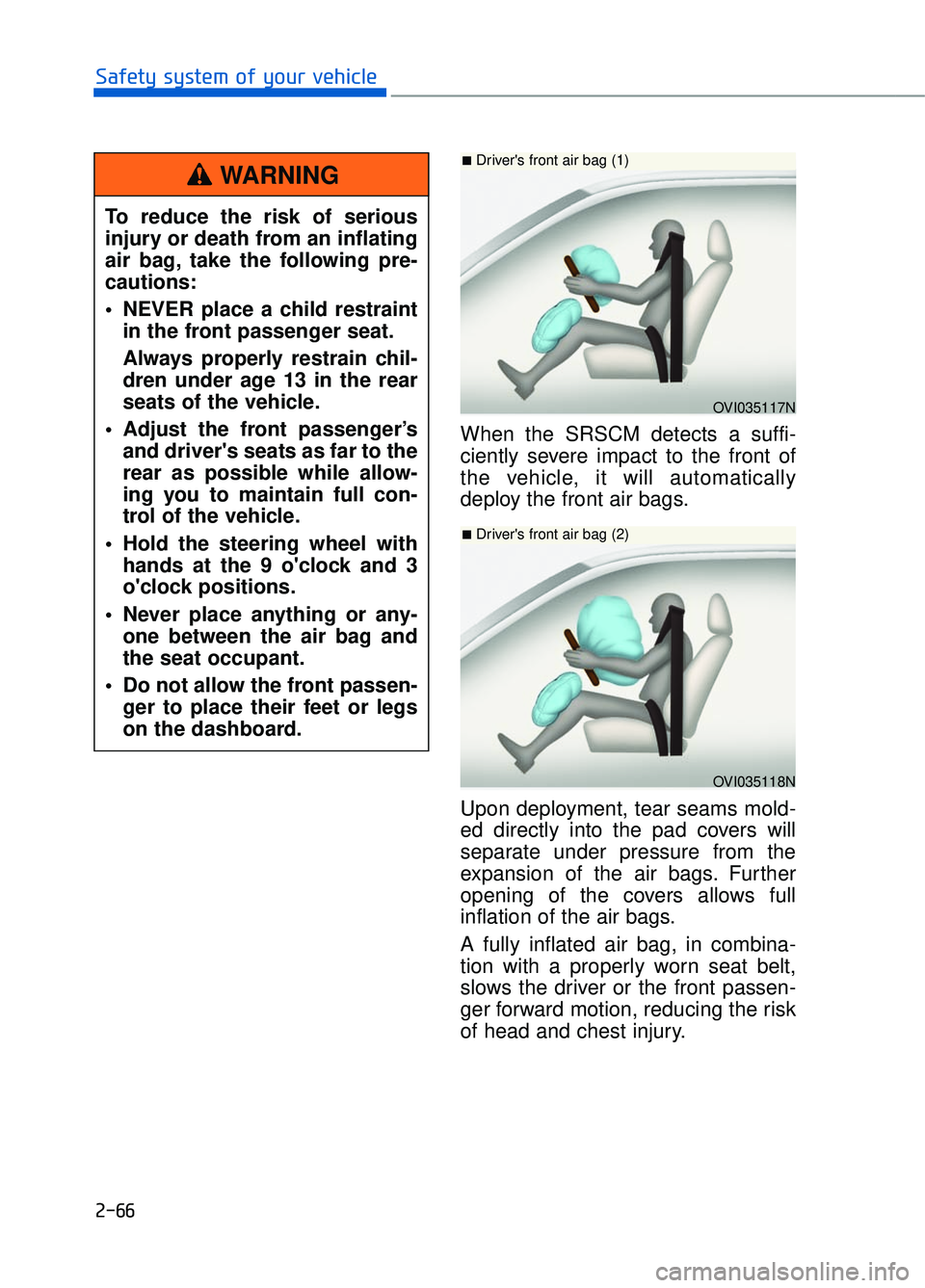
Safety system of your vehicleWhen the SRSCM detects a suffi-
ciently severe impact to the front of
the vehicle, it will automatically
deploy the front air bags.
Upon deployment, tear seams mold-
ed directly into the pad covers will
separate under pressure from the
expansion of the air bags. Further
opening of the covers allows full
inflation of the air bags.
A fully inflated air bag, in combina-
tion with a properly worn seat belt,
slows the driver or the front passen-
ger forward motion, reducing the risk
of head and chest injury.
To reduce the risk of serious
injury or death from an inflating
air bag, take the following pre-
cautions:
NEVER place a child restraint
in the front passenger seat.
Always properly restrain chil-
dren under age 13 in the rear
seats of the vehicle.
Adjust the front passenger’s and driver's seats as far to the
rear as possible while allow-
ing you to maintain full con-
trol of the vehicle.
Hold the steering wheel with hands at the 9 o'clock and 3
o'clock positions.
Never place anything or any- one between the air bag and
the seat occupant.
Do not allow the front passen- ger to place their feet or legs
on the dashboard.
WARNING
OVI035117N
■Driver's front air bag (1)
OVI035118N
■Driver's front air bag (2)
Page 88 of 524

2-68
Safety system of your vehicle
Noise and smoke from inflatingair bag
When the air bags inflate, they make
a loud noise and may produce
smoke and powder in the air inside of
the vehicle. This is normal and is a
result of the ignition of the air bag
inflator. After the air bag inflates, you
may feel substantial discomfort in
breathing because of the contact of
your chest with both the seat belt and
the air bag, as well as from breathing
the smoke and powder. The powder
may aggravate asthma for some
people. If you experience breathing
problems after an air bag deploy-
ment, seek medical attention imme-
diately.
Though the smoke and powder are
nontoxic, they may cause irritation to
the skin, eyes, nose, throat, etc. If
this is the case, wash and rinse with
cold water immediately and seek
medical attention if the symptoms
persist.
Occupant Classification
System (OCS)
Your vehicle is equipped with an
Occupant Classification System
(OCS) in the front passenger's seat.
The Occupant Classification System
sensor, which is equipped inside the
front passenger’s seat, distinguishes
whether the seat is occupied by an
adult or a child restraint system, and
sends this information to the ACU.
Then, the ACU integrates this infor-
mation with any impact information
while determining whether to deploy
the air bags for the front passenger’s
seat.
- The Occupant Classification
System properly detects a front
passenger, when a passenger sits
in upright position. In an accident, it
properly deploys the air bag.
- The Occupant Classification System detects a child restraint
system, which is installed on the
front passenger's seat. In this
case, the air bag system for the
front passenger's seat gets dis-
abled.
- The Occupant Classification System may not deploy the air bag
for the front passenger's seat,
when a tiny adult sits out of upright
position.
Page 89 of 524
2-69
02
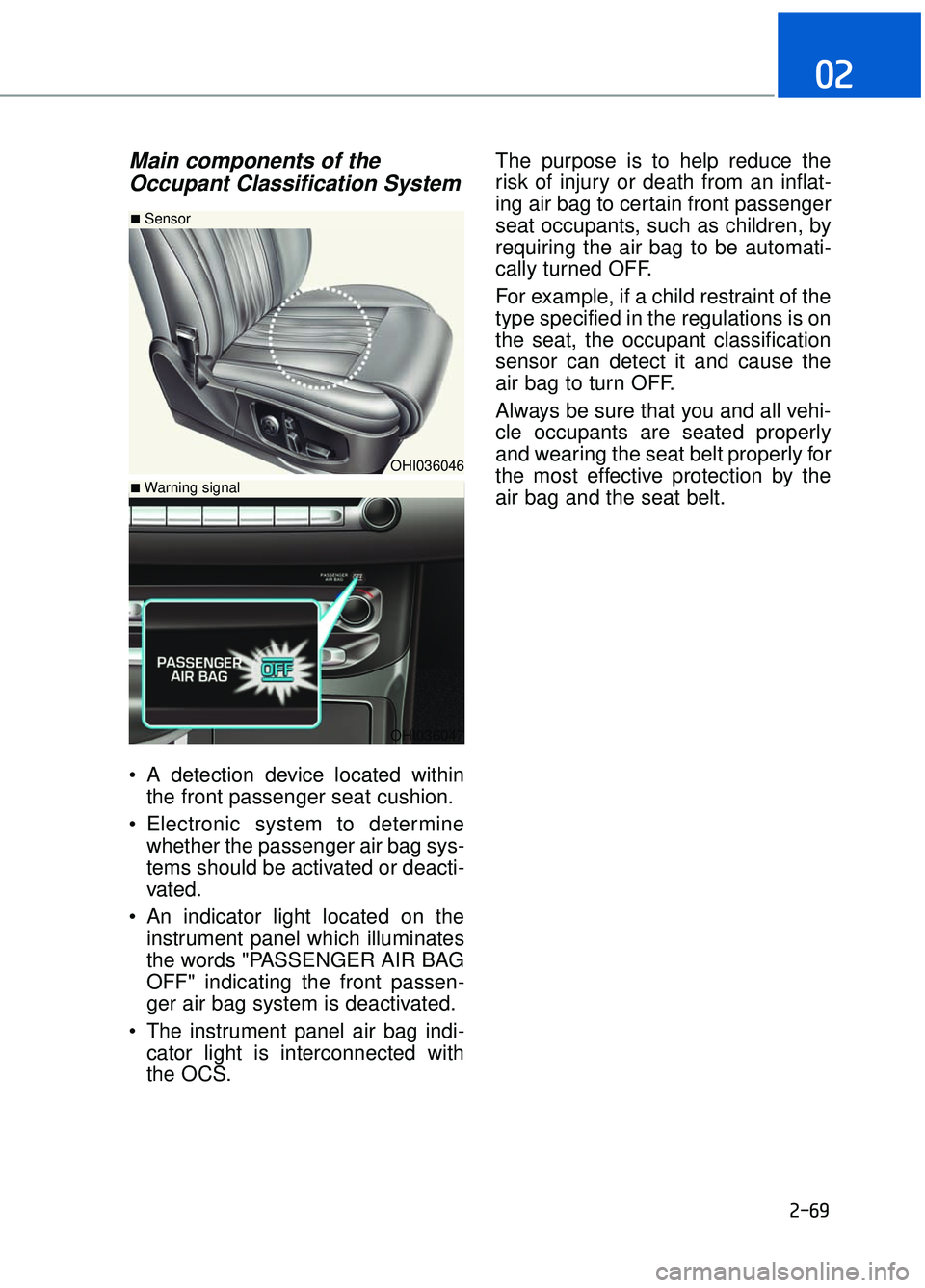
Main components of theOccupant Classification System
A detection device located within
the front passenger seat cushion.
Electronic system to determine whether the passenger air bag sys-
tems should be activated or deacti-
vated.
An indicator light located on the instrument panel which illuminates
the words "PASSENGER AIR BAG
OFF" indicating the front passen-
ger air bag system is deactivated.
The instrument panel air bag indi- cator light is interconnected with
the OCS. The purpose is to help reduce the
risk of injury or death from an inflat-
ing air bag to certain front passenger
seat occupants, such as children, by
requiring the air bag to be automati-
cally turned OFF.
For example, if a child restraint of the
type specified in the regulations is on
the seat, the occupant classification
sensor can detect it and cause the
air bag to turn OFF.
Always be sure that you and all vehi-
cle occupants are seated properly
and wearing the seat belt properly for
the most effective protection by the
air bag and the seat belt.
OHI036046
■Sensor
OHI036047
■Warning signal
Page 90 of 524

2-70
Safety system of your vehicle
Condition and operation in the front passenger Occupant Classification
System
Condition detected by the
occupant classification system
Indicator/Warning lightDevices
"PASSENGER
AIR BAG OFF" indicator lightSRS
warning lightFront passenger
air bag
1. Adult *1OffOffActivated
2. Infant *2or child restraint
system with 12 months old *3*4 OnOffDeactivated
3. Unoccupied OnOffDeactivated
4. Malfunction in the systemOffOnActivated
*1The system judges a person of adult size as an adult. When a smaller adult sits in the front
passenger seat, the system may recognize him/her as a child depending on his/her physique
and posture.
*
2Do not allow children to ride in the front passenger seat. When a larger child who has out- grown a child restraint system sits in the front passenger seat, the system may recognize
him/her as an adult depending upon his/her physique or sitting position.
*
3Never install a child restraint system on the front passenger seat.
*4The PASSENGER AIR BAG "OFF" indicator may turn on or off when a child above 12 months
to 12 years old (with or without child restraint system) sits in the front passenger seat. This is
a normal condition.
You will find the "PASSENGER AIR BAG OFF" indicator on the center facia
panel. This system detects the conditions 1-4 in the following table and acti-
vates or deactivates the front passenger air bag based on these conditions.
When the PASSENGER AIR BAG OFF indicator illuminates with an
adult occupied on the front passenger's seat, the air bag may not
deploy in an accident. On the other hand, when the PASSENGER AIR
BAG OFF indicator does not illuminate with a child restraint system
installed on the front passenger's seat, the air bag may deploy in an
accident. In those cases, you should immediately move the occupant
or the child restraint system to a rear seat. In addition, have the sys-
tem inspected by an authorized Dealer of Genesis Brand Products.
WARNING
When the PASSENGER AIR BAG OFF indicator does not illuminate
with a child restraint system installed on the front passenger's seat,
you should immediately move the child restraint system to a rear
seat. It implies that the air bag for the front passenger's seat may
deploy in an accident.
WARNING
Page 91 of 524
2-71
02
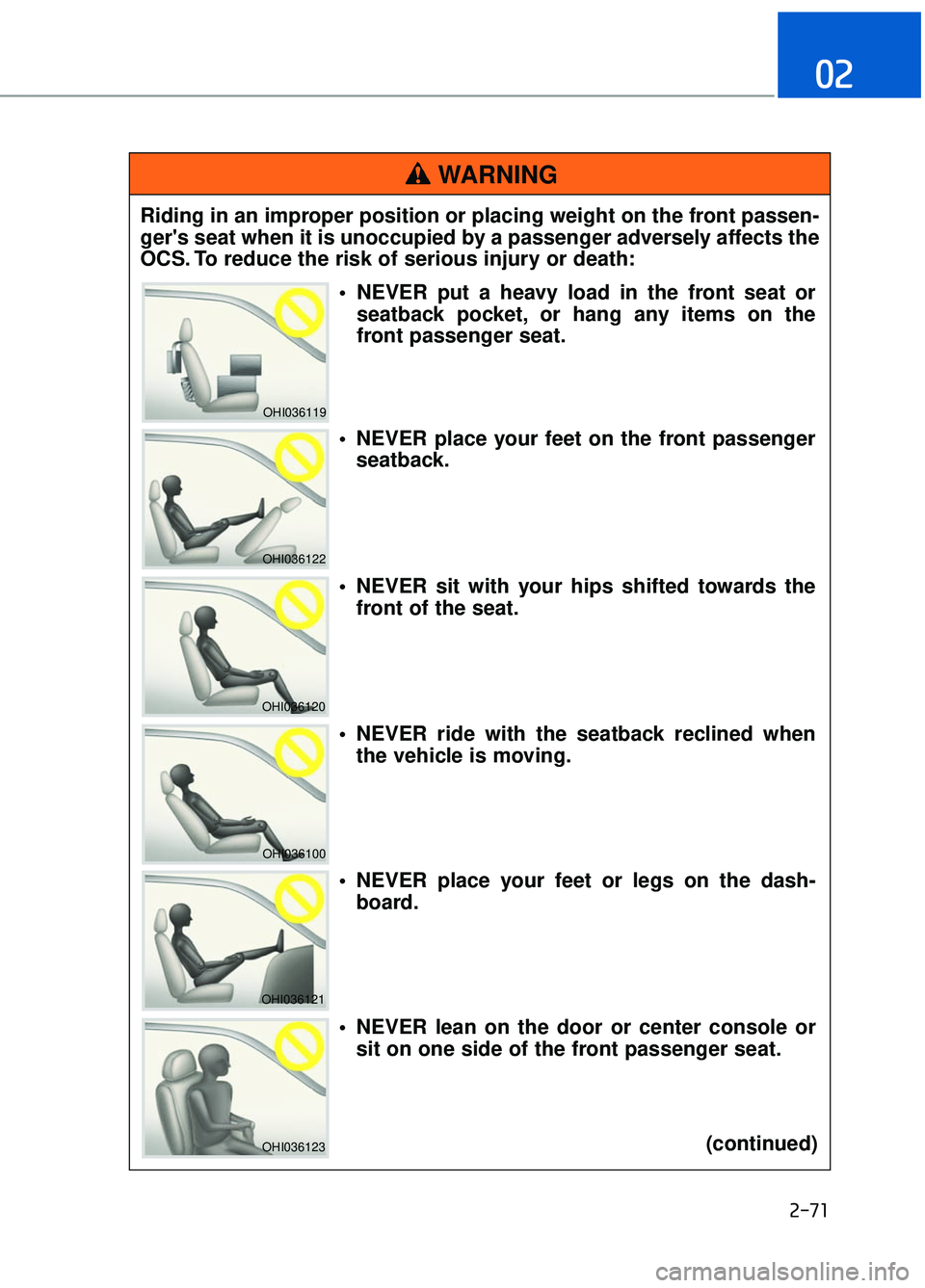
Riding in an improper position or placing weight on the front passen-
ger's seat when it is unoccupied by a passenger adversely affects the
OCS. To reduce the risk of serious injury or death:
WARNING
OHI036119
OHI036122
OHI036120
OHI036100
OHI036121
OHI036123
NEVER put a heavy load in the front seat orseatback pocket, or hang any items on the
front passenger seat.
NEVER place your feet on the front passenger seatback.
NEVER sit with your hips shifted towards the front of the seat.
NEVER ride with the seatback reclined when the vehicle is moving.
NEVER place your feet or legs on the dash- board.
NEVER lean on the door or center console or sit on one side of the front passenger seat.
(continued)
Page 92 of 524

2-72
Safety system of your vehicle
OHI036124
OHI036126
OHI036125
OHI036127
Do not sit on the passenger seat wearing heav-ily padded clothes such as ski wear and hip
protector.
Do not use car seat accessories such as thick blankets and cushions which cover up the car
seat surface.
Do not place electronic devices such as lap- tops, DVD player, or conductive materials such
as water bottles on the passenger seat.
Do not use electronic devices such as laptops and satellite radios which use inverter charg-
ers.
If large quantity of liquid has been spilled on the passenger seat, the air bag warning light
may illuminate or malfunction.
Therefore, make sure the seat has been com-
pletely dried before driving the vehicle.
Do not place sharp objects on the front passenger seat. These may damage the occupant detection system, if they puncture the seat
cushion.
Do not place any items under the front passenger seat.
When changing or replacing the seat or seat cover, use original items only. The OCS has been developed based on using original
Genesis Brand car seats only. Altering or changing the authentic
parts may result in system malfunction and increase risk of injury
when in collision. Any of the above could interfere with the proper
operation of the OCS sensor thereby increasing the risk of an injury
in an accident.
(continued)