ignition GMC ACADIA 2007 Manual PDF
[x] Cancel search | Manufacturer: GMC, Model Year: 2007, Model line: ACADIA, Model: GMC ACADIA 2007Pages: 554, PDF Size: 2.76 MB
Page 355 of 554
{CAUTION:
Coasting downhill in NEUTRAL (N) or with
the ignition off is dangerous. The brakes
will have to do all the work of slowing
down. They could get so hot that they
would not work well. You would then have
poor braking or even none going down a
hill. You could crash. Always have the
engine running and your vehicle in gear
when you go downhill.
Know how to go down hills. The most
important thing to know is this: let the engine
do some of the slowing down. Shift to a
lower gear when you go down a steep or
long hill.
Know how to go uphill. You may want to shift
down to a lower gear. The lower gears help
cool the engine and transmission, and you can
climb the hill better.
Stay in your own lane when driving on
two-lane roads in hills or mountains. Do not
swing wide or cut across the center of the
road. Drive at speeds that let you stay in your
own lane.
As you go over the top of a hill, be alert.
There could be something in your lane,
like a stalled car or an accident.
You may see highway signs on mountains
that warn of special problems. Examples
are long grades, passing or no-passing zones,
a falling rocks area, or winding roads.
Be alert to these and take appropriate action.
355
Page 368 of 554
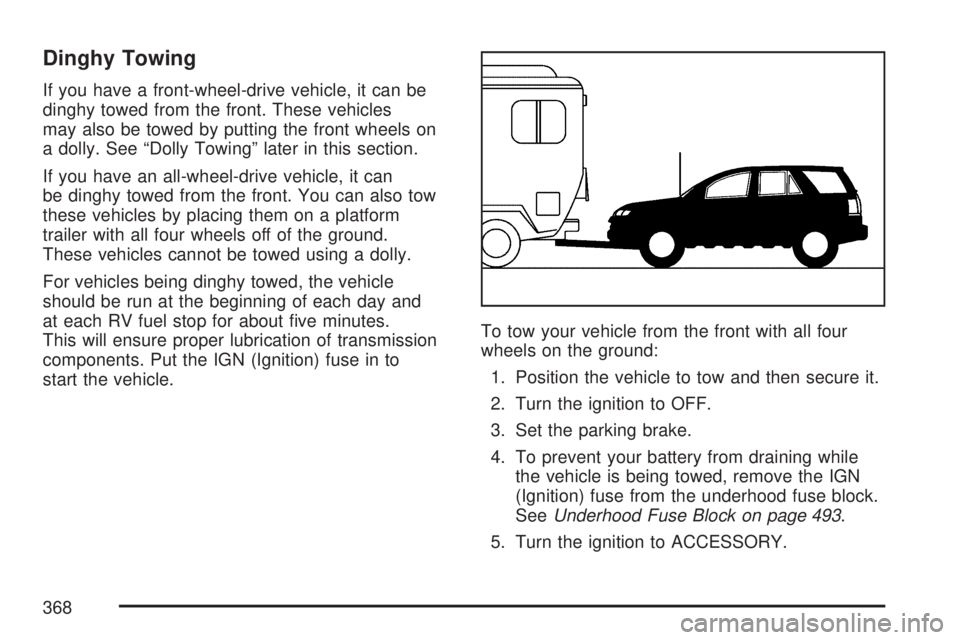
Dinghy Towing
If you have a front-wheel-drive vehicle, it can be
dinghy towed from the front. These vehicles
may also be towed by putting the front wheels on
a dolly. See “Dolly Towing” later in this section.
If you have an all-wheel-drive vehicle, it can
be dinghy towed from the front. You can also tow
these vehicles by placing them on a platform
trailer with all four wheels off of the ground.
These vehicles cannot be towed using a dolly.
For vehicles being dinghy towed, the vehicle
should be run at the beginning of each day and
at each RV fuel stop for about ve minutes.
This will ensure proper lubrication of transmission
components. Put the IGN (Ignition) fuse in to
start the vehicle.To tow your vehicle from the front with all four
wheels on the ground:
1. Position the vehicle to tow and then secure it.
2. Turn the ignition to OFF.
3. Set the parking brake.
4. To prevent your battery from draining while
the vehicle is being towed, remove the IGN
(Ignition) fuse from the underhood fuse block.
SeeUnderhood Fuse Block on page 493.
5. Turn the ignition to ACCESSORY.
368
Page 369 of 554
6. Shift your transmission to NEUTRAL (N).
7. Release the parking brake.
Notice:If you tow your vehicle without
performing each of the steps listed under
“Dinghy Towing,” you could damage the
automatic transmission. Be sure to follow all
steps of the dinghy towing procedure prior
to and after towing your vehicle.
Notice:If you exceed 65 mph (105 km/h) while
towing your vehicle, it could be damaged.
Never exceed 65 mph (105 km/h) while towing
your vehicle.
Once you have reached your destination, do the
following:
1. Set the parking brake.
2. Turn the ignition key to OFF and remove the
key from the ignition.
3. Reinstall the IGN (Ignition) fuse.
Notice:Don’t tow a vehicle with the front
drive wheels on the ground if one of the front
tires is a compact spare tire. Towing with
two different tire sizes on the front of the
vehicle can cause severe damage to the
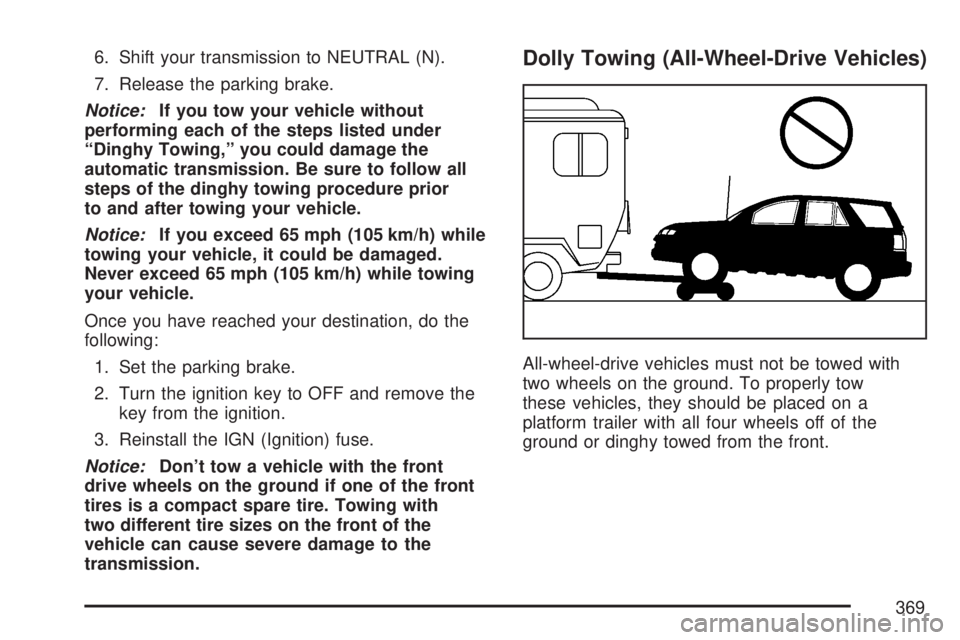
transmission.Dolly Towing (All-Wheel-Drive Vehicles)
All-wheel-drive vehicles must not be towed with
two wheels on the ground. To properly tow
these vehicles, they should be placed on a
platform trailer with all four wheels off of the
ground or dinghy towed from the front.
369
Page 401 of 554
How to Reset the Engine Oil Life
System
The Engine Oil Life System calculates when to
change the engine oil and lter based on vehicle
use. Whenever the oil is changed, reset the
system so it can calculate when the next oil
change is required. If a situation occurs where
you change the oil prior to a CHANGE ENGINE
OIL SOON message being turned on, reset
the system.
If your vehicle does not have a Driver Information
Center (DIC):
1. Turn the ignition to ON, with the engine off.
2. Fully press and release the accelerator pedal
slowly three times within ve seconds.
3. Turn the key to OFF.
If the CHANGE ENGINE OIL SOON message
comes back on when you start your vehicle,
the engine oil life system has not reset.
Repeat the procedure.If your vehicle has a DIC:
1. Turn the ignition to ON, with the engine off.
2. Press the MODE button until the DIC
reads OIL LIFE LEFT/HOLD SET TO RESET.
3. Press and hold the SET button until 100% is
displayed.
You will hear three chimes and the CHANGE
ENGINE OIL SOON message will go off.
4. Turn the key to OFF.
If the CHANGE ENGINE OIL SOON message
comes back on when you start your vehicle,
the engine oil life system has not reset.
Repeat the procedure.
401
Page 426 of 554
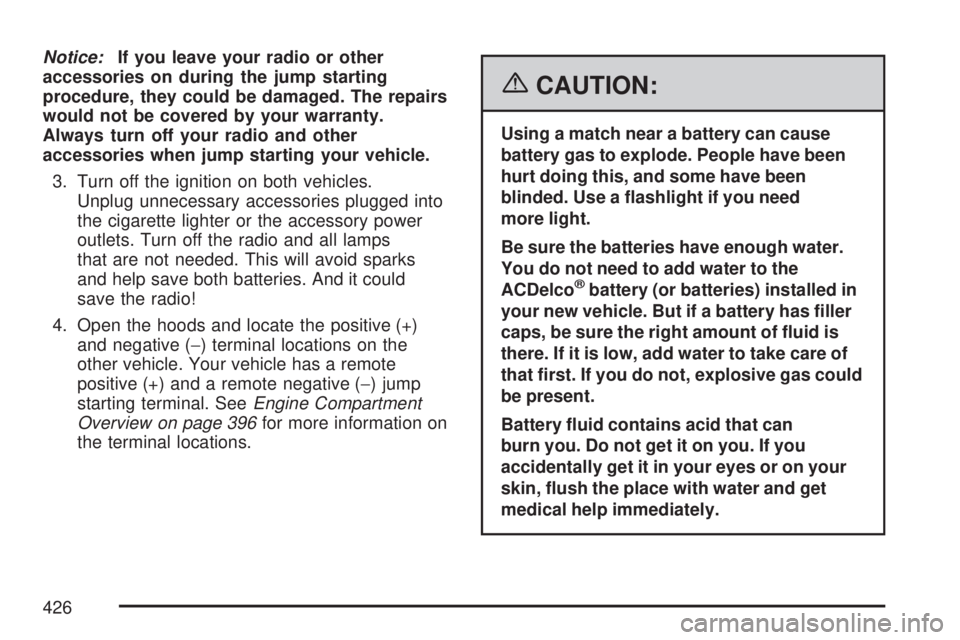
Notice:If you leave your radio or other
accessories on during the jump starting
procedure, they could be damaged. The repairs
would not be covered by your warranty.
Always turn off your radio and other
accessories when jump starting your vehicle.
3. Turn off the ignition on both vehicles.
Unplug unnecessary accessories plugged into
the cigarette lighter or the accessory power
outlets. Turn off the radio and all lamps
that are not needed. This will avoid sparks
and help save both batteries. And it could
save the radio!
4. Open the hoods and locate the positive (+)
and negative (−) terminal locations on the
other vehicle. Your vehicle has a remote
positive (+) and a remote negative (−) jump
starting terminal. SeeEngine Compartment
Overview on page 396for more information on
the terminal locations.
{CAUTION:
Using a match near a battery can cause
battery gas to explode. People have been
hurt doing this, and some have been
blinded. Use a ashlight if you need
more light.
Be sure the batteries have enough water.
You do not need to add water to the
ACDelco
®battery (or batteries) installed in
your new vehicle. But if a battery has ller
caps, be sure the right amount of uid is
there. If it is low, add water to take care of
that rst. If you do not, explosive gas could
be present.
Battery uid contains acid that can
burn you. Do not get it on you. If you
accidentally get it in your eyes or on your
skin, ush the place with water and get
medical help immediately.
426
Page 444 of 554
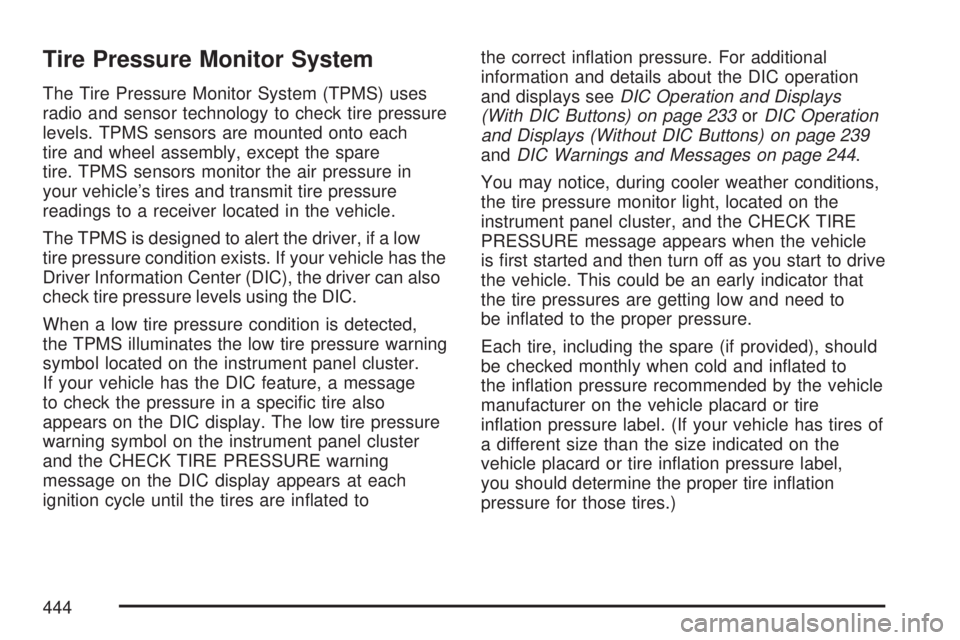
Tire Pressure Monitor System
The Tire Pressure Monitor System (TPMS) uses
radio and sensor technology to check tire pressure
levels. TPMS sensors are mounted onto each
tire and wheel assembly, except the spare
tire. TPMS sensors monitor the air pressure in
your vehicle’s tires and transmit tire pressure
readings to a receiver located in the vehicle.
The TPMS is designed to alert the driver, if a low
tire pressure condition exists. If your vehicle has the
Driver Information Center (DIC), the driver can also
check tire pressure levels using the DIC.
When a low tire pressure condition is detected,
the TPMS illuminates the low tire pressure warning
symbol located on the instrument panel cluster.
If your vehicle has the DIC feature, a message
to check the pressure in a specic tire also
appears on the DIC display. The low tire pressure
warning symbol on the instrument panel cluster
and the CHECK TIRE PRESSURE warning
message on the DIC display appears at each
ignition cycle until the tires are inated tothe correct ination pressure. For additional
information and details about the DIC operation
and displays seeDIC Operation and Displays
(With DIC Buttons) on page 233orDIC Operation
and Displays (Without DIC Buttons) on page 239
andDIC Warnings and Messages on page 244.
You may notice, during cooler weather conditions,
the tire pressure monitor light, located on the
instrument panel cluster, and the CHECK TIRE
PRESSURE message appears when the vehicle
is rst started and then turn off as you start to drive
the vehicle. This could be an early indicator that
the tire pressures are getting low and need to
be inated to the proper pressure.
Each tire, including the spare (if provided), should
be checked monthly when cold and inated to
the ination pressure recommended by the vehicle
manufacturer on the vehicle placard or tire
ination pressure label. (If your vehicle has tires of
a different size than the size indicated on the
vehicle placard or tire ination pressure label,
you should determine the proper tire ination
pressure for those tires.)
444
Page 447 of 554
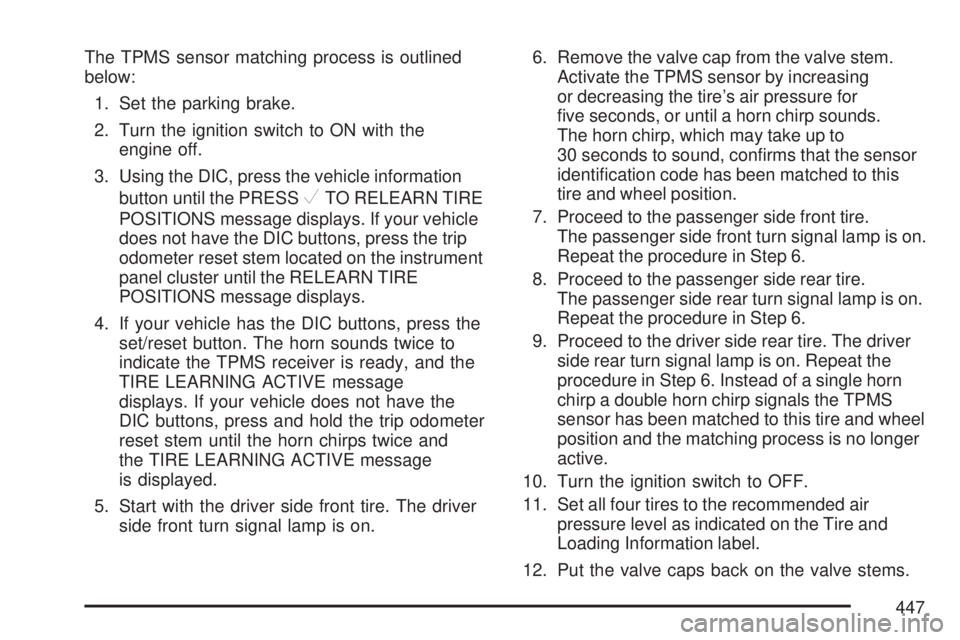
The TPMS sensor matching process is outlined
below:
1. Set the parking brake.
2. Turn the ignition switch to ON with the
engine off.
3. Using the DIC, press the vehicle information
button until the PRESS
VTO RELEARN TIRE
POSITIONS message displays. If your vehicle
does not have the DIC buttons, press the trip
odometer reset stem located on the instrument
panel cluster until the RELEARN TIRE
POSITIONS message displays.
4. If your vehicle has the DIC buttons, press the
set/reset button. The horn sounds twice to
indicate the TPMS receiver is ready, and the
TIRE LEARNING ACTIVE message
displays. If your vehicle does not have the
DIC buttons, press and hold the trip odometer
reset stem until the horn chirps twice and
the TIRE LEARNING ACTIVE message
is displayed.
5. Start with the driver side front tire. The driver
side front turn signal lamp is on.6. Remove the valve cap from the valve stem.
Activate the TPMS sensor by increasing
or decreasing the tire’s air pressure for
ve seconds, or until a horn chirp sounds.
The horn chirp, which may take up to
30 seconds to sound, conrms that the sensor
identication code has been matched to this
tire and wheel position.
7. Proceed to the passenger side front tire.
The passenger side front turn signal lamp is on.
Repeat the procedure in Step 6.
8. Proceed to the passenger side rear tire.
The passenger side rear turn signal lamp is on.
Repeat the procedure in Step 6.
9. Proceed to the driver side rear tire. The driver
side rear turn signal lamp is on. Repeat the
procedure in Step 6. Instead of a single horn
chirp a double horn chirp signals the TPMS
sensor has been matched to this tire and wheel
position and the matching process is no longer
active.
10. Turn the ignition switch to OFF.
11. Set all four tires to the recommended air
pressure level as indicated on the Tire and
Loading Information label.
12. Put the valve caps back on the valve stems.
447
Page 495 of 554
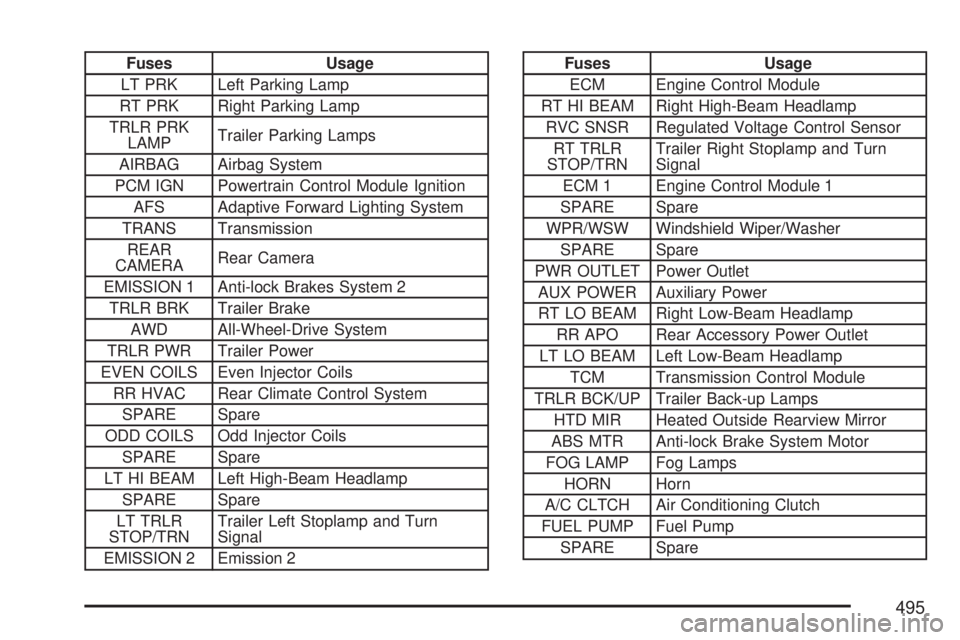
Fuses Usage
LT PRK Left Parking Lamp
RT PRK Right Parking Lamp
TRLR PRK
LAMPTrailer Parking Lamps
AIRBAG Airbag System
PCM IGN Powertrain Control Module Ignition
AFS Adaptive Forward Lighting System
TRANS Transmission
REAR
CAMERARear Camera
EMISSION 1 Anti-lock Brakes System 2
TRLR BRK Trailer Brake
AWD All-Wheel-Drive System
TRLR PWR Trailer Power
EVEN COILS Even Injector Coils
RR HVAC Rear Climate Control System
SPARE Spare
ODD COILS Odd Injector Coils
SPARE Spare
LT HI BEAM Left High-Beam Headlamp
SPARE Spare
LT TRLR
STOP/TRNTrailer Left Stoplamp and Turn
Signal
EMISSION 2 Emission 2Fuses Usage
ECM Engine Control Module
RT HI BEAM Right High-Beam Headlamp
RVC SNSR Regulated Voltage Control Sensor
RT TRLR
STOP/TRNTrailer Right Stoplamp and Turn
Signal
ECM 1 Engine Control Module 1
SPARE Spare
WPR/WSW Windshield Wiper/Washer
SPARE Spare
PWR OUTLET Power Outlet
AUX POWER Auxiliary Power
RT LO BEAM Right Low-Beam Headlamp
RR APO Rear Accessory Power Outlet
LT LO BEAM Left Low-Beam Headlamp
TCM Transmission Control Module
TRLR BCK/UP Trailer Back-up Lamps
HTD MIR Heated Outside Rearview Mirror
ABS MTR Anti-lock Brake System Motor
FOG LAMP Fog Lamps
HORN Horn
A/C CLTCH Air Conditioning Clutch
FUEL PUMP Fuel Pump
SPARE Spare
495
Page 496 of 554
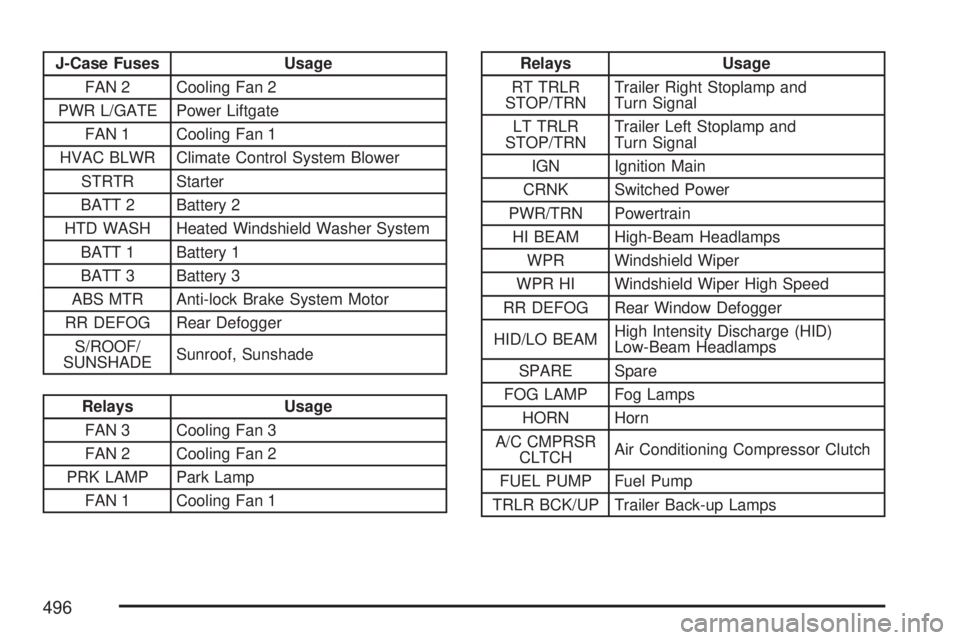
J-Case Fuses Usage
FAN 2 Cooling Fan 2
PWR L/GATE Power Liftgate
FAN 1 Cooling Fan 1
HVAC BLWR Climate Control System Blower
STRTR Starter
BATT 2 Battery 2
HTD WASH Heated Windshield Washer System
BATT 1 Battery 1
BATT 3 Battery 3
ABS MTR Anti-lock Brake System Motor
RR DEFOG Rear Defogger
S/ROOF/
SUNSHADESunroof, Sunshade
Relays Usage
FAN 3 Cooling Fan 3
FAN 2 Cooling Fan 2
PRK LAMP Park Lamp
FAN 1 Cooling Fan 1
Relays Usage
RT TRLR
STOP/TRNTrailer Right Stoplamp and
Turn Signal
LT TRLR
STOP/TRNTrailer Left Stoplamp and
Turn Signal
IGN Ignition Main
CRNK Switched Power
PWR/TRN Powertrain
HI BEAM High-Beam Headlamps
WPR Windshield Wiper
WPR HI Windshield Wiper High Speed
RR DEFOG Rear Window Defogger
HID/LO BEAMHigh Intensity Discharge (HID)
Low-Beam Headlamps
SPARE Spare
FOG LAMP Fog Lamps
HORN Horn
A/C CMPRSR
CLTCHAir Conditioning Compressor Clutch
FUEL PUMP Fuel Pump
TRLR BCK/UP Trailer Back-up Lamps
496
Page 509 of 554
At Least Once a Year
Starter Switch Check
{CAUTION:
When you are doing this inspection,
the vehicle could move suddenly. If the
vehicle moves, you or others could be
injured.
1. Before you start, be sure you have enough
room around the vehicle.
2. Firmly apply both the parking brake and the
regular brake. SeeParking Brake on page 134.
Do not use the accelerator pedal, and be
ready to turn off the engine immediately if
it starts.
3. Try to start the engine in each gear. The
vehicle should start only in PARK (P) or
NEUTRAL (N). If the vehicle starts in any
other position, contact your dealer/retailer for
service.
Automatic Transmission Shift Lock
Control System Check
{CAUTION:
When you are doing this inspection,
the vehicle could move suddenly. If the
vehicle moves, you or others could be
injured.
1. Before you start, be sure you have enough
room around the vehicle. It should be parked
on a level surface.
2. Firmly apply the parking brake. SeeParking
Brake on page 134.
Be ready to apply the regular brake
immediately if the vehicle begins to move.
3. With the engine off, turn the ignition to ON,
but do not start the engine. Without applying
the regular brake, try to move the shift lever
out of PARK (P) with normal effort. If the shift
lever moves out of PARK (P), contact your
dealer/retailer for service.
509