stop start GMC ACADIA 2008 Owner's Guide
[x] Cancel search | Manufacturer: GMC, Model Year: 2008, Model line: ACADIA, Model: GMC ACADIA 2008Pages: 472, PDF Size: 5.72 MB
Page 312 of 472
Parking on Hills
{CAUTION:
You really should not park your vehicle, with a
trailer attached, on a hill. If something goes
wrong, your rig could start to move. People
can be injured, and both your vehicle and the
trailer can be damaged.
But if you ever have to park your rig on a hill, here is
how to do it:
1. Apply your regular brakes, but do not shift into
PARK (P).
When parking uphill, turn your wheels away from
the curb. When parking downhill, turn your wheels
into the curb.
2. Have someone place chocks behind the trailer
wheels.
3. When the chocks are in place, release the regular
brakes until the chocks absorb the load.
4. Reapply the regular brakes. Then apply your
parking brake and shift into PARK (P).
5. Release the regular brakes.
When You Are Ready to Leave After
Parking on a Hill
1. Apply your regular brakes and hold the pedal down
while you:
start your engine,
shift into a gear, and
release the parking brake.
2. Let up on the brake pedal.
3. Drive slowly until the trailer is clear of the chocks.
4. Stop and have someone pick up and store the
chocks.
Maintenance When Trailer Towing
Your vehicle will need service more often when you are
pulling a trailer. SeeScheduled Maintenance on
page 6-4for more information. Things that are especially
important in trailer operation are automatic transmission
uid (do not overll), engine oil, axle lubricant, drive
belt, cooling system and brake system. Each of these is
covered in this manual, and the Index will help you
nd them quickly. If you are trailering, it is a good idea
to review this information before you start your trip.
Check periodically to see that all hitch nuts and bolts
are tight.
4-40
Page 344 of 472
{CAUTION:
You can be burned if you spill coolant on hot
engine parts. Coolant contains ethylene glycol
and it will burn if the engine parts are hot
enough. Do not spill coolant on a hot engine.
When the coolant in the coolant recovery tank is at the
FULL COLD mark, start your vehicle. If the overheat
warning continues, there is one more thing you can try.
You can add the proper mixture directly to the
radiator, but be sure the cooling system is cool before
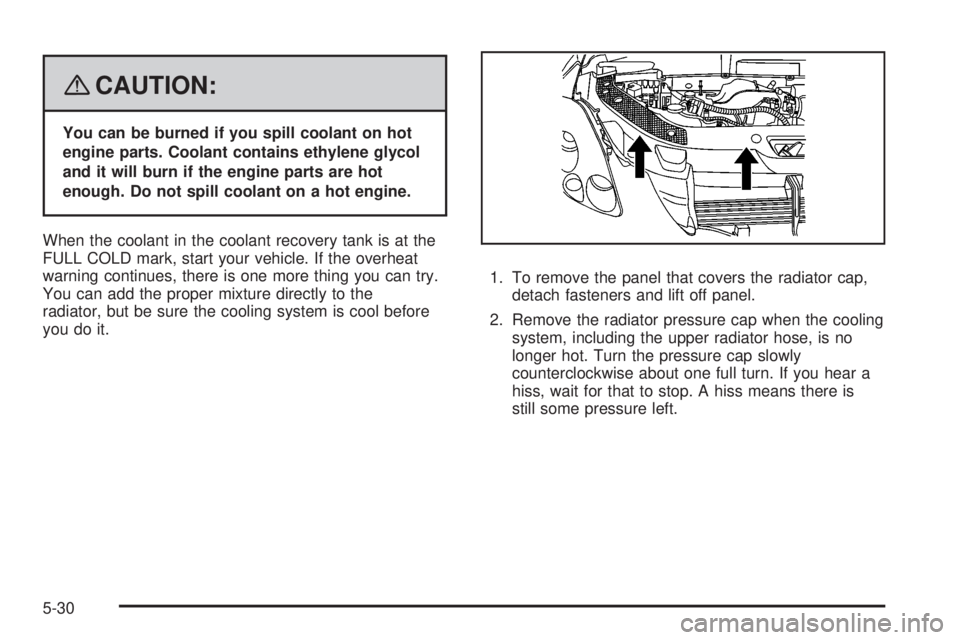
you do it.1. To remove the panel that covers the radiator cap,
detach fasteners and lift off panel.
2. Remove the radiator pressure cap when the cooling
system, including the upper radiator hose, is no
longer hot. Turn the pressure cap slowly
counterclockwise about one full turn. If you hear a
hiss, wait for that to stop. A hiss means there is
still some pressure left.
5-30
Page 371 of 472
Tire Pressure Monitor System
The Tire Pressure Monitor System (TPMS) uses radio
and sensor technology to check tire pressure levels. The
TPMS sensors monitor the air pressure in your
vehicle’s tires and transmit tire pressure readings to a
receiver located in the vehicle.
Each tire, including the spare (if provided), should be
checked monthly when cold and inated to the ination
pressure recommended by the vehicle manufacturer
on the vehicle placard or tire ination pressure label. (If
your vehicle has tires of a different size than the size
indicated on the vehicle placard or tire ination pressure
label, you should determine the proper tire ination
pressure for those tires.)
As an added safety feature, your vehicle has been
equipped with a tire pressure monitoring system (TPMS)
that illuminates a low tire pressure telltale when one
or more of your tires is signicantly under-inated.
Accordingly, when the low tire pressure telltale
illuminates, you should stop and check your tires as
soon as possible, and inate them to the proper
pressure. Driving on a signicantly under-inated tire
causes the tire to overheat and can lead to tire failure.
Under-ination also reduces fuel efficiency and tire
tread life, and may affect the vehicle’s handling
and stopping ability.Please note that the TPMS is not a substitute for proper
tire maintenance, and it is the driver’s responsibility to
maintain correct tire pressure, even if under-ination has
not reached the level to trigger illumination of the
TPMS low tire pressure telltale.
Your vehicle has also been equipped with a TPMS
malfunction indicator to indicate when the system is not
operating properly. The TPMS malfunction indicator
is combined with the low tire pressure telltale. When the
system detects a malfunction, the telltale will ash for
approximately one minute and then remain continuously
illuminated. This sequence will continue upon
subsequent vehicle start-ups as long as the malfunction
exists.
When the malfunction indicator is illuminated, the
system may not be able to detect or signal low tire
pressure as intended. TPMS malfunctions may occur for
a variety of reasons, including the installation of
replacement or alternate tires or wheels on the vehicle
that prevent the TPMS from functioning properly.
Always check the TPMS malfunction telltale after
replacing one or more tires or wheels on your vehicle to
ensure that the replacement or alternate tires and
wheels allow the TPMS to continue to function properly.
SeeTire Pressure Monitor Operation on page 5-58,
for additional information.
5-57
Page 375 of 472
TPMS Sensor Matching Process
Each TPMS sensor has a unique identication code.
Any time you rotate your vehicle’s tires or replace one or
more of the TPMS sensors, the identication codes
will need to be matched to the new tire/wheel position.
The sensors are matched to the tire/wheel positions
in the following order: driver side front tire, passenger
side front tire, passenger side rear tire, and driver
side rear tire using a TPMS diagnostic tool. See your
dealer/retailer for service.
The TPMS sensors can also be matched to each
tire/wheel position by increasing or decreasing the tire’s
air pressure. If increasing the tire’s air pressure, do
not exceed the maximum ination pressure indicated on
the tire’s sidewall.
To decrease air-pressure out of a tire you can use the
pointed end of the valve cap, a pencil-style air pressure
gage, or a key.
You have two minutes to match the rst tire/wheel
position, and ve minutes overall to match all four
tire/wheel positions. If it takes longer than two minutes,
to match the rst tire and wheel, or more than ve
minutes to match all four tire and wheel positions the
matching process stops and you need to start over.The TPMS sensor matching process is outlined below:
1. Set the parking brake.
2. Turn the ignition switch to ON/RUN with the
engine off.
3. Press the Remote Keyless Entry (RKE) transmitter’s
LOCK and UNLOCK buttons at the same time for
approximately ve seconds. The horn sounds twice
to signal the receiver is in relearn mode and
TIRE LEARNING ACTIVE message displays on the
DIC screen.
4. Start with the driver side front tire.
5. Remove the valve cap from the valve cap stem.
Activate the TPMS sensor by increasing or
decreasing the tire’s air pressure for ve seconds,
or until a horn chirp sounds. The horn chirp,
which may take up to 30 seconds to sound,
conrms that the sensor identication code has
been matched to this tire and wheel position.
6. Proceed to the passenger side front tire, and repeat
the procedure in Step 5.
7. Proceed to the passenger side rear tire, and repeat
the procedure in Step 5.
5-61
Page 395 of 472
Secondary Latch System
Your vehicle has an underbody mounted tire hoist
assembly that has a secondary latch system. It is
designed to stop the compact spare tire from suddenly
falling off your vehicle if the cable holding the spare
tire is damaged. For the secondary latch to work, the tire
must be stowed with the valve stem pointing down.
SeeStoring a Flat or Spare Tire and Tools on page 5-84
for instructions on storing the spare tire correctly.
{CAUTION:
Before beginning this procedure read all the
instructions. Failure to read and follow the
instructions could damage the hoist assembly
and you and others could get hurt. Read and
follow the instructions listed next.
To release the spare tire from the secondary latch:
{CAUTION:
Someone standing too close during the
procedure could be injured by the jack. If the
spare tire does not slide off the jack
completely, make sure no one is behind you or
on either side of you as you pull the jack out
from the under spare.
1. If the cable is not visible, start this procedure at
Step 3.
5-81
Page 398 of 472
Storing a Flat or Spare Tire and
Tools
Storing the Spare Tire
{CAUTION:
The underbody-mounted spare tire needs to be
stored with the valve stem pointing down. If
the spare tire is stored with the valve stem
pointing upwards, its secondary latch will not
work properly and the spare tire could loosen
and suddenly fall from your vehicle. If this
happened when your vehicle was being driven,
the tire might contact a person or another
vehicle, causing injury and, of course, damage
to itself as well. Be sure the
underbody-mounted spare tire is stored with
its valve stem pointing down.
{CAUTION:
Storing a jack, a tire, or other equipment in the
passenger compartment of the vehicle could
cause injury. In a sudden stop or collision,
loose equipment could strike someone. Store
all these in the proper place.
To store the spare tire:
1. Lay the compact spare tire near the rear of the
vehicle with the valve stem down.
2. Reinstall the plastic spare tire heat shield on the
compact spare tire.
3. Slide the cable retainer through the center of the
wheel and start to raise the compact spare tire.
Make sure the retainer is fully seated across
the underside of the wheel.
4. When the compact spare tire is almost in the stored
position, turn the tire so the valve is toward the rear
of the vehicle.
This position helps when checking the air pressure
in the compact spare tire.
5-84
Page 420 of 472
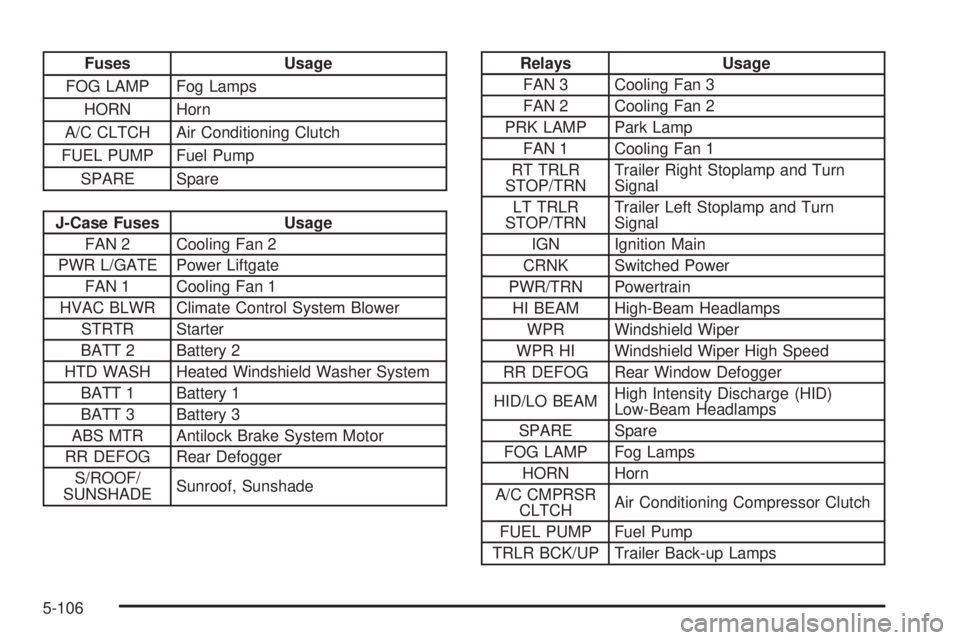
Fuses Usage
FOG LAMP Fog Lamps
HORN Horn
A/C CLTCH Air Conditioning Clutch
FUEL PUMP Fuel Pump
SPARE Spare
J-Case Fuses Usage
FAN 2 Cooling Fan 2
PWR L/GATE Power Liftgate
FAN 1 Cooling Fan 1
HVAC BLWR Climate Control System Blower
STRTR Starter
BATT 2 Battery 2
HTD WASH Heated Windshield Washer System
BATT 1 Battery 1
BATT 3 Battery 3
ABS MTR Antilock Brake System Motor
RR DEFOG Rear Defogger
S/ROOF/
SUNSHADESunroof, Sunshade
Relays Usage
FAN 3 Cooling Fan 3
FAN 2 Cooling Fan 2
PRK LAMP Park Lamp
FAN 1 Cooling Fan 1
RT TRLR
STOP/TRNTrailer Right Stoplamp and Turn
Signal
LT TRLR
STOP/TRNTrailer Left Stoplamp and Turn
Signal
IGN Ignition Main
CRNK Switched Power
PWR/TRN Powertrain
HI BEAM High-Beam Headlamps
WPR Windshield Wiper
WPR HI Windshield Wiper High Speed
RR DEFOG Rear Window Defogger
HID/LO BEAMHigh Intensity Discharge (HID)
Low-Beam Headlamps
SPARE Spare
FOG LAMP Fog Lamps
HORN Horn
A/C CMPRSR
CLTCHAir Conditioning Compressor Clutch
FUEL PUMP Fuel Pump
TRLR BCK/UP Trailer Back-up Lamps
5-106