tow GMC ACADIA 2008 Repair Manual
[x] Cancel search | Manufacturer: GMC, Model Year: 2008, Model line: ACADIA, Model: GMC ACADIA 2008Pages: 472, PDF Size: 5.72 MB
Page 393 of 472
{CAUTION:
Rust or dirt on a wheel, or on the parts to
which it is fastened, can make wheel nuts
become loose after time. The wheel could
come off and cause an accident. When you
change a wheel, remove any rust or dirt from
places where the wheel attaches to the vehicle.
In an emergency, you can use a cloth or a
paper towel to do this; but be sure to use a
scraper or wire brush later, if needed, to get all
the rust or dirt off. SeeChanging a Flat Tire on
page 5-72.
{CAUTION:
Never use oil or grease on studs or nuts.
Because the nuts might come loose. The
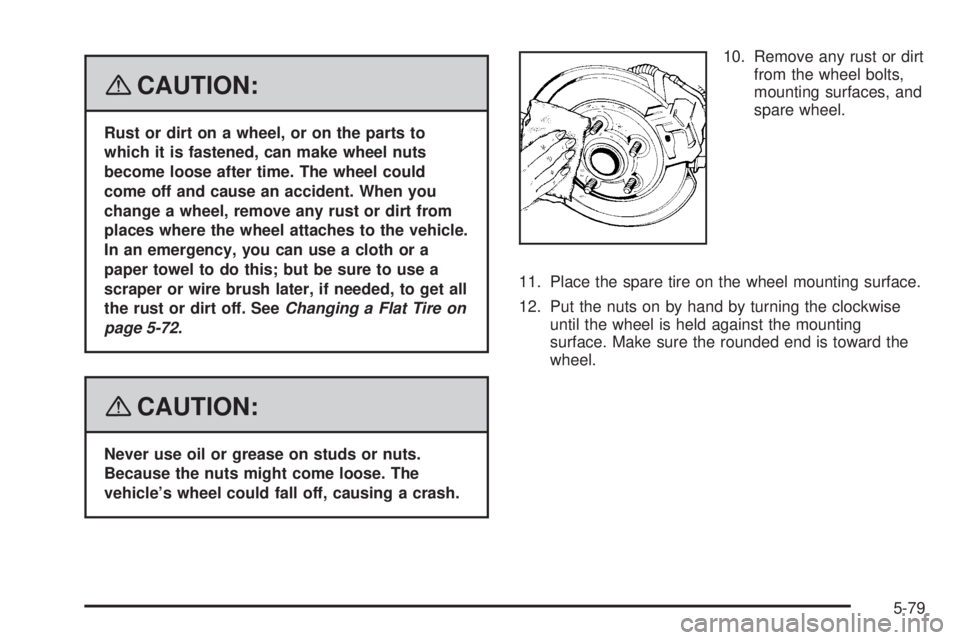
vehicle’s wheel could fall off, causing a crash.10. Remove any rust or dirt
from the wheel bolts,
mounting surfaces, and
spare wheel.
11. Place the spare tire on the wheel mounting surface.
12. Put the nuts on by hand by turning the clockwise
until the wheel is held against the mounting
surface. Make sure the rounded end is toward the
wheel.
5-79
Page 395 of 472
Secondary Latch System
Your vehicle has an underbody mounted tire hoist
assembly that has a secondary latch system. It is
designed to stop the compact spare tire from suddenly
falling off your vehicle if the cable holding the spare
tire is damaged. For the secondary latch to work, the tire
must be stowed with the valve stem pointing down.
SeeStoring a Flat or Spare Tire and Tools on page 5-84
for instructions on storing the spare tire correctly.
{CAUTION:
Before beginning this procedure read all the
instructions. Failure to read and follow the
instructions could damage the hoist assembly
and you and others could get hurt. Read and
follow the instructions listed next.
To release the spare tire from the secondary latch:
{CAUTION:
Someone standing too close during the
procedure could be injured by the jack. If the
spare tire does not slide off the jack
completely, make sure no one is behind you or
on either side of you as you pull the jack out
from the under spare.
1. If the cable is not visible, start this procedure at
Step 3.
5-81
Page 398 of 472
Storing a Flat or Spare Tire and
Tools
Storing the Spare Tire
{CAUTION:
The underbody-mounted spare tire needs to be
stored with the valve stem pointing down. If
the spare tire is stored with the valve stem
pointing upwards, its secondary latch will not
work properly and the spare tire could loosen
and suddenly fall from your vehicle. If this
happened when your vehicle was being driven,
the tire might contact a person or another
vehicle, causing injury and, of course, damage
to itself as well. Be sure the
underbody-mounted spare tire is stored with
its valve stem pointing down.
{CAUTION:
Storing a jack, a tire, or other equipment in the
passenger compartment of the vehicle could
cause injury. In a sudden stop or collision,
loose equipment could strike someone. Store
all these in the proper place.
To store the spare tire:
1. Lay the compact spare tire near the rear of the
vehicle with the valve stem down.
2. Reinstall the plastic spare tire heat shield on the
compact spare tire.
3. Slide the cable retainer through the center of the
wheel and start to raise the compact spare tire.
Make sure the retainer is fully seated across
the underside of the wheel.
4. When the compact spare tire is almost in the stored
position, turn the tire so the valve is toward the rear
of the vehicle.
This position helps when checking the air pressure
in the compact spare tire.
5-84
Page 399 of 472
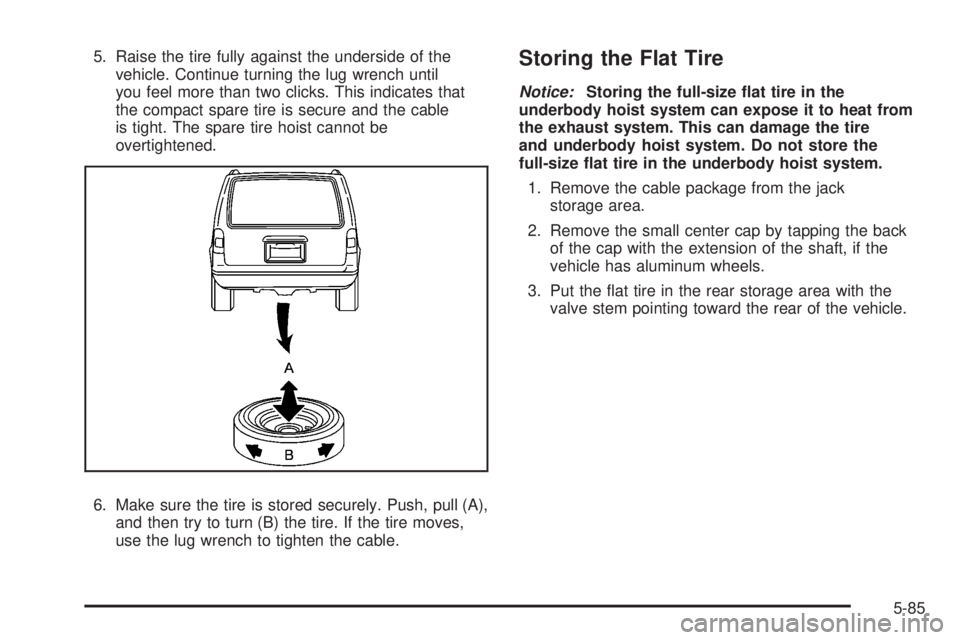
5. Raise the tire fully against the underside of the
vehicle. Continue turning the lug wrench until
you feel more than two clicks. This indicates that
the compact spare tire is secure and the cable
is tight. The spare tire hoist cannot be
overtightened.
6. Make sure the tire is stored securely. Push, pull (A),
and then try to turn (B) the tire. If the tire moves,
use the lug wrench to tighten the cable.Storing the Flat Tire
Notice:Storing the full-size at tire in the
underbody hoist system can expose it to heat from
the exhaust system. This can damage the tire
and underbody hoist system. Do not store the
full-size at tire in the underbody hoist system.
1. Remove the cable package from the jack
storage area.
2. Remove the small center cap by tapping the back
of the cap with the extension of the shaft, if the
vehicle has aluminum wheels.
3. Put the at tire in the rear storage area with the
valve stem pointing toward the rear of the vehicle.
5-85
Page 401 of 472
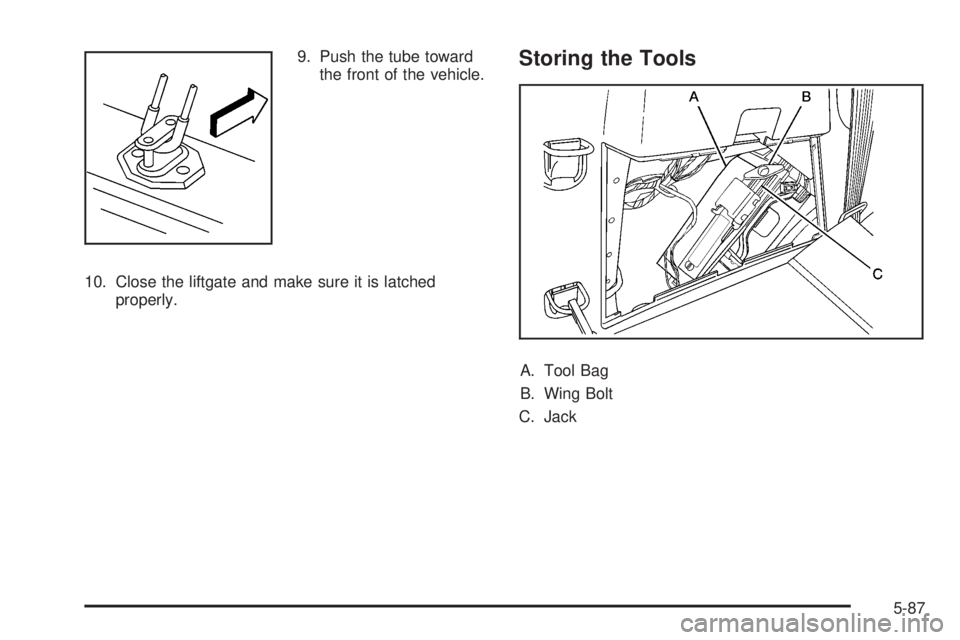
9. Push the tube toward
the front of the vehicle.
10. Close the liftgate and make sure it is latched
properly.Storing the Tools
A. Tool Bag
B. Wing Bolt
C. Jack
5-87
Page 402 of 472
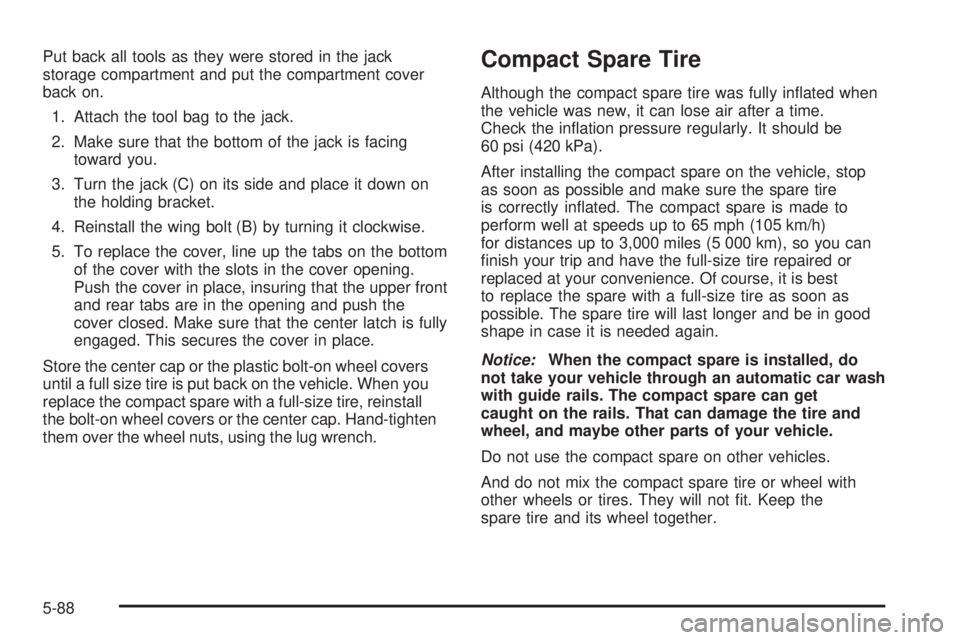
Put back all tools as they were stored in the jack
storage compartment and put the compartment cover
back on.
1. Attach the tool bag to the jack.
2. Make sure that the bottom of the jack is facing
toward you.
3. Turn the jack (C) on its side and place it down on
the holding bracket.
4. Reinstall the wing bolt (B) by turning it clockwise.
5. To replace the cover, line up the tabs on the bottom
of the cover with the slots in the cover opening.
Push the cover in place, insuring that the upper front
and rear tabs are in the opening and push the
cover closed. Make sure that the center latch is fully
engaged. This secures the cover in place.
Store the center cap or the plastic bolt-on wheel covers
until a full size tire is put back on the vehicle. When you
replace the compact spare with a full-size tire, reinstall
the bolt-on wheel covers or the center cap. Hand-tighten
them over the wheel nuts, using the lug wrench.Compact Spare Tire
Although the compact spare tire was fully inated when
the vehicle was new, it can lose air after a time.
Check the ination pressure regularly. It should be
60 psi (420 kPa).
After installing the compact spare on the vehicle, stop
as soon as possible and make sure the spare tire
is correctly inated. The compact spare is made to
perform well at speeds up to 65 mph (105 km/h)
for distances up to 3,000 miles (5 000 km), so you can
nish your trip and have the full-size tire repaired or
replaced at your convenience. Of course, it is best
to replace the spare with a full-size tire as soon as
possible. The spare tire will last longer and be in good
shape in case it is needed again.
Notice:When the compact spare is installed, do
not take your vehicle through an automatic car wash
with guide rails. The compact spare can get
caught on the rails. That can damage the tire and
wheel, and maybe other parts of your vehicle.
Do not use the compact spare on other vehicles.
And do not mix the compact spare tire or wheel with
other wheels or tires. They will not t. Keep the
spare tire and its wheel together.
5-88
Page 404 of 472
Do not clean your vehicle using the following cleaners
or techniques:
Never use a knife or any other sharp object to
remove a soil from any interior surface.
Never use a stiff brush. It can cause damage to
your vehicle’s interior surfaces.
Never apply heavy pressure or rub aggressively
with a cleaning cloth. Use of heavy pressure
can damage your interior and does not improve the
effectiveness of soil removal.
Use only mild, neutral-pH soaps. Avoid laundry
detergents or dishwashing soaps with degreasers.
Using too much soap will leave a residue that
leaves streaks and attracts dirt. For liquid cleaners,
about 20 drops per gallon (3.78 L) of water is a
good guide.
Do not heavily saturate your upholstery while
cleaning.
Damage to your vehicle’s interior may result from
the use of many organic solvents such as naptha,
alcohol, etc.
Fabric/Carpet
Use a vacuum cleaner with a soft brush attachment
frequently to remove dust and loose dirt. A canister
vacuum with a beater bar in the nozzle may only be used
on oor carpet and carpeted oor mats. For soils, always
try to remove them rst with plain water or club soda.
Before cleaning, gently remove as much of the soil as
possible using one of the following techniques:
For liquids: gently blot the remaining soil with a paper
towel. Allow the soil to absorb into the paper towel
until no more can be removed.
For solid dry soils: remove as much as possible and
then vacuum.
To clean, use the following instructions:
1. Saturate a lint-free, clean white cloth with water or
club soda.
2. Wring the cloth to remove excess moisture.
3. Start on the outside edge of the soil and gently rub
toward the center. Continue cleaning, using a clean
area of the cloth each time it becomes soiled.
4. Continue to gently rub the soiled area until the
cleaning cloth remains clean.
5. If the soil is not completely removed, use a mild
soap solution and repeat the cleaning process
that was used with plain water.
5-90
Page 405 of 472
If any of the soil remains, a commercial fabric cleaner or
spot lifter may be necessary. When a commercial
upholstery cleaner or spot lifter is to be used, test a
small hidden area for colorfastness rst. If the locally
cleaned area gives any impression that a ring formation
may result, clean the entire surface.
After the cleaning process has been completed, a paper
towel can be used to blot excess moisture from the
fabric or carpet.
Leather
A soft cloth dampened with water can be used to
remove dust. If a more thorough cleaning is necessary,
a soft cloth dampened with a mild soap solution can
be used. Allow the leather to dry naturally. Do not use
heat to dry. Never use steam to clean leather. Never
use spot lifters or spot removers on leather. Many
commercial leather cleaners and coatings that are sold
to preserve and protect leather may permanently
change the appearance and feel of your leather and are
not recommended. Do not use silicone or wax-based
products, or those containing organic solvents to clean
your vehicle’s interior because they can alter the
appearance by increasing the gloss in a non-uniform
manner. Never use shoe polish on leather.
Instrument Panel, Vinyl, and Other
Plastic Surfaces
A soft cloth dampened with water may be used to
remove dust. If a more thorough cleaning is necessary,
a clean soft cloth dampened with a mild soap solution
can be used to gently remove dust and dirt. Never use
spot lifters or removers on plastic surfaces. Many
commercial cleaners and coatings that are sold to
preserve and protect soft plastic surfaces may
permanently change the appearance and feel of your
interior and are not recommended. Do not use silicone
or wax-based products, or those containing organic
solvents to clean your vehicle’s interior because
they can alter the appearance by increasing the gloss in
a non-uniform manner.
Some commercial products may increase gloss on your
instrument panel. The increase in gloss may cause
annoying reections in the windshield and even make it
difficult to see through the windshield under certain
conditions.
5-91
Page 407 of 472
Dry the nish with a soft, clean chamois or an all-cotton
towel to avoid surface scratches and water spotting
High pressure car washes may cause water to enter the
vehicle. Avoid using high pressure washes closer
than 12 inches (30 cm) to the surface of the vehicle.
Use of power washers exceeding 1,200 psi (8 274 kPa)
can result in damage or removal of paint and decals.
Cleaning Exterior Lamps/Lenses
Use only lukewarm or cold water, a soft cloth and a car
washing soap to clean exterior lamps and lenses. Follow
instructions underWashing Your Vehicle on page 5-92.
Finish Care
Occasional waxing or mild polishing of your vehicle by
hand may be necessary to remove residue from the paint
nish. You can get approved cleaning products from your
dealer/retailer. SeeVehicle Care/Appearance Materials
on page 5-97.
If your vehicle has a basecoat/clearcoat paint nish, the
clearcoat gives more depth and gloss to the colored
basecoat. Always use waxes and polishes that are
non-abrasive and made for a basecoat/clearcoat paint
nish.Notice:Machine compounding or aggressive
polishing on a basecoat/clearcoat paint nish may
damage it. Use only non-abrasive waxes and
polishes that are made for a basecoat/clearcoat
paint nish on your vehicle.
Foreign materials such as calcium chloride and other
salts, ice melting agents, road oil and tar, tree sap, bird
droppings, chemicals from industrial chimneys, etc.,
can damage your vehicle’s nish if they remain
on painted surfaces. Wash the vehicle as soon as
possible. If necessary, use non-abrasive cleaners that
are marked safe for painted surfaces to remove
foreign matter.
Exterior painted surfaces are subject to aging, weather
and chemical fallout that can take their toll over a
period of years. You can help to keep the paint nish
looking new by keeping your vehicle garaged or covered
whenever possible.
Protecting Exterior Bright Metal Parts
Bright metal parts should be cleaned regularly to keep
their luster. Washing with water is all that is usually
needed. However, you may use chrome polish on
chrome or stainless steel trim, if necessary.
5-93
Page 408 of 472
Use special care with aluminum trim. To avoid damaging
protective trim, never use auto or chrome polish,
steam or caustic soap to clean aluminum. A coating of
wax, rubbed to high polish, is recommended for all
bright metal parts.
Windshield, Backglass, and Wiper
Blades
Clean the outside of the windshield and backglass with
glass cleaner.
Clean the rubber blades using a lint free cloth or paper
towel soaked with windshield washer uid or a mild
detergent. Wash the windshield thoroughly when you
clean the blades. Bugs, road grime, sap and a buildup of
vehicle wash/wax treatments may cause wiper
streaking. Replace the wiper blades if they are worn or
damaged.
Wipers can be damaged by:
Extreme dusty conditions
Sand and salt
Heat and sun
Snow and ice, without proper removal
Aluminum or Chrome-Plated Wheels
and Trim
Your vehicle may have either aluminum or chrome-plated
wheels.
Keep the wheels clean using a soft clean cloth with mild
soap and water. Rinse with clean water. After rinsing
thoroughly, dry with a soft clean towel. A wax may then
be applied.
Notice:Chrome wheels and other chrome trim may
be damaged if you do not wash your vehicle after
driving on roads that have been sprayed with
magnesium, calcium or sodium chloride. These
chlorides are used on roads for conditions such as
ice and dust. Always wash your vehicle’s chrome
with soap and water after exposure.
Notice:If you use strong soaps, chemicals, abrasive
polishes, cleaners, brushes, or cleaners that contain
acid on aluminum or chrome-plated wheels, you
could damage the surface of the wheel(s). The repairs
would not be covered by your warranty. Use only
approved cleaners on aluminum or chrome-plated
wheels.
The surface of these wheels is similar to the painted
surface of your vehicle. Do not use strong soaps,
chemicals, abrasive polishes, abrasive cleaners, cleaners
with acid, or abrasive cleaning brushes on them because
you could damage the surface. Do not use chrome polish
on aluminum wheels.
5-94