check engine GMC ACADIA 2009 Owner's Guide
[x] Cancel search | Manufacturer: GMC, Model Year: 2009, Model line: ACADIA, Model: GMC ACADIA 2009Pages: 420, PDF Size: 2.23 MB
Page 281 of 420
Fuel
Use of the recommended fuel
is an important part of the proper
maintenance of this vehicle. To help
keep the engine clean and maintain
optimum vehicle performance, we
recommend the use of gasoline
advertised as TOP TIER Detergent
Gasoline.
Gasoline Octane
Use regular unleaded gasoline with
a posted octane rating of 87 or
higher. If the octane rating is less
than 87, you might notice an audible
knocking noise when you drive,
commonly referred to as spark
knock. If this occurs, use a gasoline
rated at 87 octane or higher as
soon as possible. If you are using
gasoline rated at 87 octane or higher
and you hear heavy knocking, the
engine needs service.
Gasoline Specications
At a minimum, gasoline
should meet ASTM specication
D 4814 in the United States or
CAN/CGSB-3.5 or 3.511 in Canada.
Some gasolines contain an
octane-enhancing additive called
methylcyclopentadienyl manganese
tricarbonyl (MMT). We recommend
against the use of gasolines
containing MMT. SeeAdditives on
page 5-5for additional information.
California Fuel
If the vehicle is certied to meet
California Emissions Standards,
it is designed to operate on fuels
that meet California specications.
See the underhood emission control
label. If this fuel is not available in
states adopting California emissions
standards, the vehicle will operate
satisfactorily on fuels meeting federal
specications, but emission controlsystem performance might be
affected. The malfunction indicator
lamp could turn on and the vehicle
might fail a smog-check test. See
Malfunction Indicator Lamp on
page 3-41. If this occurs, return to
your authorized dealer/retailer for
diagnosis. If it is determined that the
condition is caused by the type of
fuel used, repairs might not be
covered by the vehicle warranty.
Additives
To provide cleaner air, all gasolines
in the United States are now required
to contain additives that help prevent
engine and fuel system deposits
from forming, allowing the emission
control system to work properly.
In most cases, you should not have
to add anything to the fuel. However,
some gasolines contain only the
minimum amount of additive required
to meet U.S. Environmental
Protection Agency regulations.
Service and Appearance Care 5-5
Page 285 of 420
Checking Things
Under the Hood
{CAUTION
An electric fan under the hood
can start up and injure you even
when the engine is not running.
Keep hands, clothing, and tools
away from any underhood
electric fan.
{CAUTION
Things that burn can get on hot
engine parts and start a re.
These include liquids like fuel, oil,
coolant, brake uid, windshield
washer and other uids, and
plastic or rubber. You or others
could be burned. Be careful not to
drop or spill things that will burn
onto a hot engine.
Hood Release
To open the hood, do the following:
1. Pull the hood release handle with
this symbol on it. It is located
under the instrument panel
on the driver’s side of the vehicle.
2. At the front of the vehicle, pull up
on the center of the hood, and
push the secondary hood release
to the right.
3. After you have partially lifted the
hood, gas struts will automatically
take over to lift and hold the
hood in the fully open position.Before closing the hood, be sure all
ller caps are on properly.
Pull the hood down to close. Lower
the hood until the lifting pressure of
the strut is reduced. Then allow the
hood to fall and latch into place
under its own weight. Check to make
sure the hood is closed. If the hood
does not fully latch, gently push the
hood down at the front and center
of the hood until it is completely
latched.
Service and Appearance Care 5-9
Page 287 of 420
A. Radiator Pressure Cap. See
Cooling System on page 5-16.
B. Engine Coolant Recovery Cap.
SeeCooling System on
page 5-16.
C. Remote Negative (−) Terminal.
SeeJump Starting on page 5-28.
D.Underhood Fuse Block on
page 5-92.
E. Remote Positive (+) Terminal.
SeeJump Starting on page 5-28.
F.Power Steering Fluid on
page 5-23.
G. Engine Oil Fill Cap. See “When
to Add Engine Oil” underEngine
Oil on page 5-11.
H. Engine Oil Dipstick. See
“Checking Engine Oil” under
Engine Oil on page 5-11.
I. Automatic Transmission Fluid
Dipstick. See “Checking the
Fluid Level” underAutomatic
Transmission Fluid on page 5-16.
J. Brake Master Cylinder Reservoir.
See “Brake Fluid” underBrakes
on page 5-25.K.Engine Air Cleaner/Filter on
page 5-15.
L. Windshield Washer Fluid
Reservoir. See “Adding Washer
Fluid” underWindshield
Washer Fluid on page 5-24.
Engine Oil
Checking Engine Oil
It is a good idea to check the
engine oil every time you get fuel.
In order to get an accurate reading,
the oil must be warm and the
vehicle must be on level ground.
The engine oil dipstick handle
is a yellow loop. SeeEngine
Compartment Overview on
page 5-10for the location of
the engine oil dipstick.
1. Turn off the engine and give the
oil several minutes to drain back
into the oil pan. If you do not
do this, the oil dipstick might
not show the actual level.2. Pull out the dipstick and clean
it with a paper towel or cloth,
then push it back in all the way.
Remove it again, keeping the
tip down, and check the level.
When to Add Engine Oil
If the oil is below the cross-hatched
area at the tip of the dipstick,
add at least one quart/liter of the
recommended oil. This section
explains what kind of oil to use.
For engine oil crankcase capacity,
seeCapacities and Specifications
on page 5-96.
Notice:Do not add too much oil.
If the engine has so much oil
that the oil level gets above the
cross-hatched area that shows
the proper operating range,
the engine could be damaged.
Service and Appearance Care 5-11
Page 289 of 420
Notice:Use only engine oil
identied as meeting GM Standard
GM6094M and showing the
American Petroleum Institute
Certied For Gasoline Engines
starburst symbol. Failure to use
the recommended oil can result
in engine damage not covered by
the vehicle warranty.
Cold Temperature Operation
If in an area of extreme cold,
where the temperature falls
below−20°F (−29°C), use either
an SAE 5W-30 synthetic oil or an
SAE 0W-30 engine oil. Both provide
easier cold starting for the engine at
extremely low temperatures. Always
use an oil that meets the required
specication, GM6094M. See “What
Kind of Engine Oil to Use” for more
information.
Engine Oil Additives / Engine
Oil Flushes
Do not add anything to the oil.
The recommended oils with
the starburst symbol that meet
GM Standard GM6094M are all
that is needed for good performance
and engine protection.
Engine oil system ushes are not
recommended and could cause
engine damage not covered by
the vehicle warranty.
Engine Oil Life System
When to Change Engine Oil
This vehicle has a computer system
that indicates when to change the
engine oil and lter. This is based
on engine revolutions and engine
temperature, and not on mileage.
Based on driving conditions, the
mileage at which an oil change is
indicated can vary considerably.
For the oil life system to work
properly, the system must be reset
every time the oil is changed.When the system has calculated
that oil life has been diminished,
it indicates that an oil change is
necessary. A CHANGE ENGINE OIL
SOON message comes on. Change
the oil as soon as possible within
the next 600 miles (1 000 km). It is
possible that, if driving under the best
conditions, the oil life system might
not indicate that an oil change is
necessary for over a year. However,
the engine oil and lter must be
changed at least once a year and at
this time the system must be reset.
Your dealer/retailer has trained
service people who will perform this
work using genuine parts and reset
the system. It is also important to
check the oil regularly and keep it
at the proper level.
If the system is ever reset
accidentally, the oil must be changed
at 3,000 miles (5 000 km) since the
last oil change. Remember to reset
the oil life system whenever the oil is
changed.
Service and Appearance Care 5-13
Page 292 of 420
Automatic Transmission
Fluid
It is not necessary to check
the transmission uid level.
A transmission uid leak is the
only reason for uid loss. If a
leak occurs, take the vehicle to
the dealer/retailer and have it
repaired as soon as possible.
Change the uid at the intervals
listed inAdditional Required Services
on page 6-6, and be sure to use
the transmission uid listed in
Recommended Fluids and
Lubricants on page 6-12.
Notice:Use of the incorrect
automatic transmission uid may
damage the vehicle, and the
damages may not be covered by
the vehicle’s warranty. Always
use the automatic transmission
uid listed inRecommended
Fluids and Lubricants on
page 6-12.The transmission uid will not
reach the end of the dipstick unless
the transmission is at operating
temperature. If you need to check the
transmission uid level, please take
the vehicle to your dealer/retailer.
Cooling System
The cooling system allows the
engine to maintain the correct
working temperature.
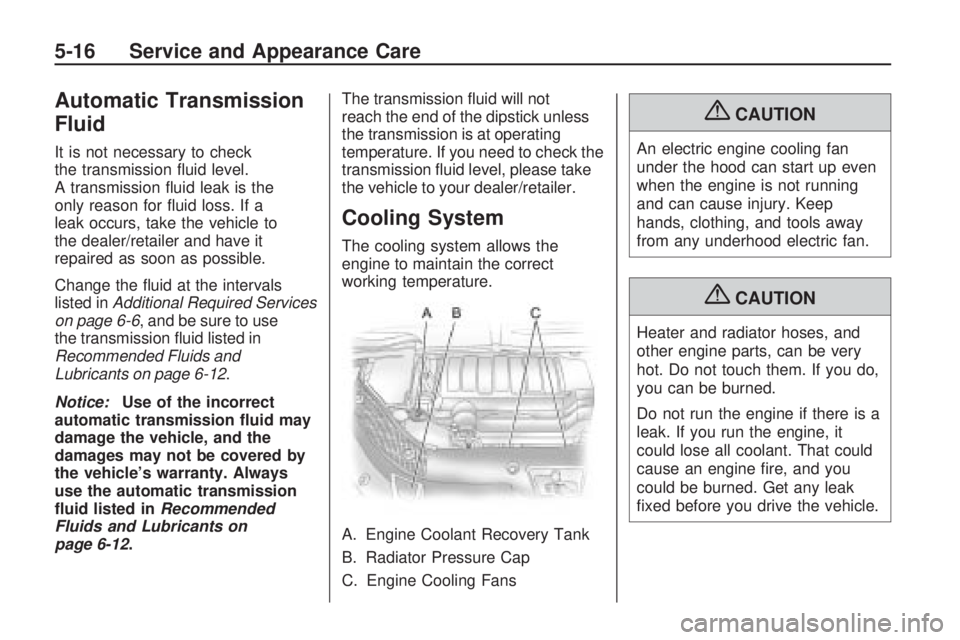
A. Engine Coolant Recovery Tank
B. Radiator Pressure Cap
C. Engine Cooling Fans
{CAUTION
An electric engine cooling fan
under the hood can start up even
when the engine is not running
and can cause injury. Keep
hands, clothing, and tools away
from any underhood electric fan.
{CAUTION
Heater and radiator hoses, and
other engine parts, can be very
hot. Do not touch them. If you do,
you can be burned.
Do not run the engine if there is a
leak. If you run the engine, it
could lose all coolant. That could
cause an engine re, and you
could be burned. Get any leak
xed before you drive the vehicle.
5-16 Service and Appearance Care
Page 293 of 420
Notice:Using coolant other
than DEX-COOL®can cause
premature engine, heater core,
or radiator corrosion. In addition,
the engine coolant could require
changing sooner, at 30,000 miles
(50 000 km) or 24 months,
whichever occurs rst. Any
repairs would not be covered by
the vehicle warranty. Always use
DEX-COOL
®(silicate-free) coolant
in the vehicle.
Engine Coolant
The cooling system in the vehicle
is lled with DEX-COOL®engine
coolant. The coolant is designed to
remain in the vehicle for ve years
or 150,000 miles (240 000 km),
whichever occurs rst.
The following explains the cooling
system and how to check and add
coolant when it is low. If there is a
problem with engine overheating,
seeEngine Overheating on
page 5-21.
What to Use
{CAUTION
Adding only plain water to the
cooling system can be dangerous.
Plain water, or some other liquid
such as alcohol, can boil before
the proper coolant mixture will.
The vehicle’s coolant warning
system is set for the proper
coolant mixture. With plain water
or the wrong mixture, the engine
could get too hot but you would
not get the overheat warning. The
engine could catch re and you or
others could be burned. Use a
50/50 mixture of clean, drinkable
water and DEX-COOL
®coolant.
Use a 50/50 mixture of clean,
drinkable water and DEX-COOL
coolant. If using this mixture,
nothing else needs to be added.
This mixture:
Gives freezing protection down to
−34°F (−37°C), outside
temperature.
Gives boiling protection up to
265°F (129°C), engine
temperature.
Protects against rust and
corrosion.
Will not damage aluminum parts.
Helps keep the proper engine
temperature.
Notice:If an improper coolant
mixture is used, the engine could
overheat and be badly damaged.
The repair cost would not be
covered by the vehicle warranty.
Too much water in the mixture
can freeze and crack the engine,
radiator, heater core, and other
parts.
Notice:If extra inhibitors
and/or additives are used in the
vehicle’s cooling system, the
vehicle could be damaged.
Use only the proper mixture
of the engine coolant listed in this
manual for the cooling system.
SeeRecommended Fluids
and Lubricants on page 6-12
for more information.
Service and Appearance Care 5-17
Page 294 of 420
Checking Coolant
The vehicle must be on a level
surface when checking the coolant
level.
Check to see if coolant is visible in
the coolant recovery tank. If the
coolant inside the coolant recovery
tank is boiling, do not do anything
else until it cools down. If coolant is
visible but the coolant level is not
at or above the FULL COLD
mark, add a 50/50 mixture of clean,
drinkable water and DEX-COOL
coolant at the coolant recovery tank,
but be sure the cooling system is
cool before this is done. SeeEngine
Coolant on page 5-17for more
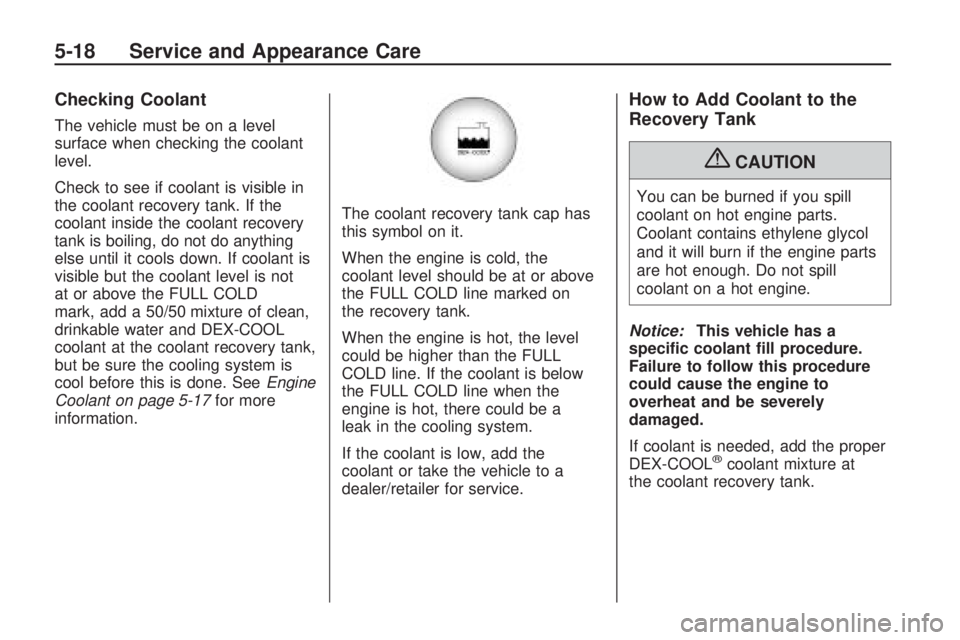
information.The coolant recovery tank cap has
this symbol on it.
When the engine is cold, the
coolant level should be at or above
the FULL COLD line marked on
the recovery tank.
When the engine is hot, the level
could be higher than the FULL
COLD line. If the coolant is below
the FULL COLD line when the
engine is hot, there could be a
leak in the cooling system.
If the coolant is low, add the
coolant or take the vehicle to a
dealer/retailer for service.
How to Add Coolant to the
Recovery Tank
{CAUTION
You can be burned if you spill
coolant on hot engine parts.
Coolant contains ethylene glycol
and it will burn if the engine parts
are hot enough. Do not spill
coolant on a hot engine.
Notice:This vehicle has a
specic coolant ll procedure.
Failure to follow this procedure
could cause the engine to
overheat and be severely
damaged.
If coolant is needed, add the proper
DEX-COOL
®coolant mixture at
the coolant recovery tank.
5-18 Service and Appearance Care
Page 297 of 420
9. If the coolant level inside the
radiator ller neck is low, add
more of the proper DEX-COOL
coolant mixture through the
ller neck until the level is back
up to the base of the ller
neck. Replace the pressure cap.
Be sure to secure it tightly.
Notice:If the pressure cap is
not tightly installed, coolant loss
and possible engine damage
may occur. Be sure the cap is
properly and tightly secured.
Engine Overheating
The vehicle has several indicators
to warn of engine overheating.
There is an engine coolant
temperature gage on the instrument
panel cluster. SeeEngine Coolant
Temperature Gage on page 3-40.The vehicle may also display
an ENGINE OVERHEATED
IDLE ENGINE and ENGINE
OVERHEATED STOP ENGINE
message in the Driver Information
Center (DIC). SeeDIC Warnings
and Messages on page 3-56.
You may decide not to lift the hood
when this warning appears, but
instead get service help right away.
SeeRoadside Assistance Program
on page 7-6.
If you do decide to lift the hood,
make sure the vehicle is parked
on a level surface
Then check to see if the engine
cooling fans are running. If the
engine is overheating, both fans
should be running. If they are
not, do not continue to run the
engine and have the vehicle
serviced.Notice:Engine damage from
running the engine without
coolant is not covered by the
warranty.
Notice:If the engine catches re
while driving with no coolant, the
vehicle can be badly damaged.
The costly repairs would not be
covered by the vehicle warranty.
SeeOverheated Engine Protection
Operating Mode on page 5-23for
information on driving to a safe
place in an emergency.
Service and Appearance Care 5-21
Page 299 of 420
Overheated Engine
Protection
Operating Mode
This emergency operating mode lets
the vehicle be driven to a safe place
in an emergency situation. If an
overheated engine condition exists,
an overheat protection mode which
alternates ring groups of cylinders
helps prevent engine damage. In this
mode, there is a signicant loss in
power and engine performance.
The temperature gage indicates an
overheat condition exists. Driving
extended distances and/or towing a
trailer in the overheat protection
mode should be avoided.
Notice:After driving in the
overheated engine protection
operating mode, to avoid engine
damage, allow the engine to
cool before attempting any repair.
The engine oil will be severely
degraded. Repair the cause
of coolant loss, change the oil
and reset the oil life system.
SeeEngine Oil on page 5-11.
Power Steering Fluid
The power steering uid reservoir
is located toward the front of the
engine compartment on the
passenger side of the vehicle.
SeeEngine Compartment Overview
on page 5-10for reservoir location.
When to Check Power
Steering Fluid
It is not necessary to regularly
check power steering uid unless
you suspect there is a leak in
the system or you hear an unusual
noise. A uid loss in this system
could indicate a problem. Have the
system inspected and repaired.
How to Check Power Steering
Fluid
To check the power steering uid:
1. Turn the key off and let the
engine compartment cool down.
2. Remove engine oil ll cap.
3. Slide engine cover rearward and
lift to remove.
4. Wipe the cap and the top of the
reservoir clean.
5. Unscrew the cap and wipe the
dipstick with a clean rag.
6. Replace the cap and completely
tighten it.
7. Remove the cap again and look
at the uid level on the dipstick.
The uid level should be somewhere
between MAX and MIN line on the
dipstick in room temperature. If the
uid is on or below MIN line, you
should add uid close to MAX Line.
Service and Appearance Care 5-23
Page 306 of 420
4. Open the hoods and locate the
positive (+) and negative (−)
terminal locations on the other
vehicle. Your vehicle has a
remote positive (+) and a
remote negative (−) jump
starting terminal. SeeEngine
Compartment Overview on
page 5-10for more information
on the terminal locations.
{CAUTION
Using a match near a battery can
cause battery gas to explode.
People have been hurt doing this,
and some have been blinded. Use
a ashlight if you need more light.
Be sure the batteries have
enough water. You do not need
to add water to the ACDelco
®
battery (or batteries) installed in
your new vehicle. But if a battery
has ller caps, be sure the right
(Continued)
CAUTION (Continued)
amount of uid is there. If it is
low, add water to take care of that
rst. If you do not, explosive gas
could be present.
Battery uid contains acid that
can burn you. Do not get it on
you. If you accidentally get it in
your eyes or on your skin, ush
the place with water and get
medical help immediately.
{CAUTION
Fans or other moving engine
parts can injure you badly. Keep
your hands away from moving
parts once the engine is running.5. Check that the jumper cables
do not have loose or missing
insulation. If they do, you could
get a shock. The vehicles
could be damaged too.
Before you connect the cables,
here are some basic things you
should know. Positive (+) will go
to positive (+) or to a remote
positive (+) terminal if the vehicle
has one. Negative (−) will go to a
heavy, unpainted metal engine
part or to a remote negative (−)
terminal if the vehicle has one.
Do not connect positive (+) to
negative (−) or you will get a short
that would damage the battery
and maybe other parts too. And
do not connect the negative (−)
cable to the negative (−) terminal
on the dead battery because this
can cause sparks.
5-30 Service and Appearance Care