tow GMC ACADIA 2009 Workshop Manual
[x] Cancel search | Manufacturer: GMC, Model Year: 2009, Model line: ACADIA, Model: GMC ACADIA 2009Pages: 420, PDF Size: 2.23 MB
Page 298 of 420
If Steam Is Coming From The
Engine Compartment
{CAUTION
Steam from an overheated engine
can burn you badly, even if you
just open the hood. Stay away
from the engine if you see or hear
steam coming from it. Turn it off
and get everyone away from the
vehicle until it cools down. Wait
until there is no sign of steam or
coolant before you open the hood.
If you keep driving when the
vehicles engine is overheated, the
liquids in it can catch re. You or
others could be badly burned.
Stop the engine if it overheats,
and get out of the vehicle until the
engine is cool.
SeeOverheated Engine
Protection Operating Mode on
page 5-23for information on
driving to a safe place in an
emergency.
If No Steam Is Coming From
The Engine Compartment
If an engine overheat warning is
displayed but no steam can be seen
or heard, the problem may not be too
serious. Sometimes the engine can
get a little too hot when the vehicle:
Climbs a long hill on a hot day.
Stops after high-speed driving.
Idles for long periods in traffic.
Tows a trailer.
If the overheat warning is displayed
with no sign of steam:
1. Turn the air conditioning off.
2. Turn the heater on to the highest
temperature and to the highest
fan speed. Open the windows as
necessary.
3. If in a traffic jam, shift to
N (Neutral), otherwise, shift
to the highest gear while
driving—D(Drive) or L (Low).If the temperature overheat gage is
no longer in the overheat zone or an
overheat warning no longer displays,
the vehicle can be driven. Continue
to drive the vehicle slow for about
10 minutes. Keep a safe vehicle
distance from the car in front of you.
If the warning does not come back
on, continue to drive normally.
If the warning continues, pull
over, stop, and park the vehicle
right away.
If there is no sign of steam, idle
the engine for three minutes while
parked. If the warning is still
displayed, turn off the engine until it
cools down. Also, see “Overheated
Engine Protection Operating Mode”
next in this section.
5-22 Service and Appearance Care
Page 299 of 420
Overheated Engine
Protection
Operating Mode
This emergency operating mode lets
the vehicle be driven to a safe place
in an emergency situation. If an
overheated engine condition exists,
an overheat protection mode which
alternates ring groups of cylinders
helps prevent engine damage. In this
mode, there is a signicant loss in
power and engine performance.
The temperature gage indicates an
overheat condition exists. Driving
extended distances and/or towing a
trailer in the overheat protection
mode should be avoided.
Notice:After driving in the
overheated engine protection
operating mode, to avoid engine
damage, allow the engine to
cool before attempting any repair.
The engine oil will be severely
degraded. Repair the cause
of coolant loss, change the oil
and reset the oil life system.
SeeEngine Oil on page 5-11.
Power Steering Fluid
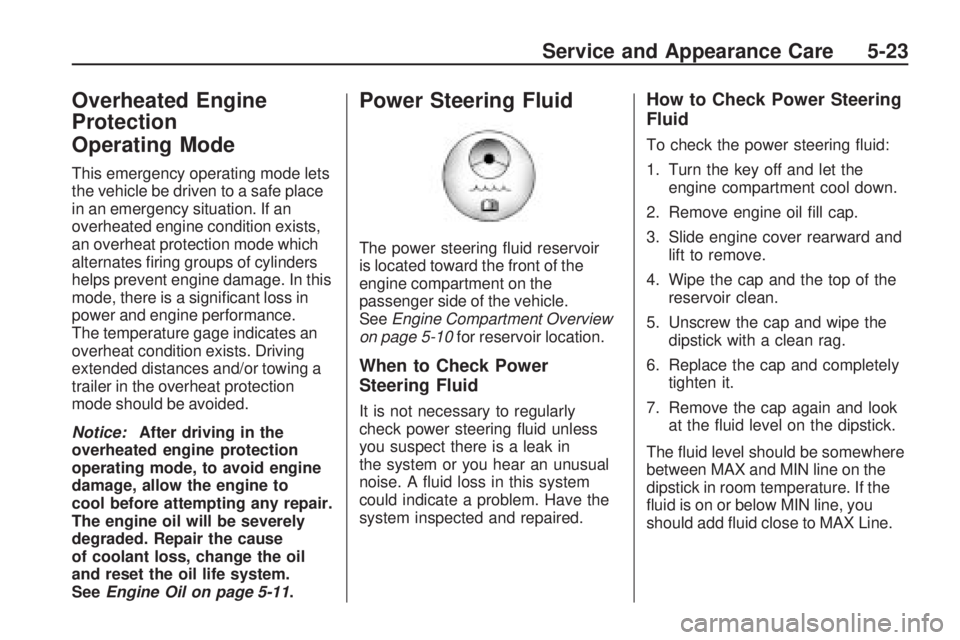
The power steering uid reservoir
is located toward the front of the
engine compartment on the
passenger side of the vehicle.
SeeEngine Compartment Overview
on page 5-10for reservoir location.
When to Check Power
Steering Fluid
It is not necessary to regularly
check power steering uid unless
you suspect there is a leak in
the system or you hear an unusual
noise. A uid loss in this system
could indicate a problem. Have the
system inspected and repaired.
How to Check Power Steering
Fluid
To check the power steering uid:
1. Turn the key off and let the
engine compartment cool down.
2. Remove engine oil ll cap.
3. Slide engine cover rearward and
lift to remove.
4. Wipe the cap and the top of the
reservoir clean.
5. Unscrew the cap and wipe the
dipstick with a clean rag.
6. Replace the cap and completely
tighten it.
7. Remove the cap again and look
at the uid level on the dipstick.
The uid level should be somewhere
between MAX and MIN line on the
dipstick in room temperature. If the
uid is on or below MIN line, you
should add uid close to MAX Line.
Service and Appearance Care 5-23
Page 324 of 420
Reset the Tire Pressure Monitor
System. SeeTire Pressure
Monitor Operation on page 5-44.
Make certain that all wheel
nuts are properly tightened.
See “Wheel Nut Torque” under
Capacities and Specifications
on page 5-96.
{CAUTION
Rust or dirt on a wheel, or
on the parts to which it is
fastened, can make wheel
nuts become loose after time.
The wheel could come off and
cause an accident. When you
change a wheel, remove any
(Continued)
CAUTION (Continued)
rust or dirt from places where
the wheel attaches to the
vehicle. In an emergency, you
can use a cloth or a paper
towel to do this; but be sure to
use a scraper or wire brush
later, if needed, to get all the
rust or dirt off. SeeChanging
a Flat Tire on page 5-69.
Make sure the spare tire, if
the vehicle has one, is stored
securely. Push, pull, and then
try to rotate or turn the tire. If it
moves, tighten the cable. See
Storing a Flat or Spare Tire and
Tools on page 5-78.When It Is Time for New
Tires
Various factors, such as
maintenance, temperatures, driving
speeds, vehicle loading, and road
conditions inuence when you need
new tires.
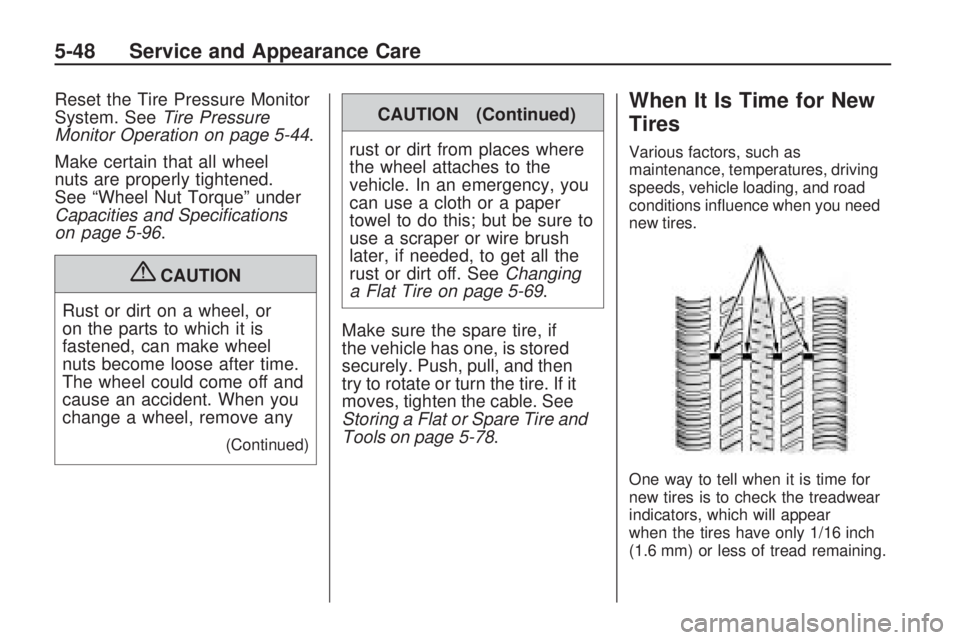
One way to tell when it is time for
new tires is to check the treadwear
indicators, which will appear
when the tires have only 1/16 inch
(1.6 mm) or less of tread remaining.
5-48 Service and Appearance Care
Page 331 of 420
If a Tire Goes Flat
It is unusual for a tire to blowout
while you are driving, especially
if you maintain the tires properly.
SeeTires on page 5-35.Ifair
goes out of a tire, It is much more
likely to leak out slowly. But if
you should ever have a blowout,
here are a few tips about what
to expect and what to do:
If a front tire fails, the at tire will
create a drag that pulls the vehicle
toward that side. Take your foot off
the accelerator pedal and grip the
steering wheel rmly. Steer to
maintain lane position, and then
gently brake to a stop well out of
the traffic lane.
A rear blowout, particularly on a
curve, acts much like a skid and may
require the same correction youwould use in a skid. In any rear
blowout, remove your foot from the
accelerator pedal. Get the vehicle
under control by steering the way
you want the vehicle to go. It may be
very bumpy and noisy, but you can
still steer. Gently brake to a stop, well
off the road if possible.
If a tire goes at, avoid further tire
and wheel damage by driving slowly
to a level place and stopping.
1. Turn on the hazard warning
ashers. SeeHazard Warning
Flashers on page 3-5.
2. Park the vehicle. Set the parking
brake rmly and put the shift
lever in P (Park).
3. Turn off the engine.
4. Inspect the at tire.{CAUTION
Lifting a vehicle and getting under
it to do maintenance or repairs is
dangerous without the appropriate
safety equipment and training. If a
jack is provided with the vehicle, it
is designed only for changing a
at tire. If it is used for anything
else, you or others could be badly
injured or killed if the vehicle slips
off the jack. If a jack is provided
with the vehicle, only use it for
changing a at tire.
This vehicle may come with a jack
and spare tire or a tire sealant
and compressor kit. To use the jack
and spare tire, seeChanging a
Flat Tire on page 5-69. To use the
tire sealant and compressor kit,
seeTire Sealant and Compressor
Kit on page 5-56.
Service and Appearance Care 5-55
Page 345 of 420
Changing a Flat Tire
If a tire goes at, avoid further
tire and wheel damage by driving
slowly to a level place. Turn on
the hazard warning ashers.
SeeHazard Warning Flashers
on page 3-5.
{CAUTION
Changing a tire can be
dangerous. The vehicle can slip
off the jack and roll over or fall
on you or other people. You and
they could be badly injured or
even killed. Find a level place to
change your tire. To help prevent
the vehicle from moving:
1. Set the parking brake rmly.
2. Put the shift lever in
P (Park).
(Continued)
CAUTION (Continued)
3. Turn off the engine and do
not restart while the vehicle
is raised.
4. Do not allow passengers to
remain in the vehicle.
To be even more certain the
vehicle will not move, you should
put blocks at the front and rear of
the tire farthest away from the
one being changed. That would
be the tire, on the other side, at
the opposite end of the vehicle.
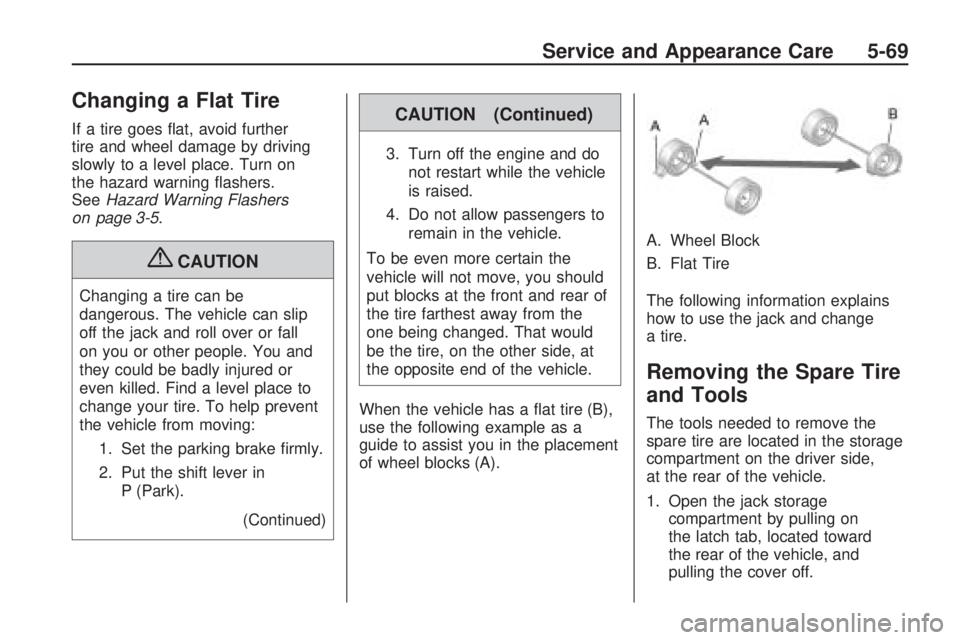
When the vehicle has a at tire (B),
use the following example as a
guide to assist you in the placement
of wheel blocks (A).A. Wheel Block
B. Flat Tire
The following information explains
how to use the jack and change
a tire.
Removing the Spare Tire
and Tools
The tools needed to remove the
spare tire are located in the storage
compartment on the driver side,
at the rear of the vehicle.
1. Open the jack storage
compartment by pulling on
the latch tab, located toward
the rear of the vehicle, and
pulling the cover off.
Service and Appearance Care 5-69
Page 346 of 420
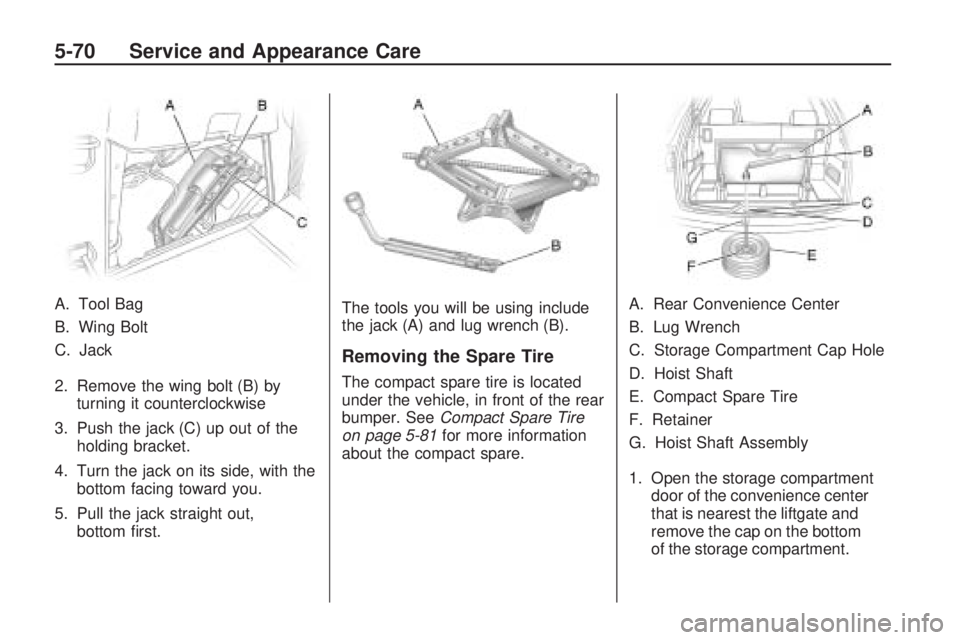
A. Tool Bag
B. Wing Bolt
C. Jack
2. Remove the wing bolt (B) by
turning it counterclockwise
3. Push the jack (C) up out of the
holding bracket.
4. Turn the jack on its side, with the
bottom facing toward you.
5. Pull the jack straight out,
bottom rst.The tools you will be using include
the jack (A) and lug wrench (B).
Removing the Spare Tire
The compact spare tire is located
under the vehicle, in front of the rear
bumper. SeeCompact Spare Tire
on page 5-81for more information
about the compact spare.A. Rear Convenience Center
B. Lug Wrench
C. Storage Compartment Cap Hole
D. Hoist Shaft
E. Compact Spare Tire
F. Retainer
G. Hoist Shaft Assembly
1. Open the storage compartment
door of the convenience center
that is nearest the liftgate and
remove the cap on the bottom
of the storage compartment.
5-70 Service and Appearance Care
Page 350 of 420
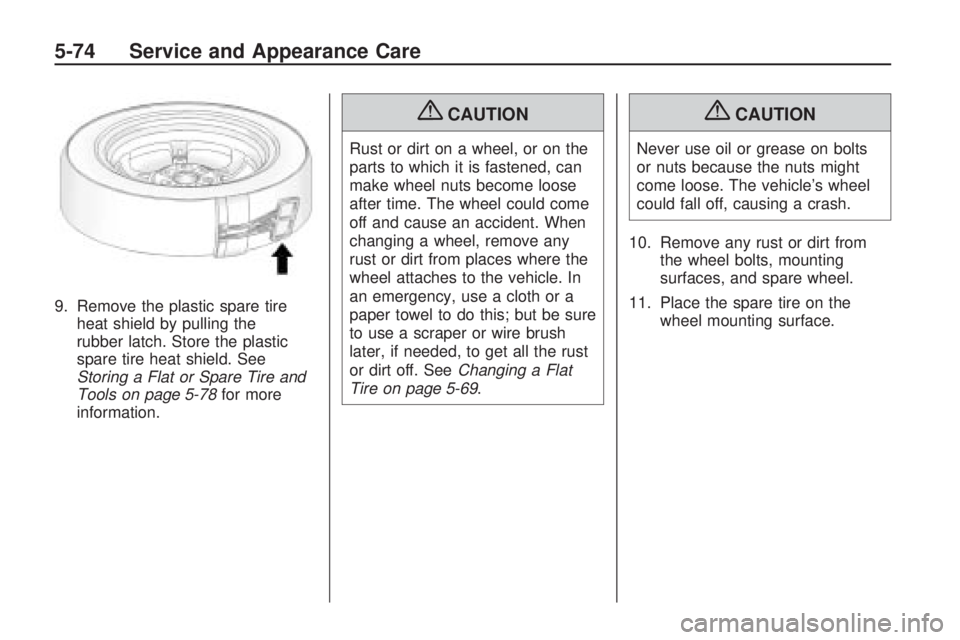
9. Remove the plastic spare tire
heat shield by pulling the
rubber latch. Store the plastic
spare tire heat shield. See
Storing a Flat or Spare Tire and
Tools on page 5-78for more
information.
{CAUTION
Rust or dirt on a wheel, or on the
parts to which it is fastened, can
make wheel nuts become loose
after time. The wheel could come
off and cause an accident. When
changing a wheel, remove any
rust or dirt from places where the
wheel attaches to the vehicle. In
an emergency, use a cloth or a
paper towel to do this; but be sure
to use a scraper or wire brush
later, if needed, to get all the rust
or dirt off. SeeChanging a Flat
Tire on page 5-69.
{CAUTION
Never use oil or grease on bolts
or nuts because the nuts might
come loose. The vehicle’s wheel
could fall off, causing a crash.
10. Remove any rust or dirt from
the wheel bolts, mounting
surfaces, and spare wheel.
11. Place the spare tire on the
wheel mounting surface.
5-74 Service and Appearance Care
Page 351 of 420
12. Put the nuts on by hand by
turning the clockwise until
the wheel is held against the
mounting surface. Make
sure the rounded end is
toward the wheel.
13. Lower the vehicle by attaching
the lug wrench to the jack
and turning the wrench
counterclockwise. Lower
the jack completely.
{CAUTION
Incorrect or improperly tightened
wheel nuts can cause the wheel
to come loose and even come off.
This could lead to a crash. If you
have to replace them, be sure to
get new original equipment wheel
nuts. Stop somewhere as soon as
(Continued)
CAUTION (Continued)
you can and have the nuts
tightened with a torque wrench to
the proper torque specication.
SeeCapacities and Specifications
on page 5-96for wheel nut torque
specication.
Notice:Improperly tightened
wheel nuts can lead to brake
pulsation and rotor damage.
To avoid expensive brake repairs,
evenly tighten the wheel nuts
in the proper sequence and to
the proper torque specication.
SeeCapacities and Specifications
on page 5-96for the wheel nut
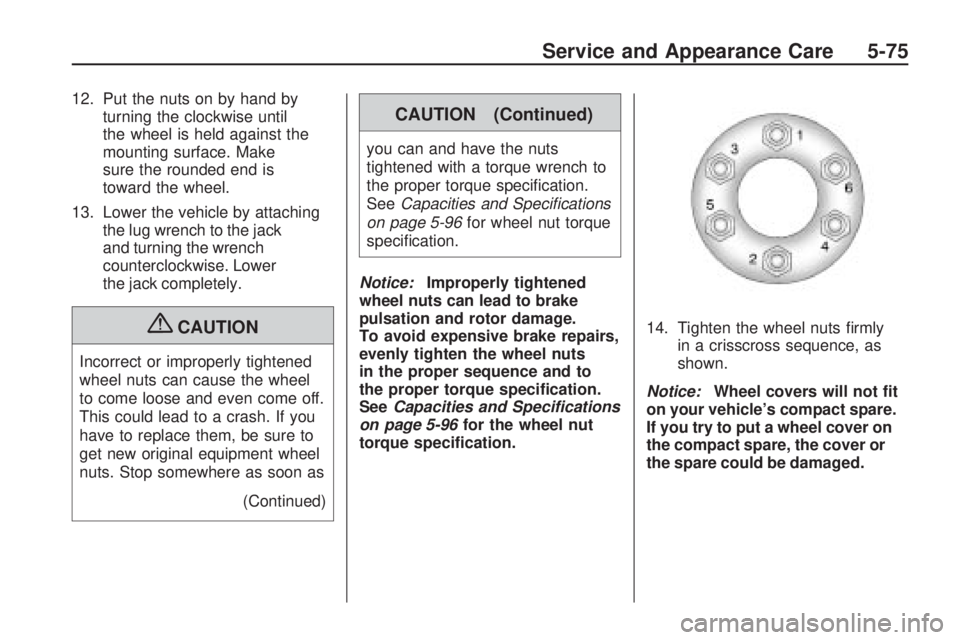
torque specication.14. Tighten the wheel nuts rmly
in a crisscross sequence, as
shown.
Notice:Wheel covers will not t
on your vehicle’s compact spare.
If you try to put a wheel cover on
the compact spare, the cover or
the spare could be damaged.
Service and Appearance Care 5-75
Page 352 of 420
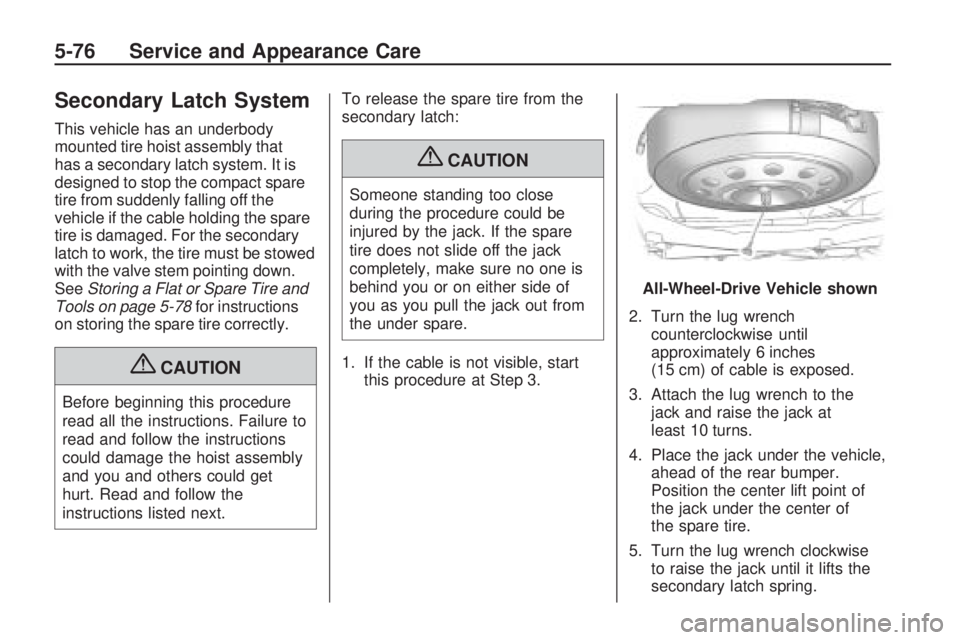
Secondary Latch System
This vehicle has an underbody
mounted tire hoist assembly that
has a secondary latch system. It is
designed to stop the compact spare
tire from suddenly falling off the
vehicle if the cable holding the spare
tire is damaged. For the secondary
latch to work, the tire must be stowed
with the valve stem pointing down.
SeeStoring a Flat or Spare Tire and
Tools on page 5-78for instructions
on storing the spare tire correctly.
{CAUTION
Before beginning this procedure
read all the instructions. Failure to
read and follow the instructions
could damage the hoist assembly
and you and others could get
hurt. Read and follow the
instructions listed next.To release the spare tire from the
secondary latch:
{CAUTION
Someone standing too close
during the procedure could be
injured by the jack. If the spare
tire does not slide off the jack
completely, make sure no one is
behind you or on either side of
you as you pull the jack out from
the under spare.
1. If the cable is not visible, start
this procedure at Step 3.2. Turn the lug wrench
counterclockwise until
approximately 6 inches
(15 cm) of cable is exposed.
3. Attach the lug wrench to the
jack and raise the jack at
least 10 turns.
4. Place the jack under the vehicle,
ahead of the rear bumper.
Position the center lift point of
the jack under the center of
the spare tire.
5. Turn the lug wrench clockwise
to raise the jack until it lifts the
secondary latch spring. All-Wheel-Drive Vehicle shown
5-76 Service and Appearance Care
Page 354 of 420
Storing a Flat or Spare
Tire and Tools
Storing the Spare Tire
{CAUTION
The underbody-mounted spare
tire needs to be stored with the
valve stem pointing down. If the
spare tire is stored with the valve
stem pointing upwards, the
secondary latch will not work
properly and the spare tire could
loosen and suddenly fall from the
vehicle. If this happened when the
vehicle was being driven, the tire
might contact a person or another
vehicle, causing injury and
damage to itself. Be sure the
underbody-mounted spare tire
is stored with the valve stem
pointing down.
{CAUTION
Storing a jack, a tire, or other
equipment in the passenger
compartment of the vehicle could
cause injury. In a sudden stop or
collision, loose equipment could
strike someone. Store all these in
the proper place.
To store the spare tire:
1. Lay the compact spare tire near
the rear of the vehicle with the
valve stem down.
2. Reinstall the plastic spare tire
heat shield on the compact
spare tire.3. Slide the cable retainer through
the center of the wheel and start
to raise the compact spare tire.
Make sure the retainer is fully
seated across the underside of
the wheel.
4. When the compact spare tire is
almost in the stored position,
turn the tire so the valve is
toward the rear of the vehicle.
This position helps when
checking the air pressure in
the compact spare tire.
5. Raise the tire fully against the
underside of the vehicle. Continue
turning the lug wrench until you
feel more than two clicks. This
indicates that the compact spare
tire is secure and the cable is
tight. The spare tire hoist cannot
be overtightened.
5-78 Service and Appearance Care