inflation pressure GMC ACADIA 2011 User Guide
[x] Cancel search | Manufacturer: GMC, Model Year: 2011, Model line: ACADIA, Model: GMC ACADIA 2011Pages: 478, PDF Size: 5.52 MB
Page 394 of 478
Black plate (66,1)GMC Acadia/Acadia Denali Owner Manual - 2011
10-66 Vehicle Care
7. Start the vehicle. The vehiclemust be running while using the
air compressor.
8. Turn the selector switch (A) counterclockwise to the
Sealant + Air position.
9. Press the on/off button (B) to turn the tire sealant and
compressor kit on.
The compressor will inject
sealant and air into the tire.
The pressure gauge (C) will
initially show a high pressure
while the compressor pushes the
sealant into the tire. Once the
sealant is completely dispersed
into the tire, the pressure will
quickly drop and start to rise
again as the tire inflates with
air only. 10. Inflate the tire to the
recommended inflation
pressure using the pressure
gauge (C). The recommended
inflation pressure can be
found on the Tire and Loading
Information label. See Tire
Pressure on page 10‑45.
The pressure gauge (C) may
read higher than the actual tire
pressure while the compressor
is on. Turn the compressor off
to get an accurate pressure
reading. The compressor may
be turned on/off until the
correct pressure is reached.
Notice: If the recommended
pressure cannot be reached
after approximately 25 minutes,
the vehicle should not be driven
farther. The tire is too severely
damaged and the tire sealant and
compressor kit cannot inflate the tire. Remove the power plug
from the accessory power
outlet and unscrew the inflating
hose from the tire valve. See
Roadside Assistance Program
(U.S. and Canada) on page 13‑8
or
Roadside Assistance Program
(Mexico) on page 13‑10.
11. Press the on/off button (B) to turn the tire sealant and
compressor kit off.
The tire is not sealed and
will continue to leak air until
the vehicle is driven and the
sealant is distributed in the tire;
therefore, Steps 12 through 18
must be done immediately after
Step 11.
Be careful while handling the
tire sealant and compressor
kit as it could be warm after
usage.
Page 395 of 478
Black plate (67,1)GMC Acadia/Acadia Denali Owner Manual - 2011
Vehicle Care 10-67
12. Unplug the power plug (H) fromthe accessory power outlet in
the vehicle.
13. Turn the sealant/air hose (F) counterclockwise to remove it
from the tire valve stem.
14. Replace the tire valve stem cap.
15. Replace the sealant/air hose (F), and the power
plug (H) back in their original
location.
16. If the flat tire was able toinflate to the recommended
inflation pressure, remove the
maximum speed label from the
sealant canister (E) and place
it in a highly visible location.
The label is a reminder not to
exceed 90 km/h (55 mph) until
the damaged tire is repaired or
replaced.
17. Return the equipment to its original storage location in the
vehicle.
18. Immediately drive the vehicle 8 km (5 mi) to distribute the
sealant in the tire. 19. Stop at a safe location and
check the tire pressure.
Refer to Steps 1 through 11
under “Using the Tire Sealant
and Compressor Kit without
Sealant to Inflate a Tire
(Not Punctured).”
If the tire pressure has fallen
more than 68 kPa (10 psi)
below the recommended
inflation pressure, stop driving
the vehicle. The tire is too
severely damaged and the
tire sealant cannot seal the
tire. See Roadside Assistance
Program (U.S. and Canada) on
page 13‑8 orRoadside
Assistance Program (Mexico)
on page 13‑10.
If the tire pressure has not
dropped more than 68 kPa
(10 psi) from the recommended
inflation pressure, inflate the
tire to the recommended
inflation pressure.
Page 397 of 478
Black plate (69,1)GMC Acadia/Acadia Denali Owner Manual - 2011
Vehicle Care 10-69
6. Plug the power plug (H) into theaccessory power outlet in the
vehicle. Unplug all items from
other accessory power outlets.
See Power Outlets on page 5‑9.
If the vehicle has an accessory
power outlet, do not use the
cigarette lighter.
If the vehicle only has a cigarette
lighter, use the cigarette lighter.
Do not pinch the power plug
cord in the door or window.
7. Start the vehicle. The vehicle must be running while using the
air compressor.
8. Turn the selector switch (A) clockwise to the Air Only
position.
9. Press the on/off (B) button to turn the compressor on.
The compressor will inflate the
tire with air only. 10. Inflate the tire to the
recommended inflation
pressure using the pressure
gauge (C). The recommended
inflation pressure can be
found on the Tire and Loading
Information label. See Tire
Pressure on page 10‑45.
The pressure gauge (C) may
read higher than the actual tire
pressure while the compressor
is on. Turn the compressor off
to get an accurate reading.
The compressor may be turned
on/off until the correct pressure
is reached.
If you inflate the tire higher
than the recommended
pressure you can adjust
the excess pressure by
pressing the pressure deflation
button (D), if equipped, until
the proper pressure reading is
reached. This option is only
functional when using the air
only hose (G). 11. Press the on/off button (B)
to turn the tire sealant and
compressor kit off.
Be careful while handling the
tire sealant and compressor
kit as it could be warm after
usage.
12. Unplug the power plug (H) from the accessory power outlet in
the vehicle.
13. Disconnect the air only hose (G) from the tire
valve stem by turning it
counterclockwise, and replace
the tire valve stem cap.
14. Replace the air only hose (G) and the power plug (H) and
cord back in their original
locations.
Page 410 of 478
Black plate (82,1)GMC Acadia/Acadia Denali Owner Manual - 2011
10-82 Vehicle Care
Have the hoist shaft assembly
inspected as soon as you can.
You will not be able to store a spare
tire using the hoist assembly until it
has been repaired or replaced.
Compact Spare Tire
{WARNING
Driving with more than one
compact spare tire at a time
could result in loss of braking
and handling. This could lead
to a crash and you or others
could be injured. Use only one
compact spare tire at a time.
The compact spare tire, if the
vehicle has one, was fully inflated
when the vehicle was new, however,
it can lose air after a time. Check
the inflation pressure regularly.
It should be 60 psi (420 kPa). After installing the compact
spare on the vehicle, stop as
soon as possible and make sure
the spare tire is correctly inflated.
The compact spare is made to
perform well at speeds up to
65 mph (105 km/h) for distances up
to 3,000 miles (5 000 km), so you
can finish your trip and have the
full-size tire repaired or replaced
at your convenience. Of course,
it is best to replace the spare with
a full-size tire as soon as possible.
The spare tire will last longer and be
in good shape in case it is needed
again.
Notice:
When the compact
spare is installed, do not take
the vehicle through an automatic
car wash with guide rails. The
compact spare can get caught on
the rails which can damage the
tire, wheel and other parts of the
vehicle. Do not use the compact spare on
other vehicles.
And do not mix the compact spare
tire or wheel with other wheels or
tires. They will not fit. Keep the
spare tire and its wheel together.
The All-Wheel Drive (AWD) system
will be automatically disabled
when you use the compact spare.
To restore the AWD and prevent
excessive wear on the clutch in
your AWD, replace the compact
spare tire with a full-size tire as
soon as possible.
Notice:
Tire chains will not fit the
compact spare. Using them can
damage the vehicle and can
damage the chains too. Do not
use tire chains on the compact
spare.
Page 431 of 478
Black plate (3,1)GMC Acadia/Acadia Denali Owner Manual - 2011
Service and Maintenance 11-3
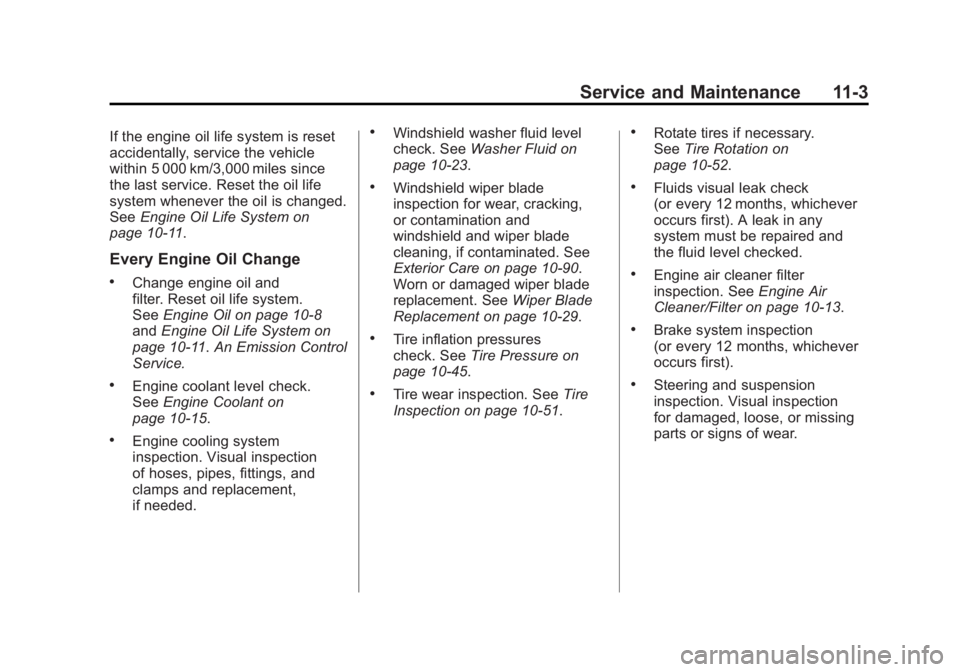
If the engine oil life system is reset
accidentally, service the vehicle
within 5 000 km/3,000 miles since
the last service. Reset the oil life
system whenever the oil is changed.
SeeEngine Oil Life System on
page 10‑11.
Every Engine Oil Change
.Change engine oil and
filter. Reset oil life system.
See Engine Oil on page 10‑8
and Engine Oil Life System on
page 10‑11. An Emission Control
Service.
.Engine coolant level check.
See Engine Coolant on
page 10‑15.
.Engine cooling system
inspection. Visual inspection
of hoses, pipes, fittings, and
clamps and replacement,
if needed.
.Windshield washer fluid level
check. See Washer Fluid on
page 10‑23.
.Windshield wiper blade
inspection for wear, cracking,
or contamination and
windshield and wiper blade
cleaning, if contaminated. See
Exterior Care on page 10‑90.
Worn or damaged wiper blade
replacement. See Wiper Blade
Replacement on page 10‑29.
.Tire inflation pressures
check. See Tire Pressure on
page 10‑45.
.Tire wear inspection. See Tire
Inspection on page 10‑51.
.Rotate tires if necessary.
See Tire Rotation on
page 10‑52.
.Fluids visual leak check
(or every 12 months, whichever
occurs first). A leak in any
system must be repaired and
the fluid level checked.
.Engine air cleaner filter
inspection. See Engine Air
Cleaner/Filter on page 10‑13.
.Brake system inspection
(or every 12 months, whichever
occurs first).
.Steering and suspension
inspection. Visual inspection
for damaged, loose, or missing
parts or signs of wear.
Page 432 of 478
Black plate (4,1)GMC Acadia/Acadia Denali Owner Manual - 2011
11-4 Service and Maintenance
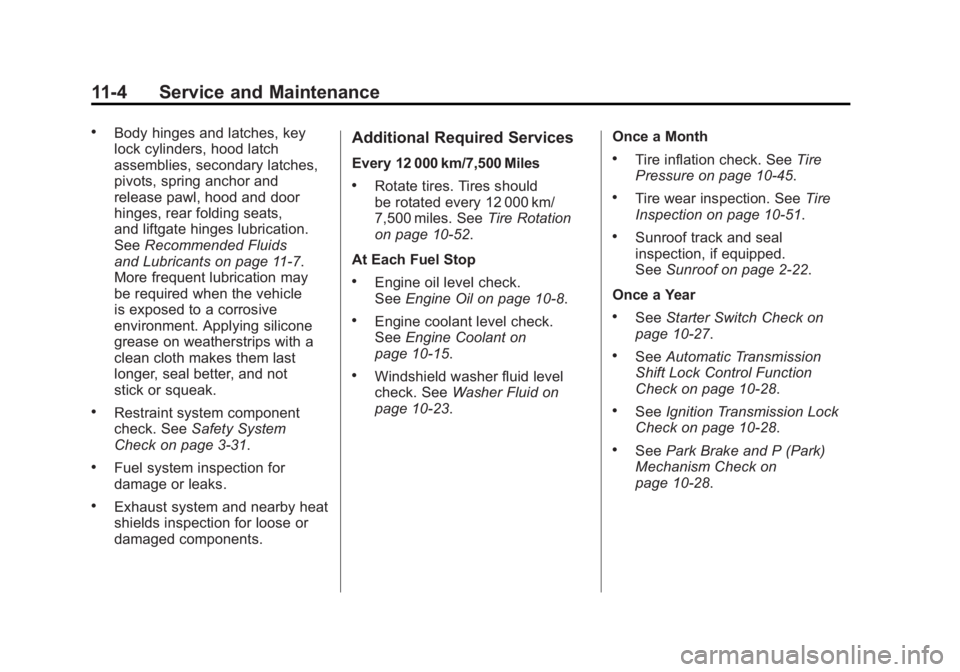
.Body hinges and latches, key
lock cylinders, hood latch
assemblies, secondary latches,
pivots, spring anchor and
release pawl, hood and door
hinges, rear folding seats,
and liftgate hinges lubrication.
SeeRecommended Fluids
and Lubricants on page 11‑7.
More frequent lubrication may
be required when the vehicle
is exposed to a corrosive
environment. Applying silicone
grease on weatherstrips with a
clean cloth makes them last
longer, seal better, and not
stick or squeak.
.Restraint system component
check. See Safety System
Check on page 3‑31.
.Fuel system inspection for
damage or leaks.
.Exhaust system and nearby heat
shields inspection for loose or
damaged components.
Additional Required Services
Every 12 000 km/7,500 Miles
.Rotate tires. Tires should
be rotated every 12 000 km/
7,500 miles. See Tire Rotation
on page 10‑52.
At Each Fuel Stop
.Engine oil level check.
See Engine Oil on page 10‑8.
.Engine coolant level check.
SeeEngine Coolant on
page 10‑15.
.Windshield washer fluid level
check. See Washer Fluid on
page 10‑23. Once a Month
.Tire inflation check. See
Tire
Pressure on page 10‑45.
.Tire wear inspection. See Tire
Inspection on page 10‑51.
.Sunroof track and seal
inspection, if equipped.
See Sunroof on page 2‑22.
Once a Year
.See Starter Switch Check on
page 10‑27.
.See Automatic Transmission
Shift Lock Control Function
Check on page 10‑28.
.See Ignition Transmission Lock
Check on page 10‑28.
.See Park Brake and P (Park)
Mechanism Check on
page 10‑28.