check engine light GMC CANYON 2008 User Guide
[x] Cancel search | Manufacturer: GMC, Model Year: 2008, Model line: CANYON, Model: GMC CANYON 2008Pages: 428, PDF Size: 5.82 MB
Page 175 of 428
DOORS
This message displays when one or more of the doors
is ajar. Check all the doors on your vehicle to make
sure they are closed. The message clears from
the display after all of the doors are closed.
ENG (Engine) HOT
This message displays when the engine coolant
temperature is hot. Check the engine coolant
temperature gage. SeeEngine Coolant Temperature
Gage on page 3-33. Have your vehicle serviced by your
dealer/retailer as soon as possible if you suspect the
engine is overheating. SeeEngine Overheating on
page 5-29for more information.
FLUID
This message displays if the brake uid is low. Check
the brake uid as soon as possible and have your
vehicle serviced by your dealer/retailer. SeeBrakes on
page 5-38for more information. Press and release the
reset stem to acknowledge the message and clear it
from the display.
FUEL CAP
This message displays if the vehicle’s fuel cap is either off
or loose. Pull over as soon as possible and check to see
if the fuel cap is secure. You may also see the check
engine light on the instrument panel cluster. If the check
engine light does come on when the fuel cap was loose,
it may take a few driving trips before the light turns off.
SeeMalfunction Indicator Lamp on page 3-34for more
information if the light still remains on. Press and release
the reset stem to acknowledge the message and clear it
from the display.
LOW FUEL
This message displays if the level of fuel in the vehicle
is low. Also check the fuel gage. SeeFuel Gage on
page 3-38for more information. Rell the fuel tank
as soon as possible.
LOW TIRE
This message displays if a low tire pressure is detected in
any of the vehicle’s tires. Press and release the reset
stem to acknowledge the message and clear it from the
display. The message appears at each ignition cycle until
the tires are inated to the correct ination pressure.
SeeTires on page 5-56andInflation - Tire Pressure on
page 5-62for more information on tires and the correct
ination pressures.
3-43
Page 176 of 428
LOW TRAC (Traction)
If your vehicle has the Traction Control System (TCS),
this message displays when a low traction condition
is detected. SeeTraction Control System (TCS)
on page 4-5for more information. Press and release
the reset stem to acknowledge the message and clear
it from the display.
OIL
This message displays when the oil pressure is low.
SeeOil Pressure Light on page 3-36andEngine Oil
on page 5-15for more information.
PARK BRK (Brake)
This message displays when the parking brake is set.
SeeParking Brake on page 2-32andBrake System
Warning Light on page 3-31for more information.
The message clears from the display after the parking
brake is released or by pressing and releasing the
reset stem.
REDUCED POWER
This message displays when the vehicle’s engine power
is reduced. Reduced engine power can affect the
vehicle’s ability to accelerate. If this message is on, but
there is no reduction in performance, proceed to your
destination. The performance may be reduced the next
time the vehicle is driven. The vehicle may be driven at areduced speed while this message is on, but acceleration
and speed may be reduced. Anytime this message stays
on, the vehicle should be taken to your dealer/retailer for
service as soon as possible. Press and release the reset
stem to acknowledge the message and clear it from the
display.
SERV (Service) 4WD
(Four-Wheel Drive)
This message displays when there is a problem with the
transfer case control system. Check the transfer case on
your vehicle and have it serviced by your dealer/retailer.
SeeFour-Wheel Drive on page 2-28for more information
about the transfer case. Press and release the reset stem
to acknowledge the message and clear it from the
display.
SERV (Service) TPM
(Tire Pressure Monitor)
This message displays if a part on the Tire Pressure
Monitor System (TPMS) is not working properly. The tire
pressure light also ashes and then remains on during
the same ignition cycle. SeeTire Pressure Light on
page 3-33. Several conditions may cause this message
to appear. SeeTire Pressure Monitor Operation on
page 5-66for more information. If the warning comes on
and stays on, there may be a problem with the TPMS.
See your dealer/retailer.
3-44
Page 206 of 428
And, of course, actual stopping distances vary greatly
with the surface of the road, whether it is pavement
or gravel; the condition of the road, whether it is wet,
dry, or icy; tire tread; the condition of the brakes; the
weight of the vehicle; and the amount of brake
force applied.
Avoid needless heavy braking. Some people drive in
spurts — heavy acceleration followed by heavy
braking — rather than keeping pace with traffic. This is
a mistake. The brakes might not have time to cool
between hard stops. The brakes will wear out much
faster if you do a lot of heavy braking. If you keep pace
with the traffic and allow realistic following distances,
you will eliminate a lot of unnecessary braking.
That means better braking and longer brake life.
If your vehicle’s engine ever stops while you are driving,
brake normally but do not pump the brakes. If you do,
the pedal could get harder to push down. If the
engine stops, you will still have some power brake
assist. But you will use it when you brake. Once the
power assist is used up, it can take longer to stop and
the brake pedal will be harder to push.
Adding non-dealer/non-retailer accessories can affect
your vehicle’s performance. SeeAccessoriesand
Modifications on page 5-3.Antilock Brake System (ABS)
Your vehicle has the Antilock Brake System (ABS), an
advanced electronic braking system that will help
prevent a braking skid.
When you start the engine and begin to drive away,
ABS will check itself. You might hear a momentary
motor or clicking noise while this test is going on.
This is normal.
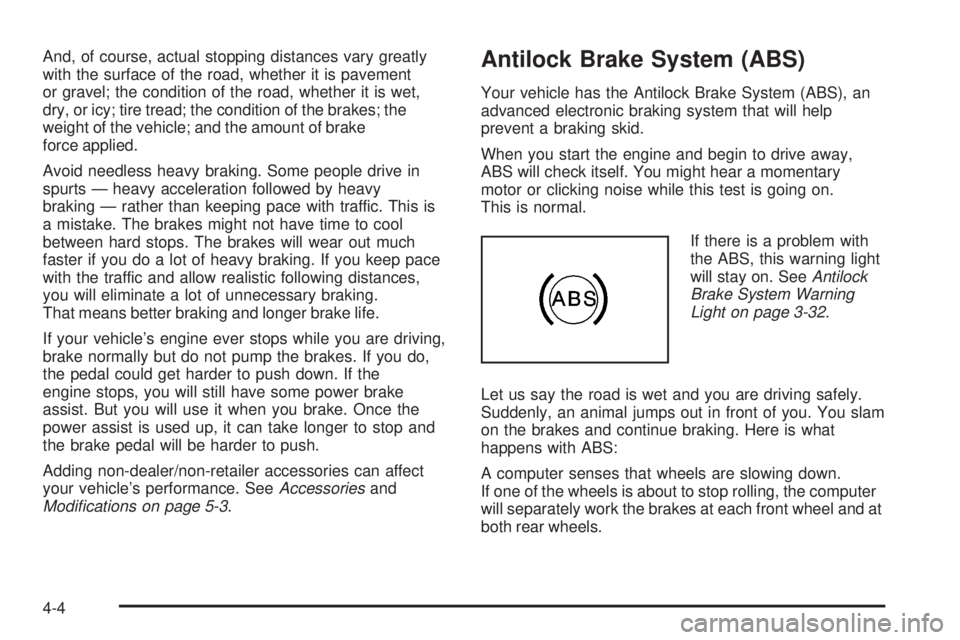
If there is a problem with
the ABS, this warning light
will stay on. SeeAntilock
Brake System Warning
Light on page 3-32.
Let us say the road is wet and you are driving safely.
Suddenly, an animal jumps out in front of you. You slam
on the brakes and continue braking. Here is what
happens with ABS:
A computer senses that wheels are slowing down.
If one of the wheels is about to stop rolling, the computer
will separately work the brakes at each front wheel and at
both rear wheels.
4-4
Page 231 of 428
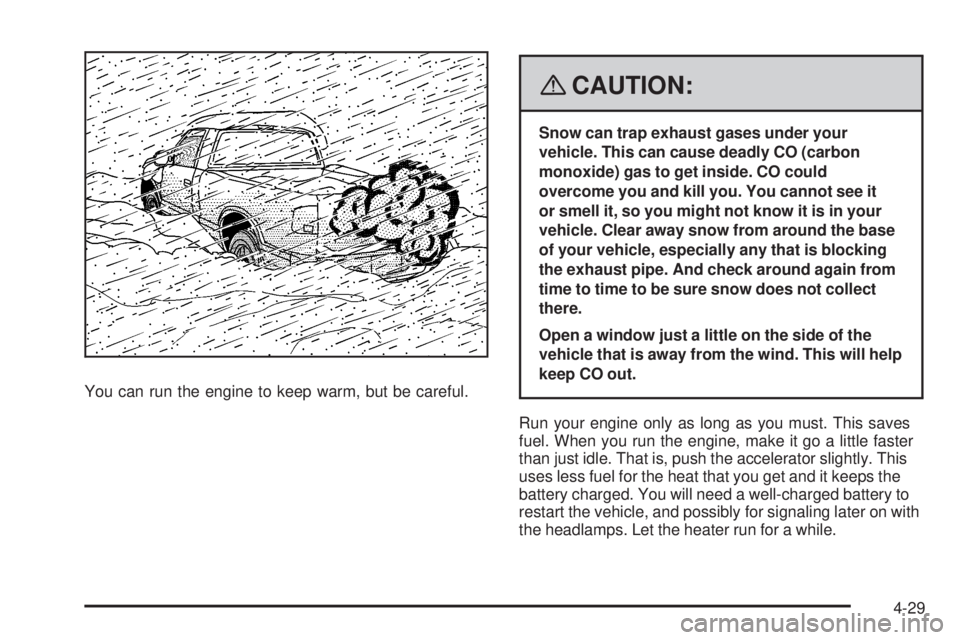
You can run the engine to keep warm, but be careful.
{CAUTION:
Snow can trap exhaust gases under your
vehicle. This can cause deadly CO (carbon
monoxide) gas to get inside. CO could
overcome you and kill you. You cannot see it
or smell it, so you might not know it is in your
vehicle. Clear away snow from around the base
of your vehicle, especially any that is blocking
the exhaust pipe. And check around again from
time to time to be sure snow does not collect
there.
Open a window just a little on the side of the
vehicle that is away from the wind. This will help
keep CO out.
Run your engine only as long as you must. This saves
fuel. When you run the engine, make it go a little faster
than just idle. That is, push the accelerator slightly. This
uses less fuel for the heat that you get and it keeps the
battery charged. You will need a well-charged battery to
restart the vehicle, and possibly for signaling later on with
the headlamps. Let the heater run for a while.
4-29
Page 269 of 428
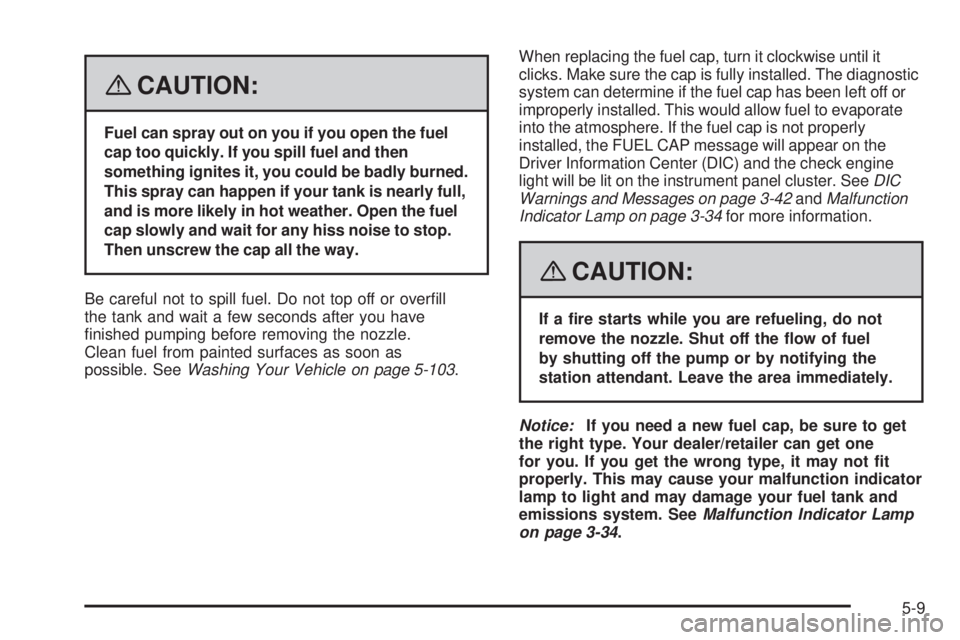
{CAUTION:
Fuel can spray out on you if you open the fuel
cap too quickly. If you spill fuel and then
something ignites it, you could be badly burned.
This spray can happen if your tank is nearly full,
and is more likely in hot weather. Open the fuel
cap slowly and wait for any hiss noise to stop.
Then unscrew the cap all the way.
Be careful not to spill fuel. Do not top off or overll
the tank and wait a few seconds after you have
nished pumping before removing the nozzle.
Clean fuel from painted surfaces as soon as
possible. SeeWashing Your Vehicle on page 5-103.When replacing the fuel cap, turn it clockwise until it
clicks. Make sure the cap is fully installed. The diagnostic
system can determine if the fuel cap has been left off or
improperly installed. This would allow fuel to evaporate
into the atmosphere. If the fuel cap is not properly
installed, the FUEL CAP message will appear on the
Driver Information Center (DIC) and the check engine
light will be lit on the instrument panel cluster. SeeDIC
Warnings and Messages on page 3-42andMalfunction
Indicator Lamp on page 3-34for more information.
{CAUTION:
If a re starts while you are refueling, do not
remove the nozzle. Shut off the ow of fuel
by shutting off the pump or by notifying the
station attendant. Leave the area immediately.
Notice:If you need a new fuel cap, be sure to get
the right type. Your dealer/retailer can get one
for you. If you get the wrong type, it may not t
properly. This may cause your malfunction indicator
lamp to light and may damage your fuel tank and
emissions system. SeeMalfunction Indicator Lamp
on page 3-34.
5-9
Page 304 of 428
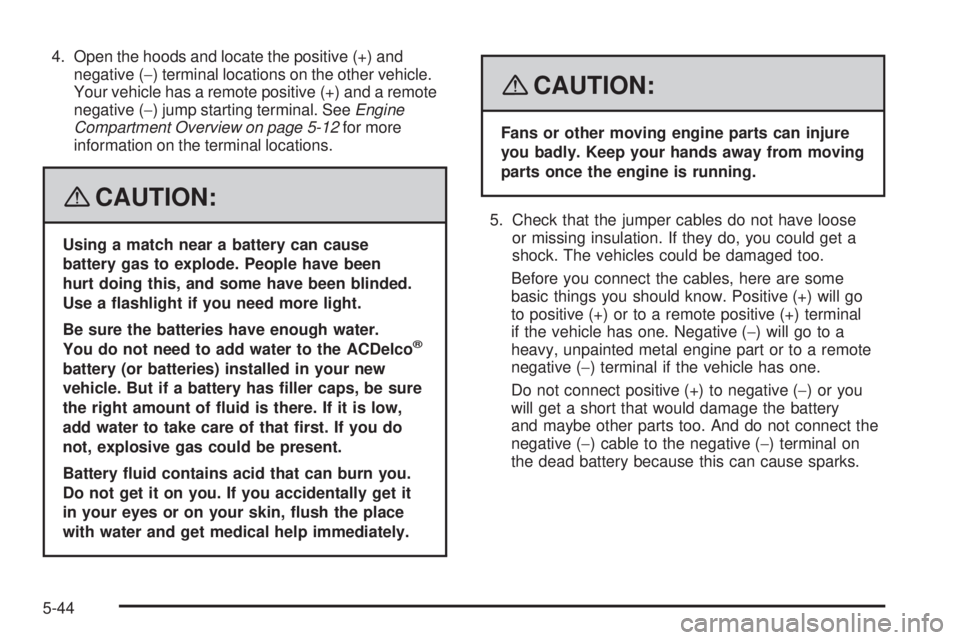
4. Open the hoods and locate the positive (+) and
negative (−) terminal locations on the other vehicle.
Your vehicle has a remote positive (+) and a remote
negative (−) jump starting terminal. SeeEngine
Compartment Overview on page 5-12for more
information on the terminal locations.
{CAUTION:
Using a match near a battery can cause
battery gas to explode. People have been
hurt doing this, and some have been blinded.
Use a ashlight if you need more light.
Be sure the batteries have enough water.
You do not need to add water to the ACDelco
®
battery (or batteries) installed in your new
vehicle. But if a battery has ller caps, be sure
the right amount of uid is there. If it is low,
add water to take care of that rst. If you do
not, explosive gas could be present.
Battery uid contains acid that can burn you.
Do not get it on you. If you accidentally get it
in your eyes or on your skin, ush the place
with water and get medical help immediately.
{CAUTION:
Fans or other moving engine parts can injure
you badly. Keep your hands away from moving
parts once the engine is running.
5. Check that the jumper cables do not have loose
or missing insulation. If they do, you could get a
shock. The vehicles could be damaged too.
Before you connect the cables, here are some
basic things you should know. Positive (+) will go
to positive (+) or to a remote positive (+) terminal
if the vehicle has one. Negative (−) will go to a
heavy, unpainted metal engine part or to a remote
negative (−) terminal if the vehicle has one.
Do not connect positive (+) to negative (−)oryou
will get a short that would damage the battery
and maybe other parts too. And do not connect the
negative (−) cable to the negative (−) terminal on
the dead battery because this can cause sparks.
5-44
Page 329 of 428
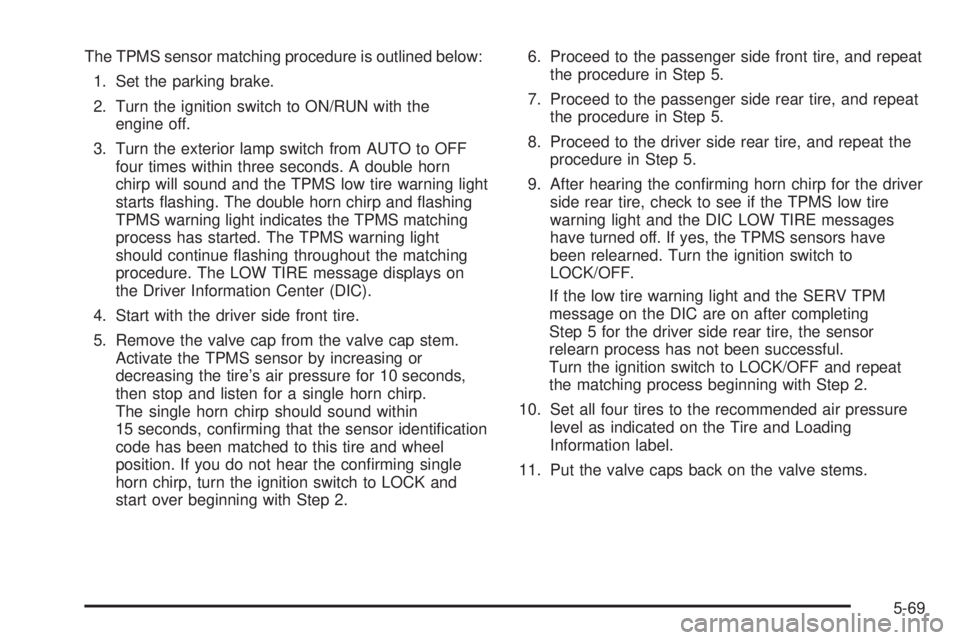
The TPMS sensor matching procedure is outlined below:
1. Set the parking brake.
2. Turn the ignition switch to ON/RUN with the
engine off.
3. Turn the exterior lamp switch from AUTO to OFF
four times within three seconds. A double horn
chirp will sound and the TPMS low tire warning light
starts ashing. The double horn chirp and ashing
TPMS warning light indicates the TPMS matching
process has started. The TPMS warning light
should continue ashing throughout the matching
procedure. The LOW TIRE message displays on
the Driver Information Center (DIC).
4. Start with the driver side front tire.
5. Remove the valve cap from the valve cap stem.
Activate the TPMS sensor by increasing or
decreasing the tire’s air pressure for 10 seconds,
then stop and listen for a single horn chirp.
The single horn chirp should sound within
15 seconds, conrming that the sensor identication
code has been matched to this tire and wheel
position. If you do not hear the conrming single
horn chirp, turn the ignition switch to LOCK and
start over beginning with Step 2.6. Proceed to the passenger side front tire, and repeat
the procedure in Step 5.
7. Proceed to the passenger side rear tire, and repeat
the procedure in Step 5.
8. Proceed to the driver side rear tire, and repeat the
procedure in Step 5.
9. After hearing the conrming horn chirp for the driver
side rear tire, check to see if the TPMS low tire
warning light and the DIC LOW TIRE messages
have turned off. If yes, the TPMS sensors have
been relearned. Turn the ignition switch to
LOCK/OFF.
If the low tire warning light and the SERV TPM
message on the DIC are on after completing
Step 5 for the driver side rear tire, the sensor
relearn process has not been successful.
Turn the ignition switch to LOCK/OFF and repeat
the matching process beginning with Step 2.
10. Set all four tires to the recommended air pressure
level as indicated on the Tire and Loading
Information label.
11. Put the valve caps back on the valve stems.
5-69
Page 416 of 428
Audio System (cont.)
Theft-Deterrent Feature................................3-69
XM™ Satellite Radio Antenna System............3-70
Audio System(s).............................................3-48
Automatic Headlamp System............................3-15
Automatic Transmission
Fluid..........................................................5-21
Operation...................................................2-23
B
Battery..........................................................5-41
Electric Power Management..........................3-18
Run-Down Protection...................................3-18
Brake
Emergencies................................................ 4-5
Brakes..........................................................5-38
System Warning Light..................................3-31
Braking........................................................... 4-3
Braking in Emergencies..................................... 4-5
Break-In, New Vehicle.....................................2-19
Bulb Replacement...........................................5-49
Center High-Mounted Stoplamp (CHMSL)........5-51
Front Turn Signal, Parking and
Daytime Running Lamps...........................5-51
Halogen Bulbs............................................5-49
Headlamp Aiming........................................5-49
Headlamps.................................................5-50Bulb Replacement (cont.)
License Plate Lamps....................................5-53
Replacement Bulbs......................................5-53
Taillamps, Turn Signal, Stoplamps and
Back-up Lamps........................................5-52
Buying New Tires...........................................5-72
C
Calibration.............................................2-40, 2-43
California Fuel.................................................. 5-6
California Perchlorate Materials
Requirements............................................... 5-4
California Proposition 65 Warning....................... 5-3
Canadian Owners................................................ ii
Capacities and Specications..........................5-116
Carbon Monoxide...................2-10, 2-37, 4-27, 4-44
Care of
Safety Belts..............................................5-103
CD, MP3 .......................................................3-64
Center Console Storage Area...........................2-50
Center High-Mounted Stoplamp (CHMSL)...........5-51
Chains, Tire...................................................5-78
Charging System Light....................................3-30
Check
Engine Light...............................................3-34
Checking Things Under the Hood......................5-10
Chemical Paint Spotting.................................5-107
2
Page 418 of 428
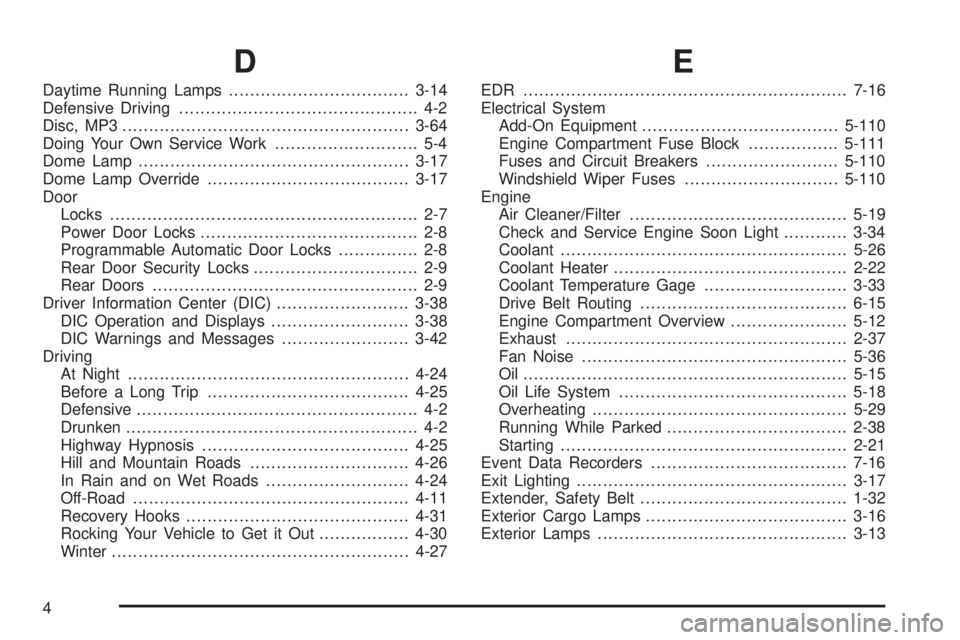
D
Daytime Running Lamps..................................3-14
Defensive Driving............................................. 4-2
Disc, MP3......................................................3-64
Doing Your Own Service Work........................... 5-4
Dome Lamp...................................................3-17
Dome Lamp Override......................................3-17
Door
Locks.......................................................... 2-7
Power Door Locks......................................... 2-8
Programmable Automatic Door Locks............... 2-8
Rear Door Security Locks............................... 2-9
Rear Doors.................................................. 2-9
Driver Information Center (DIC).........................3-38
DIC Operation and Displays..........................3-38
DIC Warnings and Messages........................3-42
Driving
At Night.....................................................4-24
Before a Long Trip......................................4-25
Defensive..................................................... 4-2
Drunken....................................................... 4-2
Highway Hypnosis.......................................4-25
Hill and Mountain Roads..............................4-26
In Rain and on Wet Roads...........................4-24
Off-Road....................................................4-11
Recovery Hooks..........................................4-31
Rocking Your Vehicle to Get it Out.................4-30
Winter........................................................4-27
E
EDR .............................................................7-16
Electrical System
Add-On Equipment.....................................5-110
Engine Compartment Fuse Block.................5-111
Fuses and Circuit Breakers.........................5-110
Windshield Wiper Fuses.............................5-110
Engine
Air Cleaner/Filter.........................................5-19
Check and Service Engine Soon Light............3-34
Coolant......................................................5-26
Coolant Heater............................................2-22
Coolant Temperature Gage...........................3-33
Drive Belt Routing.......................................6-15
Engine Compartment Overview......................5-12
Exhaust.....................................................2-37
Fan Noise..................................................5-36
Oil .............................................................5-15
Oil Life System...........................................5-18
Overheating................................................5-29
Running While Parked..................................2-38
Starting......................................................2-21
Event Data Recorders.....................................7-16
Exit Lighting...................................................3-17
Extender, Safety Belt.......................................1-32
Exterior Cargo Lamps......................................3-16
Exterior Lamps...............................................3-13
4
Page 423 of 428
O
Odometer......................................................3-25
Odometer, Trip...............................................3-25
Off-Road Driving.............................................4-11
Off-Road Recovery........................................... 4-9
Oil
Engine.......................................................5-15
Pressure Light.............................................3-36
Oil, Engine Oil Life System..............................5-18
Older Children, Restraints................................1-33
Online Owner Center........................................ 7-4
OnStar, Privacy..............................................7-17
OnStar
®System, see OnStar®Manual...............2-47
Other Warning Devices...................................... 3-6
Outlet Adjustment............................................3-22
Outlets
Accessory Power.........................................3-18
Outside
Convex Mirror.............................................2-46
Manual Mirrors............................................2-45
Power Mirrors.............................................2-46
Owner Checks and Services.............................. 6-8
Owners, Canadian............................................... ii
P
Paint, Damage..............................................5-107
Park Brake....................................................2-32
Park (P)
Shifting Into................................................2-34
Shifting Out of............................................2-36
Parking
Over Things That Burn.................................2-37
Parking Your Vehicle.......................................2-37
Passenger Airbag Status Indicator.....................3-28
Passenger Sensing System..............................1-69
Passing........................................................... 4-9
PASS-Key
®III+..............................................2-17
PASS-Key®III+ Operation................................2-17
Passlock®......................................................2-16
Perchlorate Materials Requirements, California...... 5-4
Pickup Conversion to Chassis Cab....................4-38
Power
Door Locks.................................................. 2-8
Lumbar Controls........................................... 1-4
Retained Accessory (RAP)............................2-21
Seat............................................................ 1-3
Steering Fluid.............................................5-36
Windows....................................................2-13
9