automatic transmission GMC CANYON 2008 Owner's Guide
[x] Cancel search | Manufacturer: GMC, Model Year: 2008, Model line: CANYON, Model: GMC CANYON 2008Pages: 428, PDF Size: 5.82 MB
Page 208 of 428
The TCS button is located
on your instrument panel.
Press this button to turn
the TCS off and on.
If your vehicle is in cruise control when the traction
control system begins to limit wheel spin, the cruise
control will automatically disengage. When road
conditions allow you to safely use it again, you may
re-engage the cruise control. SeeCruise Control
on page 3-10.
TCS operates in all transmission shift lever positions.
But the system can upshift the transmission only as high
as the shift lever position you have chosen, so you
should use the lower gears only when necessary.
SeeAutomatic Transmission Operation on page 2-23
and/orManual Transmission Operation on page 2-26for
more information.If there is a problem with TCS, the warning light will
come on, and TRACTION FAULT will be displayed on
your Driver Information Center (DIC). When this warning
is displayed, the system will not limit wheel spin. Adjust
your driving accordingly.
To limit wheel spin, especially in slippery road
conditions, you should always leave TCS on. But you
can turn the system off if you ever need to. You should
turn the system off if your vehicle ever gets stuck in
sand, mud or snow and rocking the vehicle is required.
SeeRocking Your Vehicle to Get It Out on page 4-30and
If Your Vehicle is Stuck in Sand, Mud, Ice, or Snow on
page 4-30for more information.
Adding non-dealer/non-retailer accessories can affect
your vehicle’s performance. SeeAccessories and
Modifications on page 5-3for more information.
Limited-Slip Rear Axle
If your vehicle has this feature, your limited-slip rear
axle can give you additional traction on snow, mud, ice,
sand or gravel. It works like a standard axle most of
the time, but when one of the rear wheels has no
traction and the other does, this feature will allow the
wheel with traction to move the vehicle.
4-6
Page 220 of 428
There are also some things you must not do if you stall,
or are about to stall, when going up a hill:
Never attempt to prevent a stall by shifting into
NEUTRAL (N), or pressing the clutch if your vehicle
has a manual transmission, to rev-up the engine
and regain forward momentum. This will not work.
Your vehicle will roll backwards very quickly and you
could go out of control.
Instead, apply the regular brake to stop the
vehicle. Then apply the parking brake. Shift to
REVERSE (R), release the parking brake, and
slowly back straight down.
Never attempt to turn around if you are about to stall
when going up a hill. If the hill is steep enough to stall
your vehicle, it is steep enough to cause you to roll
over if you turn around. If you cannot make it up the
hill, you must back straight down the hill.
If, after stalling, you try to back down the hill and decide
you just cannot do it, set the parking brake, put the
automatic transmission in PARK (P), or the manual
transmission in FIRST (1), and turn off the engine. Leave
the vehicle and go get some help. Exit on the uphill side
and stay clear of the path the vehicle would take if it
rolled downhill.
Driving Downhill
When off-roading takes you downhill, you will want to
consider a number of things:
How steep is the downhill? Will I be able to maintain
vehicle control?
What is the surface like? Smooth? Rough?
Slippery? Hard-packed dirt? Gravel?
Are there hidden surface obstacles? Ruts? Logs?
Boulders?
What is at the bottom of the hill? Is there a hidden
creek bank or even a river bottom with large rocks?
If you decide you can go down a hill safely, then try to
keep your vehicle headed straight down, and use a low
gear. This way, engine drag can help the brakes and they
will not have to do all the work. Descend slowly, keeping
your vehicle under control at all times.
4-18
Page 241 of 428
Here are some important things to consider before you
do recreational vehicle towing:
What’s the towing capacity of the towing vehicle?
Be sure you read the tow vehicle manufacturer’s
recommendations.
How far will you tow? Some vehicles have
restrictions on how far and how long they can tow.
Do you have the proper towing equipment?
See your dealer/retailer or trailering professional for
additional advice and equipment recommendations.
Is your vehicle ready to be towed? Just as you
would prepare your vehicle for a long trip, you’ll
want to make sure your vehicle is prepared to be
towed.
Dinghy Towing
Two-Wheel Drive Vehicles
Notice:If you tow your vehicle with all four wheels
on the ground, the drivetrain components could
be damaged. The repairs would not be covered by
your warranty. Do not tow your vehicle with all
four wheels on the ground.
Two-wheel-drive vehicles should not be towed
with all four wheels on the ground. Two-wheel-drive
transmissions have no provisions for internal lubrication
while being towed.
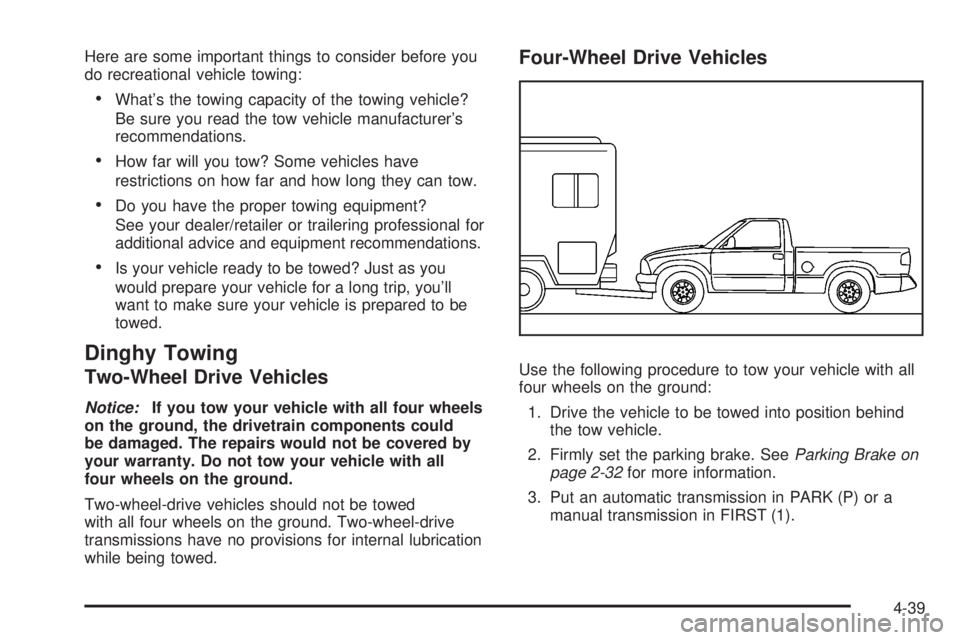
Four-Wheel Drive Vehicles
Use the following procedure to tow your vehicle with all
four wheels on the ground:
1. Drive the vehicle to be towed into position behind
the tow vehicle.
2. Firmly set the parking brake. SeeParking Brake on
page 2-32for more information.
3. Put an automatic transmission in PARK (P) or a
manual transmission in FIRST (1).
4-39
Page 242 of 428
4. Securely attach the vehicle being towed to the
tow vehicle.
{CAUTION:
Shifting a four-wheel-drive vehicle’s transfer
case into NEUTRAL can cause your vehicle to
roll even if the transmission is in PARK (P) for
an automatic transmission, or if your vehicle is
in gear, for a manual transmission. You or
others could be injured. Make sure the parking
brake is rmly set before you shift the transfer
case to NEUTRAL.
5. Shift the transfer case to NEUTRAL. See
Four-Wheel Drive on page 2-28for more
information.
6. Release the parking brake only after the vehicle
being towed is rmly attached to the tow vehicle.
7. Turn the ignition to LOCK.
If the tow vehicle will not be started or driven for
six weeks or more, remove the battery cable
from the negative terminal (post) of the battery to
prevent your battery from draining while towing.
After towing see “Shifting Out of NEUTRAL” under
Four-Wheel Drive on page 2-28.
Dolly Towing
Front Towing (Front Wheels Off the
Ground)
Two-Wheel-Drive Vehicles
Notice:If you tow a two-wheel-drive vehicle with
the rear wheels on the ground, the transmission
could be damaged. The repairs would not be
covered by your warranty. Never tow your vehicle
with the rear wheels on the ground.
Two-wheel-drive vehicles should not be towed with
the rear wheels on the ground. Two-wheel-drive
transmissions have no provisions for internal lubrication
while being towed. To dolly tow a two-wheel-drive
vehicle, you must tow the vehicle with the rear wheels
on the dolly. See “Rear Towing (Rear Wheels Off the
Ground)” later in this section for more information.
4-40
Page 243 of 428
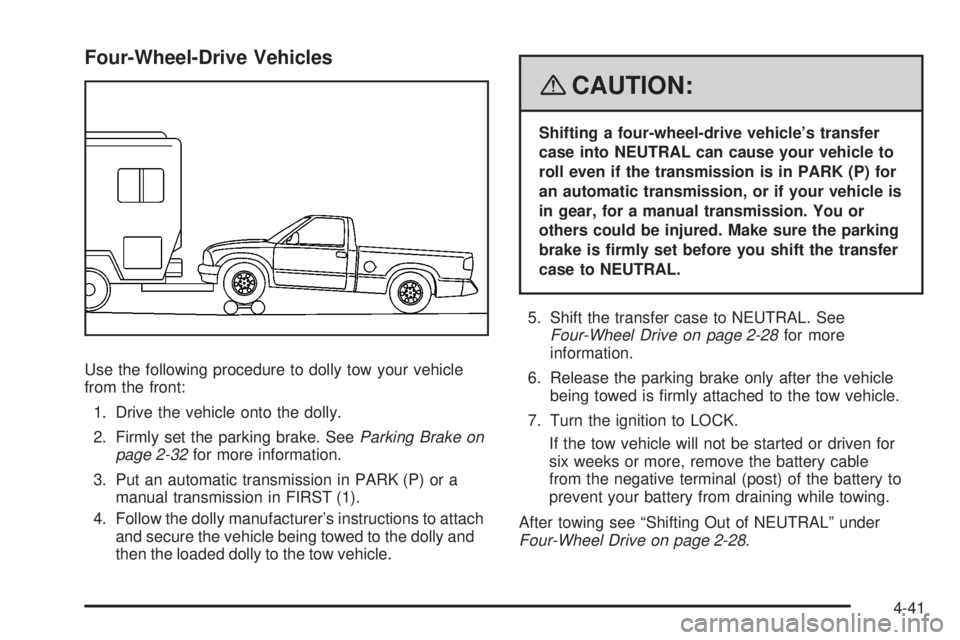
Four-Wheel-Drive Vehicles
Use the following procedure to dolly tow your vehicle
from the front:
1. Drive the vehicle onto the dolly.
2. Firmly set the parking brake. SeeParking Brake on
page 2-32for more information.
3. Put an automatic transmission in PARK (P) or a
manual transmission in FIRST (1).
4. Follow the dolly manufacturer’s instructions to attach
and secure the vehicle being towed to the dolly and
then the loaded dolly to the tow vehicle.
{CAUTION:
Shifting a four-wheel-drive vehicle’s transfer
case into NEUTRAL can cause your vehicle to
roll even if the transmission is in PARK (P) for
an automatic transmission, or if your vehicle is
in gear, for a manual transmission. You or
others could be injured. Make sure the parking
brake is rmly set before you shift the transfer
case to NEUTRAL.
5. Shift the transfer case to NEUTRAL. See
Four-Wheel Drive on page 2-28for more
information.
6. Release the parking brake only after the vehicle
being towed is rmly attached to the tow vehicle.
7. Turn the ignition to LOCK.
If the tow vehicle will not be started or driven for
six weeks or more, remove the battery cable
from the negative terminal (post) of the battery to
prevent your battery from draining while towing.
After towing see “Shifting Out of NEUTRAL” under
Four-Wheel Drive on page 2-28.
4-41
Page 244 of 428
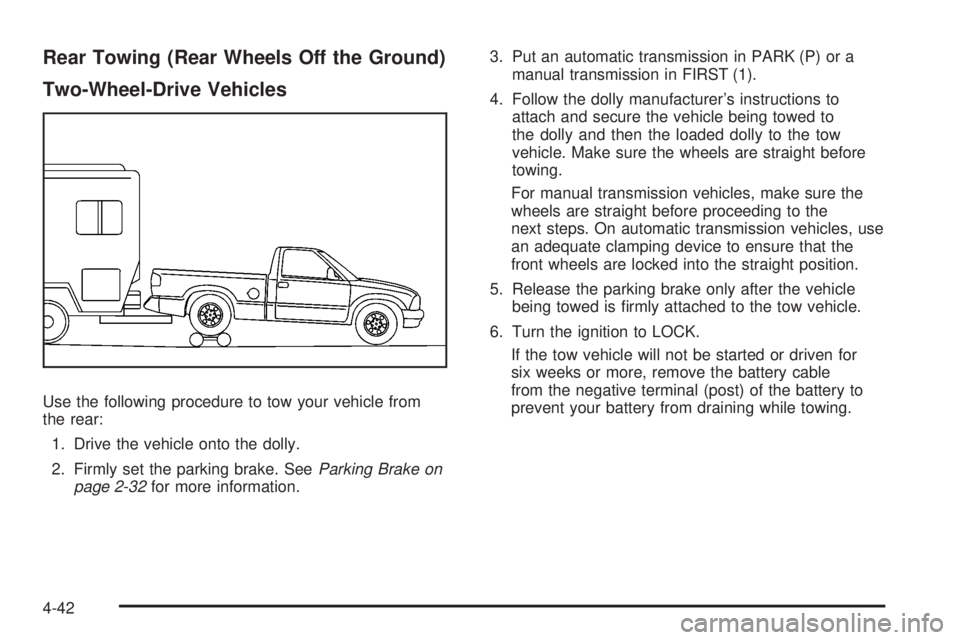
Rear Towing (Rear Wheels Off the Ground)
Two-Wheel-Drive Vehicles
Use the following procedure to tow your vehicle from
the rear:
1. Drive the vehicle onto the dolly.
2. Firmly set the parking brake. SeeParking Brake on
page 2-32for more information.3. Put an automatic transmission in PARK (P) or a
manual transmission in FIRST (1).
4. Follow the dolly manufacturer’s instructions to
attach and secure the vehicle being towed to
the dolly and then the loaded dolly to the tow
vehicle. Make sure the wheels are straight before
towing.
For manual transmission vehicles, make sure the
wheels are straight before proceeding to the
next steps. On automatic transmission vehicles, use
an adequate clamping device to ensure that the
front wheels are locked into the straight position.
5. Release the parking brake only after the vehicle
being towed is rmly attached to the tow vehicle.
6. Turn the ignition to LOCK.
If the tow vehicle will not be started or driven for
six weeks or more, remove the battery cable
from the negative terminal (post) of the battery to
prevent your battery from draining while towing.
4-42
Page 245 of 428
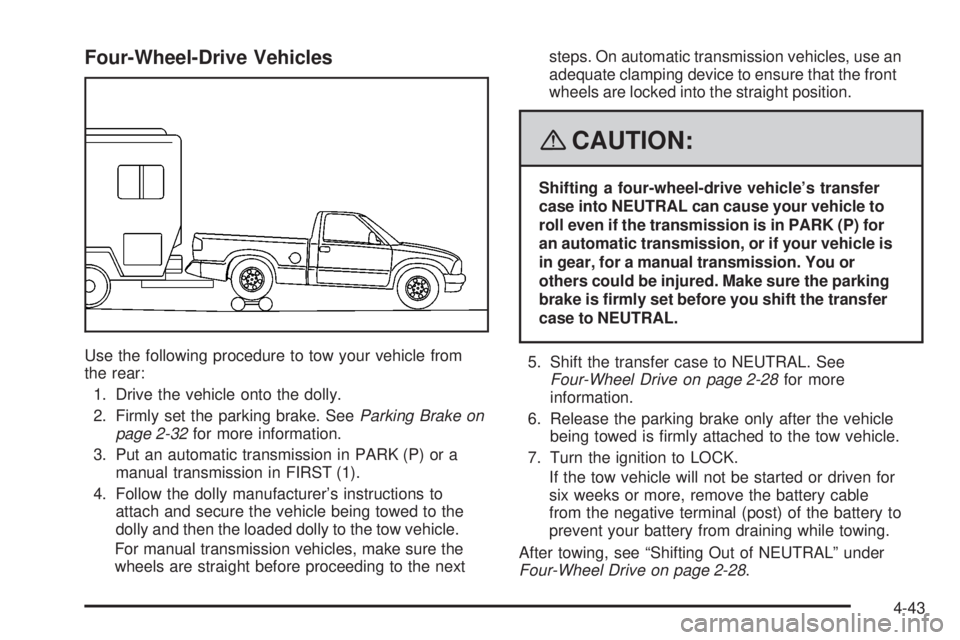
Four-Wheel-Drive Vehicles
Use the following procedure to tow your vehicle from
the rear:
1. Drive the vehicle onto the dolly.
2. Firmly set the parking brake. SeeParking Brake on
page 2-32for more information.
3. Put an automatic transmission in PARK (P) or a
manual transmission in FIRST (1).
4. Follow the dolly manufacturer’s instructions to
attach and secure the vehicle being towed to the
dolly and then the loaded dolly to the tow vehicle.
For manual transmission vehicles, make sure the
wheels are straight before proceeding to the nextsteps. On automatic transmission vehicles, use an
adequate clamping device to ensure that the front
wheels are locked into the straight position.
{CAUTION:
Shifting a four-wheel-drive vehicle’s transfer
case into NEUTRAL can cause your vehicle to
roll even if the transmission is in PARK (P) for
an automatic transmission, or if your vehicle is
in gear, for a manual transmission. You or
others could be injured. Make sure the parking
brake is rmly set before you shift the transfer
case to NEUTRAL.
5. Shift the transfer case to NEUTRAL. See
Four-Wheel Drive on page 2-28for more
information.
6. Release the parking brake only after the vehicle
being towed is rmly attached to the tow vehicle.
7. Turn the ignition to LOCK.
If the tow vehicle will not be started or driven for
six weeks or more, remove the battery cable
from the negative terminal (post) of the battery to
prevent your battery from draining while towing.
After towing, see “Shifting Out of NEUTRAL” under
Four-Wheel Drive on page 2-28.
4-43
Page 248 of 428
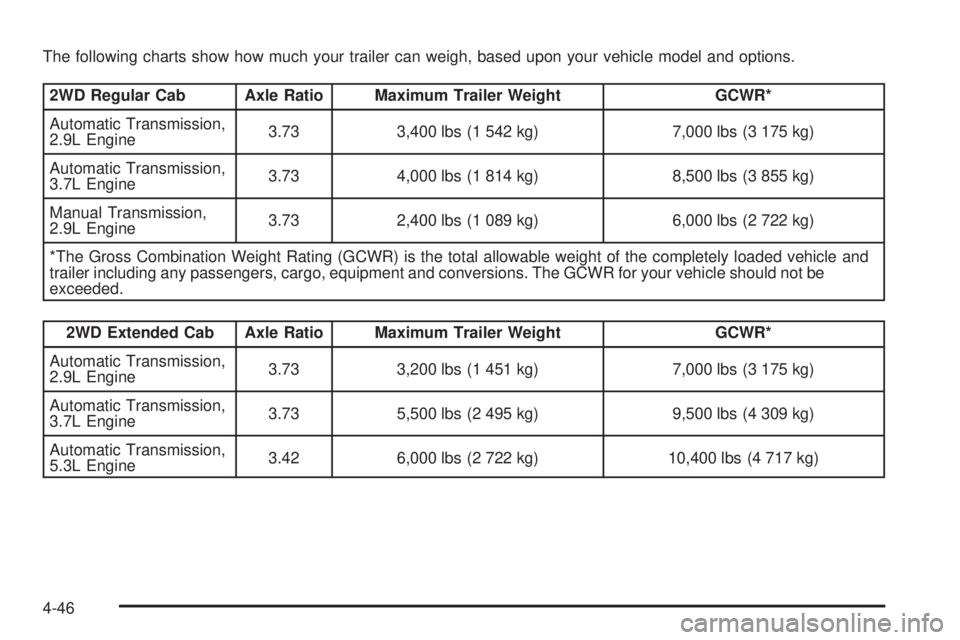
The following charts show how much your trailer can weigh, based upon your vehicle model and options.
2WD Regular Cab Axle Ratio Maximum Trailer Weight GCWR*
Automatic Transmission,
2.9L Engine3.73 3,400 lbs (1 542 kg) 7,000 lbs (3 175 kg)
Automatic Transmission,
3.7L Engine3.73 4,000 lbs (1 814 kg) 8,500 lbs (3 855 kg)
Manual Transmission,
2.9L Engine3.73 2,400 lbs (1 089 kg) 6,000 lbs (2 722 kg)
*The Gross Combination Weight Rating (GCWR) is the total allowable weight of the completely loaded vehicle and
trailer including any passengers, cargo, equipment and conversions. The GCWR for your vehicle should not be
exceeded.
2WD Extended Cab Axle Ratio Maximum Trailer Weight GCWR*
Automatic Transmission,
2.9L Engine3.73 3,200 lbs (1 451 kg) 7,000 lbs (3 175 kg)
Automatic Transmission,
3.7L Engine3.73 5,500 lbs (2 495 kg) 9,500 lbs (4 309 kg)
Automatic Transmission,
5.3L Engine3.42 6,000 lbs (2 722 kg) 10,400 lbs (4 717 kg)
4-46
Page 249 of 428
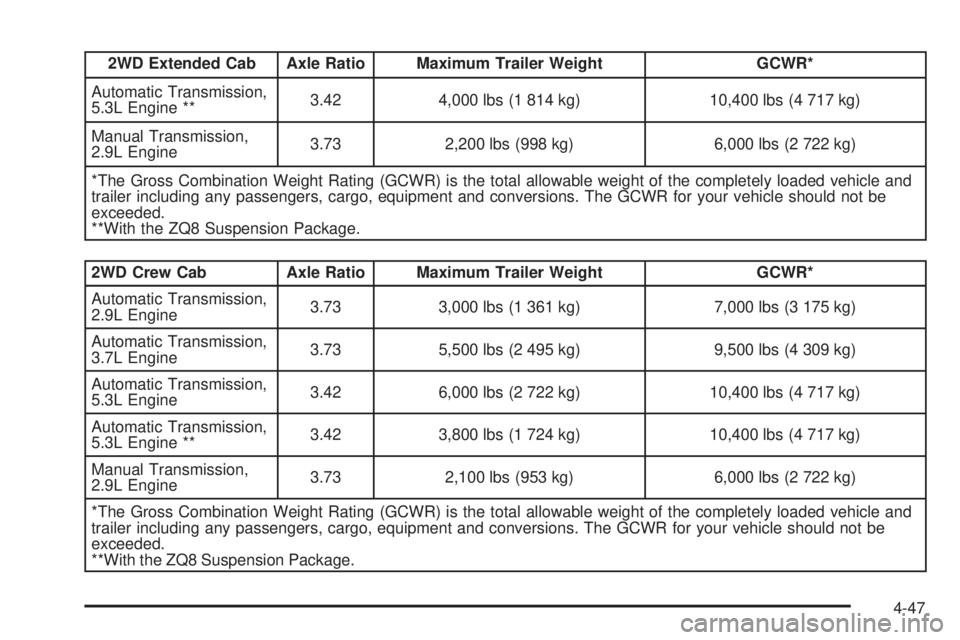
2WD Extended Cab Axle Ratio Maximum Trailer Weight GCWR*
Automatic Transmission,
5.3L Engine **3.42 4,000 lbs (1 814 kg) 10,400 lbs (4 717 kg)
Manual Transmission,
2.9L Engine3.73 2,200 lbs (998 kg) 6,000 lbs (2 722 kg)
*The Gross Combination Weight Rating (GCWR) is the total allowable weight of the completely loaded vehicle and
trailer including any passengers, cargo, equipment and conversions. The GCWR for your vehicle should not be
exceeded.
**With the ZQ8 Suspension Package.
2WD Crew Cab Axle Ratio Maximum Trailer Weight GCWR*
Automatic Transmission,
2.9L Engine3.73 3,000 lbs (1 361 kg) 7,000 lbs (3 175 kg)
Automatic Transmission,
3.7L Engine3.73 5,500 lbs (2 495 kg) 9,500 lbs (4 309 kg)
Automatic Transmission,
5.3L Engine3.42 6,000 lbs (2 722 kg) 10,400 lbs (4 717 kg)
Automatic Transmission,
5.3L Engine **3.42 3,800 lbs (1 724 kg) 10,400 lbs (4 717 kg)
Manual Transmission,
2.9L Engine3.73 2,100 lbs (953 kg) 6,000 lbs (2 722 kg)
*The Gross Combination Weight Rating (GCWR) is the total allowable weight of the completely loaded vehicle and
trailer including any passengers, cargo, equipment and conversions. The GCWR for your vehicle should not be
exceeded.
**With the ZQ8 Suspension Package.
4-47
Page 250 of 428
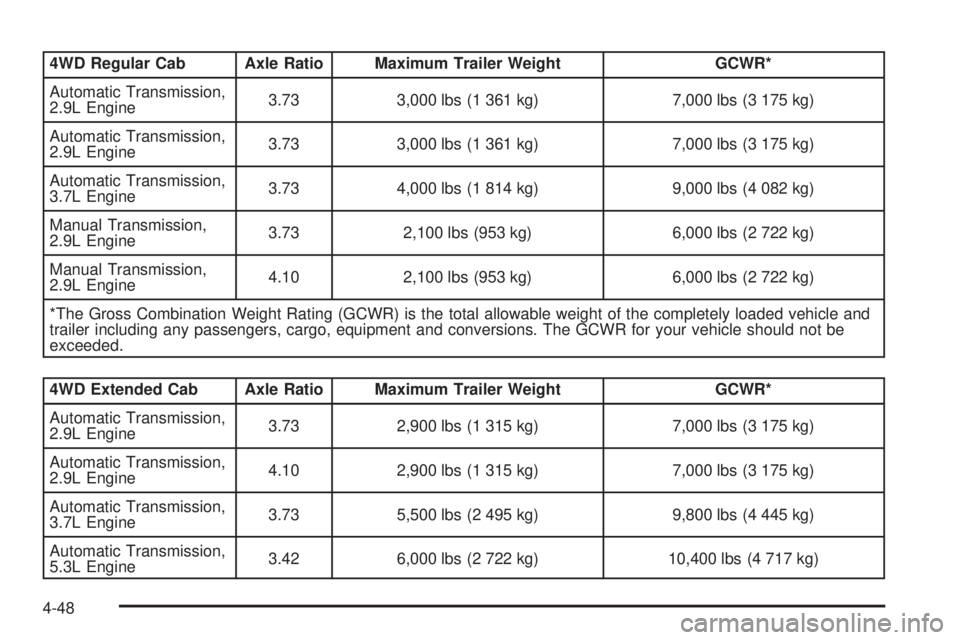
4WD Regular Cab Axle Ratio Maximum Trailer Weight GCWR*
Automatic Transmission,
2.9L Engine3.73 3,000 lbs (1 361 kg) 7,000 lbs (3 175 kg)
Automatic Transmission,
2.9L Engine3.73 3,000 lbs (1 361 kg) 7,000 lbs (3 175 kg)
Automatic Transmission,
3.7L Engine3.73 4,000 lbs (1 814 kg) 9,000 lbs (4 082 kg)
Manual Transmission,
2.9L Engine3.73 2,100 lbs (953 kg) 6,000 lbs (2 722 kg)
Manual Transmission,
2.9L Engine4.10 2,100 lbs (953 kg) 6,000 lbs (2 722 kg)
*The Gross Combination Weight Rating (GCWR) is the total allowable weight of the completely loaded vehicle and
trailer including any passengers, cargo, equipment and conversions. The GCWR for your vehicle should not be
exceeded.
4WD Extended Cab Axle Ratio Maximum Trailer Weight GCWR*
Automatic Transmission,
2.9L Engine3.73 2,900 lbs (1 315 kg) 7,000 lbs (3 175 kg)
Automatic Transmission,
2.9L Engine4.10 2,900 lbs (1 315 kg) 7,000 lbs (3 175 kg)
Automatic Transmission,
3.7L Engine3.73 5,500 lbs (2 495 kg) 9,800 lbs (4 445 kg)
Automatic Transmission,
5.3L Engine3.42 6,000 lbs (2 722 kg) 10,400 lbs (4 717 kg)
4-48