engine GMC CANYON 2008 Workshop Manual
[x] Cancel search | Manufacturer: GMC, Model Year: 2008, Model line: CANYON, Model: GMC CANYON 2008Pages: 428, PDF Size: 5.82 MB
Page 232 of 428
Then, shut the engine off and close the window
almost all the way to preserve the heat. Start the
engine again and repeat this only when you feel
really uncomfortable from the cold. But do it as little
as possible. Preserve the fuel as long as you can.
To help keep warm, you can get out of the vehicle
and do some fairly vigorous exercises every half hour
or so until help comes.
If Your Vehicle is Stuck in Sand,
Mud, Ice, or Snow
Slowly and cautiously spin the wheels to free your
vehicle when stuck in sand, mud, ice, or snow. See
Rocking Your Vehicle to Get It Out on page 4-30.
If your vehicle has a traction system, it can often help to
free a stuck vehicle. Refer to your vehicle’s traction
system in the Index. If the stuck condition is too severe
for the traction system to free the vehicle, turn the
traction system off and use the rocking method.
{CAUTION:
If you let your vehicle’s tires spin at high
speed, they can explode, and you or others
could be injured. The vehicle can overheat,
causing an engine compartment re or other
damage. Spin the wheels as little as possible
and avoid going above 35 mph (55 km/h) as
shown on the speedometer.
For information about using tire chains on your vehicle,
seeTire Chains on page 5-78.
Rocking Your Vehicle to Get It Out
First, turn the steering wheel left and right to clear the
area around the front wheels. For four-wheel drive
vehicles, shift into 4HI. For vehicles with traction control,
turn the system off. SeeTraction Control System (TCS)
on page 4-5. Then shift back and forth between
REVERSE (R) and a forward gear, or with a manual
transmission, between FIRST (1) or SECOND (2) and
REVERSE (R), spinning the wheels as little as possible.
4-30
Page 247 of 428
If You Do Decide To Pull A Trailer
If you do, here are some important points:
There are many different laws, including speed limit
restrictions, having to do with trailering. Make sure
your rig will be legal, not only where you live
but also where you’ll be driving. A good source for
this information can be state or provincial police.
Consider using a sway control. You can ask a hitch
dealer/retailer about sway controls.
Don’t tow a trailer at all during the rst 500 miles
(800 km) your new vehicle is driven. Your engine,
axle or other parts could be damaged.
Then, during the rst 500 miles (800 km) that you
tow a trailer, don’t drive over 50 mph (80 km/h)
and don’t make starts at full throttle. This helps your
engine and other parts of your vehicle wear in at
the heavier loads.
You may want to shift the transmission to THIRD (3)
or, if necessary, a lower gear selection if the
transmission shifts too often (e.g., under heavy
loads and/or hilly conditions). If you have a manual
transmission and you are towing a trailer, it’s
better not to use the highest gear.Three important considerations have to do with weight:
the weight of the trailer,
the weight of the trailer tongue
and the weight on your vehicle’s tires.
Weight of the Trailer
How heavy can a trailer safely be?
It depends on how you plan to use your rig. For
example, speed, altitude, road grades, outside
temperature and how much your vehicle is used to pull
a trailer are all important. It can also depend on any
special equipment that you have on your vehicle,
and the amount of tongue weight the vehicle can carry.
See “Weight of the Trailer Tongue” later in this
section for more information.
Maximum trailer weight is calculated assuming only the
driver is in the tow vehicle and it has all the required
trailering equipment. The weight of additional optional
equipment, passengers and cargo in the tow vehicle
must be subtracted from the maximum trailer weight.
4-45
Page 248 of 428
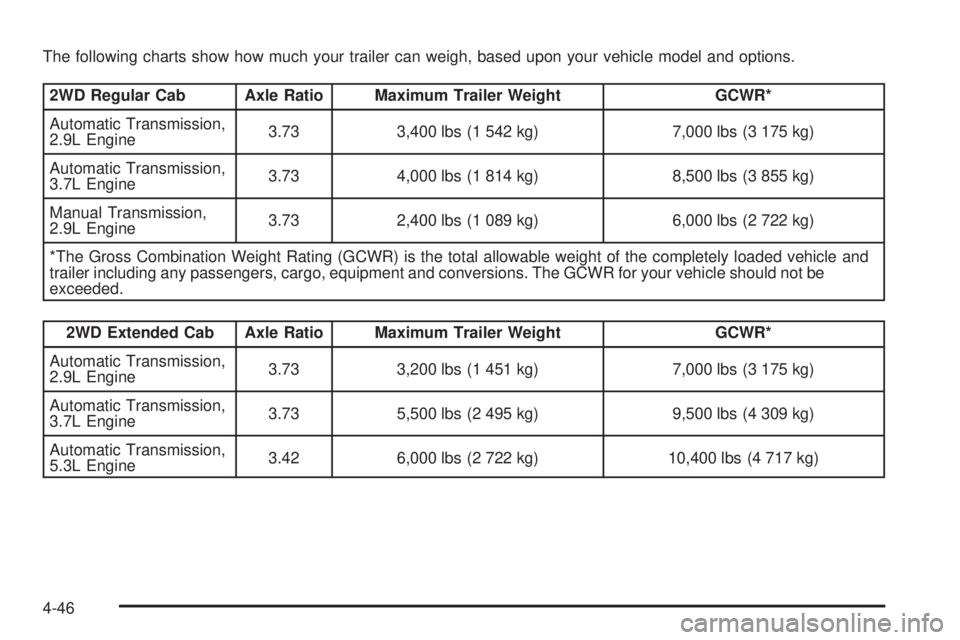
The following charts show how much your trailer can weigh, based upon your vehicle model and options.
2WD Regular Cab Axle Ratio Maximum Trailer Weight GCWR*
Automatic Transmission,
2.9L Engine3.73 3,400 lbs (1 542 kg) 7,000 lbs (3 175 kg)
Automatic Transmission,
3.7L Engine3.73 4,000 lbs (1 814 kg) 8,500 lbs (3 855 kg)
Manual Transmission,
2.9L Engine3.73 2,400 lbs (1 089 kg) 6,000 lbs (2 722 kg)
*The Gross Combination Weight Rating (GCWR) is the total allowable weight of the completely loaded vehicle and
trailer including any passengers, cargo, equipment and conversions. The GCWR for your vehicle should not be
exceeded.
2WD Extended Cab Axle Ratio Maximum Trailer Weight GCWR*
Automatic Transmission,
2.9L Engine3.73 3,200 lbs (1 451 kg) 7,000 lbs (3 175 kg)
Automatic Transmission,
3.7L Engine3.73 5,500 lbs (2 495 kg) 9,500 lbs (4 309 kg)
Automatic Transmission,
5.3L Engine3.42 6,000 lbs (2 722 kg) 10,400 lbs (4 717 kg)
4-46
Page 249 of 428
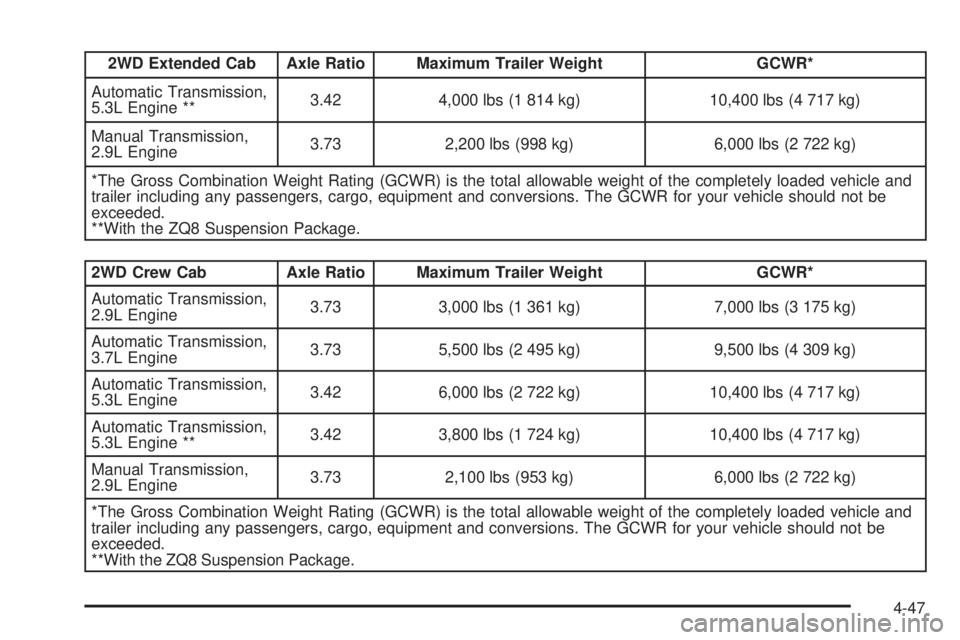
2WD Extended Cab Axle Ratio Maximum Trailer Weight GCWR*
Automatic Transmission,
5.3L Engine **3.42 4,000 lbs (1 814 kg) 10,400 lbs (4 717 kg)
Manual Transmission,
2.9L Engine3.73 2,200 lbs (998 kg) 6,000 lbs (2 722 kg)
*The Gross Combination Weight Rating (GCWR) is the total allowable weight of the completely loaded vehicle and
trailer including any passengers, cargo, equipment and conversions. The GCWR for your vehicle should not be
exceeded.
**With the ZQ8 Suspension Package.
2WD Crew Cab Axle Ratio Maximum Trailer Weight GCWR*
Automatic Transmission,
2.9L Engine3.73 3,000 lbs (1 361 kg) 7,000 lbs (3 175 kg)
Automatic Transmission,
3.7L Engine3.73 5,500 lbs (2 495 kg) 9,500 lbs (4 309 kg)
Automatic Transmission,
5.3L Engine3.42 6,000 lbs (2 722 kg) 10,400 lbs (4 717 kg)
Automatic Transmission,
5.3L Engine **3.42 3,800 lbs (1 724 kg) 10,400 lbs (4 717 kg)
Manual Transmission,
2.9L Engine3.73 2,100 lbs (953 kg) 6,000 lbs (2 722 kg)
*The Gross Combination Weight Rating (GCWR) is the total allowable weight of the completely loaded vehicle and
trailer including any passengers, cargo, equipment and conversions. The GCWR for your vehicle should not be
exceeded.
**With the ZQ8 Suspension Package.
4-47
Page 250 of 428
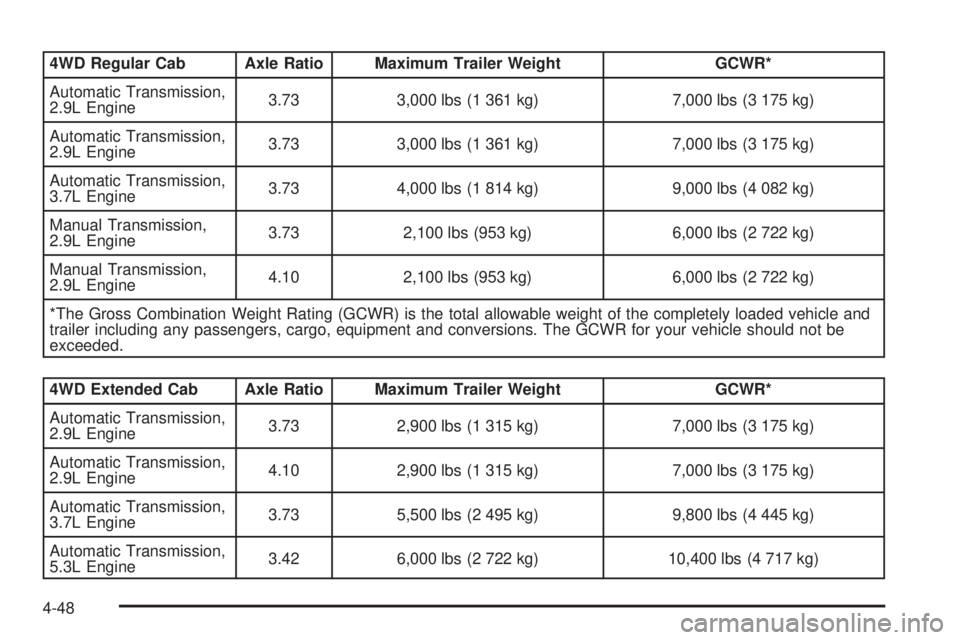
4WD Regular Cab Axle Ratio Maximum Trailer Weight GCWR*
Automatic Transmission,
2.9L Engine3.73 3,000 lbs (1 361 kg) 7,000 lbs (3 175 kg)
Automatic Transmission,
2.9L Engine3.73 3,000 lbs (1 361 kg) 7,000 lbs (3 175 kg)
Automatic Transmission,
3.7L Engine3.73 4,000 lbs (1 814 kg) 9,000 lbs (4 082 kg)
Manual Transmission,
2.9L Engine3.73 2,100 lbs (953 kg) 6,000 lbs (2 722 kg)
Manual Transmission,
2.9L Engine4.10 2,100 lbs (953 kg) 6,000 lbs (2 722 kg)
*The Gross Combination Weight Rating (GCWR) is the total allowable weight of the completely loaded vehicle and
trailer including any passengers, cargo, equipment and conversions. The GCWR for your vehicle should not be
exceeded.
4WD Extended Cab Axle Ratio Maximum Trailer Weight GCWR*
Automatic Transmission,
2.9L Engine3.73 2,900 lbs (1 315 kg) 7,000 lbs (3 175 kg)
Automatic Transmission,
2.9L Engine4.10 2,900 lbs (1 315 kg) 7,000 lbs (3 175 kg)
Automatic Transmission,
3.7L Engine3.73 5,500 lbs (2 495 kg) 9,800 lbs (4 445 kg)
Automatic Transmission,
5.3L Engine3.42 6,000 lbs (2 722 kg) 10,400 lbs (4 717 kg)
4-48
Page 251 of 428
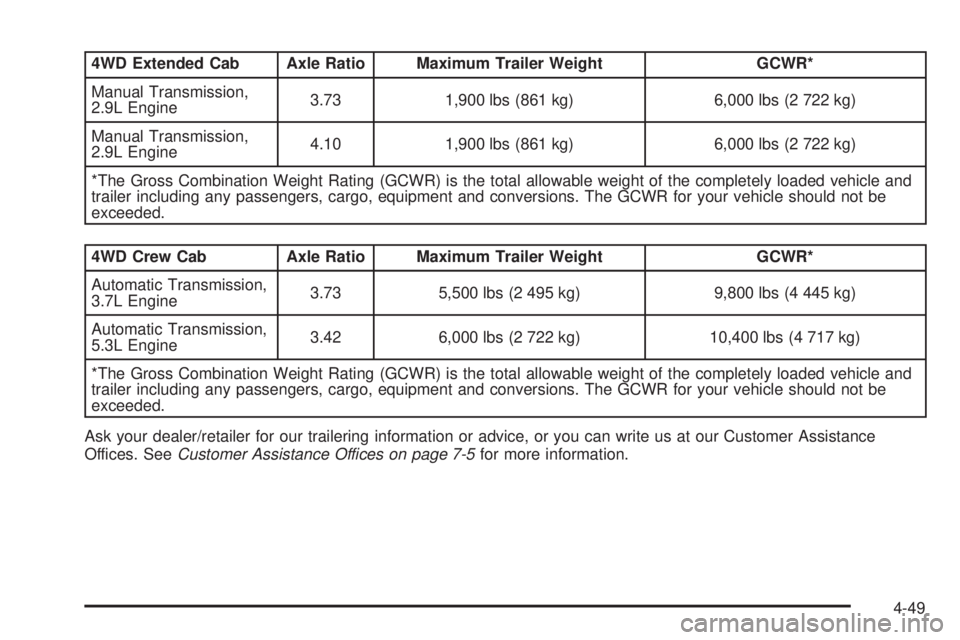
4WD Extended Cab Axle Ratio Maximum Trailer Weight GCWR*
Manual Transmission,
2.9L Engine3.73 1,900 lbs (861 kg) 6,000 lbs (2 722 kg)
Manual Transmission,
2.9L Engine4.10 1,900 lbs (861 kg) 6,000 lbs (2 722 kg)
*The Gross Combination Weight Rating (GCWR) is the total allowable weight of the completely loaded vehicle and
trailer including any passengers, cargo, equipment and conversions. The GCWR for your vehicle should not be
exceeded.
4WD Crew Cab Axle Ratio Maximum Trailer Weight GCWR*
Automatic Transmission,
3.7L Engine3.73 5,500 lbs (2 495 kg) 9,800 lbs (4 445 kg)
Automatic Transmission,
5.3L Engine3.42 6,000 lbs (2 722 kg) 10,400 lbs (4 717 kg)
*The Gross Combination Weight Rating (GCWR) is the total allowable weight of the completely loaded vehicle and
trailer including any passengers, cargo, equipment and conversions. The GCWR for your vehicle should not be
exceeded.
Ask your dealer/retailer for our trailering information or advice, or you can write us at our Customer Assistance
Offices. SeeCustomer Assistance Offices on page 7-5for more information.
4-49
Page 257 of 428
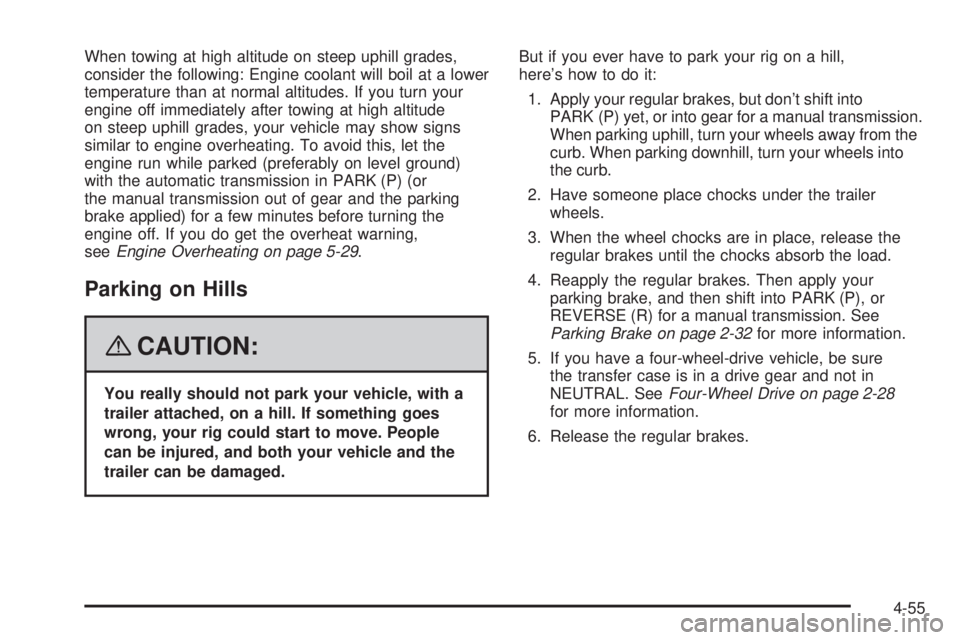
When towing at high altitude on steep uphill grades,
consider the following: Engine coolant will boil at a lower
temperature than at normal altitudes. If you turn your
engine off immediately after towing at high altitude
on steep uphill grades, your vehicle may show signs
similar to engine overheating. To avoid this, let the
engine run while parked (preferably on level ground)
with the automatic transmission in PARK (P) (or
the manual transmission out of gear and the parking
brake applied) for a few minutes before turning the
engine off. If you do get the overheat warning,
seeEngine Overheating on page 5-29.
Parking on Hills
{CAUTION:
You really should not park your vehicle, with a
trailer attached, on a hill. If something goes
wrong, your rig could start to move. People
can be injured, and both your vehicle and the
trailer can be damaged.But if you ever have to park your rig on a hill,
here’s how to do it:
1. Apply your regular brakes, but don’t shift into
PARK (P) yet, or into gear for a manual transmission.
When parking uphill, turn your wheels away from the
curb. When parking downhill, turn your wheels into
the curb.
2. Have someone place chocks under the trailer
wheels.
3. When the wheel chocks are in place, release the
regular brakes until the chocks absorb the load.
4. Reapply the regular brakes. Then apply your
parking brake, and then shift into PARK (P), or
REVERSE (R) for a manual transmission. See
Parking Brake on page 2-32for more information.
5. If you have a four-wheel-drive vehicle, be sure
the transfer case is in a drive gear and not in
NEUTRAL. SeeFour-Wheel Drive on page 2-28
for more information.
6. Release the regular brakes.
4-55
Page 258 of 428
When You Are Ready to Leave After
Parking on a Hill
1. Apply your regular brakes and hold the pedal down
while you:
start your engine,
shift into a gear, and
release the parking brake.
2. Let up on the brake pedal.
3. Drive slowly until the trailer is clear of the chocks.
4. Stop and have someone pick up and store the
chocks.
Maintenance When Trailer Towing
Your vehicle will need service more often when you’re
pulling a trailer. SeeScheduled Maintenance on page 6-4
for more on this. Things that are especially important in
trailer operation are automatic transmission uid (don’t
overll), engine oil, axle lubricant, belt, cooling system
and brake system. Each of these is covered in this
manual, and the Index will help you nd them quickly.
If you’re trailering, it’s a good idea to review these
sections before you start your trip.
Check periodically to see that all hitch nuts and bolts
are tight.
Trailer Wiring Harness
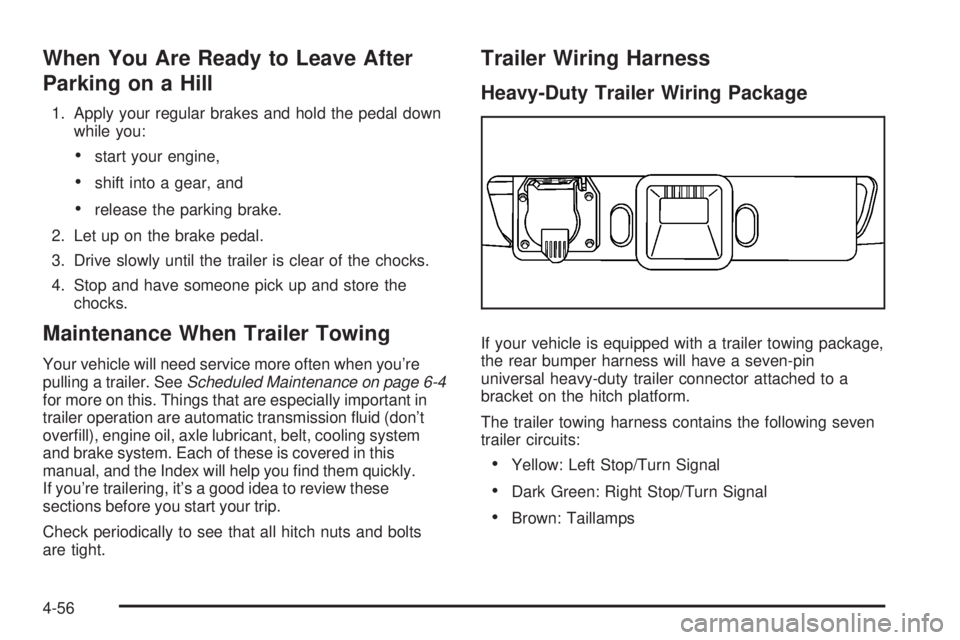
Heavy-Duty Trailer Wiring Package
If your vehicle is equipped with a trailer towing package,
the rear bumper harness will have a seven-pin
universal heavy-duty trailer connector attached to a
bracket on the hitch platform.
The trailer towing harness contains the following seven
trailer circuits:
Yellow: Left Stop/Turn Signal
Dark Green: Right Stop/Turn Signal
Brown: Taillamps
4-56
Page 261 of 428
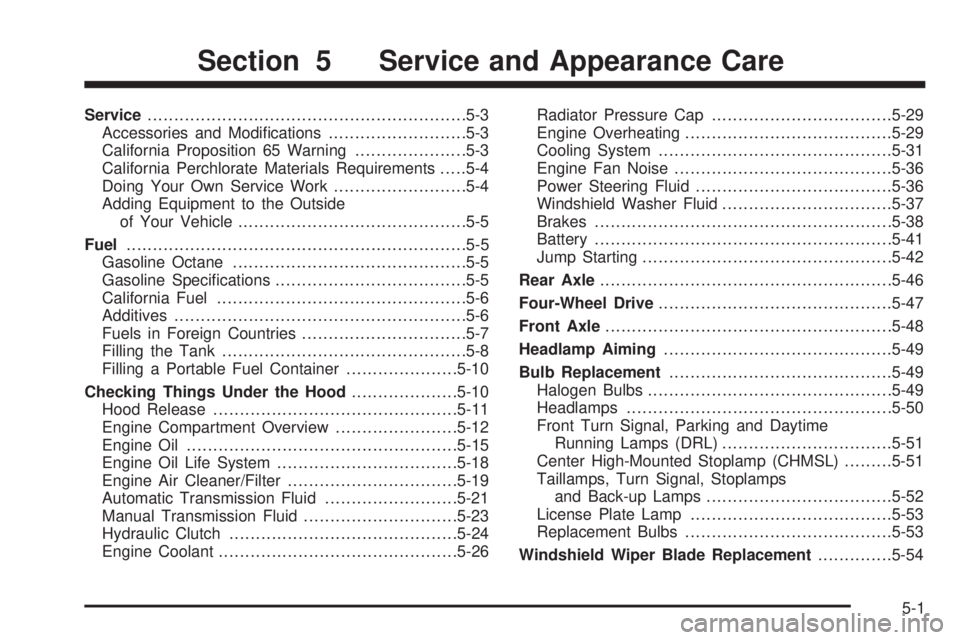
Service............................................................5-3
Accessories and Modications..........................5-3
California Proposition 65 Warning.....................5-3
California Perchlorate Materials Requirements.....5-4
Doing Your Own Service Work.........................5-4
Adding Equipment to the Outside
of Your Vehicle...........................................5-5
Fuel................................................................5-5
Gasoline Octane............................................5-5
Gasoline Specications....................................5-5
California Fuel...............................................5-6
Additives.......................................................5-6
Fuels in Foreign Countries...............................5-7
Filling the Tank..............................................5-8
Filling a Portable Fuel Container.....................5-10
Checking Things Under the Hood....................5-10
Hood Release..............................................5-11
Engine Compartment Overview.......................5-12
Engine Oil...................................................5-15
Engine Oil Life System..................................5-18
Engine Air Cleaner/Filter................................5-19
Automatic Transmission Fluid.........................5-21
Manual Transmission Fluid.............................5-23
Hydraulic Clutch...........................................5-24
Engine Coolant.............................................5-26Radiator Pressure Cap..................................5-29
Engine Overheating.......................................5-29
Cooling System............................................5-31
Engine Fan Noise.........................................5-36
Power Steering Fluid.....................................5-36
Windshield Washer Fluid................................5-37
Brakes........................................................5-38
Battery........................................................5-41
Jump Starting...............................................5-42
Rear Axle
.......................................................5-46
Four-Wheel Drive............................................5-47
Front Axle......................................................5-48
Headlamp Aiming...........................................5-49
Bulb Replacement..........................................5-49
Halogen Bulbs..............................................5-49
Headlamps..................................................5-50
Front Turn Signal, Parking and Daytime
Running Lamps (DRL)................................5-51
Center High-Mounted Stoplamp (CHMSL).........5-51
Taillamps, Turn Signal, Stoplamps
and Back-up Lamps...................................5-52
License Plate Lamp......................................5-53
Replacement Bulbs.......................................5-53
Windshield Wiper Blade Replacement..............5-54
Section 5 Service and Appearance Care
5-1
Page 262 of 428
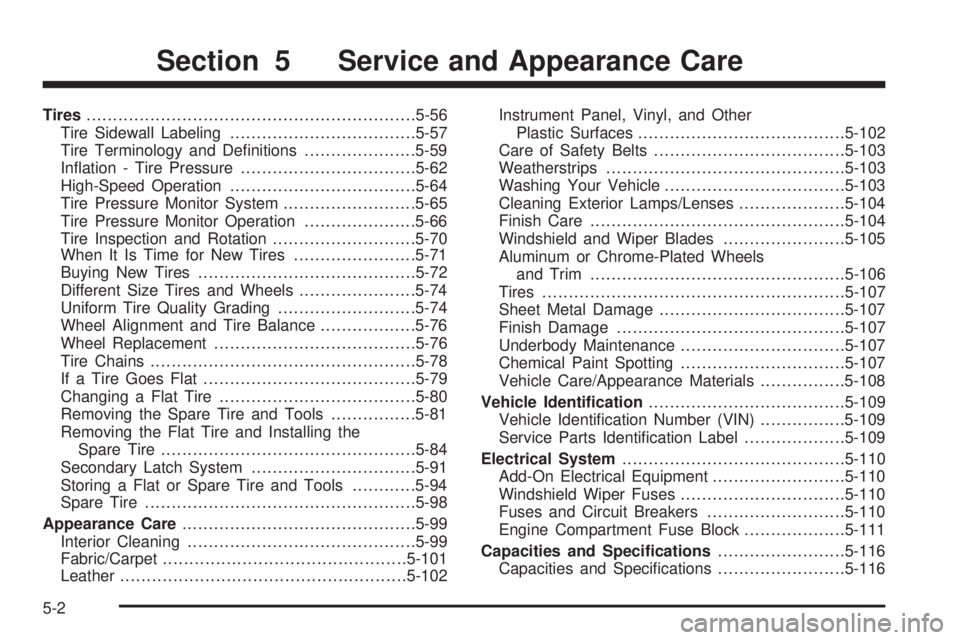
Tires..............................................................5-56
Tire Sidewall Labeling...................................5-57
Tire Terminology and Denitions.....................5-59
Ination - Tire Pressure.................................5-62
High-Speed Operation...................................5-64
Tire Pressure Monitor System.........................5-65
Tire Pressure Monitor Operation.....................5-66
Tire Inspection and Rotation...........................5-70
When It Is Time for New Tires.......................5-71
Buying New Tires.........................................5-72
Different Size Tires and Wheels......................5-74
Uniform Tire Quality Grading..........................5-74
Wheel Alignment and Tire Balance..................5-76
Wheel Replacement......................................5-76
Tire Chains..................................................5-78
If a Tire Goes Flat........................................5-79
Changing a Flat Tire.....................................5-80
Removing the Spare Tire and Tools................5-81
Removing the Flat Tire and Installing the
Spare Tire................................................5-84
Secondary Latch System...............................5-91
Storing a Flat or Spare Tire and Tools............5-94
Spare Tire...................................................5-98
Appearance Care............................................5-99
Interior Cleaning...........................................5-99
Fabric/Carpet..............................................5-101
Leather......................................................5-102Instrument Panel, Vinyl, and Other
Plastic Surfaces.......................................5-102
Care of Safety Belts....................................5-103
Weatherstrips.............................................5-103
Washing Your Vehicle..................................5-103
Cleaning Exterior Lamps/Lenses....................5-104
Finish Care................................................5-104
Windshield and Wiper Blades.......................5-105
Aluminum or Chrome-Plated Wheels
and Trim................................................5-106
Tires.........................................................5-107
Sheet Metal Damage...................................5-107
Finish Damage...........................................5-107
Underbody Maintenance...............................5-107
Chemical Paint Spotting...............................5-107
Vehicle Care/Appearance Materials................5-108
Vehicle Identication.....................................5-109
Vehicle Identication Number (VIN)................5-109
Service Parts Identication Label...................5-109
Electrical System..........................................5-110
Add-On Electrical Equipment.........................5-110
Windshield Wiper Fuses...............................5-110
Fuses and Circuit Breakers..........................5-110
Engine Compartment Fuse Block...................5-111
Capacities and Specications........................5-116
Capacities and Specications........................5-116
Section 5 Service and Appearance Care
5-2