rke GMC CANYON 2010 Owner's Guide
[x] Cancel search | Manufacturer: GMC, Model Year: 2010, Model line: CANYON, Model: GMC CANYON 2010Pages: 448, PDF Size: 2.62 MB
Page 256 of 448
Two-Tiered Loading
By positioning four 2” X 6” wooden planks across
the width of the pickup box, you can create an
upper load platform. The planks must be inserted
in the pickup box depressions. The length of
the planks must allow for at leasta2cm(3/4 inch)
bearing surface on each end of the plank.
When using this upper load platform, be sure the
load is securely tied down to prevent it from
shifting. The load’s center of gravity should be
positioned in a zone over the rear axle.
Any load that extends beyond the vehicle’s
taillamp area must be properly marked according
to local laws and regulations.
Remember not to exceed the Gross Axle Weight
Rating (GAWR) of the rear axle.
Add-On Equipment
When you carry removable items, you may need
to put a limit on how many people you carry
inside your vehicle. Be sure to weigh your vehicle
before you buy and install the new equipment.
Notice
:Overloading the vehicle may cause
damage. Repairs would not be covered by the
vehicle warranty. Do not overload the vehicle.Remember not to exceed the Gross Axle Weight
Rating (GAWR) of the rear axle.
A reinforcement kit for mounting a toolbox is
recommended. See your dealer/retailer.
Truck-Camper Loading Information
The vehicle was neither designed nor intended
to carry a slide-in type camper.
Notice
:Adding a slide-in camper or similar
equipment to the vehicle can damage it,
and the repairs would not be covered by the
vehicle warranty. Do not install a slide-in
camper or similar equipment on the vehicle.
Pickup Conversion to Chassis Cab
We are aware that some vehicle owners might consider
having the pickup box removed and a commercial or
recreational body installed. However, we recommend
that conversions of this type not be done to pickups.
Owners should be aware that, as manufactured, there
are differences between a chassis cab and a pickup with
the box removed which could affect vehicle safety.
5-40
Page 274 of 448
Driving On Grades
Reduce speed and shift to a lower gearbeforestarting
down a long or steep downgrade. If the transmission is
not shifted down, the brakes might have to be used so
much that they would get hot and no longer work well.
Vehicles with automatic transmissions can tow in
D (Drive), but you may want to shift to a lower gear
selection if the transmission shifts too often (e.g., under
heavy loads and/or hilly conditions). If the vehicle has
a manual transmission it is better not to use the
highest gear.
When towing at high altitude on steep uphill grades,
consider the following: Engine coolant will boil at a lower
temperature than at normal altitudes. If the engine is
turned off immediately after towing at high altitude on
steep uphill grades, the vehicle may show signs similar to
engine overheating. To avoid this, let the engine run whileparked, preferably on level ground, with an automatic
transmission in P (Park) or a manual transmission in
N (Neutral) with the parking brake applied, for a
few minutes before turning the engine off. If the overheat
warning comes on, seeEngine Overheating on page 6-35.
Parking on Hills
{WARNING:
Parking the vehicle on a hill with the trailer
attached can be dangerous. If something goes
wrong, the rig could start to move. People can be
injured, and both the vehicle and the trailer can be
damaged. When possible, always park the rig on a
flat surface.
5-58
Page 281 of 448
This vehicle has an airbag system. Before attempting
to do your own service work, seeServicing Your
Airbag-Equipped Vehicle on page 2-79.
Keep a record with all parts receipts and list the
mileage and the date of any service work performed.
SeeMaintenance Record on page 7-14.
Adding Equipment to the Outside of
the Vehicle
Things added to the outside of the vehicle can affect the
airflow around it. This can cause wind noise and can
affect fuel economy and windshield washer performance.
Check with your dealer/retailer before adding equipment
to the outside of the vehicle.
Fuel
Use of the recommended fuel is an important part of the
proper maintenance of this vehicle. To help keep the
engine clean and maintain optimum vehicle performance,
we recommend the use of gasoline advertised as
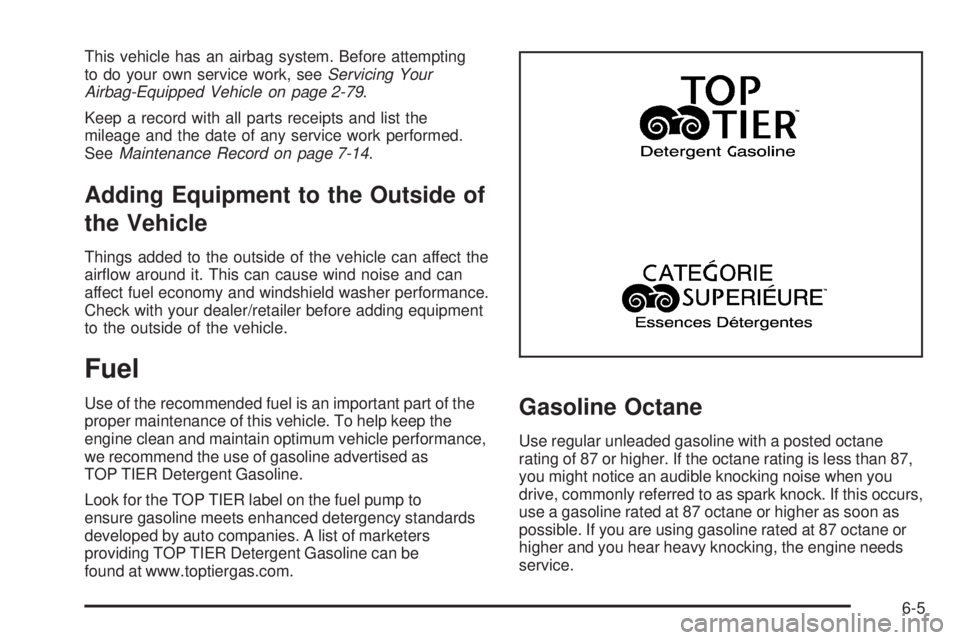
TOP TIER Detergent Gasoline.
Look for the TOP TIER label on the fuel pump to
ensure gasoline meets enhanced detergency standards
developed by auto companies. A list of marketers
providing TOP TIER Detergent Gasoline can be
found at www.toptiergas.com.Gasoline Octane
Use regular unleaded gasoline with a posted octane
rating of 87 or higher. If the octane rating is less than 87,
you might notice an audible knocking noise when you
drive, commonly referred to as spark knock. If this occurs,
use a gasoline rated at 87 octane or higher as soon as
possible. If you are using gasoline rated at 87 octane or
higher and you hear heavy knocking, the engine needs
service.
6-5
Page 301 of 448
Manual Transmission Fluid
When to Check
A good time to check the manual transmission fluid is
when the engine oil is changed. However, the fluid in
the manual transmission does not require changing.
How to Check
Because this operation can be a little difficult, you may
choose to have this done at your GM dealer/retailer
service department.
If doing it yourself, be sure to follow all the instructions
here, or there could be a false reading.
Notice:Too much or too little uid can damage
your transmission. Too little uid could cause
the transmission to overheat. Be sure to get an
accurate reading if you check your transmission
uid.
Check the fluid level only when the engine is off, the
vehicle is parked on a level place and the transmission
is cool enough to touch the transmission case.After this is done:
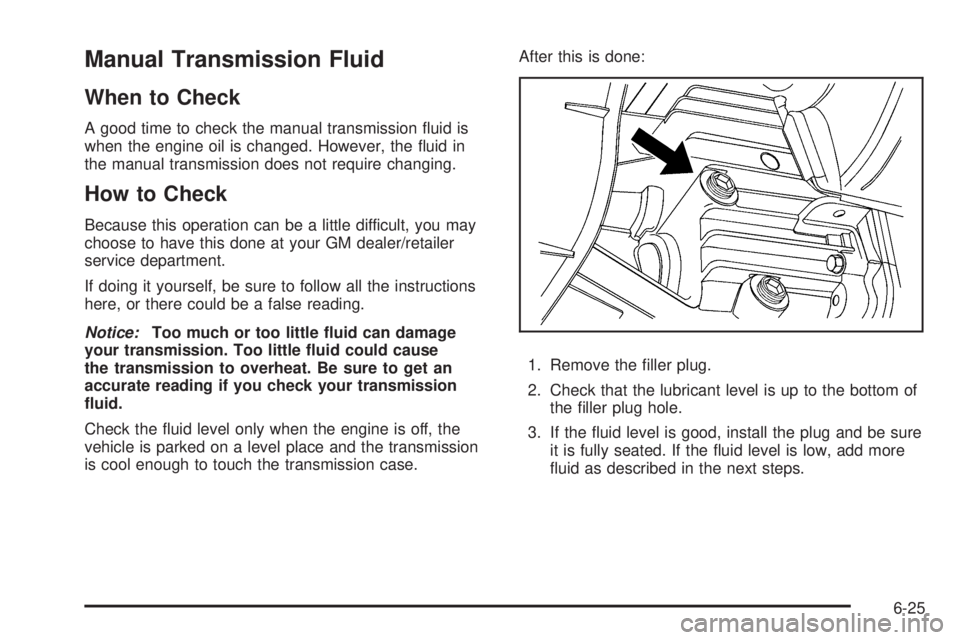
1. Remove the filler plug.
2. Check that the lubricant level is up to the bottom of
the filler plug hole.
3. If the fluid level is good, install the plug and be sure
it is fully seated. If the fluid level is low, add more
fluid as described in the next steps.
6-25
Page 311 of 448
Engine Overheating
The vehicle has a coolant temperature gage displayed
on the instrument panel to warn if the engine is
overheating. SeeEngine Coolant Temperature Gage on
page 4-27. If the engine is too hot, the air conditioning
might stop working. This is normal and helps cool
the engine.
You may decide not to lift the hood when the warning
appears, but instead get service help right away.
SeeRoadside Assistance Program on page 8-7.
If you do decide to lift the hood, make sure the vehicle
is parked on a level surface.
Then check to see if the engine cooling fan is running.
If the engine is overheating, the fan should be running.
If it is not, do not continue to run the engine and have the
vehicle serviced.
The engine cooling fan speed should increase when
idle speed is doubled by pushing the accelerator
pedal down. If it does not, the vehicle needs service.
Turn off the engine.
Notice:Engine damage from running the engine
without coolant is not covered by the warranty.
Notice:If the engine catches re because of being
driven with no coolant, your vehicle can be badly
damaged. The costly repairs would not be covered
by the vehicle warranty.
If Steam is Coming from the Engine
Compartment
{WARNING:
Steam from an overheated engine can burn you
badly, even if you just open the hood. Stay away
from the engine if you see or hear steam coming
from it. Just turn it off and get everyone away
from the vehicle until it cools down. Wait until
there is no sign of steam or coolant before you
open the hood.
If you keep driving when your engine is
overheated, the liquids in it can catch fire. You or
others could be badly burned. Stop your engine if
it overheats, and get out of the vehicle until the
engine is cool.
6-35
Page 312 of 448
If No Steam is Coming from the Engine
Compartment
If an engine overheat warning is displayed but no steam
can be seen or heard, the problem may not be too
serious. Sometimes the engine can get a little too hot
when the vehicle:
•Climbs a long hill on a hot day.
•Stops after high-speed driving.
•Idles for long periods in traffic.
•Tows a trailer. See “Driving on Grades” under
Towing a Trailer on page 5-48.
If the overheat warning is displayed with no sign of
steam:
1. Turn the air conditioning off.
2. Turn the heater on to the highest temperature and
to the highest fan speed. Open the windows as
necessary.
3. In heavy traffic, let the engine idle in N (Neutral)
while stopped. If it is safe to do so, pull off the
road, shift to P (Park) or N (Neutral) and let
the engine idle.
If the temperature overheat gage is no longer in the
overheat zone or an overheat warning no longer
displays, the vehicle can be driven. Continue to drivethe vehicle slow for about 10 minutes. Keep a safe
vehicle distance from the car in front of you. If the
warning does not come back on, continue to drive
normally.
If the warning continues, pull over, stop, and park the
vehicle right away.
If there is no sign of steam, idle the engine for three
minutes while parked. If the warning is still displayed,
turn off the engine until it cools down.Engine Fan Noise
This vehicle has a clutched engine cooling fan. When the
clutch is engaged, the fan spins faster to provide more air
to cool the engine. In most everyday driving conditions,
the clutch is not engaged. This improves fuel economy
and reduces fan noise. Under heavy vehicle loading,
trailer towing and/or high outside temperatures, the fan
speed increases when the clutch engages. So you may
hear an increase in fan noise. This is normal and should
not be mistaken as the transmission slipping or making
extra shifts. It is merely the cooling system functioning
properly. The fan will slow down when additional cooling
is not required and the clutch disengages.
You may also hear this fan noise when you start the
engine. It will go away as the fan clutch disengages.
6-36
Page 352 of 448
Treadwear
The treadwear grade is a comparative rating
based on the wear rate of the tire when tested
under controlled conditions on a specified
government test course. For example, a tire
graded 150 would wear one and a half (1.5)
times as well on the government course as a tire
graded 100. The relative performance of tires
depends upon the actual conditions of their use,
however, and may depart significantly from the
norm due to variations in driving habits, service
practices, and differences in road characteristics
and climate.
Traction – AA, A, B, C
The traction grades, from highest to lowest, are AA,
A, B, and C. Those grades represent the tire’s
ability to stop on wet pavement as measured under
controlled conditions on specified government test
surfaces of asphalt and concrete. A tire marked C
may have poor traction performance.
Temperature – A, B, C
The temperature grades are A (the highest), B,
and C, representing the tire’s resistance to the
generation of heat and its ability to dissipate heat
when tested under controlled conditions on a
specified indoor laboratory test wheel. Sustained
high temperature can cause the material of the tire
to degenerate and reduce tire life, and excessive
temperature can lead to sudden tire failure.
The grade C corresponds to a level of performance
which all passenger car tires must meet under the
Federal Motor Vehicle Safety Standard No. 109.
Grades B and A represent higher levels of
performance on the laboratory test wheel than the
minimum required by law. It should be noted that
the temperature grade for this tire is established for
a tire that is properly inflated and not overloaded.
Excessive speed, underinflation, or excessive
loading, either separately or in combination, can
cause heat buildup and possible tire failure.
6-76
Page 368 of 448
{WARNING:
Wheel nuts that are improperly or incorrectly
tightened can cause the wheels to become loose or
come off. The wheel nuts should be tightened with
a torque wrench to the proper torque specification
after replacing. Follow the torque specification
supplied by the aftermarket manufacturer when
using accessory locking wheel nuts. SeeCapacities
and Specications on page 6-118for original
equipment wheel nut torque specifications.
Notice:Improperly tightened wheel nuts can lead
to brake pulsation and rotor damage. To avoid
expensive brake repairs, evenly tighten the wheel
nuts in the proper sequence and to the proper torque
specication. SeeCapacities and Specifications on
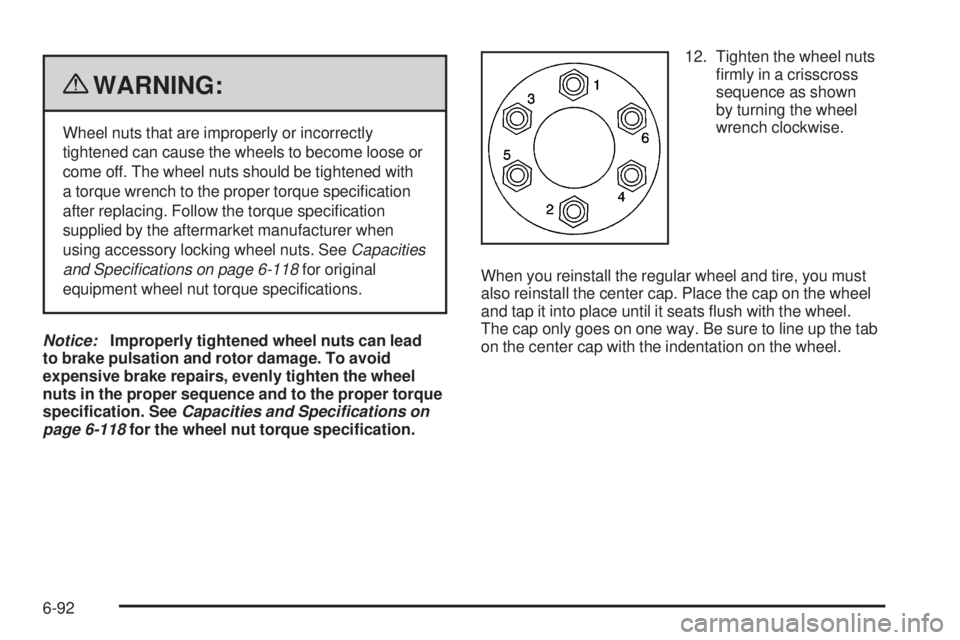
page 6-118for the wheel nut torque specication.12. Tighten the wheel nuts
firmly in a crisscross
sequence as shown
by turning the wheel
wrench clockwise.
When you reinstall the regular wheel and tire, you must
also reinstall the center cap. Place the cap on the wheel
and tap it into place until it seats flush with the wheel.
The cap only goes on one way. Be sure to line up the tab
on the center cap with the indentation on the wheel.
6-92
Page 383 of 448
Finish Care
Occasional waxing or mild polishing of the vehicle
by hand may be necessary to remove residue from
the paint finish. Approved cleaning products can
be obtained from your dealer/retailer.
If the vehicle has a basecoat/clearcoat paint finish, the
clearcoat gives more depth and gloss to the colored
basecoat. Always use waxes and polishes that are
non-abrasive and made for a basecoat/clearcoat
paint finish.
Notice:Machine compounding or aggressive
polishing on a basecoat/clearcoat paint nish
may damage it. Use only non-abrasive waxes and
polishes that are made for a basecoat/clearcoat
paint nish on the vehicle.
Foreign materials such as calcium chloride and other
salts, ice melting agents, road oil and tar, tree sap,
bird droppings, chemicals from industrial chimneys,
etc., can damage the vehicle’s finish if they remain on
painted surfaces. Wash the vehicle as soon as possible.
If necessary, use non-abrasive cleaners that are marked
safe for painted surfaces to remove foreign matter.
Exterior painted surfaces are subject to aging, weather
and chemical fallout that can take their toll over a
period of years. To help keep the paint finish looking
new, keep the vehicle garaged or covered whenever
possible.
Protecting Exterior Bright Metal Parts
Bright metal parts should be cleaned regularly to keep
their luster. Washing with water is all that is usually
needed. However, chrome polish may be used on
chrome or stainless steel trim, if necessary.
Use special care with aluminum trim. To avoid damaging
protective trim, never use auto or chrome polish, steam or
caustic soap to clean aluminum. A coating of wax, rubbed
to high polish, is recommended for all bright metal parts.
Windshield and Wiper Blades
Clean the outside of the windshield with glass cleaner.
Clean the rubber blades using a lint free cloth or paper
towel soaked with windshield washer fluid or a mild
detergent. Wash the windshield thoroughly when
cleaning the blades. Bugs, road grime, sap, and a
buildup of vehicle wash/wax treatments may cause
wiper streaking. Replace the wiper blades if they are
worn or damaged.
Wipers can be damaged by:
•Extreme dusty conditions
•Sand and salt
•Heat and sun
•Snow and ice, without proper removal
6-107
Page 404 of 448
Owner Checks and Services
Starter Switch Check
{WARNING:
When you are doing this inspection, the vehicle
could move suddenly. If the vehicle moves, you or
others could be injured.
1. Before starting this check, be sure there is enough
room around the vehicle.
2. Firmly apply both the parking brake and the regular
brake. SeeParking Brake on page 3-30.
Do not use the accelerator pedal, and be ready to
turn off the engine immediately if it starts.
3. For automatic transmission vehicles, try to start the
engine in each gear. The starter should work only
in P (Park) or N (Neutral). If the starter works in any
other position, your vehicle needs service.For manual transmission vehicles, put the shift lever
in Neutral, push the clutch pedal down halfway, and
try to start the engine. The starter should work only
when the clutch pedal is pushed down all the way to
the floor. If the starter works when the clutch pedal is
not pushed all the way down, your vehicle needs
service.Automatic Transmission Shift Lock
Control System Check
{WARNING:
When you are doing this inspection, the vehicle
could move suddenly. If the vehicle moves, you or
others could be injured.
1. Before starting this check, be sure there is enough
room around the vehicle. It should be parked on a
level surface.
2. Firmly apply the parking brake. SeeParking Brake
on page 3-30.
Be ready to apply the regular brake immediately if
the vehicle begins to move.
7-8