rke GMC CANYON 2010 Owner's Guide
[x] Cancel search | Manufacturer: GMC, Model Year: 2010, Model line: CANYON, Model: GMC CANYON 2010Pages: 448, PDF Size: 2.62 MB
Page 405 of 448
3. With the engine off, turn the ignition to ON/RUN,
but do not start the engine. Without applying the
regular brake, try to move the shift lever out
of P (Park) with normal effort. If the shift lever
moves out of P (Park), contact your dealer/retailer
for service.
Ignition Transmission Lock Check
While parked, and with the parking brake set, try to turn
the ignition to LOCK/OFF in each shift lever position.
•For automatic transmission vehicles, the ignition
should turn to LOCK/OFF only when the shift
lever is in P (Park). The ignition key should come
out only in LOCK/OFF.
•For manual transmission vehicles, the ignition
should turn to LOCK/OFF only when you press the
key release button.
On all vehicles, the ignition key should come out only in
LOCK/OFF.
Turn the steering wheel to the left and to the right.
It should only lock when turned to the right.
Contact your dealer/retailer if service is required.
Parking Brake and Automatic
Transmission P (Park) Mechanism
Check
{WARNING:
When you are doing this check, the vehicle could
begin to move. You or others could be injured and
property could be damaged. Make sure there is
room in front of the vehicle in case it begins to roll.
Be ready to apply the regular brake at once should
the vehicle begin to move.
Park on a fairly steep hill, with the vehicle facing
downhill. Keeping your foot on the regular brake, set the
parking brake.
•To check the parking brake’s holding ability: With the
engine running and the transmission in N (Neutral),
slowly remove foot pressure from the regular brake
pedal. Do this until the vehicle is held by the parking
brake only.
•To check the P (Park) mechanism’s holding ability:
With the engine running, shift to P (Park). Then
release the parking brake followed by the regular
brake.
Contact your dealer/retailer if service is required.
7-9
Page 419 of 448
GM Mobility Reimbursement
Program
This program, available to qualified applicants, can
reimburse you up to $1,000 of the cost of eligible
aftermarket adaptive equipment required for your vehicle,
such as hand controls or a wheelchair/scooter lift.
The offer is available for a very limited period of time
from the date of vehicle purchase/lease. For more
details, or to determine your vehicle’s eligibility, visit
gmmobility.com or call the GM Mobility Assistance
Center at 1-800-323-9935. Text telephone (TTY) users,
call 1-800-833-9935.
General Motors of Canada also has a Mobility Program.
Call 1-800-GM-DRIVE (463-7483) for details. TTY users
call 1-800-263-3830.
Roadside Assistance Program
For U.S. purchased vehicles, call1-800-GMC-8782
(1-800-462-8782); (Text telephone (TTY):
1-888-889-2438).
For Canadian purchased vehicles, call1-800-268-6800.
Service is available 24 hours a day, 365 days a year.
Calling for Assistance
When calling Roadside Assistance, have the following
information ready:
•Your name, home address, and home telephone
number
•Telephone number of your location
•Location of the vehicle
•Model, year, color, and license plate number of the
vehicle
•Odometer reading, Vehicle Identification Number
(VIN), and delivery date of the vehicle
•Description of the problem
8-7
Page 424 of 448
Collision Parts
Genuine GM Collision parts are new parts made with the
same materials and construction methods as the parts
with which your vehicle was originally built. Genuine GM
Collision parts are your best choice to ensure that your
vehicle’s designed appearance, durability, and safety are
preserved. The use of Genuine GM parts can help
maintain your GM New Vehicle Warranty.
Recycled original equipment parts may also be used for
repair. These parts are typically removed from vehicles
that were total losses in prior crashes. In most cases, the
parts being recycled are from undamaged sections of the
vehicle. A recycled original equipment GM part, may be
an acceptable choice to maintain your vehicle’s originally
designed appearance and safety performance, however,
the history of these parts is not known. Such parts are not
covered by your GM New Vehicle Limited Warranty, and
any related failures are not covered by that warranty.
Aftermarket collision parts are also available. These are
made by companies other than GM and may not have
been tested for your vehicle. As a result, these parts may
fit poorly, exhibit premature durability/corrosion problems,
and may not perform properly in subsequent collisions.
Aftermarket parts are not covered by your GM New
Vehicle Limited Warranty, and any vehicle failure related
to such parts are not covered by that warranty.
Repair Facility
We recommend that you choose a collision repair facility
that meets your needs before you ever need collision
repairs. Your dealer/retailer may have a collision repair
center with GM-trained technicians and state of the art
equipment, or be able to recommend a collision repair
center that has GM-trained technicians and comparable
equipment.
Insuring Your Vehicle
Protect your investment in your GM vehicle with
comprehensive and collision insurance coverage.
There are significant differences in the quality of
coverage afforded by various insurance policy terms.
Many insurance policies provide reduced protection to
your GM vehicle by limiting compensation for damage
repairs by using aftermarket collision parts. Some
insurance companies will not specify aftermarket collision
parts. When purchasing insurance, we recommend that
you assure your vehicle will be repaired with GM original
equipment collision parts. If such insurance coverage is
not available from your current insurance carrier,
consider switching to another insurance carrier.
If your vehicle is leased, the leasing company may
require you to have insurance that assures repairs with
Genuine GM Original Equipment Manufacturer (OEM)
parts or Genuine Manufacturer replacement parts. Read
your lease carefully, as you may be charged at the end of
your lease for poor quality repairs.
8-12
Page 426 of 448
Managing the Vehicle Damage Repair
Process
In the event that your vehicle requires damage repairs,
GM recommends that you take an active role in its repair.
If you have a pre-determined repair facility of choice, take
your vehicle there, or have it towed there. Specify to the
facility that any required replacement collision parts be
original equipment parts, either new Genuine GM parts or
recycled original GM parts. Remember, recycled parts
will not be covered by your GM vehicle warranty.
Insurance pays the bill for the repair, but you must live
with the repair. Depending on your policy limits, your
insurance company may initially value the repair using
aftermarket parts. Discuss this with your repair
professional, and insist on Genuine GM parts. Remember
if your vehicle is leased you may be obligated to have the
vehicle repaired with Genuine GM parts, even if your
insurance coverage does not pay the full cost.
If another party’s insurance company is paying for the
repairs, you are not obligated to accept a repair valuation
based on that insurance company’s collision policy repair
limits, as you have no contractual limits with that
company. In such cases, you can have control of the
repair and parts choices as long as cost stays within
reasonable limits.
Reporting Safety Defects
Reporting Safety Defects to the
United States Government
If you believe that your vehicle has a defect which
could cause a crash or could cause injury or death,
you should immediately inform the National
Highway Traffic Safety Administration (NHTSA) in
addition to notifying General Motors.
If NHTSA receives similar complaints, it may open
an investigation, and if it finds that a safety defect
exists in a group of vehicles, it may order a recall
and remedy campaign. However, NHTSA cannot
become involved in individual problems between
you, your dealer, or General Motors.
To contact NHTSA, you may call the Vehicle
Safety Hotline toll-free at 1-888-327-4236
(TTY: 1-800-424-9153); go to
http://www.safercar.gov; or write to:
Administrator, NHTSA
1200 New Jersey Avenue, S.E.
Washington, D.C. 20590
You can also obtain other information about motor
vehicle safety fromhttp://www.safercar.gov.
8-14
Page 439 of 448
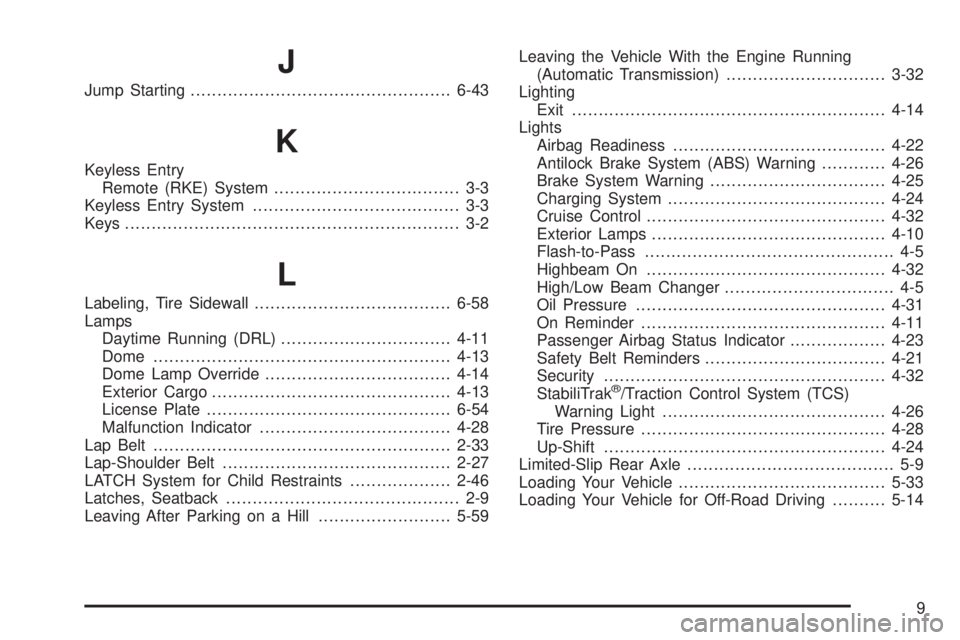
J
Jump Starting.................................................6-43
K
Keyless Entry
Remote (RKE) System................................... 3-3
Keyless Entry System....................................... 3-3
Keys............................................................... 3-2
L
Labeling, Tire Sidewall.....................................6-58
Lamps
Daytime Running (DRL)................................4-11
Dome ........................................................4-13
Dome Lamp Override...................................4-14
Exterior Cargo.............................................4-13
License Plate..............................................6-54
Malfunction Indicator....................................4-28
Lap Belt........................................................2-33
Lap-Shoulder Belt...........................................2-27
LATCH System for Child Restraints...................2-46
Latches, Seatback............................................ 2-9
Leaving After Parking on a Hill.........................5-59Leaving the Vehicle With the Engine Running
(Automatic Transmission)..............................3-32
Lighting
Exit...........................................................4-14
Lights
Airbag Readiness........................................4-22
Antilock Brake System (ABS) Warning............4-26
Brake System Warning.................................4-25
Charging System.........................................4-24
Cruise Control.............................................4-32
Exterior Lamps............................................4-10
Flash-to-Pass............................................... 4-5
Highbeam On.............................................4-32
High/Low Beam Changer................................ 4-5
Oil Pressure...............................................4-31
On Reminder..............................................4-11
Passenger Airbag Status Indicator..................4-23
Safety Belt Reminders..................................4-21
Security.....................................................4-32
StabiliTrak
®/Traction Control System (TCS)
Warning Light..........................................4-26
Tire Pressure..............................................4-28
Up-Shift.....................................................4-24
Limited-Slip Rear Axle....................................... 5-9
Loading Your Vehicle.......................................5-33
Loading Your Vehicle for Off-Road Driving..........5-14
9
Page 443 of 448
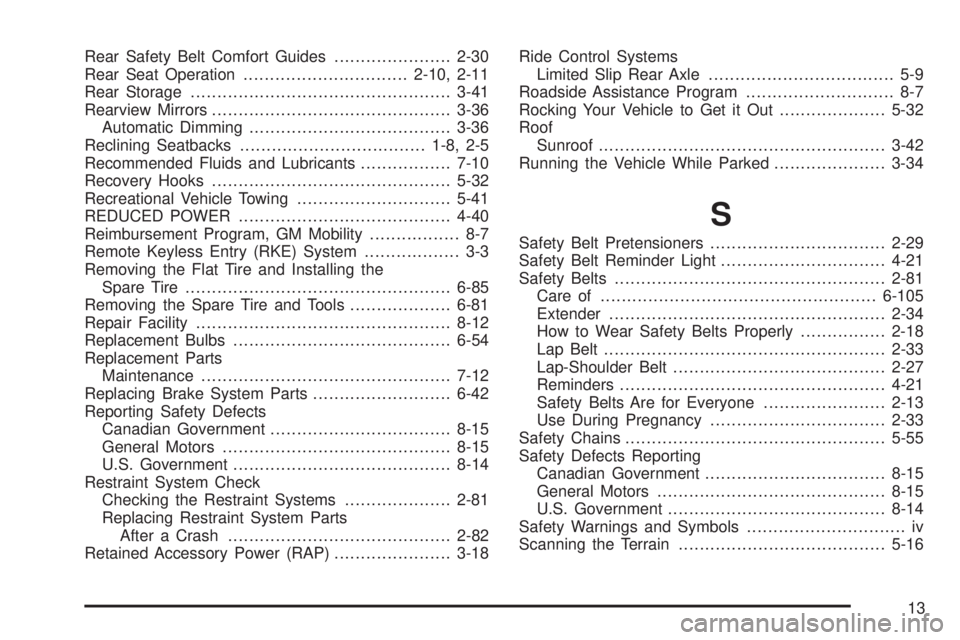
Rear Safety Belt Comfort Guides......................2-30
Rear Seat Operation...............................2-10, 2-11
Rear Storage.................................................3-41
Rearview Mirrors.............................................3-36
Automatic Dimming......................................3-36
Reclining Seatbacks...................................1-8, 2-5
Recommended Fluids and Lubricants.................7-10
Recovery Hooks.............................................5-32
Recreational Vehicle Towing.............................5-41
REDUCED POWER........................................4-40
Reimbursement Program, GM Mobility................. 8-7
Remote Keyless Entry (RKE) System.................. 3-3
Removing the Flat Tire and Installing the
Spare Tire..................................................6-85
Removing the Spare Tire and Tools...................6-81
Repair Facility................................................8-12
Replacement Bulbs.........................................6-54
Replacement Parts
Maintenance...............................................7-12
Replacing Brake System Parts..........................6-42
Reporting Safety Defects
Canadian Government..................................8-15
General Motors...........................................8-15
U.S. Government.........................................8-14
Restraint System Check
Checking the Restraint Systems....................2-81
Replacing Restraint System Parts
After a Crash..........................................2-82
Retained Accessory Power (RAP)......................3-18Ride Control Systems
Limited Slip Rear Axle................................... 5-9
Roadside Assistance Program............................ 8-7
Rocking Your Vehicle to Get it Out....................5-32
Roof
Sunroof......................................................3-42
Running the Vehicle While Parked.....................3-34
S
Safety Belt Pretensioners.................................2-29
Safety Belt Reminder Light...............................4-21
Safety Belts...................................................2-81
Care of ....................................................6-105
Extender....................................................2-34
How to Wear Safety Belts Properly................2-18
Lap Belt.....................................................2-33
Lap-Shoulder Belt........................................2-27
Reminders..................................................4-21
Safety Belts Are for Everyone.......................2-13
Use During Pregnancy.................................2-33
Safety Chains.................................................5-55
Safety Defects Reporting
Canadian Government..................................8-15
General Motors...........................................8-15
U.S. Government.........................................8-14
Safety Warnings and Symbols.............................. iv
Scanning the Terrain.......................................5-16
13
Page 447 of 448
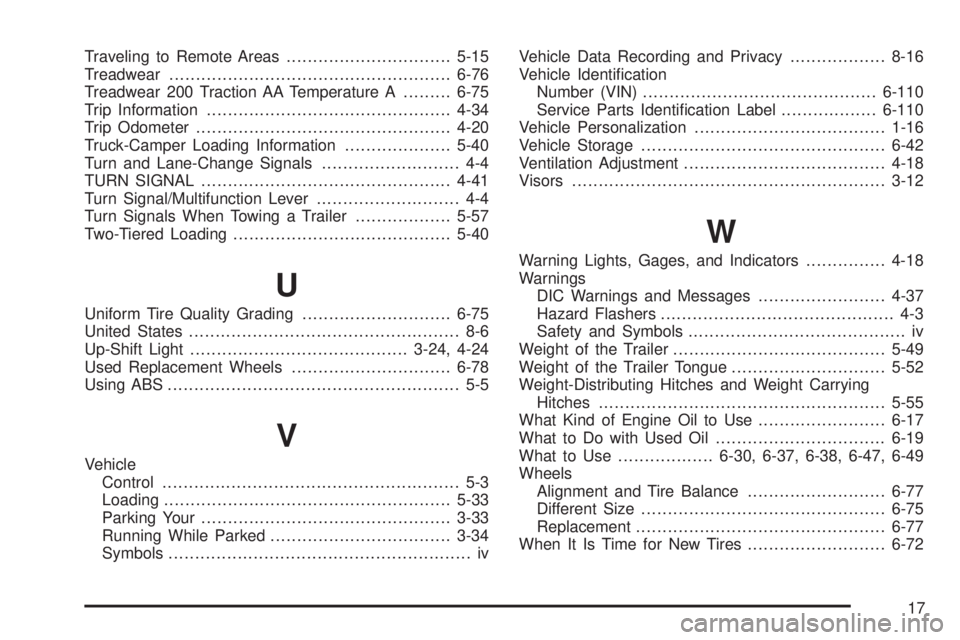
Traveling to Remote Areas...............................5-15
Treadwear.....................................................6-76
Treadwear 200 Traction AA Temperature A.........6-75
Trip Information..............................................4-34
Trip Odometer................................................4-20
Truck-Camper Loading Information....................5-40
Turn and Lane-Change Signals.......................... 4-4
TURN SIGNAL ...............................................4-41
Turn Signal/Multifunction Lever........................... 4-4
Turn Signals When Towing a Trailer..................5-57
Two-Tiered Loading.........................................5-40
U
Uniform Tire Quality Grading............................6-75
United States................................................... 8-6
Up-Shift Light.........................................3-24, 4-24
Used Replacement Wheels..............................6-78
Using ABS....................................................... 5-5
V
Vehicle
Control........................................................ 5-3
Loading......................................................5-33
Parking Your...............................................3-33
Running While Parked..................................3-34
Symbols......................................................... ivVehicle Data Recording and Privacy..................8-16
Vehicle Identification
Number (VIN)............................................6-110
Service Parts Identification Label..................6-110
Vehicle Personalization....................................1-16
Vehicle Storage..............................................6-42
Ventilation Adjustment......................................4-18
Visors...........................................................3-12
W
Warning Lights, Gages, and Indicators...............4-18
Warnings
DIC Warnings and Messages........................4-37
Hazard Flashers............................................ 4-3
Safety and Symbols......................................... iv
Weight of the Trailer........................................5-49
Weight of the Trailer Tongue.............................5-52
Weight-Distributing Hitches and Weight Carrying
Hitches......................................................5-55
What Kind of Engine Oil to Use........................6-17
What to Do with Used Oil ................................6-19
What to Use ..................6-30, 6-37, 6-38, 6-47, 6-49
Wheels
Alignment and Tire Balance..........................6-77
Different Size..............................................6-75
Replacement...............................................6-77
When It Is Time for New Tires..........................6-72
17