ecu GMC CANYON 2010 Repair Manual
[x] Cancel search | Manufacturer: GMC, Model Year: 2010, Model line: CANYON, Model: GMC CANYON 2010Pages: 448, PDF Size: 2.62 MB
Page 355 of 448
Notice:If your vehicle has a tire size other than
P215/70R16, P235/75R16, P265/70R17, or P235/50R18
use tire chains only where legal and only when
you must. Use chains that are the proper size for
your tires. Install them on the tires of the rear axle.
Do not use chains on the tires of the front axle.
Tighten them as tightly as possible with the ends
securely fastened. Drive slowly and follow the chain
manufacturer’s instructions. If you can hear the
chains contacting your vehicle, stop and retighten
them. If the contact continues, slow down until it
stops. Driving too fast or spinning the wheels with
chains on will damage your vehicle.
If a Tire Goes Flat
It is unusual for a tire to blowout while you are driving,
especially if you maintain your vehicle’s tires properly.
If air goes out of a tire, it is much more likely to leak out
slowly. But if you should ever have a blowout, here
are a few tips about what to expect and what to do:
If a front tire fails, the flat tire creates a drag that pulls
the vehicle toward that side. Take your foot off the
accelerator pedal and grip the steering wheel firmly.
Steer to maintain lane position, and then gently brake
to a stop well out of the traffic lane.A rear blowout, particularly on a curve, acts much like a
skid and may require the same correction you would use
in a skid. In any rear blowout remove your foot from the
accelerator pedal. Get the vehicle under control by
steering the way you want the vehicle to go. It may be
very bumpy and noisy, but you can still steer. Gently
brake to a stop, well off the road if possible.
{WARNING:
Lifting a vehicle and getting under it to do
maintenance or repairs is dangerous without the
appropriate safety equipment and training. If a jack
is provided with the vehicle, it is designed only for
changing a flat tire. If it is used for anything else,
you or others could be badly injured or killed if the
vehicle slips off the jack. If a jack is provided with
the vehicle, only use it for changing a flat tire.
If a tire goes flat, the next part shows how to use the
jacking equipment to change a flat tire safely.
6-79
Page 365 of 448
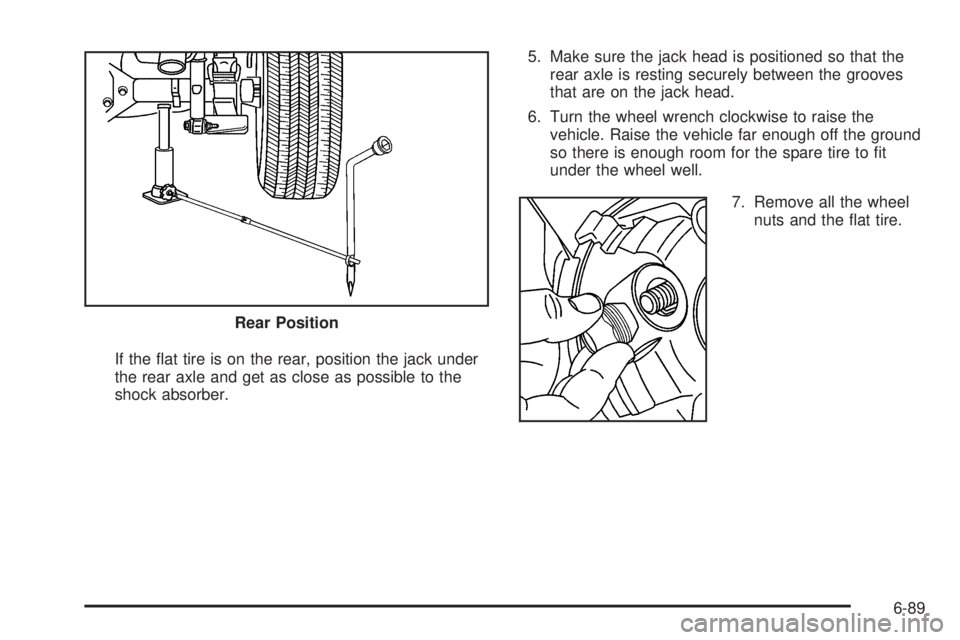
If the flat tire is on the rear, position the jack under
the rear axle and get as close as possible to the
shock absorber.5. Make sure the jack head is positioned so that the
rear axle is resting securely between the grooves
that are on the jack head.
6. Turn the wheel wrench clockwise to raise the
vehicle. Raise the vehicle far enough off the ground
so there is enough room for the spare tire to fit
under the wheel well.
7. Remove all the wheel
nuts and the flat tire.
Rear Position
6-89
Page 370 of 448
3. Loosen the cable by turning the wheel wrench
counterclockwise three or four turns.
4. Repeat this procedure at least two times. If the
spare tire lowers to the ground, continue with
Step 5 underRemoving the Spare Tire and Tools
on page 6-81.
5. Turn the wrench counterclockwise until
approximately 6 inches (15 cm) of cable is
exposed.
6. Stand the wheel blocks on their shortest ends,
with the backs facing each other.
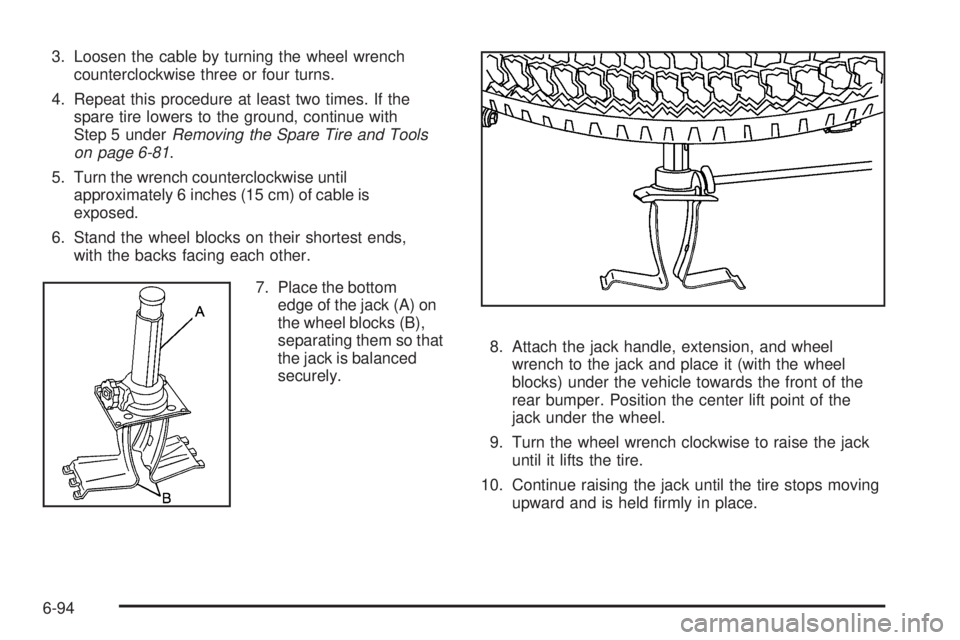
7. Place the bottom
edge of the jack (A) on
the wheel blocks (B),
separating them so that
the jack is balanced
securely.8. Attach the jack handle, extension, and wheel
wrench to the jack and place it (with the wheel
blocks) under the vehicle towards the front of the
rear bumper. Position the center lift point of the
jack under the wheel.
9. Turn the wheel wrench clockwise to raise the jack
until it lifts the tire.
10. Continue raising the jack until the tire stops moving
upward and is held firmly in place.
6-94
Page 375 of 448
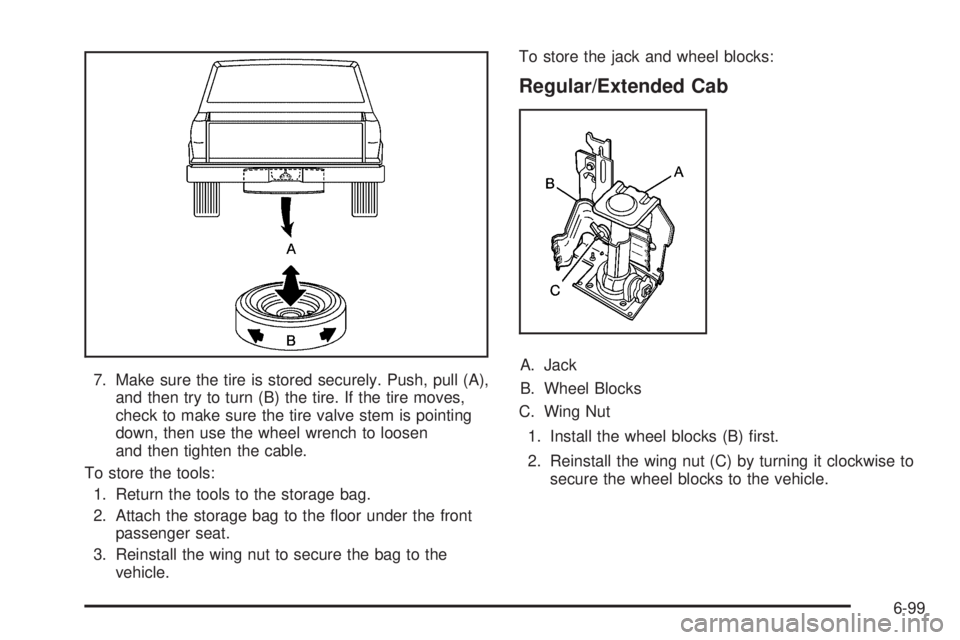
7. Make sure the tire is stored securely. Push, pull (A),
and then try to turn (B) the tire. If the tire moves,
check to make sure the tire valve stem is pointing
down, then use the wheel wrench to loosen
and then tighten the cable.
To store the tools:
1. Return the tools to the storage bag.
2. Attach the storage bag to the floor under the front
passenger seat.
3. Reinstall the wing nut to secure the bag to the
vehicle.To store the jack and wheel blocks:
Regular/Extended Cab
A. Jack
B. Wheel Blocks
C. Wing Nut
1. Install the wheel blocks (B) first.
2. Reinstall the wing nut (C) by turning it clockwise to
secure the wheel blocks to the vehicle.
6-99
Page 376 of 448
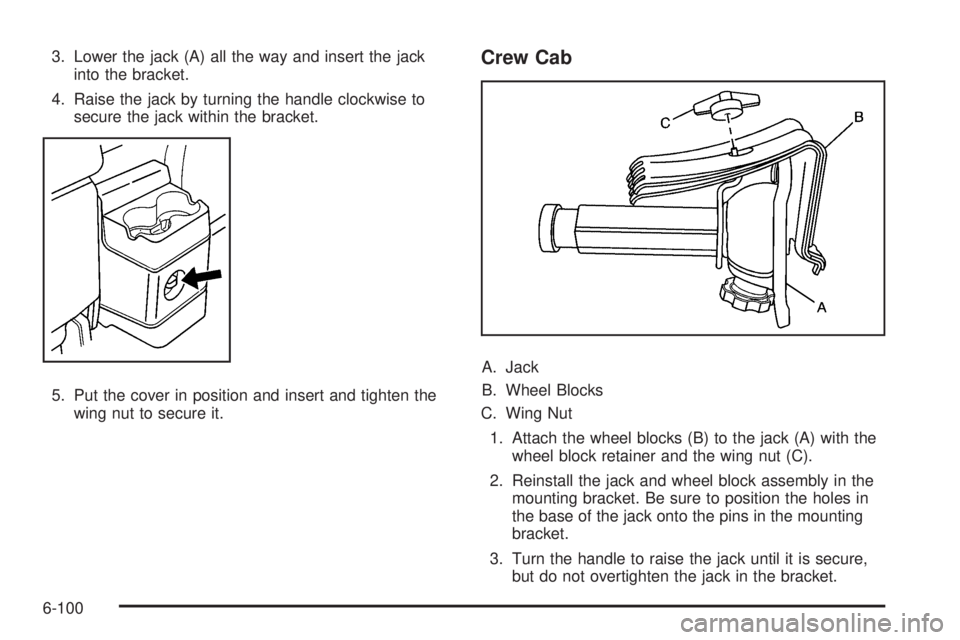
3. Lower the jack (A) all the way and insert the jack
into the bracket.
4. Raise the jack by turning the handle clockwise to
secure the jack within the bracket.
5. Put the cover in position and insert and tighten the
wing nut to secure it.Crew Cab
A. Jack
B. Wheel Blocks
C. Wing Nut
1. Attach the wheel blocks (B) to the jack (A) with the
wheel block retainer and the wing nut (C).
2. Reinstall the jack and wheel block assembly in the
mounting bracket. Be sure to position the holes in
the base of the jack onto the pins in the mounting
bracket.
3. Turn the handle to raise the jack until it is secure,
but do not overtighten the jack in the bracket.
6-100
Page 420 of 448
Coverage
Services are provided up to 5 years/100,000 miles
(160 000 km), whichever comes first.
In the U.S., anyone driving the vehicle is covered.
In Canada, a person driving the vehicle without
permission from the owner is not covered.
Roadside Assistance is not a part of the New Vehicle
Limited Warranty. GMC and General Motors of Canada
Limited reserve the right to make any changes or
discontinue the Roadside Assistance program at any
time without notification.
GMC and General Motors of Canada Limited reserve
the right to limit services or payment to an owner
or driver if they decide the claims are made too often,
or the same type of claim is made many times.
Services Provided
•Emergency Fuel Delivery:Delivery of enough fuel
for the vehicle to get to the nearest service station.
•Lock-Out Service:Service is provided to unlock the
vehicle if you are locked out. A remote unlock may
be available if you have OnStar
®. For security
reasons, the driver must present identification
before this service is given.
•Emergency Tow From a Public Road or
Highway:Tow to the nearest GMC dealer for
warranty service, or if the vehicle was in a crash
and cannot be driven. Assistance is also given when
the vehicle is stuck in the sand, mud, or snow.
•Flat Tire Change:Service is provided to change a
flat tire with the spare tire. The spare tire, if equipped,
must be in good condition and properly inflated.
It is the owner’s responsibility for the repair or
replacement of the tire if it is not covered by the
warranty.
•Battery Jump Start:Service is provided to jump
start a dead battery.
•Trip Routing Service:Detailed maps of North
America are provided when requested either with
the most direct route or the most scenic route.
Additional travel information is also available.
Allow three weeks for delivery.
•Trip Interruption Benets and Assistance:If your
trip is interrupted due to a warranty failure, incidental
expenses may be reimbursed during the 5 years/
100,000 miles (160 000 km) Powertrain warranty
period. Items considered are hotel, meals, and
rental car.
8-8
Page 430 of 448
OnStar®
If the vehicle has OnStar and you subscribe to the
OnStar services, please refer to the OnStar Terms and
Conditions for information on data collection and use.
Radio Frequency
Identication (RFID)
RFID technology is used in some vehicles for functions
such as tire pressure monitoring and ignition system
security, as well as in connection with conveniences
such as key fobs for remote door locking/unlocking and
starting, and in-vehicle transmitters for garage door
openers. RFID technology in GM vehicles does not use
or record personal information or link with any other
GM system containing personal information.
Radio Frequency Statement
This vehicle has systems that operate on a radio
frequency that comply with Part 15 of the Federal
Communications Commission (FCC) Rules and with
RSS-210/211 of Industry and Science Canada.
Operation is subject to the following two conditions:
1. The device may not cause interference.
2. The device must accept any interference received,
including interference that may cause undesired
operation of the device.
Changes or modifications to any of these systems by
other than an authorized service facility could void
authorization to use this equipment.
8-18
Page 433 of 448
Bulb Replacement (cont.)
Halogen Bulbs............................................6-50
Headlamp Aiming........................................6-50
Headlamps.........................................6-50, 6-51
License Plate Lamps....................................6-54
Taillamps, Turn Signal, Stoplamps and
Back-up Lamps........................................6-53
Buying New Tires...........................................6-73
C
Calibration.....................................................3-37
California
Perchlorate Materials Requirements................. 6-4
Warning....................................................... 6-4
California Fuel.................................................. 6-6
Calling for Assistance........................................ 8-7
Canada........................................................... 8-6
Canadian Owners............................................... iii
Canadian Owners (Propriétaires Canadiens)........... iii
Capacities and Specifications..........................6-118
Carbon Monoxide
Engine Exhaust...........................................3-34
Tailgate........................................................ 3-8
Winter Driving.............................................5-29
Care of
Safety Belts..............................................6-105
CD Messages................................................4-55
CD, MP3 .......................................................4-56Cellular Phone Usage......................................4-62
Center Console Storage...................................3-40
Center High-Mounted Stoplamp (CHMSL)...........6-52
Certification/Tire Label.....................................5-38
Chains, Tire...................................................6-78
CHANGE OIL .................................................4-38
Charging System Light....................................4-24
Check
Engine Lamp..............................................4-28
Check Engine Light.........................................4-28
Checking Brake Fluid......................................6-40
Checking Coolant............................................6-31
Checking Engine Oil........................................6-15
Checking Things Under the Hood......................6-10
Chemical Paint Spotting.................................6-109
Child Restraints
Infants and Young Children...........................2-38
Lower Anchors and Tethers for Children..........2-46
Older Children.............................................2-35
Securing a Child Restraint in a
Rear Seat Position...................................2-58
Securing a Child Restraint in the
Center Front Seat Position........................2-60
Securing a Child Restraint in the
Right Front Seat Position
..........................2-60
Systems.....................................................2-42
Where to Put the Restraint...........................2-44
Chime Level Adjustment..................................4-63
Cigarette Lighter.............................................4-16
3
Page 435 of 448
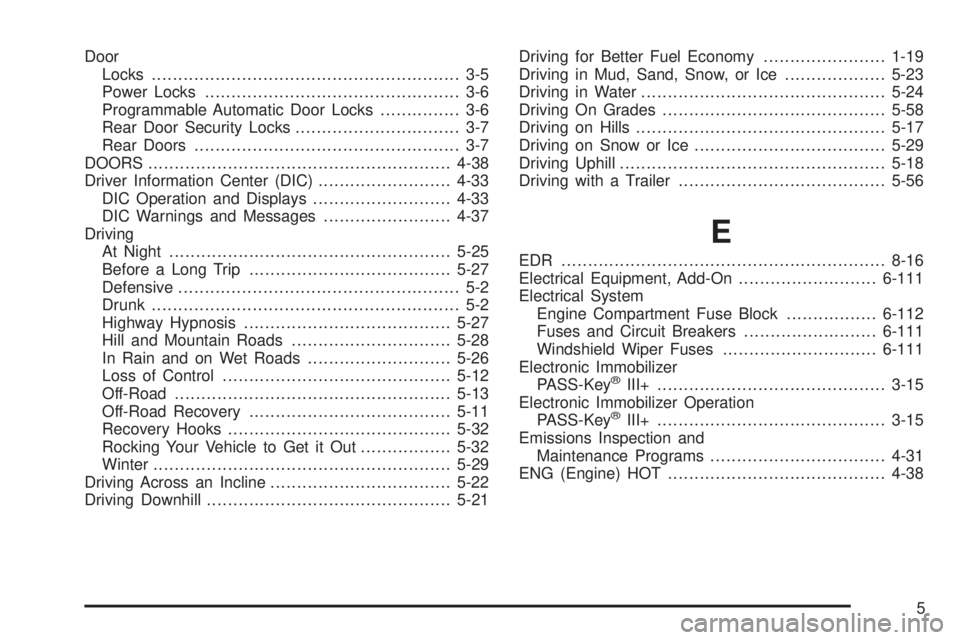
Door
Locks.......................................................... 3-5
Power Locks................................................ 3-6
Programmable Automatic Door Locks............... 3-6
Rear Door Security Locks............................... 3-7
Rear Doors.................................................. 3-7
DOORS.........................................................4-38
Driver Information Center (DIC).........................4-33
DIC Operation and Displays..........................4-33
DIC Warnings and Messages........................4-37
Driving
At Night.....................................................5-25
Before a Long Trip......................................5-27
Defensive..................................................... 5-2
Drunk.......................................................... 5-2
Highway Hypnosis.......................................5-27
Hill and Mountain Roads..............................5-28
In Rain and on Wet Roads...........................5-26
Loss of Control...........................................5-12
Off-Road ....................................................5-13
Off-Road Recovery......................................5-11
Recovery Hooks..........................................5-32
Rocking Your Vehicle to Get it Out.................5-32
Winter........................................................5-29
Driving Across an Incline..................................5-22
Driving Downhill..............................................5-21Driving for Better Fuel Economy.......................1-19
Driving in Mud, Sand, Snow, or Ice...................5-23
Driving in Water..............................................5-24
Driving On Grades..........................................5-58
Driving on Hills...............................................5-17
Driving on Snow or Ice....................................5-29
Driving Uphill..................................................5-18
Driving with a Trailer.......................................5-56
E
EDR .............................................................8-16
Electrical Equipment, Add-On..........................6-111
Electrical System
Engine Compartment Fuse Block.................6-112
Fuses and Circuit Breakers.........................6-111
Windshield Wiper Fuses.............................6-111
Electronic Immobilizer
PASS-Key
®III+...........................................3-15
Electronic Immobilizer Operation
PASS-Key
®III+...........................................3-15
Emissions Inspection and
Maintenance Programs.................................4-31
ENG (Engine) HOT.........................................4-38
5
Page 439 of 448
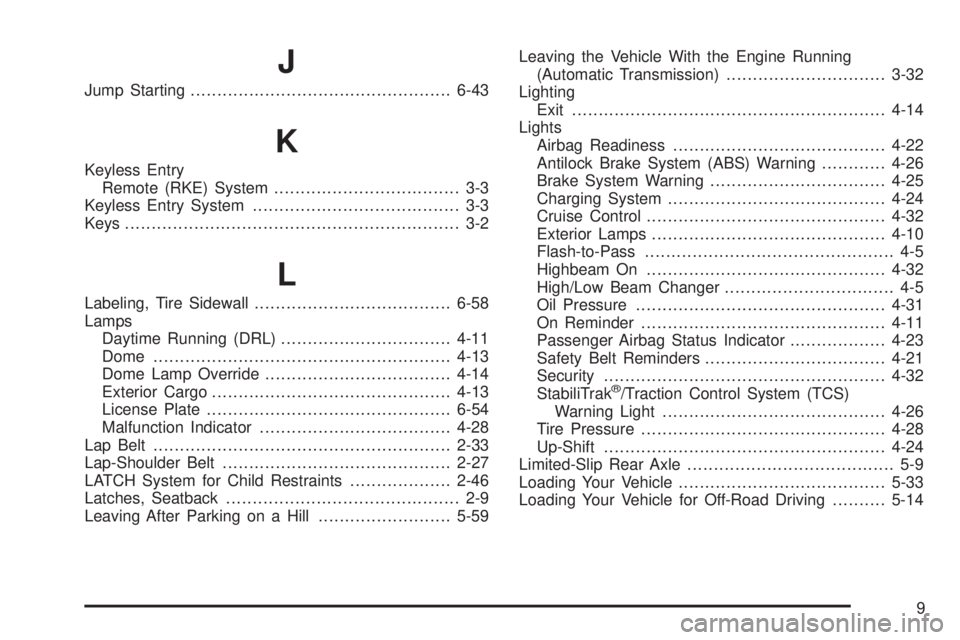
J
Jump Starting.................................................6-43
K
Keyless Entry
Remote (RKE) System................................... 3-3
Keyless Entry System....................................... 3-3
Keys............................................................... 3-2
L
Labeling, Tire Sidewall.....................................6-58
Lamps
Daytime Running (DRL)................................4-11
Dome ........................................................4-13
Dome Lamp Override...................................4-14
Exterior Cargo.............................................4-13
License Plate..............................................6-54
Malfunction Indicator....................................4-28
Lap Belt........................................................2-33
Lap-Shoulder Belt...........................................2-27
LATCH System for Child Restraints...................2-46
Latches, Seatback............................................ 2-9
Leaving After Parking on a Hill.........................5-59Leaving the Vehicle With the Engine Running
(Automatic Transmission)..............................3-32
Lighting
Exit...........................................................4-14
Lights
Airbag Readiness........................................4-22
Antilock Brake System (ABS) Warning............4-26
Brake System Warning.................................4-25
Charging System.........................................4-24
Cruise Control.............................................4-32
Exterior Lamps............................................4-10
Flash-to-Pass............................................... 4-5
Highbeam On.............................................4-32
High/Low Beam Changer................................ 4-5
Oil Pressure...............................................4-31
On Reminder..............................................4-11
Passenger Airbag Status Indicator..................4-23
Safety Belt Reminders..................................4-21
Security.....................................................4-32
StabiliTrak
®/Traction Control System (TCS)
Warning Light..........................................4-26
Tire Pressure..............................................4-28
Up-Shift.....................................................4-24
Limited-Slip Rear Axle....................................... 5-9
Loading Your Vehicle.......................................5-33
Loading Your Vehicle for Off-Road Driving..........5-14
9