child seat GMC ENVOY 1998 Owners Manual
[x] Cancel search | Manufacturer: GMC, Model Year: 1998, Model line: ENVOY, Model: GMC ENVOY 1998Pages: 386, PDF Size: 20.33 MB
Page 8 of 386
Section 1 Seats and Restraint Systems
Here you’ll find information about the seats in your vehicle and how to use your safety belts properly. You can also
learn about some things you should nut do with air bags and safety belts.
1-2
1-7
1-11
1-12
1-12
1-19
1-20 1-20
1-28 Seats
and Seat Controls
Safety Belts: They’re for Everyone
Here Are Questions
Many People Ask About
Safety Belts
-- and the Answers
How to Wear Safety Belts Properly
Driver Position
Safety Belt Use During Pregnancy
Right Front Passenger Position
Supplemental Inflatable Restraint
(SIR) System
Rear Seat Passengers 1-3
1
1-34
1-35
1-38
1-49
1-52 1-52
1-53
Rear Safety Belt Comfort Guides for Children
and Small Adults
Center Rear Passenger Position
Children Child Restraints
Larger Children
Safety Belt Extender
Checking Your Restraint Systems
Replacing Restraint System Parts After
a Crash
1-1
ProCarManuals.com
Page 38 of 386
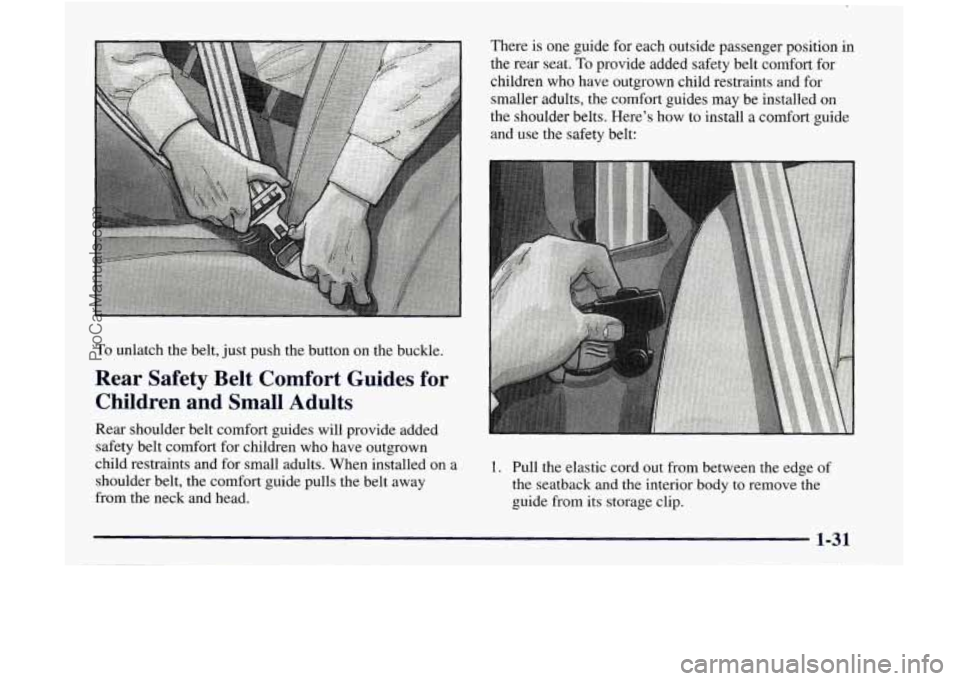
To unlatch the belt, just push the button on the buckle.
Rear Safety Belt Comfort Guides for
Children and Small Adults
Rear shoulder belt comfort guides will provide added
safety belt comfort for children who have outgrown
child restraints and for small adults. When installed on a
shoulder belt, the comfort guide pulls the belt away
from the neck and head. There is one guide for each outside passenger position in
the rear seat.
To provide added safety belt comfort for
children who have outgrown child restraints and for smaller adults, the comfort guides may be installed
on
the shoulder belts. Here’s how to install a comfort guide
and use the safety belt:
1. Pull the elastic cord out from between the edge of
the seatback and the interior body to remove the
guide from its storage clip.
1-31
I
ProCarManuals.com
Page 47 of 386
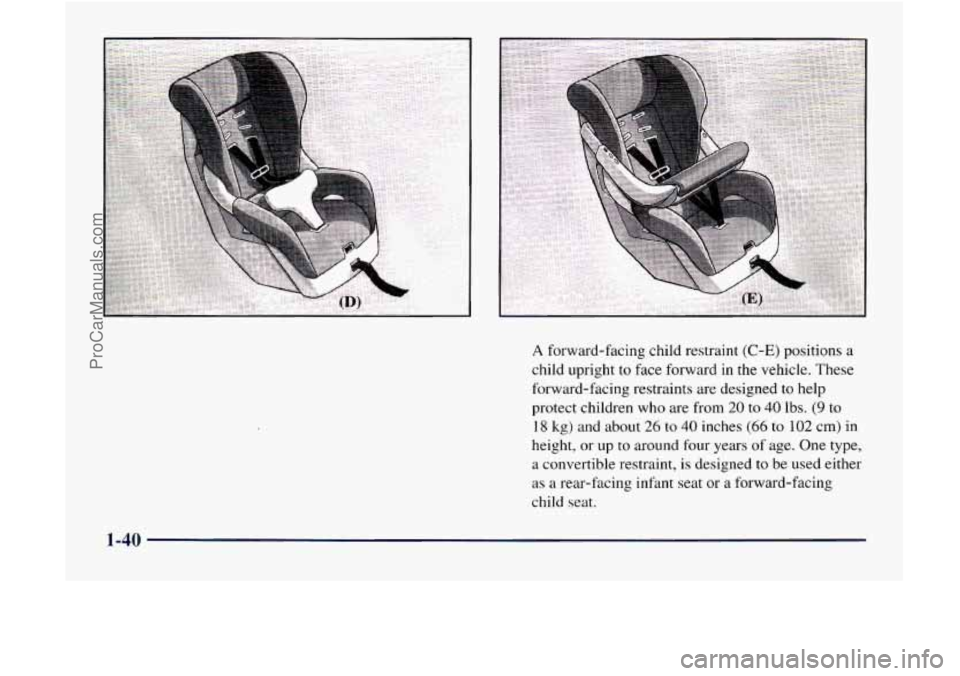
A forward-facing child restraint (C-E) positions a
child upright to face forward in the vehicle. These
forward-facing restraints are designed to help
protect children
who are from 20 to 40 lbs. (9 to
18 kg) and about 26 to 40 inches (66 to 102 cm) in
height, or up to around four years of age. One type,
a convertible restraint, is designed to be used either
as a rear-facing infant seat or a forward-facing
child seat.
1-40
ProCarManuals.com
Page 48 of 386
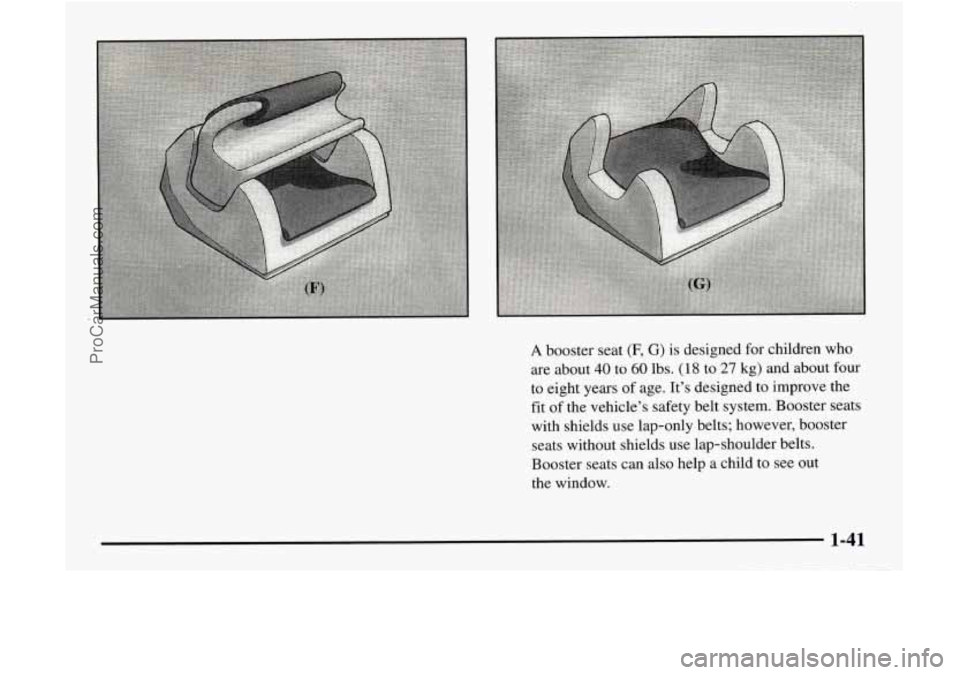
A booster seat (F, G) is designed for children who
are about
40 to 60 lbs. (1 8 to 27 kg) and about four
to eight years of age. It’s designed to improve the
fit of the vehicle’s safety belt system. Booster seats
with shields use lap-only belts; however, booster
seats without shields use lap-shoulder belts.
Booster seats can also help a child to see out the window.
1-41
ProCarManuals.com
Page 49 of 386
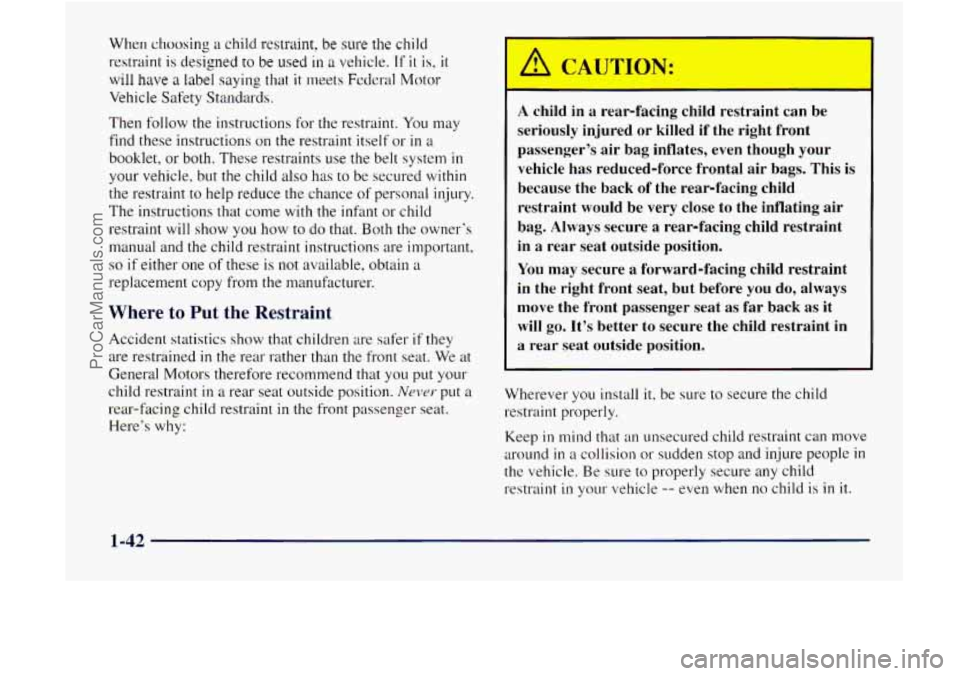
When choosing a child restraint, be sure the child
restraint
is desigmd to be used in a vehicle. If it is, it
will have a label saying that it meets Federal Motor
Vehicle Safety Standards.
Then follow the instructions for the restraint. You may
find these instructions
on the restraint itself or in a
booklet,
or both. These restraints use the belt system in
your vehicle, but the child also has to be secured within
the restraint to help reduce the chance of personal injury.
The instructions that come with the
infant or child
restraint
will show you how to do that. Both the owner’s
manual and
the child restraint instructions are important,
so if either one of these is not available, obtain a
replacement copy from the manufacturer.
Where to Put the Restraint
Accident statistics show that children are safer if they
are restrained
in the rear rather than the front seat. We at
General Motors therefore recommend that you put your
child restraint
in a rear seat outside position. N~wr put a
rear-facing child restraint in the front passenger seat.
Here’s
why:
A child in a rear-facing child restraint can be
seriously injured or killed if the right front
passenger’s air bag inflates, even though your
vehicle has reduced-force frontal air bags. This
i
because the back of the rear-facing child
restraint would be very close to the inflating air
bag. Always secure a rear-facing child restraint
in a rear seat outside position.
You may secure a forward-facing child restraint
in the right front seat, but before you do, always
move the front passenger seat as far back as it
will go. It’s better to secure the child restraint in
a rear seat outside position.
Wherever you install it. be sure to secure the child
restraint properly.
Keep
in mind that a11 unsecured child restraint can move
around
in a collision or sudden stop and injure people in
the vehicle. Be sure to properly secure any child
restraint
in your vehicle -- even when no child is in it.
1-42
ProCarManuals.com
Page 50 of 386
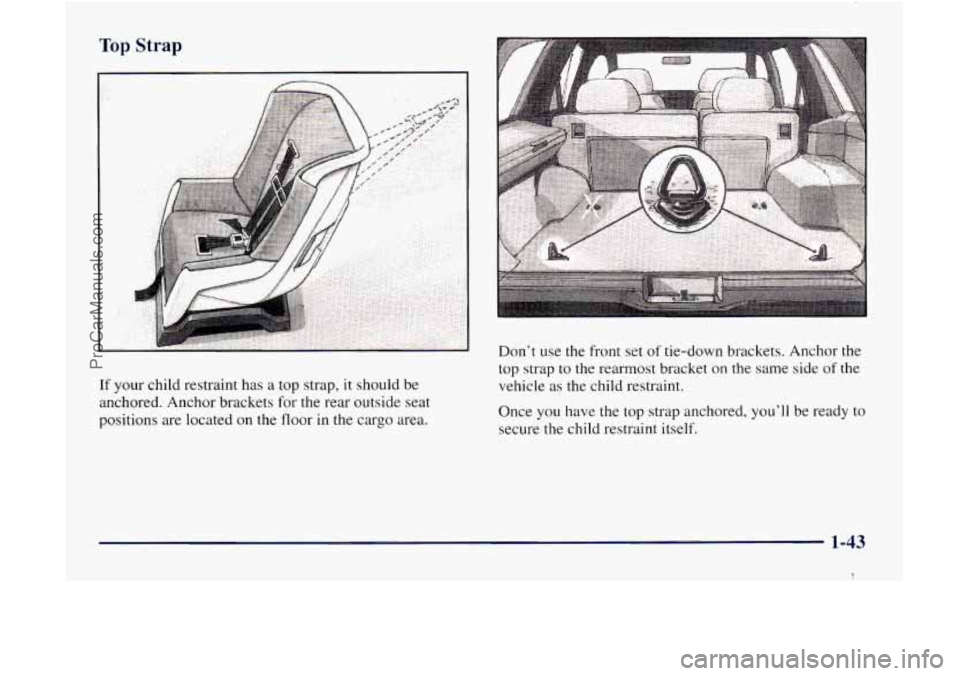
If your child restraint has a top strap, it should be
anchored. Anchor brackets
for the rear outside seat
positions are located
on the floor in the cargo area. Don’t
use the front set of tie-down brackets. Anchor the
top strap to the rearmost bracket
on the same side of the
vehicle as the child restraint.
Once
you have the top strap anchored, you’ll be ready to
secure the child restraint itself.
1-43
ProCarManuals.com
Page 51 of 386
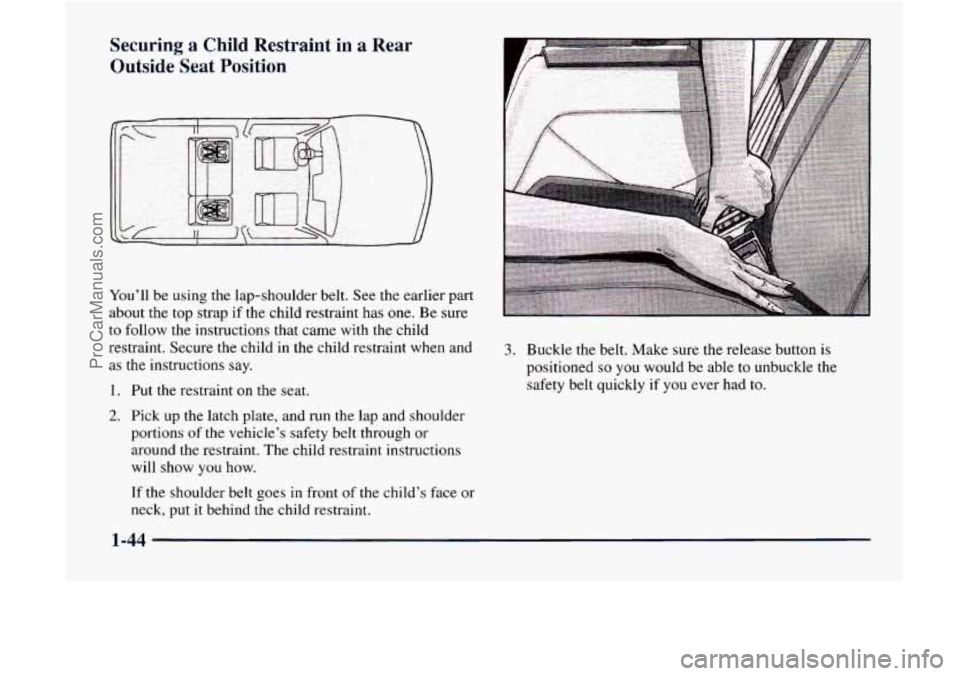
Securing a Child Restraint in a Rear
Outside Seat Position
You’ll be using the lap-shoulder belt. See the earlier part
about the top strap if the child restraint has one. Be sure
to follow the instructions that came with
the child
restraint. Secure the child
in the child restraint when and
as the instructions
say.
1. Put the restraint on the seat.
2. Pick up the latch plate, and run the lap and shoulder
portions of the vehicle’s safety belt through or
around the restraint. The child restraint instructions
will show you how.
If the shoulder belt goes in front of the child’s face or
neck, put
it behind the child restraint.
3. Buckle the belt. Make sure the release button is
positioned
so you would be able to unbuckle the
safety belt quickly if you ever had to.
1-44
ProCarManuals.com
Page 53 of 386
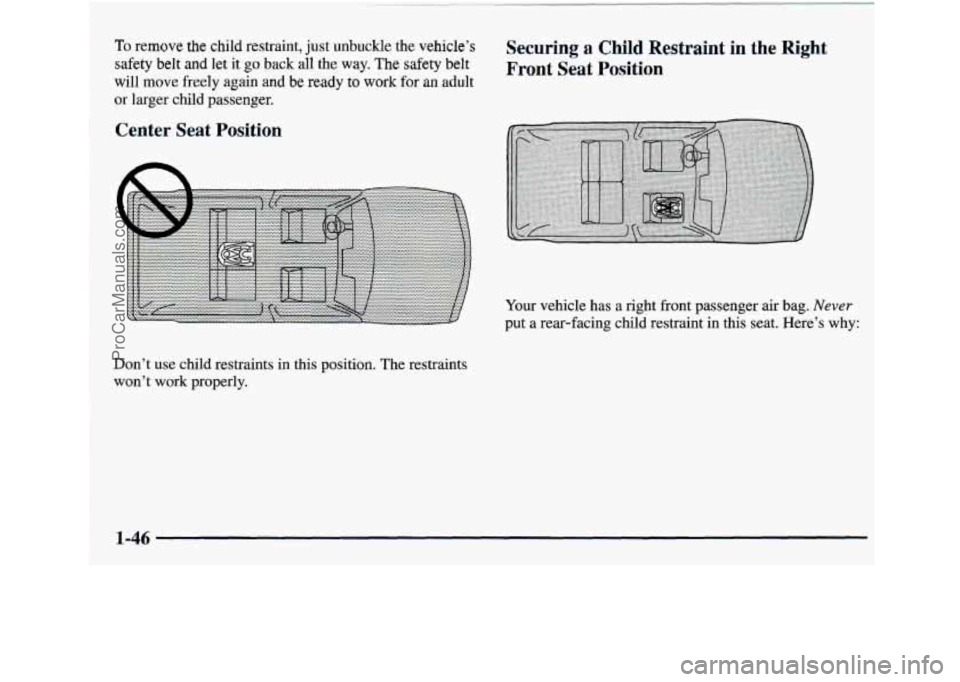
To remove the child restraint, just unbuckle the vehicle’s Securing a Child Restraint in the Right
safety belt and let it go back all the way. The safety belt Front Seat, Position
will move freely again and be ready to work for an adult
or larger child passenger.
Center Seat Position
Don’t use child restraints in this position. The restraints
won’t work properly. Your
vehicle has
a right front passenger air bag. Never
put a rear-facing child restraint in this seat. Here’s why:
1-46
rn
ProCarManuals.com
Page 54 of 386
A CAULON:
A child in a rear-facing child restraint can be
seriously injured or killed
if the right front
passenger’s air bag inflates, even though your
vehicle has reduced-force frontal air bags. This
is
because the back of the rear-facing child
restraint would be very close to the inflating air
bag. Always secure a rear-facing child restraint
in the rear seat.
You’ll be using the lap-shoulder belt. See the earlier part
about the top strap if the child restraint has one. Be sure
to follow the instructions that came with the child
restraint. Secure
the child in the child restraint when and
as the instructions say.
1.
2.
3.
Because your vehicle has a right front passenger air
bag, always move the seat as far back as it will
go
before securing a forward-facing child restraint. (See
“Seats” in the Index.)
Put the restraint on the seat.
Pick up the latch plate,
and run the lap and shoulder
portions
of the vehicle’s safety belt through or
around the restraint. The child restraint instructions
will show you how.
If the shoulder belt goes in front of the child’s face or
neck, put it behind the child restraint.
1-47
I
ProCarManuals.com
Page 57 of 386
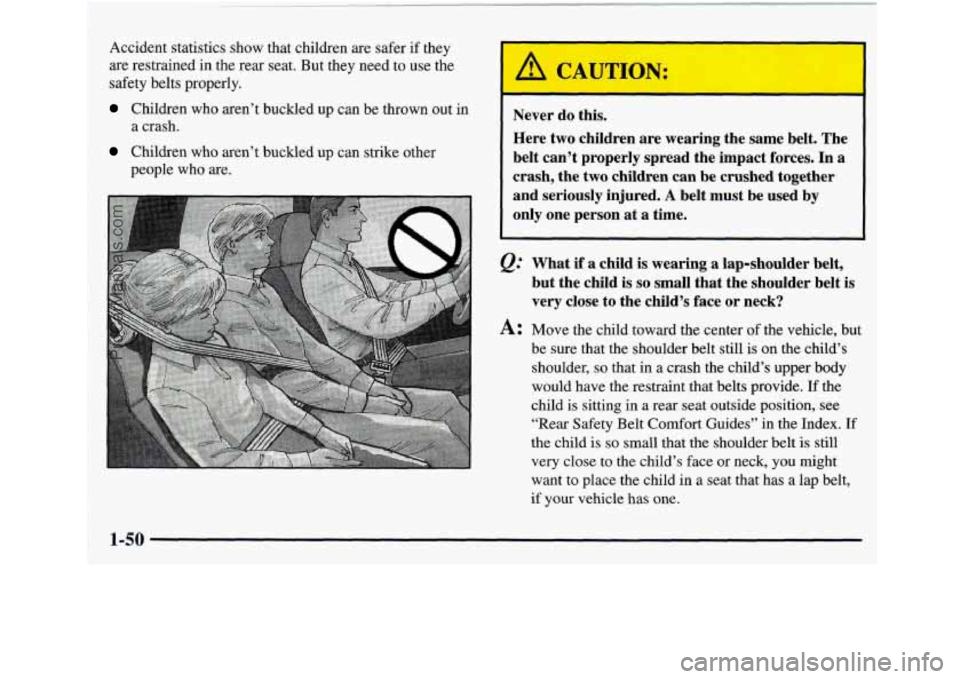
Accident statistics show that children are safer if they
are restrained in the rear seat. But they need
to use the
safety belts properly.
Children who aren’t buckled up can be thrown out in
a crash.
Children who aren’t buckled up can strike other
people who
are.
Never do this.
Here two children are wearing the same belt. The
belt can’t properly spread the impact forces.
In a
crash, the two children can be crushed together
and seriously injured.
A belt must be used by
only one person at a time.
What if
a child is wearing a lap-shoulder belt,
but the child is
so small that the shoulder belt is
very close to the child’s face or neck?
A: Move the child toward the center of the vehicle, but
be sure that the shoulder belt still is on the child’s
shoulder,
so that in a crash the child’s upper body
would have the restraint that belts provide. If the
child is sitting in a rear seat outside position, see
“Rear Safety Belt Comfort Guides’’ in the Index.
If
the child is so small that the shoulder belt is still
very close
to the child’s face or neck, you might
want to place the child in a seat that has a lap belt,
if your vehicle has one.
1-50
ProCarManuals.com