oil level GMC ENVOY 1998 Owners Manual
[x] Cancel search | Manufacturer: GMC, Model Year: 1998, Model line: ENVOY, Model: GMC ENVOY 1998Pages: 386, PDF Size: 20.33 MB
Page 130 of 386
Have you recently changed brands of fuel?
If so, be sure to fuel your vehicle with quality fuel (see
"Fuel"
in the Index). Poor fuel quality will cause your
engine not to run as efficiently
as designed. You may
notice this as stalling after start-up, stalling when you
put the vehicle into gar, misfiring, hesitation on
acceleration or stumbling on acceleration. (These
conditions may go away once the engine
is warmed up.)
This will be detected by the system and cause the light
to turn on.
If you experience one or more of these conditions,
change the
fuel brand you use. It will require at least one
full tank of the proper fuel to turn the light off.
If none of the above steps have made the light turn off,
have your dealer or qualified service center check the
vehicle. Your dealer has the proper test equipment and
diagnostic tools to
fix any mechanical or electrical
problems that may have developed.
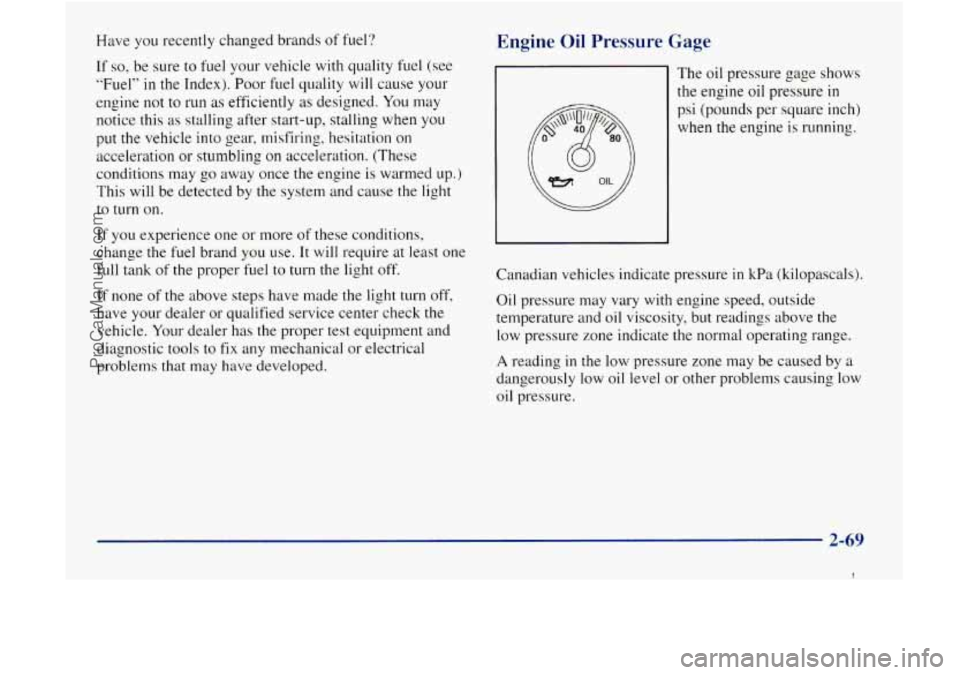
Engine Oil Pressure Gage
The oil pressure gage shows
the engine
oil pressure in
psi (pounds per square inch)
when the engine is running.
Canadian vehicles indicate pressure
in kPa (kilopascals).
Oil pressure may vary with engine speed, outside
temperature and oil viscosity, but readings above the
low pressure zone indicate the normal operating range.
A reading in the low pressure zone may be caused by a
dangerously low
oil level or other problems causing low
oil pressure.
2-69
I
ProCarManuals.com
Page 192 of 386
The exit speed is usually posted.
Reduce your speed according to your speedometer’
not
to your sense of motion. After driving for any distance
at higher speeds,
you may tend to think you are going
slower than you actually are.
Before Leaving on a Long Trip
Make sure you’re ready. Try to be well rested. If you
must start when you’re not fresh
-- such as after a day’s
work
-- don’t plan to make too many miles that first part
of the journey. Wear comfortable clothing and shoes you
can easily drive
in.
Is your vehicle ready for a long trip? If you keep it
serviced and maintained, it‘s ready to go. If it needs
service, have
it done before starting out. Of course,
you’ll find experienced and able service experts
in GM
dealerships all across North America. They’ll be ready
and willing to help if you need it.
Here are some things you can check before a trip:
0
0
0
0
0
0
0
WincJsl~ield Wcrshc~r- Fluid: Is the reservoir full? Are
all windows clean inside and outside?
Wiper Blcrdes: Are they in good shape?
Fuel, Elzgirze Oil, Other Flr.ds: Have you checked
all levels‘?
Lcunps: Are they all working? Are the lenses clean?
Tires: They are vitally important to a safe,
trouble-free trip.
Is the tread good enough for
long-distance drivingi? Are the tires all inflated
to the
recommended pressure?
Wecrther Forec*cr.sts: What’s the weather outlook
along your route? Should
you delay your trip a short
time to avoid
a major storm system?
A4crp.s: Do you have up-to-date maps?
4-33
I
ProCarManuals.com
Page 209 of 386

Driving On Grades
Reduce speed and shift to a 1owe.r gear Iwfow you start
down a long or steep downgrade.
If you don’t shift
down. you might have to use your brakes
so much that
they would get hot and no longer work well.
On
a long uphill grade, shift down and reduce your
speed to around
45 mph (70 km/h) to reduce the
possibility of engine and transmission overheating.
You should use DRIVE
(D) when towing a trailer.
Operating your vehicle
in DRIVE (D) when towing a
trailer
will minimize heat buildup and extend the life of
your transmission.
When towing at high altitude
on steep uphill grades,
consider the following: Engine coolant
will boil at a lower
temperature than at normal altitudes.
If you twn your
engine off imnlediately after towing at high altitude on
steep uphill grades, your vehicle may show signs similar to
engine overheating.
To avoid this, let the engine run while
parked (preferably on level ground)
with the automatic
transmission
in PARK (PI for a few minutes before turning
the engine off.
If you do get the overheat warning. see
”Engine Overheating”
in the Index.
Parking on Hills
You really should not park your vehicle, with a trailer
attached.
on a hill. If‘ something goes wrong, your rig
could start
to move. People can be injured, and both
your vehicle and the trailer can be damaged.
But
if you ever have to park your rig on a hill, here‘s
how
to do it:
1.
-. 3
3.
4.
5.
Apply your regular brakes, but don’t shift into
PARK
(P) yet. Then turn your wheels into the curb
if facing downhill or into traffic if facing uphill.
Have someone place chocks under the trailer wheels.
When the wheel chocks are
in place, release the
regular brakes
until the chocks absorb the load.
Reapply the regular brakes. Then apply your parking
brake, and then shift into PARK
(P).
Release the regular brakes.
4-50
ProCarManuals.com
Page 224 of 386

When you decide it's safe to lift the hood, here's what
you'
I I see:
If the coolant inside the coolant recovery tank is boiling,
don't do anything else
until it cools down.
A. Coolant Recovery Tank
B. Radiator Pressure Cap
C. Engine Fan
c.
I
The coolant level should be at least up to the
ADD mark.
If it isn't, you may have a leak in the radiator hoses,
heater hoses, radiator, water pump or somewhere else
in
the cooling system.
5-13
ProCarManuals.com
Page 225 of 386

1 h CAUTION:
Heater and radiator hoses, and other engine
parts, can be very hot. Don’t touch them.
If you
do, you can be burned.
Don’t run the engine if there is a leak.
If you run
the engine,
it could lose all coolant. That could
cause an engine fire, and you could be burned.
Get any leak fixed before you drive the vehicle.
NOTICE: I
Engine damage from running your engine
without coolant isn’t covered by your
1 warranty.
If there seems to be no leak, start the engine again. See
if the engine cooling fan speed increases when idle
speed is doubled by pushing the accelerator pedal down.
If it doesn’t, your vehicle needs service. Turn off
the engine.
How to Add Coolant to the Coolant
Recovery Tank
If you haven’t found a problem yet, but the coolant level
isn’t
at the ADD mark, add a 50/50 mixture of clean
brater (preferably distilled) and DEX-COOL@ engine
coolant at the coolant recovery tank. (See “Engine
Coolant”
in the Index for more information.)
Adding only plain water to your cooling system
can be dangerous. Plain water, or some other
liquid like alcohol, can boil before the proper
coolant mixture will. Your vehicle’s coolant
warning system is set for the proper coolant
mixture. With plain water
or the wrong mixture,
your engine could get too hot but you wouldn’t
get the overheat warning. Your engine could
catch fire and you or others could be burned.
Use a
50/50 mixture of clean water and
DEX-COOL@ coolant.
5-14
ProCarManuals.com
Page 248 of 386

Section 6 Service and Appearance Care
Here you will find information about the care of your vehicle. This section begins with service and fuel information,
and then
it shows how to check important fluid and lubricant levels. There is also technical information about your
vehicle, and a part devoted
to its appearance care.
6-2
6-3
6-5
6-5
6-7
6-8
6-
10
6-14
6- 15
6-19
6-20
6-2
1
6- 24
6-25
6-25
6-26
6-
2’7
Service
Fuel
Fuels in Foreign Countries
Filling Your Tank
Filling a Portable
Fuel Container
Checking Things Under the Hood
Engine Oil
Air Cleaner
Automatic Transmission Fluid
Rear Axle
Four- Wheel Drive
Engine Coolant
Radiator Pressure Cap
Thermostat
Power Steering Fluid
Windshield Washer Fluid
Brakes Battery
Bulb Replacement
Windshield Wiper Blade Replacement
Tires
Appearance Care
Cleaning the Inside
of Your Vehicle
Care of Safety Belts
Cleaning the Outside of Your Vehicle
Appearance Care Materials Chart
Vehicle Identification Number (VIN)
Service Parts Identification Label
Electrical System
Replacement Bulbs
Capacities and Specifications
Air Conditioning Refrigerants
6-30
6-3
1
6-34
6-36
6-45
6-46
6-48
6-50
6-53
6-54
6-54
6-54
6- 60
6- 60
6-62
6-1
ProCarManuals.com
Page 257 of 386

Remove the hood prop from the slot in the hood and
return the prop to its retainer.
Then just pull the hood down firmly
to close. It will
latch when dropped from 10 to12 inches (25 to 30 cm)
without pressing on the hood.
Engine Oil
It's a good idea to check your engine oil every time you
get fuel. In order to get an accurate reading, the oil must
be warm and the vehicle must be on level ground.
The oil
yellow dipstick is
a
ring.
Turn off the engine and give the
oil a few minutes to
drain back into the oil pan.
If you don't, the oil dipstick
might
not show the actual level.
6-10
ProCarManuals.com
Page 258 of 386

Checking Engine Oil
Pull out the dipstick and clean it with a paper towel or
cloth, then push it back in all the way. Remove it again,
keeping the tip down, and check the level.
When to Add Engine Oil
If the oil is at or below the ADD line, then you’ll need
to add at least one quart
of oil. But you must use the
right kind. This part explains what kind
of oil to use. For
crankcase capacity, see “Capacities and Specifications”
in the Index.
NOTICE:
Don’t add too much oil. If your engine has so
much oil that the oil level gets above the
cross-hatched area that shows the proper
operating range, your engine could be damaged.
Be sure to fill it enough to put the level somewhere in
the proper operating range. Push the dipstick
all the way
back in when you’re through.
6-11
ProCarManuals.com
Page 262 of 386

A CAUTION:
Operating the engine with the air cleaner off can
cause you or others to be burned. The air cleaner
not only cleans the air, it stops flame
if the engine
backfires.
If it isn’t there, and the engine
backfires, you could be burned. Don’t drive with
it
off, and be careful working on the engine with
the
air cleaner off.
NOTICE:
If the air cleaner is off, a backfire can cause a
damaging engine fire. And, dirt can easily get
into your engine, which will damage it. Always
have the air cleaner in place when you’re driving.
Automatic Transmission Fluid
When to Check and Change
A good time to check your automatic transmission fluid
level
is when the engine oil is changed.
Change both the fluid and filter every
15,000 miles
(25 000 km) if the vehicle is mainly driven under one
or more of these conditions:
In heavy city traffic where the outside temperature
regularly reaches
90°F (32°C) or higher.
In hilly or mountainous terrain.
When doing frequent trailer towing.
Uses such as found in taxi, police or delivery service.
If you do not use your vehicle under any of these
conditions, change the fluid and filter every
50,000 miles (83 000 km).
See “Scheduled Maintenance Services’’ in the Index.
ProCarManuals.com
Page 306 of 386
Name
RT TRN
RR PRK
TRL PRK
LT HDLP
RT HDLP
LT HI
RT HI
FR PRK
INT BAT
ENG
I
ECM B
ABS
ECM
1
HORN
BTS
I
BIU LP
IGN E
AIC
RAP
OXYSEN
Usage
Right Turn Signal Rear
Right Rear Parking Lamps
Trailer Park Lamps Left Headlamp
Right Headlamp
Left High Beam
Right High Beam
Front Parking Lamps
I/P Fuse Block Feed
Engine SensorsISolenoids, MAP,
CAM. PURGE, VENT
Engine Control Module, Fuel Pump,
Module, Oil Pressure
Anti-Lock Brake System
Engine Control Module Injectors Horn
Brake-Transmission Shift Interlock
Back-up
Lalllps
Engine
Air Conditioning
Retained Accessory Power
Oxygen Sensor
Name
IGN B
DRL
FOG LP
IGN
A
STUD #2
PARKLP
LR PRK
IGN C
HTDSEAT ATC
RRDFOG
HVAC
TRCHMSL
RR W/W
CRANK
LD LEV
HI BEAM
HAZLP
VECHMSL
HTDMIR
STOPLP
TBC
Usage
Column Feed, IGN 2, 3,4
Daytime Running Lamps
Fog Lamps
Starting and Charging IGN
I
Accessory Feeds, Electric Brake
Parking La~nps
Left Rear Parking Lamps Starter Solenoid, Fuel Pump. PRNDL
Heated Seat
Electronic Transfer Case
Rear Defogger
HVAC System
Trailer Center High Mount Stop Light
Rear Window Wiper
Clutch Switch, NSBU Switch
Electronic Load Leveling
HID Headlamps Hazard Lamps
Vehicle Center High
Mount Stop Lamp
Heated Mirror
Stoplamps
Truck Body Computer
6-59
1
ProCarManuals.com