window GMC ENVOY 1998 Owners Manual
[x] Cancel search | Manufacturer: GMC, Model Year: 1998, Model line: ENVOY, Model: GMC ENVOY 1998Pages: 386, PDF Size: 20.33 MB
Page 6 of 386
1
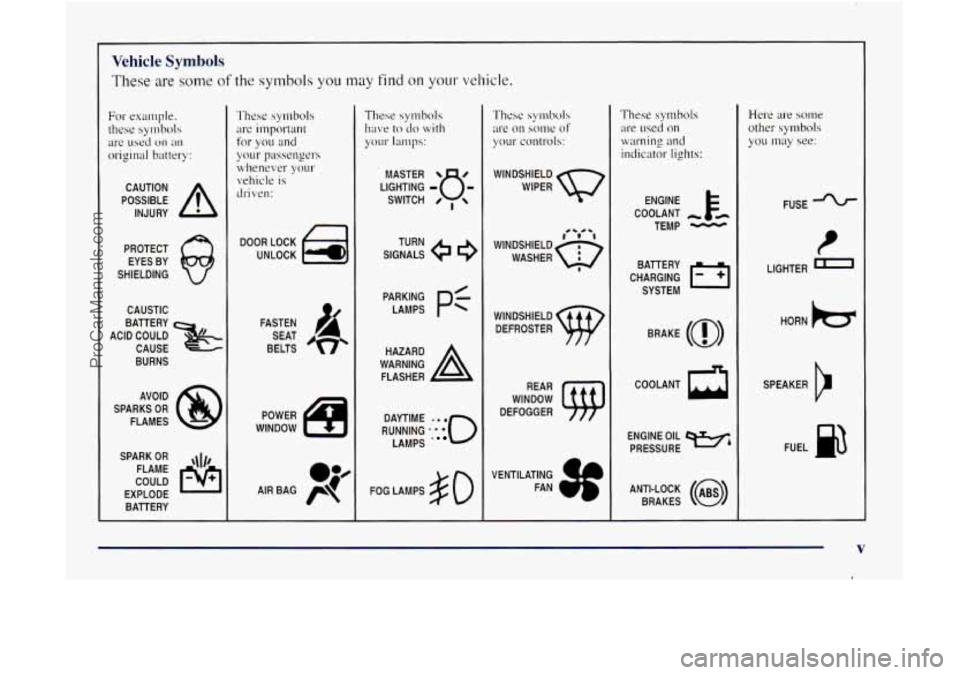
Vehicle Symbols
These are some of the symbols you tnay find on your vehicle.
For example.
these symbols
are used
on an
original battery:
POSSIBLE A
CAUTION
INJURY
PROTECT EYES BY
SHIELDING
CAUSTIC
ACID COULD
BATTERY
CAUSE
BURNS
AVOID
SPARKS
OR
FLAMES
SPARK
OR ,111,
COULD FLAME
EXPLODE BATTERY
These symbols
are important
for you and
your passenpel-s
whenever your vehicle
is
driven:
DOOR LOCK
UNLOCK
FA$TEll SEAT
BELTS SIGNALS
TURN
RUNNING
.':**o
DAYTIME LAMPS
*
FOG LAMPS $0
WINDSHIELD
WIPER
WINDSHIELD DEFROSTER
WINDOW
DEFOGGER
VENTILATING
i F,
FAN COOLANT
-
TEMP -
CHARGING I-1
BATTERY
SYSTEM
BRAKE
(a)
COOLANT a
ENGINE OIL w,
PRESSURE
ANTI-LOCK
(@)
BRAKES
Here are some
other symbols
you may see:
FUSE
P
LIGHTER m
HORN b
SPEAKER
b
FUEL p3
V
1
ProCarManuals.com
Page 32 of 386
What makes an air bag inflate?
In an impact of sufficient severity, the air bag sensing
system detects that the vehicle is in a crash. The sensing
system triggers
a release of gas from the inflator, which
inflates the air bag.
The inflator, air bag and related
hardware are all part of the air bag modules inside the
steering wheel and in the instrument panel in front
of the
right front passenger.
How does an air bag restrain?
In moderate to severe frontal or near-frontal collisions,
even belted occupants can contact the steering wheel or
the instrument panel. Air bags supplement the protection
provided
by safety belts. Air bags distribute the force of
the impact more evenly over the occupant’s upper body,
stopping the occupant more gradually. But air bags
would not help
you in many types of collisions,
including rollovers, rear impacts and side impacts,
primarily because an occupant’s motion
is not toward
those air bags. Air bags should never be regarded as
anything more than a supplement
to safety belts,
and then only
in moderate to severe frontal or
near-frontal collisions.
What will you see after an air bag inflates?
After an air bag inflates, it quickly deflates, so
quickly that some people may not even realize the
air bag inflated. Some components of the air bag
module
-- the steering wheel hub for the driver’s air bag,
or the instrument panel for the right front passenger’s
bag
-- will be hot for a short time. The parts of the bag
that come into contact with you may be warm, but not
too hot
to touch. There will be some smoke and dust
coming from vents
in the deflated air bags. Air bag
inflation doesn’t prevent the driver from seeing or from
being able to steer
the vehicle, nor does it stop people
from leaving
the vehicle.
When an air bag inflates, there is dust in the air.
This dust could cause breathing problems for
people with a history of asthma or other
breathing trouble. To avoid this, everyone in the
vehicle should get out as
soon as it is safe to do so.
If you have breathing problems but can’t get out
of the vehicle after an air bag inflates, then get
fresh air by opening a window or door.
1-25
1
ProCarManuals.com
Page 35 of 386
Rear Seat Passengers
It's very important for rear seat passengers to buckle up!
Accident statistics show that unbelted people in the rear
seat are hurt more often
in crashes than those who are
wearing safety belts.
Rear passengers who aren't safety belted can be thrown
out
of the vehicle in a crash. And they can strike others
in the vehicle who are wearing safety belts.
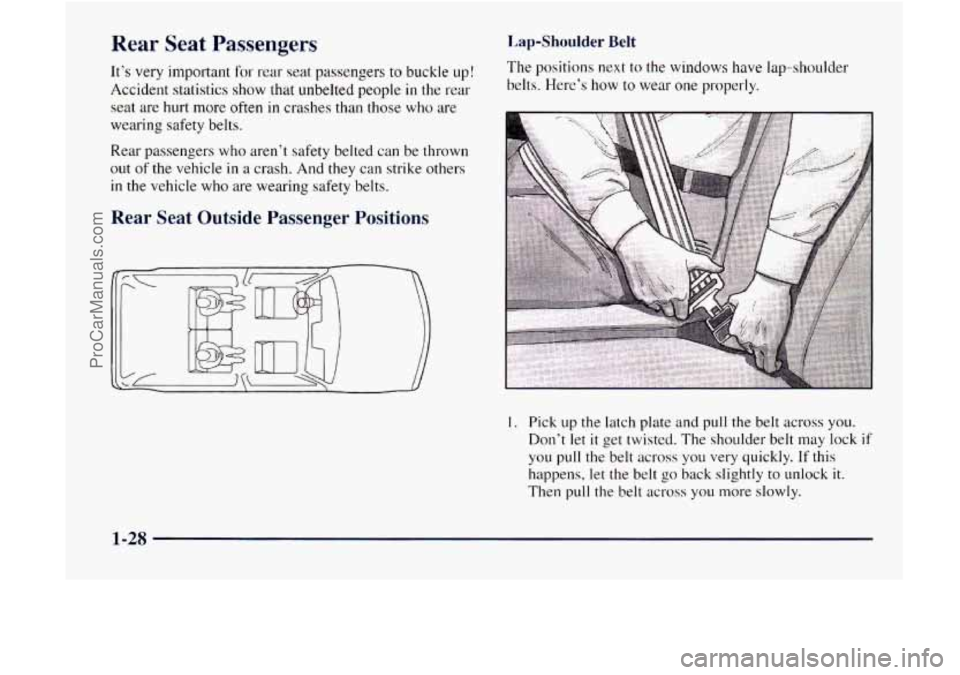
Lap-Shoulder Belt
The positions next to the windows have lap-shoulder
belts. Here's how
to wear one properly.
Rear Seat Outside Passenger Positions
I. Pick up the latch plate and pull the belt across you.
Don't let
it get twisted. The shoulder belt may lock if
you pull the belt across you very quickly. If this
happens, let the belt
go back slightly to unlock it.
Then pull the belt across you more slowly.
1-28
ProCarManuals.com
Page 48 of 386
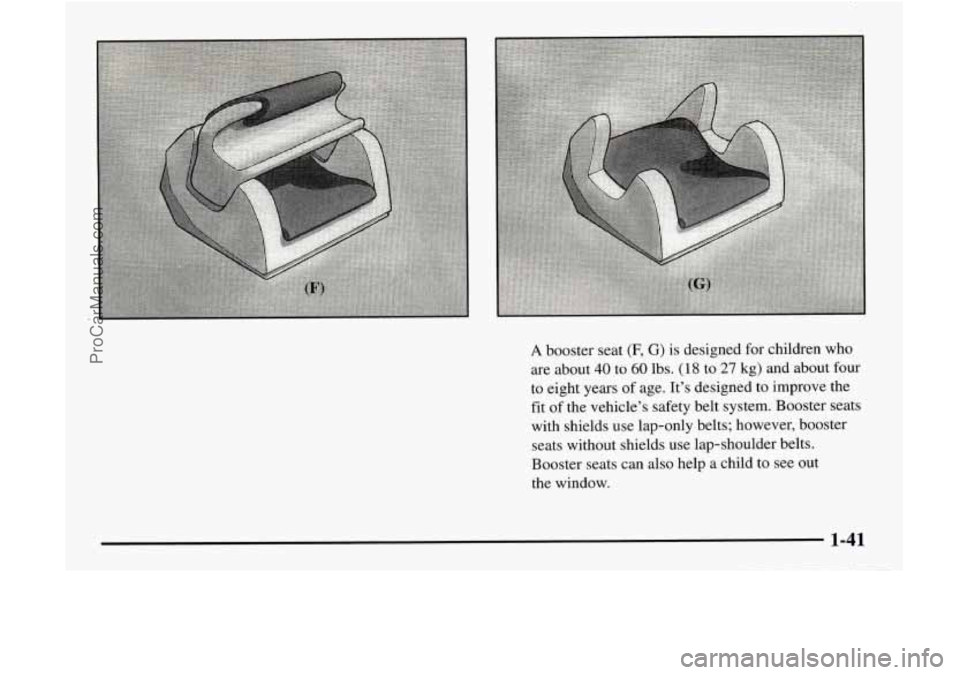
A booster seat (F, G) is designed for children who
are about
40 to 60 lbs. (1 8 to 27 kg) and about four
to eight years of age. It’s designed to improve the
fit of the vehicle’s safety belt system. Booster seats
with shields use lap-only belts; however, booster
seats without shields use lap-shoulder belts.
Booster seats can also help a child to see out the window.
1-41
ProCarManuals.com
Page 56 of 386
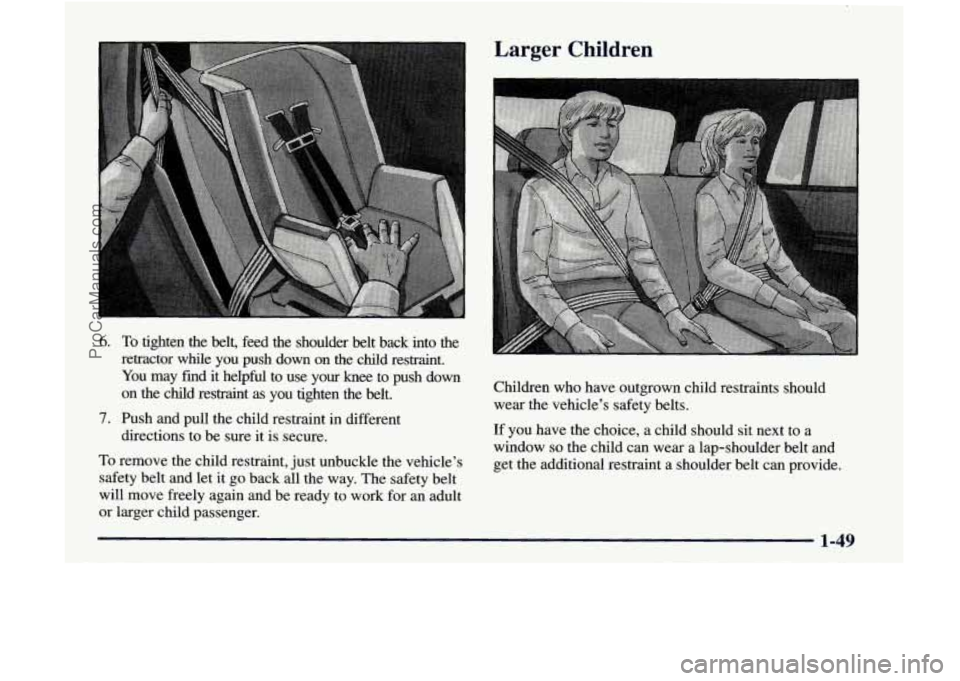
6. To tighten the belt, feed the shoulder belt back into the
retractor while you push down on the child restraint.
You may find it helpful to use your knee to push down
on the child restraint as you tighten
the belt.
I. Push and pull the child restraint in different
directions to be sure it is secure.
To remove the child restraint, just unbuckle the vehicle’s
safety belt and let it go back all the way. The safety belt \
will move freely again and be ready to work for an adult or larger child passenger. Children who have outgrown child restraints should
wear the vehicle’s safety belts.
If you have the choice, a child should sit next to a window
so the child can wear a lap-shoulder belt and
get the additional restraint a shoulder belt can provide.
1-49
ProCarManuals.com
Page 62 of 386

Section 2 Features and Controls
Here you can learn about the many standard and optional features on your vehicle, \
and information on starting,
shifting and braking. Also explained
are the instrument panel and the warning systems that tell you if everything is
working properly
-- and what to do if you have a problem.
2-2 2-4
2-6
2-9 2-10 2-1 1
2-12
2- 13
2- 14
2- 15
2- 16
2-18 2-20
2-2
1
2-23 2-24
2-24
2-25 Keys
Door Locks
Keyless Entry System
LiftgateLiftglass
Theft Content Theft-Deterrent
Passlock@ New Vehicle “Break-In’’
Ignition Positions Starting Your Engine
Engine Coolant Heater
(If Equipped)
Automatic Transmission Operation
Parking Brake Shifting Into PARK (P)
Shifting Out of PARK
(P)
Parking Over Things That Burn
Engine Exhaust Running Your Engine While You’re Parked 2-26
2-26
2-28 2-29
2-30
2-30 2-36
2-39
2-40
2-42
2-49 2-50
2-52 2-52
2-53 2-58 2-60
2-62 Locking Rear Axle
Four-wheel Drive
Windows Horn
Tilt Wheel Turn SignalMultifunction Lever
Exterior Lamps
Interior Lamps
Mirrors Storage Compartments
Ashtrays and Cigarette Lighter
Sun Visors
Accessory Power Outlets Sunroof (If Equipped)
Universal Transmitter Instrument Panel
Instrument Panel Cluster
Warning Lights, Gages and Indicators
2-1
ProCarManuals.com
Page 63 of 386
Keys
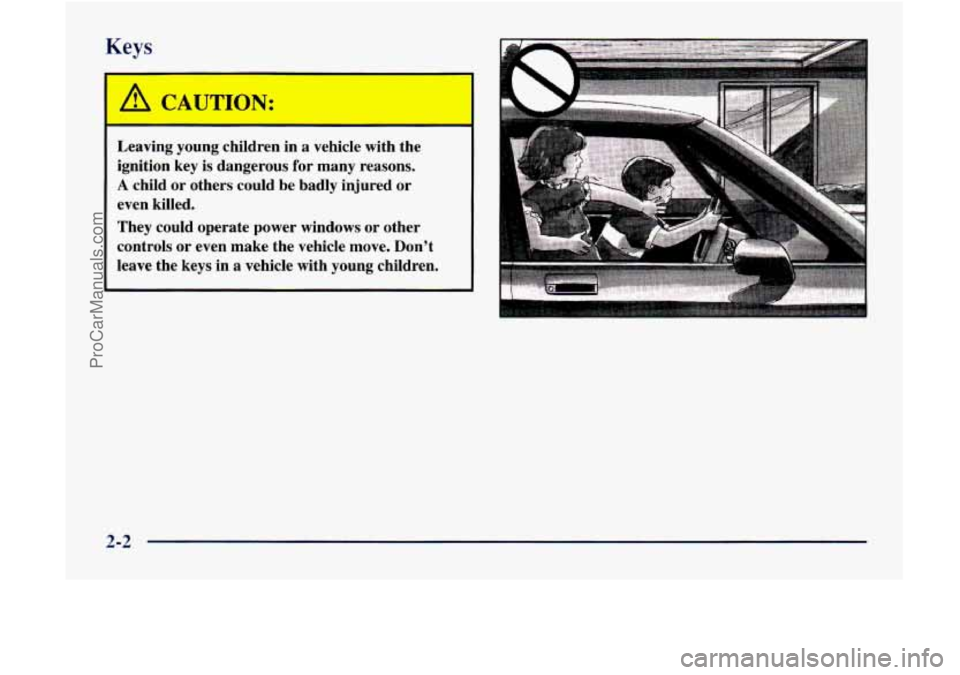
A CAUTION:
Leaving young children in a vehicle with the
ignition key is dangerous for many reasons.
A child or others could be badly injured or
even killed.
They could operate power windows or other
controls or even make the vehicle move. Don't
leave the keys in
a vehicle with young children.
2-2
ProCarManuals.com
Page 70 of 386

Resynchronization Resynchronization may be necessary due to the security
method used by this system. The transmitter does not
send the
same signal twice to the receiver. The receiver
will
not respond to a signal it has been sent previously.
This prevents anyone
from recording and playing back
the signal from the transmitter.
To resynchronize your transmitter, stand close to your
vehicle and press and hold the LOCK and UNLOCK
buttons on the transmitter at the same time for seven
seconds. The door locks should cycle to confirm
synchronization.
If the locks do not cycle. see your
dealer for service.
LiftgateLiftglass
It can be dangerous to drive with the liftgate or
liftglass open because carbon monoxide (CO) gas
can come into your vehicle. You can’t see or smell
CO. It can cause unconsciousness and even death.
If‘ you must drive with the liftgate or liftglass
open or if electrical wiring or other cable
connections must pass through the seal between
the body and the liftgate
or liftglass:
Make sure all windows are shut.
Turn the fan on your heating or cooling
system to its highest speed with the setting
on any airflow selection except
RECIRCULATION. That will force outside
air into your vehicle. See “Comfort
Controls” in the Index.
If you have air outlets on or under the
instrument panel, open them
all the way.
See “Engine Exhaust” in the Index.
2-9
I
ProCarManuals.com
Page 72 of 386
Key in the Ignition
If you leave your vehicle with the keys inside, it’s an
easy target for joy riders or professional thieves
-- so
don’t do it.
When you park your vehicle and open the driver’s door,
you’ll hear a chime reminding
you to remove your key
from the ignition and take
it with you. Always do this.
Your steering wheel will be locked, and
so will your
ignition and transmission. And remember to lock
the doors.
Parking at Night
Park in a lighted spot, close all windows and lock your
vehicle. Remember to keep your valuables out
of sight.
Put them
in a storage area, or take them with you.
Parking Lots
If you park in a lot where someone will be watching
your vehicle, it’s best to lock it up and take your keys.
But what
if you have to leave your ignition key? What if
you have to leave something valuable in your vehicle?
Put your valuables in a storage area, like your
glove box.
Lock all the doors except the driver’s.
Content Theft-Deterrent
Your vehicle is equipped
with
a Content
Theft-Deterrent
SECURITY alarm system.
With this system, the SECURITY light will flash as
you
open the door (if your ignition is off).
This light reminds you to activate the theft-deterrent
system. Here’s how
to do it:
1. Open the door.
2. Lock the door with the power door lock switch or the
remote keyless entry transmitter. The SECURITY
light should come
on and stay on.
3. Close all doors. The SECURITY light should go off
after approximately
30 seconds. The alarm is not
armed until the SECURITY light goes off.
If a door is opened without the key or the remote keyless
entry transmitter, the alarm will go
off. Your vehicle’s
high-beam headlamps will flash
and the horn will sound
for
30 seconds, then will turn off to save the battery power.
2-11
I
ProCarManuals.com
Page 73 of 386

Remember, the theft-deterrent system won‘t activate if
you lock the doors with a key or use the manual door
lock. It activates only if
you use a power door lock
switch with the door open, or with the remote keyless
entry transmitter. You should
also remember that you
can start your vehicle with the correct ignition key
if’ the
alarm has been set
off.
Here’s how to avoid setting off the alarm by accident:
If you don’t want to activate the theft-deterrent
system, the vehicle should be locked
with the door
key
after the doors are closed.
Always unlock a door with a key, or use the remote
keyless entry transmitter. Unlocking
a door any other
way will set off the alarm.
If you set off the alarm by accident, unlock any door
with the key. You can
also turn off the alarm by pressing
UNLOCK on the remote keyless entry transmitter.
The alarm won’t stop if you try to unlock a door any
other way.
Testing the Alarm
The alarm can be tested by following these steps:
I. From inside the vehicle, lower the driver‘s window
and open the driver’s door.
3.
4.
Activate the system by locking the doors with the
power door
lock switch while the door is open, or
with the remote keyless entry transmitter.
Get out
of the vehicle, close the door and wait for the
SECURITY light to
go out.
Then reach
in through the window, unlock the door
with the manual door lock and open the door. This
should set
off the alarm.
If the alarm does not sound when it should but the
vehicle’s high-beam headlamps flash, check
to see if the
horn works. The horn fuse may be blown.
To replace the
f~~se, see “Fuses and Circuit Breakers”
in the Index.
If the alarm does not sound or the vehicle’s high-beam
headlamps do not flash, the vehicle should be serviced
by
an authorized service center.
Passlock’
Your vehicle is equipped with the Passlock
theft-deterrent system.
Passlock is
a passive theft-deterrent system. The system
is armed once the key is removed from the ignition.
Passlock enables fuel
if the ignition lock cylinder is
turned with a valid key. If a correct key is not used, fuel
is disabled.
2-12
ProCarManuals.com