belt GMC ENVOY 2003 Workshop Manual
[x] Cancel search | Manufacturer: GMC, Model Year: 2003, Model line: ENVOY, Model: GMC ENVOY 2003Pages: 442, PDF Size: 3.1 MB
Page 239 of 442

If you need to reduce your speed as you approach a
curve, do it before you enter the curve, while your front
wheels are straight ahead.
Try to adjust your speed so you can ªdriveº through the
curve. Maintain a reasonable, steady speed. Wait to
accelerate until you are out of the curve, and then
accelerate gently into the straightaway.
Steering in Emergencies
There are times when steering can be more effective
than braking. For example, you come over a hill and ®nd
a truck stopped in your lane, or a car suddenly pulls
out from nowhere, or a child darts out from between
parked cars and stops right in front of you. You
can avoid these problems by braking Ð if you can stop
in time. But sometimes you can't; there isn't room.
That's the time for evasive action Ð steering around the
problem.
Your vehicle can perform very well in emergencies like
these. First apply your brakes.
See
Braking on page 4-5. It is better to remove as much
speed as you can from a possible collision. Then
steer around the problem, to the left or right depending
on the space available.An emergency like this requires close attention and a
quick decision. If you are holding the steering wheel at
the recommended 9 and 3 o'clock positions, you
can turn it a full 180 degrees very quickly without
removing either hand. But you have to act fast, steer
quickly, and just as quickly straighten the wheel
once you have avoided the object.
The fact that such emergency situations are always
possible is a good reason to practice defensive driving
at all times and wear safety belts properly.
4-11
Page 246 of 442

Controlling your vehicle is the key to successful off-road
driving. One of the best ways to control your vehicle
is to control your speed. Here are some things to keep
in mind. At higher speeds:
·you approach things faster and you have less time
to scan the terrain for obstacles.
·you have less time to react.
·you have more vehicle bounce when you drive over
obstacles.
·you'll need more distance for braking, especially
since you're on an unpaved surface.
{CAUTION:
When you're driving off-road, bouncing and
quick changes in direction can easily throw
you out of position. This could cause you to
lose control and crash. So, whether you're
driving on or off the road, you and your
passengers should wear safety belts.
Scanning the Terrain
Off-road driving can take you over many different kinds
of terrain. You need to be familiar with the terrain
and its many different features. Here are some things to
consider.
Surface Conditions:Off-roading can take you over
hard-packed dirt, gravel, rocks, grass, sand, mud, snow
or ice. Each of these surfaces affects the steering,
acceleration and braking of your vehicle in different ways.
Depending upon the kind of surface you are on, you may
experience slipping, sliding, wheel spinning, delayed
acceleration, poor traction and longer braking distances.
Surface Obstacles:Unseen or hidden obstacles can
be hazardous. A rock, log, hole, rut or bump can startle
you if you're not prepared for them. Often these
obstacles are hidden by grass, bushes, snow or even
the rise and fall of the terrain itself. Here are some
things to consider:
·Is the path ahead clear?
·Will the surface texture change abruptly up ahead?
·Does the travel take you uphill or downhill?
(There's more discussion of these subjects later.)
·Will you have to stop suddenly or change direction
quickly?
4-18
Page 287 of 442

{CAUTION:
It can be dangerous to get out of your vehicle
if the shift lever is not fully in PARK (P) with
the parking brake ®rmly set. Your vehicle
can roll.
If you have left the engine running, the vehicle
can move suddenly. You or others could be
injured. To be sure your vehicle won't move,
even when you're on fairly level ground, use
the steps that follow.
Always put the shift lever fully in PARK (P)
with the parking brake ®rmly set.
If the transfer case on four-wheel drive
vehicles is in NEUTRAL, your vehicle will be
free to roll, even if your shift lever is in
PARK (P). So, be sure the transfer case is in a
drive gear Ð not in NEUTRAL.
See ªFour-Wheel Drive (Automatic Transfer
Case)º in the Index.
When You Are Ready to Leave After
Parking on a Hill
1. Apply your regular brakes and hold the pedal down
while you:
·start your engine,
·shift into a gear, and
·release the parking brake.
2. Let up on the brake pedal.
3. Drive slowly until the trailer is clear of the chocks.
4. Stop and have someone pick up and store the
chocks.
Maintenance When Trailer Towing
Your vehicle will need service more often when you're
pulling a trailer. See the Maintenance Schedule for more
on this. Things that are especially important in trailer
operation are automatic transmission ¯uid (don't over®ll),
engine oil, axle lubricant, belt(s), cooling system and
brake system. Each of these is covered in this manual,
and the Index will help you ®nd them quickly. If
you're trailering, it's a good idea to review these sections
before you start your trip.
Check periodically to see that all hitch nuts and bolts
are tight.
4-59
Page 290 of 442
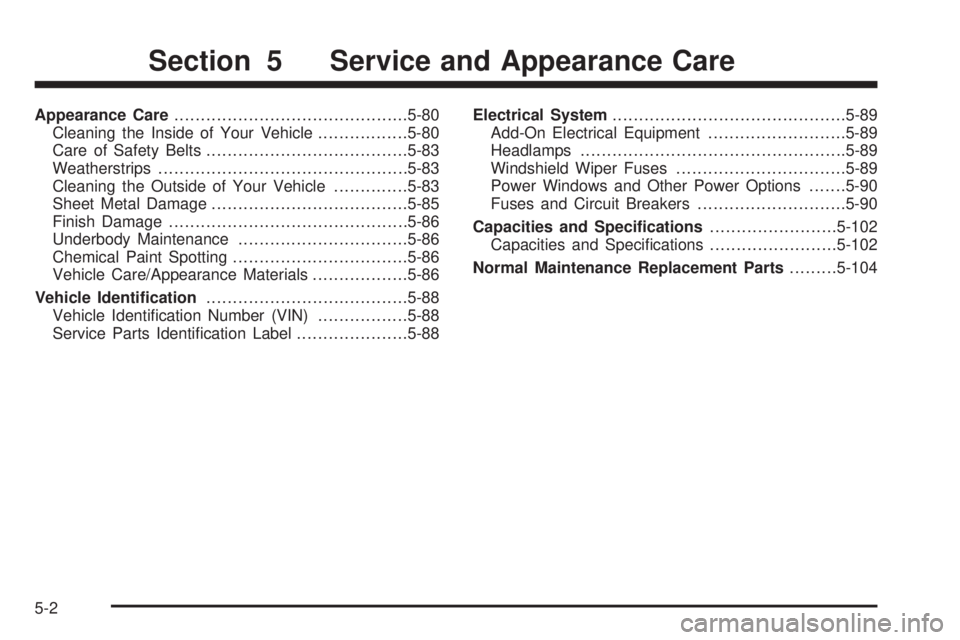
Appearance Care............................................5-80
Cleaning the Inside of Your Vehicle.................5-80
Care of Safety Belts......................................5-83
Weatherstrips...............................................5-83
Cleaning the Outside of Your Vehicle..............5-83
Sheet Metal Damage.....................................5-85
Finish Damage.............................................5-86
Underbody Maintenance................................5-86
Chemical Paint Spotting.................................5-86
Vehicle Care/Appearance Materials..................5-86
Vehicle Identi®cation......................................5-88
Vehicle Identi®cation Number (VIN).................5-88
Service Parts Identi®cation Label.....................5-88Electrical System............................................5-89
Add-On Electrical Equipment..........................5-89
Headlamps..................................................5-89
Windshield Wiper Fuses................................5-89
Power Windows and Other Power Options.......5-90
Fuses and Circuit Breakers............................5-90
Capacities and Speci®cations........................5-102
Capacities and Speci®cations........................5-102
Normal Maintenance Replacement Parts.........5-104
Section 5 Service and Appearance Care
5-2
Page 346 of 442
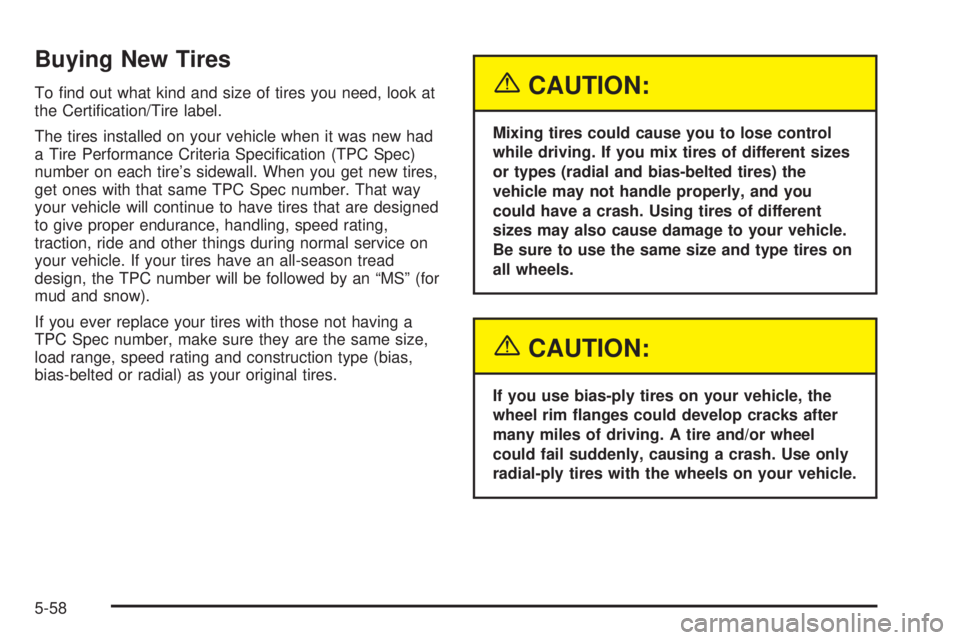
Buying New Tires
To ®nd out what kind and size of tires you need, look at
the Certi®cation/Tire label.
The tires installed on your vehicle when it was new had
a Tire Performance Criteria Speci®cation (TPC Spec)
number on each tire's sidewall. When you get new tires,
get ones with that same TPC Spec number. That way
your vehicle will continue to have tires that are designed
to give proper endurance, handling, speed rating,
traction, ride and other things during normal service on
your vehicle. If your tires have an all-season tread
design, the TPC number will be followed by an ªMSº (for
mud and snow).
If you ever replace your tires with those not having a
TPC Spec number, make sure they are the same size,
load range, speed rating and construction type (bias,
bias-belted or radial) as your original tires.{CAUTION:
Mixing tires could cause you to lose control
while driving. If you mix tires of different sizes
or types (radial and bias-belted tires) the
vehicle may not handle properly, and you
could have a crash. Using tires of different
sizes may also cause damage to your vehicle.
Be sure to use the same size and type tires on
all wheels.
{CAUTION:
If you use bias-ply tires on your vehicle, the
wheel rim ¯anges could develop cracks after
many miles of driving. A tire and/or wheel
could fail suddenly, causing a crash. Use only
radial-ply tires with the wheels on your vehicle.
5-58
Page 371 of 442

Care of Safety Belts
Keep belts clean and dry.
{CAUTION:
Do not bleach or dye safety belts. If you do, it
may severely weaken them. In a crash, they
might not be able to provide adequate
protection. Clean safety belts only with mild
soap and lukewarm water.
Weatherstrips
Silicone grease on weatherstrips will make them last
longer, seal better, and not stick or squeak. Apply
silicone grease with a clean cloth at least every six
months. During very cold, damp weather more frequent
application may be required. See
Part D: Recommended
Fluids and Lubricants on page 6-18.
Cleaning the Outside of Your
Vehicle
The paint ®nish on your vehicle provides beauty, depth
of color, gloss retention and durability.
Washing Your Vehicle
The best way to preserve your vehicle's ®nish is to
keep it clean by washing it often with lukewarm or
cold water.
Don't wash your vehicle in the direct rays of the sun.
Use a car washing soap. Don't use strong soaps
or chemical detergents. Be sure to rinse the vehicle
well, removing all soap residue completely. You can get
GM-approved cleaning products from your dealer.
See
Vehicle Care/Appearance Materials on page 5-86.
Don't use cleaning agents that are petroleum based,
or that contain acid or abrasives. All cleaning agents
should be ¯ushed promptly and not allowed to dry on the
surface, or they could stain. Dry the ®nish with a soft,
clean chamois or an all-cotton towel to avoid surface
scratches and water spotting.
High pressure car washes may cause water to enter
your vehicle.
5-83
Page 402 of 442
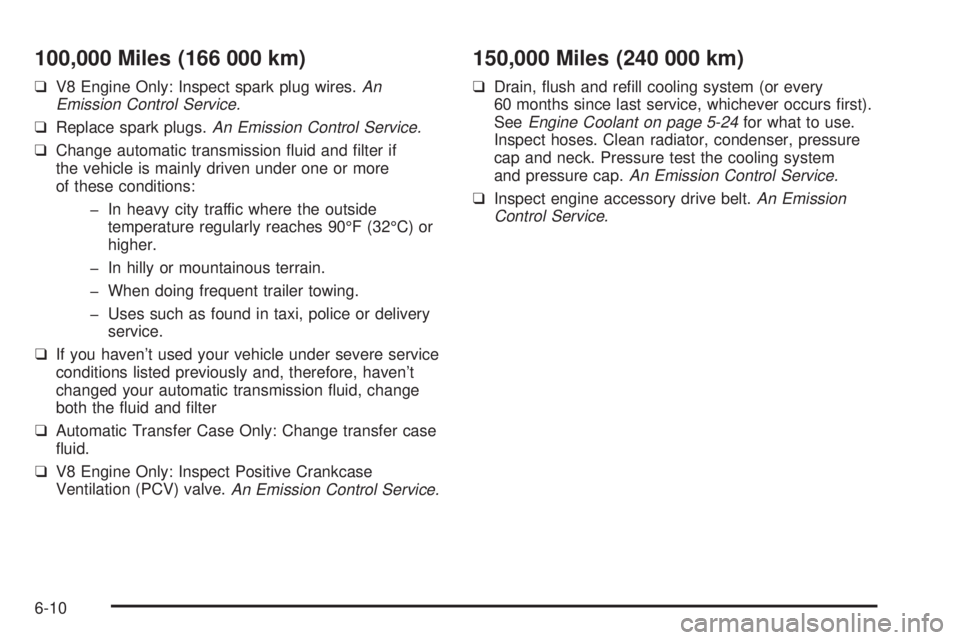
100,000 Miles (166 000 km)
qV8 Engine Only: Inspect spark plug wires.An
Emission Control Service.
qReplace spark plugs.An Emission Control Service.
qChange automatic transmission ¯uid and ®lter if
the vehicle is mainly driven under one or more
of these conditions:
þ In heavy city traffic where the outside
temperature regularly reaches 90ÉF (32ÉC) or
higher.
þ In hilly or mountainous terrain.
þ When doing frequent trailer towing.
þ Uses such as found in taxi, police or delivery
service.
qIf you haven't used your vehicle under severe service
conditions listed previously and, therefore, haven't
changed your automatic transmission ¯uid, change
both the ¯uid and ®lter
qAutomatic Transfer Case Only: Change transfer case
¯uid.
qV8 Engine Only: Inspect Positive Crankcase
Ventilation (PCV) valve.
An Emission Control Service.
150,000 Miles (240 000 km)
qDrain, ¯ush and re®ll cooling system (or every
60 months since last service, whichever occurs ®rst).
See
Engine Coolant on page 5-24for what to use.
Inspect hoses. Clean radiator, condenser, pressure
cap and neck. Pressure test the cooling system
and pressure cap.
An Emission Control Service.
qInspect engine accessory drive belt.An Emission
Control Service.
6-10
Page 404 of 442

At Least Twice a Year
Restraint System Check
Make sure the safety belt reminder light and all your
belts, buckles, latch plates, retractors and anchorages
are working properly. Look for any other loose or
damaged safety belt system parts. If you see anything
that might keep a safety belt system from doing its
job, have it repaired. Have any torn or frayed safety belts
replaced.
Also look for any opened or broken air bag coverings,
and have them repaired or replaced. (The air bag
system does not need regular maintenance.)
Wiper Blade Check
Inspect wiper blades for wear or cracking. Replace
blade inserts that appear worn or damaged or that
streak or miss areas of the windshield. Also see
Cleaning the Outside of Your Vehicle on page 5-83.
Spare Tire Check
At least twice a year, after the monthly in¯ation check of
the spare tire determines that the spare is in¯ated to
the correct tire in¯ation pressure, make sure that
the spare tire is stored securely. Push, pull, and then try
to rotate or turn the tire. If it moves, use the wheel
wrench/ratchet to tighten the cable. See
Changing a Flat
Tire on page 5-64.
Weatherstrip Lubrication
Silicone grease on weatherstrips will make them last
longer, seal better, and not stick or squeak. Apply
silicone grease with a clean cloth. During very cold,
damp weather more frequent application may be
required. See
Part D: Recommended Fluids and
Lubricants on page 6-18.
Automatic Transmission Check
Check the transmission ¯uid level; add if needed. SeeAutomatic Transmission Fluid on page 5-21. A ¯uid loss
may indicate a problem. Check the system and repair
if needed.
6-12
Page 427 of 442
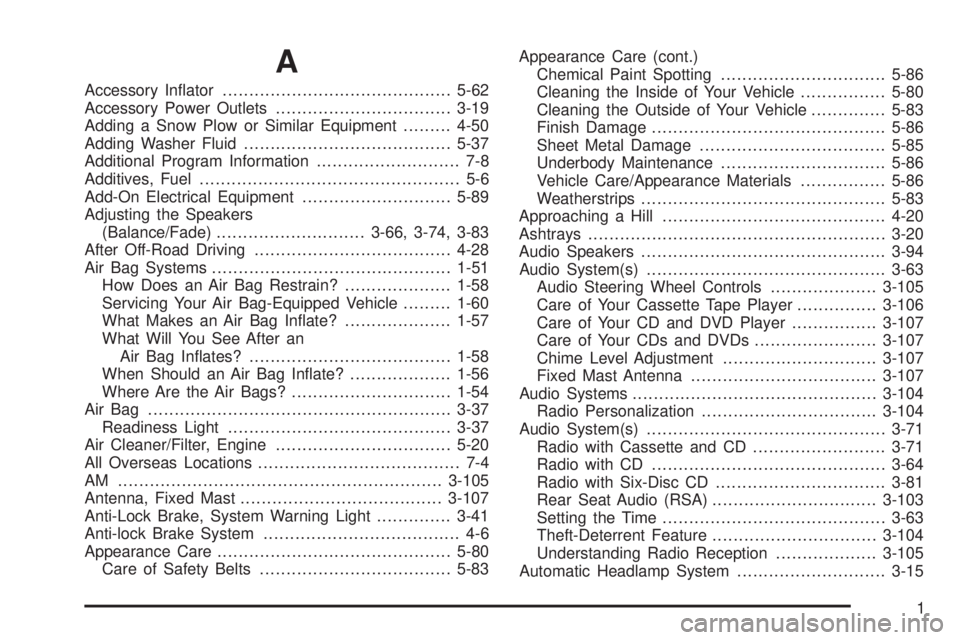
A
Accessory In¯ator...........................................5-62
Accessory Power Outlets.................................3-19
Adding a Snow Plow or Similar Equipment.........4-50
Adding Washer Fluid.......................................5-37
Additional Program Information........................... 7-8
Additives, Fuel................................................. 5-6
Add-On Electrical Equipment............................5-89
Adjusting the Speakers
(Balance/Fade)............................3-66, 3-74, 3-83
After Off-Road Driving.....................................4-28
Air Bag Systems.............................................1-51
How Does an Air Bag Restrain?....................1-58
Servicing Your Air Bag-Equipped Vehicle.........1-60
What Makes an Air Bag In¯ate?....................1-57
What Will You See After an
Air Bag In¯ates?......................................1-58
When Should an Air Bag In¯ate?...................1-56
Where Are the Air Bags?..............................1-54
Air Bag .........................................................3-37
Readiness Light..........................................3-37
Air Cleaner/Filter, Engine.................................5-20
All Overseas Locations...................................... 7-4
AM .............................................................3-105
Antenna, Fixed Mast......................................3-107
Anti-Lock Brake, System Warning Light..............3-41
Anti-lock Brake System..................................... 4-6
Appearance Care............................................5-80
Care of Safety Belts....................................5-83Appearance Care (cont.)
Chemical Paint Spotting...............................5-86
Cleaning the Inside of Your Vehicle................5-80
Cleaning the Outside of Your Vehicle..............5-83
Finish Damage............................................5-86
Sheet Metal Damage...................................5-85
Underbody Maintenance...............................5-86
Vehicle Care/Appearance Materials................5-86
Weatherstrips..............................................5-83
Approaching a Hill..........................................4-20
Ashtrays........................................................3-20
Audio Speakers..............................................3-94
Audio System(s).............................................3-63
Audio Steering Wheel Controls....................3-105
Care of Your Cassette Tape Player...............3-106
Care of Your CD and DVD Player................3-107
Care of Your CDs and DVDs.......................3-107
Chime Level Adjustment.............................3-107
Fixed Mast Antenna...................................3-107
Audio Systems..............................................3-104
Radio Personalization.................................3-104
Audio System(s).............................................3-71
Radio with Cassette and CD.........................3-71
Radio with CD............................................3-64
Radio with Six-Disc CD................................3-81
Rear Seat Audio (RSA)...............................3-103
Setting the Time..........................................3-63
Theft-Deterrent Feature...............................3-104
Understanding Radio Reception...................3-105
Automatic Headlamp System............................3-15
1
Page 428 of 442
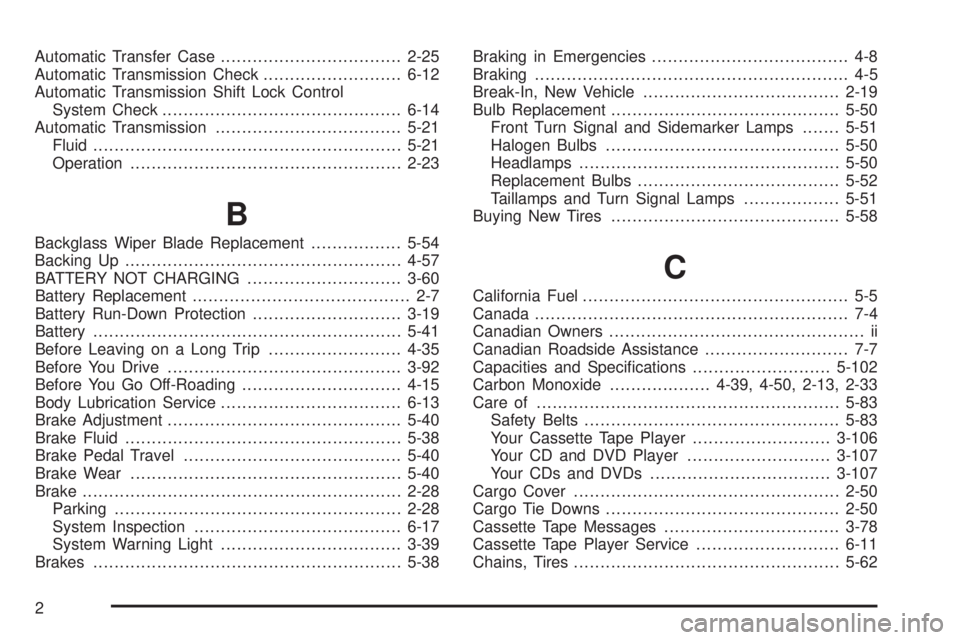
Automatic Transfer Case..................................2-25
Automatic Transmission Check..........................6-12
Automatic Transmission Shift Lock Control
System Check.............................................6-14
Automatic Transmission...................................5-21
Fluid..........................................................5-21
Operation...................................................2-23
B
Backglass Wiper Blade Replacement.................5-54
Backing Up....................................................4-57
BATTERY NOT CHARGING.............................3-60
Battery Replacement......................................... 2-7
Battery Run-Down Protection............................3-19
Battery..........................................................5-41
Before Leaving on a Long Trip.........................4-35
Before You Drive............................................3-92
Before You Go Off-Roading..............................4-15
Body Lubrication Service..................................6-13
Brake Adjustment............................................5-40
Brake Fluid....................................................5-38
Brake Pedal Travel.........................................5-40
Brake Wear...................................................5-40
Brake............................................................2-28
Parking......................................................2-28
System Inspection.......................................6-17
System Warning Light..................................3-39
Brakes..........................................................5-38Braking in Emergencies..................................... 4-8
Braking........................................................... 4-5
Break-In, New Vehicle.....................................2-19
Bulb Replacement...........................................5-50
Front Turn Signal and Sidemarker Lamps.......5-51
Halogen Bulbs............................................5-50
Headlamps.................................................5-50
Replacement Bulbs......................................5-52
Taillamps and Turn Signal Lamps..................5-51
Buying New Tires...........................................5-58
C
California Fuel.................................................. 5-5
Canada........................................................... 7-4
Canadian Owners................................................ ii
Canadian Roadside Assistance........................... 7-7
Capacities and Speci®cations..........................5-102
Carbon Monoxide...................4-39, 4-50, 2-13, 2-33
Care of.........................................................5-83
Safety Belts................................................5-83
Your Cassette Tape Player..........................3-106
Your CD and DVD Player...........................3-107
Your CDs and DVDs..................................3-107
Cargo Cover..................................................2-50
Cargo Tie Downs............................................2-50
Cassette Tape Messages.................................3-78
Cassette Tape Player Service...........................6-11
Chains, Tires..................................................5-62
2