belt GMC ENVOY 2003 Owner's Guide
[x] Cancel search | Manufacturer: GMC, Model Year: 2003, Model line: ENVOY, Model: GMC ENVOY 2003Pages: 442, PDF Size: 3.1 MB
Page 48 of 442
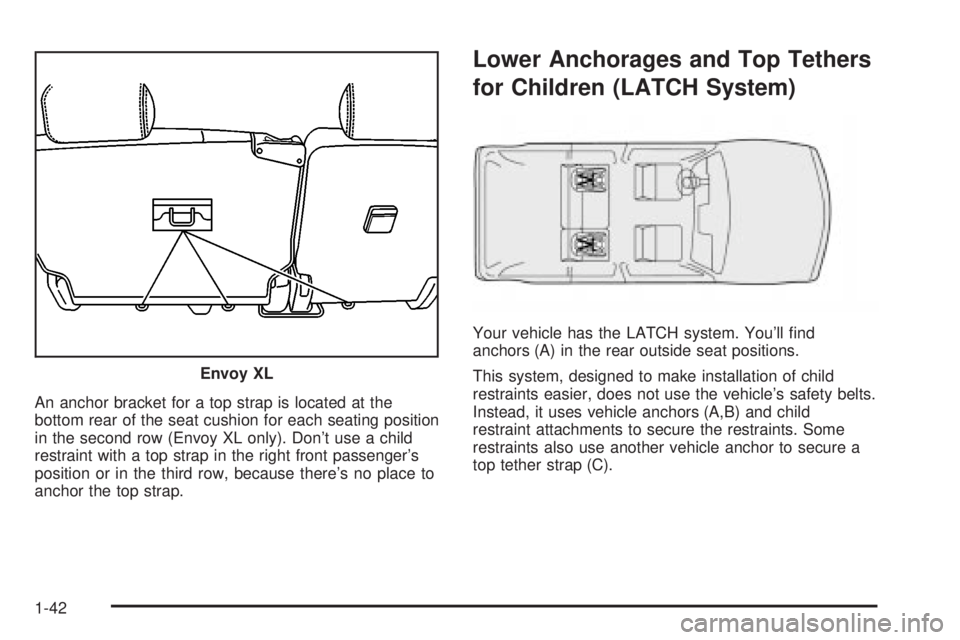
An anchor bracket for a top strap is located at the
bottom rear of the seat cushion for each seating position
in the second row (Envoy XL only). Don't use a child
restraint with a top strap in the right front passenger's
position or in the third row, because there's no place to
anchor the top strap.
Lower Anchorages and Top Tethers
for Children (LATCH System)
Your vehicle has the LATCH system. You'll ®nd
anchors (A) in the rear outside seat positions.
This system, designed to make installation of child
restraints easier, does not use the vehicle's safety belts.
Instead, it uses vehicle anchors (A,B) and child
restraint attachments to secure the restraints. Some
restraints also use another vehicle anchor to secure a
top tether strap (C). Envoy XL
1-42
Page 50 of 442
To assist you in locating
the lower anchors for this
child restraint system,
each seating position with
the LATCH system has
a label on the seatback at
each lower anchor
position.
The labels are located near the base of the rear outside
seat positions.
{CAUTION:
If a LATCH-type child restraint isn't attached to
its anchorage points, the restraint won't be
able to protect the child correctly. In a crash,
the child could be seriously injured or killed.
Make sure that a LATCH-type child restraint is
properly installed using the anchorage points,
or use the vehicle's safety belts to secure the
restraint. See ªSecuring a Child Restraint
Designed for the LATCH Systemº or ªSecuring
CAUTION: (Continued)
CAUTION: (Continued)
a Child Restraint in a Rear Outside Seat
Positionº in the Index for information on how
to secure a child restraint in your vehicle.
Securing a Child Restraint Designed
for the LATCH System
1. Find the anchors for the seating position you want
to use, where the bottom of the seatback meets the
back of the seat cushion.
2. Put the child restraint on the seat.
3. Attach the anchor points on the child restraint to the
anchors in the vehicle. The child restraint
instructions will show you how.
4. If the child restraint is forward-facing, attach the top
strap to the top strap anchor. See
Top Strap on
page 1-40. Tighten the top strap according to
the child restraint instructions.
5. Push and pull the child restraint in different
directions to be sure it is secure.
To remove the child restraint, simply unhook the top
strap from the top tether anchor and then disconnect the
anchor points.
1-44
Page 51 of 442

Securing a Child Restraint in a Rear
Outside Seat PositionIf your child restraint is equipped with the LATCH
system, seeLower Anchorages and Top Tethers for
Children (LATCH System) on page 1-42. SeeTop Strap
on page 1-40if the child restraint has one.
There are no top strap anchors at the third row seating
positions. Do not secure a child seat in these positions
if a national or local law requires that the top strap
be anchored, or if the instructions that come with the
child restraint say that the top strap must be anchored.
You will be using the lap-shoulder belt. Be sure to
follow the instructions that came with the child restraint.
Secure the child in the child restraint when and as
the instructions say.
1. Put the restraint on the seat.
2. Pick up the latch plate, and run the lap and shoulder
portions of the vehicle's safety belt through or
around the restraint. The child restraint instructions
will show you how.
1-45
Page 52 of 442

3. Buckle the belt. Make sure the release button is
positioned so you would be able to unbuckle the
safety belt quickly if you ever had to.4. Pull the rest of the shoulder belt all the way out of
the retractor to set the lock.
1-46
Page 53 of 442

5. To tighten the belt, feed the shoulder belt back into
the retractor while you push down on the child
restraint. If you are using a forward-facing child
restraint, you may ®nd it helpful to use your knee to
push down on the child restraint as you tighten
the belt.
6. Push and pull the child restraint in different
directions to be sure it is secure.
To remove the child restraint, just unbuckle the vehicle's
safety belt and let it go back all the way. The safety
belt will move freely again and be ready to work for an
adult or larger child passenger.
1-47
Page 55 of 442

Your vehicle has a right front passenger air bag.Neverput a rear facing child restraint in this seat.
Here's why:
{CAUTION:
A child in a rear-facing child restraint can be
seriously injured or killed if the right front
passenger's air bag in¯ates. This is because
the back of the rear-facing child restraint
would be very close to the in¯ating air bag.
Always secure a rear-facing child restraint in a
rear seat.
Although a rear seat is a safer place, you can secure a
forward-facing child restraint in the right front seat.
You'll be using the lap-shoulder belt. See
Top Strap on
page 1-40if the child restraint has one. Be sure to
follow the instructions that came with the child restraint.
Secure the child in the child restraint when and as
the instructions say.
1. Because your vehicle has a right front passenger's
air bag, always move the seat as far back as it will
go before securing a forward-facing child restraint.
See
Power Seats on page 1-2.2. Put the restraint on the seat.
3. Pick up the latch plate, and run the lap and shoulder
portions of the vehicle's safety belt through or
around the restraint. The child restraint instructions
will show you how.
4. Buckle the belt. Make sure the release button is
positioned so you would be able to unbuckle the
safety belt quickly if you ever had to.
1-49
Page 56 of 442

5. Pull the rest of the shoulder belt all the way out of
the retractor to set the lock.6. To tighten the belt, feed the shoulder belt back into
the retractor while you push down on the child
restraint. You may ®nd it helpful to use your knee to
push down on the child restraint as you tighten
the belt.
7. Push and pull the child restraint in different
directions to be sure it is secure.
To remove the child restraint, just unbuckle the vehicle's
safety belt and let it go back all the way. The safety
belt will move freely again and be ready to work for an
adult or larger child passenger.
1-50
Page 58 of 442

Here are the most important things to know about the
air bag systems:
{CAUTION:
You can be severely injured or killed in a crash
if you aren't wearing your safety belt ± even if
you have air bags. Wearing your safety belt
during a crash helps reduce your chance of
hitting things inside the vehicle or being
ejected from it. Air bags are designed to work
with safety belts but don't replace them.
Frontal air bags for the driver and right front
passenger are designed to deploy only in
moderate to severe frontal and near frontal
crashes. They aren't designed to in¯ate at all in
rollover, rear or low-speed frontal crashes, or in
CAUTION: (Continued)
CAUTION: (Continued)
many side crashes. And, for some
unrestrained occupants, frontal air bags may
provide less protection in frontal crashes than
more forceful air bags have provided in the
past.
The side impact air bags for the driver and
right front passenger are designed to in¯ate
only in moderate to severe crashes where
something hits the side of your vehicle. They
aren't designed to in¯ate in frontal, in rollover
or in rear crashes.
Everyone in your vehicle should wear a safety
belt properly ± whether or not there's an air
bag for that person.
1-52
Page 59 of 442

{CAUTION:
Both frontal and side impact air bags in¯ate
with great force, faster than the blink of an
eye. If you're too close to an in¯ating air bag,
as you would be if you were leaning forward, it
could seriously injure you. Safety belts
helpkeep you in position for air bag in¯ation
before and during a crash. Always wear your
safety belt, even with frontal air bags. The
driver should sit as far back as possible while
still maintaining control of the vehicle. Front
occupants should not lean on or sleep against
the door.
{CAUTION:
Anyone who is up against, or very close to,
any air bag when it in¯ates can be seriously
injured or killed. Air bags plus
lap-shoulderbelts offer the best protection for
adults, but not for young children and infants.
Neither the vehicle's safety belt system nor its
air bag system is designed for them. Young
children and infants need the protection that a
child restraint system can provide. Always
secure children properly in your vehicle. To
read how, see the part of this manual called
ªOlder Childrenº or ªInfants and Young
Children.º
1-53
Page 63 of 442
If the front of your vehicle goes straight into a wall
that doesn't move or deform, the threshold level for
the reduced deployment is about 12 to 16 mph
(19 to 26 km/h), and the threshold level for a full
deployment is about 16 to 25 mph (26 to 40 km/h). The
threshold level can vary, however, with speci®c
vehicle design, so that it can be somewhat above or
below this range.
If your vehicle strikes something that will move or
deform, such as a parked car, the threshold level will be
higher. The driver's and right front passenger's frontal
air bags are not designed to in¯ate in rollovers, rear
impacts, or in many side impacts because in¯ation
would not help the occupant.
Your vehicle may or may not have a side impact air
bag. See Air Bag Systems in the Index. Side impact air
bags are designed to in¯ate in moderate to severe
side crashes. A side impact air bag will in¯ate if
the crash severity is above the system's designed
ªthreshold level.º The threshold level can vary with
speci®c vehicle design. Side impact air bags are
not designed to in¯ate in frontal or near-frontal impacts,
rollovers or rear impacts, because in¯ation would not
help the occupant. A side impact air bag will only deploy
on the side of the vehicle that is struck.In any particular crash, no one can say whether an air
bag should have in¯ated simply because of the damage
to a vehicle or because of what the repair costs were.
For frontal air bags, in¯ation is determined by the angle
of the impact and how quickly the vehicle slows down
in frontal and near-frontal impacts. For side impact
air bags, in¯ation is determined by the location
and severity of the impact.
The air bag system is designed to work properly under
a wide range of conditions, including off-road usage.
Observe safe driving speeds, especially on rough
terrain. As always, wear your safety belt. See
Off-Road
Driving with Your Four-Wheel-Drive Vehicle on
page 4-15
for tips on off-road driving.
What Makes an Air Bag In¯ate?
In an impact of sufficient severity, the air bag sensing
system detects that the vehicle is in a crash. For
both frontal and side impact air bags, the sensing
system triggers a release of gas from the in¯ator, which
in¯ates the air bag. The in¯ator, the air bag and
related hardware are all part of the air bag modules.
Frontal air bag modules are located inside the steering
wheel and instrument panel. For vehicles with side
impact air bags, the air bag modules are located in the
seatback closest to the driver's and/or right front
passenger's door.
1-57