page 33 GMC ENVOY 2006 User Guide
[x] Cancel search | Manufacturer: GMC, Model Year: 2006, Model line: ENVOY, Model: GMC ENVOY 2006Pages: 524, PDF Size: 3.36 MB
Page 53 of 524
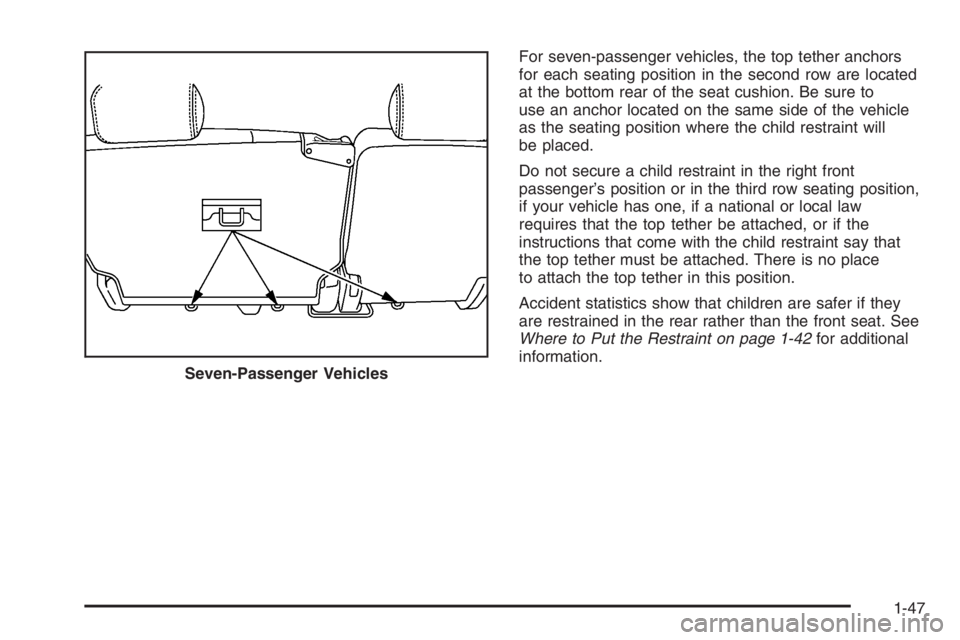
For seven-passenger vehicles, the top tether anchors
for each seating position in the second row are located
at the bottom rear of the seat cushion. Be sure to
use an anchor located on the same side of the vehicle
as the seating position where the child restraint will
be placed.
Do not secure a child restraint in the right front
passenger’s position or in the third row seating position,
if your vehicle has one, if a national or local law
requires that the top tether be attached, or if the
instructions that come with the child restraint say that
the top tether must be attached. There is no place
to attach the top tether in this position.
Accident statistics show that children are safer if they
are restrained in the rear rather than the front seat. See
Where to Put the Restraint on page 1-42for additional
information.
Seven-Passenger Vehicles
1-47
Page 55 of 524
{CAUTION:
Children can be seriously injured or strangled
if a shoulder belt is wrapped around their neck
and the safety belt continues to tighten.
Secure any unused safety belts behind the
child restraint so children cannot reach them.
Pull the shoulder belt all the way out of the
retractor to set the lock, if your vehicle has
one, after the child restraint has been installed.
Be sure to follow the instructions of the child
restraint manufacturer.
Notice:Contact between the child restraint or the
LATCH attachment parts and the vehicle’s safety
belt assembly may cause damage to these parts.
Make sure when securing unused safety belts
behind the child restraint that there is no contact
between the child restraint or the LATCH attachment
parts and the vehicle’s safety belt assembly.
Folding an empty rear seat with the safety belts
secured, may cause damage to the safety belt or the
seat. When removing the child restraint, always
remember to return the safety belts to their normal
position before folding the rear seat.1. Attach and tighten the lower attachments to the
lower anchors. If the child restraint does not have
lower attachments or the desired seating position
does not have lower anchors, secure the child
restraint with the top tether and the safety belts.
Refer to your child restraint manufacturer
instructions and the instructions in this manual.
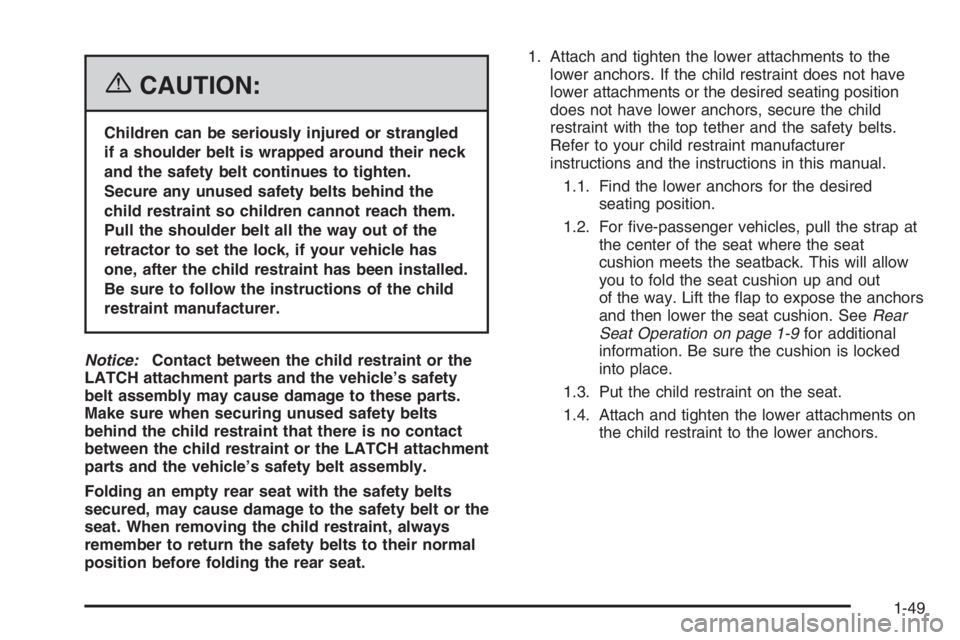
1.1. Find the lower anchors for the desired
seating position.
1.2. For ve-passenger vehicles, pull the strap at
the center of the seat where the seat
cushion meets the seatback. This will allow
you to fold the seat cushion up and out
of the way. Lift the ap to expose the anchors
and then lower the seat cushion. SeeRear
Seat Operation on page 1-9for additional
information. Be sure the cushion is locked
into place.
1.3. Put the child restraint on the seat.
1.4. Attach and tighten the lower attachments on
the child restraint to the lower anchors.
1-49
Page 56 of 524
2. If the child restraint manufacturer recommends that
the top tether be attached, attach and tighten the
top tether to the top tether anchor, if equipped.
Refer to the child restraint instructions and
the following steps:
2.1. Find the top tether anchor.
2.2. Route and tighten the top tether according to
your child restraint instructions and the
following instructions. For ve-passenger
vehicles, if your vehicle is equipped with a
cargo shade, route the top tether between
the seatback and the cargo shade.
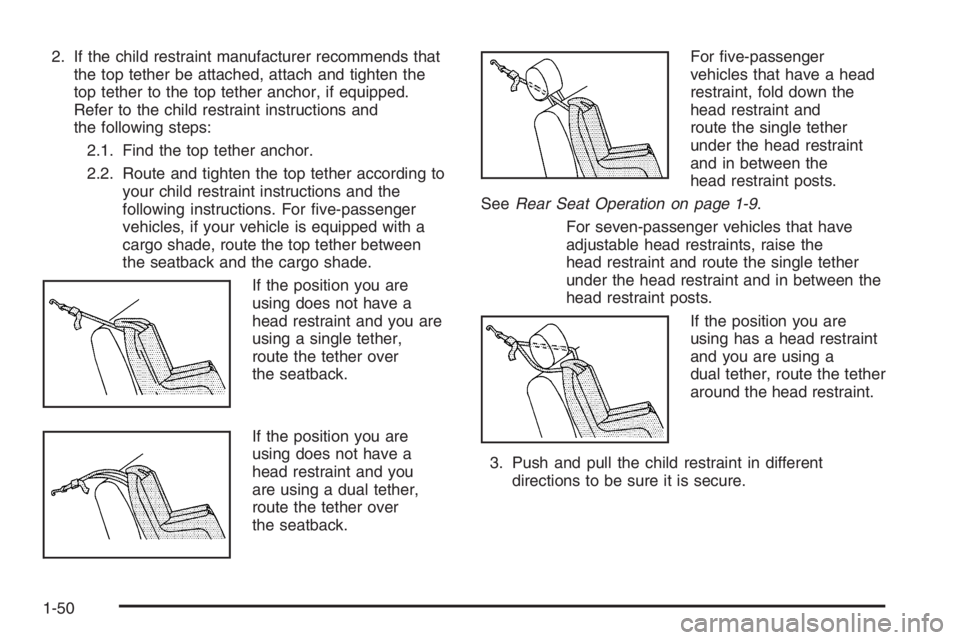
If the position you are
using does not have a
head restraint and you are
using a single tether,
route the tether over
the seatback.
If the position you are
using does not have a
head restraint and you
are using a dual tether,
route the tether over
the seatback.For ve-passenger
vehicles that have a head
restraint, fold down the
head restraint and
route the single tether
under the head restraint
and in between the
head restraint posts.
SeeRear Seat Operation on page 1-9.
For seven-passenger vehicles that have
adjustable head restraints, raise the
head restraint and route the single tether
under the head restraint and in between the
head restraint posts.
If the position you are
using has a head restraint
and you are using a
dual tether, route the tether
around the head restraint.
3. Push and pull the child restraint in different
directions to be sure it is secure.
1-50
Page 57 of 524
Securing a Child Restraint in a Rear
Outside Seat Position
If your child restraint is equipped with the LATCH
system, seeLower Anchors and Tethers for Children
(LATCH) on page 1-43.
There are no top tether anchors at the third row seating
positions (if equipped). Do not secure a child seat in
these positions if a national or local law requires that the
top tether be anchored, or if the instructions that
come with the child restraint say that the top tether must
be anchored.
If your child restraint does not have the LATCH system,
you will be using the lap-shoulder belt to secure the
child restraint in this position. Be sure to follow the
instructions that came with the child restraint. Secure
the child in the child restraint when and as the
instructions say.
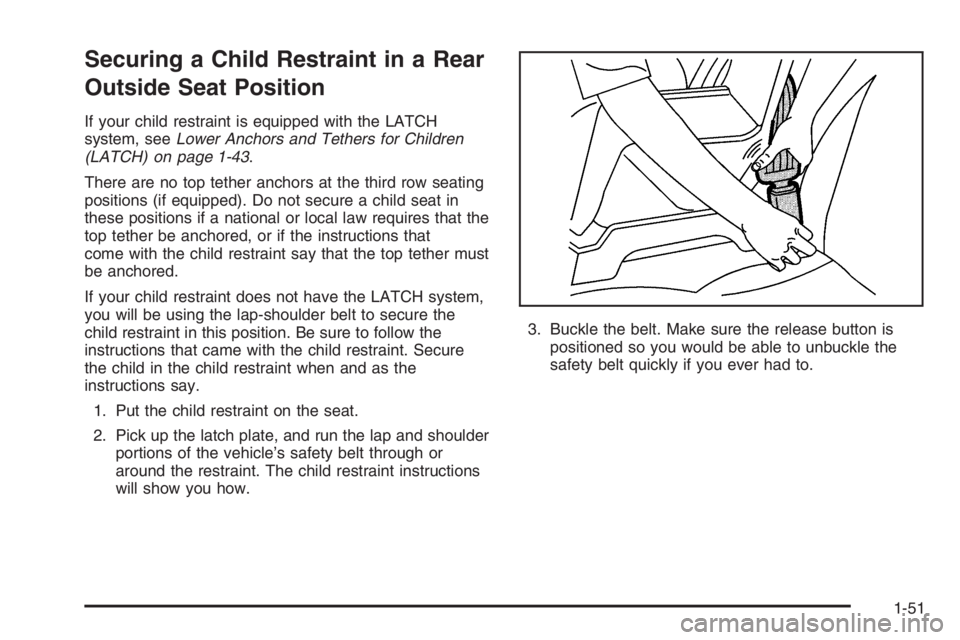
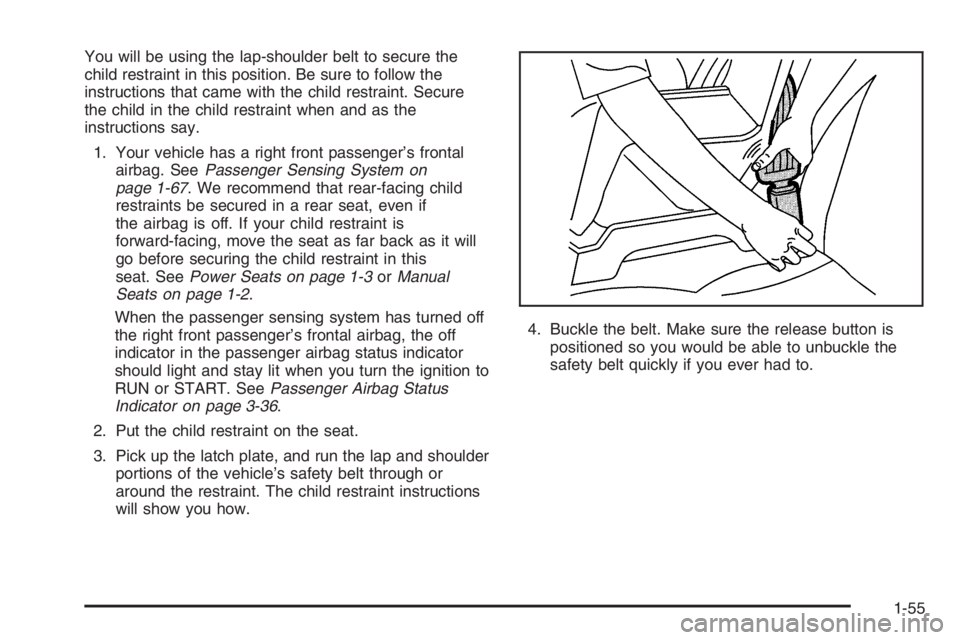
1. Put the child restraint on the seat.
2. Pick up the latch plate, and run the lap and shoulder
portions of the vehicle’s safety belt through or
around the restraint. The child restraint instructions
will show you how.3. Buckle the belt. Make sure the release button is
positioned so you would be able to unbuckle the
safety belt quickly if you ever had to.
1-51
Page 59 of 524
6. If your child restraint manufacturer recommends
using a top tether, and the position that you are
using has a top tether anchor, attach and tighten the
top tether to the top tether anchor. Refer to the
instructions that came with the child restraint and to
Lower Anchors and Tethers for Children (LATCH)
on page 1-43.
7. Push and pull the child restraint in different
directions to be sure it is secure.
To remove the child restraint, if the top tether is attached
to the top tether anchor, disconnect it. Unbuckle the
vehicle’s safety belt and let it go back all the way. The
safety belt will move freely again and be ready to
work for an adult or larger child passenger.
Securing a Child Restraint in the
Center Rear Seat Position
Many child restraints are too wide to be correctly
secured in the center rear seat, although some of them
will t there. If the center seat position is too narrow
for your child restraint, secure it in a rear outside
seat position.
If you secure a child restraint in the center seat position,
follow the instructions inSecuring a Child Restraint in
a Rear Outside Seat Position on page 1-51.
Securing a Child Restraint in the
Right Front Seat Position
Your vehicle has a right front passenger’s airbag. A rear
seat is a safer place to secure a forward-facing child
restraint. SeeWhere to Put the Restraint on page 1-42.
In addition, your vehicle has a passenger sensing
system. The passenger sensing system is designed to
turn off the right front passenger’s frontal airbag
when an infant in a rear-facing infant seat or a small
child in a forward-facing child restraint or booster seat is
detected. SeePassenger Sensing System on page 1-67
andPassenger Airbag Status Indicator on page 3-36
for more information on this including important
safety information.
1-53
Page 60 of 524
A label on your sun visor says, “Never put a rear-facing
child seat in the front.” This is because the risk to the
rear-facing child is so great, if the airbag deploys.
{CAUTION:
A child in a rear-facing child restraint can be
seriously injured or killed if the right front
passenger’s airbag inates. This is because
the back of the rear-facing child restraint
would be very close to the inating airbag.
Even though the passenger sensing system is
designed to turn off the passenger’s frontal
airbag if the system detects a rear-facing
child restraint, no system is fail-safe, and no
one can guarantee that an airbag will not
deploy under some unusual circumstance,
even though it is turned off. We recommend
that rear-facing child restraints be secured in
the rear seat, even if the airbag is off.If you need to secure a forward-facing child restraint in
the right front seat position, move the seat as far
back as it will go before securing the forward-facing
child restraint. SeePower Seats on page 1-3orManual
Seats on page 1-2.
If your child restraint is equipped with the LATCH
system, seeLower Anchors and Tethers for Children
(LATCH) on page 1-43.
There is no top tether anchor at the right front seating
position. Do not secure a child seat in this position
if a national or local law requires that the top tether be
anchored or if the instructions that come with the
child restraint say that the top tether must be anchored.
SeeLower Anchors and Tethers for Children (LATCH)
on page 1-43if the child restraint has a top tether.
1-54
Page 61 of 524
You will be using the lap-shoulder belt to secure the
child restraint in this position. Be sure to follow the
instructions that came with the child restraint. Secure
the child in the child restraint when and as the
instructions say.
1. Your vehicle has a right front passenger’s frontal
airbag. SeePassenger Sensing System on
page 1-67. We recommend that rear-facing child
restraints be secured in a rear seat, even if
the airbag is off. If your child restraint is
forward-facing, move the seat as far back as it will
go before securing the child restraint in this
seat. SeePower Seats on page 1-3orManual
Seats on page 1-2.
When the passenger sensing system has turned off
the right front passenger’s frontal airbag, the off
indicator in the passenger airbag status indicator
should light and stay lit when you turn the ignition to
RUN or START. SeePassenger Airbag Status
Indicator on page 3-36.
2. Put the child restraint on the seat.
3. Pick up the latch plate, and run the lap and shoulder
portions of the vehicle’s safety belt through or
around the restraint. The child restraint instructions
will show you how.4. Buckle the belt. Make sure the release button is
positioned so you would be able to unbuckle the
safety belt quickly if you ever had to.
1-55
Page 66 of 524
{CAUTION:
Anyone who is up against, or very close to,
any airbag when it inates can be seriously
injured or killed. Airbags plus lap-shoulder
belts offer the best protection for adults, but
not for young children and infants. Neither the
vehicle’s safety belt system nor its airbag
system is designed for them. Young children
and infants need the protection that a child
restraint system can provide. Always secure
children properly in your vehicle. To read how,
seeOlder Children on page 1-32orInfants and
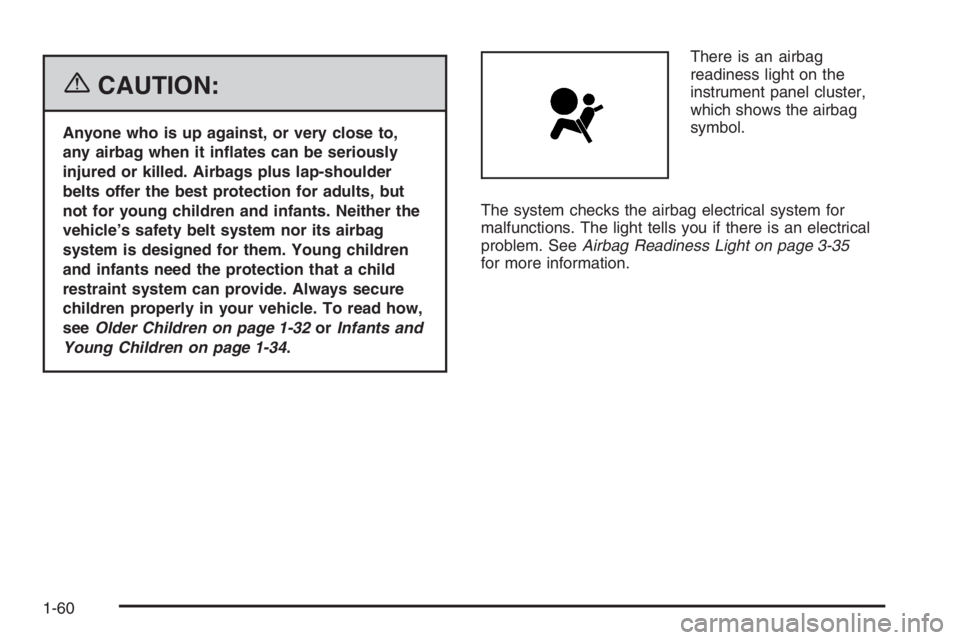
Young Children on page 1-34.There is an airbag
readiness light on the
instrument panel cluster,
which shows the airbag
symbol.
The system checks the airbag electrical system for
malfunctions. The light tells you if there is an electrical
problem. SeeAirbag Readiness Light on page 3-35
for more information.
1-60
Page 70 of 524

Frontal airbags may inate at different crash speeds.
For example:
If the vehicle hits a stationary object, the airbags
could inate at a different crash speed than if the
vehicle hits a moving object.
If the vehicle hits an object that deforms, the
airbags could inate at a different crash speed than
if the vehicle hits an object that does not deform.
If the vehicle hits a narrow object (like a pole) the
airbags could inate at a different crash speed
than if the vehicle hits a wide object (like a wall).
If the vehicle goes into an object at an angle the
airbags could inate at a different crash speed
than if the vehicle goes straight into the object.
The frontal airbags (driver and right front passenger) are
not intended to inate during vehicle rollovers, rear
impacts, or in many side impacts.
Your vehicle has seat position sensors which enable the
sensing system to monitor the position of the driver’s
seat and the right front passenger’s seat. Seat position
sensors provide information that is used to determine
if the airbags should deploy at a reduced level or at full
deployment.Your vehicle may or may not have a roof-mounted
airbag and a rollover sensor. SeeAirbag System on
page 1-58. These “rollover capable” airbags are
intended to inate in moderate to severe side crashes
or during a rollover. A roof-mounted airbag will inate if
the crash severity is above the system’s designed
“threshold level.” The threshold level can vary with
specic vehicle design. Roof-mounted airbags are not
intended to inate in frontal or near-frontal impacts,
or rear impacts. Both roof-mounted airbags will deploy
when either side of the vehicle is struck or during
a rollover.
In any particular crash, no one can say whether an
airbag should have inated simply because of the
damage to a vehicle or because of what the repair costs
were. For frontal airbags, ination is determined by
what the vehicle hits, the angle of the impact, and how
quickly the vehicle slows down. For roof-mounted
airbags, ination is determined by the location and
severity of the impact.
The airbag system is designed to work properly under a
wide range of conditions, including off-road usage.
Observe safe driving speeds, especially on rough
terrain. As always, wear your safety belt. SeeOff-Road
Driving on page 4-19for tips on off-road driving.
1-64
Page 73 of 524

In many crashes severe enough to inate an airbag,
windshields are broken by vehicle deformation.
Additional windshield breakage may also occur from the
right front passenger airbag.
Airbags are designed to inate only once. After an
airbag inates, you will need some new parts for
your airbag system. If you do not get them,
the airbag system will not be there to help protect
you in another crash. A new system will include
airbag modules and possibly other parts. The
service manual for your vehicle covers the need to
replace other parts.
Your vehicle is equipped with a crash sensing and
diagnostic module which records information after
a crash. SeeVehicle Data Collection and Event
Data Recorders on page 7-10.
Let only qualied technicians work on your airbag
system. Improper service can mean that your
airbag system will not work properly. See your
dealer for service.
Passenger Sensing System
Your vehicle has a passenger sensing system for the
right front passenger’s position. A passenger airbag
status indicator in the rearview mirror will be visible when
you turn your ignition key to START or RUN. The words
ON and OFF or the symbol for on and off, will be visible
during the system check. When the system check is
complete, either the word ON or the word OFF, or the
symbol for on or the symbol for off will be visible. See
Passenger Airbag Status Indicator on page 3-36.
Passenger Airbag Status Indicator – United States
Passenger Airbag Status Indicator – Canada
1-67